Événement gratuit : écoutez des experts de l’influence chez ŌURA, Adobe, Stanley 1913, etc.
Voir l'affiche



On attend presque des spécialistes du marketing d’influence qu’ils fassent des miracles. On attend d’eux qu’ils prennent en charge l’ensemble du processus de A à Z, qu’ils collaborent avec différentes équipes et qu’ils gèrent parfois des centaines, voire des milliers de relations externes.
Et la plupart d’entre eux n’ont pas le sentiment d’être rémunérés équitablement pour cela.
Au début de cette année, nous avons interrogé 400 spécialistes du marketing d’influence travaillant en interne ou en agence au sujet de leurs salaires, de leurs attentes professionnelles et de leurs conditions de travail.
Dans cet article, je vais passer en revue nos principales conclusions :
Les données sont loin d’être parfaites, mais je pense néanmoins qu’elles peuvent vous aider à comparer votre propre salaire à une référence et, espérons-le, à trouver des moyens de l’augmenter lors de votre prochaine opportunité.
Remarque : il ne s’agit que d’un bref résumé des principales conclusions. Consultez le rapport complet pour des données plus détaillées (ainsi que les résultats obtenus auprès des spécialistes indépendants du marketing d’influence).
Répondons donc à la grande question : combien gagnent réellement les spécialistes du marketing d’influence ?

La réponse est simple. Parmi nos près de 400 spécialistes du marketing d’influence travaillant en interne, le salaire moyen mondial s’élève à 49 981 $.
Cependant, la véritable réponse est plus complexe. La zone géographique, le genre, la taille de l’entreprise, les années d’expérience, etc. : tous ces facteurs déterminent la référence la plus pertinente pour vous.
Répartition des salaires par région géographique :
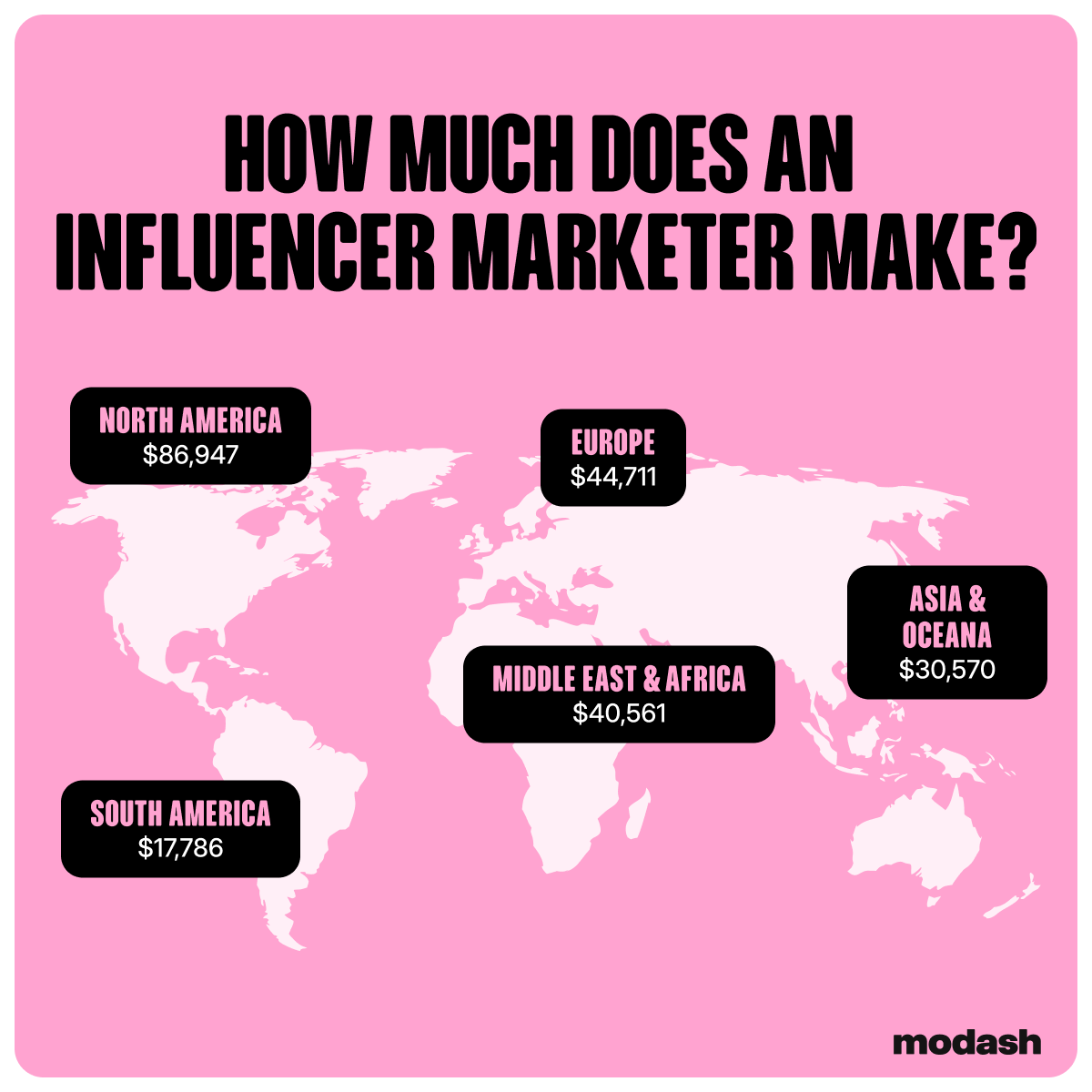
Oui, les salaires en Amérique du Nord éclipsent ceux des autres régions – mais ce n’est pas sans raison. Le coût de la vie y est souvent nettement plus élevé, et les entreprises paient bien moins pour embaucher quelqu’un que dans d’autres régions.
Par exemple, selon le calculateur de coût d’un employé de Remote, rémunérer quelqu’un aux États-Unis vous coûterait 8 % supplémentaires du salaire total. À titre de comparaison, un employé en Suède vous coûte la somme considérable de 32 % de son salaire en charges patronales.
Les règles du jeu ne sont pas du tout les mêmes.
Cela dit, si la situation géographique détermine votre rémunération, l’expérience est également un facteur majeur.
Si vous travaillez depuis un certain temps dans une niche du marketing, vous savez que les intitulés de poste n’ont plus beaucoup de sens depuis l’apparition des « pirates du marketing » et des « ninjas de la croissance ».
C’est toujours le cas aujourd’hui : hormis les grandes différences de niveau hiérarchique, l’intitulé de poste n’a pas vraiment d’incidence sur votre rémunération, à moins qu’il ne commence par un C.
Ce qui compte vraiment pour les spécialistes du marketing d’influence, ce sont les années d’expérience.
Répartition des salaires selon l’expérience :
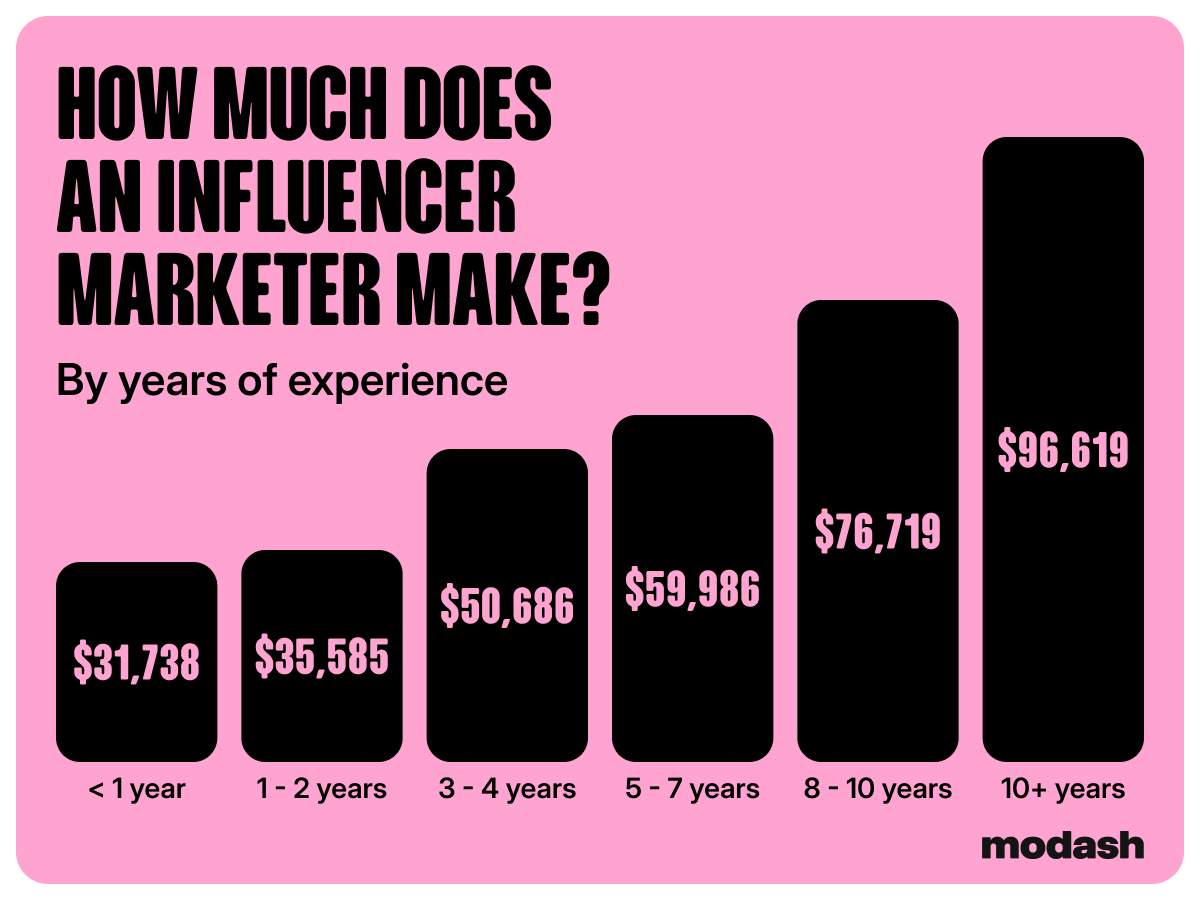
Les plus fortes hausses de salaire surviennent à des étapes clés de la carrière d’un spécialiste du marketing d’influence.
Entre les années 3-4, avec une augmentation de salaire de $15K, un spécialiste du marketing d’influence n’est plus considéré comme débutant. Ils ont davantage progressé dans leur carrière et ont peut-être suffisamment compris les spécificités de leur niche pour maîtriser la stratégie. C’est également à ce stade que les spécialistes du marketing d’influence développent leurs compétences.
C’est entre les années 8-10 que survient la plus forte augmentation de salaire : $16K. C’est souvent à ce stade que les spécialistes du marketing d’influence choisissent soit de se spécialiser et de se concentrer sur une niche plus précise, soit d’évoluer vers des postes de direction.
Parmi nos répondants travaillant en interne, plus de 62 % travaillaient pour des marques e-commerce/DTC, tandis qu’un autre tiers travaillait en agence pour ces mêmes types de marques.
Parmi les niches les plus représentées :

La mode et l’habillement, bien qu’il s’agisse du secteur le plus populaire, affichaient le salaire moyen le plus bas : c’était le seul secteur en dessous du salaire moyen mondial.
Les secteurs des logiciels, de la santé & du bien-être, ainsi que de l’hôtellerie & des voyages, impliquent généralement des achats plus élevés, ce qui permet d’offrir des salaires plus élevés grâce à ces marges supérieures.
En effet, 6 spécialistes du marketing d’influence sur 10 ont déclaré que leur salaire ne reflétait pas fidèlement leur rôle et leurs tâches.

7 sur 10 ont également déclaré que le secteur du marketing d’influence, dans son ensemble, ne rémunère pas les spécialistes du marketing à la hauteur de la valeur qu’ils apportent.
En comparant les moyennes selon les réponses à cette question, les spécialistes du marketing d’influence ne commencent à se sentir équitablement rémunérés qu’à partir d’un salaire moyen de 62 895 $.
Les personnes qui estimaient que leur propre salaire et les salaires du secteur étaient équitables gagnaient plus de $20K de plus que celles qui avaient répondu non aux deux questions.
Fait intéressant, en comparant la répartition par genre parmi les personnes qui estimaient que leur propre rémunération était équitable, les hommes gagnaient en moyenne 9 % de plus – ce qui signifie qu’ils ont un seuil plus élevé quant à ce qu’ils considèrent comme un salaire équitable.
Même si une perte de $20K déstabiliserait presque tout le monde, elle n’a pas la même signification pour chacun.
Nous avons ventilé, par région, l’écart entre ce qui était considéré comme équitable et ce qui ne l’était pas. Sans surprise, les spécialistes du marketing d’influence qui jugeaient leur salaire injuste gagnaient nettement moins, mais l’impact selon les régions est essentiel.
| Région | Salaire équitable (moy.) | Salaire injuste (moy.) | Montant de l’écart | Différence |
|---|---|---|---|---|
| Amérique du Nord | 97 515 $ | 79 902 $ | 17 613 $ | 18 % |
| Europe | 55 703 $ | 38 787 $ | $16,916 | 30 % |
| Moyen-Orient et Afrique | $58,667 | $30,214 | $28,453 | 48 % |
| Asie et Océanie | $38,711 | $26,500 | $12,211 | 46 % |
| Amérique du Sud | $20,250 | $17,206 | $3,044 | 15 % |
Perdre 17 k$ ne représente qu’une baisse de revenus de 18 % pour un spécialiste du marketing d’influence basé en Amérique du Nord. Pourtant, presque le même montant représente une perte de 30 % pour une personne basée en Europe. Au Moyen-Orient & en Afrique, l’écart entre un salaire équitable et un salaire inéquitable était de près de 50 %.
Toute baisse de revenus réduit directement votre pouvoir d’achat – et un salaire inéquitable peut avoir un impact plus important selon la région où vous vivez. Toutefois, une baisse de revenus de 50 % implique un mode de vie complètement différent, des priorités différentes et une expérience professionnelle globalement radicalement différente.
J’ai présenté aux spécialistes du marketing ce que je pensais être une liste exhaustive des tâches possibles qu’un spécialiste du marketing d’influence pourrait devoir effectuer au cours d’une semaine moyenne.
Je n’avais même pas effleuré la surface. Parmi les quelque 20 tâches que nous avons énumérées, les spécialistes du marketing d’influence ont répondu : « D : Toutes les réponses ci-dessus. »

De plus, de nombreux professionnels du marketing ont ajouté des tâches que nous n’avions pas incluses, dont certaines n’étaient même pas spécifiques au marketing d’influence.
Cela nous indique que les spécialistes du marketing d’influence devaient non seulement être des experts de bout en bout, mais aussi être polyvalents.
On attend déjà des professionnels du marketing qu’ils prennent en charge l’ensemble du cycle de vie des influenceurs, de A à Z. Mais c’est lorsqu’ils gèrent aussi d’autres aspects, comme le budget, la stratégie et la collaboration avec d’autres services, qu’ils connaissent les plus fortes augmentations de salaire.
Nous avons également constaté que la spécialisation peut contribuer à augmenter les salaires : se spécialiser dans les programmes d’ambassadeurs ou d’affiliation, ou même dans la gestion d’événements, peut accroître votre rémunération globale.

À l’inverse, nous avons constaté que les tâches très axées sur l’exécution étaient corrélées à certains des salaires les plus bas au monde.
Mais ce n’est pas tout : les spécialistes du marketing d’influence ayant des tâches transversales étaient eux aussi souvent moins bien rémunérés.
Pour de nombreux spécialistes du marketing d’influence, la gestion des comptes de réseaux sociaux d’une marque — un emploi à temps plein à part entière — s’ajoute souvent aux tâches hebdomadaires des professionnels du marketing qui ne sont pas spécialisés dans ce domaine.
Quatre professionnels du marketing sur 10 que j’ai interrogés ont déclaré que la gestion des réseaux sociaux faisait également partie de leurs tâches hebdomadaires. Cependant, ce n’était pas leur priorité principale, mais simplement une tâche supplémentaire ajoutée à leur liste croissante de responsabilités.

C’est une mauvaise décision à double titre. Non seulement les entreprises confient à des spécialistes du marketing d’influence déjà surchargés un travail qui devrait être à temps plein (lorsqu’il est bien fait), mais elles les obligent aussi à répartir leur temps entre les deux.
Résultat : ni la stratégie de la marque sur les réseaux sociaux ni son programme de marketing d’influence ne bénéficient du temps dédié dont chacun a besoin pour atteindre son plein potentiel.
Et les professionnels du marketing le ressentent aussi : ceux dont le rôle incluait les réseaux sociaux ont déclaré un niveau global de satisfaction au travail inférieur de 15 %.
Mais ce n’est même pas le pire : les spécialistes du marketing d’influence qui devaient aussi gérer les réseaux sociaux gagnaient en moyenne 12 % de moins que leurs pairs, tout cela pour faire tenir deux postes à temps plein dans une semaine de travail déjà surchargée.
Cette charge de travail excessive implique généralement de travailler un peu plus longtemps tout au long de la semaine pour tout accomplir. Nous avons demandé aux professionnels du marketing combien d’heures par semaine leur contrat prévoyait, puis combien d’heures ils travaillaient réellement.
En divisant le salaire annuel par le nombre d’heures contractuelles par semaine, nous pouvons estimer un taux horaire approximatif. En comparant ce même salaire au nombre d’heures réellement travaillées, nous pouvons voir combien les spécialistes du marketing d’influence perdent en heures supplémentaires non rémunérées.
Les spécialistes du marketing d’influence perdent en moyenne plus de 1 200 $ par an en heures supplémentaires non rémunérées.
| Région | Heures contractuelles | Heures réelles | Heures supplémentaires (moy.) | Perte |
|---|---|---|---|---|
| Amérique du Nord | 39.2 | 43.8 | 4.6 | $10,202 |
| Europe | 38.4 | 40.3 | 1.9 | $2,212 |
| Moyen-Orient et Afrique | 41.9 | 49.1 | 7.2 | $6,985 |
| Asie et Océanie | 44.4 | 44.9 | 0.5 | $344 |
| Amérique du Sud | 39.4 | 44 | 4.6 | $2,076 |
À l’échelle mondiale, les professionnels du marketing effectuent en moyenne 2,9 heures supplémentaires par semaine. Au Moyen-Orient & en Afrique, ce chiffre atteint pas moins de 7,2 heures supplémentaires non rémunérées, tandis qu’en Amérique du Nord et du Sud, il s’élève à 4,6 heures non rémunérées par semaine.

Les heures supplémentaires non rémunérées ont eu un impact direct sur la satisfaction au travail : les spécialistes du marketing d’influence ayant déclaré être les moins satisfaits effectuaient le plus d’heures supplémentaires non rémunérées.
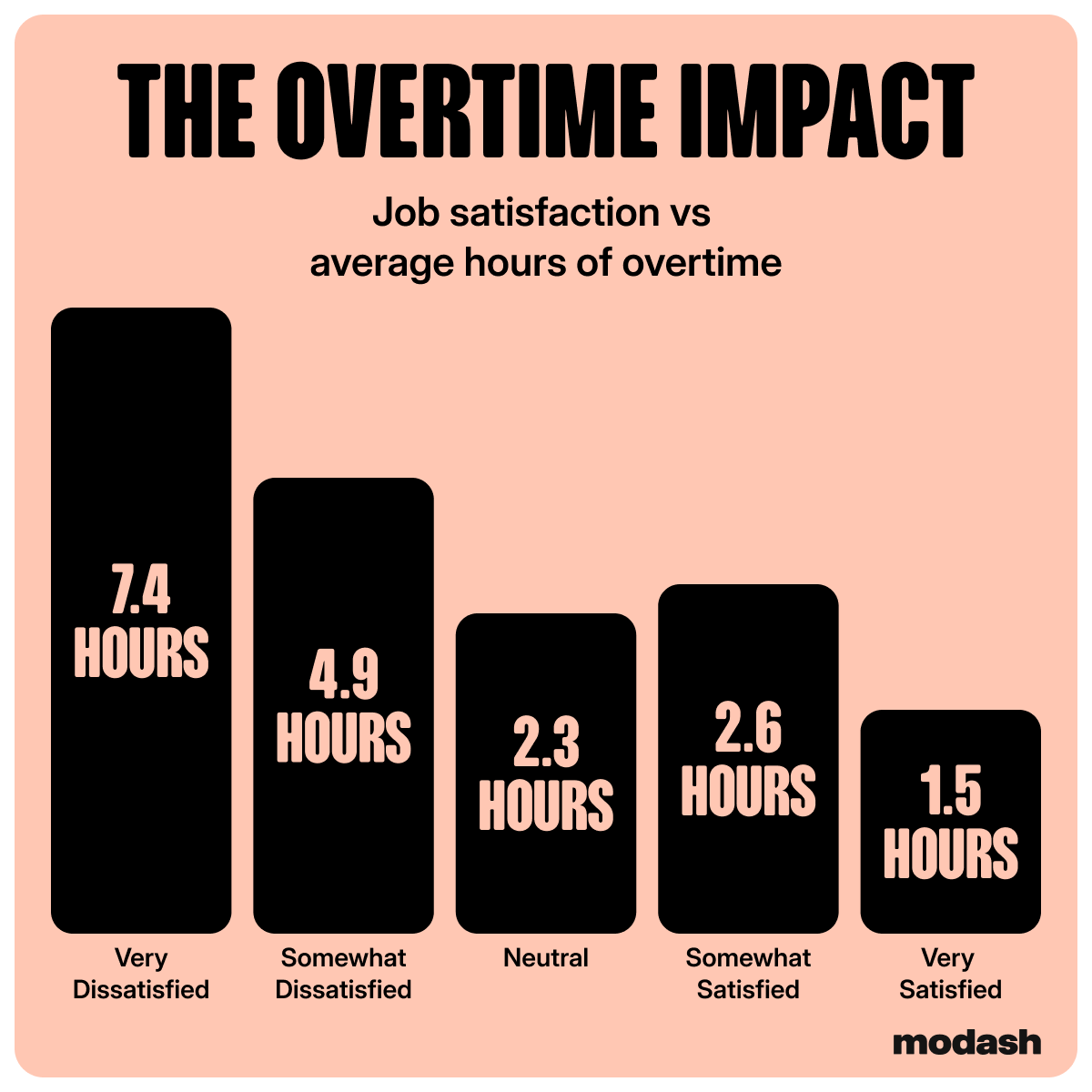
Après tout, effectuer beaucoup d’heures supplémentaires non rémunérées fait partie de votre salaire. Non seulement les heures non rémunérées diminuent votre taux horaire global, mais elles empiètent aussi sur votre temps personnel et détruisent l’équilibre entre vie professionnelle et vie privée.
Bien que la situation ait semblé sombre jusqu’ici, les spécialistes du marketing d’influence sont généralement optimistes quant à leur emploi.
Six professionnels du marketing sur 10 ont déclaré être satisfaits de leur emploi.

Cependant, de nombreux spécialistes du marketing d’influence se situaient dans les catégories « plutôt » ou « neutre » et, si la plupart se disent effectivement satisfaits, cela signifie qu’il y a une marge d’amélioration et que la plupart des professionnels du marketing ne ressentent pas un grand enthousiasme, dans un sens comme dans l’autre.
Les spécialistes du marketing d’influence se sont également montrés optimistes quant à leur potentiel de revenus global : plus de 57 % se situent du côté des « globalement optimistes ».
Cependant, très peu ont répondu « très optimiste », ce qui indique que, si les choses vont bien aujourd’hui, cela pourrait ne pas durer.
Plus de la moitié des spécialistes du marketing d’influence recommanderaient cette voie professionnelle, près d’un tiers déclarant ne pas être sûrs.
Bien que les spécialistes du marketing d’influence aiment ce qu’ils font, des fissures commencent à apparaître. Ils sont optimistes pour l’instant, mais cet optimisme s’érodera à mesure qu’ils resteront dans une entreprise avec un salaire plus faible ou des horaires de travail plus longs.
Et cela devient encore plus évident lorsque l’on tient compte de l’ancienneté dans l’entreprise. Nous avons demandé aux professionnels du marketing depuis combien de temps ils travaillaient dans leur entreprise actuelle : la majorité des spécialistes du marketing d’influence y sont depuis moins de 3 ans.

Un taux de rotation élevé, même parmi les professionnels du marketing les plus expérimentés, me montre que la satisfaction au travail pose problème. Qu’ils recherchent de meilleurs avantages sociaux, un meilleur équilibre entre vie professionnelle et vie privée ou un salaire plus élevé, les professionnels du marketing n’hésitent pas à changer d’entreprise pour les obtenir.
Seuls 4 professionnels du marketing sur 10 ont déclaré avoir le sentiment que leurs équipes et leur direction comprenaient réellement leurs rôles et la valeur qu’ils apportent.

Nous avons également constaté une corrélation directe entre la satisfaction au travail et le fait que les équipes internes comprennent le rôle d’un professionnel du marketing d’influence. Les professionnels du marketing d’influence qui ne bénéficiaient pas de ce soutien de la part de leur équipe étaient plus nombreux à se dire « neutres » ou « plutôt insatisfaits », et affichaient un niveau de satisfaction générale plus faible.
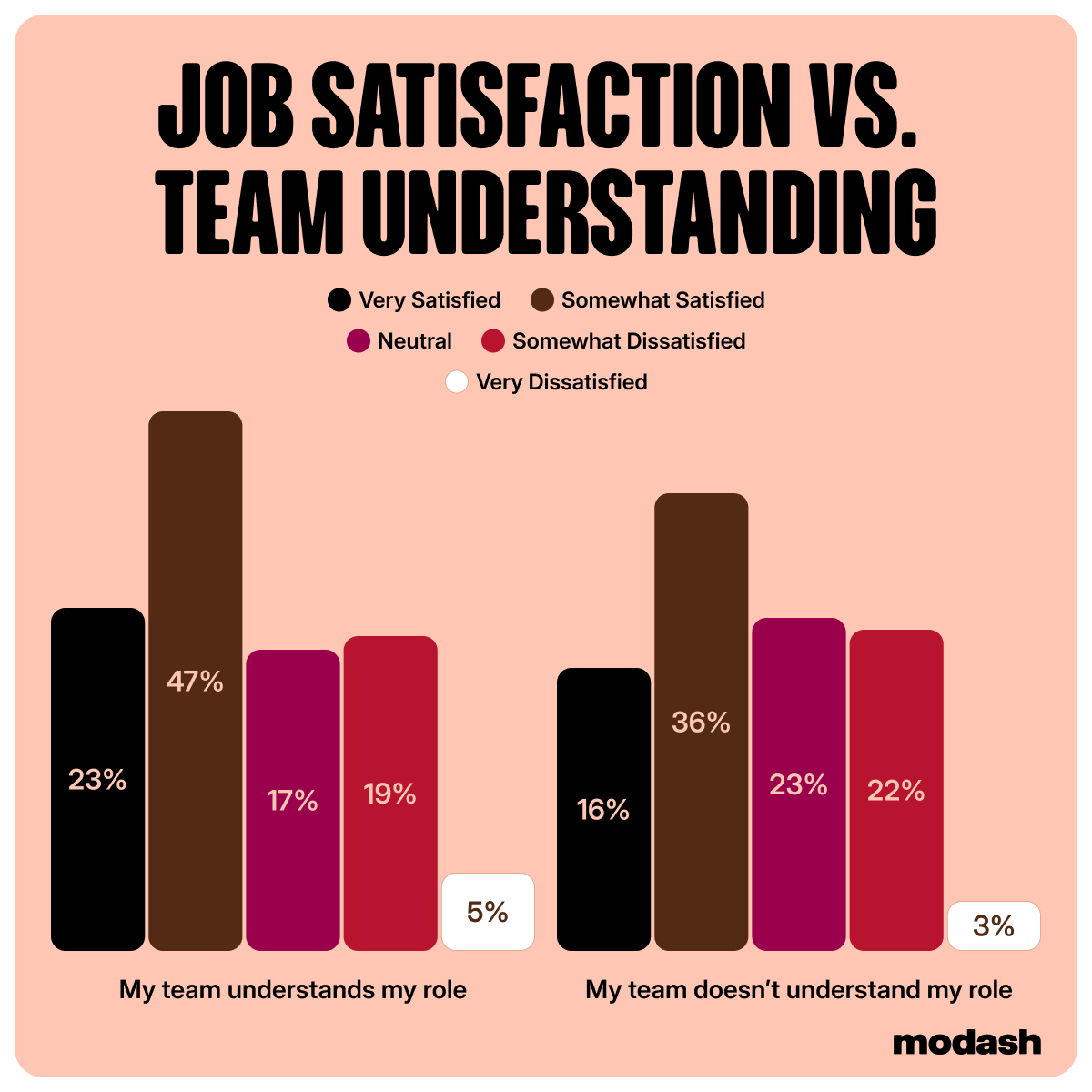
Il est essentiel que votre équipe croie en ce que vous faites. Et elle ne peut pas vraiment le faire si elle ne comprend pas votre rôle dès le départ.
Si votre équipe ou votre direction ne comprend pas votre rôle, vous devrez faire davantage d’efforts pour que les autres perçoivent la valeur que vous apportez. Vous devrez vous battre pour obtenir un budget, contester plus souvent des KPI ou des demandes irréalistes, et vous aurez généralement le sentiment de ne pas être soutenu par votre équipe.
Ces résultats montrent clairement que lorsqu’une équipe ne s’investit pas pour comprendre et défendre le marketing d’influence, les professionnels concernés se disent moins épanouis dans leur rôle au sein de cette équipe.
Les conclusions que nous pouvons tirer de ces données sont claires :
Cela entraîne un taux de rotation élevé, les professionnels du marketing d’influence les plus expérimentés et les mieux rémunérés étant eux aussi relativement nouveaux dans leur entreprise.
Malgré tout cela, les professionnels du marketing d’influence sont globalement optimistes quant à leur rôle. Il faut de la passion pour affronter ce que les professionnels du marketing d’influence vivent au quotidien, et c’est cette passion qui pousse nombre d’entre eux à rester dans un secteur qui pourrait mieux les traiter.
Les tendances observées suggèrent que, même si les professionnels du marketing d’influence se sentent relativement épanouis aujourd’hui, cela pourrait ne pas durer très longtemps.
De plus, alors que le salaire auquel les professionnels du marketing d’influence estiment être rémunérés équitablement dépasse $60K, la moyenne mondiale s’élève à $49K. C’est un problème.
Et lorsque 70 % des professionnels du marketing d’influence s’accordent à dire que le secteur dans son ensemble ne les rémunère pas aussi bien qu’il le devrait, c’est une crise.
Le marketing d’influence n’en est plus à ses balbutiements. C’est le moment d’établir des normes pour les professionnels du marketing d’influence, et ces normes ne peuvent pas reposer sur des heures de travail non rémunérées, des équipes qui ne comprennent pas ce que font ces professionnels ni la valeur qu’ils apportent, ou des salaires qui ne reflètent pas l’étendue des compétences requises par ces postes.
Vous souhaitez aller plus loin ? Consultez et téléchargez le rapport complet ici !
Nous avons considérablement condensé ce rapport pour le blog, mais les résultats complets sont disponibles gratuitement au téléchargement. Dans notre rapport complet, nous approfondissons de nombreux points de données, notamment la place des professionnels freelance du marketing d’influence dans l’équation, ainsi que qui, des freelances ou des salariés en interne, gagne réellement le plus.
Nous avons reçu 499 réponses au total. 399 provenaient de professionnels travaillant en interne ou en agence, et 100 autres de professionnels freelance du marketing d’influence. Nous reconnaissons que ces données ne sont pas parfaites et que, par conséquent, ce rapport ne l’est pas non plus. Nous espérons toutefois que ces tendances aideront les professionnels du marketing d’influence à mieux défendre leurs intérêts et à négocier de meilleures conditions à l’avenir.