


More tools
Use cases



One of the top questions newer influencer marketers ask is: “How do we know how much to pay influencers?!”
Of course, they soon learn that there are few definite answers in influencer marketing. Still, I’ve done my best to provide data for the three main influencer marketing platforms – Instagram, TikTok, and YouTube.
The biggest challenge to answering questions about influencer pricing is that there are so many variables at play, each of which can have a huge impact on price. Let’s take a look at the key factors:
These factors are equally important, so you should consider them all when negotiating with influencers. For example, a YouTuber with a smaller audience may charge less for a dedicated video than an Instagrammer with a larger audience charges for a Reel.
Rather than providing a single overarching answer to the influencer pricing question, I’ve shared separate pricing benchmarks for Instagram, TikTok, and YouTube:
After much debate, we came up with some ballpark price ranges for Instagram. These figures are based on US pricing and largely apply to home and lifestyle categories. Other niches (like beauty, fashion, and finance) would likely skew higher, while different locations might see significantly lower rates. Additional factors – like usage rights, influencer exclusivity, and the number of frames in a Story – can also bump prices up.
Since there's so much variation across industries, you might find it useful to hear a real-world example from outside the US:
Anna-Maria Klappenbach, Senior Influencer Marketing Manager at Modash, shared her experiences in the DACH market (Germany, Austria, Switzerland), based on hundreds of collaborations across a two-year period, and expressed in terms of CPMs rather than absolute cost:
💰 Instagram Stories are landing in the €25-€45 CPM range, though rarely above €35.
💰 Instagram Reels have a broader range, anywhere from €10 – €50, but most often land in a similar range to Stories.
Try our Instagram influencer pricing calculator to get more accurate estimates of creator rates on the platform.
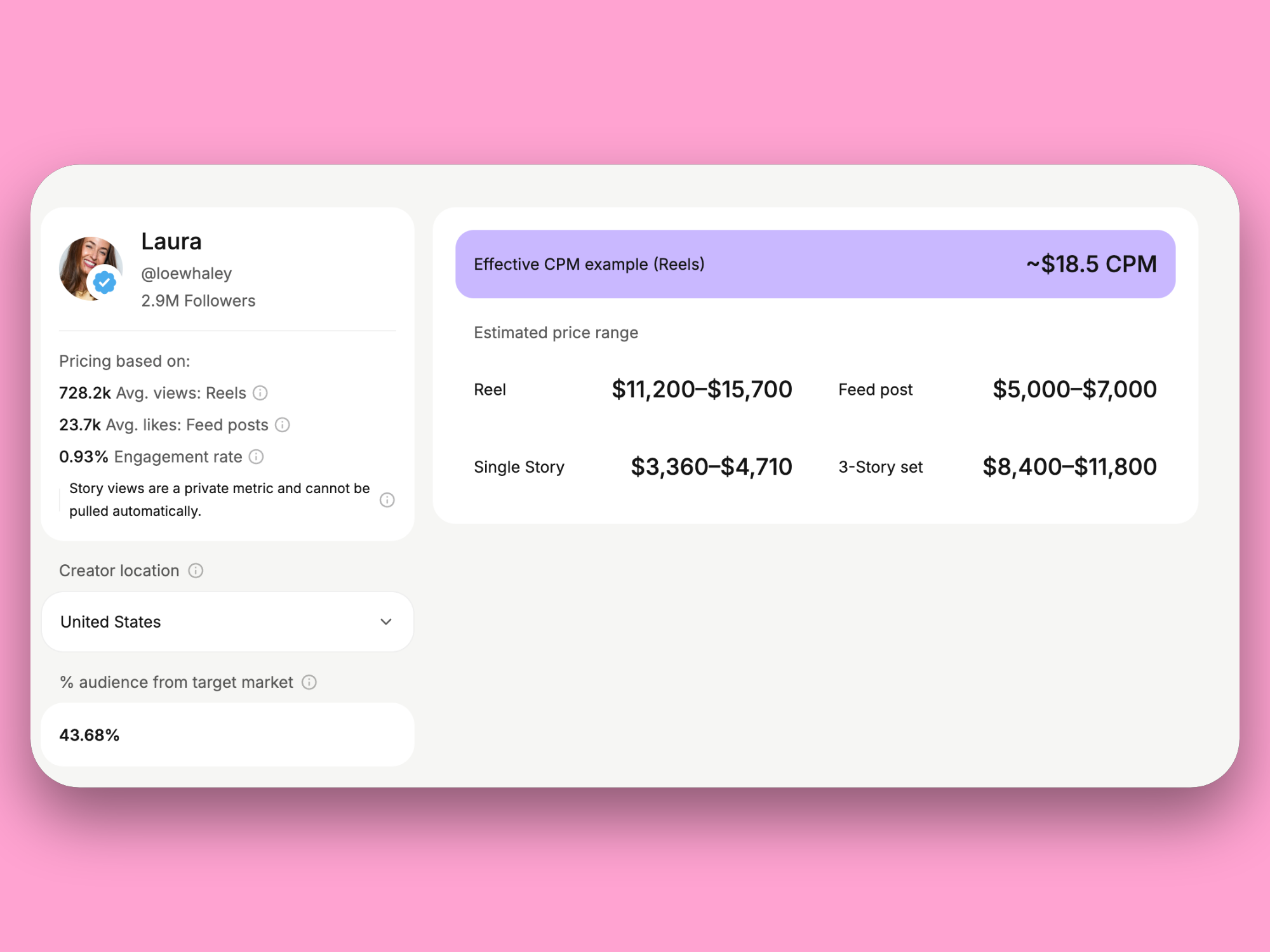
In terms of CPMs, you should aim for a maximum of $20, according to Marit Tiesema, Sr KOL and Ambassador Specialist at Loop Earplugs.
Separately, we’ve put together some broad benchmarks for sponsored video costs on TikTok, segmented by influencer size. Follower count should never be your sole metric for assessing influencer pricing, but we had to segment somehow, and these figures should at least give you an idea of what to expect. Adjust your CPM based on your creators metrics and your budget for best results.
As with our Instagram pricing benchmarks, these are ballpark prices based on creators in North America. Influencers will absolutely have different pricing based on their region, niche, and just about anything else that might vary.
Ultimately, your needs and budget will determine which TikTok influencers you approach – but these can at least give you a jumping off point.
🤓 Pro tip: Bundling deliverables works particularly well with Instagram Reels and TikToks because the formats are so similar – so your influencer partner doesn’t have to do much (if any) extra work.
You know the score by now: YouTube influencer pricing can vary widely, yadda yadda. Still, here are some broad numbers based on what we're seeing, mostly in the US and based on integrations rather than dedicated videos (expect to pay significantly more for those).
Naturally, channel size is far from the only pricing factor to consider here. The position of your ad can also have a major impact, as Influencer Marketing Consultant Julianne Kiider explains:
Post-roll ads are cheaper because influencers know viewers drop off as the video goes on. Brands with smaller budgets can benefit by purchasing post-roll ads because they’ll be seen by the most engaged viewers and they're cheaper.

Just as there are multiple factors affecting influencer pricing, there’s also a bunch of different ways to pay influencers. Let’s take a look at the most common pricing models:
Exactly what it sounds like: you agree to pay an influencer a fixed amount for each piece of content they share. Per-post rates can vary widely, from $100-or-so to five-plus figures, based on factors like platform, niche, and content type.
This model is popular with brands because it guarantees a set number of deliverables. It can help you secure collaborations with larger influencers who aren’t open to commission-based deals (see below…), and it’s often the best option for promoting lower-margin products, where revenue-sharing isn’t an option.
However, bear in mind you’ll likely pay more for one-off posts than for longer-term influencer partnerships.
From a brand’s perspective, performance-based payments are low-risk and super scalable. There are no upfront costs and you only pay a commission when an influencer refers a paying customer – what’s not to like?
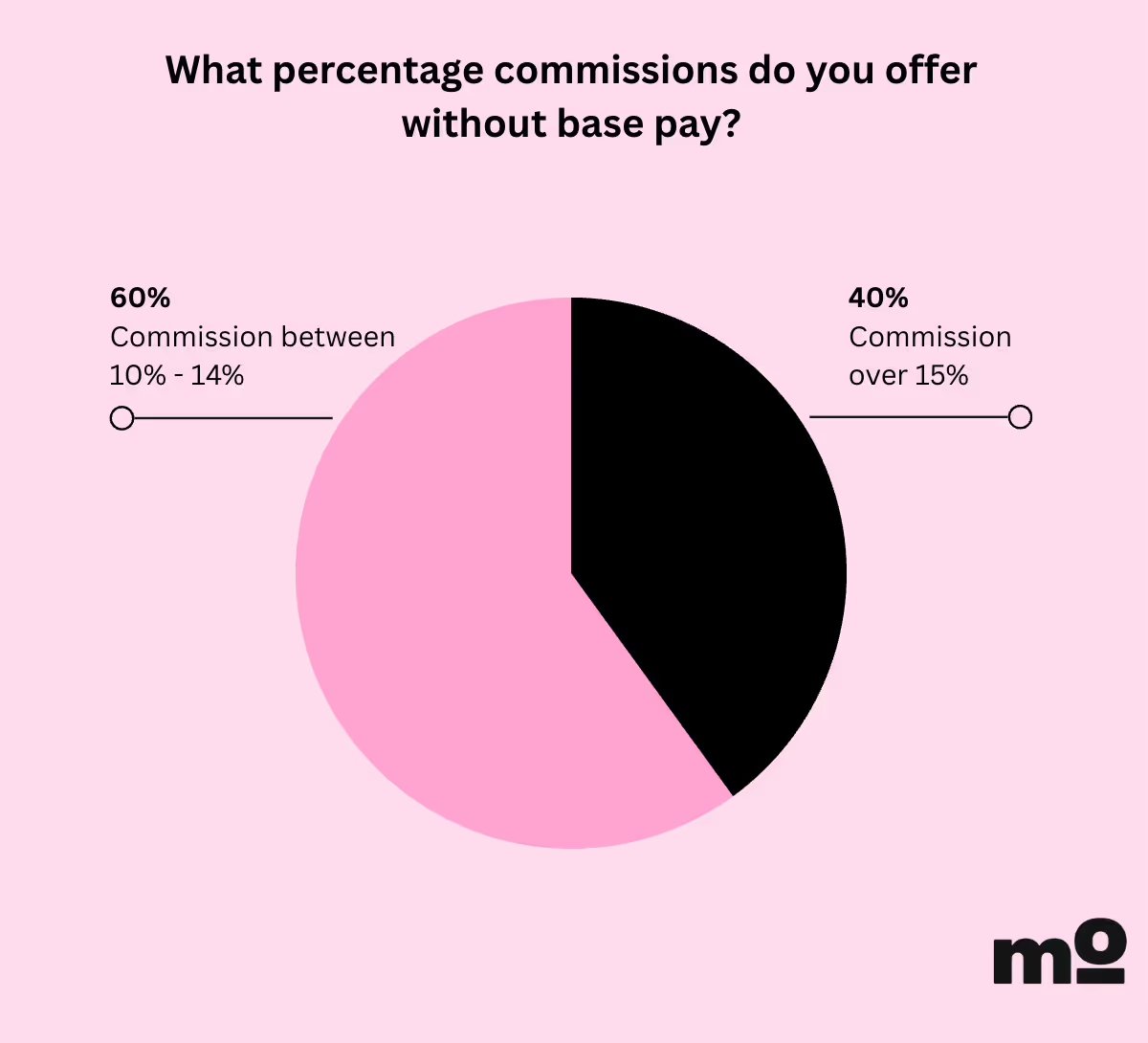
Speaking of commissions, three-fifths of brands we surveyed paid influencers 10% – 14% per sale, with the remainder paying 15%+.
The major downside to this model is that some influencers – especially well-established creators with large, engaged audiences – won’t agree to commission-only payments. In which case you may need to negotiate a hybrid flat fee + commission deal.
Gifting used to be the default option for influencer payments. And it’s still super popular today.
To be precise, product-only collaborations actually come in two distinct flavors:
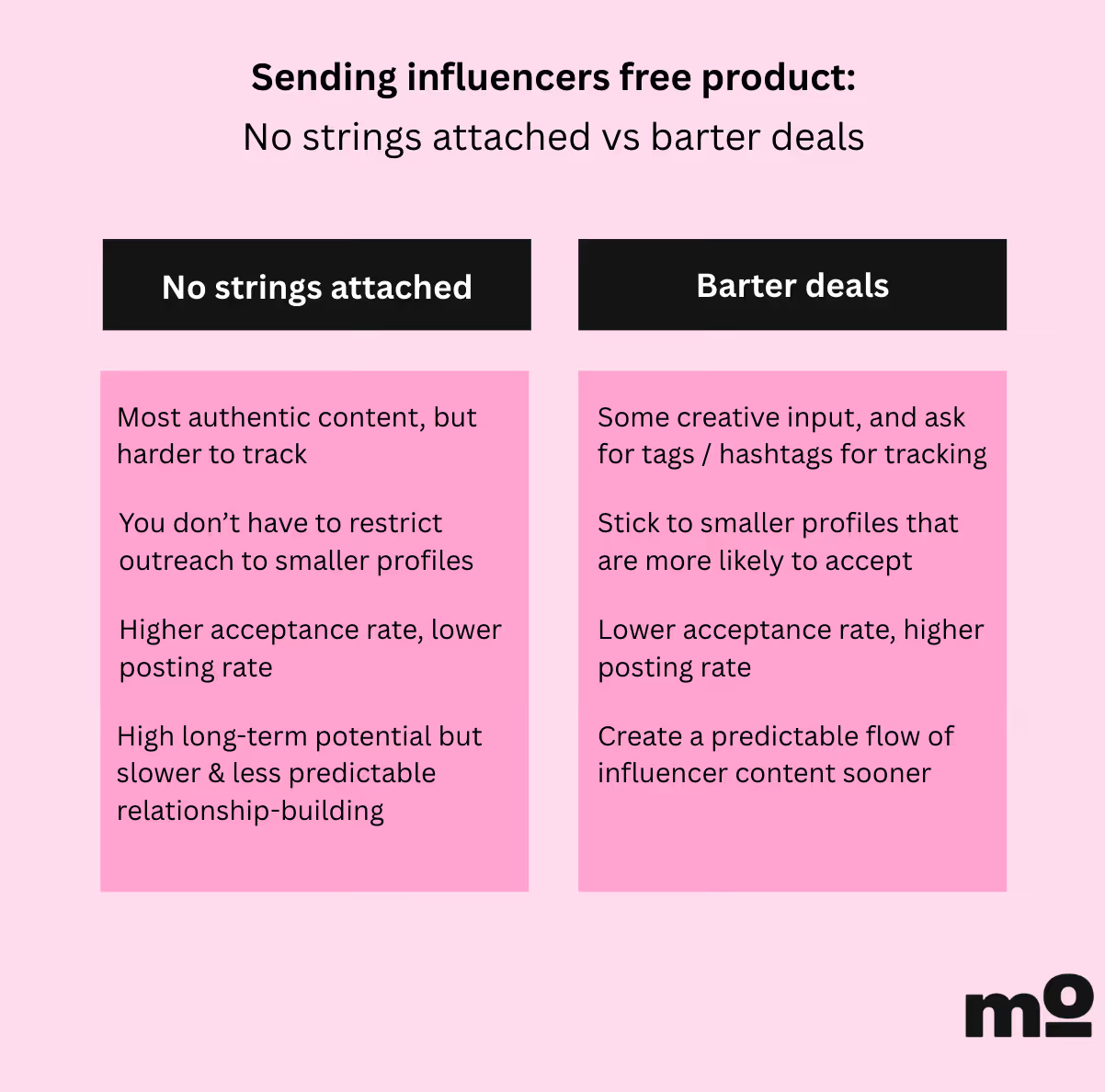
Whether barter-based or no-strings, gifting is a great fit for brands with limited influencer marketing budgets, as it only requires the cost of the product plus shipping fees.
However, it might not be suitable if you sell high-ticket products and/or bulky items with expensive shipping costs. And, like with performance-based pay, bear in mind that not all influencers will be open to product-only collabs.
Every influencer wants to secure high-value long-term collaborations with brands they love.
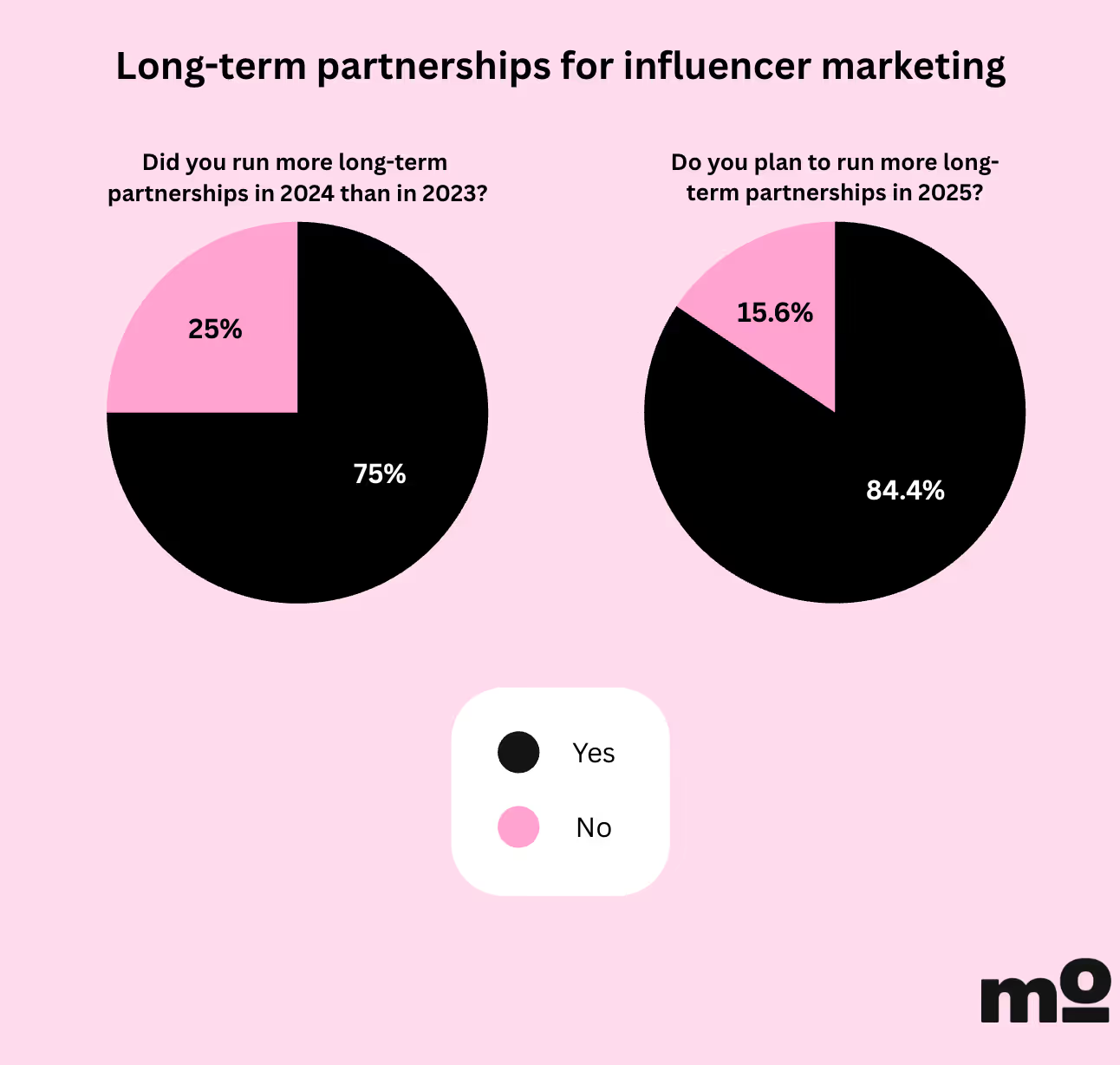
And brands want this too, with 75% of influencer marketers telling us they ran more long-term partnerships in 2024 than 2023 – and 84% revealing they planned to run even more long-term collabs in 2025:
There are plenty of benefits to building longer-term relationships with influencers, either through agreeing multi-campaign deals or starting a brand ambassador program. It allows more time for planning, which can lead to better content. It also feels more authentic and trustworthy, according to Cheyanne Pettyjohn, Director of Influencer Marketing at Rookie Wellness.
Long-term partnerships show that the brand has built trust with an influencer, and usually influencers who focus on those kinds of partnerships have audiences that trust them to promote real products they use/believe in.

On the downside, you don’t want to be stuck in a long-term deal with an influencer who isn’t performing.
Bundling is pretty self-explanatory: rather than paying for posts on a one-off basis, negotiate a package of multiple deliverables (ideally at a discounted rate).
There are plenty of scenarios where it makes sense to bundle content. For instance, you can boost awareness by getting an influencer to post across multiple platforms in the same campaign. Or you could use “supporting” content to drive audiences toward a “hero” asset (like promoting a dedicated YouTube video by adding a link to a YouTube Short).
Negotiating with influencers can be tricky – on one hand you want to keep them happy, but on the other you need to secure the best possible deal for your brand. What a minefield.
I’ve written a whole article on how to negotiate with influencers, so check that out for an in-depth guide, but here are a few tried-and-trusted pointers to start you off:
Extra [non-financial] incentives not only strengthen the partnership but also make the collaboration more appealing beyond just monetary compensation.

It’s easy to forget, but influencer pricing is about more than your agreed monthly retainer or per-post fees. Here are some potential extra costs you may not have factored in, segmented across three categories:
🚚 Logistics
📹 Content production
💼 Management
One of these costs warrants further discussion: influencer content usage rights.
If you’re planning to use an influencer’s content in your own marketing – such as organic reposting or influencer whitelisting – you’ll need to secure usage rights first, with most brands asking for one to three months of rights (in our experience, at least). Any influencer worth their salt will charge more for these rights, typically ranging from 25% – 100% of their base fee, so they don’t come cheap.
🤓 For more on this, check out my in-depth guide: Influencer Content Usage Rights: Here’s Everything You Need to Know.
Collectively, all the extra costs in this section can have a serious impact on your influencer program’s bottom line – so be sure to account for them upfront if you don’t want to blow your budget.
I’ve given you a bunch of benchmarks and some practical considerations around influencer pricing – but how much should you actually pay influencers? To answer that question, you need to consider a bunch of additional factors, such as:
There are three common reasons to invest in influencer marketing:
Before you can decide how much to pay influencers, you need to define the specific goal you want to achieve, and figure out what that goal is worth to your business. To give a basic example, if your goal is to generate $50,000 in attributable sales from influencer marketing, your total campaign costs – including influencer fees – should be significantly less than $50,000.
Performance-based pricing appeals to a lot of brands because it’s low-risk. But would you end up with a better value deal if you negotiate fixed influencer pricing? For example, if an influencer generates $50,000 in sales, it’d be cheaper to pay them a fixed $10,000 than offer them a 15% revenue share.
Of course, even if you’ve worked with an influencer on a bunch of previous campaigns, you can never be 100% confident when it comes to predicting revenue. I’m not saying you should be able to read the future here – I’m just pointing out that performance-based payments aren’t automatically the “best” option for brands.
As the old adage goes, when you’re buying a service, it can never be good and fast and cheap. At best, it can only be two of the three.
The same goes for influencer marketing. If you’re promoting a product launch that absolutely must happen in one week, you’re gonna have to pay a higher price for a rapid turnaround. Whereas if you’ve got three months of lead-in, you can avoid paying a premium – so you can focus more on quality.
Remember all those potential extra costs I mentioned in the previous section? They need to be factored in when considering influencer pricing, especially if you have a limited budget. For another simple example, if your total campaign budget is a non-negotiable $10,000 and your operational costs eat up 90% of that sum, you’ve only got $1,000 to pay influencers.
As a very basic rule of thumb, influencers charge around $100 per 1,000 followers, although this varies widely based on platform, location, niche, content type, engagement rate, usage rights, and more. Ultimately, only you can decide how much to charge as an influencer – it’s about how much you value your own time.
Earnings per view vary by platform. For example, on YouTube, influencers can earn anywhere from $2 – $30 for 1,000 views, based on the following third-party data:
Rates are typically lower on TikTok, although bear in mind this excludes any money earned from sponsored content campaigns.
Based on the simple formula of $100 per 1,000 followers, an influencer with 100,000 followers could expect to make around $10,000 per post. However, data from Influence.co suggests that most Instagram influencers with 100,000 – 150,000 followers earn just $501 – $1,000 per post. In reality, as with any pricing question, there are simply too many variables to give a definitive answer.
There’s no such thing as an average influencer rate per platform – it all depends on location, niche, content type, engagement rate, follower count, and a ton of other factors. However, we can share some broad benchmarks for the three main influencer marketing platforms:
That depends on the content type(s) and campaign budget. For instance, if a content bundle already includes three Reels, it shouldn’t be expensive to add on three TikToks – because they’ll require little extra work for the influencer.
Yes! Some influencers are definitely open to posting in exchange for nothing more than a free product. In fact, if they love your product, they might even post about it multiple times. Generally, this sort of collaboration is most appealing to smaller influencers, with brands sending products to a high volume of influencers to maximize their potential reach and awareness.
🤓 Learn more in How To Do Influencer Gifting: A Complete Guide and check out 10 Brands That Win With Product Seeding (& What We Can Learn).
Yes, to an extent. Follower count is often a factor in influencer pricing decisions, but it shouldn’t be the only metric for deciding how much to pay an influencer (or whether to work with them in the first place). Other important factors include engagement rate, views, shares, and fake follower count percentage.
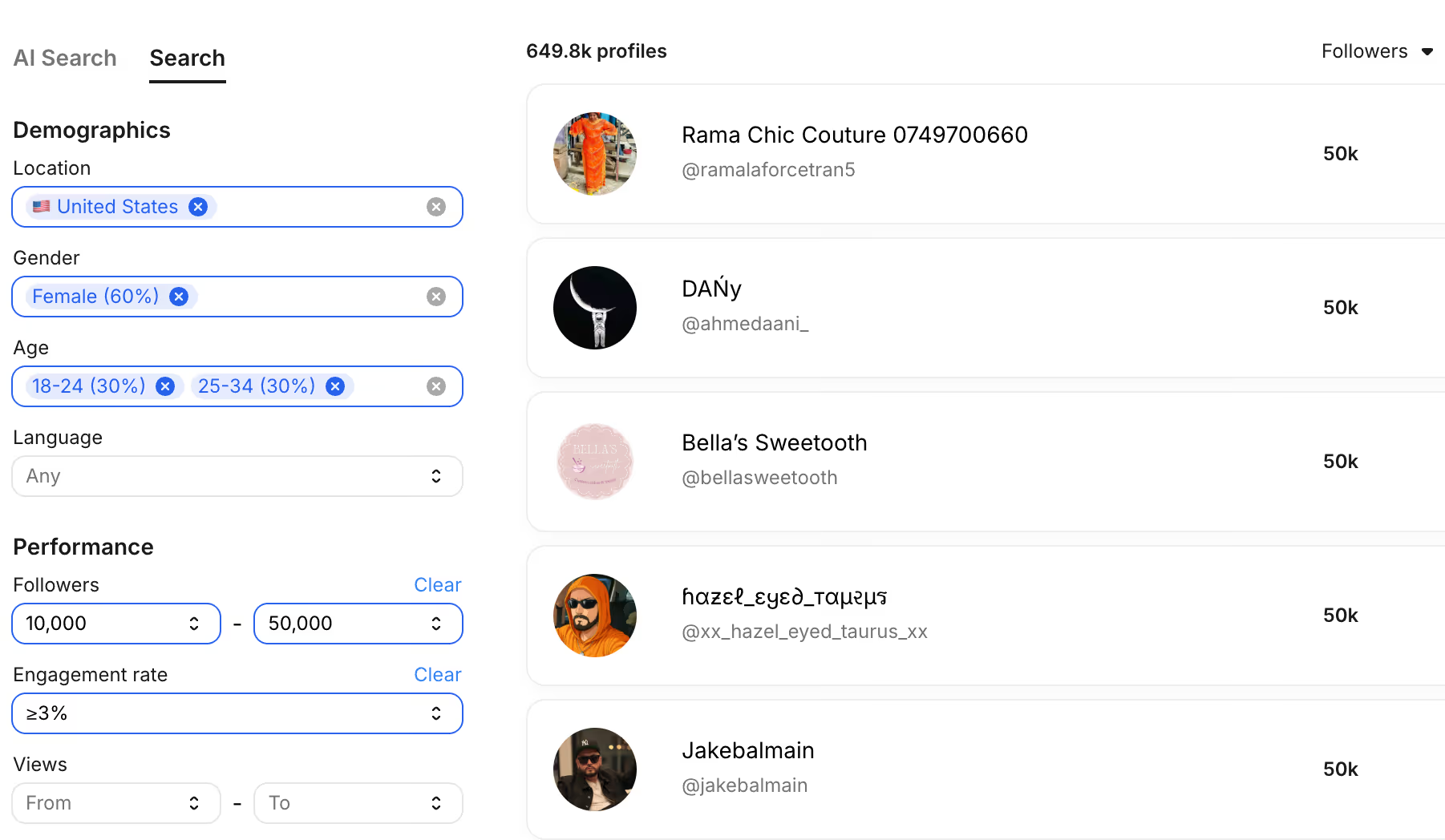
Data is your best friend when it comes to influencer pricing decisions – and Modash helps you access the numbers you need.
First, you can use filters to find influencers that meet your criteria in the first place.
Second, you can review influencer profiles to check if they’re a good fit, before you invest time into reaching out.
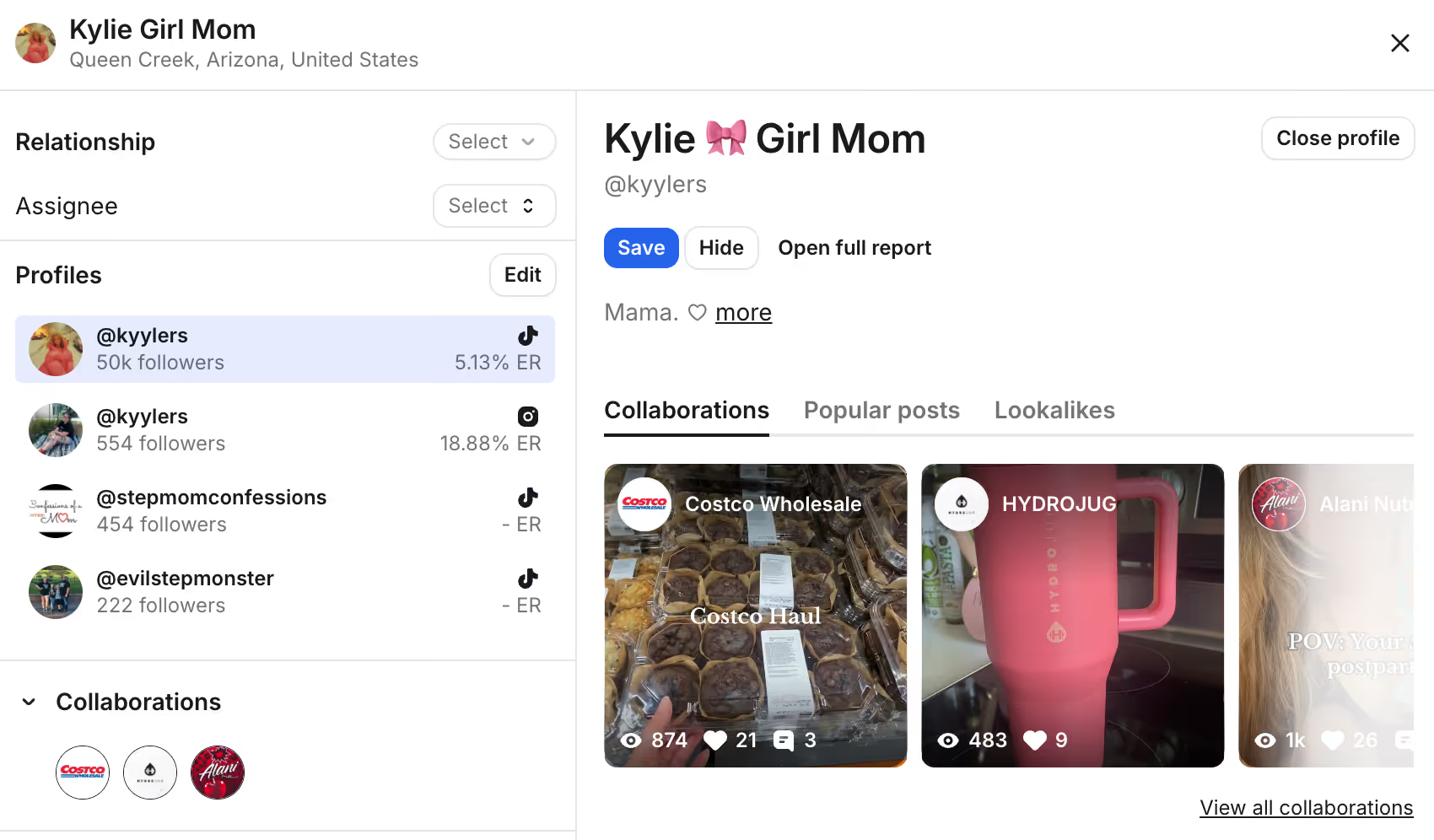
Modash can provide data on…
✅ Audience locations
✅ Average Reels views
✅ Average comments
✅ Past sponsors
… and more.
See for yourself by creating your free Modash account – no credit card required!