




Narzędzia
Zastosowania



Affiliate marketing kind of feels like a throwaway.
It seems like a lot of people “get their feet wet in influencer marketing” by attempting affiliate marketing first. Or, they feel like it’s a program you can set up and let it run on its own.
But that’s not reality – not in 2026 anyway. Affiliate marketing is not a “starter influencer program.”
Affiliates are your brand ambassadors. They’re long-term relationships where your creator works with you to promote and sell your brand. They’re equally as invested in your success because it means their success too.
And it’s also not as easy as it sounds. Running an affiliate program that’s actually successful means you need to invest budget, time, and brain power into it.
In this guide, you’ll learn how to set up an affiliate program that will work for your brand:
In reality, affiliate marketing is going to work best for brands who:
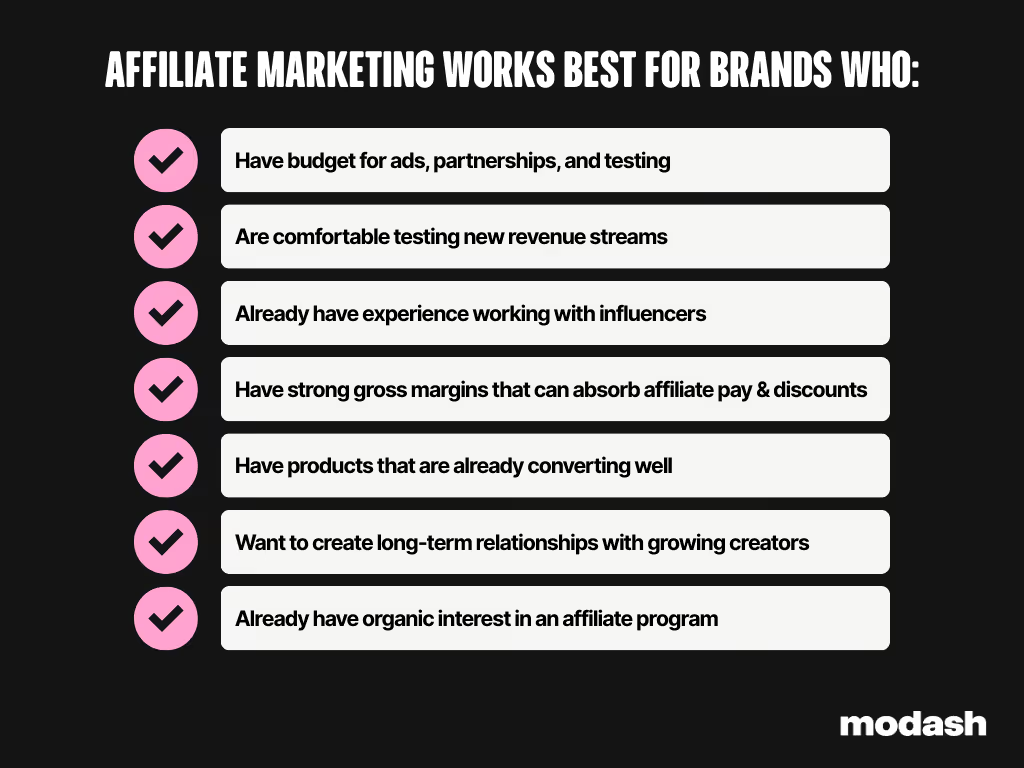
If the above doesn’t describe your brand, or you’re not quite there yet, affiliate marketing may not be the best growth avenue for you right now.
Affiliate marketing isn’t for everyone – and not in the same way brussel sprouts aren’t for everyone. I mean, by nature, it’s not going to work unless you’re willing to do the following:
While we’re talking about affiliates, in this case, they should be synonymous with brand ambassadors. These creators will represent your brand, and shooting for high quality and brand fit will help you better create trust with their audiences because the collaboration will feel more natural and organic.
Affiliate marketing is just as much a collaboration as anything else. That means that it’s on you to:
A lot of people think an affiliate program is a set-it-and-forget-it kind of situation. This couldn’t be further from the truth. It takes real time and investment to get to an always-on program that earns revenue round the clock.
You’ll want to onboard your affiliates properly, equip them with everything they need to be successful, and nurture them over time to keep them motivated and engaged. Affiliate marketing works best when it’s based around repetition.
If you don’t do those things at bare minimum, the best affiliate in the world won’t perform.
You’ll have to do some math. I know, no one told any of us how much math would be in marketing. But we all got scammed, so let’s get into it.
Deciding on affiliate commission is a delicate balance between being attractive and competitive for your affiliates, and also keeping your own margins attractive.
The general rule is: the lower your average order value (AOV), the higher your commission should be.
That might feel immediately counterintuitive, but hear me out. If your AOV is $30, and you offer a 10% commission, your affiliate will only earn $3 per sale. To make a decent amount, say $500, they’d have to make 166 sales.
That may not be the most attractive option out there.
However, if your AOV is $300, a 10% commission works out to $30 per sale – where it only takes about 17 orders for an affiliate to make $500.
It might be tempting to just say “Just add more commission, duh.” However, if you’re only earning 20% gross revenue on your products, do you really want to give 10% away to affiliates?
And if you happen to offer a discount with their code, you’re eating further into that gross revenue.
For example, if your AOV is $30, and you’re offering a 15% discount, plus a 10% commission, your revenue would work out to $22.95. Is that feasible for you?
If you happen to have more expensive products, it makes sense to think about things from a consumer perspective. Let’s say your product is $2500 – we’d expect a discount code to take $50 - $100 off to make it “worth it” for the customer. If your products sit more in the $20 range, 15% - 20% off an entire order is more reasonable.
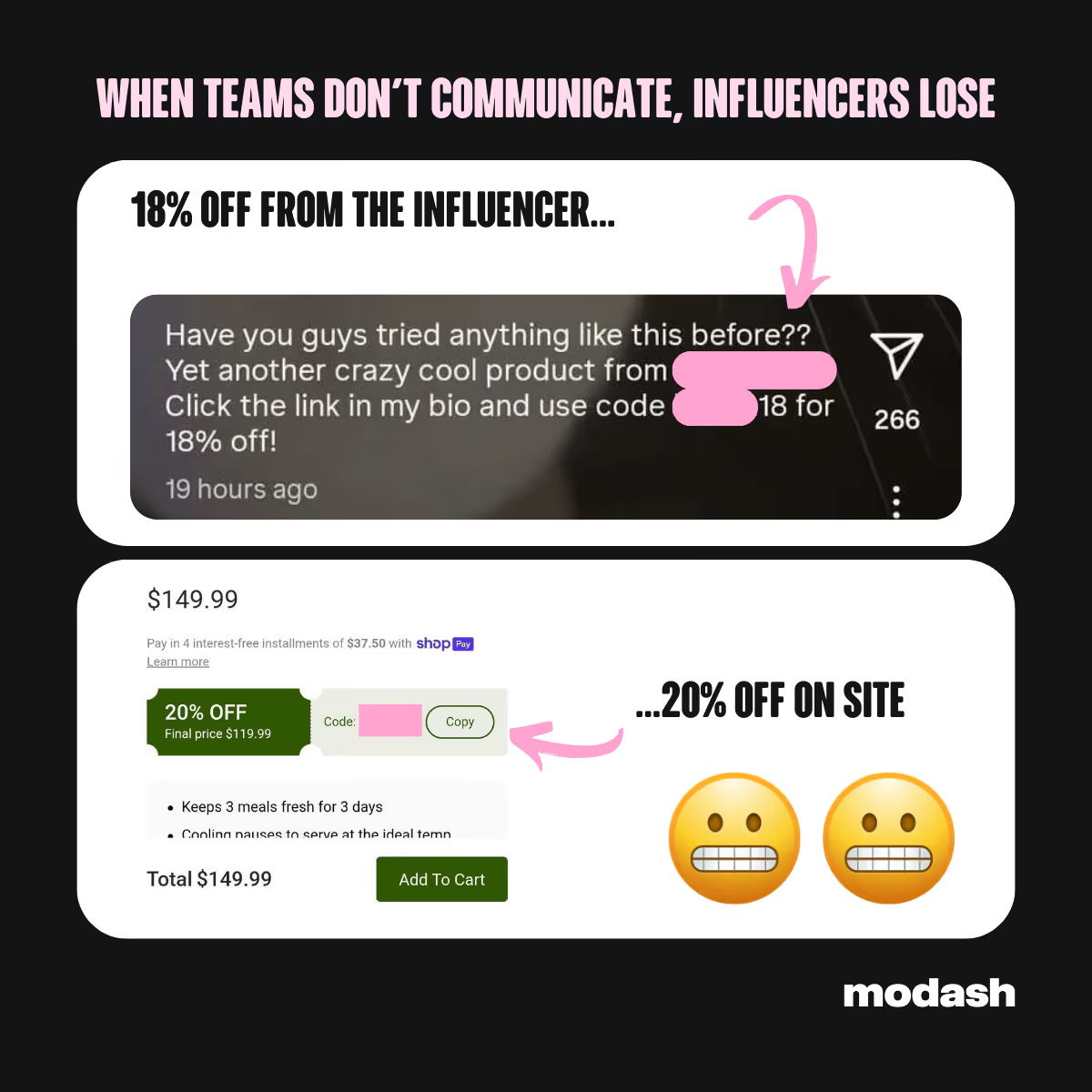
⚠️ Note: Do not put your affiliate in a situation where their code is less valuable than a sale you’re running. I have absolutely followed an affiliate code to a site to see that it offered me less of a discount than the other running sale from the brand. Why would I ever use that affiliate’s code?
And don’t tell me it doesn’t happen.
Benchmarks are benchmarks. They’re never going to be perfect, and they won’t tell you exactly what you should offer – because your commission rates are going to completely depend on your margins, your prices, and what makes you the most competitive.
But, you can get an idea of what others are doing. We pulled this table from Post Affiliate Pro:
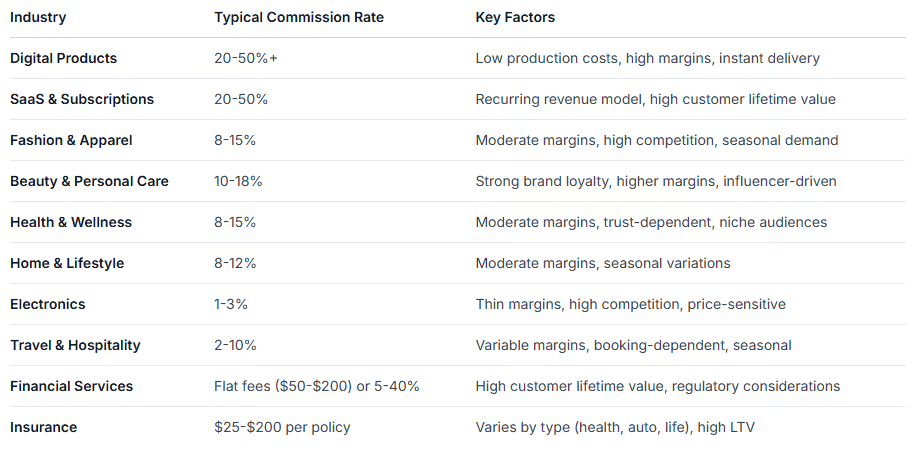
What I really liked about this table is that it explains on the right why the commission sits where it does. You’ll see that several factors go into setting a commission rate, such as competition, margins, seasonality, and customer lifetime value.
Then, Amazon also provides transparency on their commission structure.
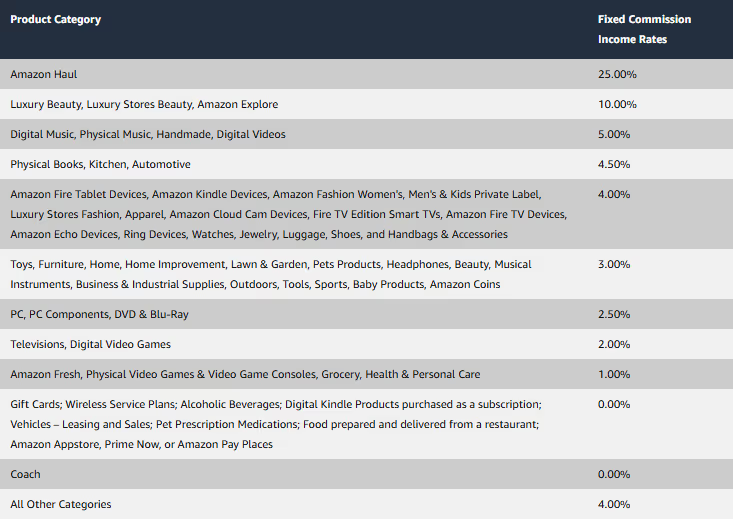
You’ll see the same kinds of trends, where expensive products (like electronics, furniture, etc.) have razor thin commission rates, while cheaper products (I see you Amazon Haul) sit at a 25% commission rate.
We also recently polled marketers about their affiliate commissions, and found that the averages for a 3-tier program were 10%, 14%, and 19%. However, your mileage will vary based on the kinds of products you sell and what your margins look like.
Not everyone has several tiers to their affiliate program – some offer a single commission rate and call it good.
That might work for you, but I’ve found that a 3-tier system seems to be the most common.
You want your creator to want to work towards something, while keeping your initial commission attractive. You also want your creators who reach the top tier to feel like they’ve earned something, and that they’re rewarded for their work.
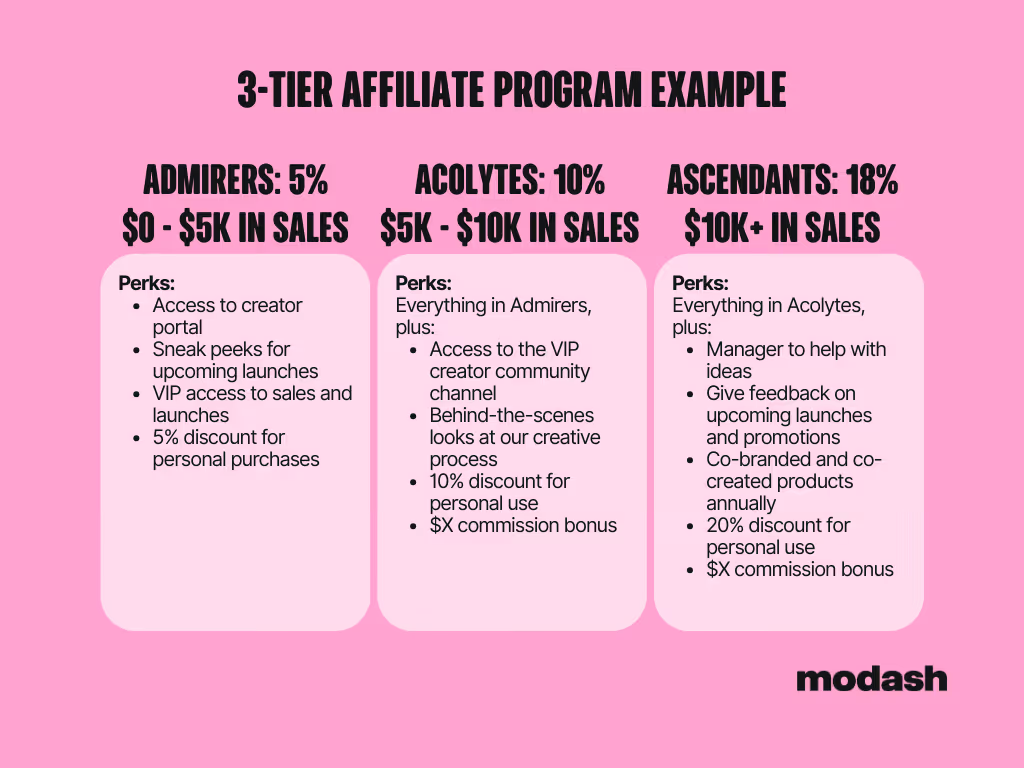
Circle back to the section about deciding on commission and tiers: What makes the most sense for you in terms of gross revenue margins, and what keeps you competitive. But this time, add in the last question: is moving to the next tier actually attainable for your affiliates?
Because having an ultra attractive final tier means nothing if it’s almost impossible to get to. Your affiliates will end up feeling demotivated, and lose interest in promoting your products.
The next logistics step is about how you’re going to track the sales and commissions that you’ll offer to your affiliates.
There are a few different ways you’ll be able to track your affiliates’ sales.
The most common option is to use both a discount code and a tracking link.
Why both? Think of it as a contingency plan. The customer journey is messy, codes often get forgotten, and sometimes links just aren’t used because of the user experience of any given social platform (that’s subject to change at a moment’s notice anyway. Looking at you Meta).
A discount code incentivizes customers to actually use the creator’s code – even if they bounce off of the creator’s post and search for your brand via Google.
Tracking links help when the codes fail – especially if you embed the discount code in the link so it automatically pops up during checkout. These are also super handy for deliverables like Instagram Stories and YouTube videos, where you can actually add a direct link.
“Do I have to include a discount with the code or tracking link?”
No, but.
The issue with only using a tracking link or affiliate code that doesn’t have a discount is that you’re not making it particularly attractive to use the code – and thus, kind of shooting your attribution and your creator in the foot.
On top of that, tracking links function based on cookie-tracking (which is a lot less delicious than it sounds). If a customer disables cookies, when they click on the link, the tracking will break and not even Google Analytics will be able to attribute the sale to your affiliate. Discount codes solve that problem entirely.
⚠️ Note: It’s also not a bad idea to give long-term affiliates an evergreen discount code. For example, if you wanted to re-use THOMAS15 for a 10% discount, the customer might feel a little slighted. Otherwise, you could use THOMASROCK and be able to re-use your affiliate code throughout the year without needing to generate yet another code to track.
Code poaching (or “code leakage”) is when an affiliate’s code and discount get leaked into one of those scammy discount code aggregation sites. It sucks – and often, there’s no way to actually get your creator’s code removed once it’s there.
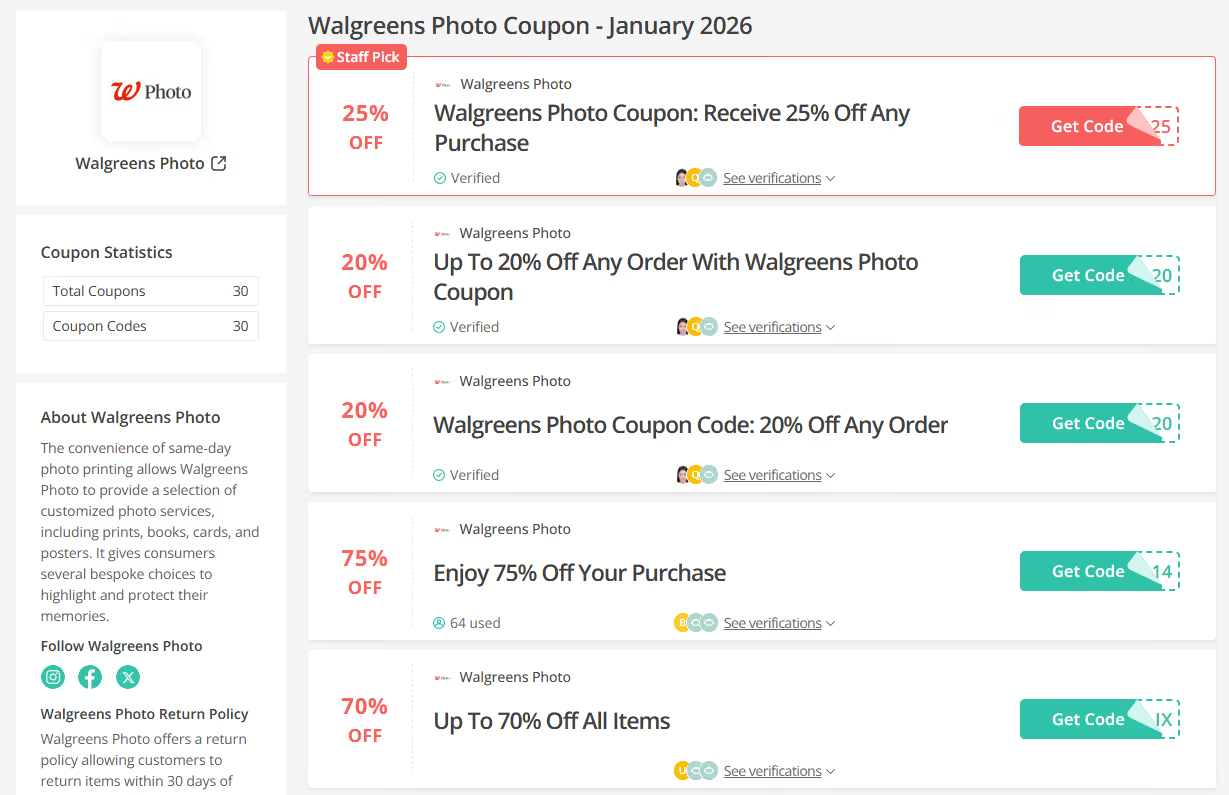
The issue with code poaching is that it can mess with your attribution and sales. If it just meant paying a creator for a few sales they didn’t inherently earn, it wouldn’t be a huge deal – but it also affects whether or not you know if your affiliate marketing is actually working.
Another avenue is getting these sites their own code – which would help fix at least the attribution side of it. I spoke with one affiliate marketer about this, and she’d even tried to reach out to the site’s owners and offer them their own special discount code in exchange for taking down her affiliates’ codes, but there was just no one actually at the wheel for her to get in contact with. While it’s not impossible, it’s really going to depend on the site itself.
So what do you do? In theory, you could:
We asked marketers how they handle code poaching in a recent survey, and it seems like most are either changing up their codes, or relying on other tracking methods to fix the attribution problem.
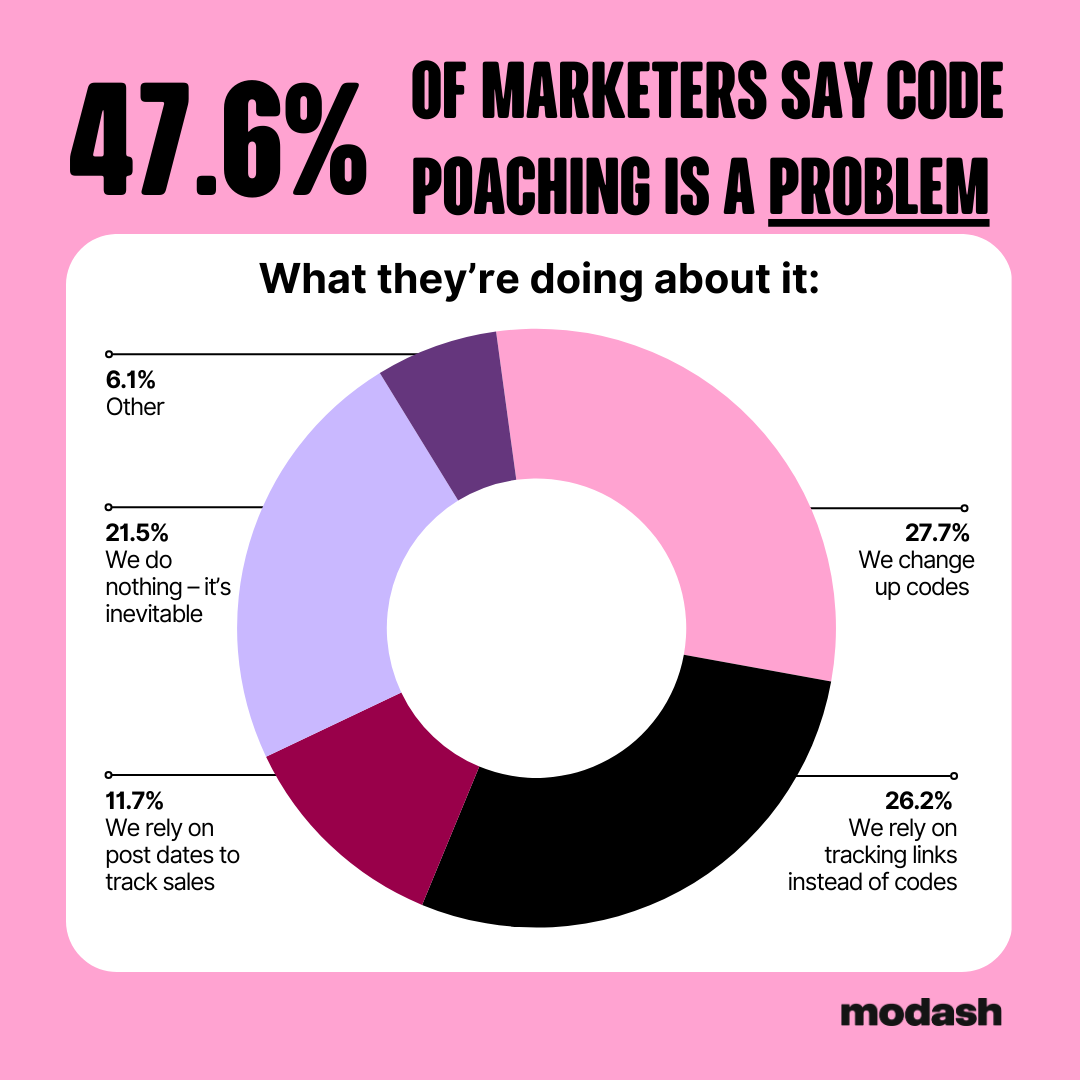
Or, like 1 in 5 of the influencer marketers we polled, you could just do nothing and accept that it’s a reality. There are other challenges with the above solutions:
It might be tempting to stress out over code poaching, but unless it’s really affecting a huge amount of your attribution and sales, it might not be worth the headache of changing codes. Besides, you’ll be able to connect code spikes to recent posts by your affiliates, and if you can’t you know to un-attribute the sales to your creator.
It might be worth it to consider adding something into your contract or terms and conditions about code poaching.
For example:
It’s just a good idea to be transparent and clear about how you’ll handle code poaching from the beginning – that way no one feels things are unfair later.
Here’s the thing: Kylie Jenner isn’t going to join your affiliate program. Nor will Chappell Roan. Forget about Dwayne The Rock Johnson.
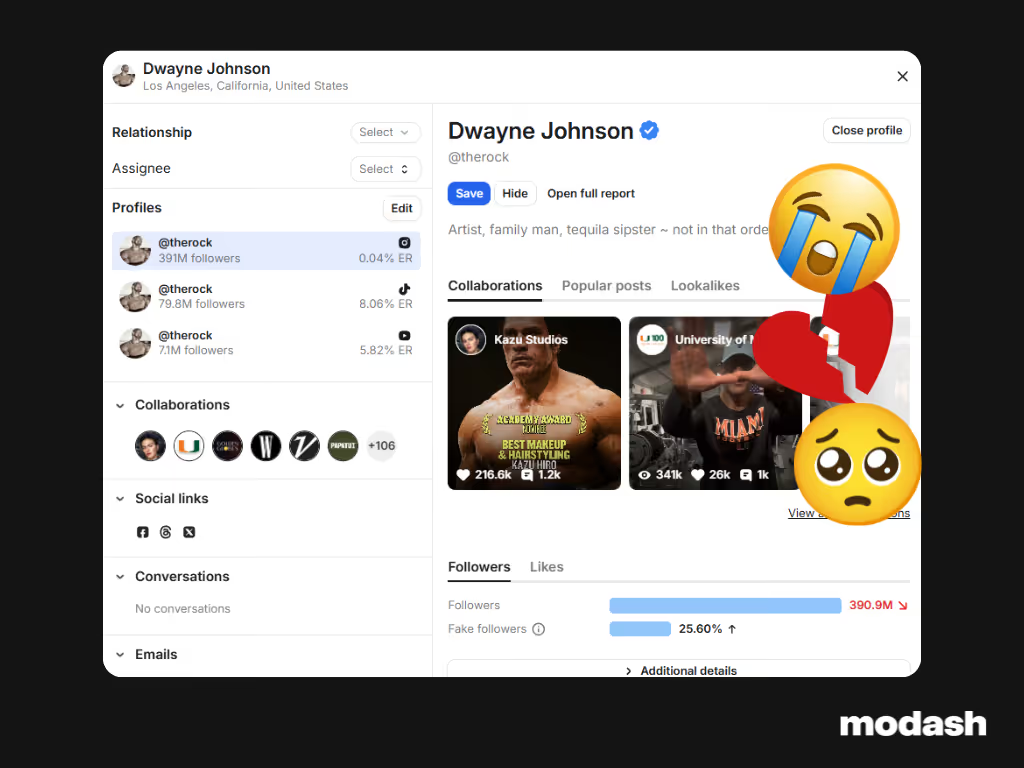
And frankly, that’s okay. Because while they have huge audiences, those huge audiences aren’t necessarily the best audience for your brand.
Larger, celebrity influencers are likely used to getting big bucks for them to feature a brand. So chances are, they’re not going to be interested in getting paid-per-commission.
In reality, your best affiliates are probably already on your radar:
Who:
Those people are much more likely to (enthusiastically) promote your brand. You’ll want content and product placement to feel authentic and natural instead of forced, obvious promotion that they’d only do for a payout.
Affiliate marketing isn’t a “post the link once and boom, you’re done” kind of thing. It takes repetition, brand familiarity, and consistency. A great affiliate will be able to find different ways to promote your products, warm up their audience to your brand, and do all of that in an organic way.
For example, you’d want an affiliate working supplements or skincare products into their daily routine, instead of just showing them once and then moving on to the next competitor’s product.
If an affiliate genuinely likes your product and brand – you’ve got a great match. It’ll be easy for them to be genuine when gushing about your products.
Once you’ve honed in on your perfect affiliate archetype, you can get to actually recruiting them.
There are a few methods for this, both active and passive:
Obviously, the passive methods are going to bring in less people overall, but also be less work overall. But active methods give you more control over who you bring in, and you’ll likely be able to bring in more affiliates.
As far as active search, you can do it the old-fashioned way – opening up your given social account and searching via relevant hashtags. You could also look through your own socials and see if anyone with a sizeable audience has engaged with your posts.
From there, it’s as straightforward as making a list in a spreadsheet, and contacting them all one-by-one.
Alternatively, Modash takes all the manual work out of this process. For example, you can search for creators based on their audience demographics, a few keywords, or even use the AI search to find creators based on vibes.
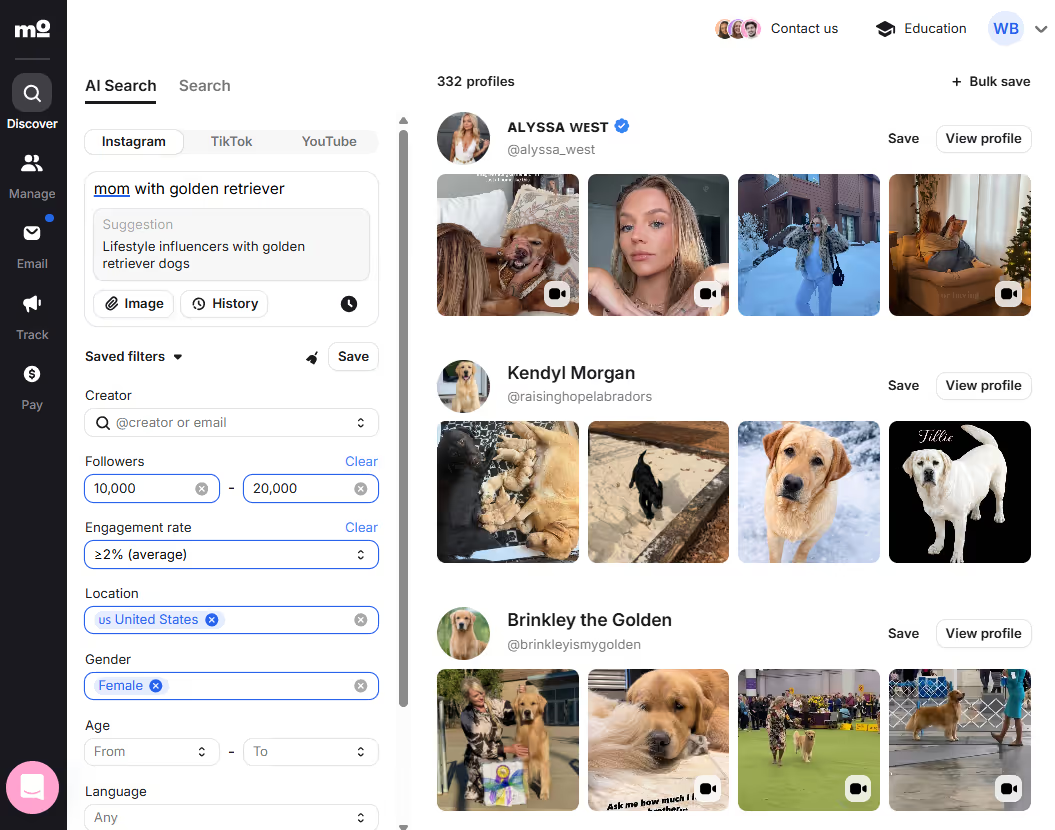
Once you find an affiliate you like, you can click on their profile, check out their audience metrics, engagement rate, most recent posts (including sponsored posts), and add them to a list.
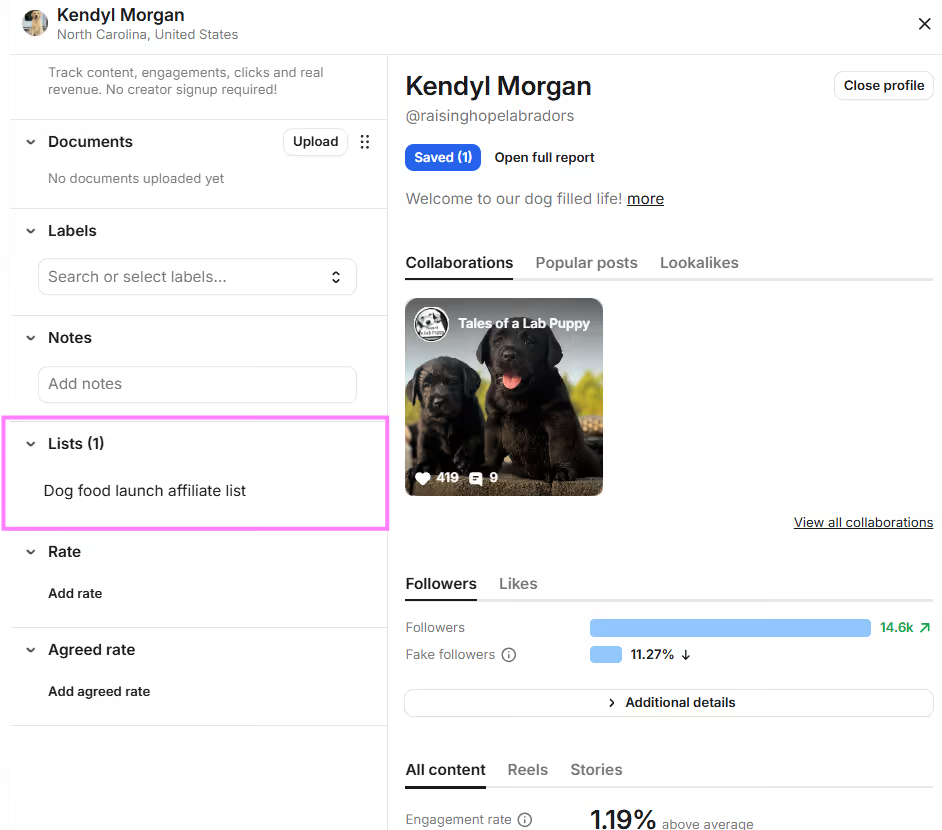
Once you have a few shortlisted creators in your list, you can proceed to reaching out directly from within Modash using the Inbox feature.
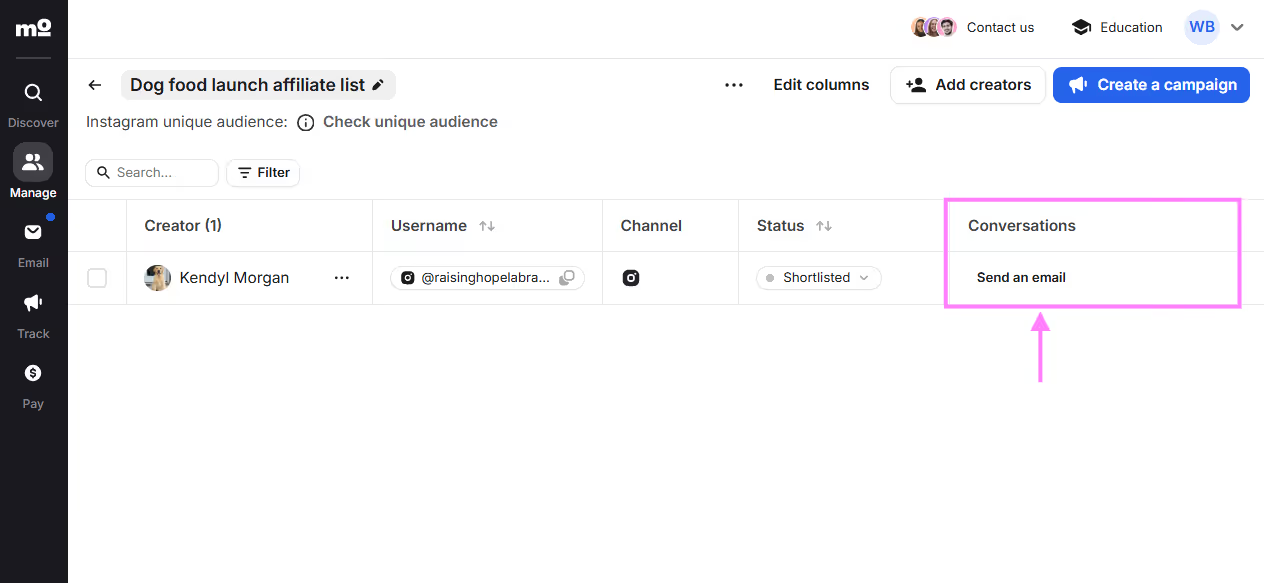
Then, you can choose a template for your outreach, or even create a sequence that will follow up for you in case you don’t hear back.
What’s cool is that while you’re emailing a creator, their profile is in the sidebar, making it easy to refer to their metrics, personalize the email, and add in your own notes about what their affiliate commission is, their beloved dog’s first name, whatever you’d like to add. It’s all in front of you without needing to swap back and forth between tabs.
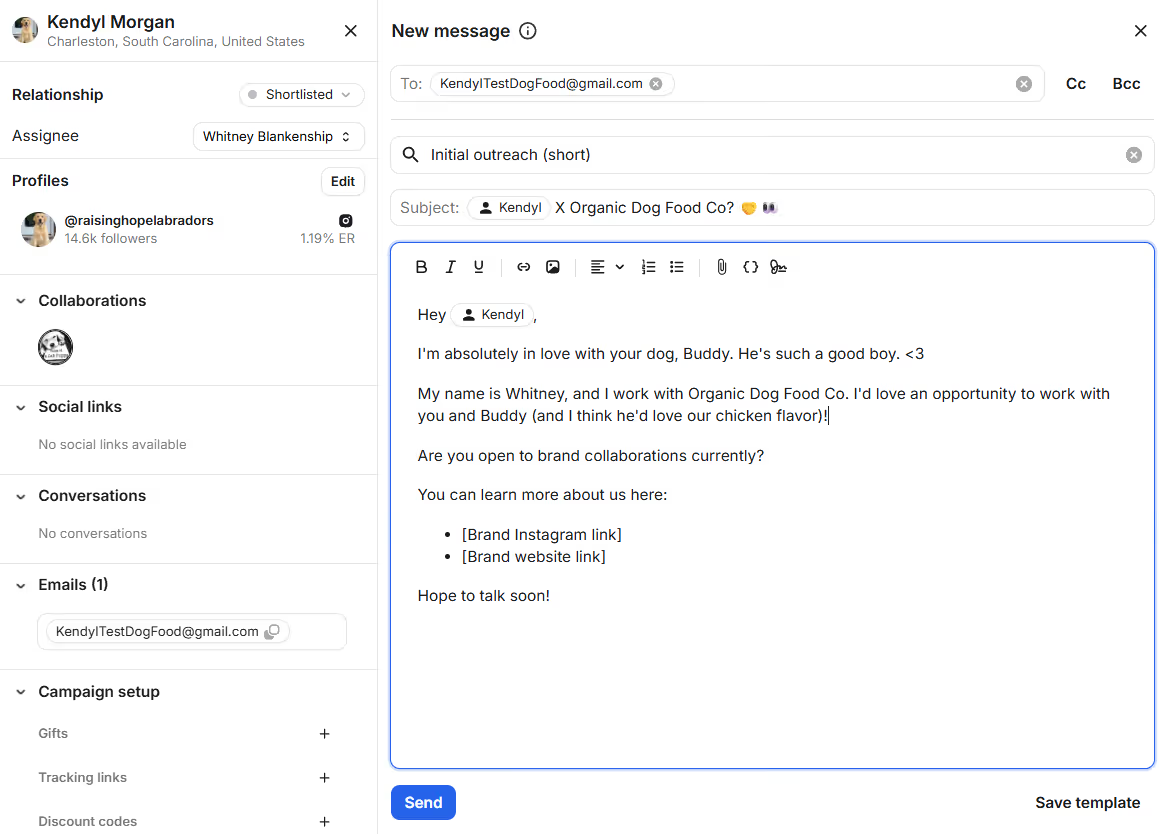
Then, as your conversation progresses with your creator, you can update the campaign in their profile as you go. You can create tracking links, discount codes, and even gift products from directly within Modash without ever leaving the profile.
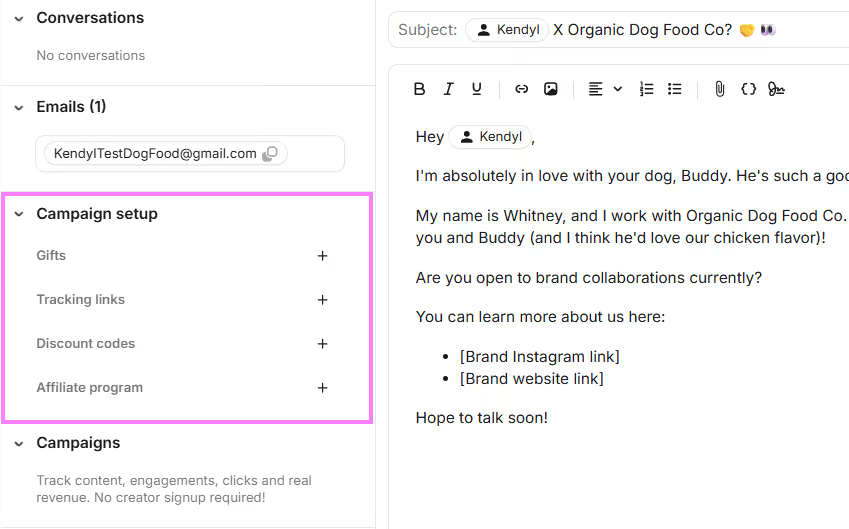
(And yes, if you really really want to, you can always export all lists, campaign data, and tracking to .csv to add it to a spreadsheet.)
Need a deeper dive into recruiting affiliates? I’ve got you covered: How To Recruit Affiliates: A Guide To Finding, Reaching Out, & Activating Affiliates
So you’ve done the hard part, you set up your program, crunched all the math, and recruited a superstar A-team of affiliates. Now you just sit back and relax.
If only that were so. 😭
The hard part has only just begun. I say hard, but none of this is hard per se – it just requires work. Affiliate, as mentioned, is not set-it-and-forget-it. You’ll need to nurture your affiliates over time – because an inactive affiliate doesn’t do anything for you.
Here are a few ways you can do that.
Easier said than done, but you can start with a one-to-many communication platform – such as a:
Creating a community hub, so to speak, does a few things for you. First, you’ll be able to reach out to your affiliates with updates, sneak peeks, and other critical information quickly.
It’s important to choose the channel that your affiliates will actually use – a place that feels native for them. For example, Slack and Discord are super native to me, as someone who games and works in corporate, but if you’re pulling influencers into a Slack community, you might end up with a dead server.
My recommendation? Use a combination of a newsletter and a community channel, like WhatsApp or a group DM.
For example, with WhatsApp communities, you can create a channel with admin rights (like on Discord or Slack) and have that channel only for announcements, while keeping other channels open for affiliates to speak with one another. That way, your critical info doesn’t get lost in the shuffle, while your affiliates can still discuss and gush over your latest drops.
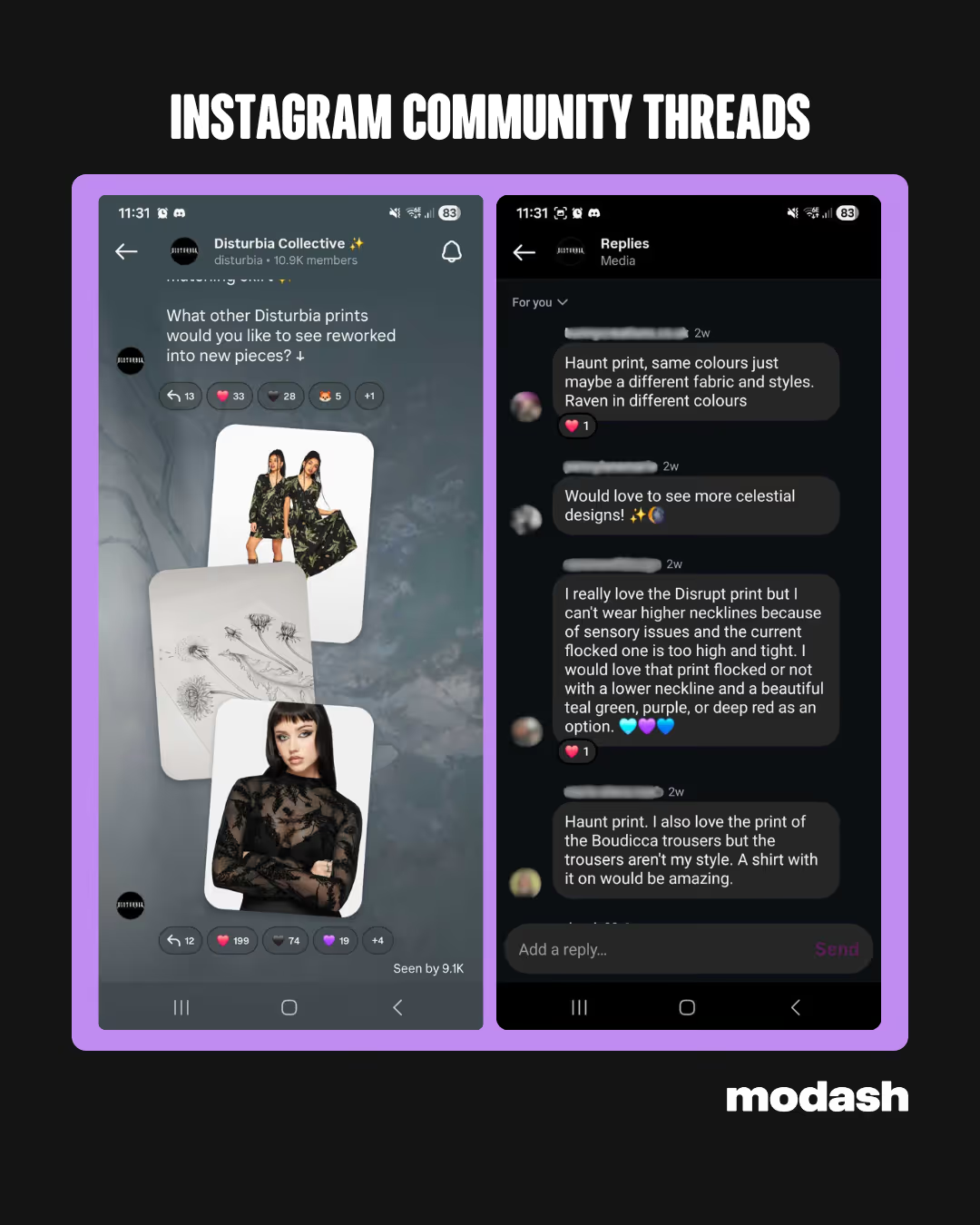
In a group DM on Instagram, for example, you can make posts that your affiliates can then reply to in a sort of “thread” situation – which can also help them interact with both you and each other, while keeping messages organized within each topic.
So you onboard your new affiliate, and you gift them a few products to demo. They promote those products – and then what?
What happens to your affiliate’s content when you release new products, or they run out of the products you originally sent them? If you’re not replenishing your affiliates, they’re less likely to be able to promote your brand. This also falls into nurturing the relationship you have with your affiliates.
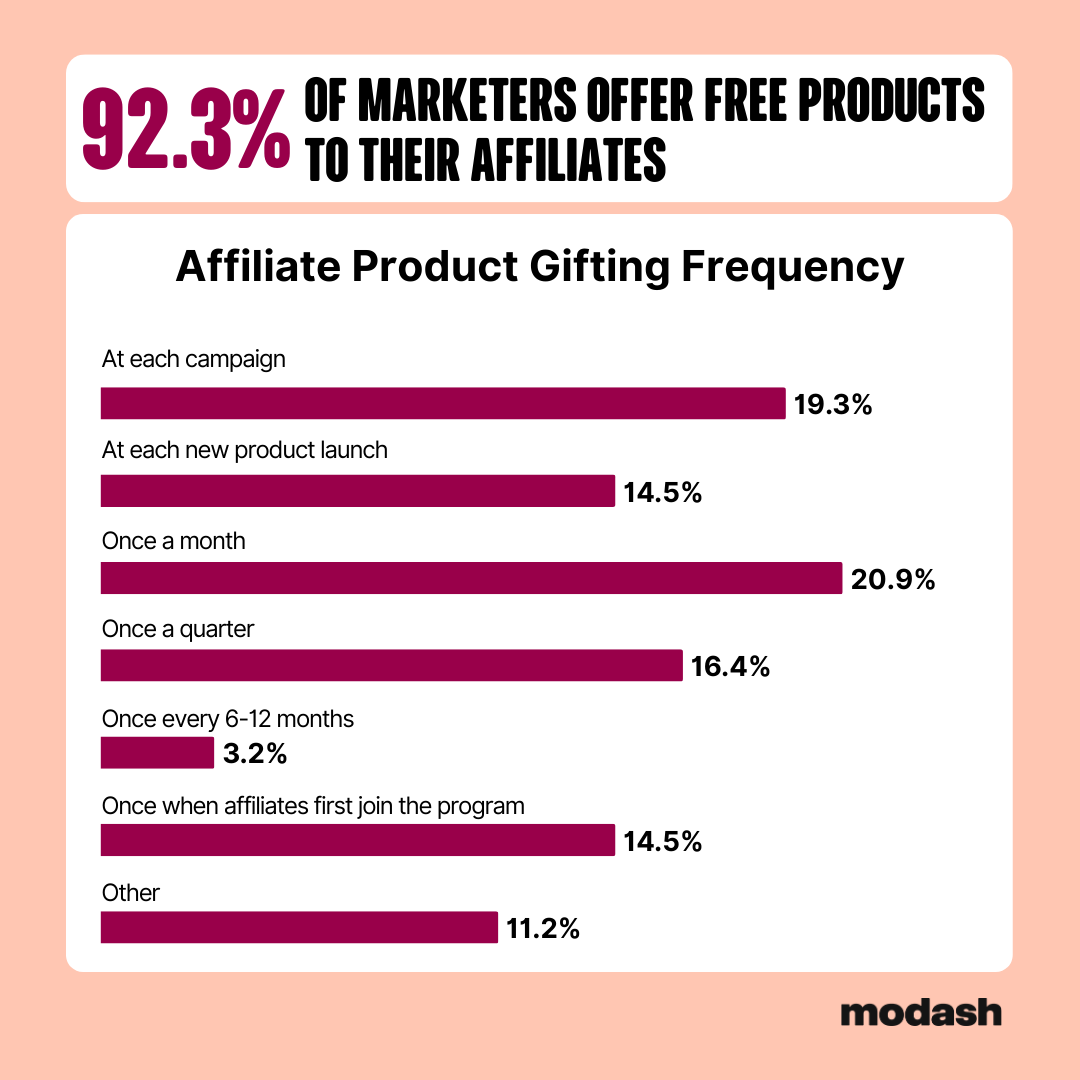
Many of the marketers we polled tend to regift at least monthly – if not more frequently.
For smaller, faster-moving products, think about a schedule to re-up your affiliate’s stock. You’ll want them to have the new things you’re launching so they can get their audiences excited about it. After all, it’s hard to promote a dress you sold over 2 years ago. It’s hard to promote cosmetics that have long since been used up.
Not to mention, regifting helps incentivize your affiliate to keep creating content. You could even rope the amount that you gift into your tiered system as an added bonus. For example, maybe you gift $50 worth of product every 6 months to tier 1, $100 every 6 months to tier 2, and $150 every 6 months to tier 3.
The amount of product you gift and the frequency is largely going to depend on how frequently you release products, how long it takes to use a product up, and your products’ prices. It might be useful to take a look at when customers need to replenish their own stocks and make an average timeline for your affiliates too.
Affiliates are great at telling a long-term story about your products and brand, but that doesn’t last forever. That doesn’t mean that you shake out the inactive affiliates and replace them with new creators – it means you work harder at keeping those relationships in place as long as possible.
And there are a ton of ways to incentivize them:
This last one is especially interesting, because the sky’s the limit. You can create a full campaign-long competition around a certain product. You could create a leaderboard and send out your newsletter (or DM announcements) with your top 3, 5, or 10 sellers. You can really get creative with the prizes for winning, such as a cash bonus, an amount of store credit, a trip to your offices to meet the staff, or even a trip to Disneyland if it’s in-budget.
It also doesn’t always have to be about sales. You could even hold a competition around who earns the most engagement around their Reels. That could be an effective way to test different content types, and which kinds your own audiences respond best to.
If you’ve opted for a community-style hub where affiliates can interact with each other, you could always prompt them to share their own ideas and help each other too. That’ll reinforce the community-aspect and keep your affiliates engaged for longer.
Affiliate marketing is unique – it reflects your own investment. The more you put into it, the more you get out of it.
Once you get it all figured out, you’re golden.
It’s also important to test over time. If you see your commission rates aren’t working, or your affiliates aren’t engaged, then it’s time to switch it up. In the meantime, you’ll be able to build long-lasting relationships with growing creators that end up transforming into brand advocates.
While it does take work, it doesn’t have to be as time-consuming as it all feels. Modash can help you find brand-fit affiliates, keep them to their own campaign, outreach them, track their sales, and pay them out – all without disrupting your already growing list of tabs.
But don’t take my word for it – try it free for 14 days (without even getting out your credit card).