

Meer tools
Toepassingen



Influencer marketing started with bloggers. Back before the days of social media, before even Tom was your first friend on Myspace, bloggers were the influencers.
Then social media became a thing – and as we all collectively moved towards its undeniable gravitational force, the influencers moved along with it.
But that relatable aspect of “this is a normal person like me” came with them. The format changed from text to photos to videos – but that authenticity was a core thread.
What changed was scale. Today, influencers reach more people than bloggers ever could. And algorithmic feeds power it – you’re shown the exact people you’re likely to engage with. You’re shown people like you. They’re relatable. They’re trustworthy.
But it’s 2026. Do we really trust those influencers? Or do we all go in understanding they have rent to pay too?
We surveyed 1042 US adults in June 2026, and asked them how much they trust creators.
We found:
(Want to skip straight to the report? Grab it here – ungated, like all the good stuff should be)
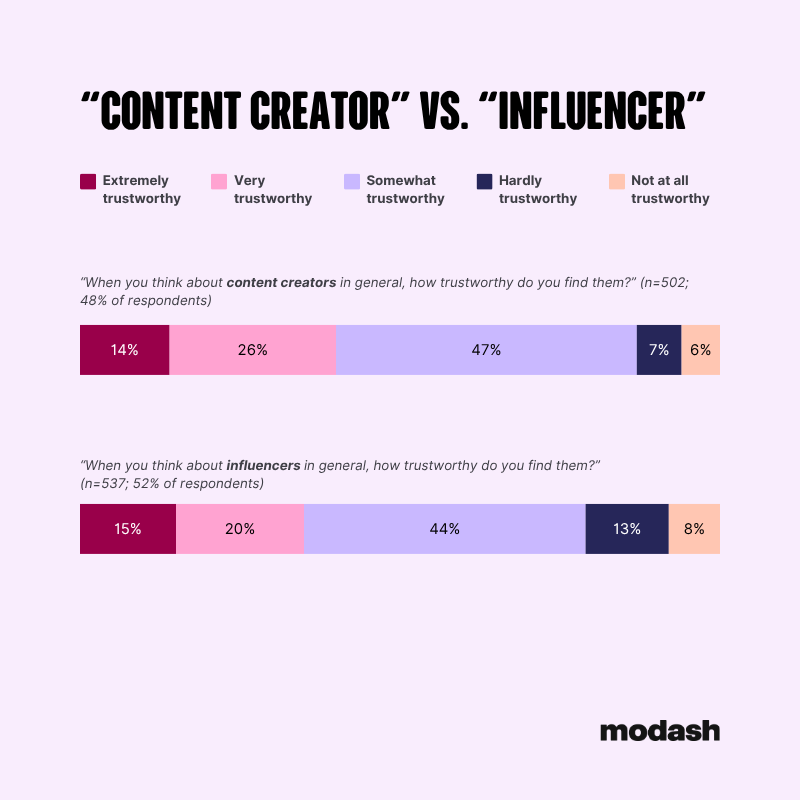
One hypothesis we had was based on word choice. Does it make a difference if you call someone a “content creator” or an “influencer”?
We A/B tested it and asked respondents how trustworthy they found “influencers” or “content creators”.
And from a bird’s-eye-view, there are only slight differences.
That said, when we split it out by generation, we found that the word “influencer” had a particularly negative effect for Boomers.
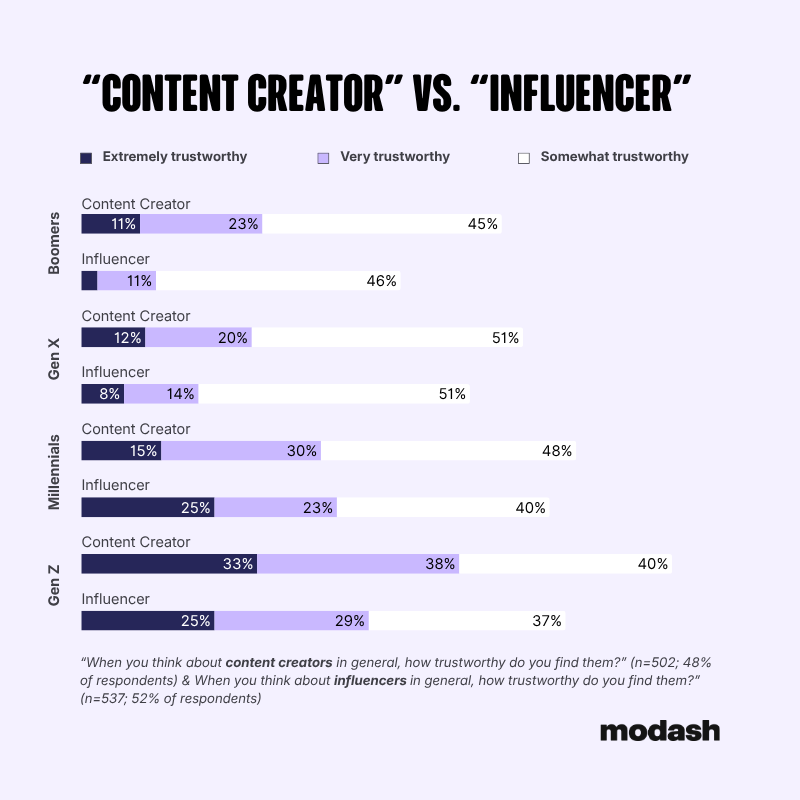
Meanwhile, for Millennials and Gen Z – there’s almost no difference between the two. They trust creators considerably more than older generations, regardless of what you call them.
And it’s because they spend more time interacting with creators as a whole.
63% of the people we polled said they interacted with creator content daily or more. We call them “enthusiasts”.
Those enthusiasts are also a lot more likely to say that creators were trustworthy (very + extremely).
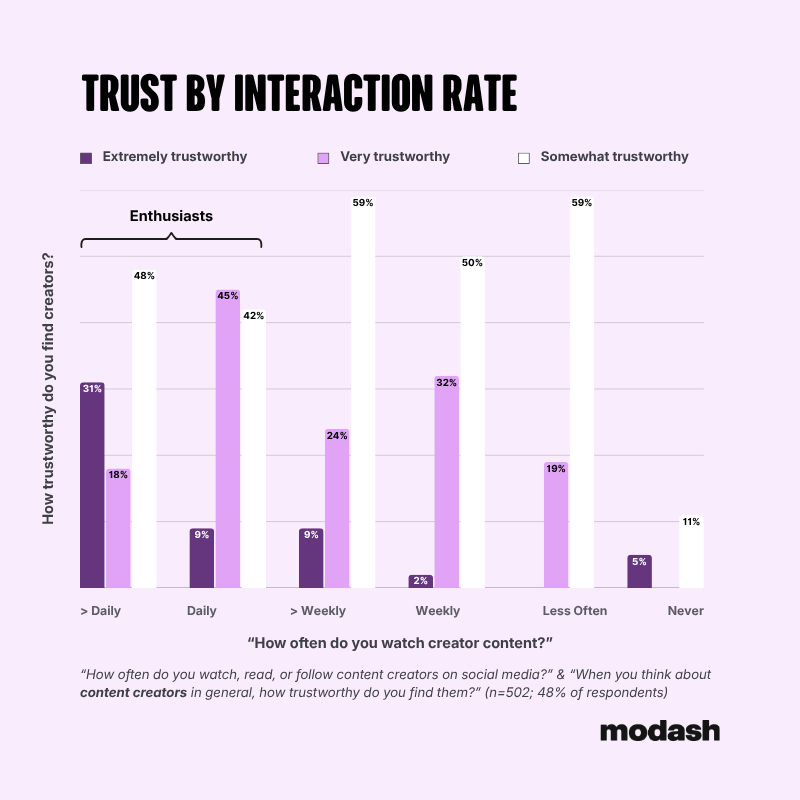
And if you were born after 1981, you’re 74% likely to be an enthusiast. 82% if you were born after ‘96.
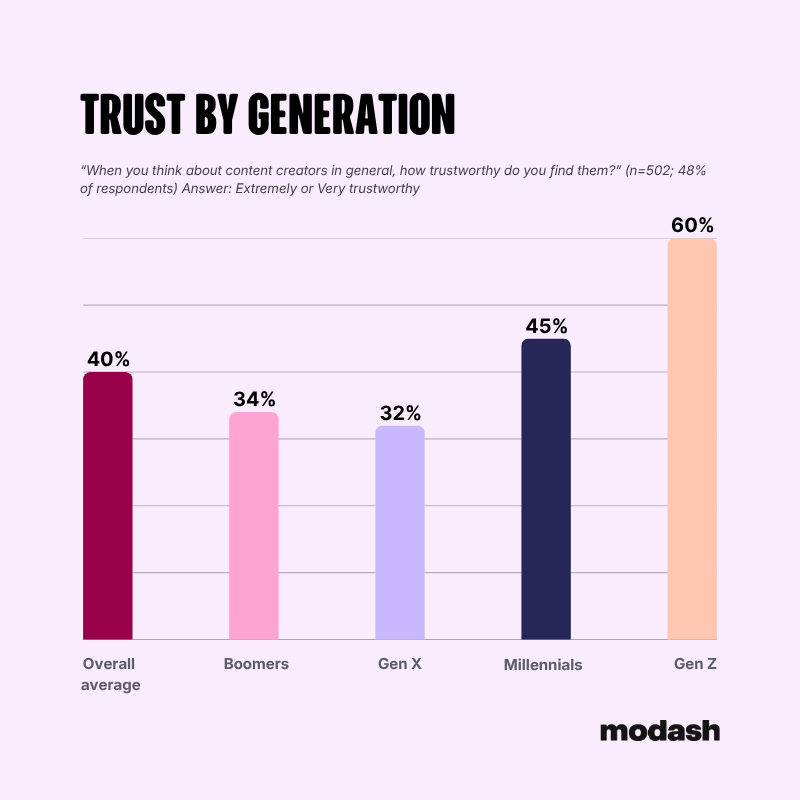
Thus, it’s no surprise that 45% of Millennials and 60% of Gen Z say that creators are trustworthy (compared to just 34% of Boomers and 32% of Gen X).
While how much you interact with creators is a pretty strong indicator of how likely you are to trust them, there are also different situations which might impact that trust.
We presented people with different scenarios and asked them whether it increased or decreased their trust in that creator.
They said their trust increased when:
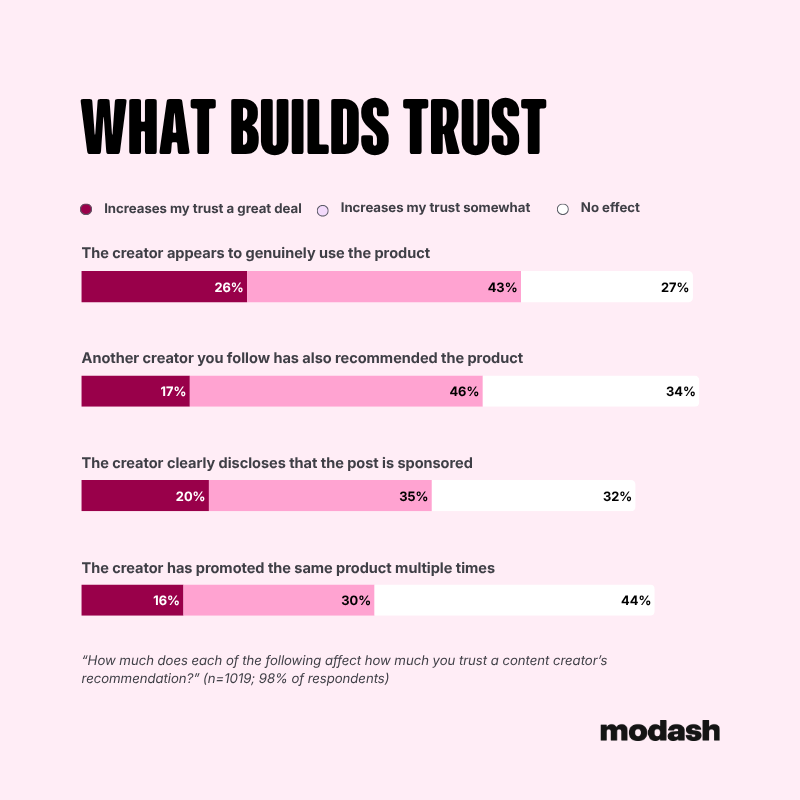
It boils down to what feels authentic. When the audience feels like the recommendation is genuine, and the sponsorship is disclosed, they’re okay being marketed to.
And when several creators they follow are recommending the same product, they’re even more inclined to trust the recommendation.
While there was a bit more consensus about what built trust, there was a bit less for what broke it.
That said, there are a few scenarios that seemed to undermine the trust respondents had in creators:
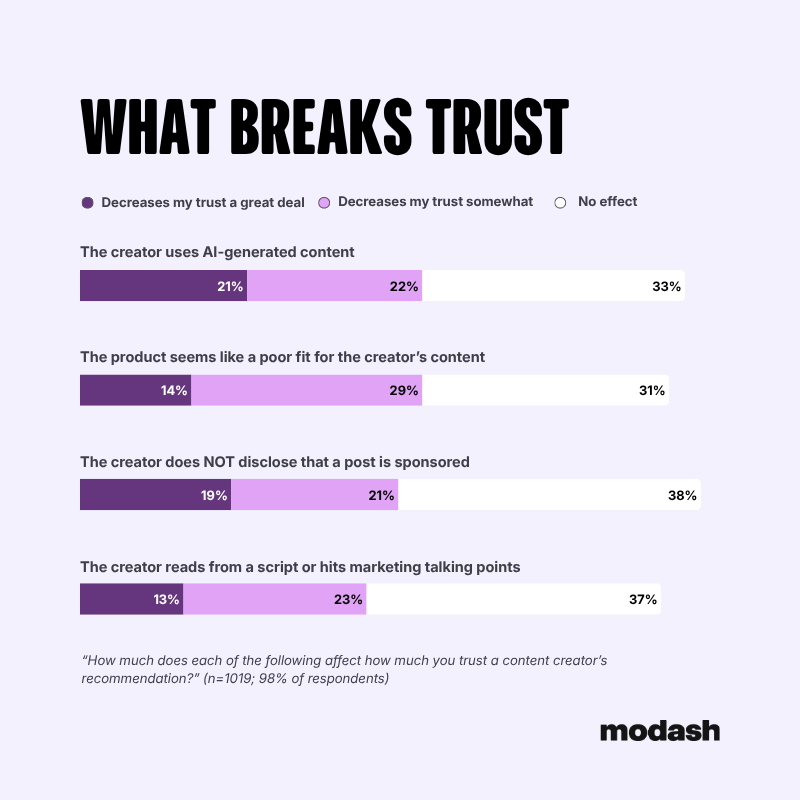
The most visceral negative response came from the creator using AI-generated content. Questions around AI-use were polarizing for respondents. About 40% of those asked responded negatively to creators promoting generative AI products – and the remaining 60% being evenly split between positive and neutral responses.
AI aside, the remaining scenarios undermine authenticity for respondents. When it feels like a product is unnaturally forced into the content, when the creator is reading from a script, or if the content feels sponsored but isn’t disclosed, people have a hard time trusting that creator.
From the start, creators you follow regularly appear pretty high in the list of trusted sources for product recommendations. Respondents ranked their followed creators in the 2nd spot – tied with online reviews, and just after friends and family.
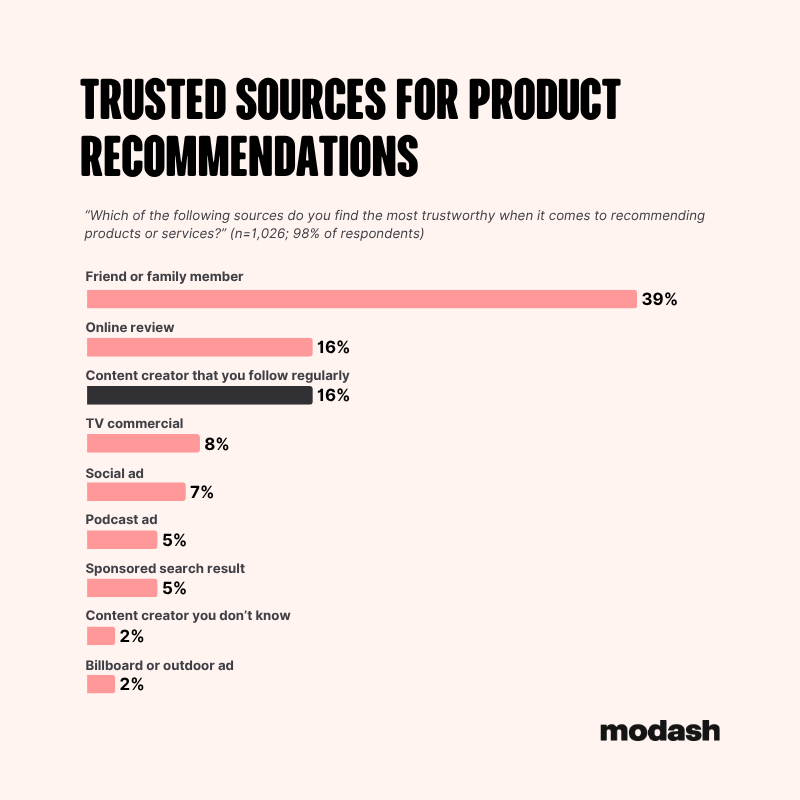
Creators people didn’t know? At the bottom, with billboards.
Familiarity counts for something – we know those who watch creators more often are more likely to trust them. That trust also extends to product research, especially for Gen Z. Gen Z was the only age group where followed creators were tied for first place with friends and family.
Trusting creators is all well and good – but how does it impact purchase behavior – if at all?
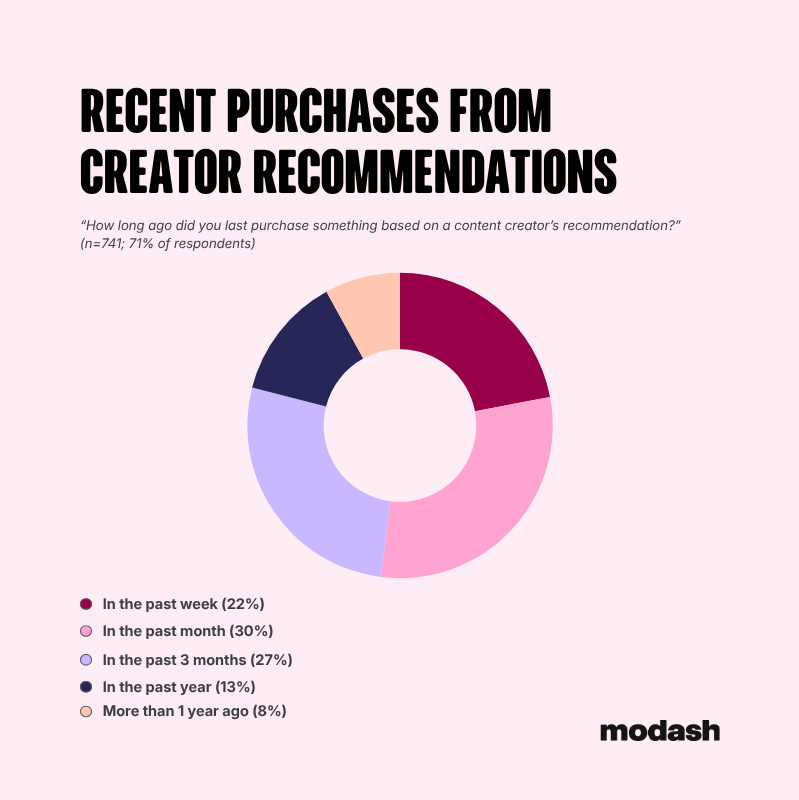
Among the people who follow creators, 84% have purchased something based on a creator’s recommendation.
Half of everyone we polled had purchased in the last month – and nearly a quarter had done it in the last week.
These people might just be exceptional shoppers – we can’t be sure that there’s a link between trust and buying.
Unless we look at the people who trust creators the most, that is.
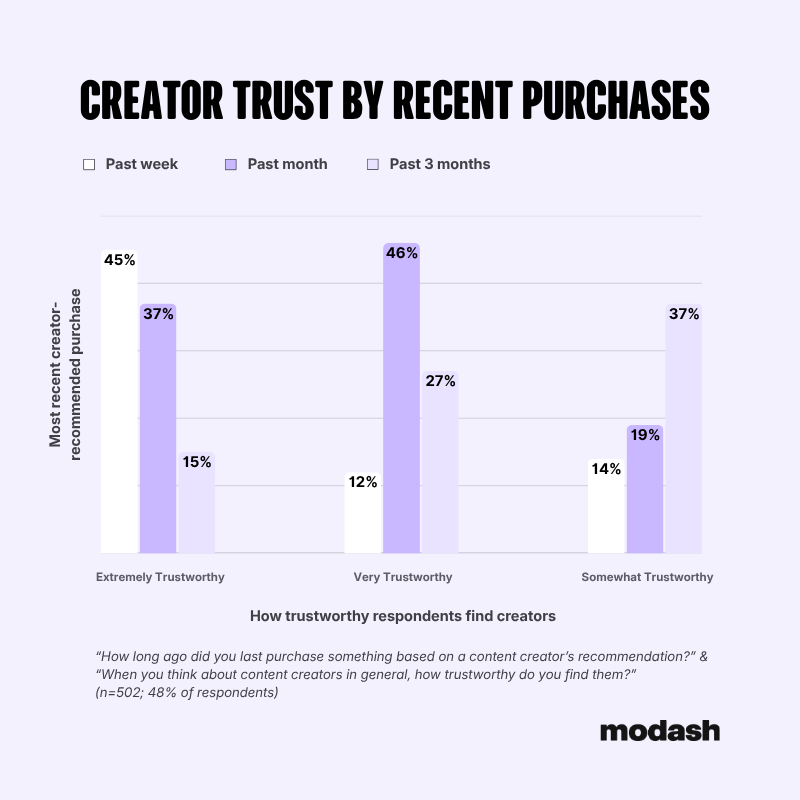
For the people who said creators were extremely trustworthy, 82% purchased from a creator in the last month – 45% in the last week.
Even those who said creators were very trustworthy, purchases from the last week dropped by 2/3rds – to just 12%.
Meanwhile, only 35% of the people who found creators to be somewhat trustworthy had purchased in the last month.
While it seems the people that trust creators the most also purchase from creator recommendations the most often – we also wanted to know just how much sway a creator’s recommendation really had.
We asked respondents two questions: “How likely are you to purchase a product from an unknown brand based solely on a creator’s recommendation?”
And followed it up with: “How likely are you to purchase that same product if you know the brand too?”
Over a third of respondents (35%) said they were willing to purchase a product from an unknown brand on the creator’s word alone.
When they knew the brand, the number jumped to 58%.
It gets really interesting when you look at the people who trust creators the most.
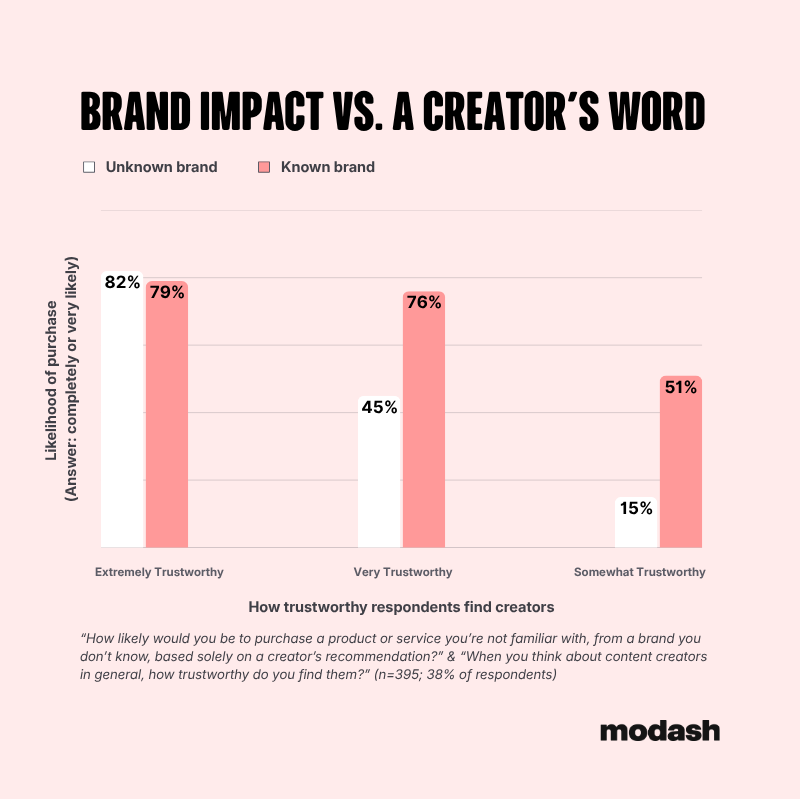
For those who trust creators the most – knowing the brand really didn’t matter.
They’re already on board. The creator’s word is enough.
Even dropping to “very” trustworthy is enough to half a respondent’s likelihood to purchase without knowing the brand. The brand has to do significantly more legwork to get a person over the finish line.
For those who only find creators to be somewhat trustworthy – knowing the brand is the difference between a purchase likelihood of 15% and 51%.
I’m going to argue – yes. So long as we know them.
The more time we spend with creators, the more we feel like we know them. That might feel parasocial of me to say – but realistically, we relate to them. They feel like a friend – not an ad placement on the side of whatever content we’re reading or watching.
That relatability and proximity is powerful. It’s what makes a creator feel more trustworthy than a random ad.
And considering that 6 out of 10 respondents interact with creators daily or more, it’s not hard to build that proximity.
The big takeaway for marketers is this: trust plays a huge role in influencer marketing. The more you strive for authenticity, the better your sponsored content will perform.
And that means trusting your creators to deliver your messages the way they know best.
Want more on creator trust? Click here for a direct download of the full report.