CPM (cost per 1,000 impressions) is a core metric in influencer marketing.
It has some flaws, but it is absolutely a useful metric that you should track.
Here, Iโm going to share my thoughts around:
- What are reasonable benchmarks to expect per channel / deliverable
- The limitations you need to have in mind when using CPM as a metric
- Quick wins to improve your CPM in influencer campaigns
Influencer CPM benchmarks per channel & deliverable
Iโd imagine benchmarks are what many of you are most interested in, so letโs start with that.
This is not based on a large quantitative study, but rather based on experience, conversations, and anecdotes. For more detailed discussions on a specific platformโs influencer pricing, see:
Iโd also encourage you to remember that these ranges will vary based on:
- Audience relevance (broad or niche)
- Country / market
- How well-known your brand is
- The content format
- โฆand so on
The benchmarks above are primarily based on experiences in the US/UK.
3 limitations of CPM you should be aware of
If CPM will influence decisions in your day-to-day work, these are a few things you should understand & keep in mind.
Without a broader understanding, you will be entirely reliant on the data. And data alone is almost always incomplete and potentially misleading.
1. You cannot compare influencer CPMs to paid ad CPMs
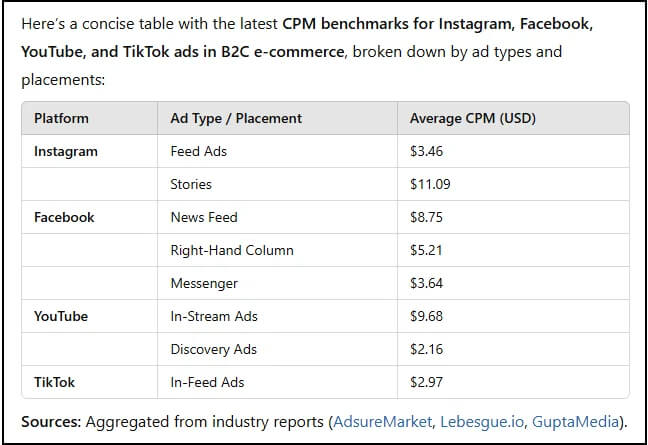
Here are some paid social CPM benchmarks, courtesy of ChatGPT.
(AI didnโt work great for influencer CPMs, but there is more data available on the internet for ads.)

Youโll notice theyโre a lot lower than the ones I gave above.
The two main reasons for this are:
a) In paid ads, production costs are not usually included. When you pay an influencer, youโre paying for everything all in one: planning, creation, and reach. When measuring CPM in paid ads, youโre only looking at reach. No salaries, agencies, production, editing etc.
b) Trust factor. Having your message delivered by the right social media creator is simply worth more than delivering a similar message from your own brand account. The person has worked over months or years to become trusted, and so their voice is more impactful.
2. Not every view is equal
It is entirely possible to have two sponsored videos with the exact same CPM, but drastically different business impact.
Here are some examples of how the value or quality of a view might vary:
The โdepthโ of your brand feature. For example, if youโre in one part of a gift guide where 6 other brands are mentioned - Iโd perceive that to be a lower value view than a dedicated post. Similarly if someone watches a 15-minute dedicated YouTube video, thatโs drastically different than seeing a 30-second integration.
Is the audience broad, or niche? Typically, the broader the audience, the lower the CPM. Sometimes, it will be more valuable to reach a more specific audience at a higher CPM.
Video retention. Especially for influencer marketing on YouTube: how many people actually saw the part where your brand was mentioned?
3. It doesnโt tell you the full picture
Building on the point above, you shouldnโt make decisions on new partnerships or renewals solely based on CPM.
It is a very useful signal (hence, I do recommend tracking it), but it is just one part of a bigger picture.
That bigger picture should include, for example:
- The wider business context. What are you trying to achieve, and how does this contribute?
- Performance metrics. Link clicks, code redemptions, revenue, margin.
- Content value, especially if you have usage rights. Could it be a high-performing ad, or an impactful landing page feature?
- Engagement metrics. Reactions, saves, comments (and comment quality), etc.
- Content longevity. Is that content likely to continue getting more views over time from search?
(This is non-exhaustive, but you get the idea.)
With all of those things in mind โ there might be cases where you decide to renew a partnership that had a way higher CPM than average. It always depends. Donโt get stuck in a box thinking only in CPMs.
3 tactics to improve influencer marketing CPM
A major disclaimer for this section:
โImproving your CPMโ is only a sensible goal in influencer marketing if all the marketing foundations are in place.
(i.e. youโre confident youโre reaching the right people, in the right place, with the right message.)
That said, IF improving CPM is indeed the right goal, hereโs three tactics to achieve it.
1. Negotiate cross-posting where possible in paid partnerships
Cross-posting content on another social platform is usually an easy win for CPM.
For the influencer - they squeeze extra revenue out of the brand partnership with little extra work. For the brand - they get more views for a relatively lower CPM (usually).
(Obviously, this only works if the influencer has โsecondaryโ channels to leverage.)
The most likely cross-post opportunity is with vertical video. Instagram Reels, TikToks, and YouTube Shorts can easily be cross-posted.
For a few more ideas:
- If you sponsor a podcast, the creator can post the clip as a Reel
- A carousel on Instagram could be repurposed to LinkedIn, X, or Threads
- If you buy a sponsored Story, ask if it can be saved in Highlights for ongoing visibility (not really a โcross-postโ, but serves the same purpose: more low-cost views)
2. Focus on deliverables that reach more new people
Some channels & content formats naturally drive more impressions for the same budget.
For example on Instagram, if your goal revolves around CPM, you might choose to invest more into Reels and less into Stories. Since Reels have a broader reach.
On YouTube, you can choose to prioritize integrations over dedicated videos for a lower CPM.
Or, you might choose to invest more into TikTok influencer marketing due to a lower average CPM.
3. Boost via paid ads (whitelisting) for a lower blended CPM
Considering that paid social CPMs are lower, and youโve already paid the influencer fee, then boosting existing content will likely yield lower CPMs vs. adding more new content.
Plus, you get the benefit of having more control over the audience targeting.
The only thing you still need to navigate is usage rights, which might add a recurring cost, depending on the contract.
Hereโs an introductory guide to whitelisting, if itโs unfamiliar.
Keep reading
If you found this useful, youโll find more content like it in three places:
- My personal LinkedIn; I post regularly. Say hi!
- Modashโs free newsletter, Return on Influence, written by Eleni Zoe
- Modashโs blog, ran by Whitney Blankenship, with a wealth of content designed to help B2C influencer marketers to do their job better
Thanks for reading! ๐ซก

.avif)

.avif)