




When brands struggle to find good creators, the problem usually isn’t volume. It’s vision.
There are millions of incredible creators out there – with even more popping up every day.
But if you’re looking for a shopping list of criteria, and only filtering for product-match (people who are already in your niche, or talking about products like yours) – you’re going to hit a wall.
We call it overfitting. We (shamelessly stole) borrowed 💅 the concept from mathematics, and it means when you’re interpreting data too literally to be able to account for outliers or predict the future.
In layman’s terms, it means your influencer search criteria is too strict, and you need to chill out.
Enter, storyfit influencers. They’re those misfit influencers who don’t work on paper but perform surprisingly well.
I’m going to go deeper into what overfitting really looks like, how it affects your influencer search, and teach you how to find those storyfit influencers who are going to help you tell your brand story.
Overfitting boils down to just being too strict about what an influencer needs to have to be considered a “good brand fit.”
It’s when you’re looking for:
The list goes on.
By overfitting your influencers, you are:
For example, let’s say you sell protein bars. If your entire search strategy revolves around “people who review protein bars,” you’re going to be competing in a tiny niche, with every other company that sells protein bars.
Not to mention, you might even end up competing with larger brands who have bigger budgets, more products, and deeper relationships with the creators in that tiny niche.
You’ll fight and scrape and claw for the tiniest crumb of your audience’s attention – who have “seen it all before,” and will instantly compare you to everyone else also selling protein bars, asking themselves, “Right, but why should I care about your bars specifically?”
They’ve already heard your talking points, your brand angles, and the promised outcomes your products provide. They’ve just heard it from your competitor instead.
After all – how many ways can you really sell a protein bar?
Enter, the storyfit influencer.
A storyfit influencer is a creator who can tell your brand’s story in a way that feels authentic to them, and will resonate with their (read: your) audience.
There are three different ways to go about this:
.avif)
Category entry points (or CEPs) are those real-life triggers that make someone think “I could use something like that.”
They’re moments in time where your product is super relevant and timely. They give your brand emotional and contextual relevance – even if the creator hasn’t talked about your product niche before.
Leading with those emotional triggers dramatically opens up the people who are suddenly “a brand fit.”
Let’s circle back to protein bars. You’re not looking for just “people who review protein bars.” You’re not even just looking for “fitness influencers.”
These aren’t markets – they’re moments. And they’re moments that you can use to make your audience the hero of your story, and your product is what they need to complete that story.
Identity refers to creators who represent your customer’s values, lifestyle, or goals – even if they’re not in your particular niche. The idea is to look for an influencer who is your ideal customer profile (ICP).
So, for example, circling back to the protein bar example, a fitness influencer ends up being The Obvious Choice™.
Instead, who needs your product? What are their goals and aspirations?
The idea is that you want an influencer in whom the audience sees themselves. Identity is powerful – because when you make something, or someone part of your identity, that is a hard bond to break.
By going for creators whose identities fit your ICP, you’re integrating your brand into that identity.
This one can be a little harder to pin down. It refers to the influencer’s style of content – which could be their humor, drama, chaos, etc.
The idea is reframing your product in a fresh, resonant way. These are those unique content creators that just got it. That “It Factor” is what makes their audiences stop, watch, absorb, and engage – every time.
So again, instead of going for The Obvious Choice™:
For these creators, you’re pretty much just cutting them loose. They have the creativity to present your product and brand in a way that’s going to resonate with their audiences.
This means less time briefing for you – because you’re just letting the influencer take the reins. And chances are, they’re going to be the best captain of that collaboration.
Developing a storyfit strategy means you’ll reach more creators, and get better, more unique content than simply going for the same creators everyone else is going for.
They may not be in as high-demand as The Obvious Choice™, and if they’re not already working with your competitors, chances are your product and brand will feel more fresh and resonant with their audiences.
Don’t confuse reach with resonance.
Too many marketers get burned because they pick creators based on numbers or vibes – but not both.
You don’t need the biggest name, or the trendiest format. You need someone who moves people, and moves the right people. That’s what vetting really comes down to.
Finding an interesting influencer is only half the battle. Vetting is where you transform your strategy into success.
Put away those criteria shopping lists. They have no power here.
Instead, we’re going to ask ourselves 3 main questions about any influencer:
.avif)
These are the three-layer fit test of storyfit.
Think of this like a tripod. A tripod is only upright with a solid foundation. If you remove any of the three legs, it all gets wobbly.
But, if all three are present, even imperfectly, you’ve got a solid bet. And your job as an influencer marketer is to make solid bets again and again and again.
This is your quantitative layer. You want to measure the actual attention your products might get.
Here’s what you check:
This is the qualitative layer – where the context of a creator's content and targeting matter the most.
Here’s what you check:
Most of the time – an audience is going to make or break a collaboration. If they’re not going to move relevant people, what’s the point?
(Unless you’re that one guy from our survey who targeted the wrong audience location, but ended up promoting the influencer’s content as an ad in the right location – but that feels messy)
This is the emotional layer – it’s where that gut feeling comes in.
Here’s what you’re looking for:
And the most important part: Gut check: Are you comfortable with this person representing your brand?
If not, it’s not a fit.
Influencers don’t have to be perfect on each of these points – but they absolutely do need to hit these minimum three layers. If so, collaboration might make sense for you.
Okay okay – yes. That sounds like some Finance Bro advice. But hear me out.
Influencer marketing is kinda like investing in the sense that nothing is a sure bet. Even an influencer you’ve worked with before who overperformed at the time could have a bad week (or get got by the algorithm).
And if you’re only investing in one kind of influencer, and the algorithm does what it does, or if it doesn’t land, or insert any other variable that could happen, your campaign is going to fall flat.
Investors have a few safe, but predictable and slow growth investments. They usually take a smaller slice of their capital, and put it into something that has bigger growth, but a little more risk. Then, they take a tiny portion of their money and put it into something very risky, but could turn out huge rewards if it does well.
So, think like an investor:
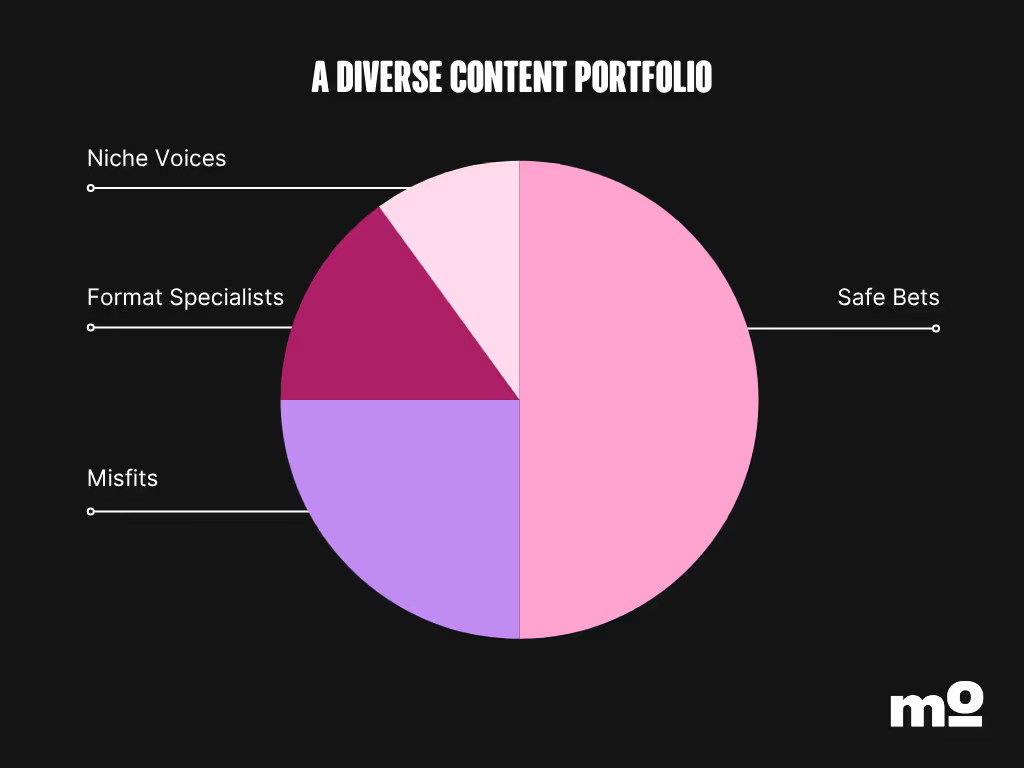
Each creator will bring you something unique – whether it’s reach, engagement, storytelling style, audience trust, etc.
The point isn’t to get every single post to go viral or bring in a ton of revenue. That’s not realistic no matter who you work with. But, you want to build a system where enough of the content will perform well enough to drive consistent, scalable results.
So if 70% of your content performs as expected, 20% over delivers, and 10% flops – that’s completely healthy.
But Whitney, why wouldn’t I just put everything in the safe bets and just be reasonably sure that it’ll all work?
Because you won’t learn anything. And you’ll end up right back where you started, looking for one specific kind of influencer and hitting a wall.
When you diversify your content portfolio, you:
And with a system like that, your overall strategy is stronger, and has a better chance of performing.
What I’ve learned from marketers is that a lot of influencer search and vetting is developing and trusting your gut.
And you absolutely should – but also back it up with a system. You’ll want the numbers to verify that an unconventional creator has legs. Don’t use it as a replacement shopping list – instead, try to find people that are 75% of the way there.
This is where Modash can help. With Modash, you can search for every influencer with more than 1000 followers – and we do mean all of them.
You’ll also get deep data on each creator, including audience demographics, engagement rates, and you’ll even be able to see previously sponsored content – all from the same dashboard. You’ll finally be able to say goodbye to endless scrolling, wondering if this interesting creator even reaches your ideal audience.
But don’t take my word for it. Try Modash absolutely free for 14 days (without even getting out your credit card).