



Autres outils
Cas d'usage



Like Atlas holding up the sky, affiliate programs rely on a layer of infrastructure that stops everything collapsing in on itself – and if you don’t take the time to rebuild that layer before you scale, it’s all gonna come tumbling down 🫠 With that in mind, in this guide I’ll share effective strategies for brands that already know affiliate marketing works for them, and are ready to systematize.
⚠️ Full disclosure: I’ve never actually scaled an affiliate program myself. So for a lot of the more technical and strategic stuff in this article, I’ve leaned heavily on three people with a ton of hands-on affiliate marketing experience, namely:
First, let’s look at what happens when you don’t get the right systems in place before you scale. In a nutshell: stuff starts to break.
Recruitment and tracking are the two biggies.
Gabija notes that sometimes, affiliate tracking just “poofs” and disappears 💨 Plus mistakes happen while copying affiliate links, which throws everything out – and without an effective review process, it might take you days or weeks to notice.
Similarly, she says validating commissions can be a real headache.
If you have a large number of affiliates, it becomes difficult to spot fake sales.

Then there’s recruitment. Melissa explains that if you’re doing everything manually and/or without robust systems, it’s seriously tough to recruit new affiliates while also maintaining strong relationships with the creators who made your program a success.
Another piece of the recruitment puzzle is onboarding new affiliates. Robert says that teaching new recruits how everything works can be tricky at the best of times, but it’s a real problem when you’re trying to scale.
Creators often don't pay close attention to setup instructions. In our case, this probably happens with every second creator we onboard. And the more creators you recruit, the more time you have to spend doing it for them.

🤓 Further reading: Sick of manual recruitment? Check out our roundup of the 10 Best Affiliate Recruitment Software Tools.
The Pareto principle (AKA the 80:20 rule) claims that roughly 80% of outcomes come from 20% of causes.
In other words: however successful your recruitment and onboarding efforts, chances are that just a handful of creators will generate the vast majority of program revenue.
This is a problem, because you don’t want to pin all your scale-up plans on a small group of “super affiliates” (even if they’ve delivered exceptional results in the past), as Melissa explains:
It's important not to become too reliant on a handful of top performers because things can change quickly if they sign an exclusive partnership, start working more closely with a competitor, or become less active.

This issue is exacerbated at scale because, as I (well, Melissa) noted in the previous section, it’s hard to find the time for both relationship-building and recruitment when you’re growing an affiliate program.
Scaling an affiliate program isn’t necessarily the same as hiring a bunch more affiliates.
Sure, if you’re gonna expand, you probably need to spend some time on recruiting the right creators. But there’s no point having 1,000 affiliates on your books if only 100 of them ever post.
Fact is, 60% of affiliate marketers told us that their biggest challenge is “keeping affiliates active”.
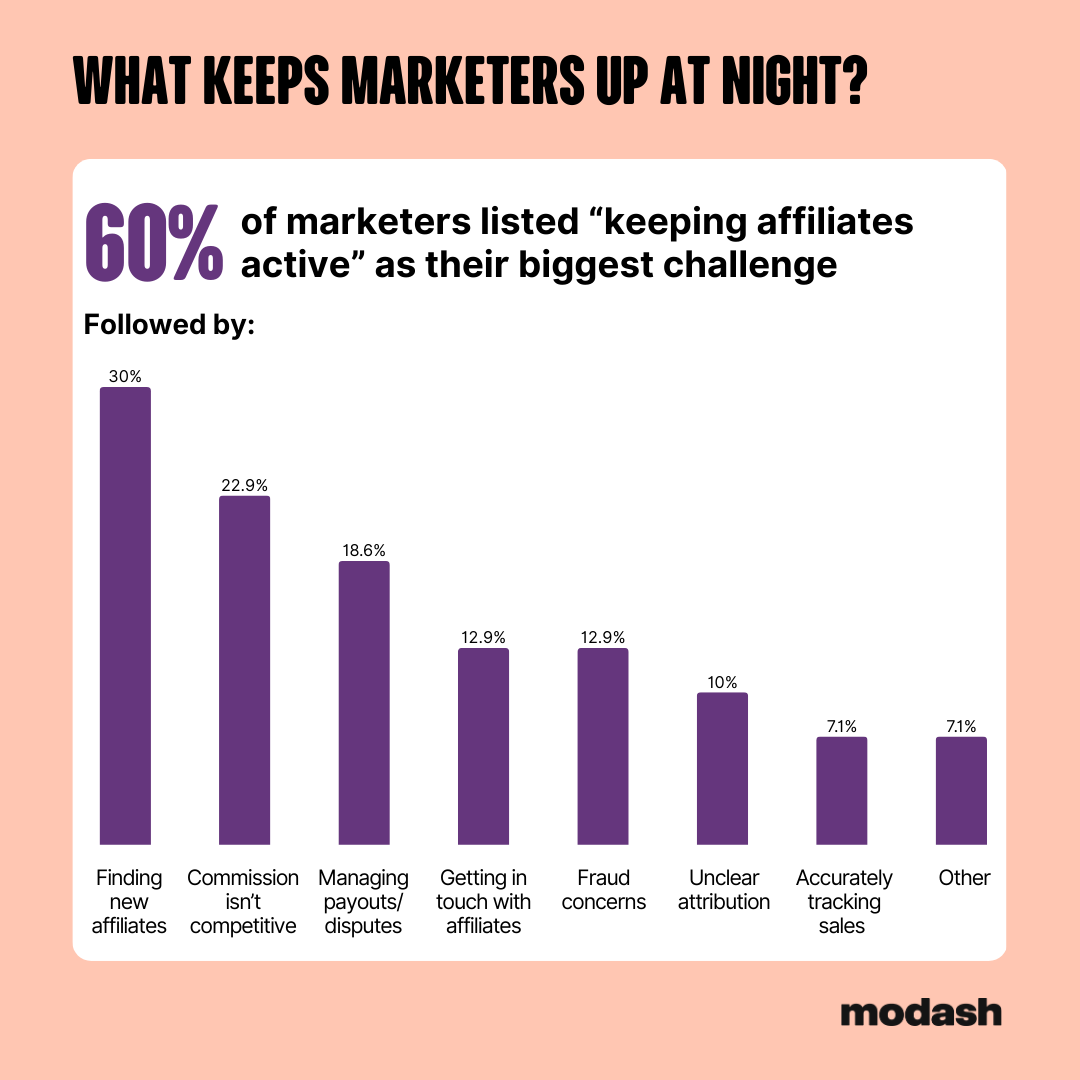
And no wonder, given that over one-third admitted <20% of their brand’s affiliates are active (and by “active”, most mean any creator who posts just once a month).
So remember: your goal here isn’t to recruit as many affiliates as possible, as quickly as possible. Scaling effectively is about growing your pool of active affiliates who are actually sharing quality content and generating sales.
If you’re a household name brand, you can maybe rely on quality affiliates coming to you.
If not, you’re gonna have to get proactive about recruitment to scale your program – and doing this manually is a serious heavy lift. You have to:
Realistically, this way, it might take you an hour or more to find and outreach a single affiliate. So what if your boss says you need 100+ new affiliates onboarded by the end of the month? 🤯
That’s why most brands switch to dedicated creator marketing software before scaling.
With a tool like Modash, you can discover new affiliates in bulk from our database of 380M+ creators (that’s every public profile on Instagram, TikTok, and YouTube with at least 1,000 followers).
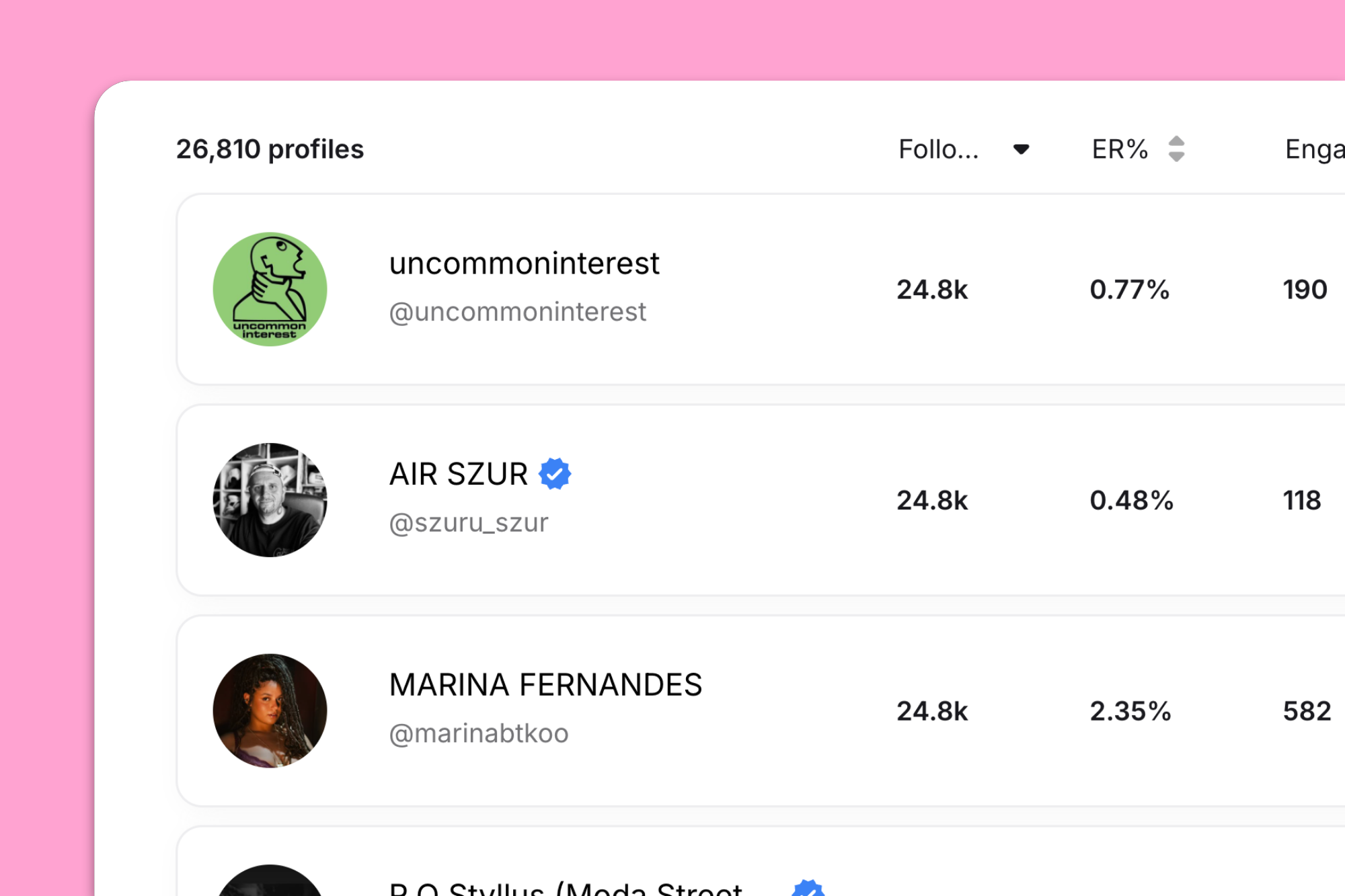
Then you can unlock their email addresses and add them to a personalized outreach campaign with automated follow-ups – so you never have to worry about manually chasing up non-responders.
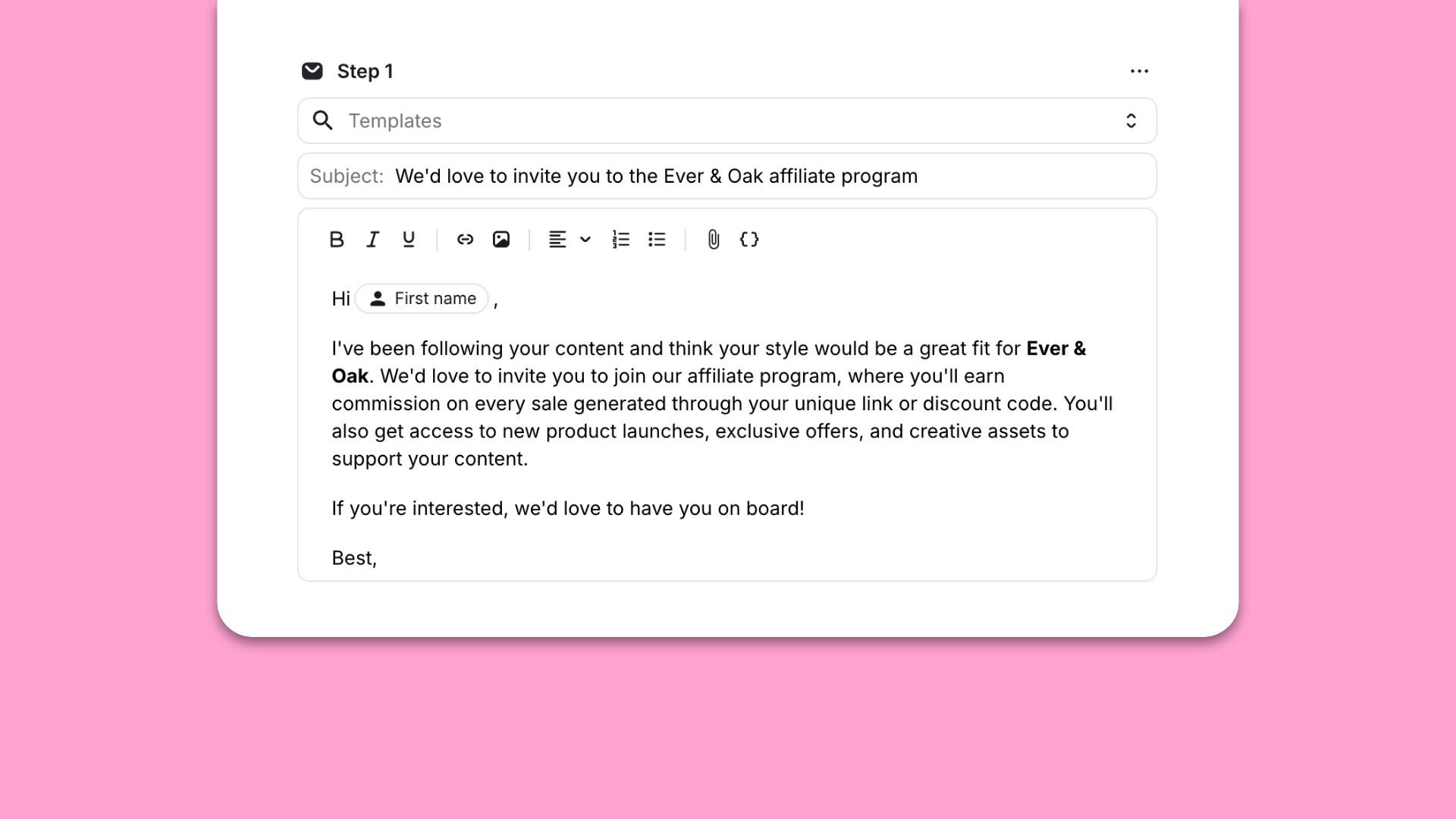
That way, recruitment goes from a labor-intensive 1:1 exercise to a highly scalable and repeatable process.
🤓 Further reading: For more on writing engaging outreach messages, check out How To Do Influencer Outreach: A Guide For Brands.
A cheat code to scalable affiliate recruitment is to hire creators who are already working with other brands in your niche.
They’ve already demonstrated interest in your category, they have an audience that buys similar products, and they’re clearly open to brand partnerships. Plus if they’ve been posting about the same brand over an extended period (say, 2-3+ months) you can safely assume they’re generating sales, too. Otherwise, why are they still doing it?
Fortunately, there are lots of ways to track them down.
(FYI I go into seven effective methods in How to Find Your Competitors' Affiliates, so if you’re looking for an in-depth guide, check it out 👀)
Manual, software-free tactics include:
Each of those approaches is totally viable, albeit a little clunky at scale.
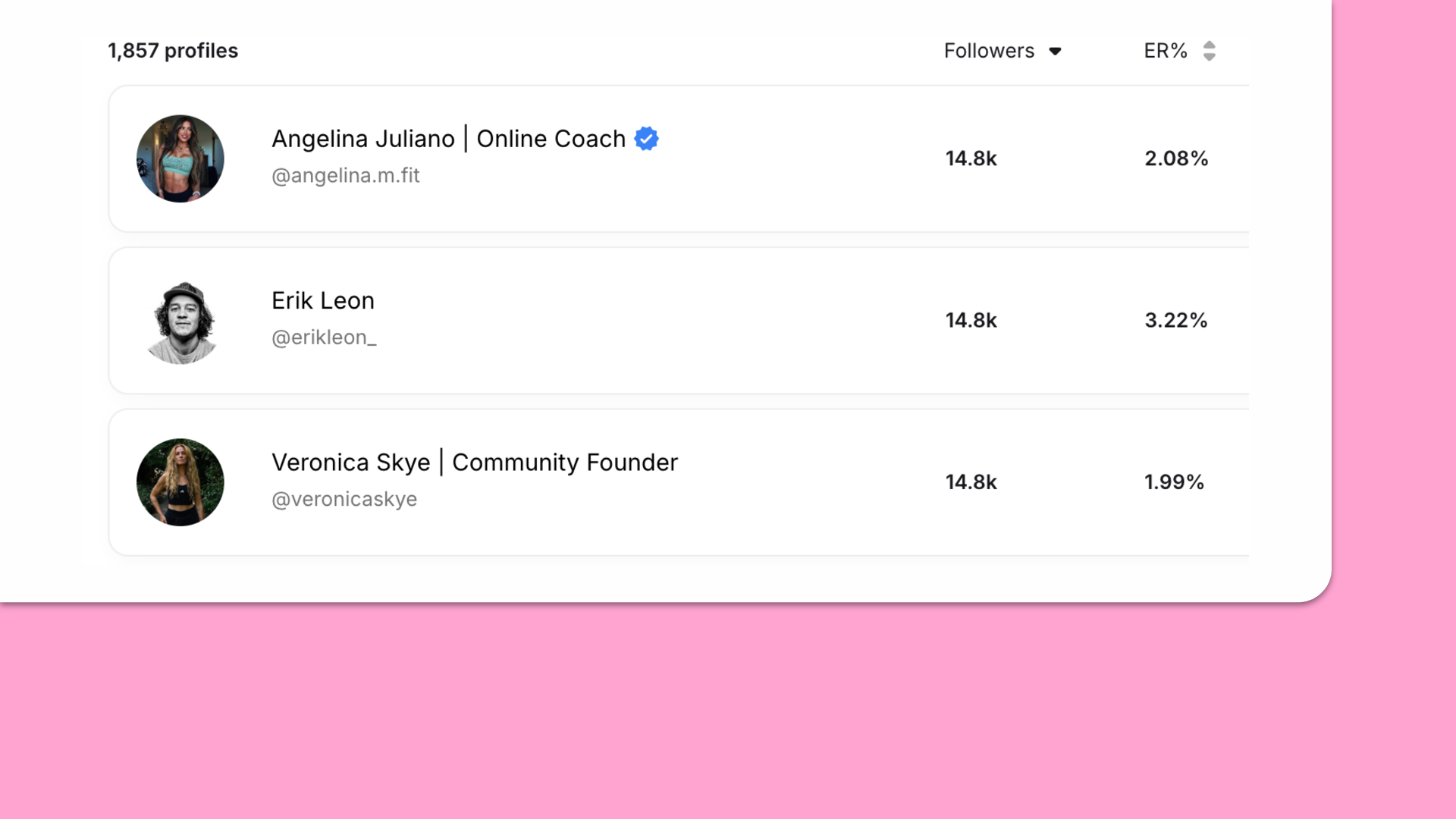
For a more efficient option, use a creator search tool like Modash, which lets you filter by brand mentions and previous collaborations for a quick-and-definitive list of your competitors’ affiliates.
👉 Try all of our affiliate search tools by creating your free Modash account!
While you don’t want to just sit back and wait for high-quality affiliates to join your program, there are ways to make inbound recruitment a little less passive.
One method is to ask people who’ve just bought a product to join your affiliate program. After all, they clearly like you, so why not invite them to make some walking around money by promoting your brand?
Unless you have a super low sales volume, there’s no way to do this manually – you’d be constantly sending emails to new customers. So you’ll need to automate the process by creating a post-purchase email flow including the invite and key program terms (like your commission rate and any other bonuses you offer), then directing your would-be affiliates to sign up on a dedicated landing page.
Realistically, only a small proportion of customers will have a large enough online audience to make them worth recruiting.
But the beauty of this tactic is that once you’ve built your landing page and set up the initial automations, everything happens on autopilot – zero manual effort.
While you don’t want to rely on a half-dozen-or-so high-performing creators to bring in the lion’s share of sales and revenue, you definitely want to make sure that your best affiliate partners are feeling the love.
And one of the most effective ways to do this is by paying tiered commissions, with higher rewards for your top sellers. Modash research reveals that brands with three-tier programs have active affiliate rates close to 50%, compared to 37% for those with flat commission structures.
Okay, so tiers = good 👍 But how much should you pay at each tier?
Well, our research also reveals that the average tiered affiliate program pays the following commissions:
Still, ultimately, you don’t want to rely on benchmarks – you need to customize your own commission tiers based on various factors specific to your brand, including your margins, AOV, and customer lifetime value.
As for working out qualification requirements for each tier, again, that’s kinda up to you. But as a general guide, you want your top tier to be highly attractive yet achievable enough to motivate lower performers.
Because if only your top 0.1% of affiliates are ever going to reach your highest commission tier, you risk intimidating new recruits before they’ve even gotten started.
🤓 Further reading: We go into more depth on commissions and tiers in The Complete Influencer Marketer's Playbook to Affiliate Marketing.
As Robert Polonski pointed out back at the start of this article, onboarding new affiliates can require a bunch of work (and, sometimes, a lot of hand-holding). And while you can afford to manually onboard super high-value creators with big audiences, you definitely don’t want this to be the norm for every new affiliate who joins your program.
In an ideal world, you’d automate the entire onboarding process. That way, you save a bunch of time, while ensuring that every new affiliate starts out on the right foot.
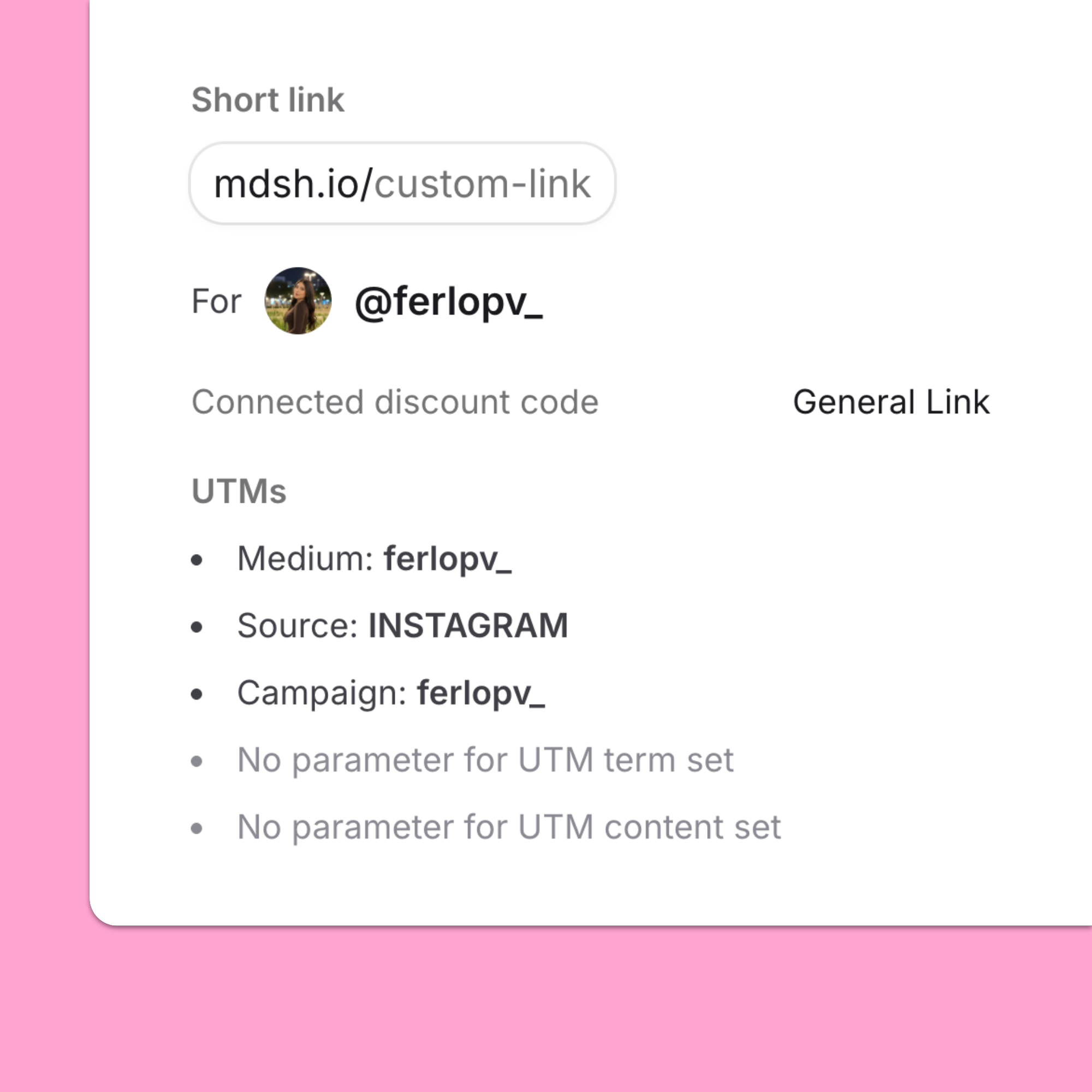
Modash gives you a bunch of tools to streamline onboarding, like automatically assigning connected promo codes at the same time you share tracking links with new affiliates:
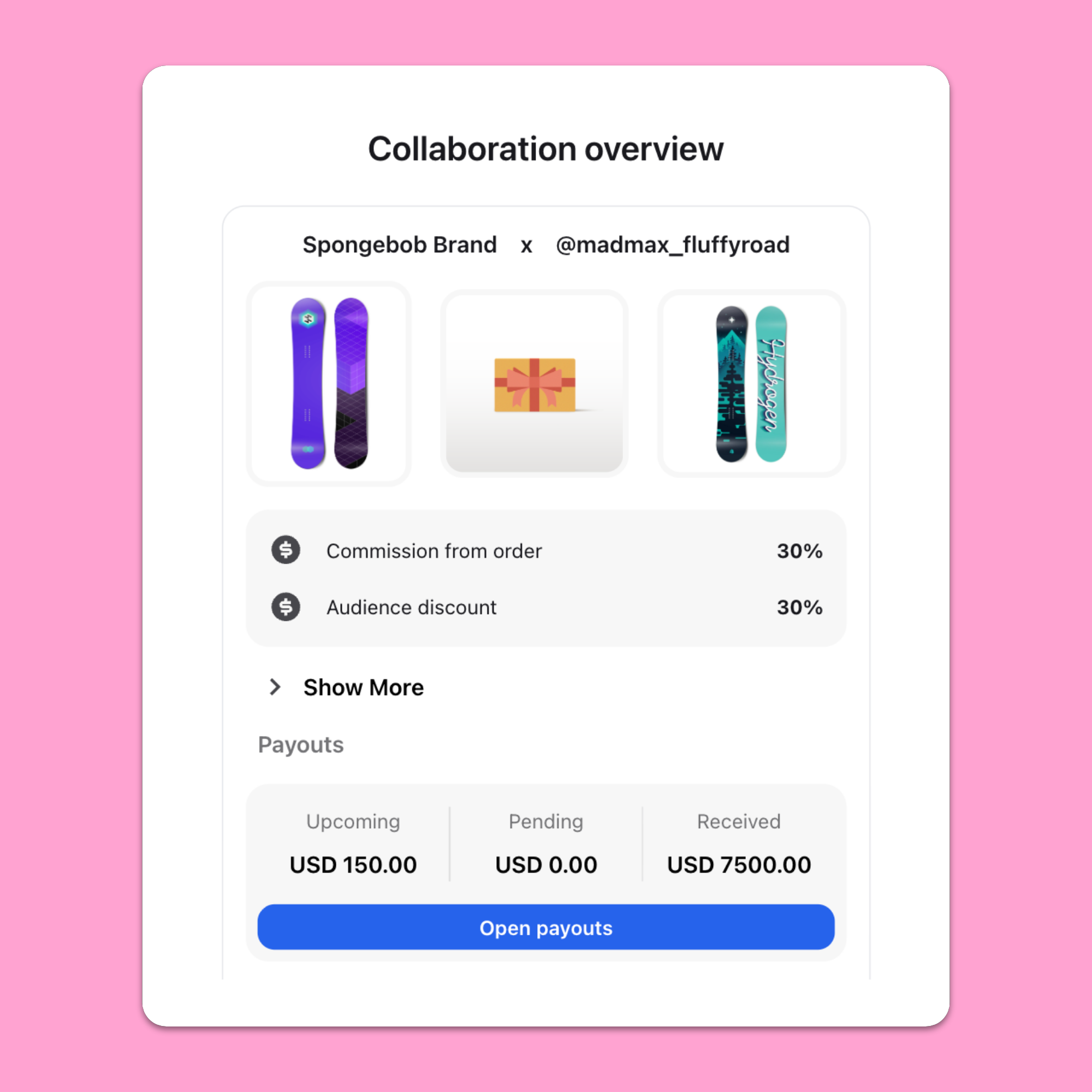
Plus they can find a ton of essentials in the Modash affiliate portal, including commission rates, pending payments, discount codes, and tracking links.
When you don’t have to spend valuable time answering basic questions like “how do I find my affiliate link?”, you can focus on those urgent and/or irregular onboarding queries that actually require your expert attention.
In the early days of running an affiliate program, many brands rely on manual tracking. It goes something like this:
It works for ~5 affiliates. It might even work for 10. But if you’re scaling to 50+ affiliates, fuhgeddaboudit. Honestly, you’ll spend your entire life staring at Excel or Google Sheets, and that’s no way to live.
Far better to let a tool like Modash do all the hard work. If your store is on Shopify, our native integration lets you view per-affiliate orders, revenue, commissions, and more:
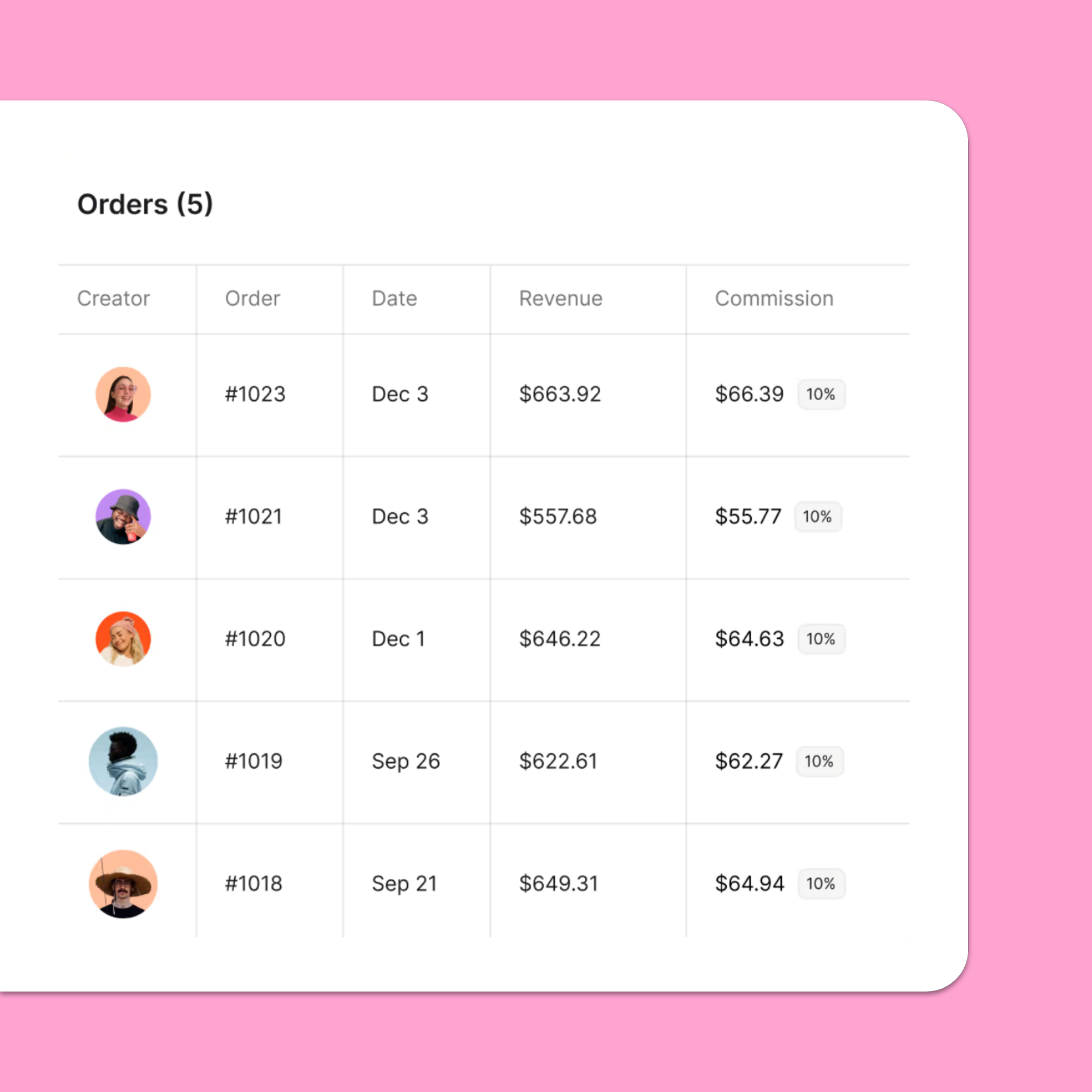
And best of all, it happens within Modash, so you’ll never need to look at another spreadsheet full of promo codes 😅
Running an affiliate program manually takes so much effort that it’s easy to forget about reviewing performance until something goes wrong and you have to dive into the data. But if you’re serious about scaling, you need a consistent review process to help you make smarter strategic decisions.
So what does that look like in practice?
To find out, I asked Gabija, Melissa, and Robert how they run performance reviews. All three recommended running reviews monthly – although Melissa said this should be a minimum expectation, and that in reality, reviews are “pretty much a constant task”. That way, if a creator is on a strong run of content and sales, there’s an opportunity to proactively offer additional incentives or increased commission to keep the momentum going.
The goal of regular performance reviews is to maximize high-performing moments while they're happening, rather than waiting until the end of a month when it’s potentially too late.
As for what these reviews should cover, well, that depends on your internal reporting needs.
For her part, Gabija focuses on key performance metrics such as:
Melissa says she analyzes MoM / YoY performance and key campaign launches to understand which creators, products, and content types are driving the strongest results.
Primarily, she’s looking at the overall success of the program, but with an eye on creator and product trends – are certain products consistently selling well? Are there any surprise bestsellers? Are particular products resonating more than others?
For Robert, things are a little more complicated, because Deeper works with two distinct types of creators – paid influencers and ambassadors (AKA “Heroes”) – on an affiliate basis. So he’s not just reviewing overall program performance, but also how each category of creator is contributing.
He’s also a big fan of comparing results to discover “hidden” trends. For instance, comparing revenue vs units sold helps Robert identify affiliates who consistently sell higher-value products.
This data opens up a lot of possibilities. Like, maybe it’s best to stop investing into low-value sellers and pay more attention towards motivating high-value sellers? Or maybe we need to play around with how discounts are applied to different products?
Paying creators manually is another common barrier to scaling an affiliate program.
Requesting invoices, cross-referencing them against your own sales figures, and chasing your finance team about late payments can quickly become a full-time job. And while you’re bogged down in all that low-value admin, your creator relationships are suffering and your program is stagnating.
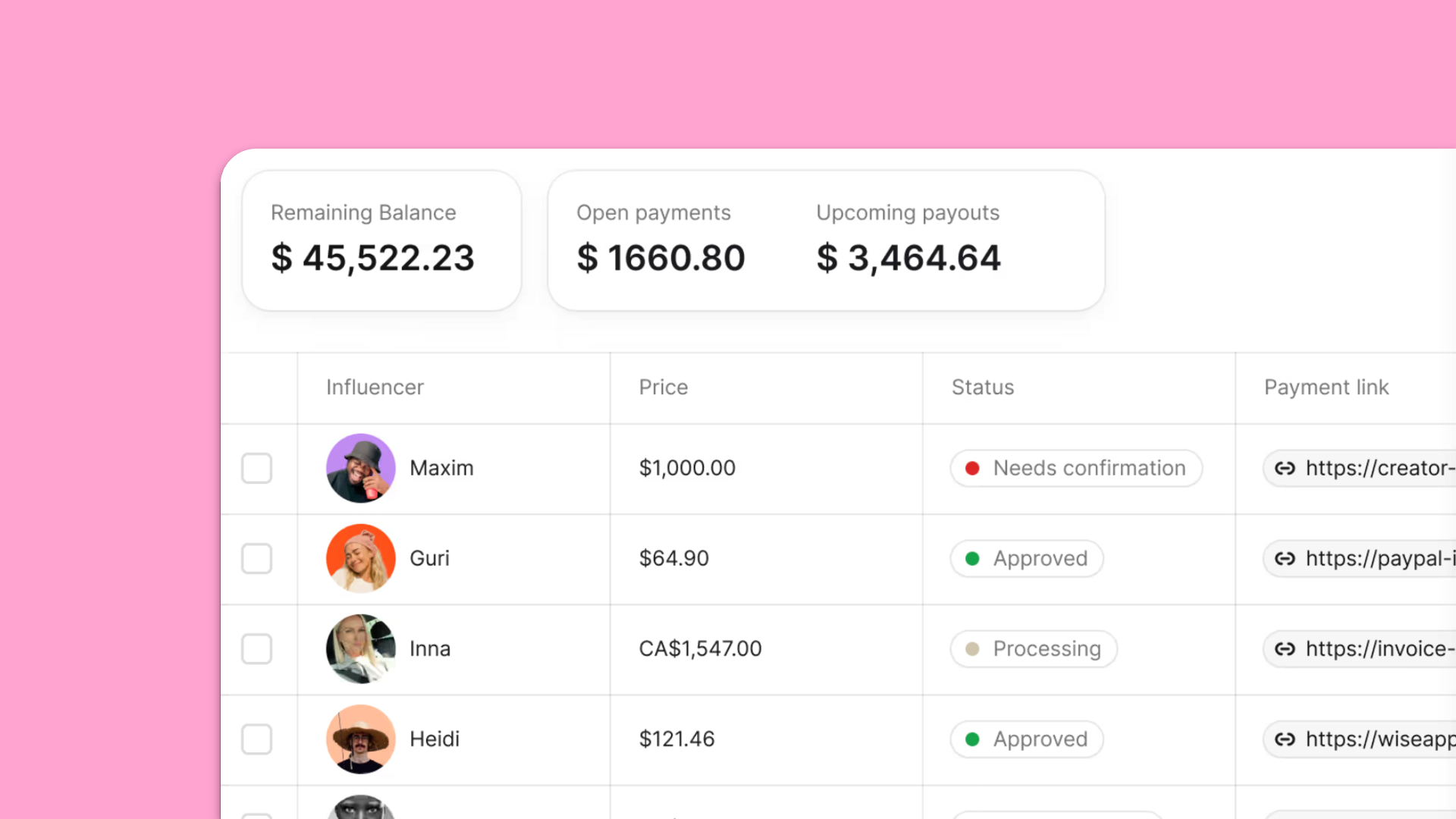
The smart move here is to remove that big old bottleneck by automating payouts. For example, with Modash Pay, all you have to do is send payment links and we do everything else, like:
🤓 Further reading: For more on handling payouts, check out How to Pay Affiliates: Methods, Tools, and Best Practices.
Hopefully, after making it this deep into the article, you’re already clear that affiliate programs need the right systems in place to scale effectively. But there are a bunch of other practical measures you need to address before scaling.
I asked Gabija and Melissa to walk through all their “must-haves” for a ready-to-scale program.
For Gabija, it’s a matter of technical essentials + existing performance.
A program is ready to scale when the technical setup is fully in place and performing reliably, and when you start seeing consistent traction from the first affiliates signing up and generating conversions.
Getting more granular, she’d also want to see the following stuff in place:
Melissa agrees that you shouldn’t look to scale until you’re generating consistent sales and have started using a reliable affiliate platform.
Beyond that, she’d want to ensure that tracking, reporting, and onboarding processes are working as intended – after all, there's no point scaling if you can't properly support new affiliates or maintain relationships with top performers – and that the program has a good mix of creators in place generating organic views across a variety of products.
One more thing: Melissa would also want to firm up future growth plans.
I’d also want to ensure we had a strategy in place for recruiting and growing the affiliate program, with ideally an incentive-based model to continually encourage creators to link.
On the flip side, there are a few red flags that indicate it’s not the time to scale your program 🚩🚩🚩
For Melissa, one of the biggest tell-tale signs is a low rate of active affiliates.
If a large percentage of the programme is inactive, or you're constantly recruiting new affiliates to replace people who have disengaged, I'd focus on understanding why that's happening before investing in growth.
Team capacity is another key factor. If there aren’t at least one or two people who can properly own and nurture the affiliate program, it can quickly become ineffective – and, at worst, even damage the brand.
As the program grows, affiliates need onboarding, regular communication, performance reviews and relationship management. If those things start slipping, top performers can feel undervalued and become less engaged.
Meanwhile, Gabija says technical issues are a key sign a program isn’t ready to scale, especially if tracking hasn’t been properly tested and validated. And she also warns against poorly configured commission structures that overly benefit lower-value affiliates.
If commission groups aren’t set up correctly, coupon or voucher sites can end up receiving higher commissions than intended. This is particularly problematic because they often drive a large share of sales by leaking discount codes, which customers actively search for.
Ultimately, scaling affiliate marketing is about shifting away from all those time-intensive manual processes that helped get your program off the ground, and toward automation.
Once your program runs on autopilot, you can be confident that your affiliate partners are being onboarded effectively, everything’s tracking accurately, and everyone’s being paid the correct commissions (and on time).
All of which frees you up to concentrate on the higher-value actions that are so crucial to driving continued growth 📈
👉 See how Modash can help scale your affiliate program by creating your free account today!