




More tools
Use cases



You’ve spent hours (maybe days?) recruiting a network of brand-fit affiliates, briefing them, answering their questions, sending them free products, tracking their content, and measuring the results… Now you just have to pay them!
Should be easy, right?
But affiliate payments are actually unexpectedly painful and time-consuming. Plenty of marketers lose affiliates (and their own sanity) to a monthly cycle of chasing invoices, reconciling spreadsheets, and manually cross-referencing code redemptions 😩
It doesn’t have to be like that, though. In this article, I’ll walk through how to pay affiliates accurately, on time, and without friction.
For many ecommerce brands, their main reason for starting an affiliate program is to drive purchase intent. So the most logical way for them to pay affiliates is on a per-sale basis – meaning creators earn a commission for referring customers who go on to buy something.
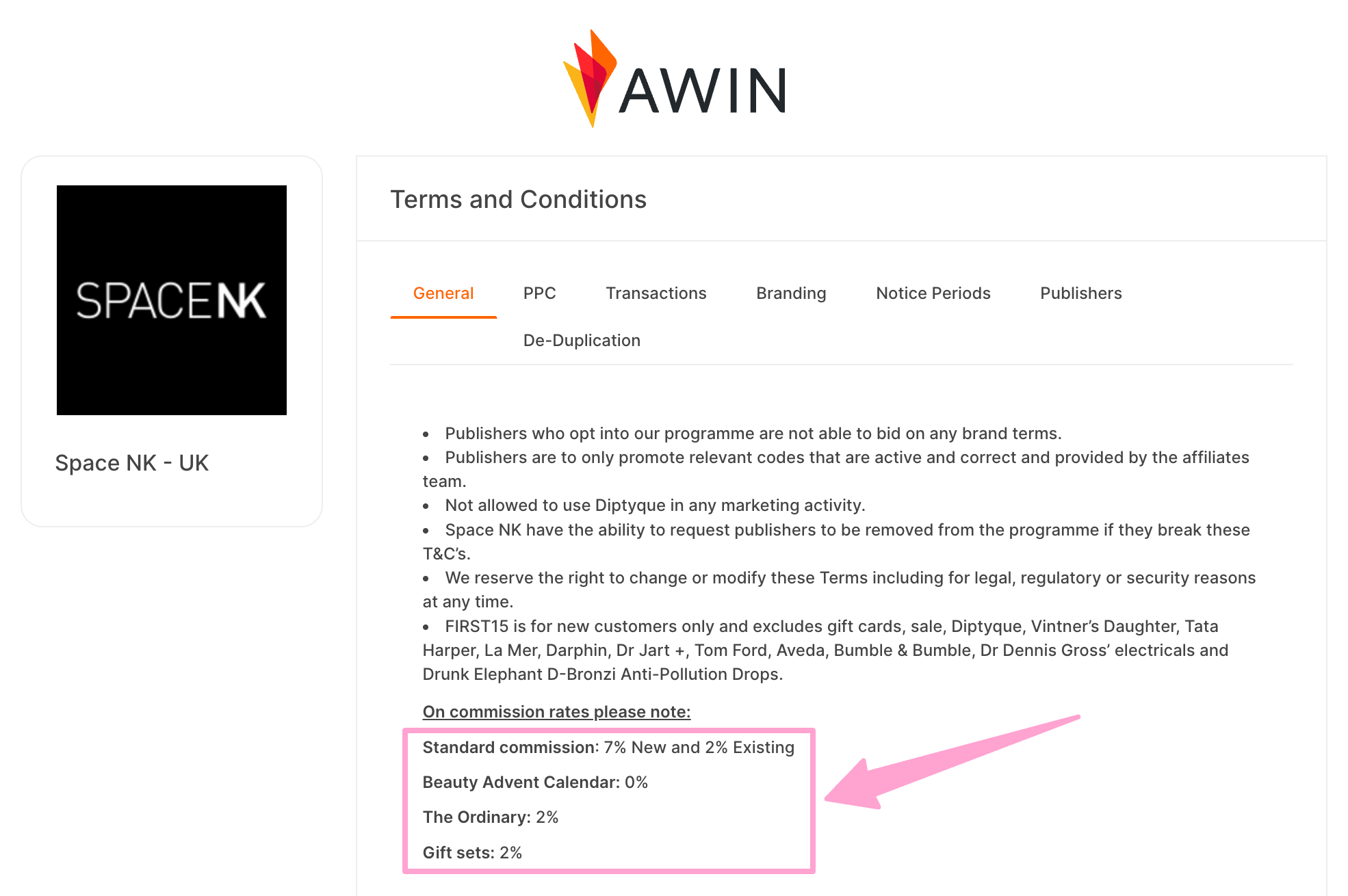
👉 Example: Beauty brand Space NK pays a standard 7% per-sale commission on new customer transactions, with lower rates in place for certain sale types (like existing customer transactions and gift set purchases).
Paying affiliates for generating leads through actions like free trial signups and form fills is super common in industries like finance and SaaS, where margins are higher and/or customer relationships are more valuable because revenue is retained over a longer period. This model is pretty rare in the ecommerce world, although brands might occasionally pay for leads on higher-ticket items (especially if they’re available on finance).
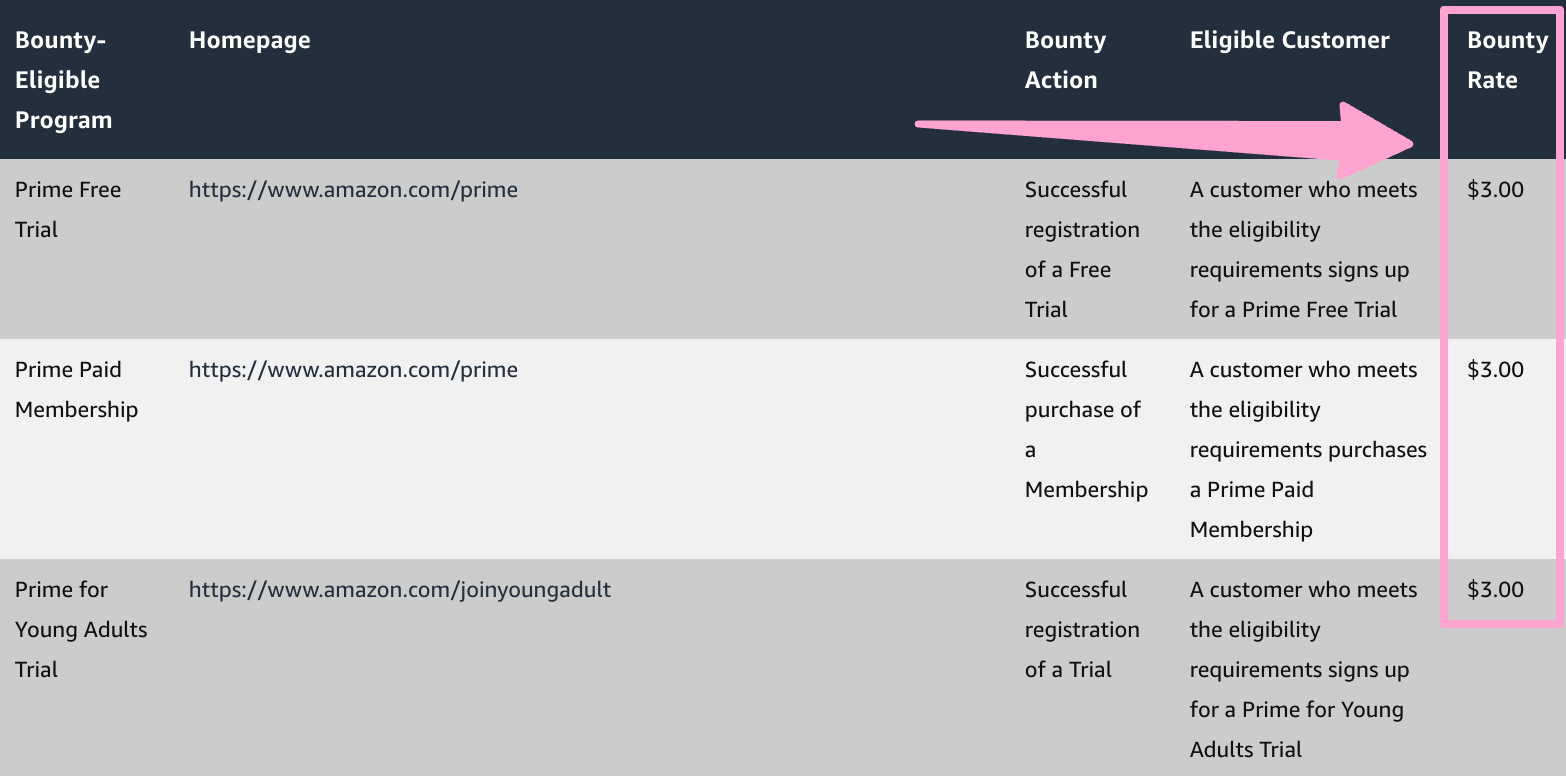
👉 Example: Ecommerce giant Amazon pays lead-based “bounty” commissions for free trial signups on services like Amazon Prime and Audible.
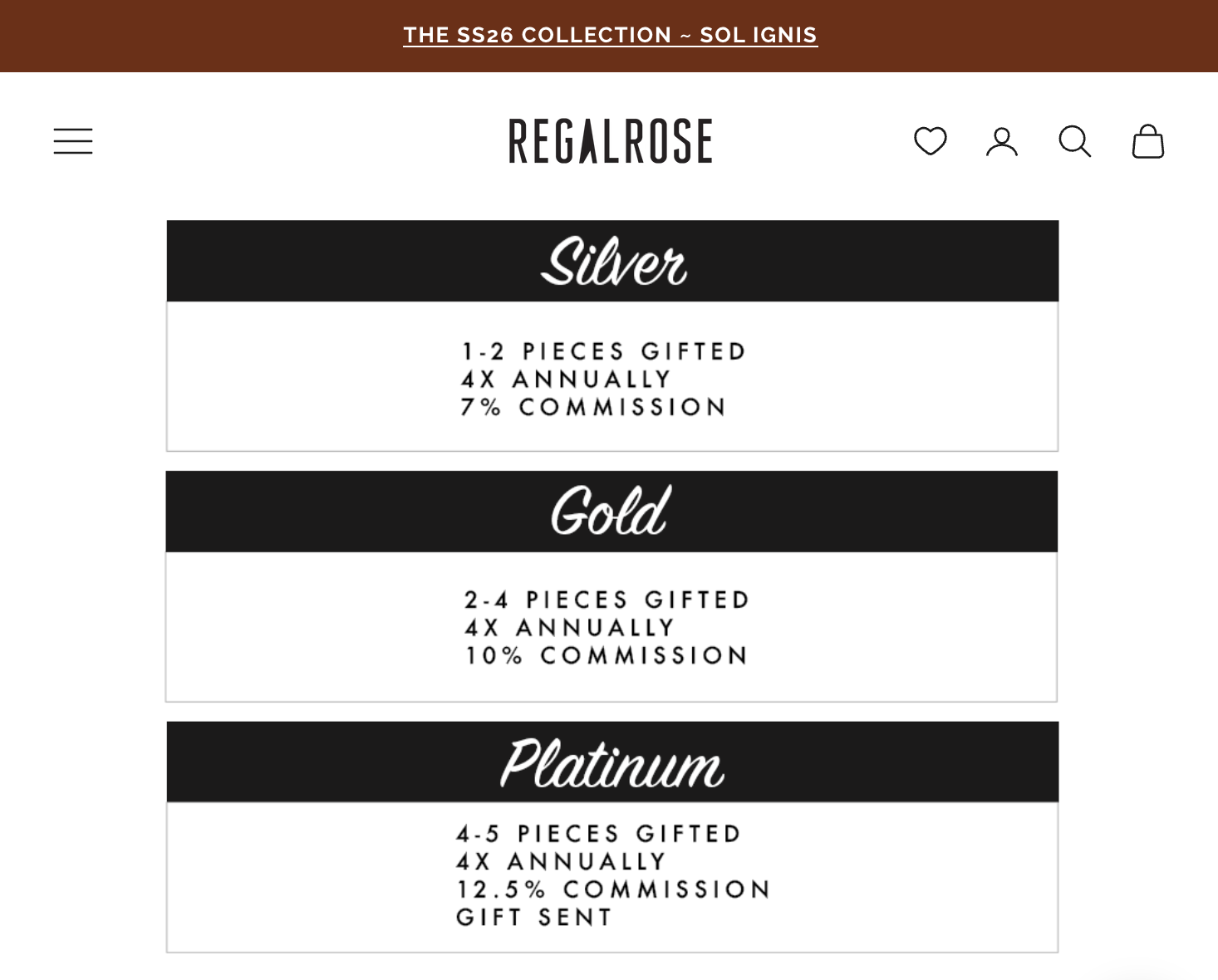
Programs with tiered commission structures typically offer an entry-level rate for “regular” creators, then at least one additional tier for affiliates who hit specific sales targets. This model is one of the most effective ways to reward and retain top-performing affiliates, with Modash research revealing that brands with three commission tiers have 30% more active affiliates than those offering a flat rate.
👉 Example: Jewelry brand Regal Rose has a three-tier commission structure. Rates start at 7% and climb to 10% for affiliates who earn £1,000 in commission within a six-month rolling period, then to 12.5% for affiliates who hit £1,500 in six months. They offer additional free products at higher tiers, while Platinum affiliates also receive an exclusive gift.
Hybrid payment models involve paying a flat fee – similar to a traditional influencer partnership – alongside a per-sale or per-lead commission.
This model is an obvious way to build longer-term relationships with high-value creators who you're super keen to retain. And it can also help with acquiring totally new affiliate partners. A creator who would have declined an affiliate-only deal might be persuaded by a hybrid one – and there are even creators who would push for hybrid themselves because they believe they can earn more that way 💰
Despite these benefits, 55% of affiliate marketers told us that <25% of their influencer partners also work with them on an affiliate basis.
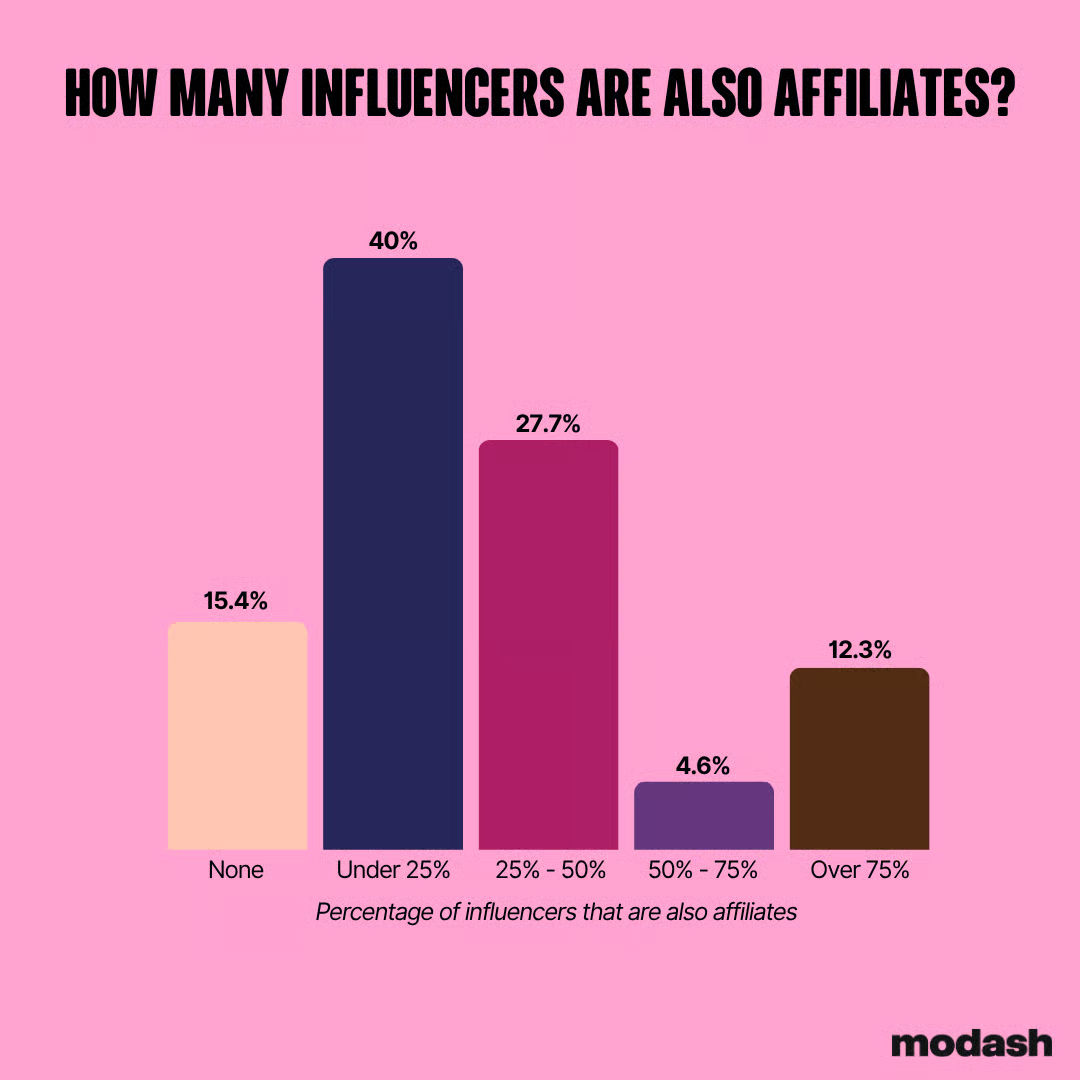
In other words: hybrid can be a real differentiator for your program because a lot of brands aren’t doing it yet!
🤓 Further reading: Dig into the full survey by reading Affiliate Marketing Survey 2026: Why Hands-On Programs Outperform the Rest and check out How to Use Hybrid Influencer Payments to Improve Your ROI.
Beyond the broad payment models I described in the previous section, there are three different structures you can adopt for paying affiliates:
👉 Flat commission rate
👉 Percentage-based commissions
👉 Tiered commissions
Let’s take a deeper look at those structures…
While there are benefits to each approach, if you’re serious about retaining affiliates then (generally speaking) flat rates < percentage commissions < tiered structures. Unlike flat commissions, percentage-based commissions encourage affiliates to promote higher-ticket products and/or larger baskets, while tiered structures are naturally designed to reward strong performance. All of which gives your affiliate partners an added incentive to stick around.
As for setting your commission rate(s), the best tactic is to work backward from your margin. For example, if your net margin is 30%, you can (probably) afford to pay a top commission tier of ~15%, with lower rates for newer and lower-performing affiliates. Ultimately, it’s up to you – if you’re looking for aggressive growth, you might sacrifice a little more margin in return for more attractive (AKA higher) commission rates.
Similarly, there are three different ways to manage timings for commission payouts:
👉 Threshold-based, where you only pay out when an affiliate earns a minimum commission amount (typically ~$50). If the creator earns less than your threshold in a month, their accrued commissions roll over to the following month (and so on until they eventually reach the target).
👉 Time-based, where you pay affiliate commissions after a certain amount of time (say, 30 days after the initial sale). This approach should help you avoid paying commissions on transactions that end up getting cancelled or returned.
👉 Hybrid, where commissions are paid after X amount of time, but only if the affiliate has also hit a minimum commission threshold.
If you’re scaling an affiliate program, it’s essential to pick the right approach for your specific requirements.
Why? Because it cuts down the need for constant micro-payments. Paying 50 affiliates $2.40 each, multiple times a month, is operationally wasteful and incurs higher-than-necessary transaction fees. Far better to wait for a certain length of time to pass, and/or for your affiliates to reach a defined sales target.
There’s another important factor to consider when discussing payout timings – the issue of chargebacks and refunds:
👉 Chargebacks happen when a customer tells their bank that they didn’t authorize a credit card charge, or never received the product, or that the item didn’t fit the description. The bank claws back the money and you lose the revenue.
👉 Refunds are simpler because the customer directly asks you for their money back rather than getting the bank involved. You process the return and the transaction closes.
Chargebacks and refunds affect every brand with an online store – and if you’re running a successful affiliate program, it’s highly likely some affiliate sales will encounter these issues. You can choose to eat the costs yourself, claw them back from affiliates, or split the losses between you and the creator. Of course, having a longer payout timing helps mitigate the risk of overpaying affiliates for these lost sales.
In other words – longer payout windows are generally better for brands. Just be careful to avoid unfair terms that turn off potential affiliate partners. No creator’s going to agree to a $1,000 payment threshold or wait six months to get hold of their hard-earned commissions.
Whether you forget to reward a creator for a legit sale or pay out for a purchase that never actually happened, inaccurate payments are bad news for all concerned. That’s why you need an effective way to track sales and reconcile them before paying commissions.
When it comes to tracking, you’ve got two main options:
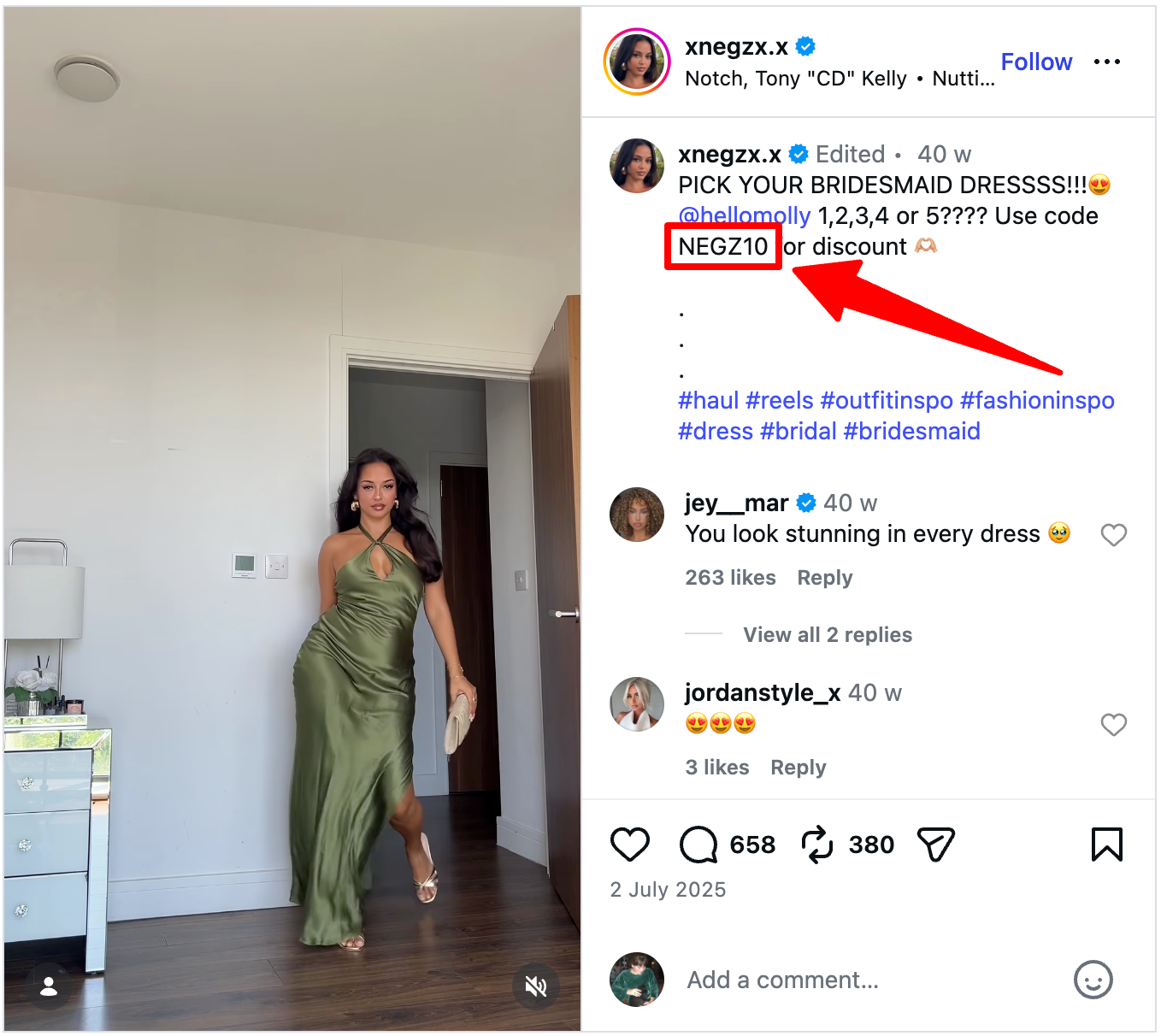
👉 Promo codes: Also called “discount codes”, these are unique to each affiliate. When a customer submits one of these codes at checkout, they receive a discount, and the transaction is tracked back to the affiliate who referred them. Here’s an example from Instagram influencer Negar Aghaei:
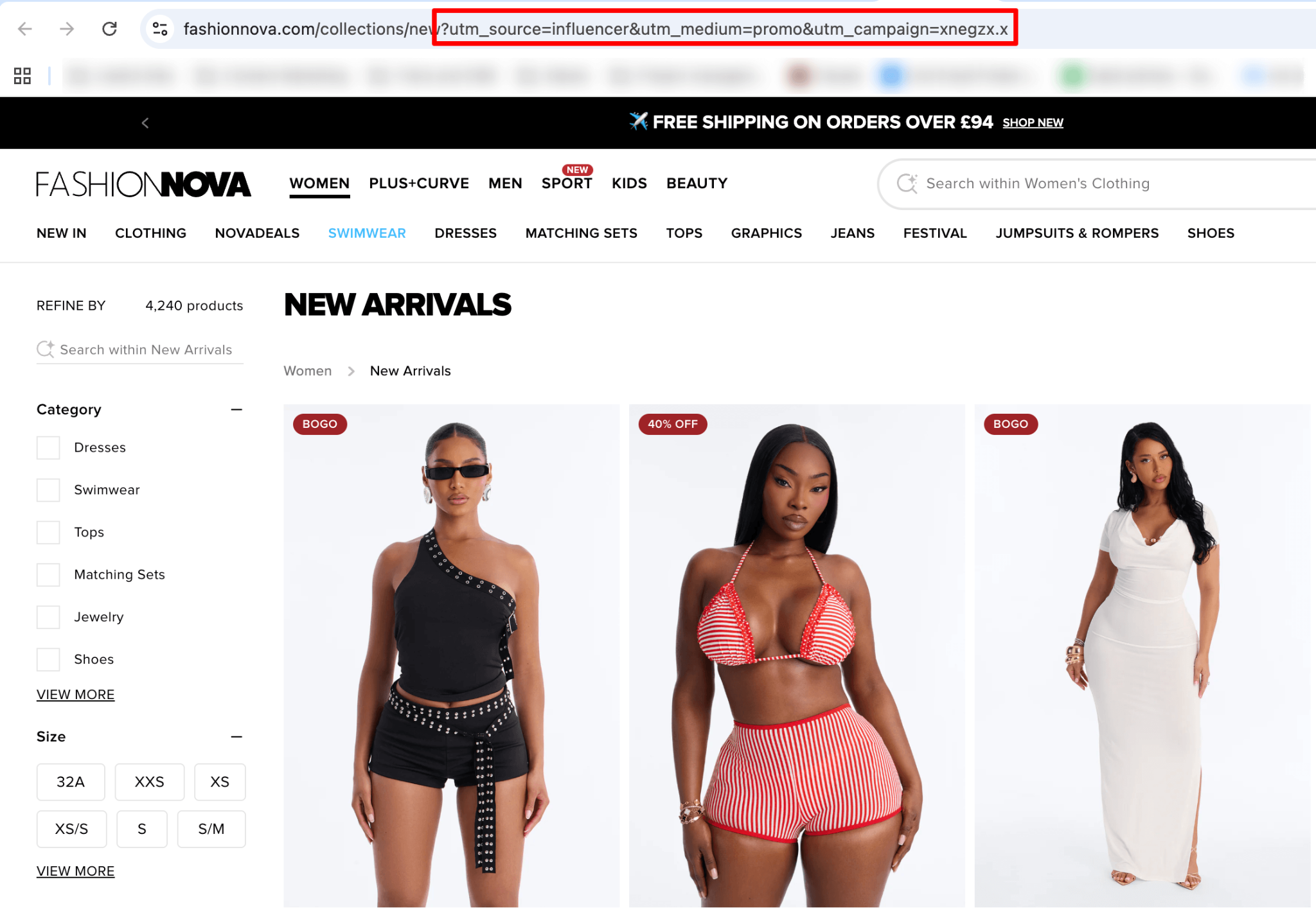
👉 UTM links: These are custom URLs that help analytics tools understand where a click originated. Again, they’re unique to individuals, so they’re useful for showing which creators are sending most traffic to your store. Here’s a UTM link from one of Negar Aghaei’s campaigns on the women’s fashion store Fashion Nova:
But tracking on its own isn’t enough; you also need some way to tie all those link clicks and code redemptions to specific transactions and affiliates. Doing this manually involves spending hours reconciling everything in a gigantic spreadsheet – rather you than me.
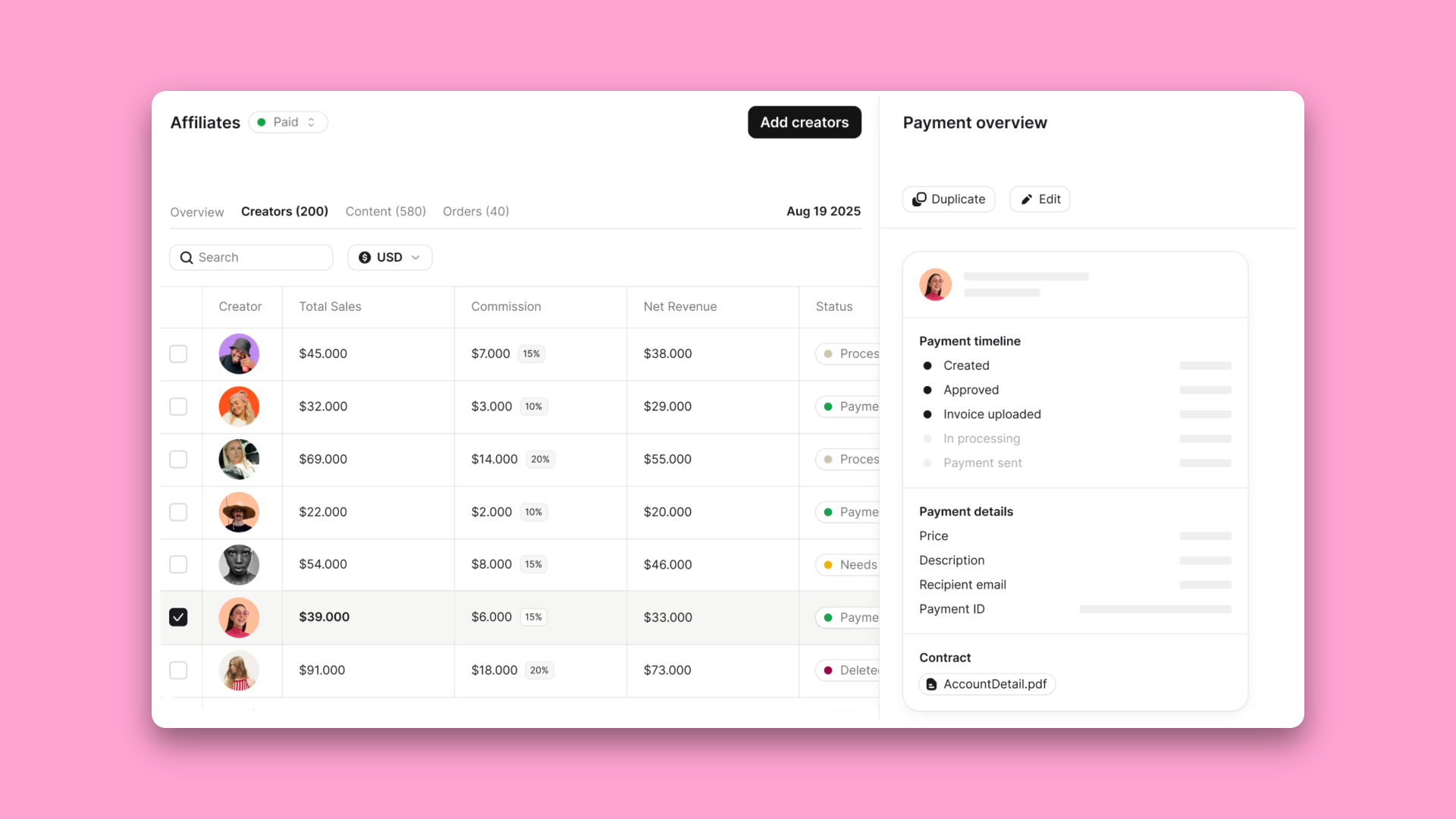
Or you can save a ton of time with an affiliate marketing platform like Modash, which automatically ties codes and UTM links to Shopify sales – giving you all your per-affiliate revenue in a single view 😎
At this point, we need to talk about attribution, or the system that dictates which creator gets rewarded for a sale.
This sounds easy on the face of things – customer sees affiliate content > clicks link > buys product > affiliate earns commission – but what happens when multiple creators are involved in the path to purchase? Should you reward the affiliate who first turned the customer onto your product (AKA first-click attribution), or the one who finally closed the deal (last-click)? Or do they both deserve a cut of the commission?
Complicated stuff, and there’s no univeral solution.
You’ll also want to consider the length of your attribution window (AKA cookie window, AKA referral window), which is the timeframe after a potential customer first clicks an affiliate link during which the specific creator is eligible to earn a commission if/when the customer eventually buys something.
These vary widely, with the shortest only lasting for a single browsing session and the longest running to 365+ days. Some programs even offer a lifetime attribution window.
Unsurprisingly, longer windows are more attractive to affiliates, but might lead to you paying commissions for sales that happened weeks or months after the customer first saw the creator’s content.
🤓 Further reading: For more on tracking sales, check out 12 Best Affiliate Tracking Software Tools and How to Report on Influencer Marketing (+ Templates).
You can pay affiliates any way you want – iTunes vouchers; bullion; their bodyweight in Werther's Originals – but most brands use one of the following methods:
👉 PayPal
👉 Bank transfer
👉 Stripe
👉 In-platform via affiliate software
There are pros and cons to each:
I can’t tell you which to choose – I barely even know you. There are far too many variables at play to give a blanket recommendation, from the level of flexibility you require to whether your affiliate partners are predominantly domestic or international.
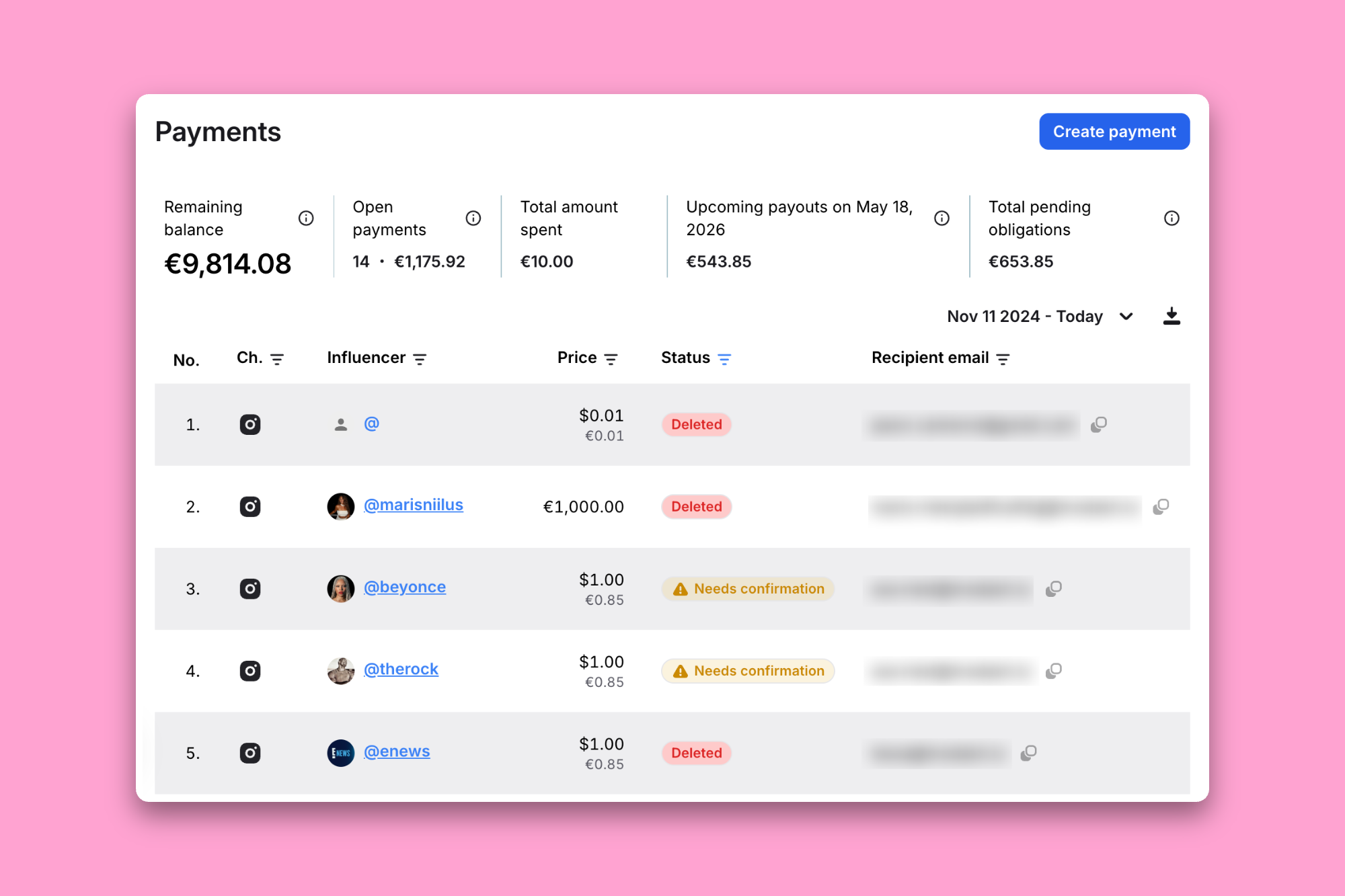
But I can tell you that Modash Pay, our proprietary payments solution, lets you pay creators in 36 currencies across 180+ countries, with zero invoicing required. Plus we handle all your tax and regulatory compliance.
Everyone loves getting paid, but no one likes dealing with invoices. So it’s in your best interests to spend as little time on invoicing as possible by eradicating the constant back-and-forth between your affiliates, your finance team, and you.
There are various best practices to help you do this manually. For example, you can:
👉 Share clear invoice submission guidelines so affiliates know who to send invoices to, in what format, and what information they need to include.
👉 Manage expectations around payment times so your affiliate partners have a decent idea when they’re going to get paid, reducing the need for them to chase you up.
👉 Optimize your approval process to clarify who’s responsible for signing off invoices.
👉 Proactively communicate around disputes and delays to build trust with affiliates and set clear expectations.
But even if you do all that (and more), you’re still going to have to deal with some level of to-ing and fro-ing. That’s invoicing babyyyyyyy 🤷♀️
The alternative is to handle payments through a platform like Modash. With Modash, you send a payment link, then creators add their details and generate automated compliant invoices.
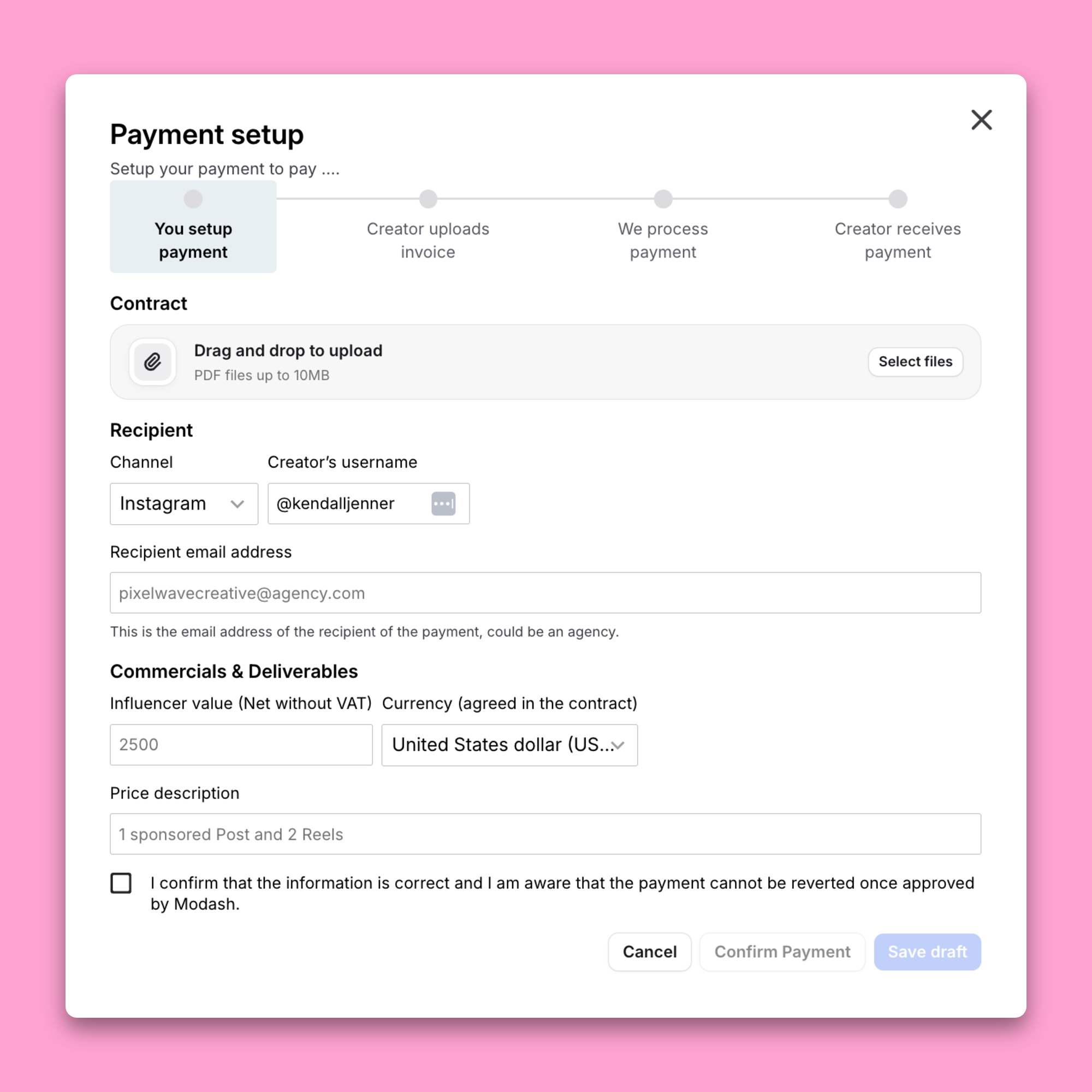
Your finance team receives a single consolidated invoice for all payments, while your affiliates can check their payment status themselves – so they’ve got no need to chase you up. Think of all the time you’ll save 💅
Like with anything financial, you’ll want to keep accurate records about past affiliate commission payments. That way, you can:
👉 Quickly resolve disputes around previous conversions, payouts, refunds, and adjustments
👉 Support your accounting, tax reporting, and financial reconciliation processes
👉 Build trust with affiliates by sharing clear records of past commissions and payments
If you’re handling affiliate payments manually (AKA without dedicated software), your only real option is to keep a folder full of previous invoices. Make sure to use a consistent naming protocol to help you find old invoices when you need them – something like: [Affiliate’s name] + [Invoice period]
(You can also add other parameters, like the name of a specific campaign, if you like.)
This process is effective enough in smaller volumes. But at scale, it results in a whole lot of filing.
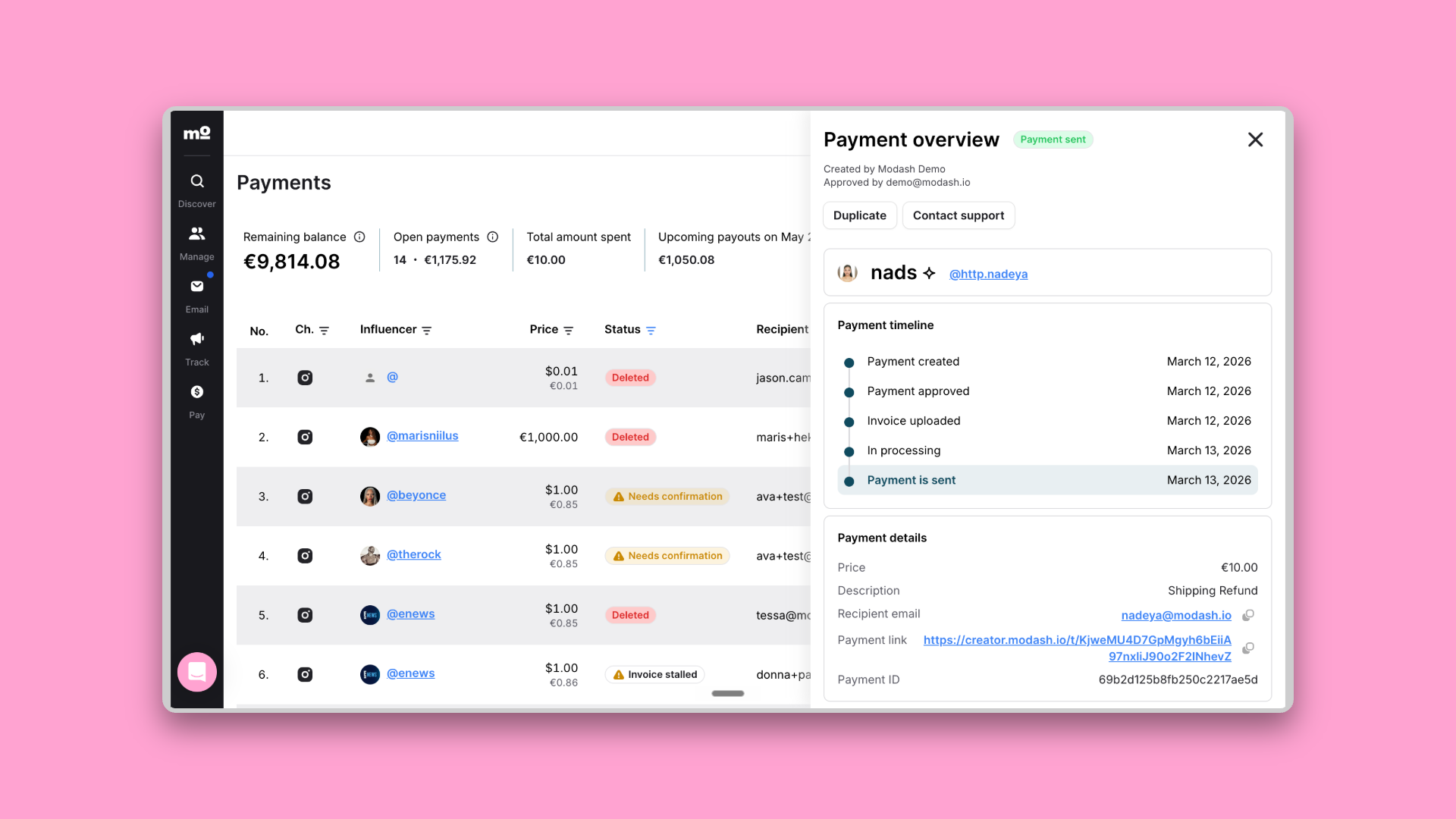
For a more efficient solution, use Modash, which keeps up-to-date per-affiliate records on lifetime earnings, commissions paid to date, and outstanding balances.
👉 Check out all our payment tools by creating your free Modash account – no credit card required!
While there are few one-size-fits-all solutions in affiliate marketing, paying affiliates monthly is pretty standard practice.
Gabija Jankauskė, Affiliate Marketing Manager at PartnerGap and former Influencer and Affiliate Marketing Manager at Son de Flor, says that in her previous role they paid affiliates manually, so processing payments at the beginning of each month simply “seemed like the best option”. And Robert Polonski, Media Partnerships Manager at Deeper, explains that monthly payments are the optimal timing for them – although he notes that any locked payment period offers control over timings.
If we have a locked date by when each month's commission must be paid out, it makes it easier for both parties. The creator has less stuff to worry about and we have a stable movement of budget.

Long story short: legal and tax requirements can vary significantly from country to country. For example, Gabija notes that in Lithuania, the State Tax Inspectorate requires brands to know a bunch of information about their affiliates – name, surname, address, phone number, even date of birth – so creators are asked to provide all these details when signing up for an affiliate program. Robert adds that Deeper’s agreements rely on creators taking care of the taxes on their end.
This usually means that we need creators to either have a registered business or other form of work that allows them to invoice us. This is most likely the smoothest way for partnerships to work, as creators can take into account the final cost for them to operate, and present their pricings to us accordingly.
While there’s no universally agreed minimum, the most common thresholds range from $10 – $100 (or the same amount in euros). New programs and/or brands in highly competitive niches might set lower thresholds to attract more affiliates, while in-demand programs may have higher limits.
Paying affiliates almost always involves some kind of invoicing. However, if you use an affiliate marketing platform like Modash, compliant invoices are generated automatically – all you have to do is share a payment link with your affiliate partners.
Lots of payment solutions offer ways to pay international affiliates in their native currency. For example, PayPal lets you send money to people in 110+ countries and 25 currencies, while Modash supports payments in 36 currencies and over 180 countries.
Most brands have to deal with the occasional dispute around commission payments. The best solution is to maintain accurate records around sales and commissions so you can deal with the query by checking over past invoices and transactions. Modash keeps per-affiliate records of lifetime earnings, commissions paid to date, and outstanding balances. Plus creators can check the numbers themselves via their affiliate dashboard – so they shouldn’t need to dispute their payout amount in the first place 👏