



More tools
Use cases



There are various ways to track affiliate sales – links, codes, pixels – yet each has limitations that turn into serious headaches at scale. But this article isn’t designed to scare you 👻 Rather, it’s about helping you build a more accurate setup by walking through each method honestly and highlighting where it breaks.
Your affiliate shared a 🔥 post. You know because you’ve seen it. And you also know that you’ve generated a bunch of affiliate sales.
Trouble is, what happens between those two things is kinda murky. Like one of those old-timey world maps that substituted entire continents for the words “here be dragons”.
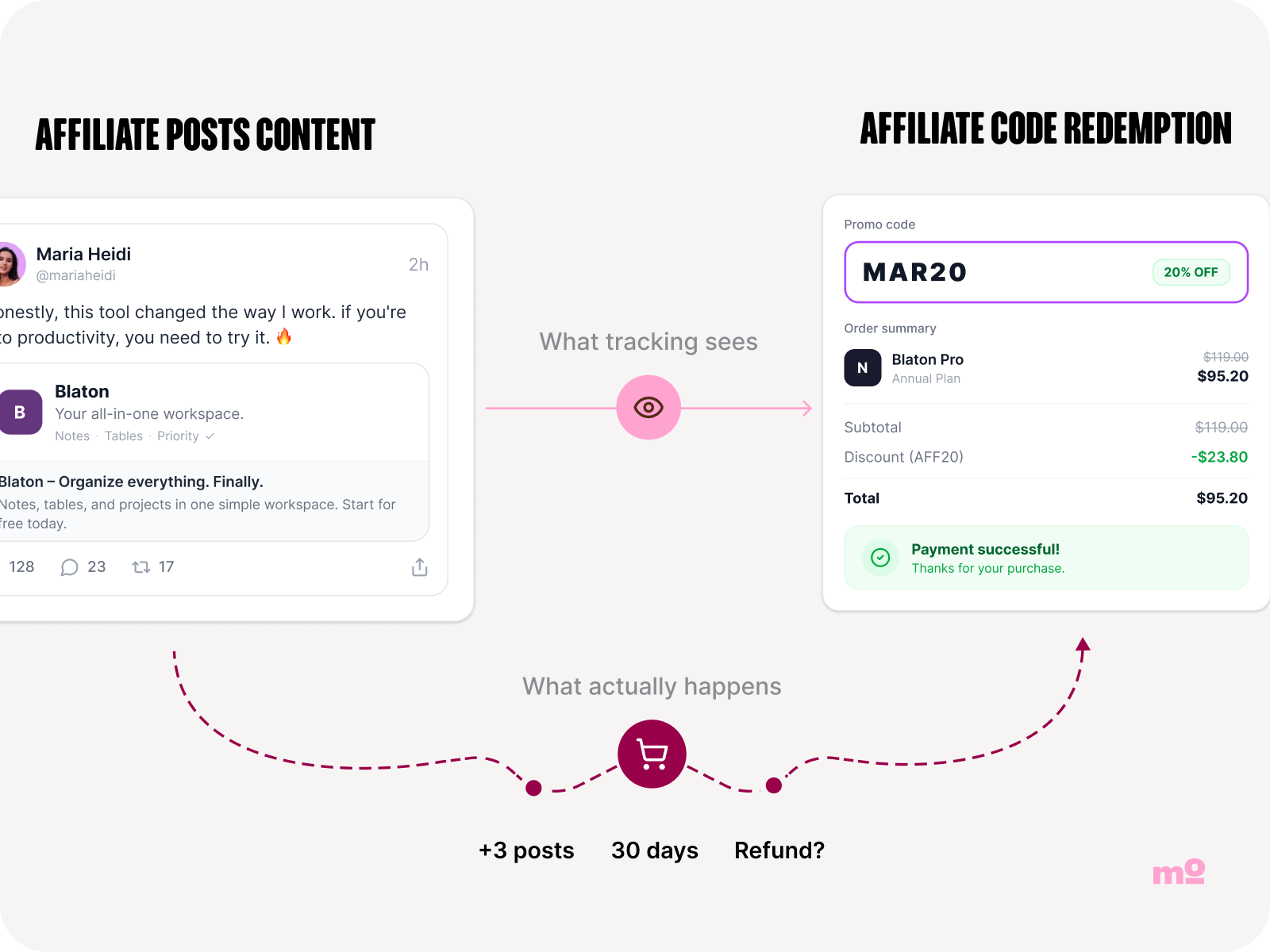
In a nutshell, this is the problem with tracking affiliate sales. And it’s a big problem, because if you can’t tell your board exactly how your creator program is contributing to the bottom line, you’re gonna struggle to keep hold of your budget.
Inaccurate tracking isn’t just a problem for your own reporting. It also risks damaging relationships with the most important people in your affiliate program: your creator partners.
Unfortunately, ecommerce platforms and creator marketing tools don’t always track sales in the same way. There might be differences in attribution windows, or perhaps the affiliate marketing software doesn’t account for refunded or cancelled orders.
The upshot is that the affiliate sees 50 code redemptions at their end, while the brand’s ecommerce software only shows 45. Which inevitably leads to arguments about commissions and a general erosion of trust.
🤓 Further reading: Using Shopify as your ecommerce platform? Check out our dedicated guide to Shopify affiliate tracking, including how to set it up yourself.
You need an accurate method that tells you which affiliates (and posts) are driving traffic to your store, and which of those clickers go on to convert. So what does that look like in practice?
I put that question to three real-world affiliate marketers who’ve been there, done it, and tracked the sale of the T-shirt:
Their answers reinforce the point that there’s no single, perfect way to track affiliate sales.
For his part, Robert relies on an affiliate tool for tracking via promo codes:
The software is integrated into our ecommerce platform. As soon as a purchase is made with the creator’s code, we know the code was used, when it was used, what was ordered, and how much commission our creator has to be paid.

On the flip side, Gabija says affiliate links are the way to go because they eradicate the issue of promo code sharing (more on this later):
Our promo codes leaked so fast, so using unique affiliate links exclusively is the most effective method.

Melissa, meanwhile, notes that the tracking process gets a whole lot easier when your creator marketing tool and your ecommerce platform play nice together:
While no attribution model is ever perfect, having a platform integrated with Shopify (or whichever ecommerce platform you use) gives you confidence in the data and allows you to track performance at both creator and content level.

First up, let’s look at affiliate links. Brands assign unique links to each affiliate in their program because those links contain what we call UTM parameters. When someone clicks the link, these parameters help the brand to understand where the click came from.
For example, here’s a YouTube video from creator Leigh Fuge promoting Gear4music’s Hartwood Drifter guitar, featuring an affiliate link in the video’s description…

…and here’s a closer look at some of the UTM parameters in that link showing Leigh’s YouTube channel as the source of the click:

👎 iOS cookie blocking: Tracking via affiliate links relies on cookies to determine attribution. Trouble is, cookies now get blocked on iOS by default, so clicks/sales from Apple phones and tablets may not be attributed correctly.
👎 Complex paths to purchase: Cross-device journeys can break attribution. So if a shopper clicks an affiliate link on their phone but purchases later on desktop, the conversion won’t be tracked back to the original creator.
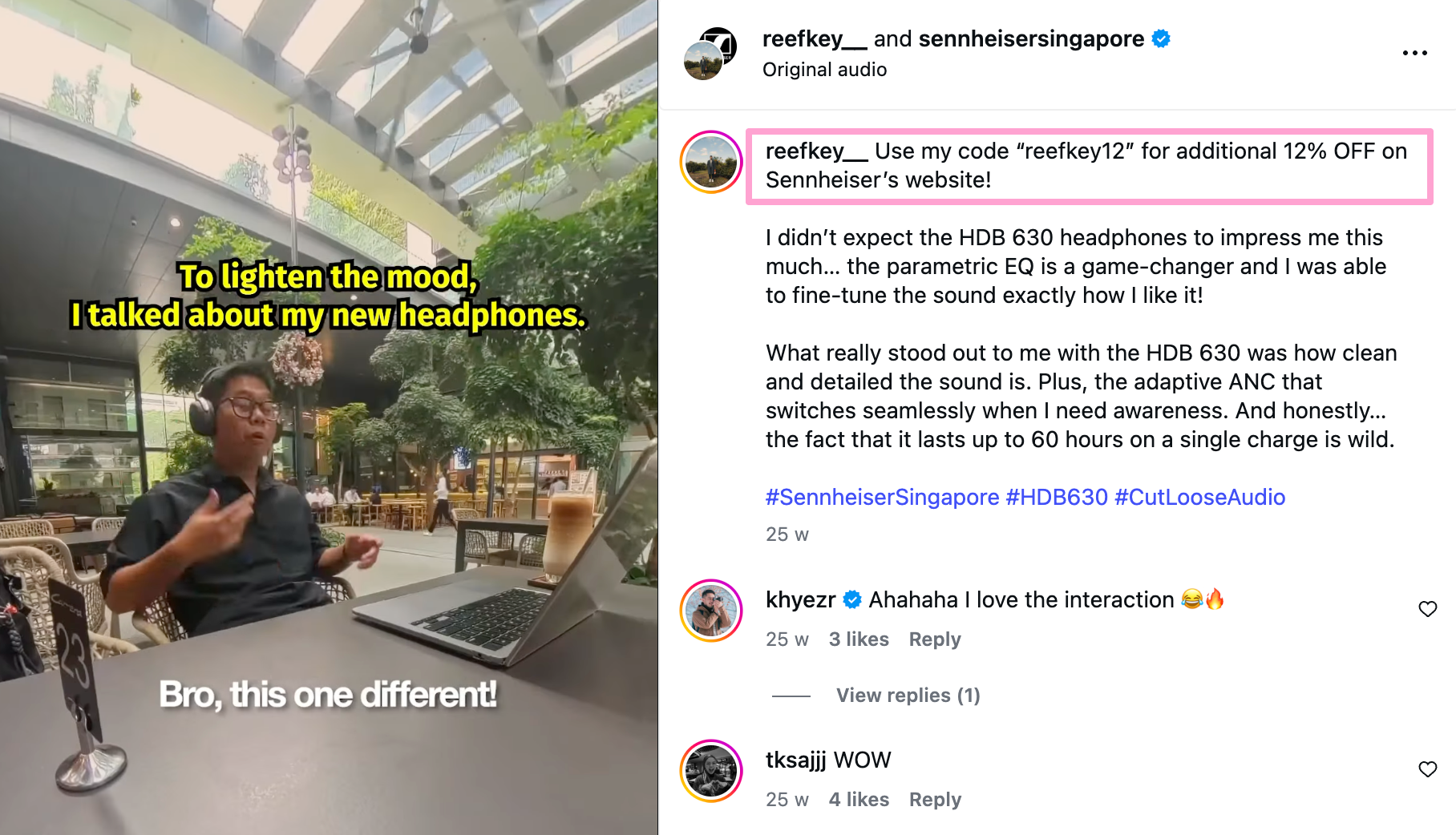
Along with affiliate links, discount codes are the most common way to track affiliate sales. Again, each creator gets their own unique code; when a shopper enters that code at checkout, they receive a discount and the creator gets credited with the sale.
Here’s an example of a discount code from Sennheiser affiliate Muhd Rifqi:
👎 Code sharing: Affiliate codes get shared publicly (or leaked) on forums and coupon code sites, distorting attribution and eating into the brand’s margins.
👎 Lack of click context: Codes only identify the creator. They don’t tell you where the shopper actually came from or what their intention was, so it’s hard to separate “genuine” affiliate-driven sales from organic searchers looking for discount codes.
Okay, we’re back to affiliate links.
When a would-be customer clicks one of your creator’s links, the affiliate’s ID is stored on the visitor’s device through a browser cookie. Now, if the user in question gets distracted but comes back later to make the purchase, the order details are sent back to the affiliate platform via tracking pixel.
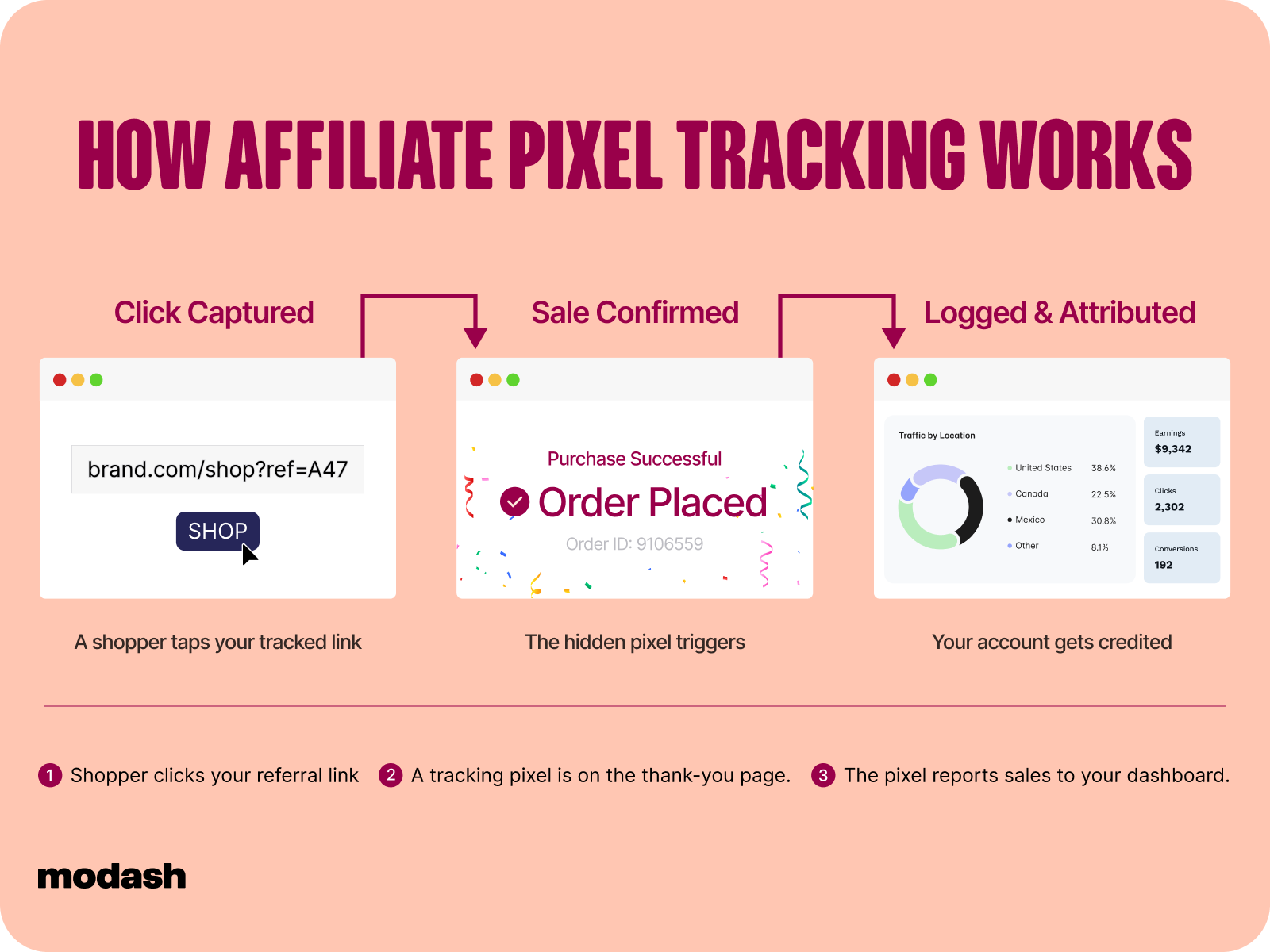
That way, even though there was a gap between the original click and the eventual purchase, the brand still knows which affiliate referred the sale. Smart stuff!
👎 Reduced accuracy: Pixel tracking accuracy has been dramatically reduced (or even completely ruined) by measures like Apple’s iOS privacy updates 14+ and Intelligent Tracking Prevention for Safari ITP, combined with continued growth in ad blocker usage.
Most affiliate platforms have their own built-in dashboard for tracking clicks and commissions. That way, you don’t have to look at one tool for traffic data and another for sales. Often, these platforms also feature affiliate portals, so creators can track how their content is performing too.
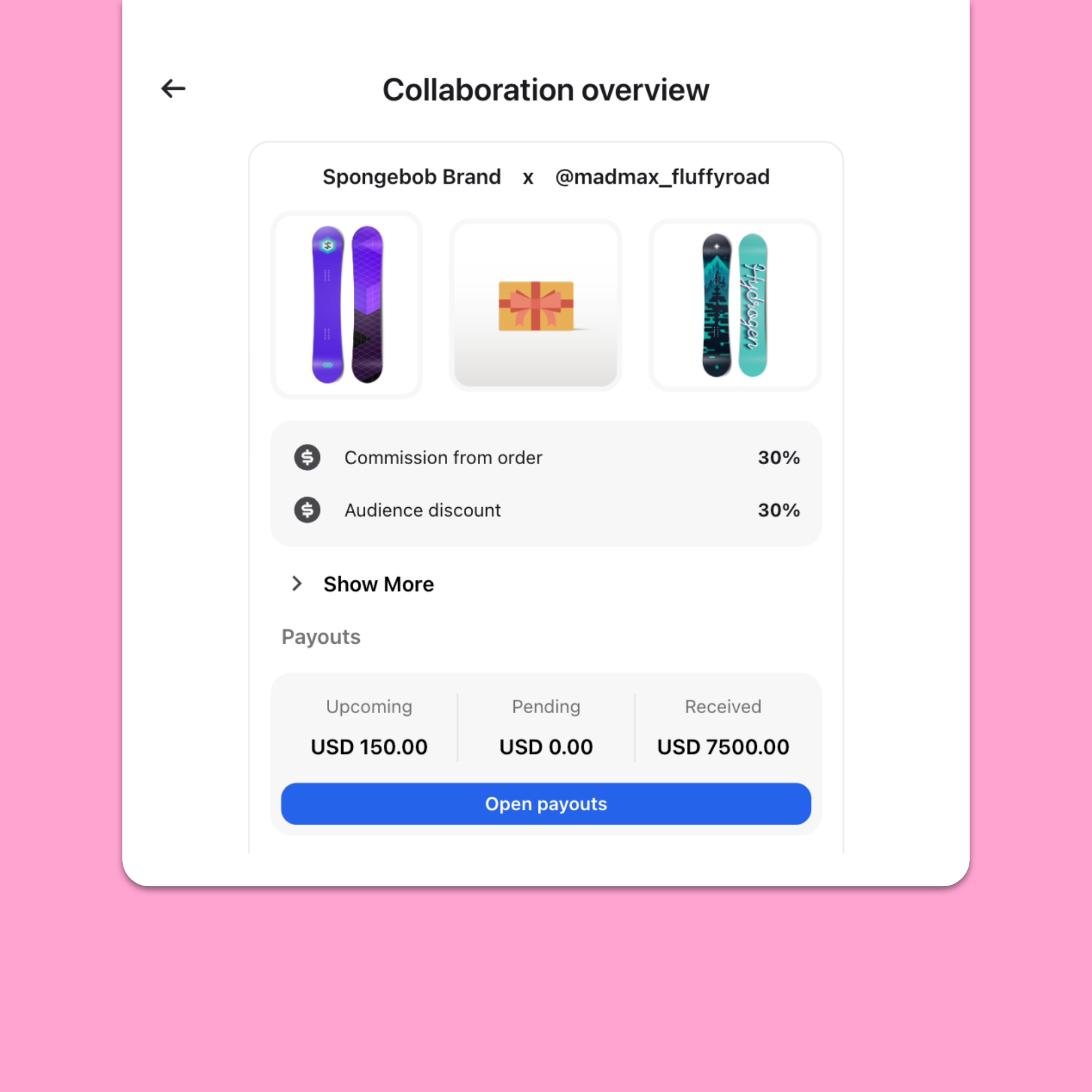
👎 Potential data inaccuracies: There's a difference between tracking that a sale happened and having full access to the order record. Platforms typically get a conversion event – potentially including the order ID + value – but miss a lot of other key info (like customer names and line items). So if there's a dispute, you can't drill down into the detail.
While no affiliate sales tracking method is completely perfect, the best solution for most brands is to use a dedicated creator marketing solution with a native integration to your chosen ecommerce platform.
For example, Modash has a native Shopify integration that pulls data on revenue, order count, and conversion rates per affiliate straight from Shopify:
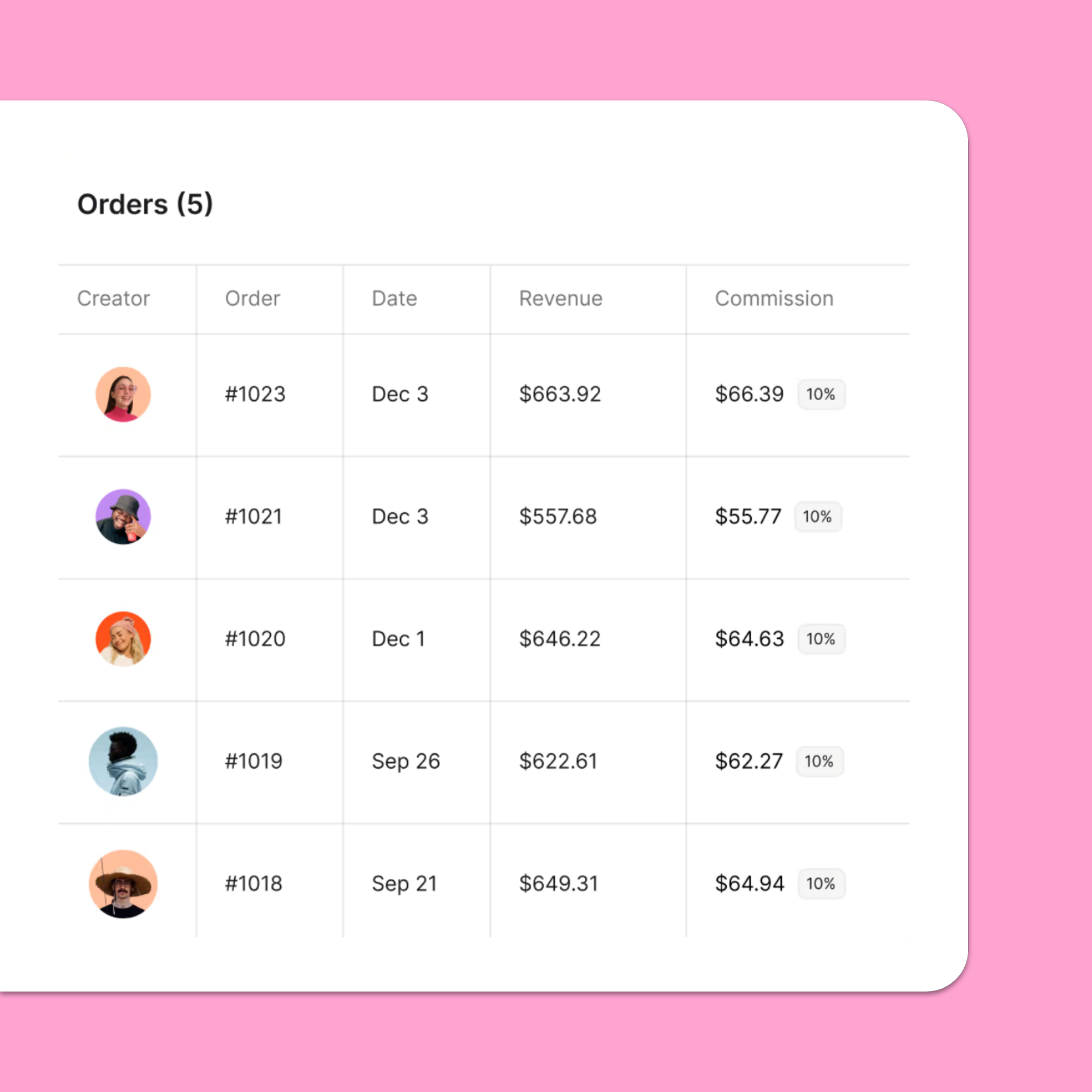
This gives you waaaay more depth to your reports, without forcing you to waste time on manually matching code redemptions to affiliates and order numbers. And because you’re not dependent on tracking pixels or cookies to measure the performance of your affiliate program, you can trust the numbers in front of you 😮💨
👉 Try our affiliate tracking tools today by creating your free Modash account!
👎 Platform coverage: Most creator marketing tools only offer deep integrations with one or two ecommerce platforms. For example, Modash only integrates with Shopify – so if your store runs on BigCommerce or WooCommerce or some other platform, you won’t get the same detail in your reports.
One of the biggest issues with affiliate tracking is that the two most popular methods – affiliate links and promo codes – work totally differently:
This creates confusion around which is best. And to make matters worse, if you use both, the numbers don’t always match up 🤦♀️
Like an old married couple, promo codes and links often disagree with each other. Not about who forgot to feed the dog or turn off the oven, but about which affiliate deserves to be credited for the sale (or whether an affiliate was even involved).
Here are some common scenarios in which links and codes don’t see eye to eye 👀
*In this scenario, the affiliate link will credit the creator who originally drove the click, while the promo code will attribute the purchase to the coupon site.
Okay, so codes and links might not tell you exactly the same story for every conversion.
But, combined, they give you a clearer picture than you’d get from only using one or the other. Despite the issues around code sharing and theft (and the possibility that shoppers will simply forget or misspell them), promo codes track most affiliate-driven transactions. And affiliate links give you a bunch more valuable context, like exactly where the customer saw your creator’s content.
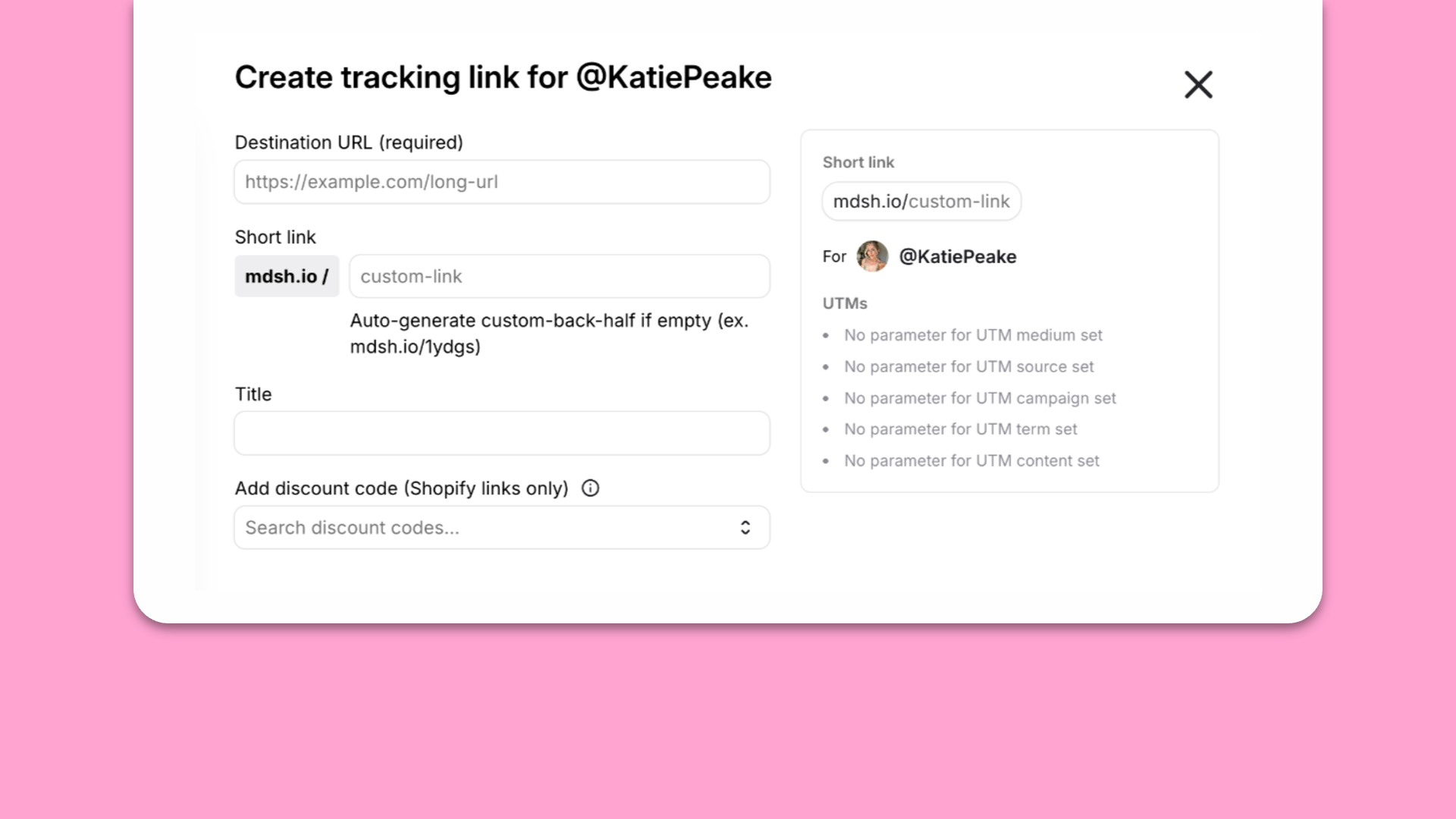
That’s why it makes sense to track affiliate sales using Modash, which assigns both a link and a code to each affiliate – so you can cross-reference and catch discrepancies.
On the face of things, affiliate code sharing looks like a non-issue. Ohh nooo I’m getting too many code redemptions and sales 😭 Also did I mention my steak is too juicy and my lobster’s too buttery?
However, it’s not quite that simple. When affiliate codes end up on coupon sites and browser extensions like Honey and RetailMeNot, they start getting used by shoppers who’d already found your store and product. In fact, there’s a good chance they were already going to buy – they just decided to pause the checkout process to hunt for a slightly better deal.
In other words, the promo code isn’t generating new sales; it’s eating into your margins.
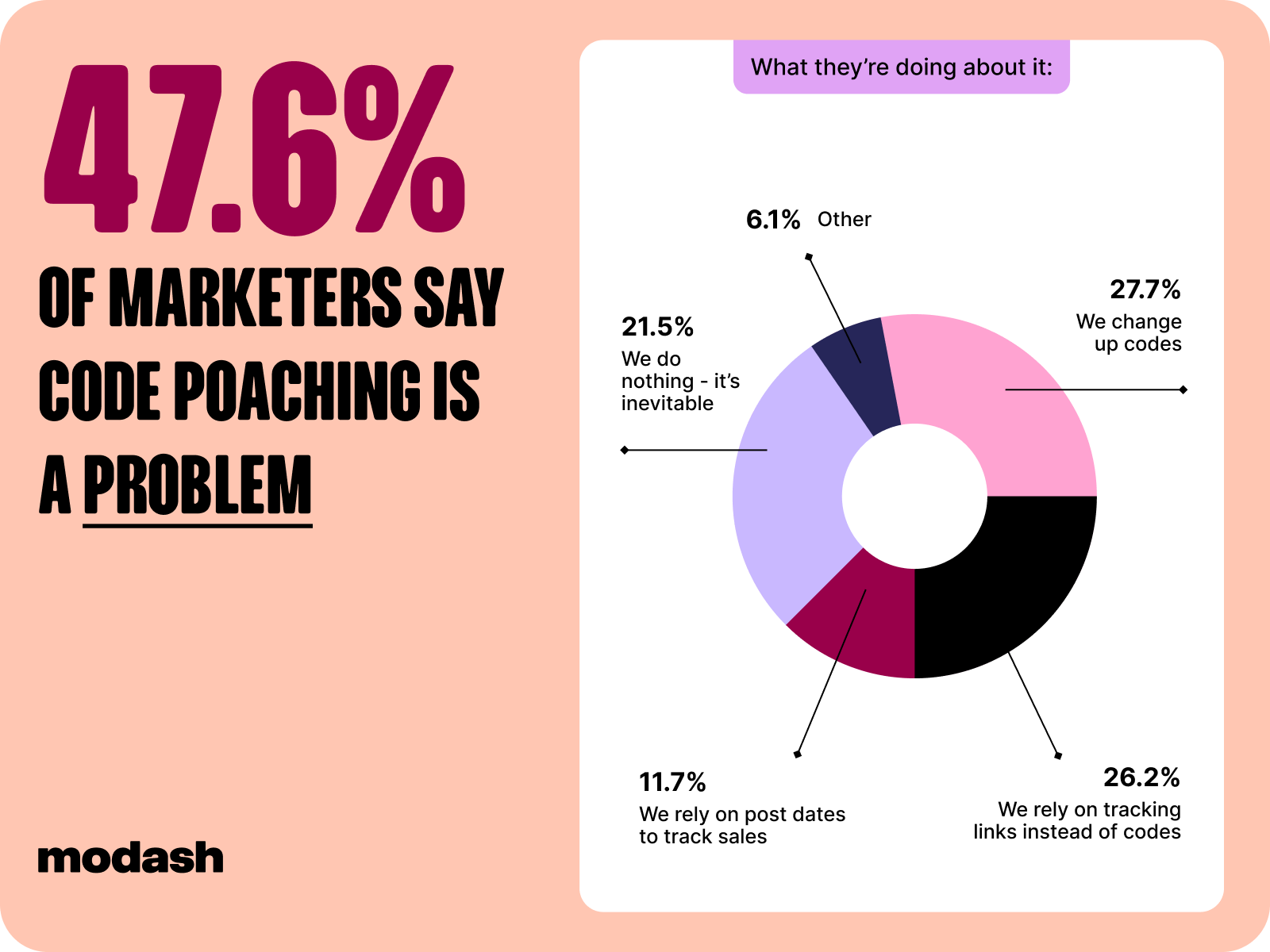
Which explains why 47.6% of affiliate marketers we surveyed said code poaching is a problem.
Scale turns this issue into a serious headache 🤯
If you’ve only got ~5 affiliates, you'd probably notice the occasional instance of code poaching. But when you’ve scaled to 50+, you won’t have time to analyze each and every conversion, so there’s far more chance of it slipping through the net.
As I’ve already mentioned, the consumer tech world’s growing push for privacy has seriously eroded the reliability of cookie-based tracking.
Again, this problem increases exponentially at scale. If you’re only generating a couple dozen affiliate sales a month, and maybe half of them are on iOS, you can probably get to the bottom of any tracking gaps by looking at your analytics data (or by making some educated guesses).
But what if your affiliates are bringing in hundreds or thousands of monthly sales? You’ve no hope of closing that gap yourself.
It’s totally possible to run a (small) affiliate program in Excel or Google Sheets. In fact, you can find a free affiliate tracking spreadsheet template in our article 5 Spreadsheets for Influencer Marketers – don’t say we never give you anything 🎁
However, spreadsheet-based tracking is simply too labor-intensive once you've scaled to, say, ~20 affiliates. At that level, the amount of time you spend manually matching code redemptions to individual transactions and affiliates will far outweigh the cost of most creator marketing platforms (for reference, Modash pricing starts at $299 per month, or $199 when paid yearly).
Cookies get blocked. Codes get shared. Pixels fire incorrectly. Tracking affiliate sales is tough, huh?
But it gets a whole lot easier when you choose a creator marketing platform that integrates natively with the ecommerce software powering your store. That way, you get granular data on every affiliate sale, rather than simply being told that a conversion “happened”. Plus you save time on key tracking-related tasks like assigning codes and links to new affiliates.
If your store is on Shopify, Modash is the obvious choice. Bring your Shopify data to Modash lets you track…
…in real time, with no need to switch between tools or reconcile transactions manually. Phew.
👉 See for yourself by creating your free Modash account today!