Claude, ChatGPT, Cursor 등 AI 도구에서 Modash 사용하기
MCP 시작하기



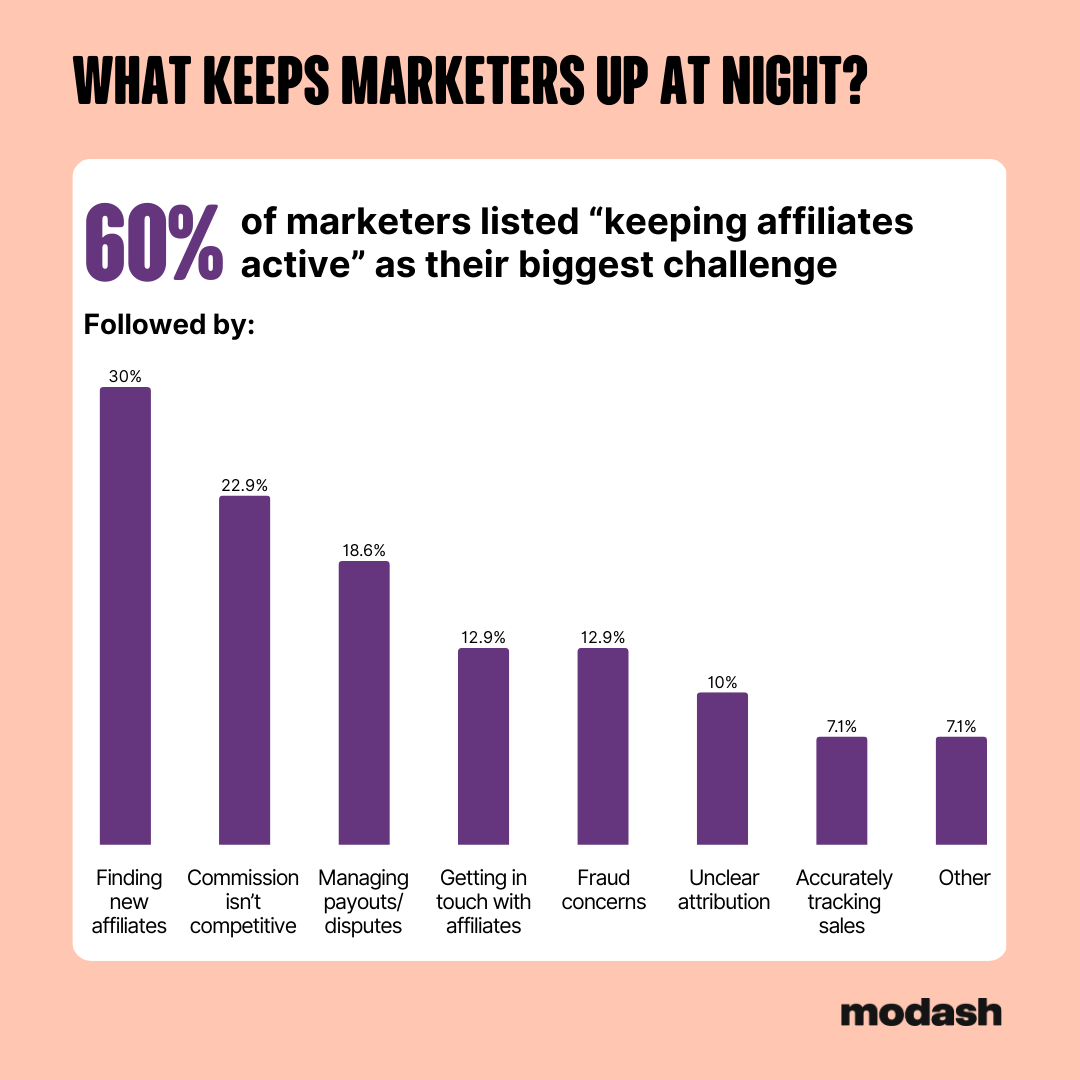
You’re running an affiliate program – but so far you’re not bringing in the sort of revenue you expected, and you’re looking for concrete levers to pull. At this point, most brands start blindly recruiting more affiliates. But the real power move is getting existing affiliates to post more consistently, promote more strategically, and stay motivated over time 💪
Fact is, most brands already have more than enough affiliates. That’s why the biggest challenge for influencer marketers isn’t recruiting more affiliates – it’s keeping the ones they’ve already got engaged and active.
🤓 Further reading: Get more stats like this in Affiliate Marketing Survey 2026: Why Hands-On Programs Outperform the Rest.
At this point, you might be wondering: what even is an “active” affiliate?
Well, more than half of those we surveyed said any affiliates who post at least once a month can be considered active – yet despite this low bar, over one-third of marketers admitted that <20% of their brand’s affiliates are active 🤯 So if they’ve got 1,000 affiliates on their books, just 200 (or fewer) are creating content monthly.
This is an inconvenient truth for brands, because it’s a whole lot easier to recruit 20 or 30 or 50 new affiliates (and burn through them, too) than to make wholesale changes to the way they motivate and communicate with creators.
If you only take one thing away from this blog post, let it be this:
⚠️ Before you start your next affiliate recruitment drive, pause to audit your program’s existing activation rate ⚠️
Count your total number of affiliates, then calculate the percentage who’ve shared at least one piece of affiliate content about your brand per month for the last three months.
🤓 Pro tip: Calculating all this stuff manually is a serious headache, especially if you’ve got hundreds of affiliate partners. Speed up the process with an influencer marketing platform like Modash, which shows you how often your creators have posted in a set time period – including when their most recent content went live.

While generic benchmarks only tell you so much, the top-performing brands see activation rates of 50%+. So if your figure is in the low double digits, I’d strongly suggest focusing on engagement (or re-engagement) before hiring any more affiliates.
A creator might have had the best of intentions when they decided to join your program. But then life got in the way and they never actually got around to sharing their first post.
Sure, some of those creators have basically just ghosted you 👻 But others are prime for re-engaging; they just need a little nudge to remind them why they signed up in the first place.
First you need to track them down by whatever method you use to track affiliate activity. For instance, you can do it in Modash by creating a list/segment of all your affiliate creators, then seeing who’s posted in the last 30/60/90 days. And if you’ve enabled always-on creator tracking for that list, you can also spot people with no tracked posts at all (meaning they signed up but never posted) – that way, there’s no risk of missing a post because the affiliate forgot to add a hashtag or @mention your brand.
Next, reach out with the simplest possible version of your welcome email – think commission rates, tracking instructions, and a couple easy-to-replicate content ideas. Your immediate goal is to motivate their first post, so don’t worry about explaining the more intricate points of your affiliate program; you can worry about that later if/when they’re fully onboard.
🤓 Further reading: For more on welcome emails and the wider onboarding process, check out the relevant bits of my guide on 8 Ways to Hire Affiliate Creators (And Actually Activate Them).
One of the keys to successfully re-engaging lapsed affiliates is to focus your resources in the right places. Because, let’s face it, not all of them are worth the effort.
There’s no hard-and-fast criteria for who to target and who to ignore – there are just too many types of creator and too many factors at play. But the following should almost certainly be a priority:
By contrast, if a creator has only ever sent one or two (or zero) sales your way, you can probably afford to let them go 👋
Chances are, it’ll take more than a single email or DM to transform an inactive affiliate into a regular poster. You need a multistep sequence to remind them what’s so great about promoting your brand and coax them back into action.
Here’s how that might look in practice:
| Email step 📧 | Purpose 🎯 | Example 👇 |
|---|---|---|
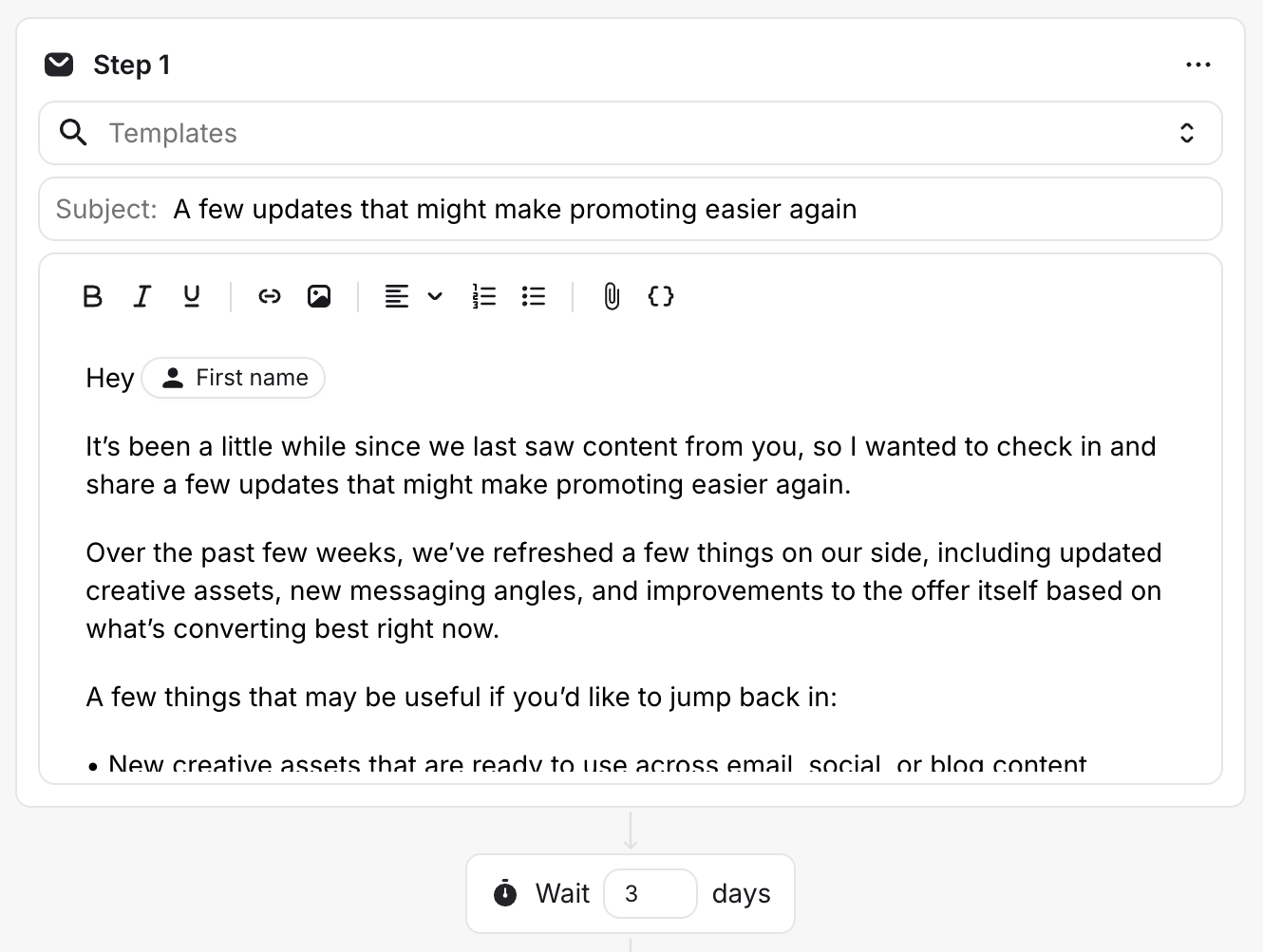
| Step #1 | Acknowledge the gap without playing the blame game | “It’s been a little while since we last saw content from you, so I wanted to check in and share a few updates that might make promoting easier again.” |
| Step #2 | Share a concrete reason to re-engage now | “We’ve just updated our top-converting offer and added new creatives you can use right away.” |
| Step #3 | Provide fresh assets they can use immediately | “Here are three angles that are converting best right now.” |
| Step #4 | Remind them what worked before (ideally personalized for each affiliate) | “Your audience loved your last tutorial-style post, so we thought this new offer might fit that format too.” |
| Step #5 | Sign off with a low-friction “ask” | “If you’d like, reply and I’ll send the top-performing creative for your audience.” |
What you definitely don’t want to do is make the creator in question feel like they’ve done something wrong. So avoid any accusatory language or threats to close their account if they don’t start posting again right now.
🤓 Pro tip: Modash makes it easy to create personalized email sequences with custom wait steps between each email, so you don’t have to remember to send each follow-up manually.
As you saw in the previous section 👆👆👆 one of the main focuses of any re-engagement campaign is to give lapsed creators a meaningful reason to take immediate action. And it doesn’t get much more meaningful than a limited-time bonus, such as a short-term increase to their percentage commission rate or a one-off fixed cash bonus on their next sale.
Certain bonuses might be a better fit for certain types of affiliates. For example, if you’re trying to win back a previous top performer, you might pull out all the stops by doubling their commission rate for the next week – even if you barely break even on those sales. Whereas it’s (probably) not worth taking such a big hit to your margins just to re-engage a new creator who’s never shared a single post about your brand.
One of the best things about affiliate marketing is that you get to benefit from the creativity of dozens of different creators. But just because they’re the experts when it comes to sharing great content, that doesn’t mean it always comes easy. A lack of new content ideas – or a lack of understanding about what works – makes it harder for them to post. If those struggles persist, eventually they’ll give up completely 🤷♀️
Unlike you, none of your affiliate partners has a full, data-backed overview of which platforms, content formats, hooks, and products are really resonating in terms of engagement and sales. Rather than keeping that information to yourself, share it with your affiliates to boost performance across the board. It could be the difference between an affiliate re-engaging with your program or ghosting you for good.
🤓 Pro tip: Get into the habit of sharing at least one roundup per month highlighting top-performing content angles and trends. This sort of messaging is perfect for one-to-many broadcast channels like Discord, Slack, and WhatsApp – speaking of which…
One of the best things you can do to reduce your proportion of inactive affiliates is to stop them lapsing in the first place. And if you’re gonna do that, you’ll need to maintain a steady stream of high-value communications to keep them feeling motivated (and appreciated).
To be clear, no one expects you to reach out individually, multiple times a month, to every affiliate in your program. There just aren’t enough hours in the day. The smart option is to save 1:1 comms for when you need to make a real impact – say, inviting your highest-performing affiliate to become a brand ambassador – and handle everything else through broadcast channels.
The big benefit of broadcast channels like Discord and Slack is that they’re a real conversation, rather than a static, one-way interaction. So they’re not just great for sharing important information – they also give your affiliates the chance to respond, which keeps them engaged.
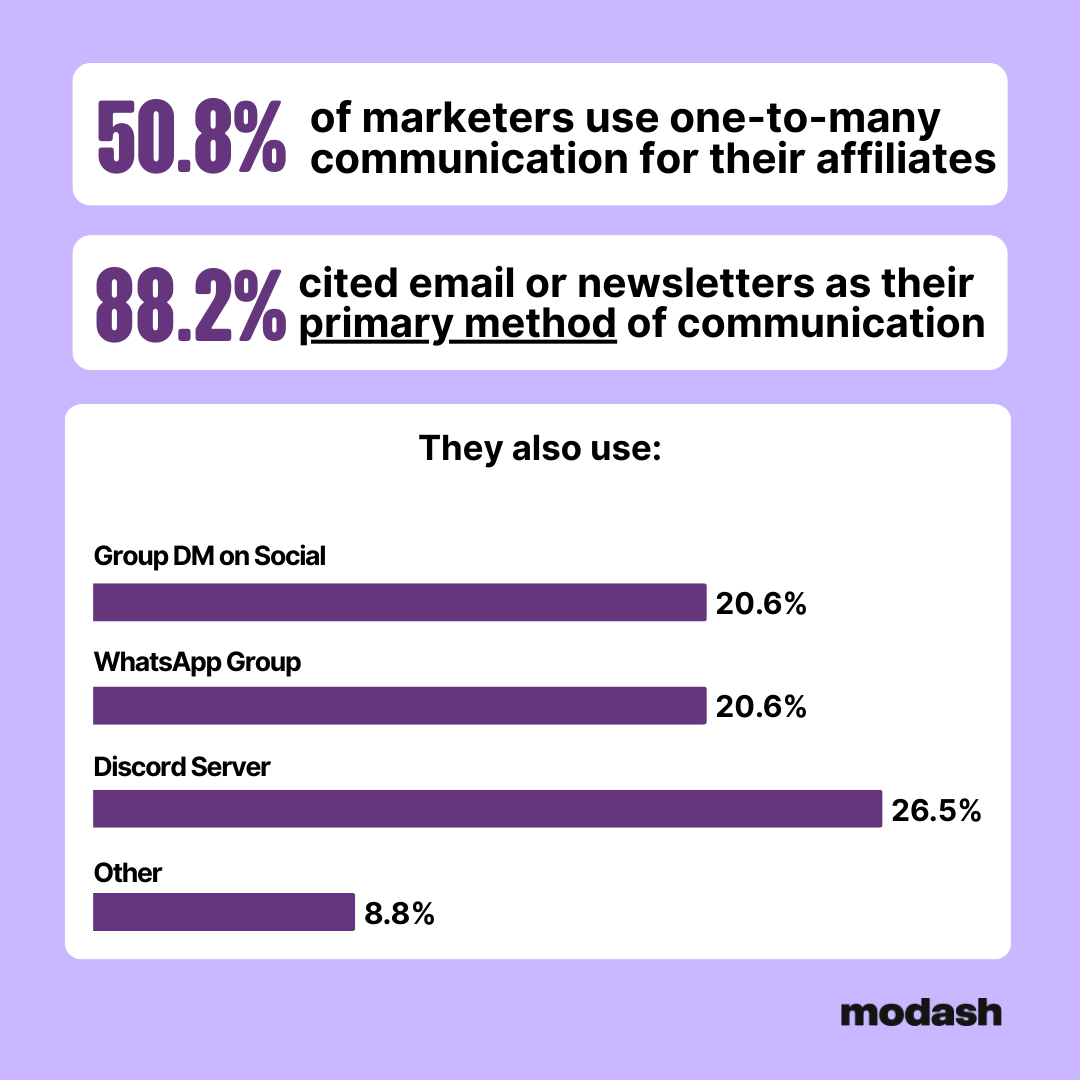
Despite the obvious upside, just half of influencer marketers we surveyed use one-to-many communication for reaching affiliates, with 88% relying on email or newsletters as their primary method.
For best results, treat broadcast channels as your “always-on” option for when you need to reach affiliate partners at scale. That way, you can send regular communications without too much of a heavy lift, while boosting engagement in a way that email just can’t.
🤓 Further reading: Learn more in How to Use One-to-Many Broadcast Channels in Influencer Marketing (Without Erasing the Personal Touch).
Your affiliates are less likely to lapse if you set clear expectations around posting frequency during the onboarding process, then ensure they’ve got all the support and motivation they need to keep hitting those output levels.
Because without clear expectations, an affiliate might simply “lapse” because they didn’t realize you actually wanted them to post every month 🤦♀️
Still, it’s important you keep these expectations realistic. Most successful affiliates work with a bunch of different brands, each with their own demands around posting frequency. So don’t burn your creators out by asking for too much content (chances are, their audience will get sick of constantly hearing about you anyway).
There are two main ways to track affiliate marketing results:
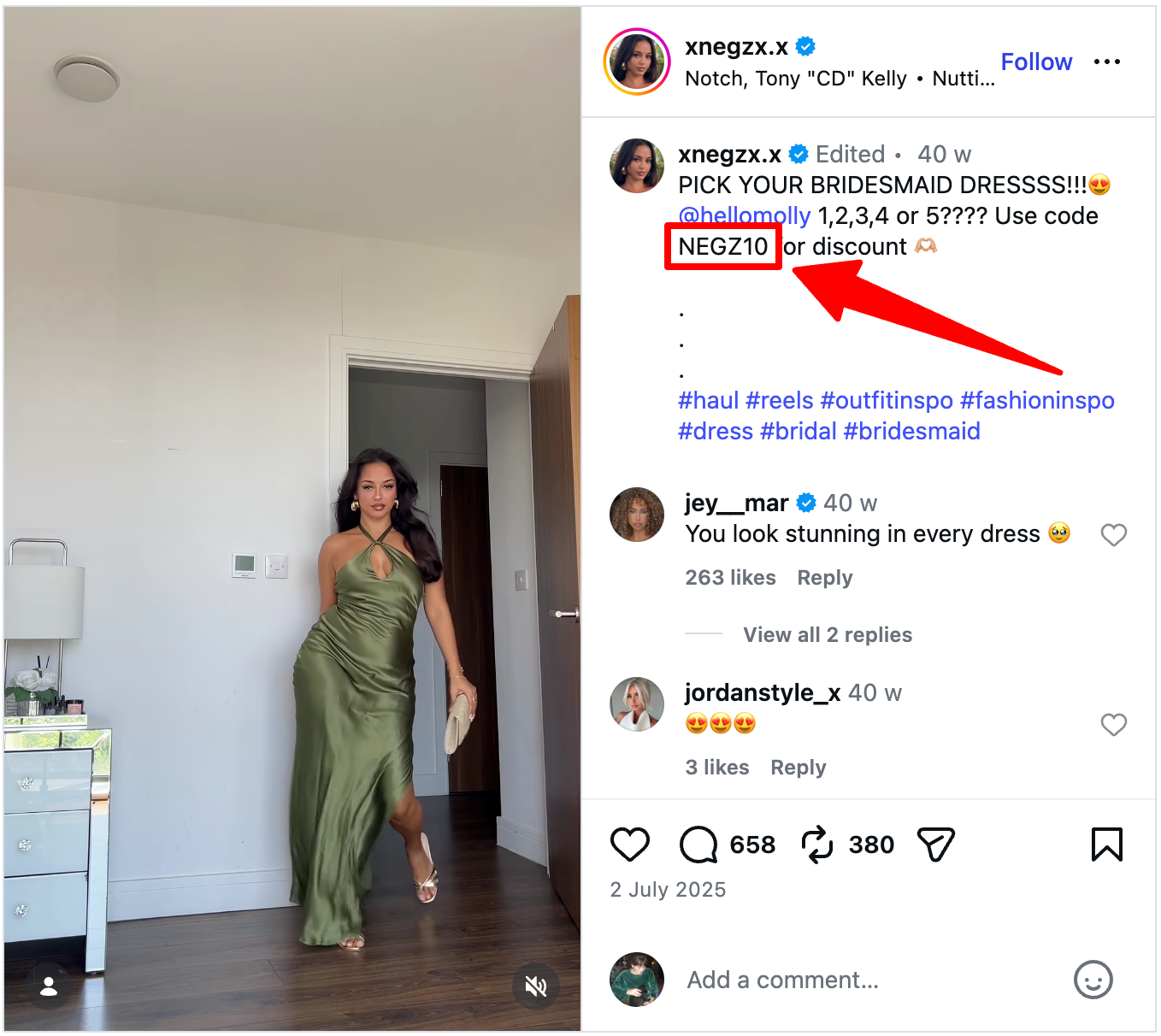
👉 Promo codes (AKA discount codes) are unique codes given to each of your affiliate partners that give their followers some sort of discount or reward. When a customer enters the code at checkout, their purchase is tracked back to the relevant affiliate. Here’s an example from influencer Negar Aghaei:
👉 UTM links are custom URLs that tell tools like Google Analytics where your website visitors came from. UTMs are unique to each affiliate, so they’re useful for understanding which affiliates are driving the most traffic. Here’s an example of a UTM link on the store Fashion Nova from one of Negar Aghaei’s campaigns:
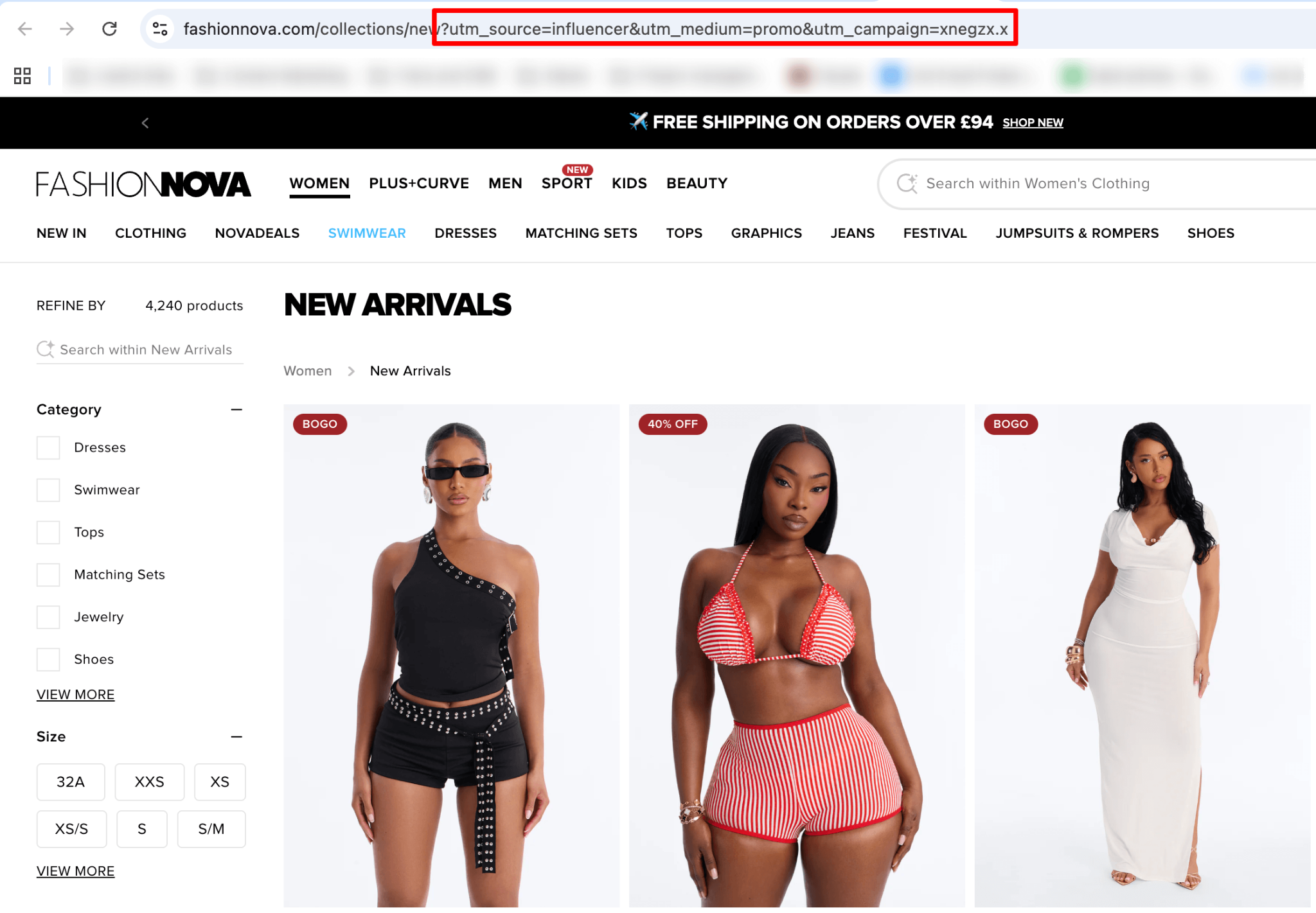
While both have their uses, discount codes are generally more reliable for affiliate attribution specifically, because they tie directly to a completed purchase rather than a website session. UTMs are better for understanding traffic behavior (like bounce rate and what page a customer lands on), which is useful, but should never be the primary attribution signal for affiliate sales.
🤓 Further reading: Learn more about UTM links, promo codes, and other forms of attribution in How to Measure Influencer Marketing: 8 Proven Tracking Methods.
Even if you track clicks and sales with UTM links and promo codes, you can still run into attribution problems that skew your data, making it hard – or impossible – to get an accurate view of program performance. Let’s take a look at some common issues (and how to fix them):
👉 Example: A user clicks an affiliate’s UTM link, checks out the product, and decides to buy – but before hitting the checkout, they trawl Google for a discount code. Hey presto, they find one on a coupon website, which ends up taking full credit for the sale.
🔨 How to fix it: The simplest solution is to totally exclude coupon sites from joining your affiliate program. Or, for a more technical approach, try splitting commissions between “introducer” and “closer” to incentivize and protect upper-funnel affiliates.
👉 Example: A customer clicks an affiliate link on mobile, then switches to their laptop to complete the purchase. It looks like any other (non-affiliate) sale, so the creator who inspired the purchase loses out.
🔨 How to fix it: Discount codes already solve this problem because they’re bound to the referring affiliate, regardless of which device the customer uses to buy. Alternatively (or additionally), encourage all store visitors to log in or create an account – that way, the affiliate click ID is stored with the customer’s account/email, so the affiliate will still be rewarded if the logged-in customer buys later on a different device.
👉 Example: A customer clicks an affiliate link but leaves your store without buying. Later, they type your URL straight into the address bar and complete the purchase, so the sale is attributed to direct traffic rather than affiliate.
🔨 How to fix it: Again, you can fix this one with discount codes – so long as the customer enters the code at checkout, the relevant affiliate gets credited. Or you can switch to first-touch reporting and credit affiliates for sending traffic to your store, even if those customers don’t convert there and then.
Affiliate tracking isn’t just about measuring who sells what. It’s also about keeping a record of all the content assets your affiliates are creating.
If you’re only working with a tiny number of affiliates (say 10 maximum) and you’ve got time to kill, you can do this manually – either by chasing creators for screenshots and/or live content links, or by capturing screenshots and links yourself. Even if you don’t currently do this, you can probably see how time-consuming it can be.
That’s why most brands with mature and/or growing programs rely on influencer marketing software for affiliate content tracking. For instance, with Modash, you simply tell us which hashtags, mentions, and/or keywords to track – then we’ll capture and store all the live content for you (even Stories):
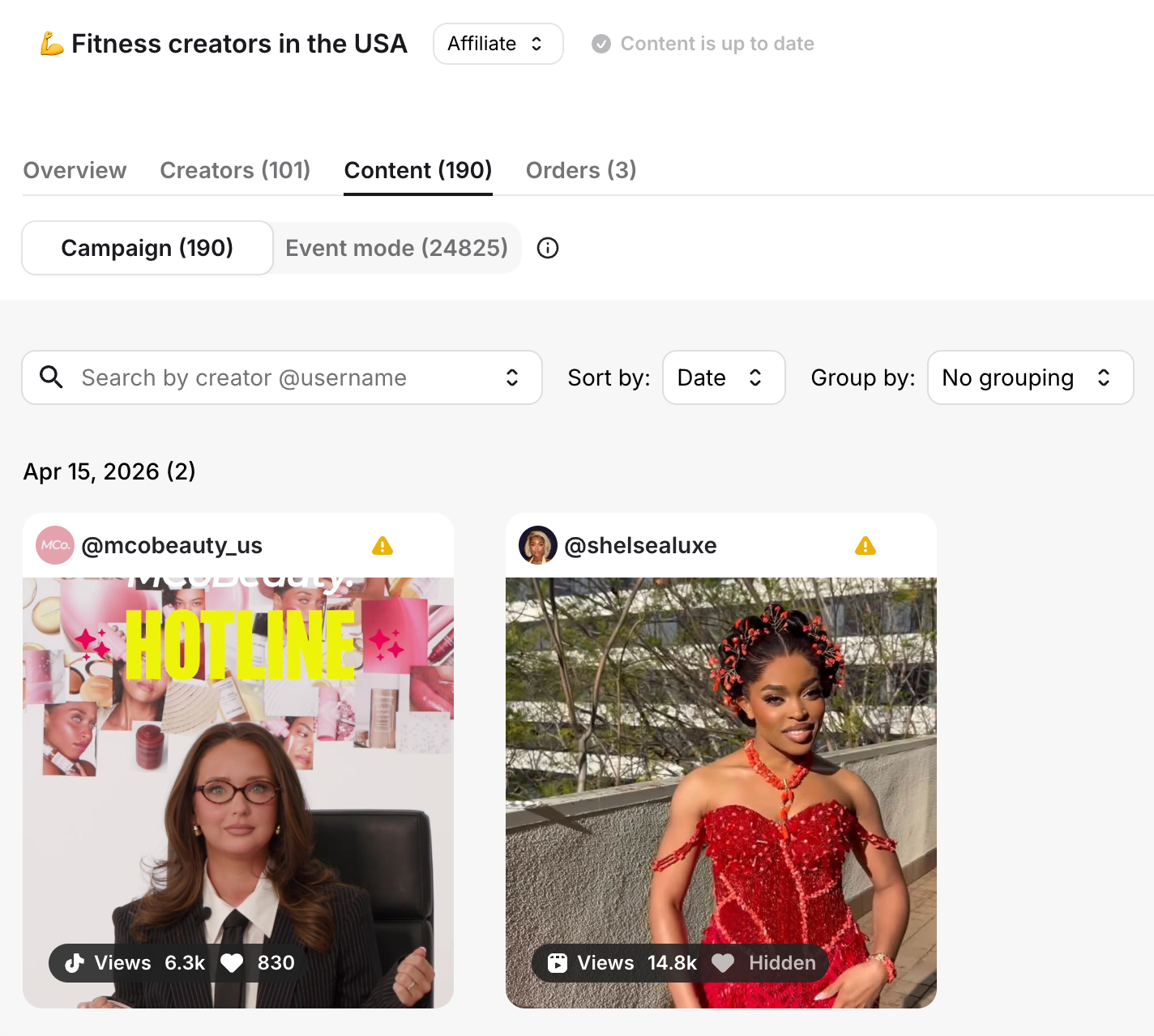
Or you can switch on our Event mode to automatically track every piece of content created by selected creators to ensure you never miss a post – even if an affiliate misspells a hashtag or forgets a mention.
👉 Want to try our affiliate tracking tools? Sure thing, just create your free Modash account!
The final piece in the attribution puzzle is understanding whether changes to your affiliate program are generating the desired results. To do that, you need to pick a couple affiliate marketing KPIs and do a before-and-after comparison.
The right KPIs will depend on your program’s goals. For example, if you’re trying to boost brand awareness, track things like your number of views or branded search volume. Whereas if sales are your #1 objective, you’ll be looking at revenue, code redemptions, and other conversion-focused metrics.
🤓 Further reading: For more on tracking and analyzing KPIs, check out How to Report on Influencer Marketing (+ Templates).
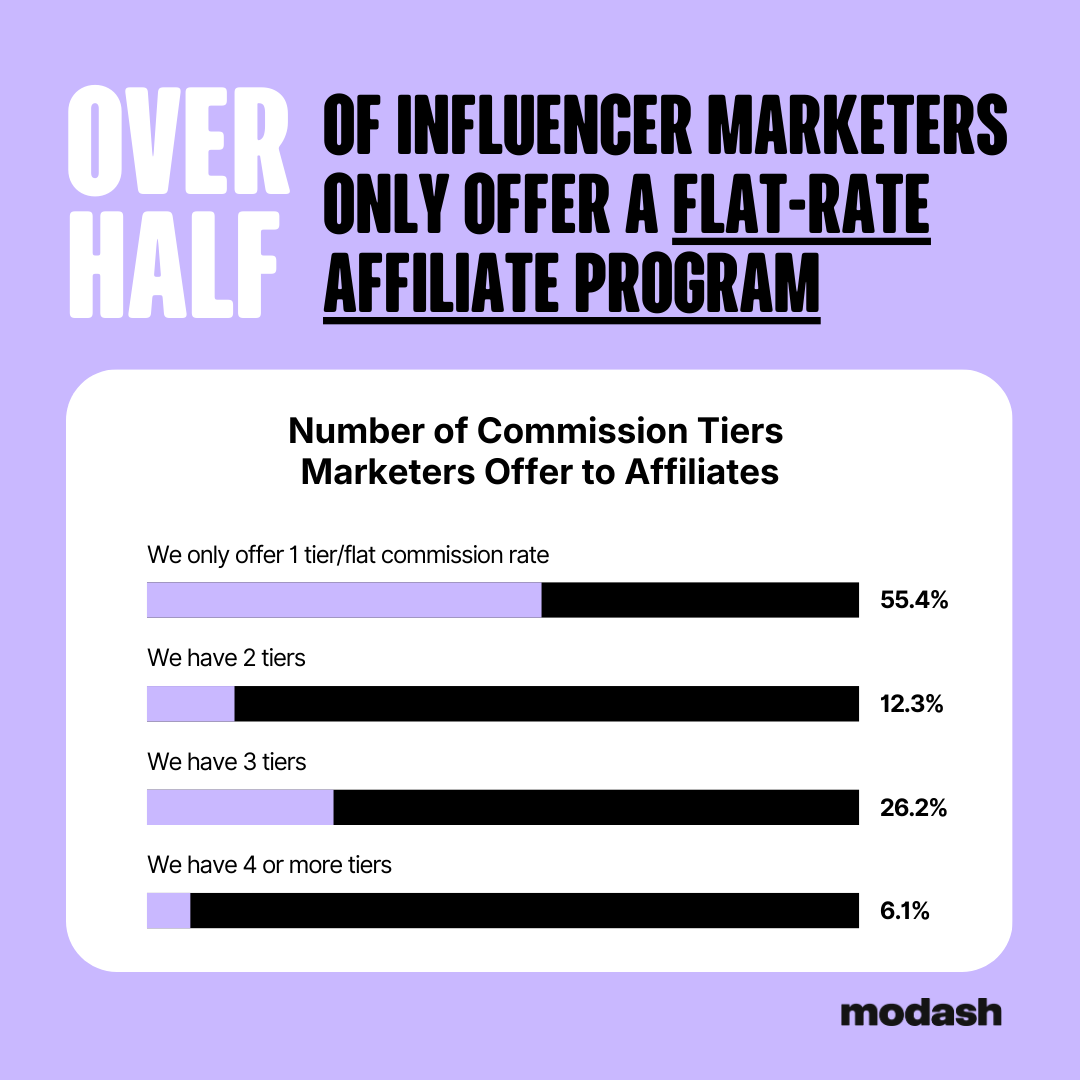
Tiered commission structures motivate affiliates by rewarding stronger performance. For instance, you might pay a standard 10% commission rate, but increase it to 15% for affiliates who generate $500+ in monthly sales.
Our research shows how well this works: on average, programs with a single commission tier only have 35% active affiliates, climbing to almost 55% for programs with 3+ tiers. Despite this, just 45% of influencer marketers say their affiliate program has multiple tiers of commission.
Not sure how to introduce your own tiered structure? Plan to introduce three levels:
🥉 Base rate for all affiliates
🥈 Mid-tier, unlocked after hitting a monthly sales threshold
🥇 Top tier for consistent high performers
As for setting those rates, start with a benchmark commission range – between 10% and 20% is typical for ecommerce affiliate marketing – then work backwards based on your margin and average order value (AOV).
Tiered commissions are a valuable “always-on” incentive. But there are certain points when you really need your affiliates to go the extra mile, such as:
At times like these, you might want to provide an extra incentive in the form of a time-limited bonus event. For instance, you can pay a fixed cash bonus on sales of specific products, or temporarily boost your regular commission rate(s). That way, your affiliates will be motivated to post more than usual around these key periods.
Affiliates are most likely to lapse if they don’t see immediate results. It’s just human nature – if something looks like too much effort, we’ll go searching for an easier solution. So if you can motivate n00b affiliates to secure their first sale, they’re much more likely to stick around.
That’s why it makes sense to over-reward early milestones, such as paying double commissions or a fixed cash bonus on a new affiliate’s first ever sale 🎉
Not all incentives are purely financial – sometimes, a little healthy competition can be all the motivation your affiliates need to step up performance. Try creating a leaderboard displaying your top revenue earners for the week, month, quarter, or year. And be sure to shout out the top dog in your affiliate newsletters and broadcast channel messages 📣
(That said, your leaderboard will likely be even more effective if you offer a cash bonus or some other prize for the eventual winner, and maybe two or three runners-up too.)
Of course, leaderboards aren’t your only option when it comes to non-financial incentives. Others include:
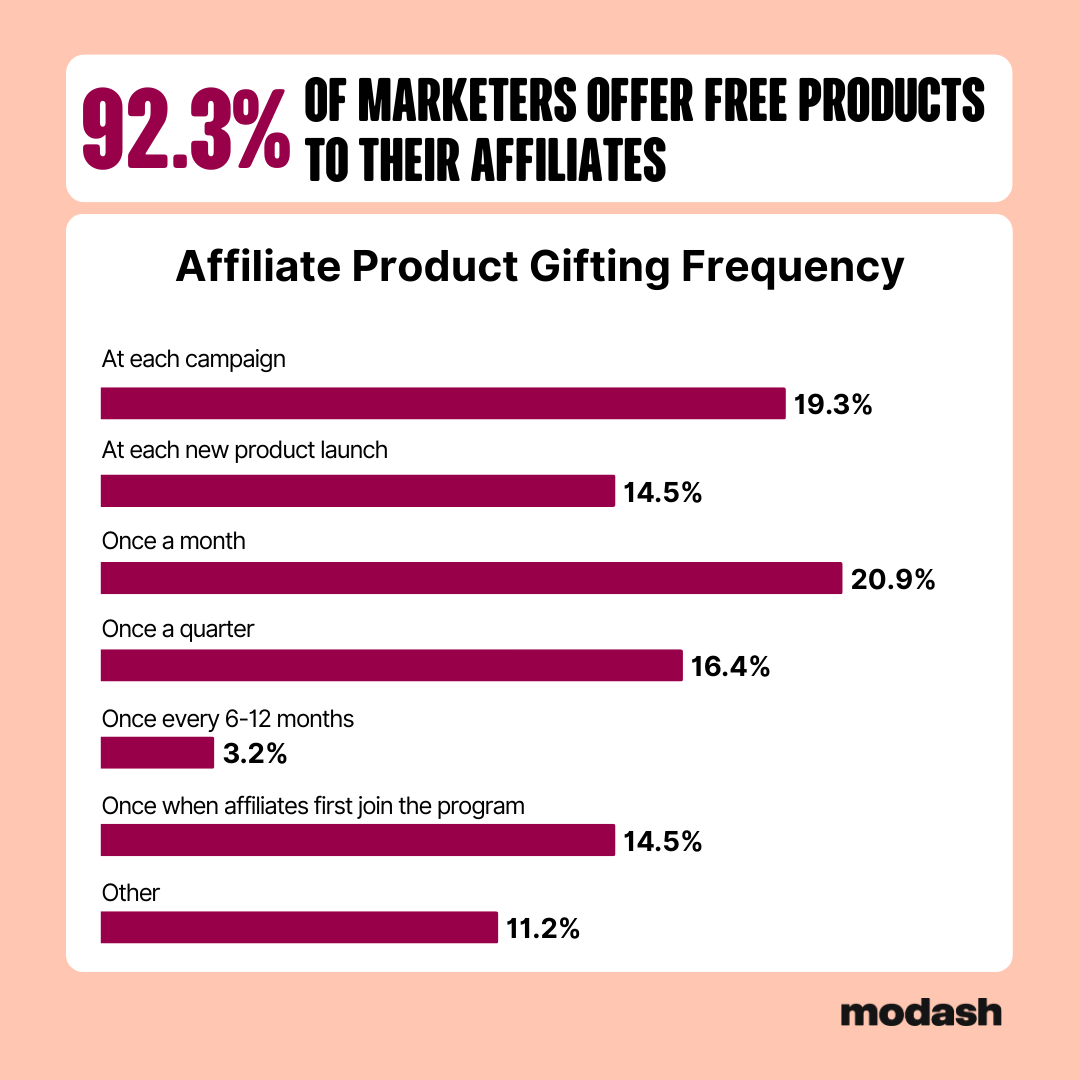
One quick point on free products: they work great as a non-financial incentive, with 92.3% of marketers we surveyed offering them to affiliates. But don’t let those products go stale – 19.3% of marketers told us they refresh free products for each campaign, while 14.5% do so for every new product launch.
Sure, you could just guess at ways to incentivize affiliate performance. Or you could go straight to the source and actually ask what motivates them. You can do this through a simple broadcast channel message – platforms like Discord and Slack make it easy to poll your community members.
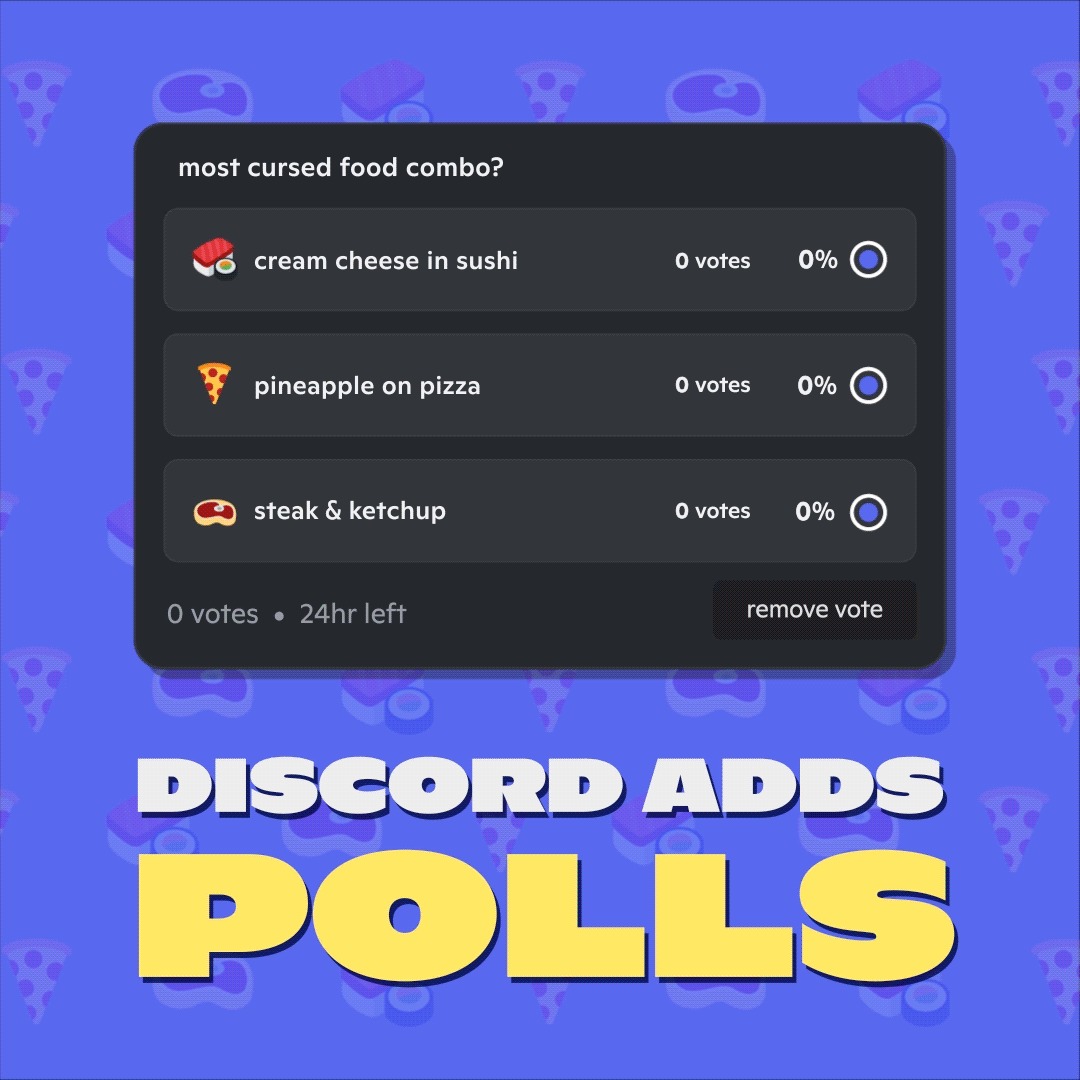
Or for a more in-depth option, use a dedicated tool like Google Forms to write your questions, then distribute your survey through your broadcast channel or email newsletter.
Just bear in mind you might need to offer an extra incentive – like the chance to win a free product or gift voucher – to encourage affiliates to complete your survey. After all, they’re busy people.
Naturally, you want to retain your top performers. So it makes sense to reward them for their work by moving them to a higher commission tier when they hit certain predefined milestones, such as:
When sharing the good news with affiliates who qualify for a higher tier, make sure you explain why they’re being promoted – that way, they’ll feel like they really earned it. For example: “Your last three posts drove $X in sales and converted above average.”
Also, be sure to clearly and succinctly explain the benefits (e.g. “You’re now on Tier 2: +5% commission + early access to launches.”) Finally, motivate them to create their next post by offering to share some sort of insight, such as your current 2-3 highest-converting content angles.
Follower count has always been a big factor in calculating influencer pricing. But, honestly, it’s pretty useless for predicting affiliate marketing performance. Fact is, a smaller creator with super engaged followers interested in products like yours will almost always outperform a larger affiliate with a disinterested, disengaged audience. (That's why our pricing calculator weighs views, engagement rate, and likes to estimate what a creator's cost.)
🤓 Further reading: For more on working with smaller creators, check out Nano Influencer Marketing: Complete Guide (With Examples).
That’s why it pays to hire affiliate creators based on brand fit, not just the size of their following.
There are a couple ways to find brand-fit creators manually (AKA without paid software). For instance, you can:
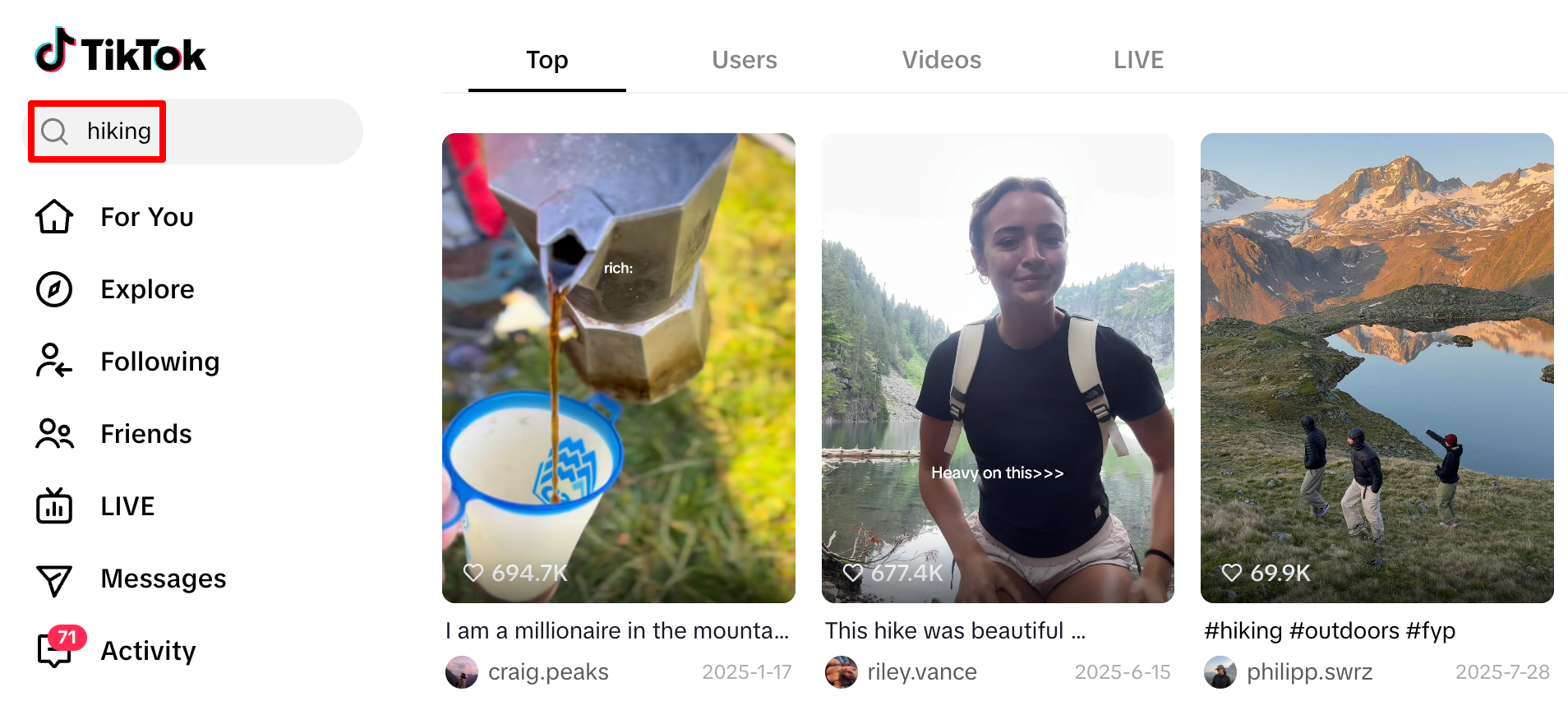
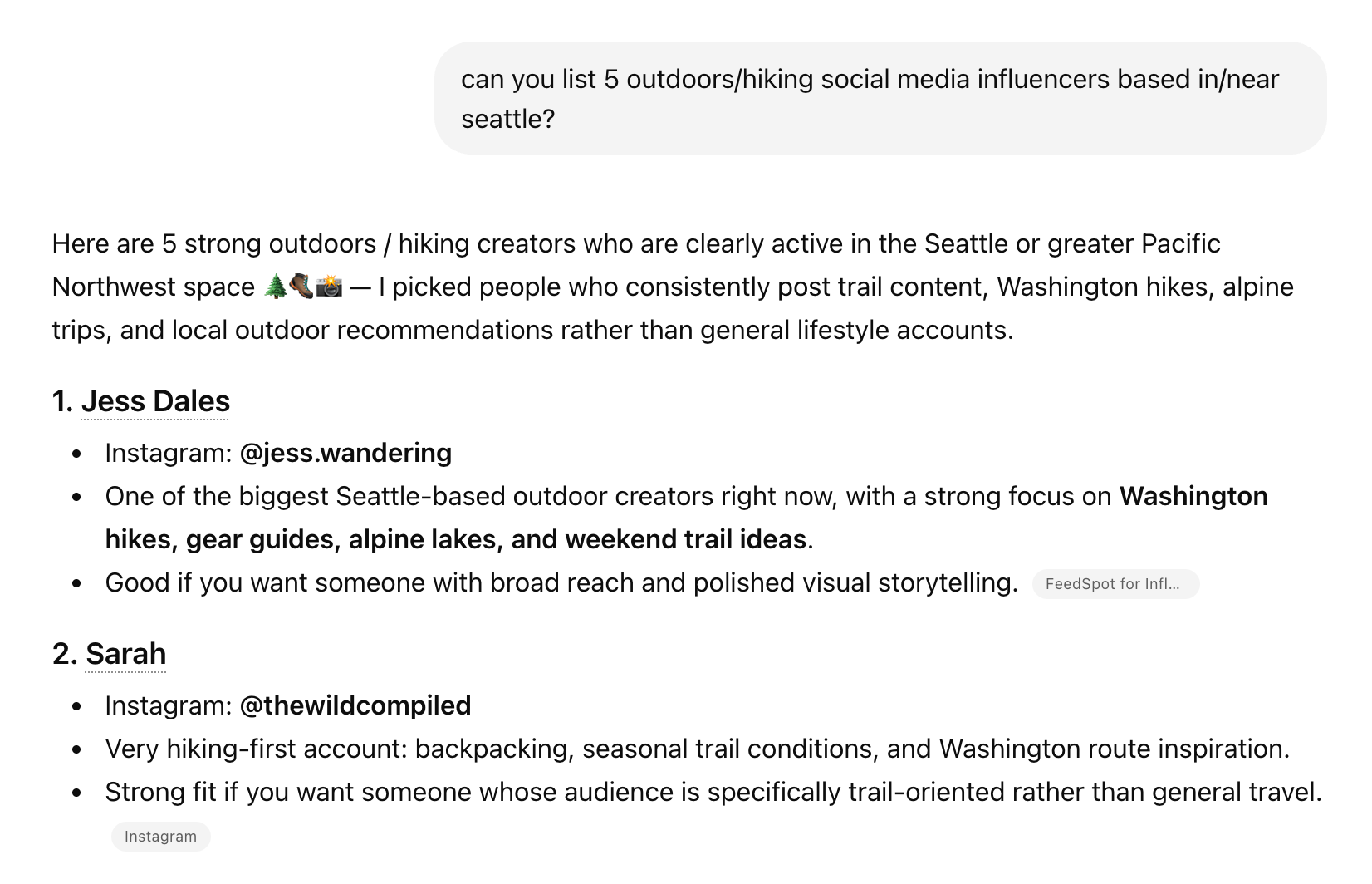
Those methods work fine if you’re only trying to hire a handful of affiliates. But if you’re recruiting at scale (say, more than ~10 creators at a time), you’re much better off with an influencer search tool like Modash – it’ll save you a ton of time and effort.
With Modash, it’s easy to find affiliates who align with your brand from our database of 380M+ creators across Instagram, TikTok, and YouTube. Either browse using discovery filters like:
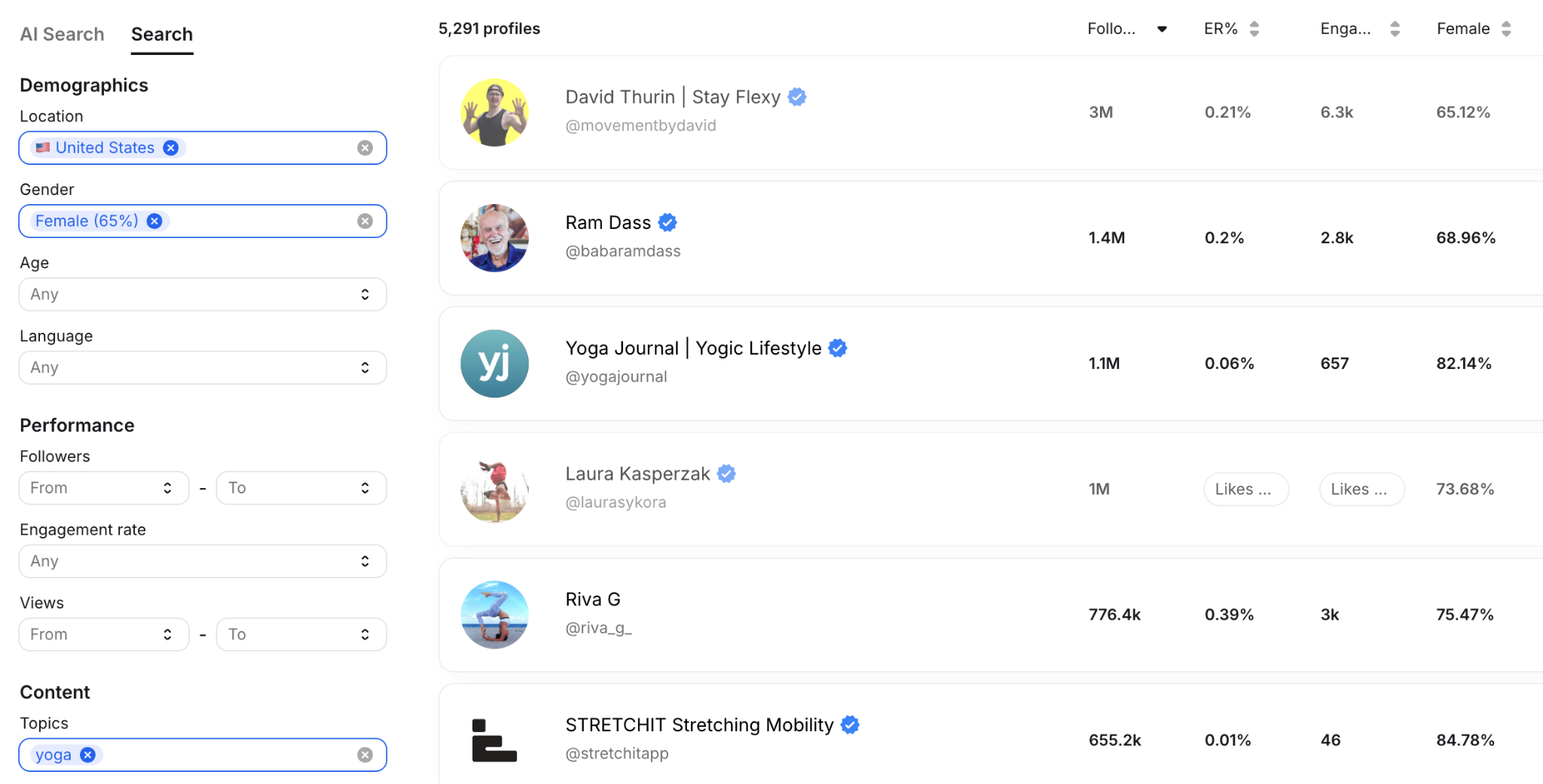
Or track down creators who are already discussing your brand by searching hashtags and mentions. Here’s how it’d look if you were running affiliate recruitment for Kylie Cosmetics:
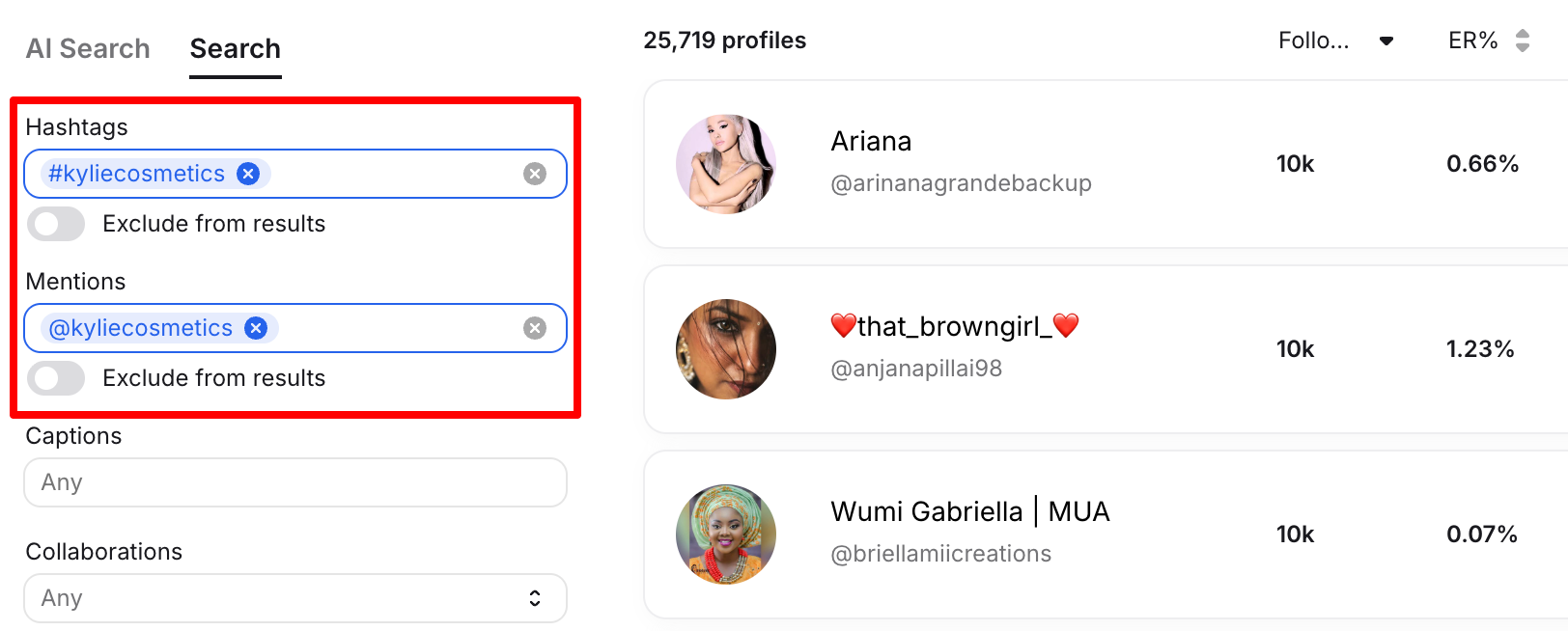
Either way, you’ve likely generated hundreds or thousands of results in a matter of seconds.
Chances are, a small proportion of your existing affiliates are generating an oversized share of clicks and sales. Wouldn’t it be great if you could instantly track down a bunch more creators with similar characteristics?
Actually, you can 🥳
Just like in the previous section, there are a couple solutions – one with a dedicated influencer search tool, and one without.
Without dedicated software, your best bet is to prompt a tool like ChatGPT to find accounts with similar audiences and content to one of your top performers.
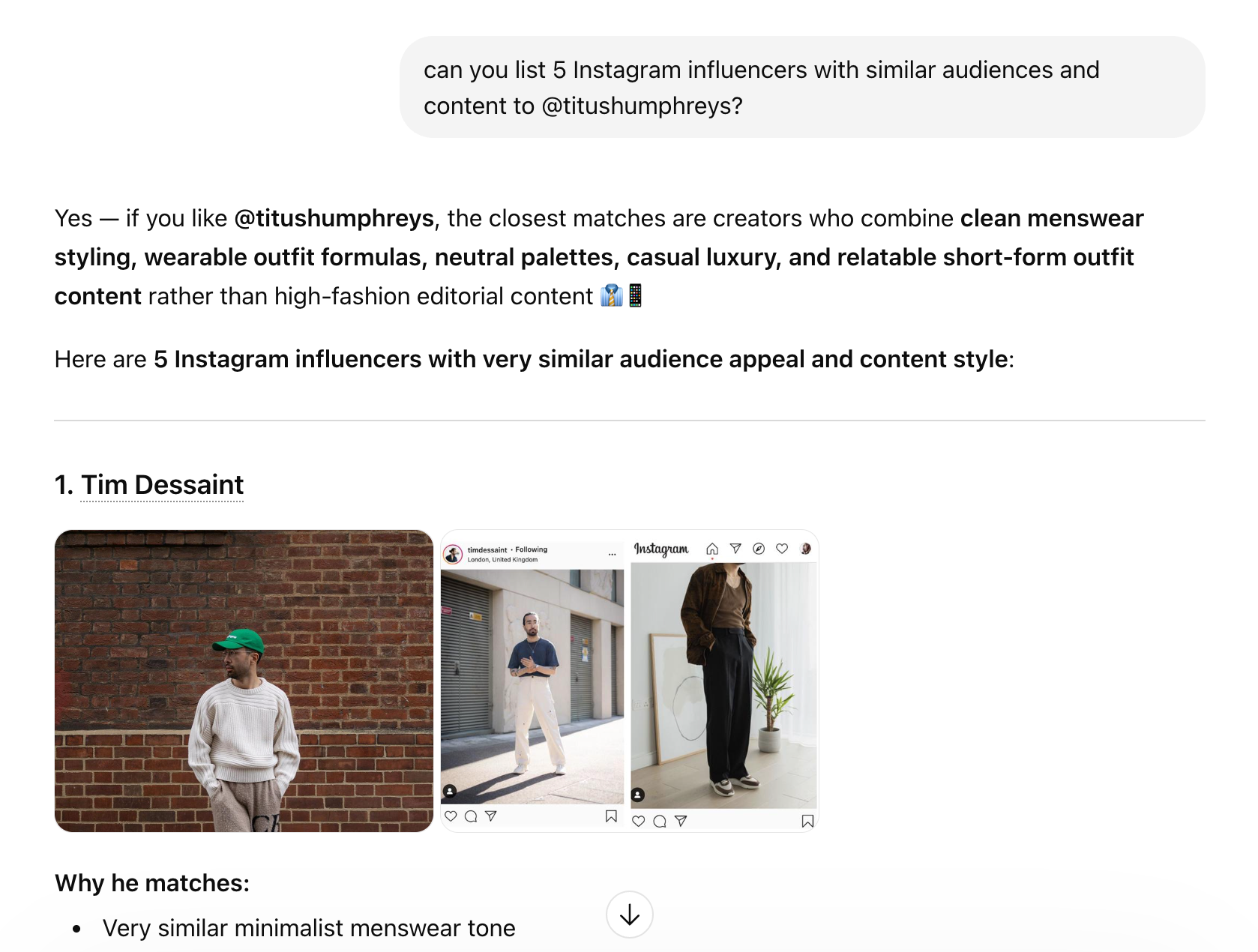
Be wary of the results, though. In the above example, I asked for lookalikes to @titushumphreys, who posts about outdoor activities and adventures – but ChatGPT gave me a bunch of menswear influencers 🤷♀️ Must be one of those AI hallucinations you read about…
For a more scalable (and accurate) solution, you’ll need a tool like Modash. Just open a creator’s profile to see a shortlist of similar accounts, or click View all lookalikes for a more in-depth overview:
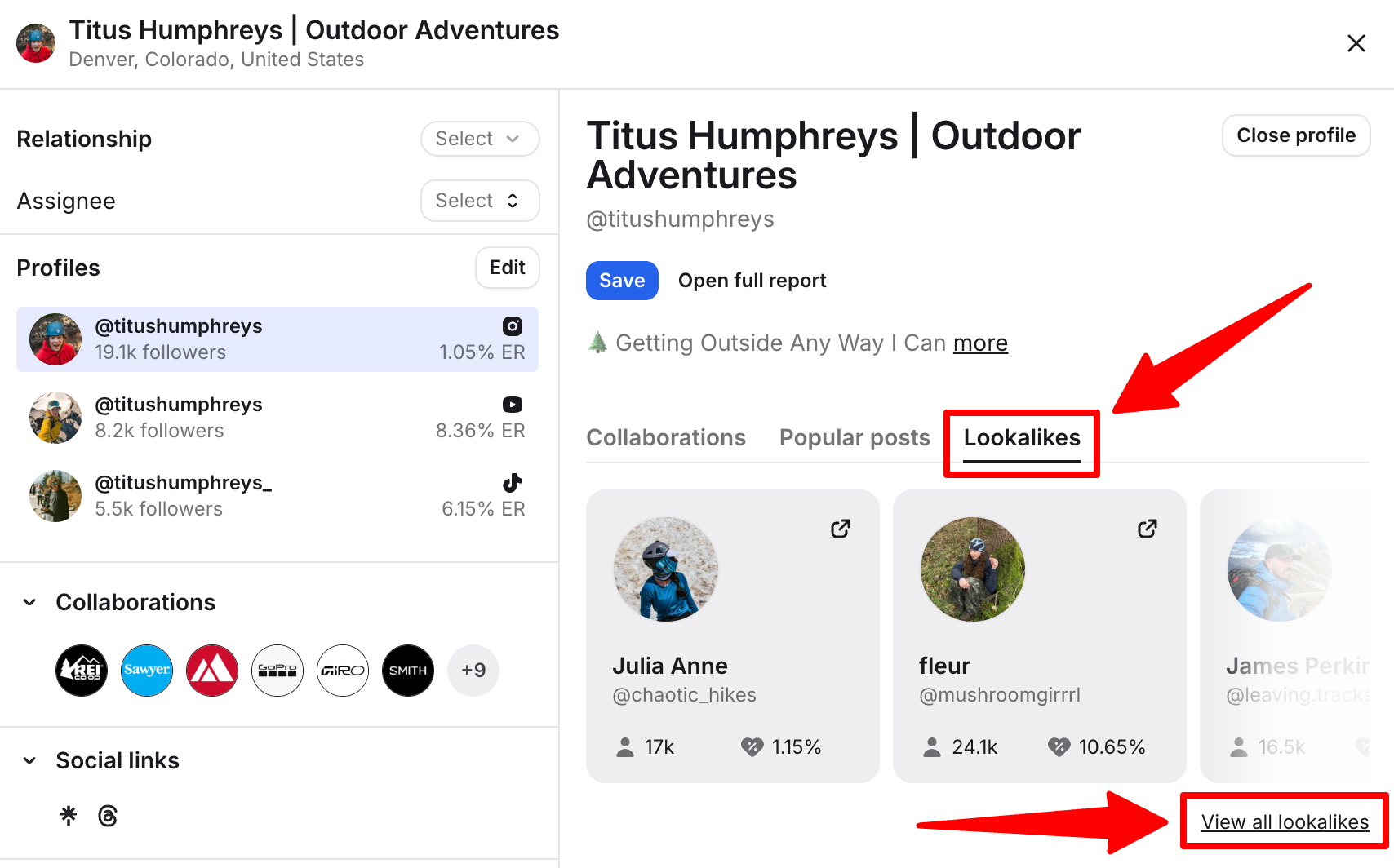
And because each lookalike has their own lookalikes, it takes barely any effort to find hundreds of relevant affiliates using this approach 😎
👉 Try our discovery filters, lookalike search tools, and more by creating your free Modash account!
Reaching out to creators to ask if they want to join your affiliate program can be slow going. They’re busy, and they don’t check their emails every day. So before you dive into creator outreach, double-check that the creators on your shortlist are definitely a good fit.
Vetting helps you avoid hiring creators who have:
Sadly, there’s no easy way to do it without dedicated software. Your best bet is to email the creator in question (or slide into their DMs) and ask them to send screenshots of their engagement rate data and audience breakdown, then run their profile through Modash’s fake follower checker. As you can see, all you’re really doing here is adding another step to the start of the outreach process, which is far from ideal.
Modash makes things a whole lot easier. Before reaching out to a potential affiliate partner, you can access all the information and data you need to effectively vet them, including their:

🤓 Further reading: Learn more about vetting in How to Assess Influencer Profiles: 7 Factors You Should Look For.
Brands that nail affiliate marketing have the best relationships with their affiliate creators – keeping them motivated through regular communication, rewarding them with attractive (tiered) commissions, and ensuring they’re getting correctly credited for all the sales they generate.
Building rock-solid affiliate relationships takes a lot of work. But Modash saves you time and effort on key tasks like tracking content, measuring results, and re-engaging dormant affiliates. Plus we help you find the right affiliates in the first place with our database of 380M+ creators.
See for yourself by creating your free Modash account – no credit card required 💅