Free virtual event: hear from influencer leaders at ŌURA, Adobe, Stanley 1913 & more.
See the lineup


No matter how you slice it, gifting is a roll of the dice.
You’re sending “free” product to an influencer, and hoping there’s going to be some kind of ROI.
But gifting is notoriously unpredictable. Creators might:
And whether you choose barter deals or no-strings attached, you’re still gambling. You’re just swapping the stakes: relationship against ROI.
So what do you do?
Gifting is always a gamble. And while marketers might opt for barter deals as more of a sure bet, what they’re gambling instead is the relationship with their creator.
We’ve got a problem with gifting.
Well, a lot of problems.
The first is that an email titled “We’d love to gift you” can mean two totally opposite things:
The second problem is that marketers have expectations – both on themselves and on their creators. It doesn’t matter that 90% of influencer marketing is directly dependent on the actions of others. Marketers are still responsible for making the number in the spreadsheet go up.
That means marketers want predictability. They want sure bets. So, they love barter deals.
The third problem is that creators hate barter deals. Whether it’s because they’ve been burned in the past, or they just feel like it’s unfair, influencers have cooled off on accepting gifted products in return for content.
So that leaves us with:
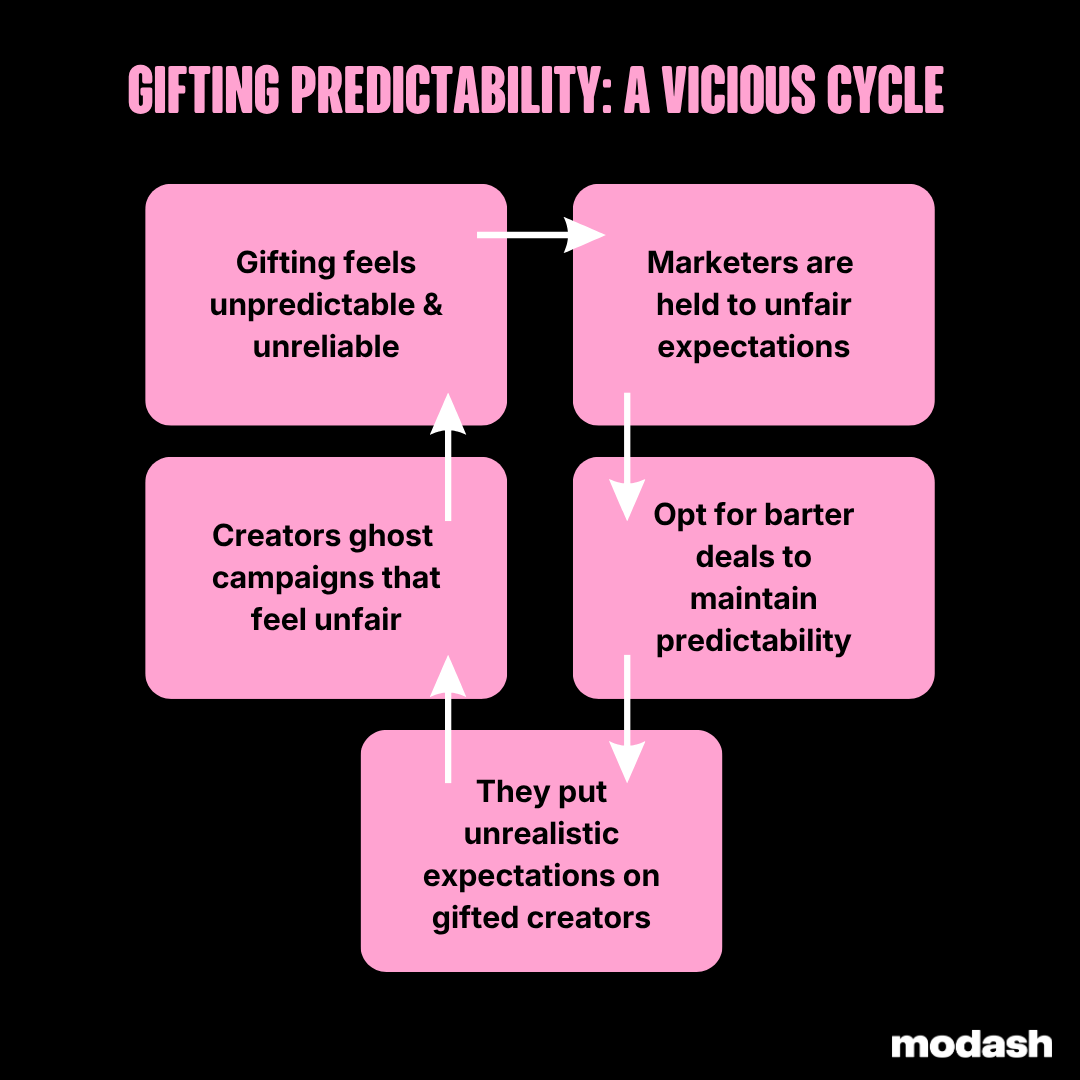
It’s a vicious cycle.
Barter deals feel more certain for sure. After all, a creator has agreed to post.
And you’ve got metrics to hit and a deadline to meet. You get more say in the deliverables, and you can actually measure progress.
But creators hate barter deals.
According to marketers – creators they outreach only accept barter deals a paltry 36% of the time.
And that’s even if you get a response. 7 out of 10 marketers said they get significantly fewer responses with barter deals compared to no-strings attached offers.
When creators do respond – they push back on barter deals.

That said – barter deals do offer some posting consistency.
Kinda.
65% of marketers said that creators post more consistently for barter deals. But when we asked the marketers that use barter deals how often those collabs actually ended with a post – it was a coin toss (43.8% for no-strings attached vs. 50% for barter deals).
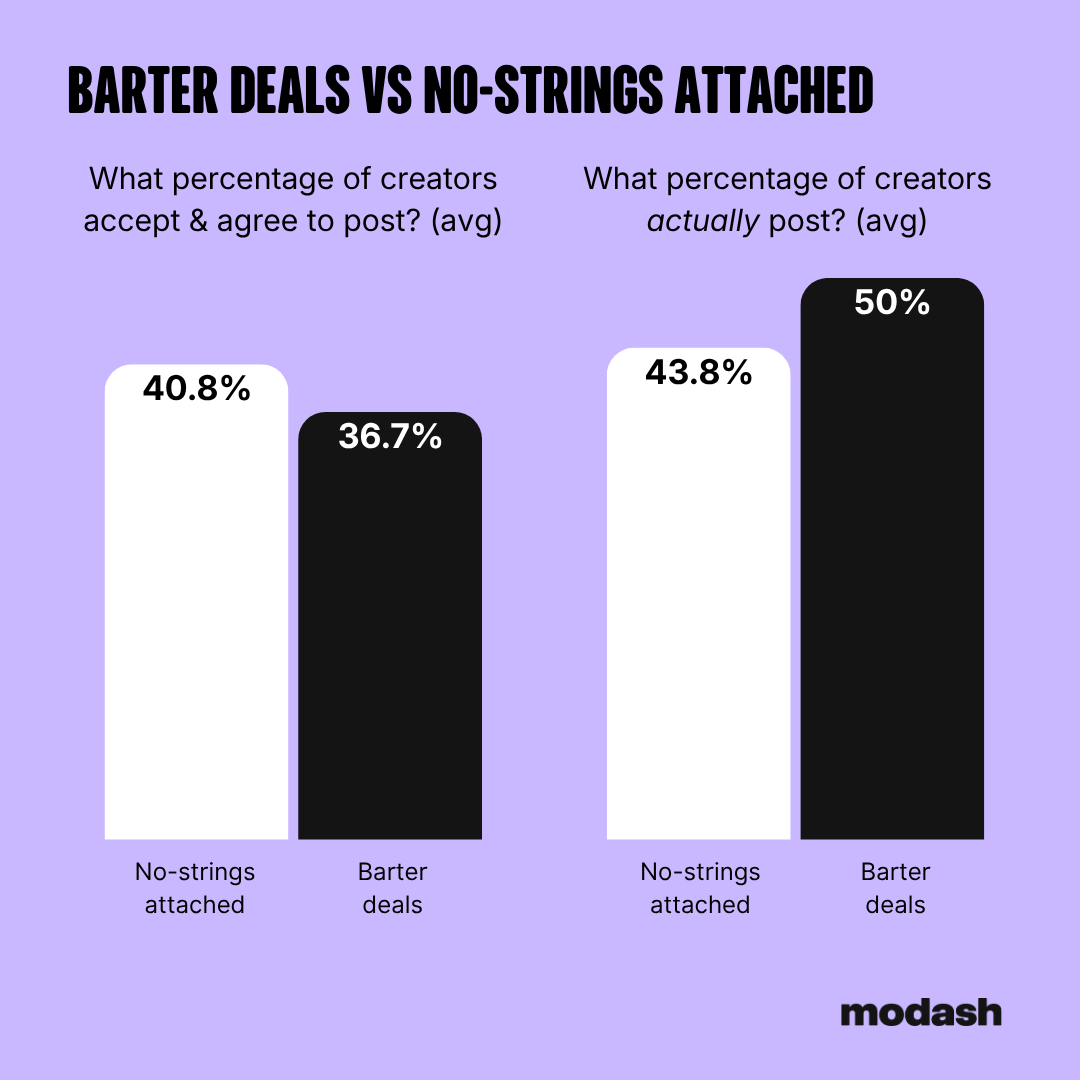
So my question is: If a creator responds less often, pushes back harder, and only posts half the time – is a barter deal worth starting a contentious relationship with a creator?
Let’s crunch some numbers.
Using the above averages, let’s say you’re gifting a $50 product and outreaching 100 creators as a benchmark.
| No-Strings Attached | Barter Deals | |
|---|---|---|
| Creator accept rate | 41% | 37% |
| Total cost of gifted products | $2050 | $1850 |
| Number of posts | 18 | 19 |
| Cost per post | $113.88 | $97.36 |
On paper, barter deals do work out to a slightly better ROI – just on cost-to-posted content alone, despite the lower response rate. Even though no-strings-attached deals end up with fewer posts overall, you’re sending more products, so a similar amount of influencers end up posting.
As we say in French – it’s kif-kif. It all works out about the same. This is going to depend on your product price point, of course. If you gift a higher ticket item, that tiny difference isn’t so tiny.
But if your price point is on the lower side, is $16.52 worth gambling a creator relationship?
Creators can’t feed themselves or pay their rent from product alone. Yet, some marketers offer barter deals with no other incentive – despite asking for several deliverables and long-term usage rights.
Oh, and without a contract.
But here’s the thing – creators push back against barter deals when they feel they’re getting taken advantage of. And it’s not rocket science – why would you do something for free when others are paying you for it?
And I’m not saying they’ll never accept barter deals – nor am I saying you shouldn’t do them.
What I am saying is that you need to pick the right tool for the job – or in this case, the right gifting method for your creator, brand, product, and situation.
Barter deals are good when:
And there is a right way to do barter deals in a way that feels fair to both you and your influencer.
Barter with happy customers that have small followings. They already know and love you, so they'd be overjoyed to post in return for product they'd have purchased anyway.
Not only is the relationship going to start off more positively, but the content is likely to be much more authentic. Barter deals are a great way to turn your happy customer into a full-on brand advocate.
We’re currently surveying creators, and the vast majority of brand offers creators get are gifting. So if you're going to join the throng of brands vying for their attention, you’ll need to make sure you’re offering something that’s worth their time.
Anna Jędrzejewska mentions that sometimes the offer doesn’t fit the demand – which is where a lot of brands are getting barter deals wrong.
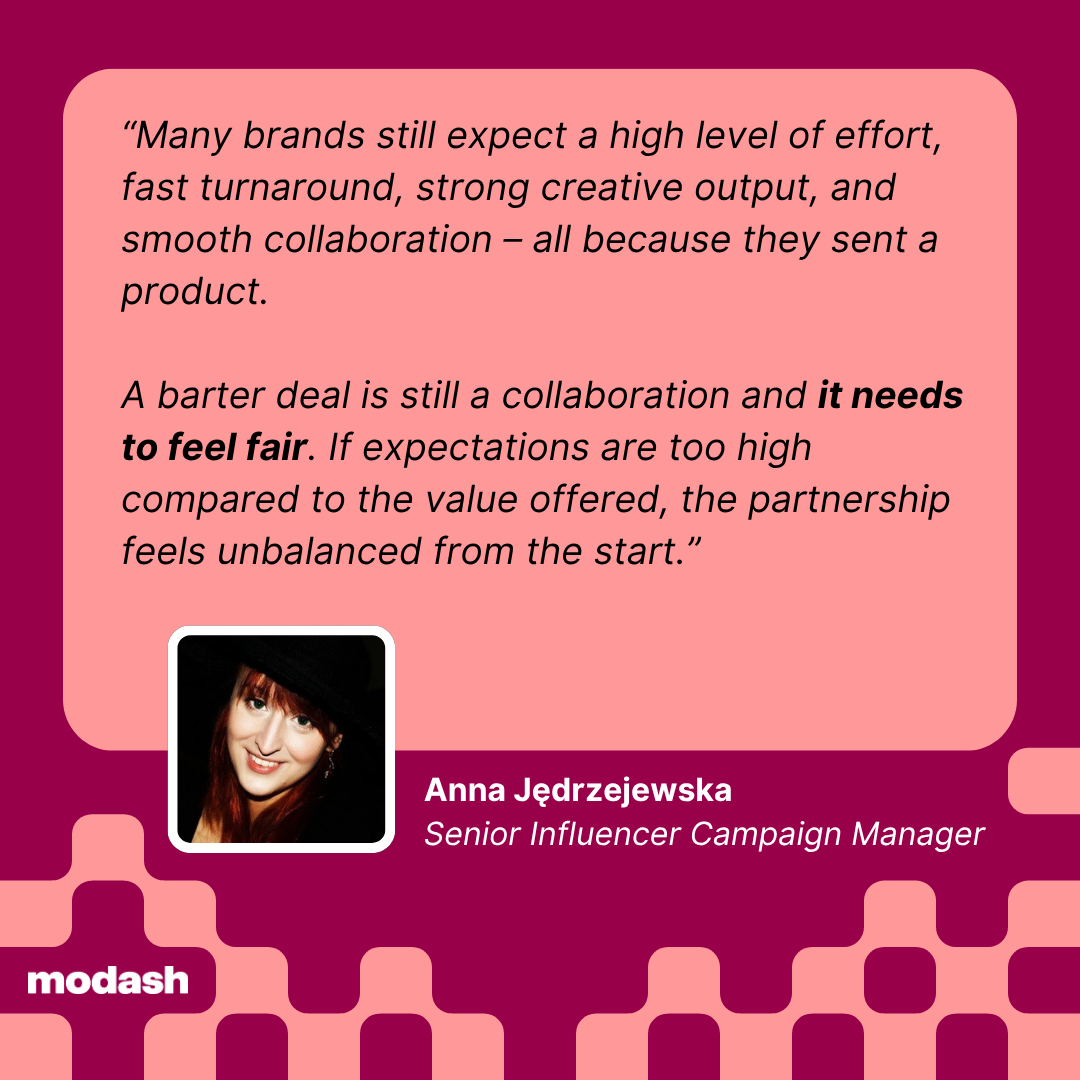
For barter deals, you'll want to offer things that justify what you're asking for. Obviously, for big-ticket items, the gift might be enough. But if your products are at a lower price point, it doesn't hurt to offer some other things as well – especially if you’re asking for multiple deliverables and usage rights.
This could be:
So again – you can’t offer $20 worth of product to an influencer who’s never heard of you, and expect deliverables that they normally get paid for. That’s not going to work.
So heavily consider what you ask of someone:
When you follow up with a creator, ask about the product. Give them time to have formed an opinion on it. Ask if they’ve had a chance to try it out, and ask for genuine feedback.
What we’re doing here is specifically not putting pressure on your influencer. No one likes feeling pressured. Instead, make your follow-ups about the product and whether your creator likes it.
That means each follow-up needs to count. Robert Polonski of Deeper says that it’s sometimes like pulling teeth – especially when each follow up feels so risky.
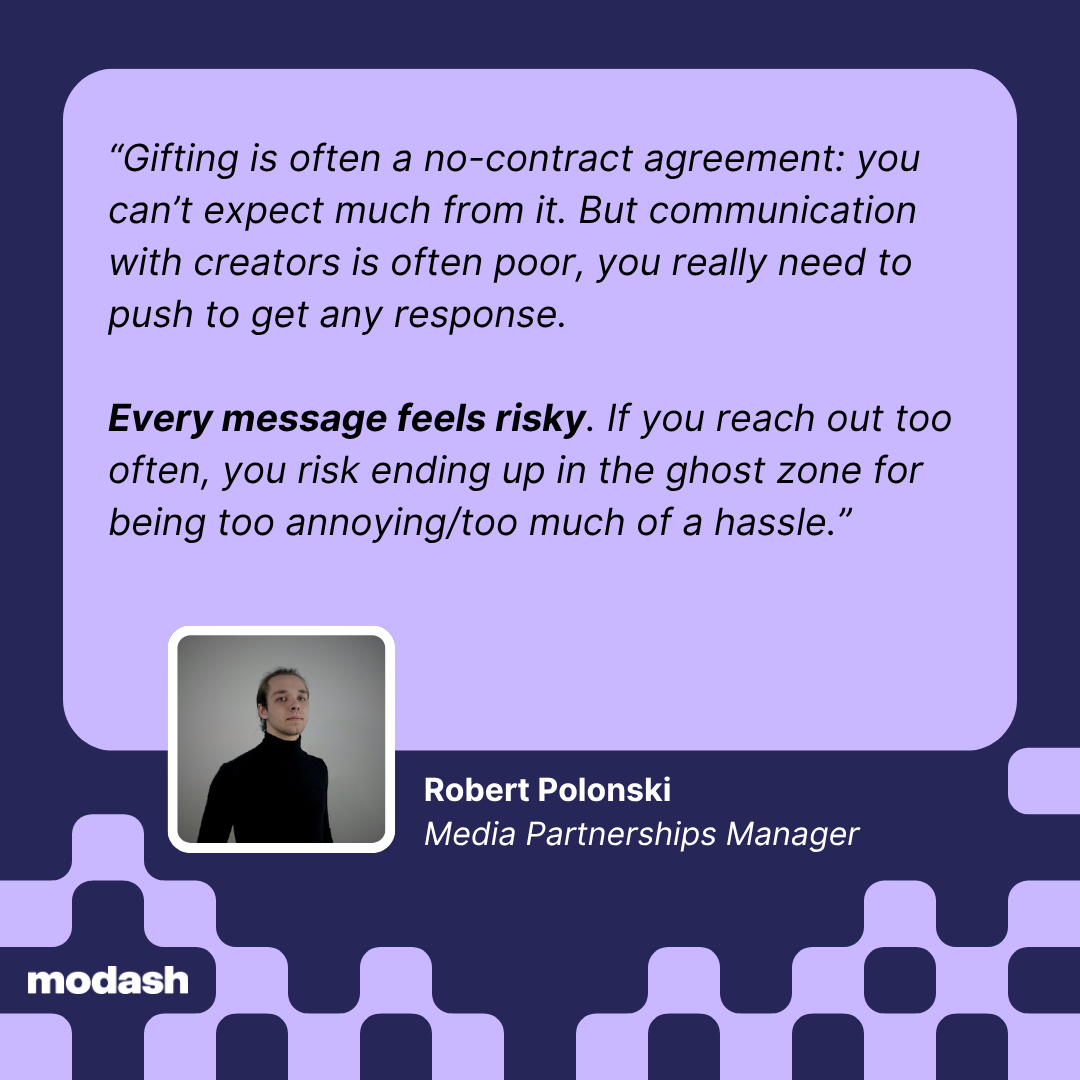
We already know that gifting deals have the highest ghosting rates of any other kind of collaboration. Don’t give your influencer a reason to ghost before your collab has even gotten off the ground. And if they do happen to ghost before you get a post – at least you get feedback, so it’s not a complete loss.
Here’s the thing: you’re going in with no contract, and no monetary payment. So if you’re looking to start a relationship off on the right foot, no-strings attached is the way. But like, real no-strings attached. Not the kind where you send a brief alongside just in case and ask them to post later.
The best way to approach no-strings attached deals is to make it about your creator – not your product or brand.
Think of it like a first date. You’d ghost someone who only talked about themselves and didn’t ask questions about you, right? It’s the same situation here.
This is your opportunity to start a real relationship with your creator:
This is your opportunity to build brand affinity. If a creator ends up liking your product and having a good experience with your brand, they’re going to be so much sweeter on posting content afterwards.
And it only works if you’re being intentional about gifting to that creator. Alice Arruda says it’s about making your creator feel valued.
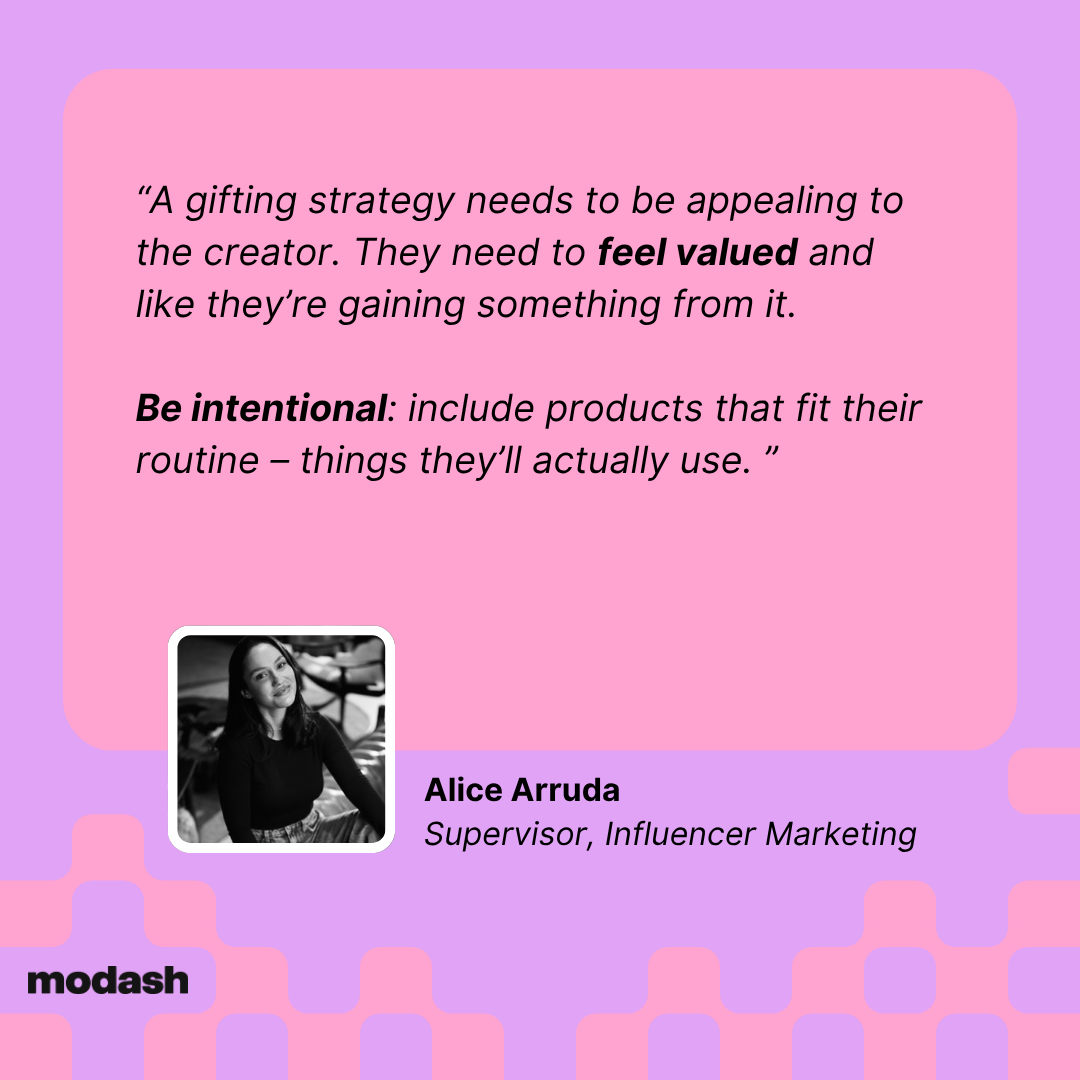
Much like our follow-ups, it means making the gifting about the creator, and not about you.
It’s basically the same thing you’d ask about a customer. And that’s the point.
An influencer you work with should be the spitting image of your ideal customer – or at least one of your customer profiles.
When a relationship feels transactional, there’s obligation. Obligation immediately colors someone’s perception of a gift. That means what they say is going to be less of their honest feelings, and more of your talking points.
The result? According to Victor Wiśniowski, stiff inauthentic content, or a dreaded ghost.
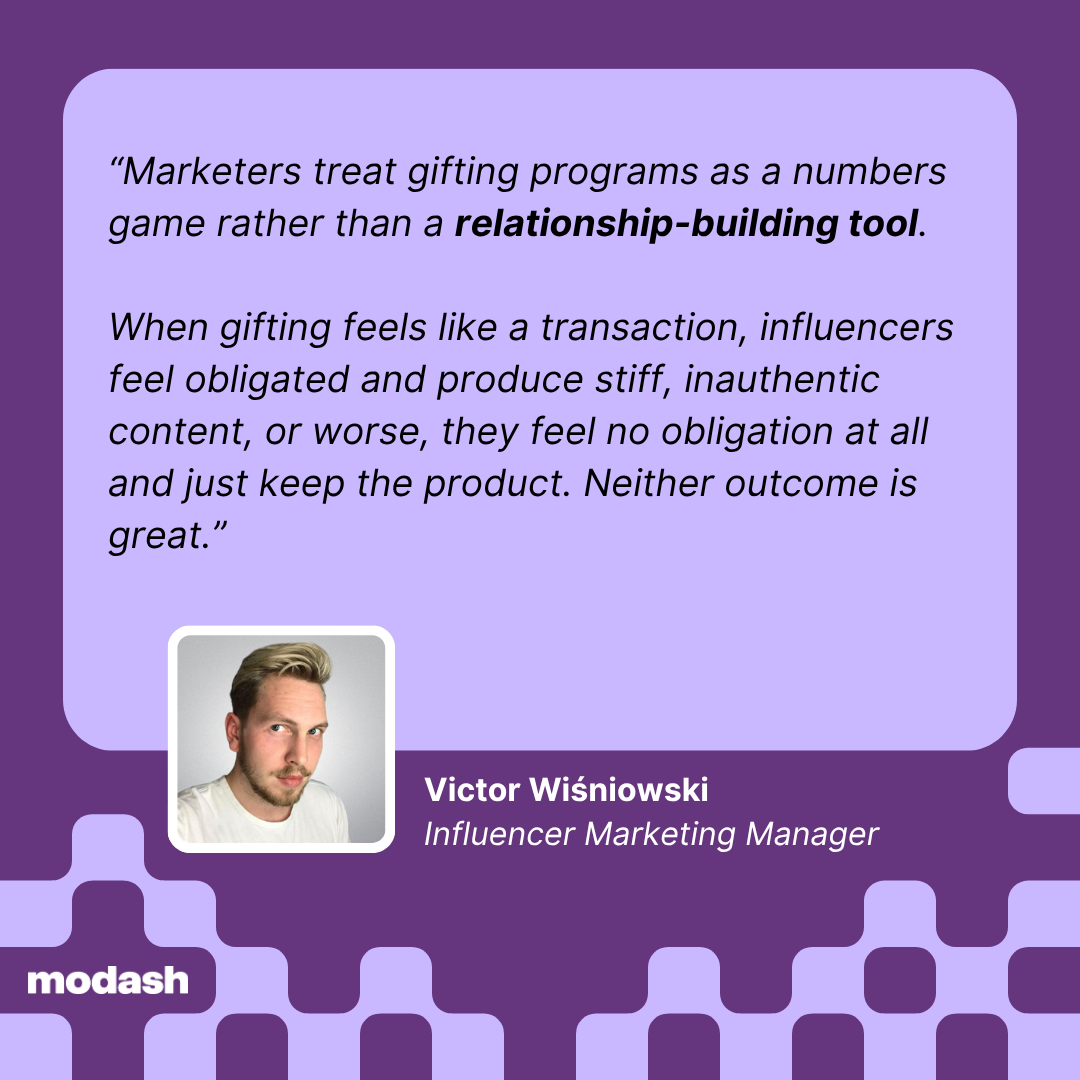
It’s cool if that’s what you want – but if that’s the case, buy an ad. You’re not working with influencers for them to regurgitate your marketing slogan, you’re working with them because an audience relates to them, and trusts their opinions.
It's obvious when a creator isn't being completely genuine about their experience. It’s your job to make sure that experience is stellar.
No-strings attached only works if there actually aren’t expectations attached.
Are creators going to ghost you? Yes.
Are they going to post less-than-ideal content? Yes.
Are you maybe going to get zero ROI on some of those gifted products? Yes.
It’s going to happen. And that means you need to be okay with that.
You are more than welcome to hope they post content – but do it quietly. In your corner. Don’t pressure them.
– And you can’t presume to. It’s no-strings attached after all.
According to Athira Aravind, the second you start asking for things in return, the gift doesn’t really feel like a gift anymore.
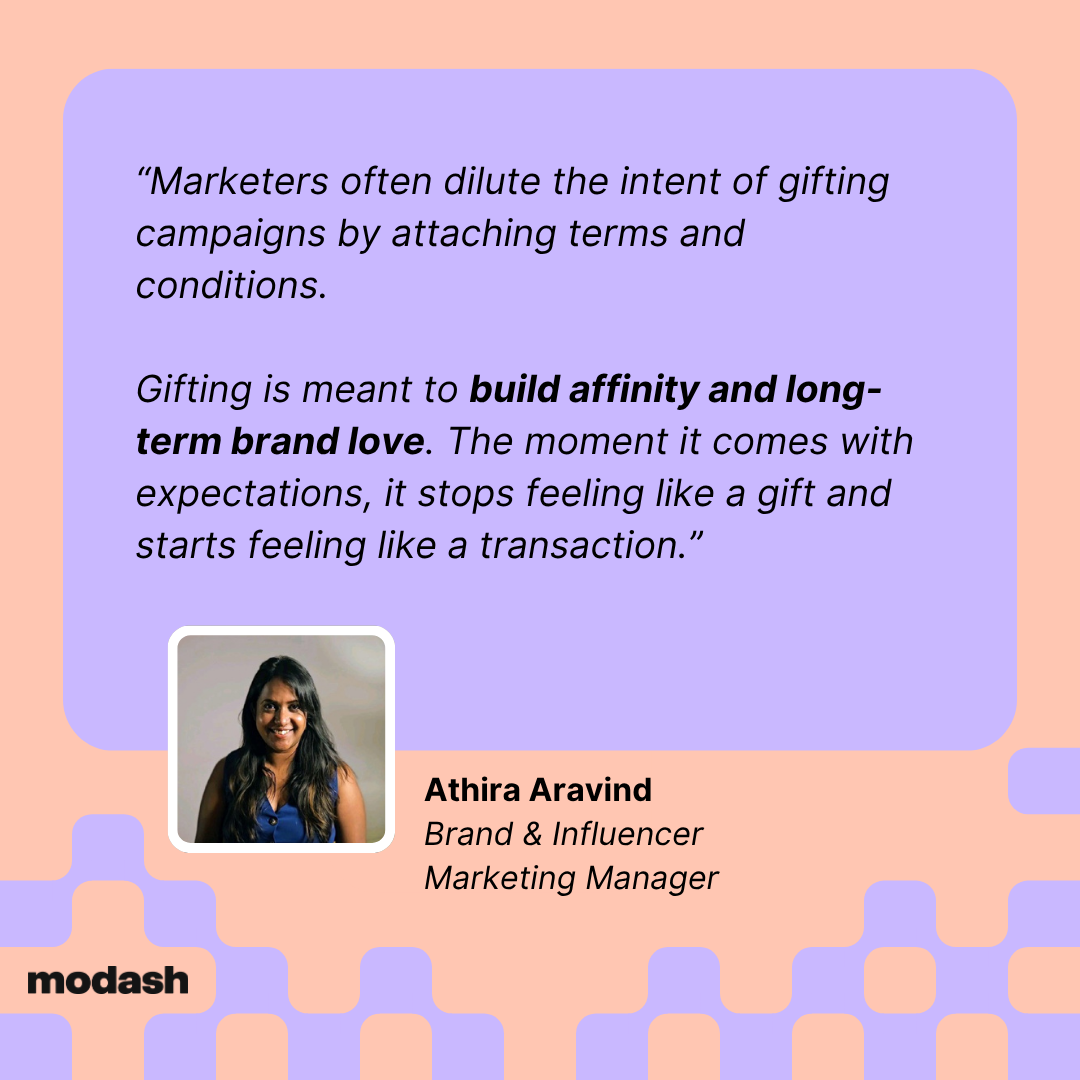
And no one likes a gift that comes with expectations. Especially if you weren’t honest about that from the start.
No-strings attached isn’t about generating immediate revenue – it’s about building relationships and testing the waters.
No-strings attached deals are great for:
There’s going to be loss. It happens. But as long as you let go of the inner control freak (we’ve all got one. Mine’s named Maurice), it’s going to be okay.
Gifting is tough. There’s a ton of work involved, logistics to think of, and when creators aren’t even responding to your emails – it’s easy to want collabs that feel the most certain.
But no matter what, you’re making a gamble. You’re either gambling your ROI or you’re gambling creator relationships. The thing that feels more expensive to you is going to determine what gifting style you opt for.
But as a general rule:
Barter deals are great when you:
No-strings attached deals are great when you:
And if you need more – check out the Modash Gifting Playbook for a full tutorial on gifting.
Our expert contributors