Free virtual event: hear from influencer leaders at ŌURA, Adobe, Stanley 1913 & more.
See the lineup


Two years ago, we ran our first gifting survey. Back then, most of the marketers we talked to were running gifting as a core part of their influencer program.
That’s changed.
Today, most marketers use gifting to support other initiatives – paid collabs, affiliate programs, product launches. And when asked to rank their influencer marketing initiatives by importance, marketers put gifting near the bottom of the list.
The weird part is that nearly 80% of marketers still say gifting is ROI-positive.
Why has a program that clearly works fallen so far out of favor? We surveyed 74 influencer marketers to find out. The short answer is:
Gifting can still be an incredible way to open the door to real creator relationships. But for that to happen, brands need to be more intentional about who they gift and why, sweeten the deal if they expect posts without payment, and temper their expectations around what free product actually earns them.
In this report, you’ll learn:
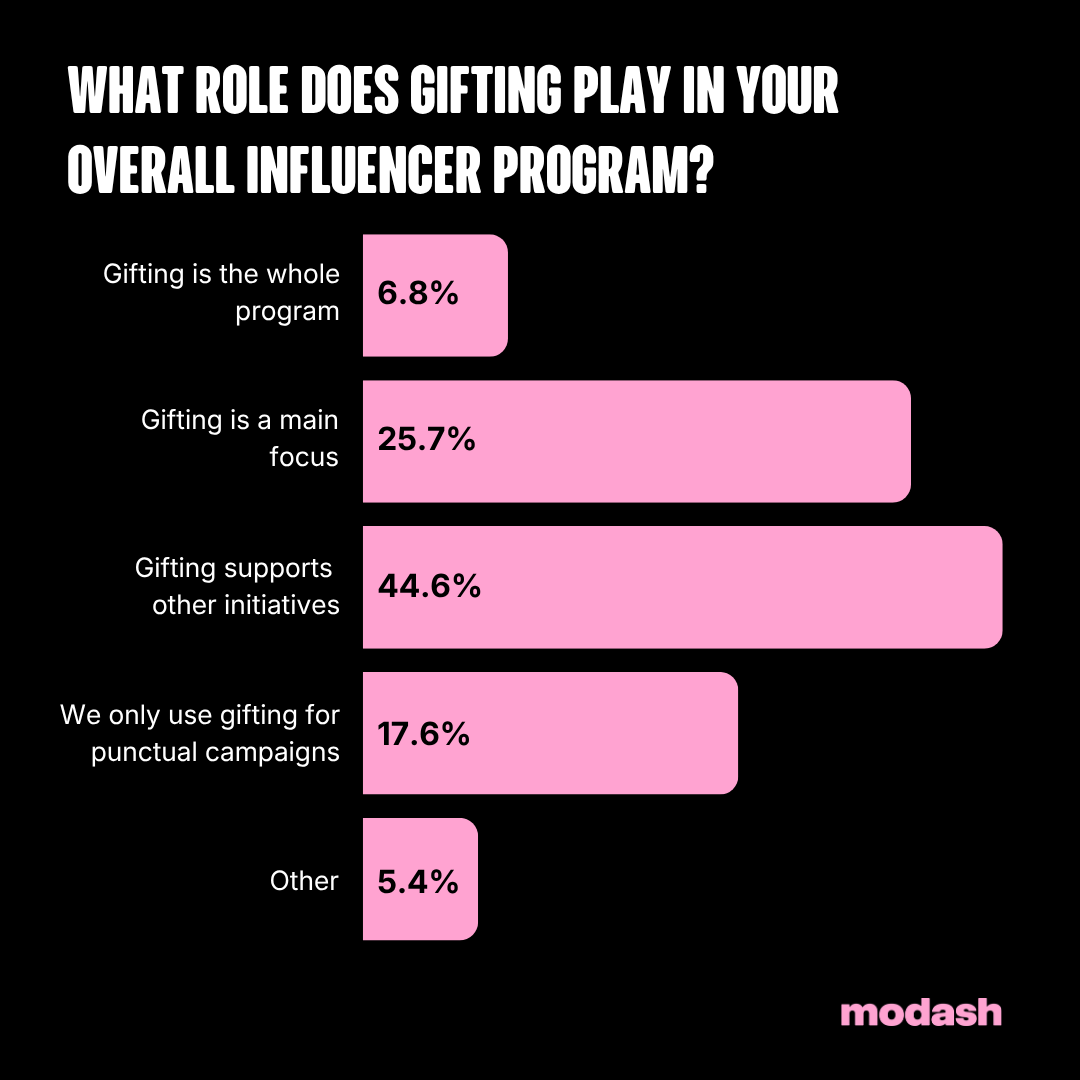
For most marketers, gifting plays a supporting role in their influencer marketing strategy. Nearly half of the marketers we surveyed said gifting supports other initiatives – paid collabs, affiliate programs, product launches. Fewer than 7% said it’s a main focus or their entire program.
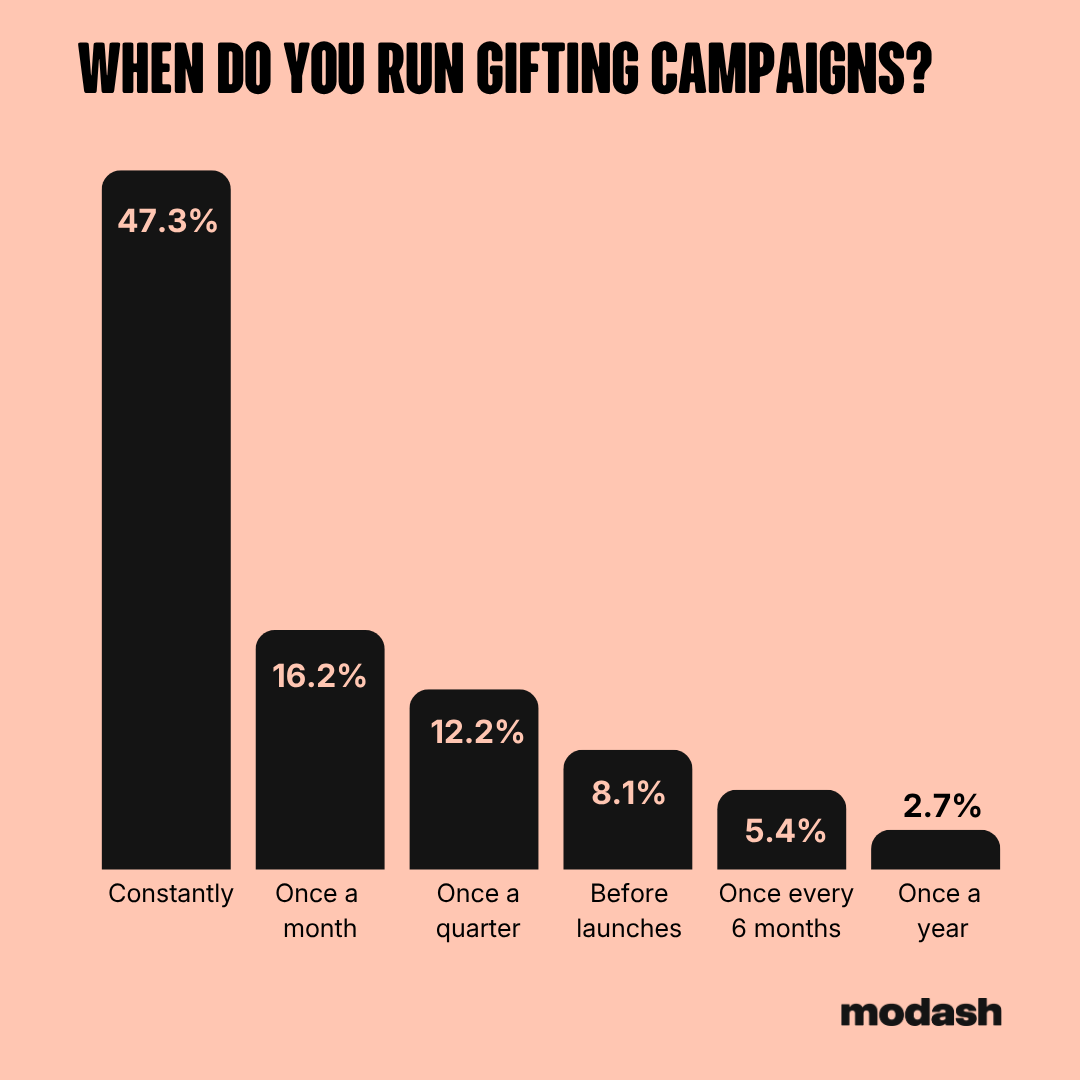
Despite that, most marketers run gifting collaborations constantly. Nearly half say they run gifting on an ongoing basis, and another 16% run campaigns monthly.
But the scale stays small. Two-thirds of marketers have fewer than 25 gifted collabs go live in a typical month, and most are reaching out to fewer than 50 creators per gifting campaign.
So gifting is always on – but it’s rarely given the attention or resources of a real program.
Here are the top reasons marketers aren’t able to scale gifting collaborations:
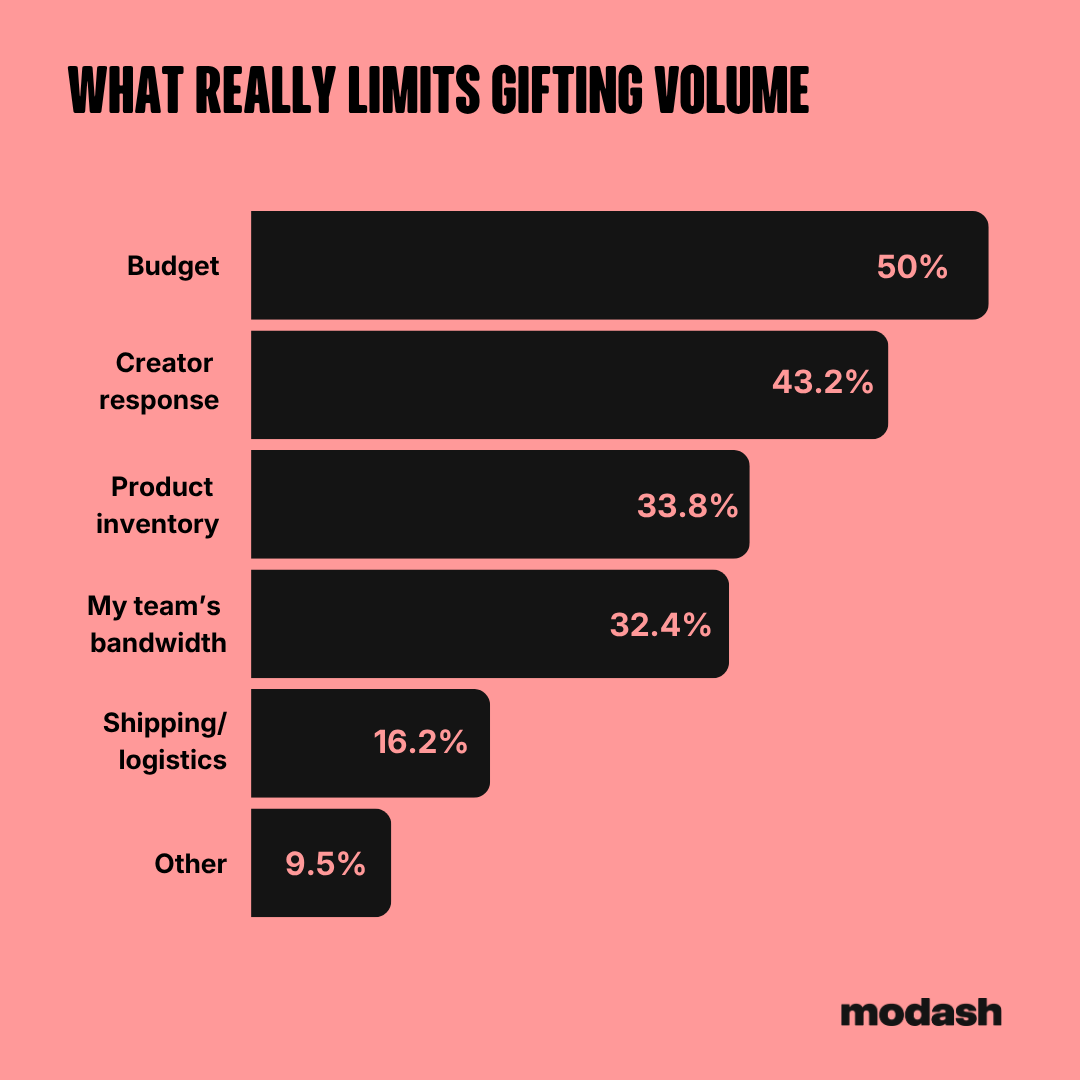
Budget, of course, is the most obvious culprit.
Creator response comes in at second place. Nearly as many marketers (43.2%) are being held back by creators not wanting to participate as by the money itself.
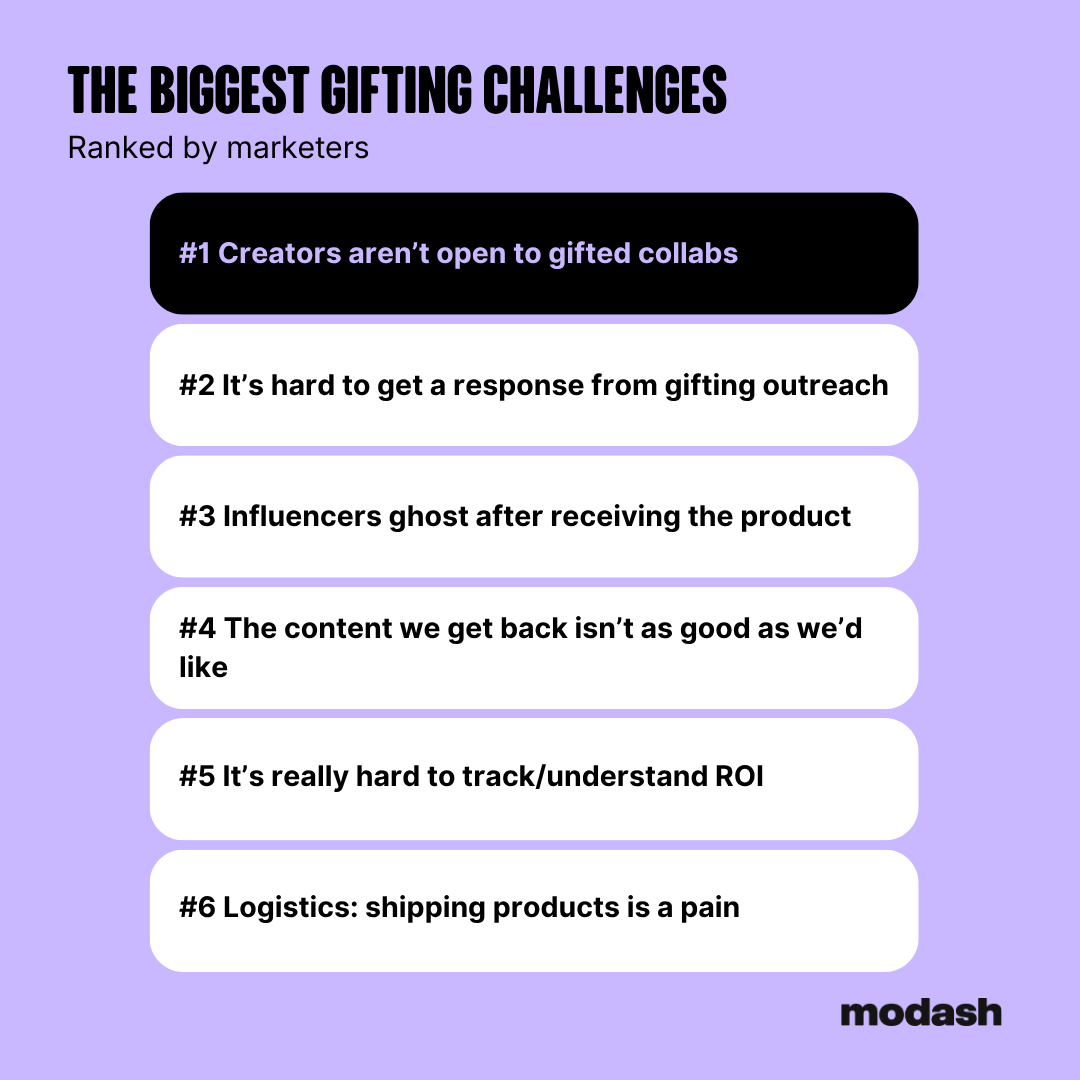
This becomes even clearer when you look at the biggest challenges brands face with gifting today. The top three are all about creators’ lack of willingness to participate in gifting programs (often shown through lack of responses and ghosting).
Team bandwidth is also one of the most practical reasons why gifting becomes an afterthought for marketers. According to our salary report, marketers are managing nearly 20 different task types in an average week – discovery, outreach, contracts, content review, reporting, cross-team collaboration, etc. Four in 10 are also managing their brand’s social media accounts on the side.
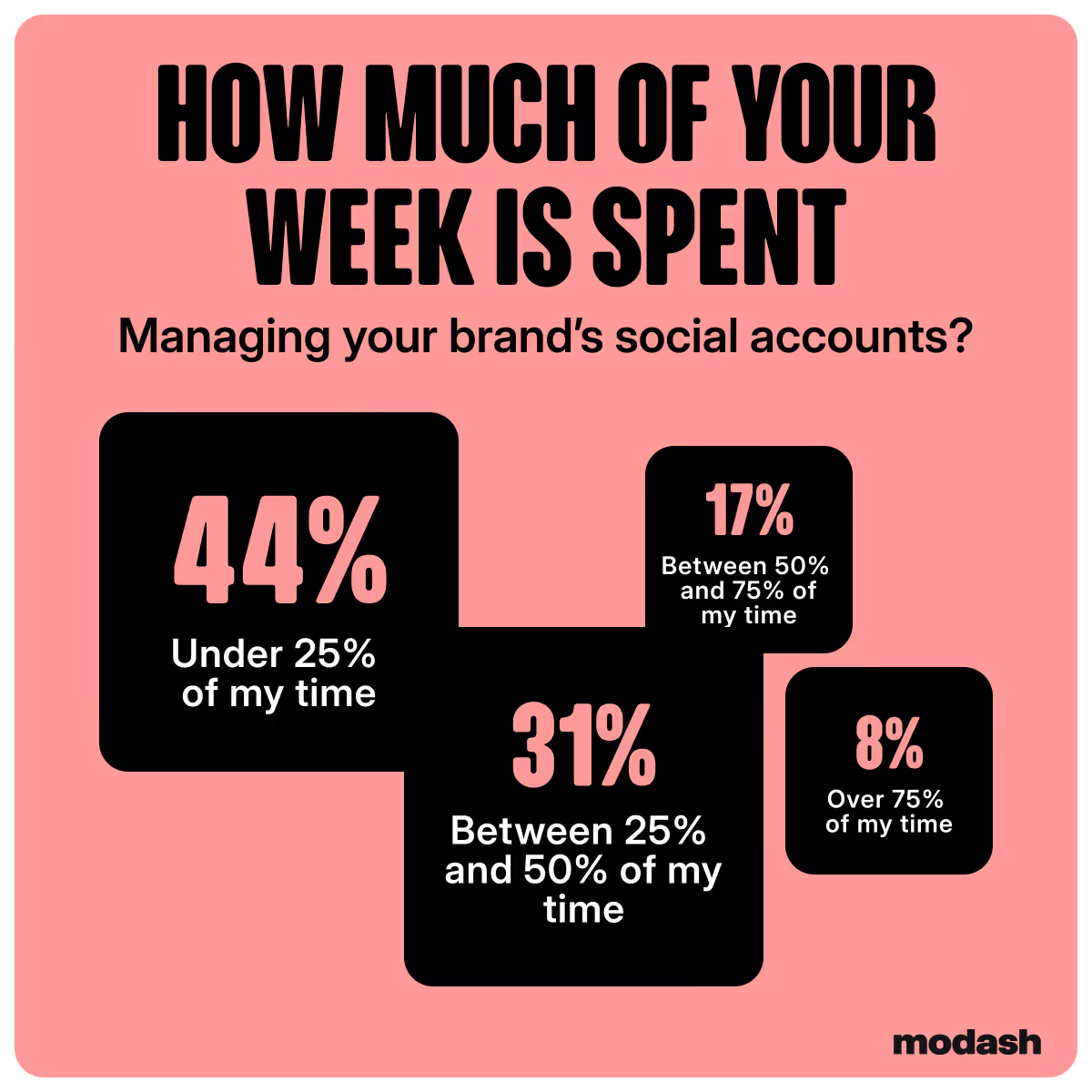
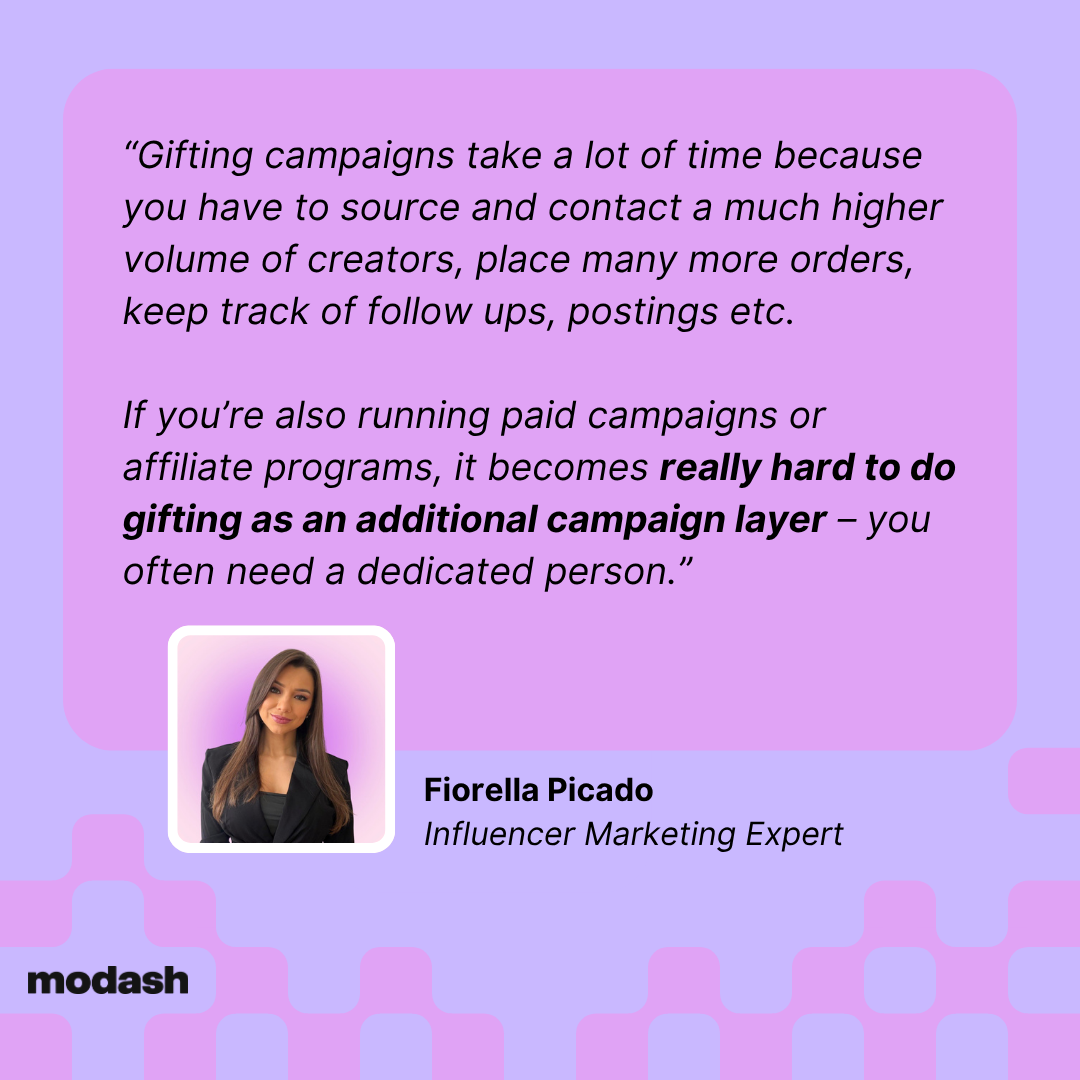
Gifting adds its own layer of sourcing, shipping logistics, and follow-up on top of all of that, which many teams – especially small ones – just don’t have the time to scale.
Fiorella Picado puts it well:
And even when teams magically manage to find the bandwidth, the logistics side creates its own headaches. Internal delays, custom duties, shipping costs, delayed delivery, lost packages, and damaged products are some of the biggest challenges marketers face in gifting operations.
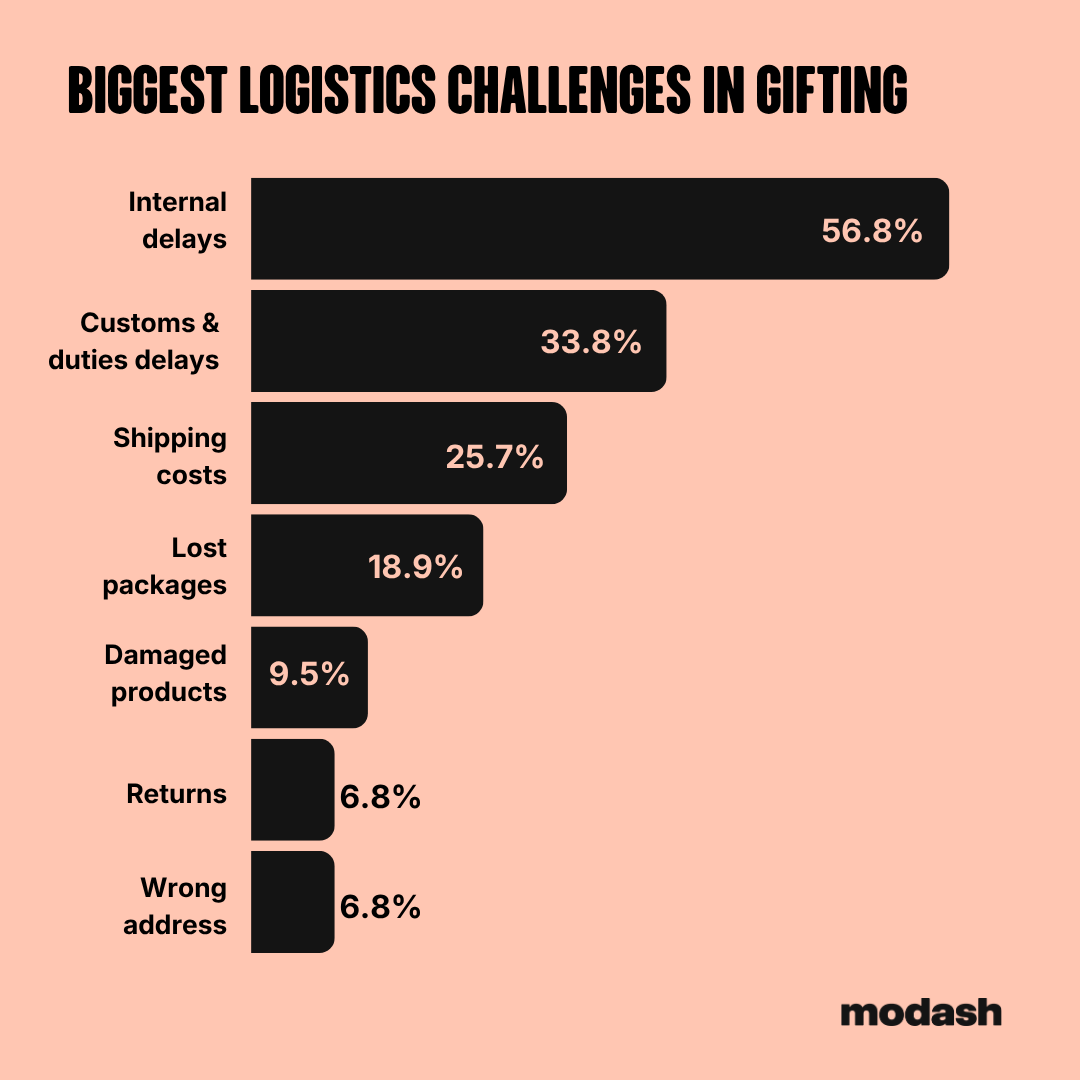
When we asked marketers what gifting problem they’d magically solve, logistics came up over and over – from international shipping nightmares to lost packages to the sheer operational chaos of tracking addresses, sizes, and delivery statuses at scale.
Between the bandwidth constraints and the logistics headaches, it makes sense that most teams keep gifting running but never scale it up.
Gifting feels low-risk. The cost per creator is just the product* and shipping – there’s no creator fee.
(*Assuming you aren’t practicing influencer marketing for an expensive product.)
But when you start scaling your gifting program and start reaching out to 50, 100, and more creators a month, the product cost, shipping, and follow-up time add up fast. If two-thirds of those creators don’t post about you, you’re likely losing money investing in those partnerships.
Most marketers know this. More than eight in 10 say they evaluate creators differently for gifting than for paid campaigns. What’s the stuff they look for? Content quality tops the list at 75.6%, followed by engagement rate (59.5%) and audience fit (56.8%). Viewcount, post consistency, responsiveness, and past collabs trail behind.
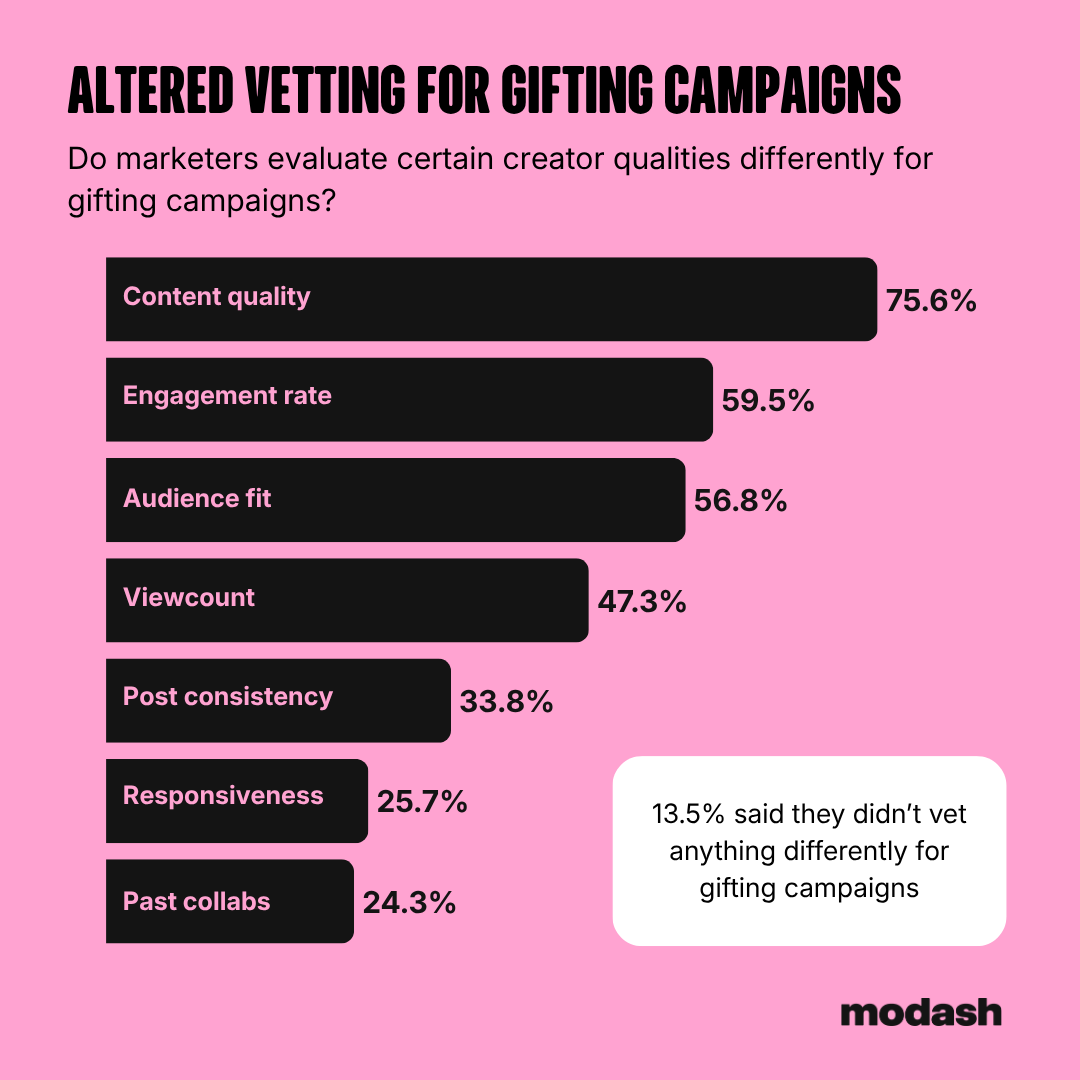
If you’re among the 13.5% who don’t vet any differently for gifting, remember that skipping this step can get expensive, fast.
Given that the top three challenges marketers face in gifting are about creators not responding, not posting, or ghosting entirely – you need to find creators who are a true brand fit and would be genuinely interested in your product and brand.
A staggering 90.5% of marketers say creators ghost gifting campaigns more often than other types of collaborations. This is true despite a majority of marketers (74.3%) following up twice or thrice after product delivery.
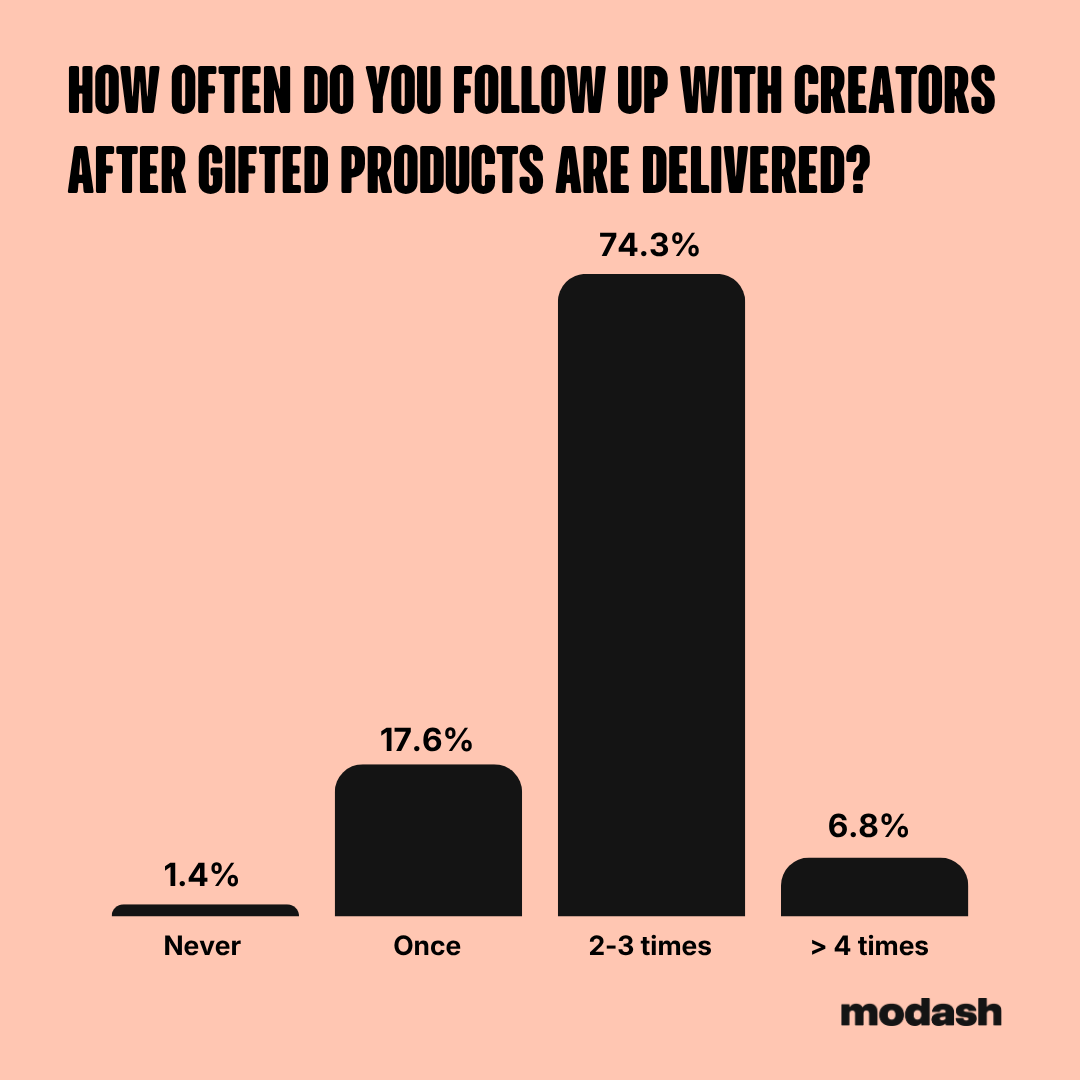
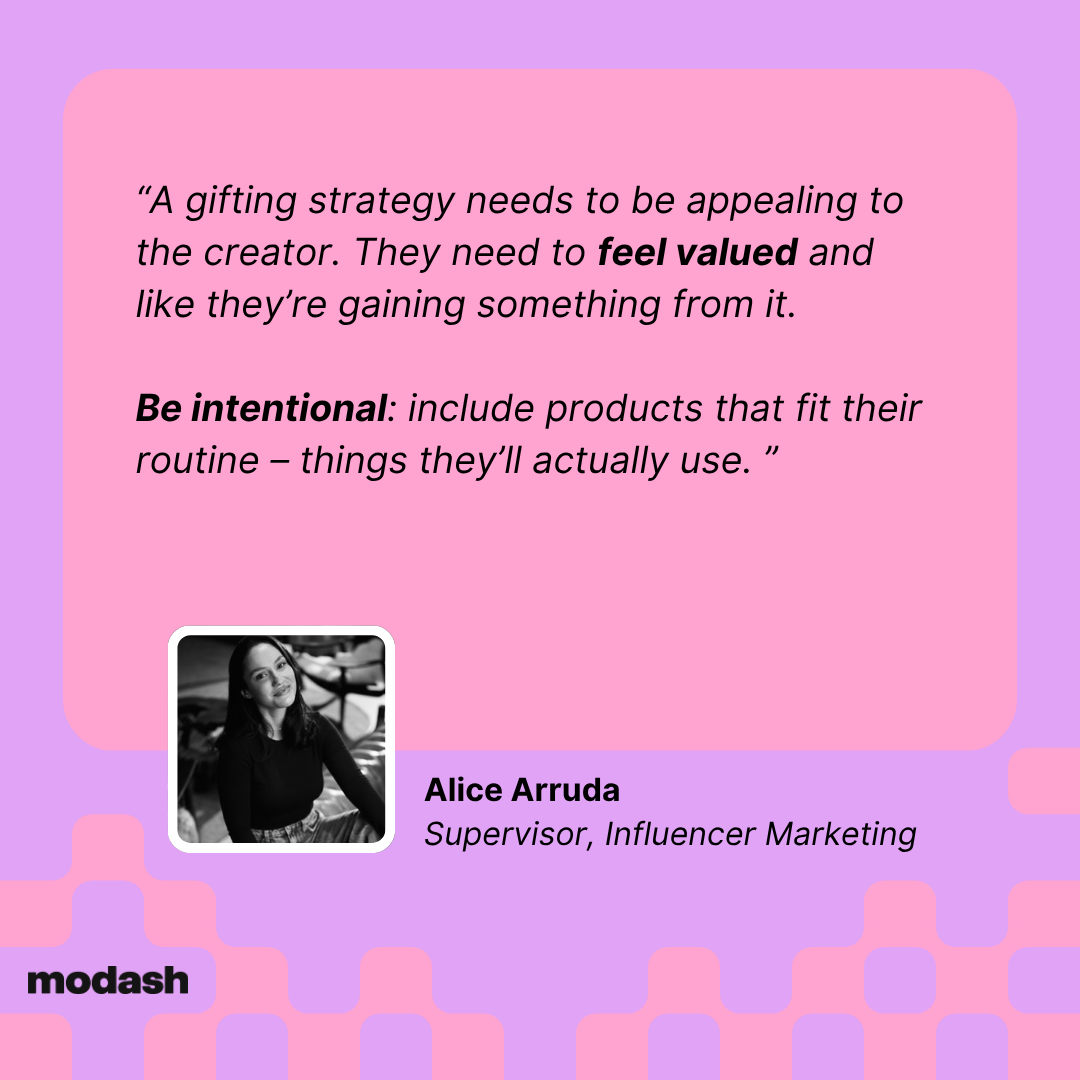
The reality is follow-ups only work if the creator was truly keen to try your product in the first place. When someone accepts a free product and then disappears, it’s equally likely that it’s a vetting problem as much as it’s a creator problem. Alice Arruda elaborates:
Most marketers know they should invest more time in checking if an influencer is truly a brand fit. But thorough vetting takes time that most teams don’t have.
Manually checking content quality, engagement rates, audience demographics, and past brand collabs for every potential gifting candidate is a significant task – especially when you’re reaching out to 50+ creators per campaign.
But if you’re frustrated by low response rates and ghosting in your gifting campaigns, it’s worth examining if you’re casting too wide a net. Gifting at volume only works when the volume is intentional – and even then, finding the right creators is only half the battle. The other half is what happens after the product ships.
When you first kickstart a gifting collaboration with a creator, the hopes are high. You expect the creator to try it, love it, post about it, and become a long-term partner. You dream it’s the beginning of a wonderful friendship.

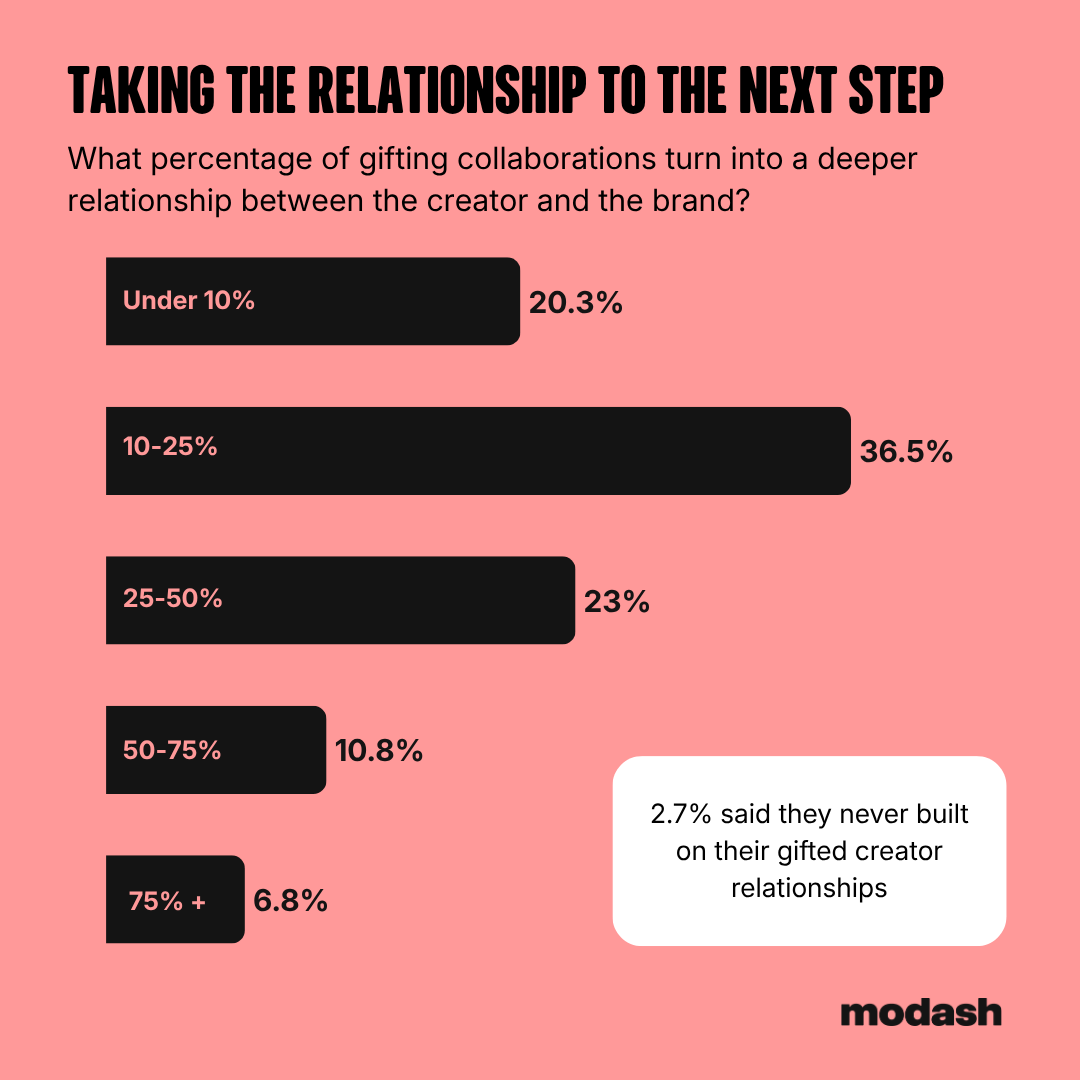
The reality is less romantic. For the vast majority of marketers, fewer than 25% of their gifted collaborations ever turn into a deeper relationship with the creator. About one in five say the number is under 10%.
Some of that traces back to the vetting problem we covered earlier – if you’re gifting to an influencer who’s never been a strong brand fit, the relationship was never going to bloom.
But even when the creator is a good match, brands’ expectations from a gifting collaboration don’t always match what creators are willing to give for free product alone.
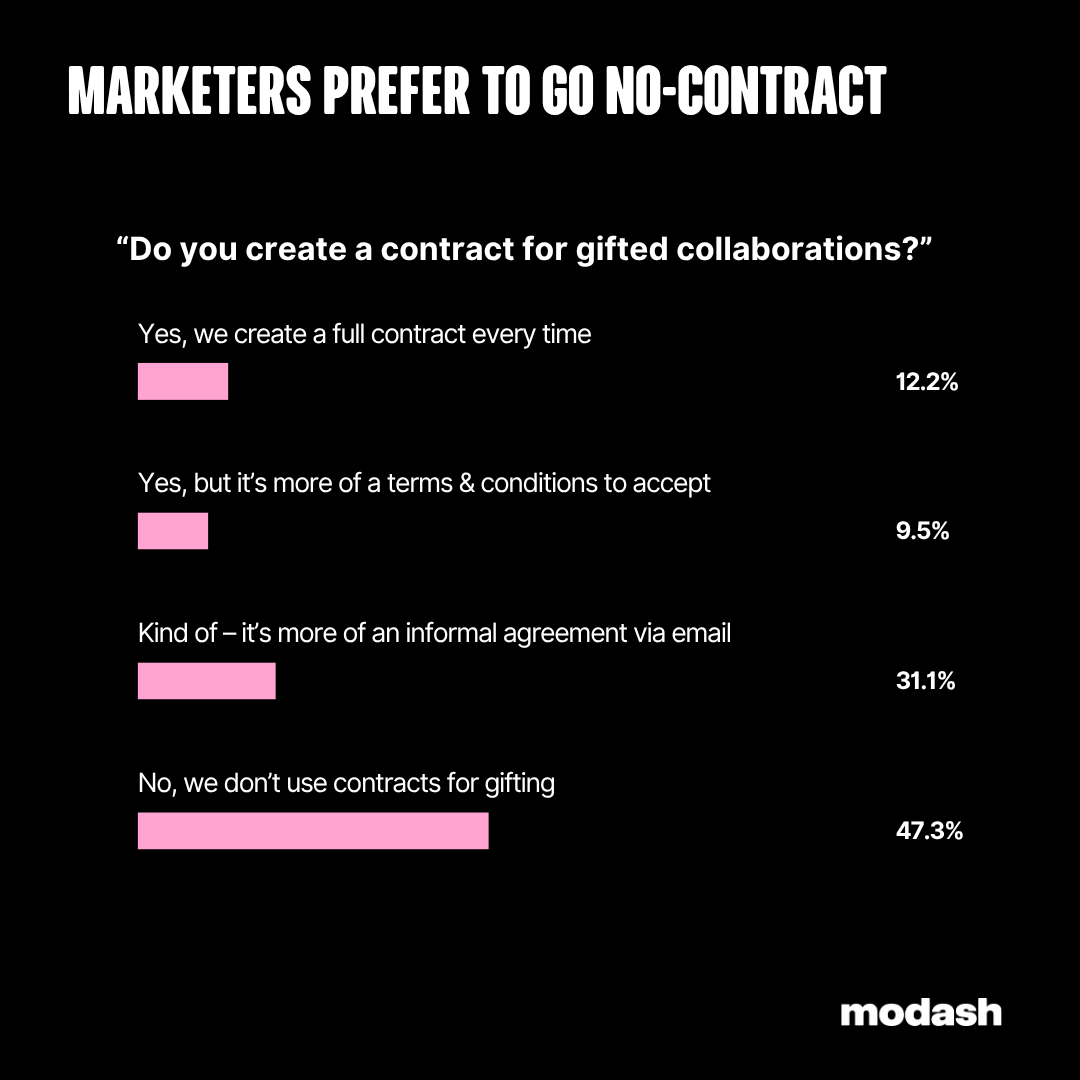
For starters, most brands keep gifting informal – nearly half don’t use contracts at all, and another 31.1% rely on informal email agreements. That makes sense. A contract for a free product feels like overkill.
Despite that informality, though, nearly 80% of marketers still ask for usage rights at least some of the time. And almost a third always ask for them.
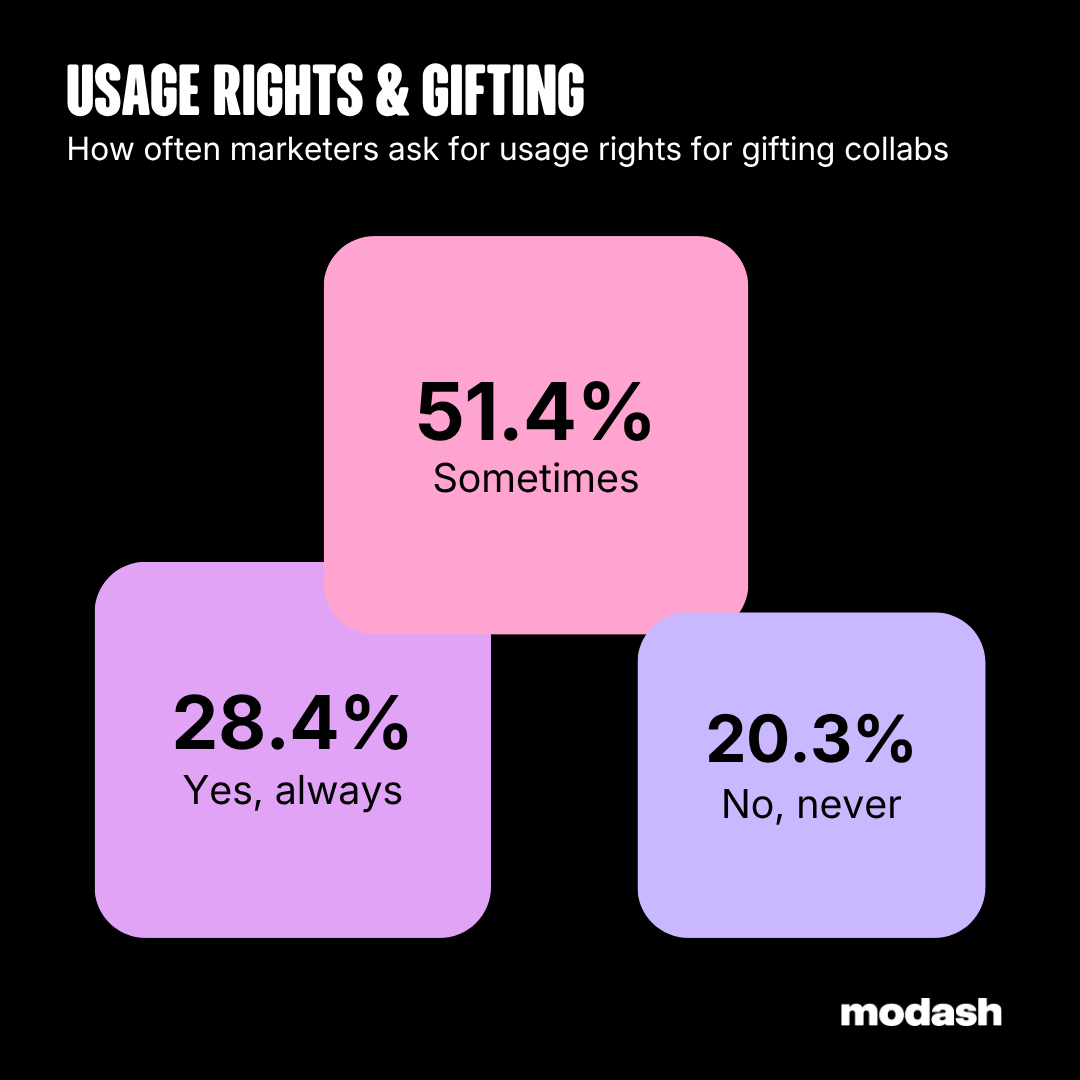
That creates a gap – no formal commitment on either side, but a clear expectation of content and usage rights from the brand. For creators, this stops feeling like a “gift” quickly – which is one reason why relationships don’t move beyond the gifting stage.
This might also explain why ghosting is such a big problem in gifting – nine in 10 marketers say creators ghost gifting campaigns more than any other collaboration type. Gifting will always have a higher ghosting rate than paid partnerships. That’s the trade-off of not paying. But when brands pile on expectations – content deliverables, usage rights, posting timelines – for free products alone, they give creators even more reason to disappear.
In marketers’ defense, most do try to make the experience special for the creator. Over a third send PR box packaging or a handwritten note. Nearly three in 10 also throw in an extra product the creator isn’t expecting.
But the majority are also sending discount codes (52.7%) and creative briefs (51.4%).
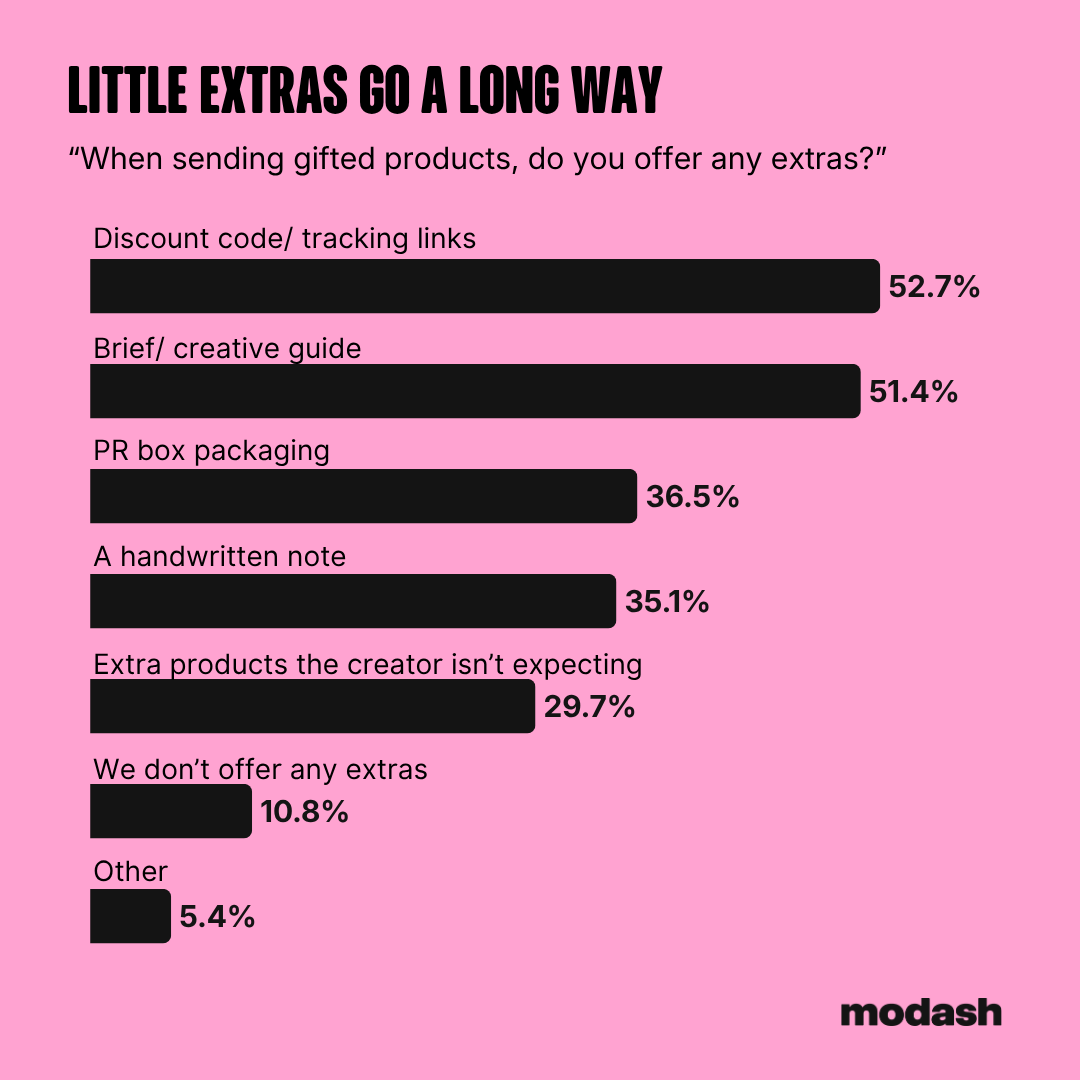
In a no-strings-attached context, this signals you’re expecting a post even when you’ve said otherwise. And even in a barter deal, discount codes and creative briefs serve the brand more than the creator. They’re useful once a relationship is established – but in a first-time gift, they can come across as an expectation rather than a gesture.
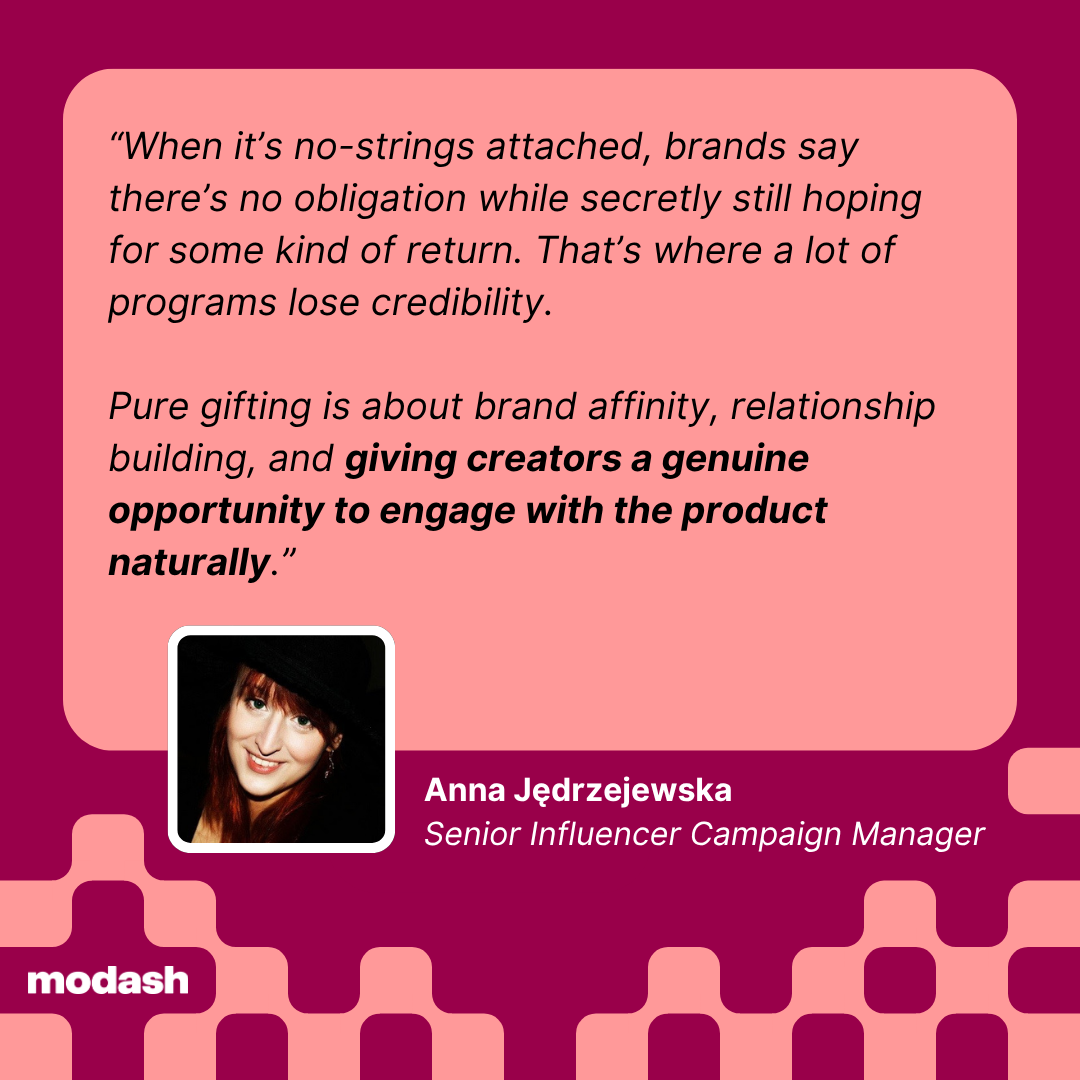
Anna Jędrzejewska points out that marketers often also expect posting in no-strings attached collaborations, despite explicitly saying otherwise:
The way marketers measure gifting success tells a similar story. Engagement leads at 35.1%, but one in four also look at direct sales and another one in five check for clicks and purchases.
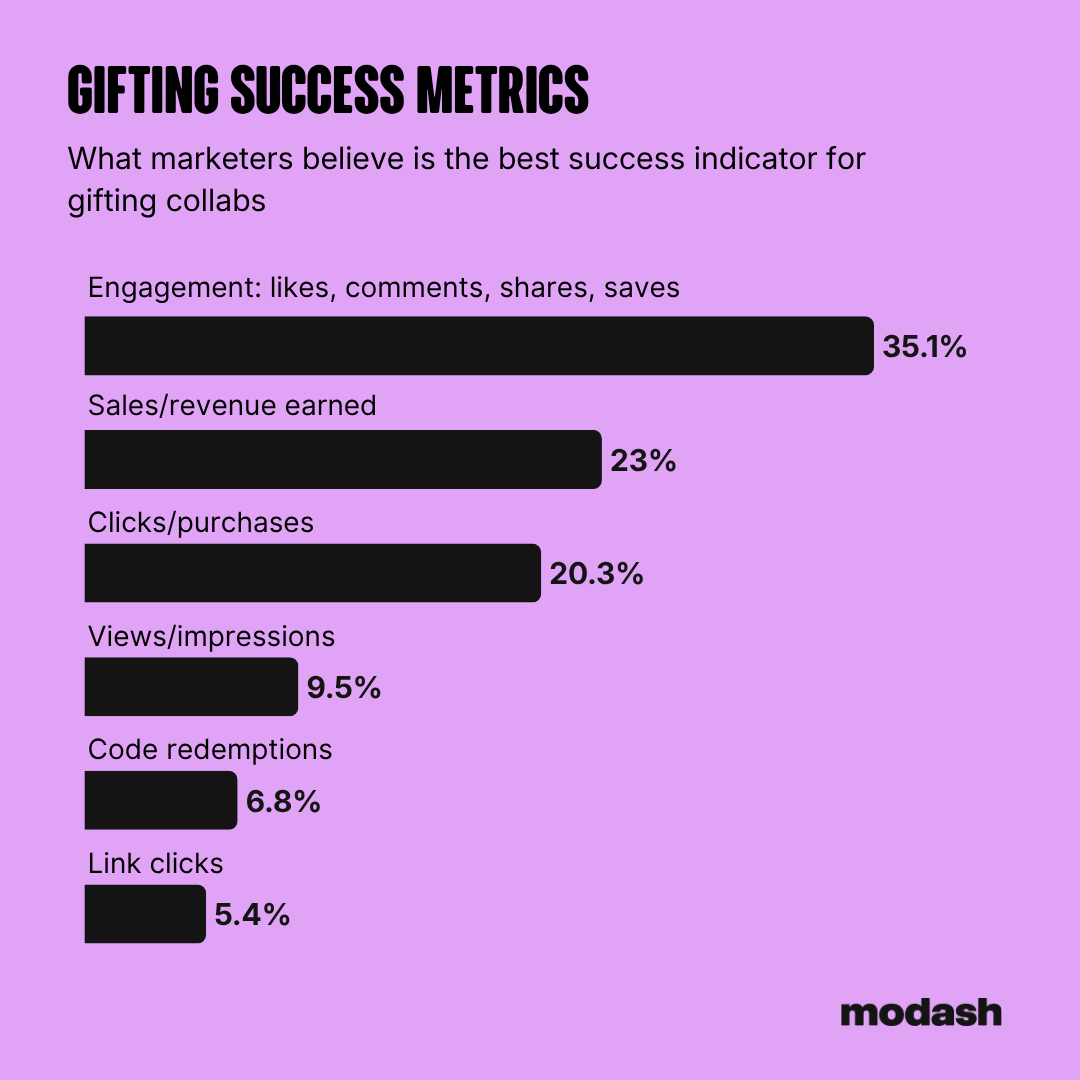
These are metrics that make sense for paid campaigns. But gifting serves a different purpose. Measuring it by sales and code redemptions applies paid-campaign logic to a program that works differently.
The same pattern shows up in how marketers decide whether to continue with a gifted creator. Content quality came first, followed by responsiveness, audience response, and enthusiasm for the product.
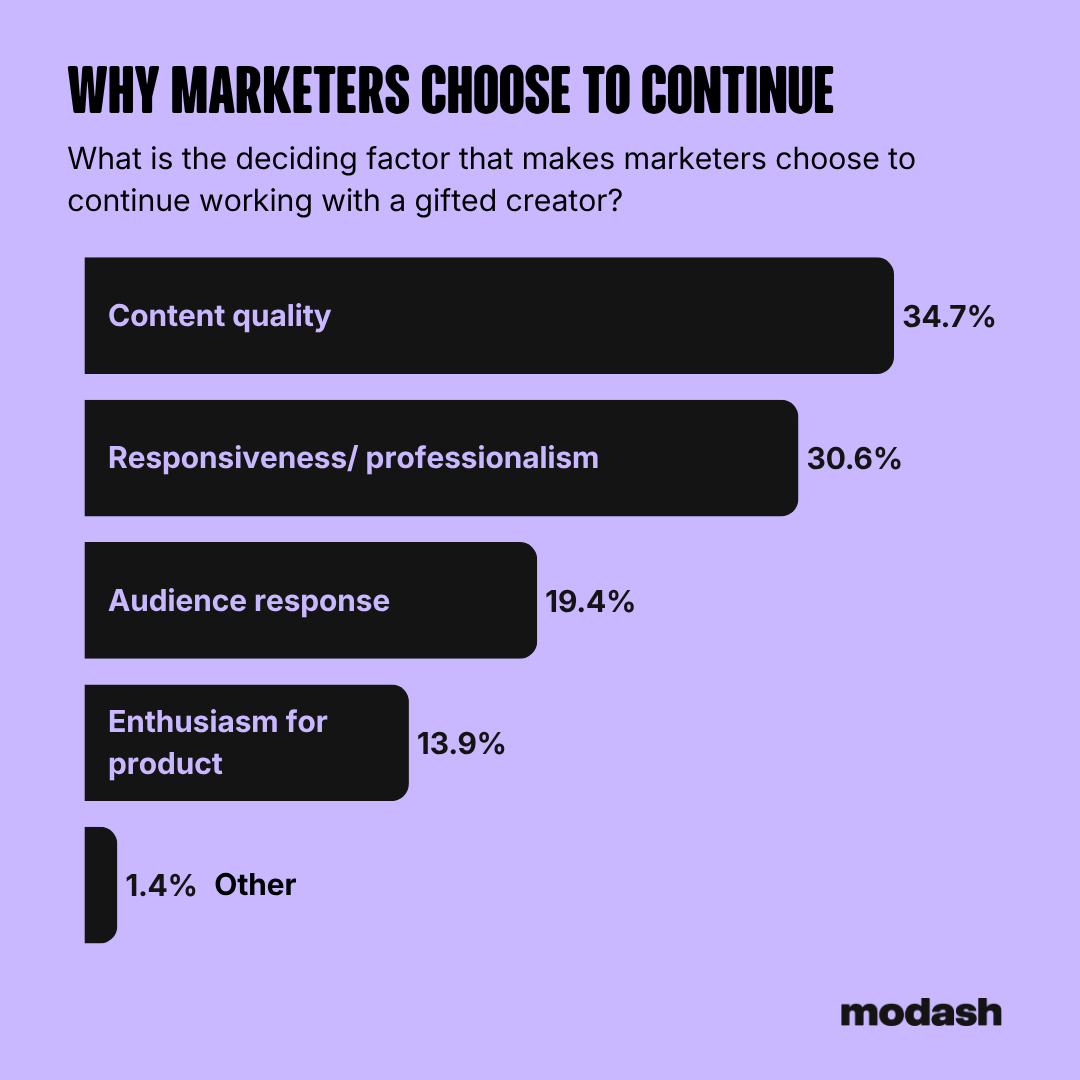
High-quality content and fast responses are reasonable things to want. But creators are unlikely to treat gifting with the same level of commitment as paid campaigns – and that’s a fair response when there’s no payment involved. Anna Jędrzejewska agrees:
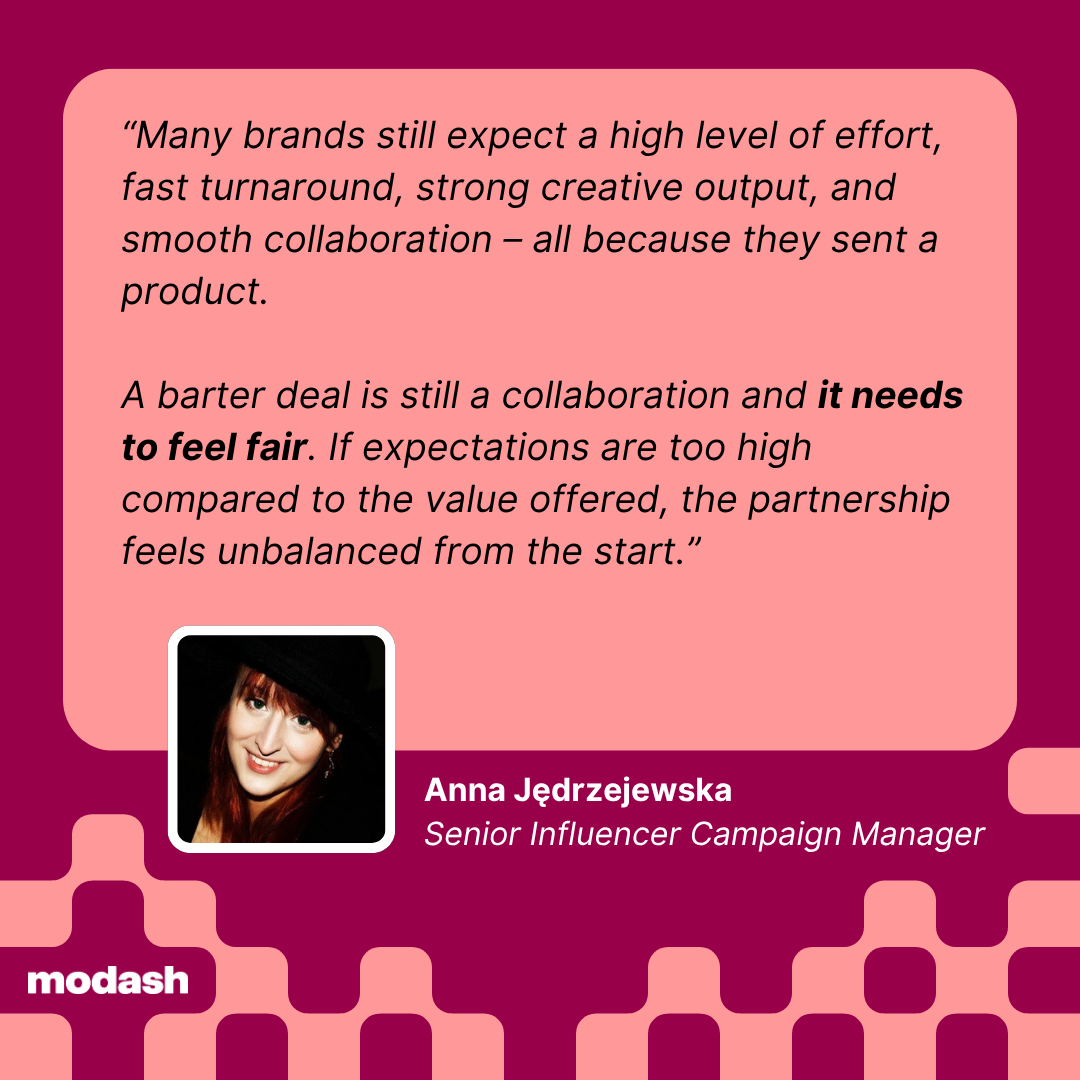
When creators don’t meet these unspoken expectations, the relationship ends before it ever had a chance to develop.
Gifting works best as a first touchpoint – a way to find the right creators, test brand fit, and open the door to something bigger. Brands that vet well and keep their expectations in check during that first touchpoint are far more likely to turn a gifted creator into a long-term partner.
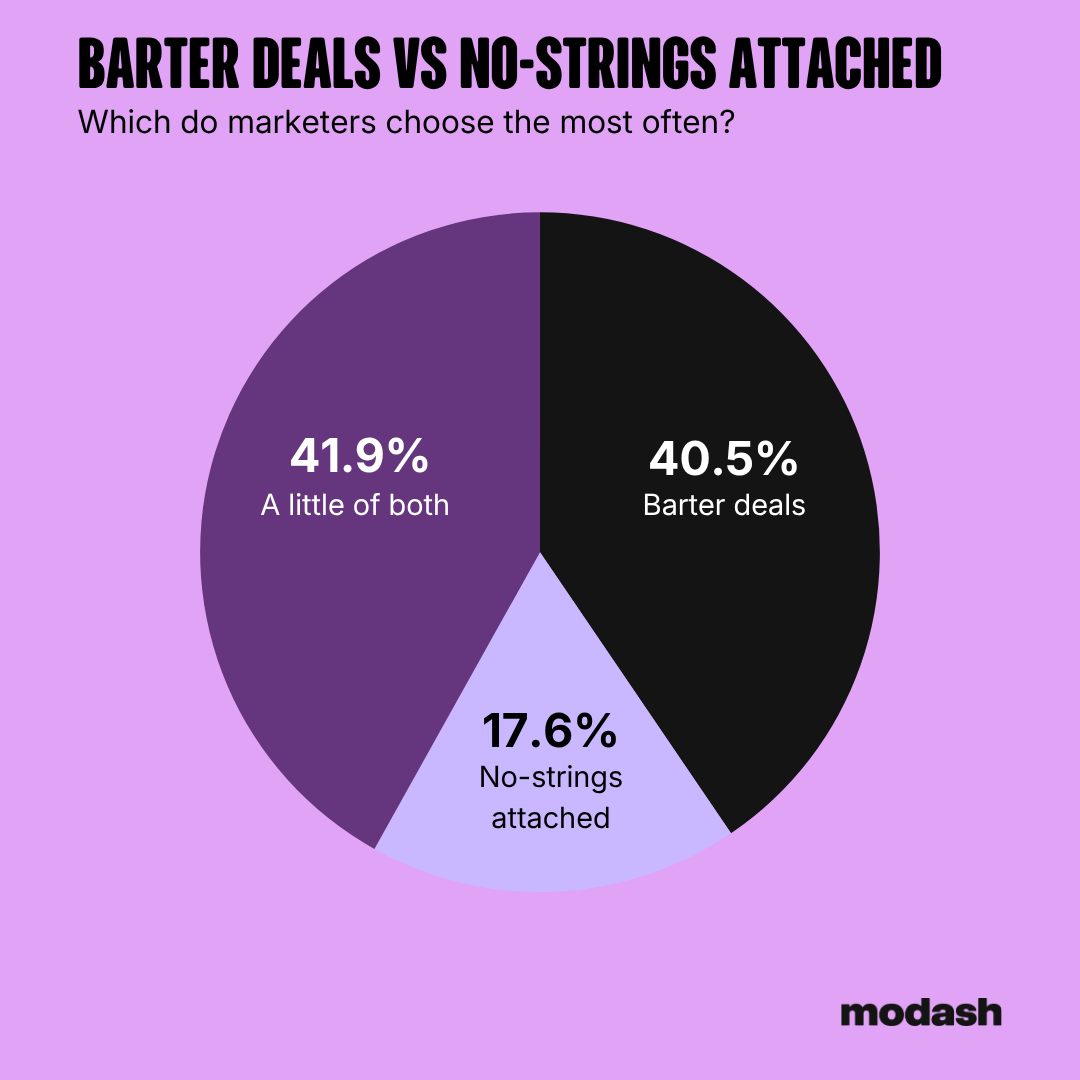
Not every brand is comfortable with the open-endedness of no-strings-attached gifting. About four in 10 marketers use barter deals – where a post or specific deliverable is expected in exchange for the product. Another 41.9% use a mix of both approaches. Fewer than one in six go fully no-strings-attached.
On paper, barter deals solve the biggest frustration in gifting: uncertainty. And the data backs that up – creators post more consistently under barter arrangements (50% vs. 43.8% for no-strings-attached).
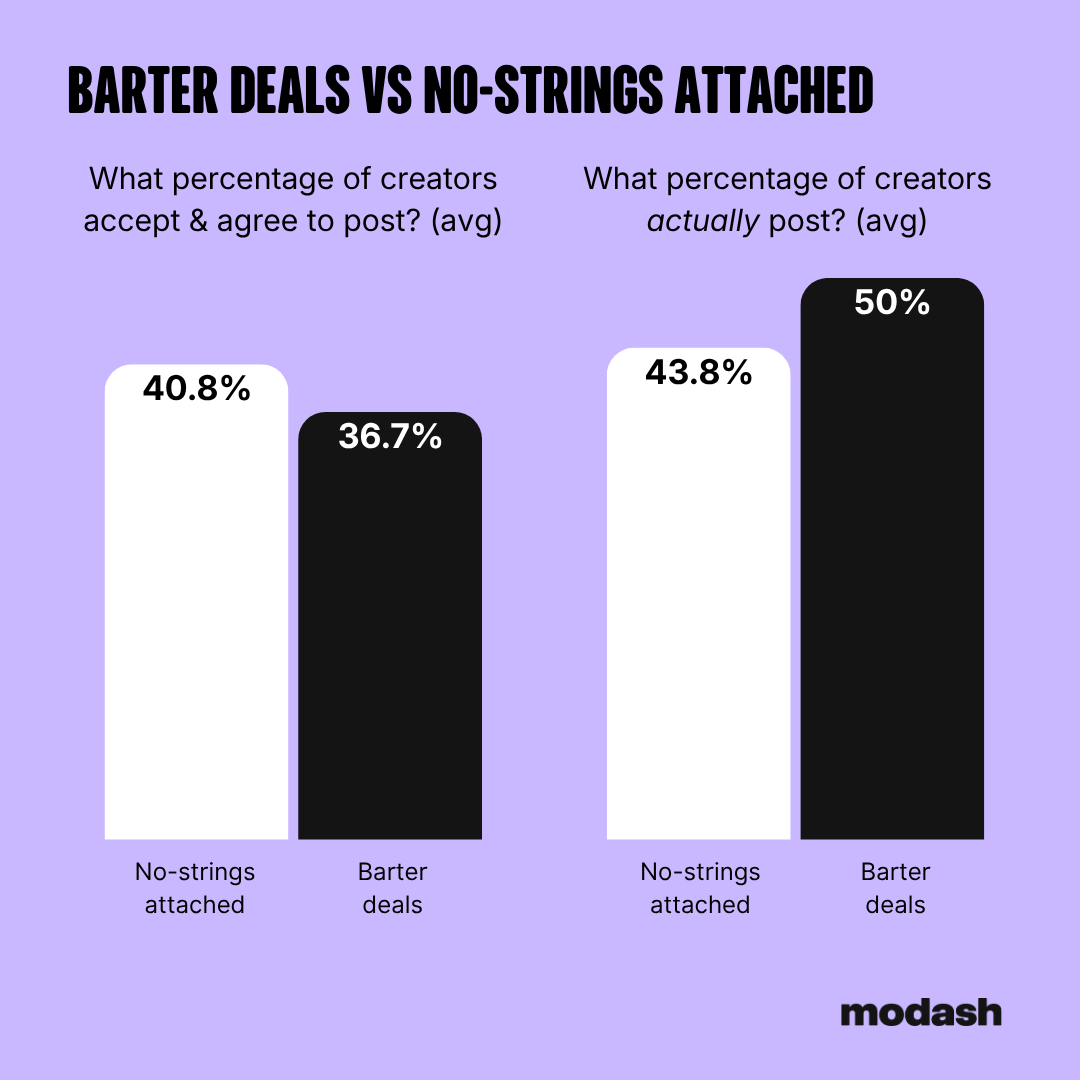
But that predictability comes at a cost. 77.4% of marketers say creators respond better to no-strings-attached outreach. And close to three in four saying creators push back hardest against barter specifically.
The data clearly tells that creators prefer the no-strings attached approach. This makes sense because creators want to protect their relationship with the audience they’ve worked so hard to build. Promoting a product they haven’t had time to genuinely try – or one that isn’t the right fit – puts that trust at risk. No-strings-attached gifting gives them the space to decide.
Athira Aravind argues that fewer strings might also be better for the brand side in the long-term:
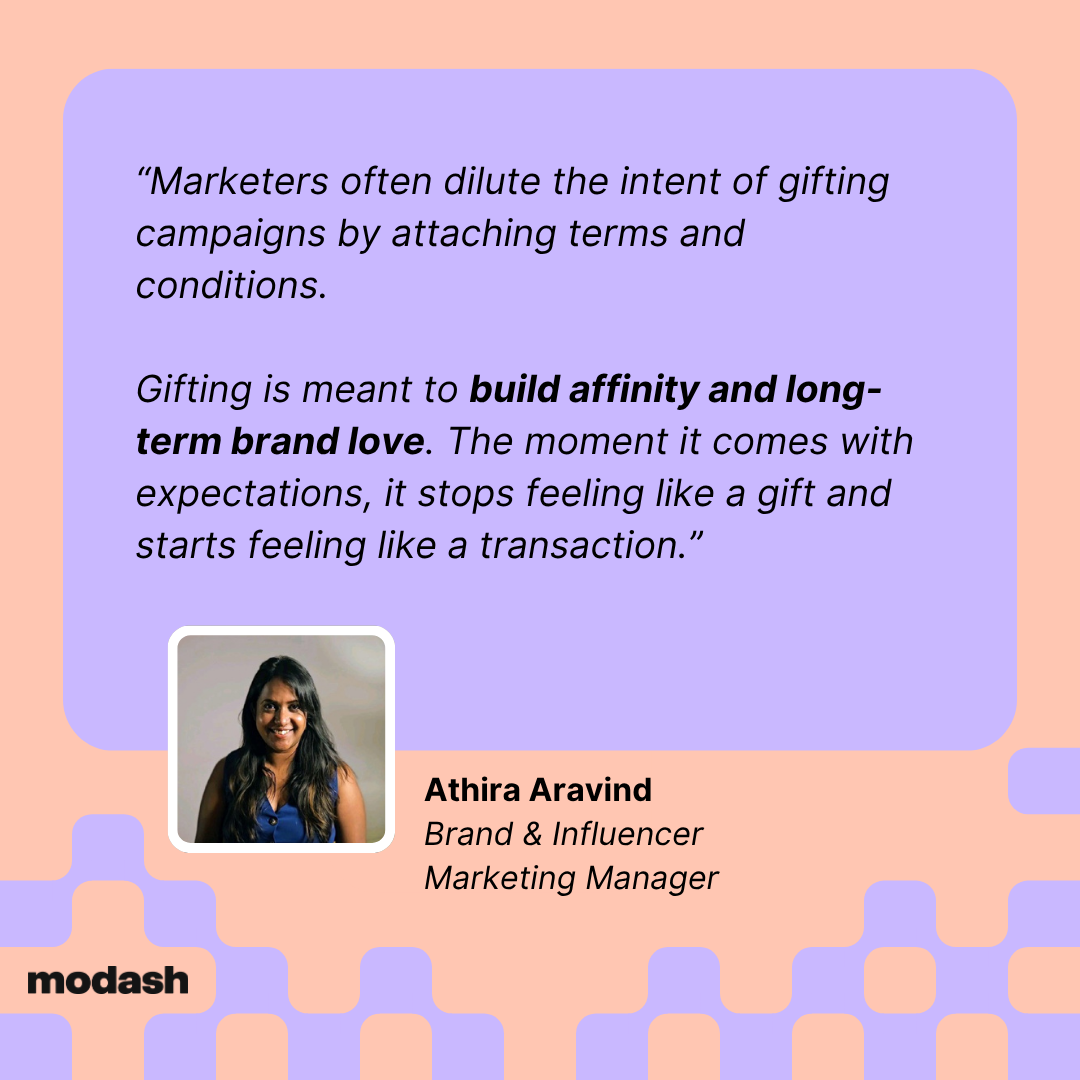
So barter gets you posts. No-strings-attached gets you goodwill. Neither approach is wrong – but the data suggests that brands leaning too heavily on barter may be trading short-term content for long-term relationships.
There’s a lot more to unpack here: [link to upcoming piece on the topic]
Despite everything – the ghosting, the pushback, the low conversion rates – nearly 80% of marketers say gifting is ROI-positive for their brand.
The frustration comes from how gifting is being run – and a lot of that is fixable. Here’s where to start:
If you want a step-by-step breakdown of how to build and run a gifting program from scratch, check out our complete influencer gifting guide.
-----------------------------------------
Survey data based on 74 marketers who are primarily in-house at ecommerce brands or freelancing/working in an agency dedicated to ecommerce brands. Respondents are located primarily in the US, Europe, and Asia.
Our expert contributors