




A customer watches an influencer’s Reel about your product. They like what they see, but they’re too busy to buy right – so days later they Google your brand and buy (without using a discount code, BTW).
No code, no link click; so who gets the credit? 🤷♀️
Because influencer marketing is a full-funnel channel, attribution issues like these are inevitable. You can’t eradicate them; all you can do is control what’s in your hands by:
By happy coincidence, I’ll be walking you through all of that (and more) in this very article…
Before I get too into the weeds, let’s get some definitions out the way:
Attribution and measurement are pretty similar – they’re both about understanding how your creators and campaigns are performing – but they’re not exactly the same:
🤓 Further reading: Want to learn more about the metrics-and-tracking side of the coin? Check out How to Measure Influencer Marketing in 5 Steps (From Goal Setting to Reporting).
Honestly, there’s a whole bunch of reasons why influencer marketing attribution is tougher than for other channels.
For example, if you’re running Meta Ads, Zuckerberg knows everything – who was served an ad, who clicked or engaged with it, and who converted. The impact is obvious, and so is attribution.
Or take affiliate attribution, which is (mostly) about tracking direct sales through link clicks and promo code redemptions.
Attribution isn’t nearly so clean with influencer marketing due to factors like:
Also, bear in mind that influencer marketing isn’t one single “thing”. Rather, it’s a variety of campaign types, each with different goals and requiring different types of attribution:
And if all those variables aren’t enough of a headache, you’ve also got to contend with the fact that the sales influencers generate for you are often tricky to attribute (more on this in the next section…).
Because of these challenges, influencer marketing consultant Andreea Moise (AKA the Hype Maven) explains that it often makes sense to concentrate on measuring output rather than directly attributable sales:
Direct attribution will always be flawed and show limited impact. So unless we have access to analytics and an understanding of how to attribute some of the overall revenue lift after the channel is live, we need to focus on getting content in front of the right audience and then use ad budget to boost that.

Pinning sales to a specific influencer (or even to influencer marketing as a channel) is often slippier than a buttered eel. Here are some of the reasons it’s so tricky…
In an ideal world, every influencer-driven conversion would look something like:
👉 Content view 👉 Link click 👉 Store visit 👉 Purchase
One slick, trackable journey with zero doubt about who gets credit for the sale.
Unfortunately, real life often gets in the way of a smooth path to purchase. Customers get busy or bored or distracted, so they don’t click the influencer’s link at all. Rather, they Google you later and then buy, so the sale gets attributed to organic search instead.
Even if they do hit the link, they don’t get around to buying until a week later – by which point your attribution window has closed 🤦♀️
And that’s before we even consider the even-more-confusing impact of dark social, which adds a bunch more steps between the original content view and the eventual transaction.
🤓 Pro tip: While convoluted journeys like this can be tough to track, you can close some of the attribution gap with post-purchase surveys. I’ll explain how they work and how to use them later in the article.
I’ll get into the ins and outs of first-click vs last-click attribution later in the article, but before then, there are two things to know about the last-click approach:
However, simplest isn’t always best. The problem with last-click attribution is that it only rewards “deal closers” over “demand-builders”.
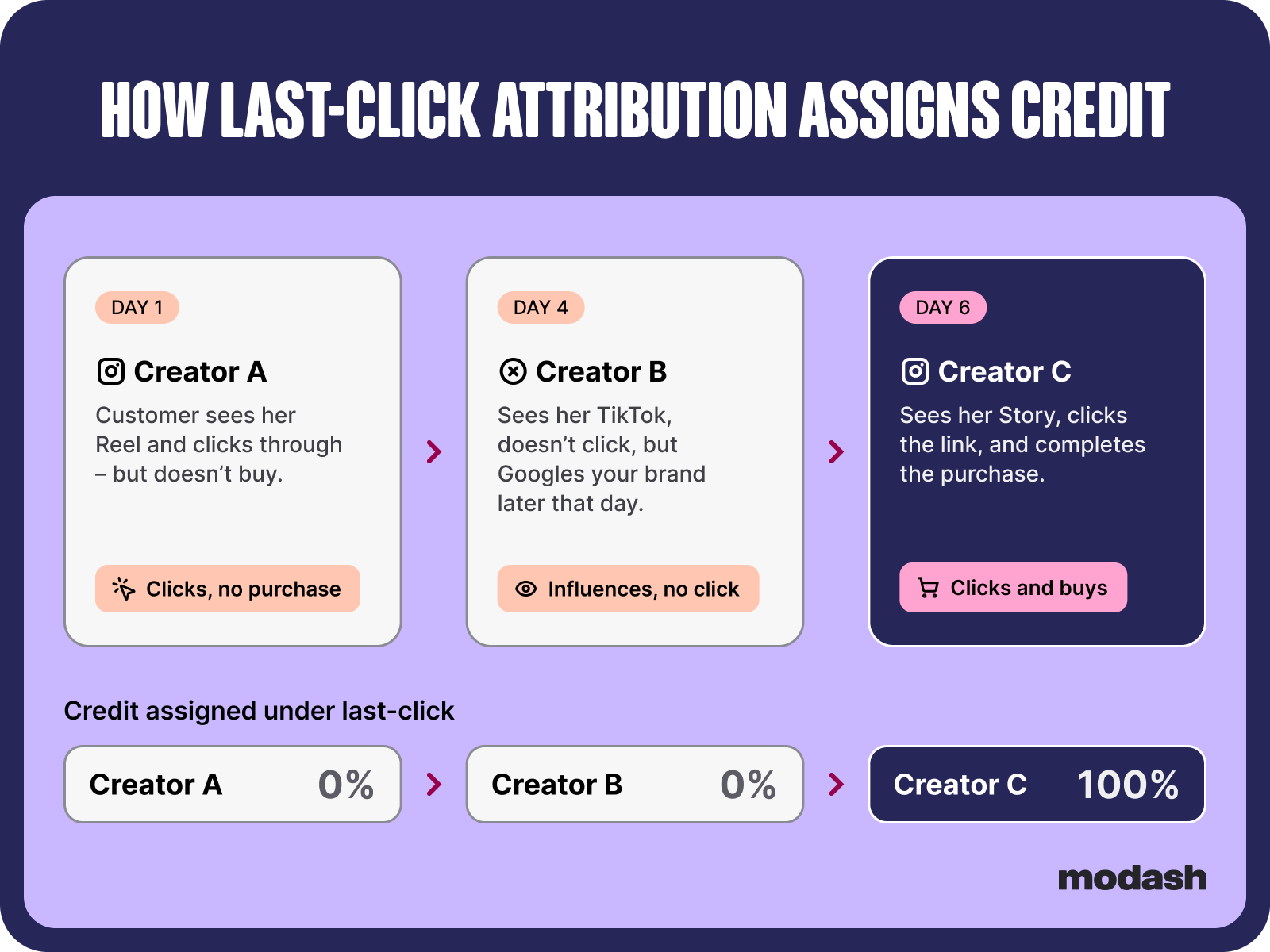
Sometimes both of those things happen in a single touchpoint. But in cases where a buyer sees multiple pieces of content before buying, the creators driving valuable top-of-the-funnel awareness end up reading as dead weight 💀
For starters, they’re all-too-easily missed. If a customer buys without clicking a link or using a promo code at checkout, that sale will be attributed to a whole other channel.
Even if they do click a tracking link, they’ve only got a limited time in which to buy, due to a little thing called an attribution window.
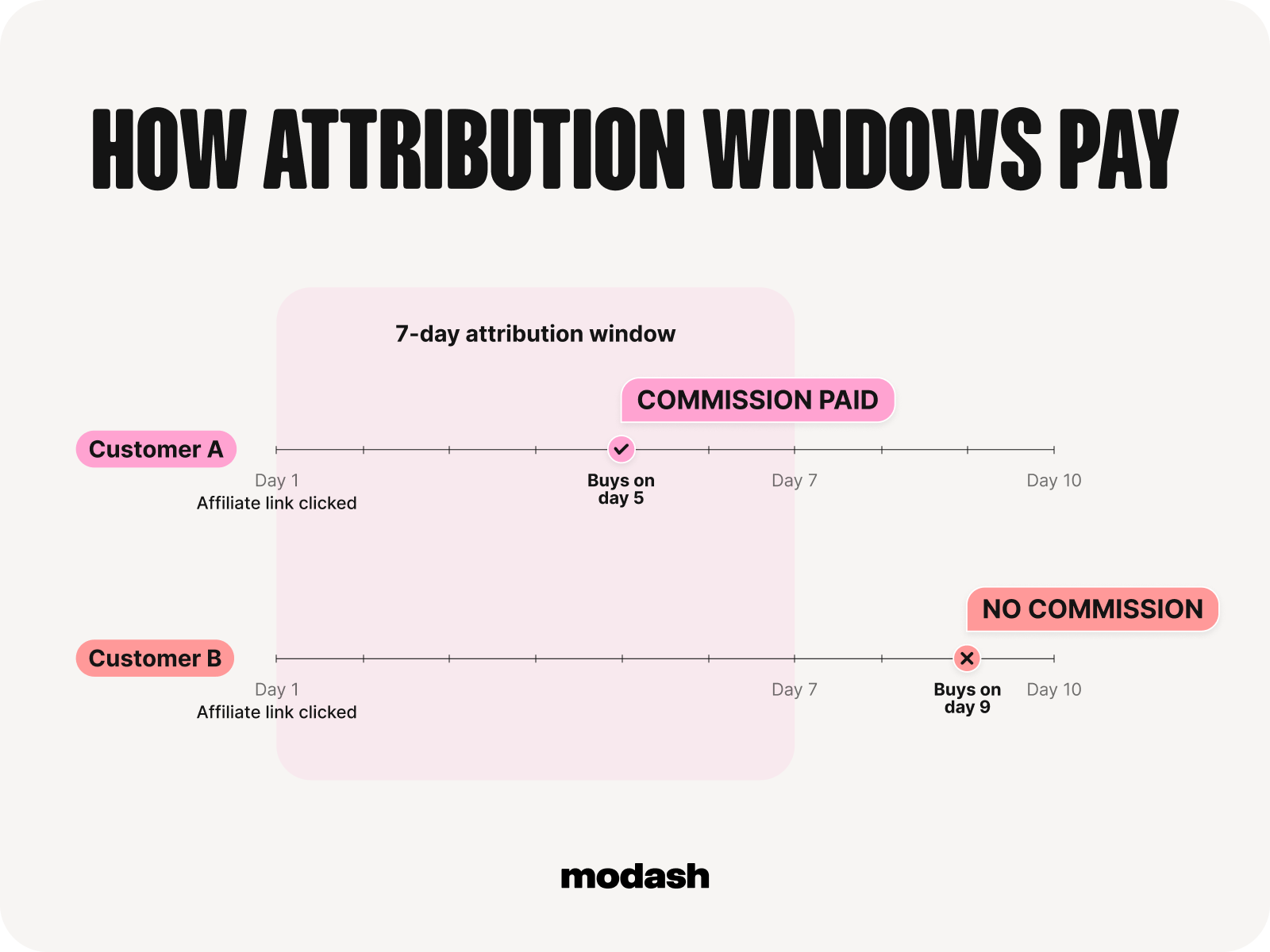
Ecommerce brands often use a 7-day attribution window – in which case any sales that happen 8+ days after the initial click might still be tracked to your influencer program, but won’t be credited to the creator who actually drove the conversion.
Then there are the honest technical issues that screw with your link-based attribution by interrupting the chain between initial click and eventual purchase. Things like:
And just because there are a bunch of potential issues with tracking through links, don’t think promo codes are god’s gift to attribution. There are plenty of ways they can go wrong, too.
For instance, say you’re running a sitewide sale alongside your influencer’s 10% discount code. The customer might enter the sitewide code instead (or it might get autofilled at checkout), so the creator never gets the credit.
Or, at the opposite end of the spectrum, influencer codes often get hijacked by third-party coupon sites.
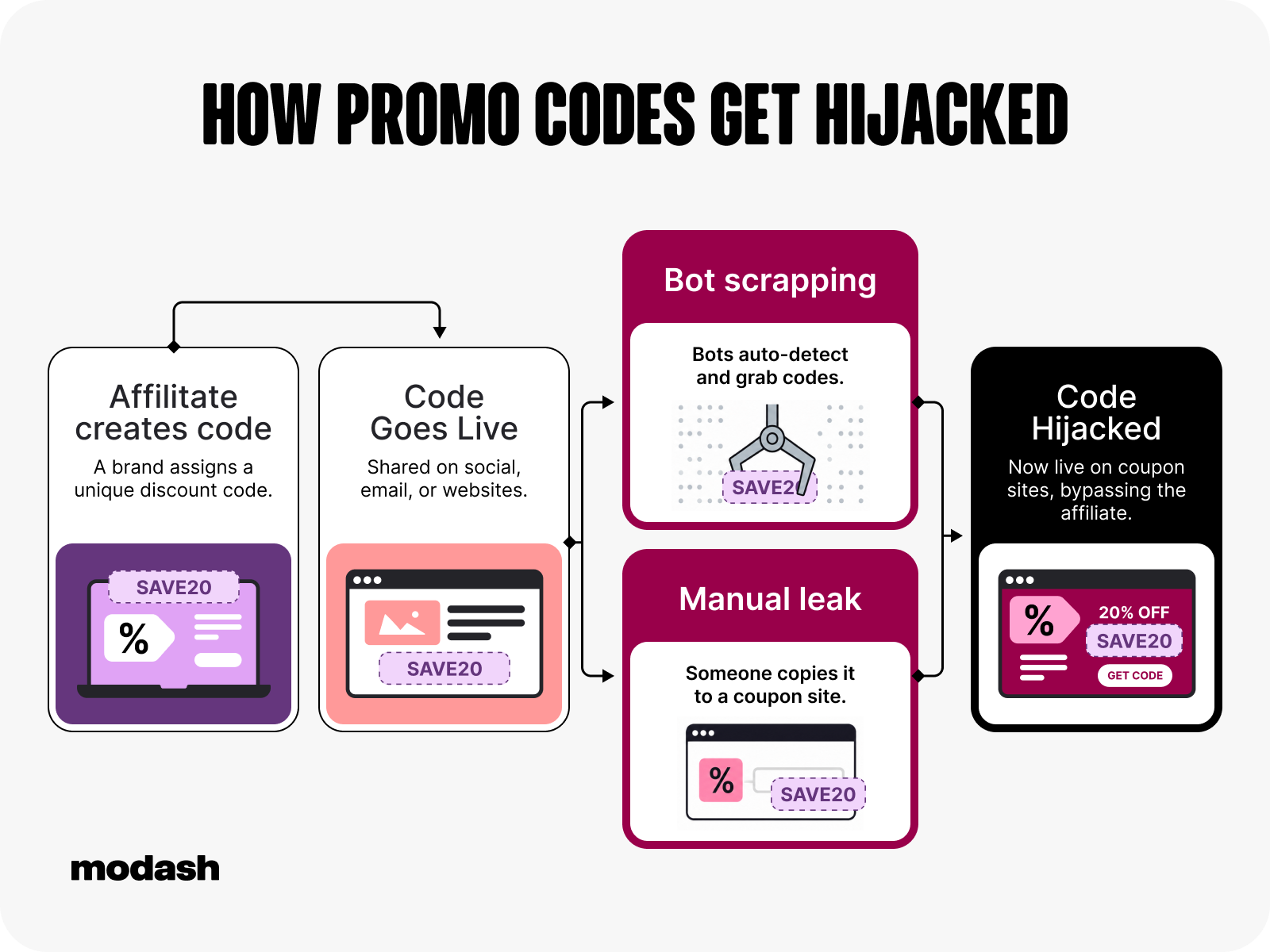
The net result? A bunch of customers end up searching Google for discount codes when they were going to buy anyway – so your influencer program ends up stealing credit from a different channel.
🤓 Further reading: For more on the wacky world of code-based attribution, check out How to Set Up Influencer Discount Codes (Without Losing Track of Who Earned What).
Attribution would be a whole lot easier if last-click could do all the heavy lifting. But, as you and I have already discussed, it doesn’t capture the true impact of influencer marketing – particularly when it comes to tracking brand awareness campaigns – because it only measures direct sales.
That’s why you need to consider all the different attribution models. First, here’s a side-by-side comparison of the five main models…
…and now for a closer look at each:
As the name suggests, first- and last-click attribution are opposite sides of the same coin:
Both models are widely used (particularly last-click) because they’re simple to understand, easy to implement through links and codes, and effective to a point.
Of course, by design, each model only sees one end of the buyer journey, so you either end up rewarding the deal closers and totally ignoring the demand generators, or vice versa.
Plus the usual caveats apply about link and code-based tracking – if the customer doesn’t click the link, or buys on a different device, or forgets to use the code at checkout, the link between creator and conversion breaks down and the attribution model fails 👎
Next up, let’s look at three different attribution models that spread credit across the buyer journey, rather than only rewarding touchpoints at the very beginning or very end:
Each is fairer than first- or last-click attribution when it comes to assigning credit across longer buyer journeys, but they still only reward touches that leave a clickable trail. So if a customer was influenced by a post but didn’t click a link, the creator gets nothing for their efforts.
All the above models share one glaring drawback: they award credit through link clicks (and sometimes also code redemptions). This makes them largely useless for attributing results in campaigns that rarely produce clicks, like brand deals, gifting, and awareness campaigns.
When clicks aren’t a thing, your best bet is to track through one or more of these methods:
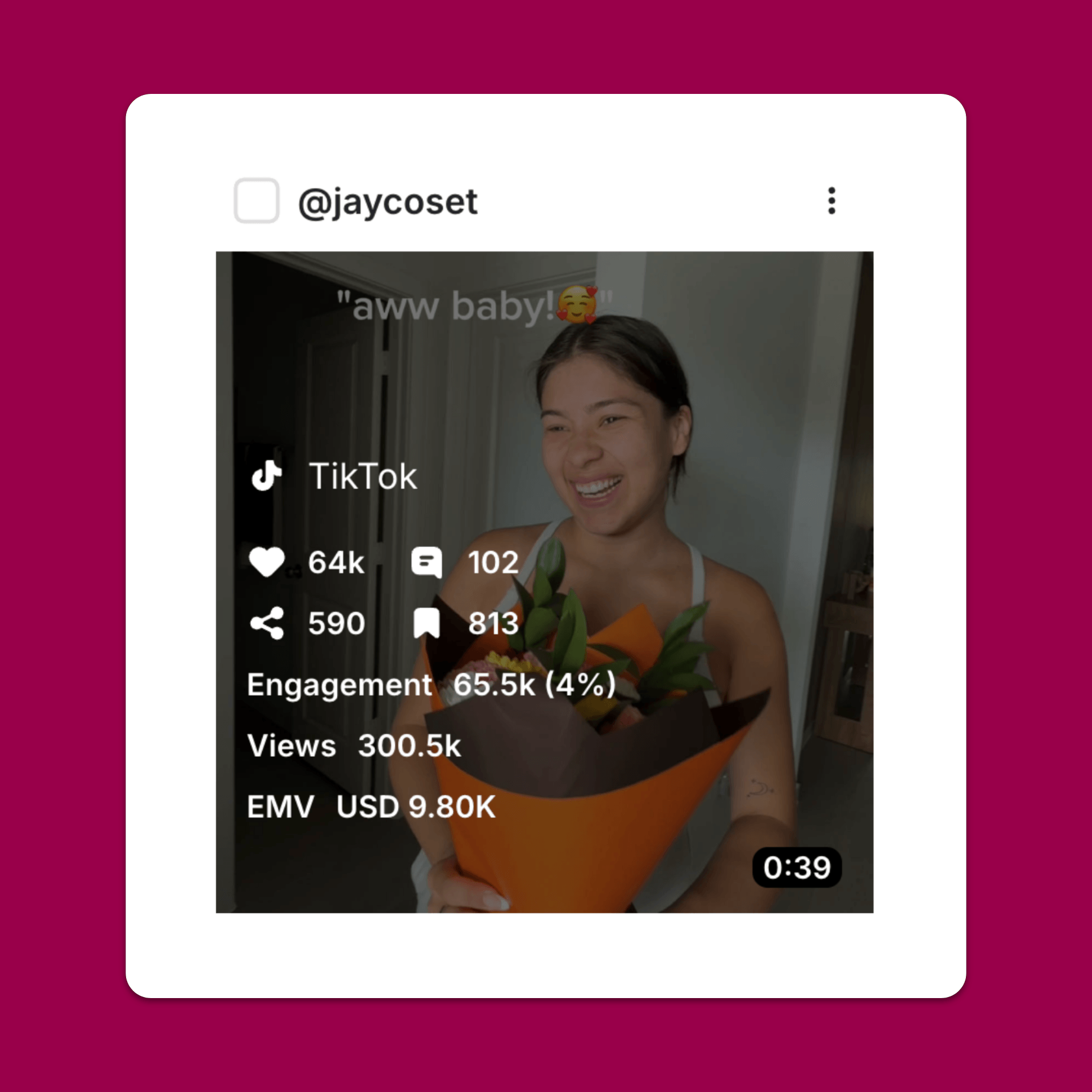
🤓 Pro tip: Influencer tracking tools make it easier to track content performance. For example, Modash automatically captures live influencer posts and provides an at-a-glance view of engagement, views, and EMV.
Hopefully, by now, you’re clear on all the different ways to attribute influencer marketing performance. But how, exactly, do you choose the model that’s best for your specific program?
Well, you can either listen to the wise words in this beautiful flow chart…
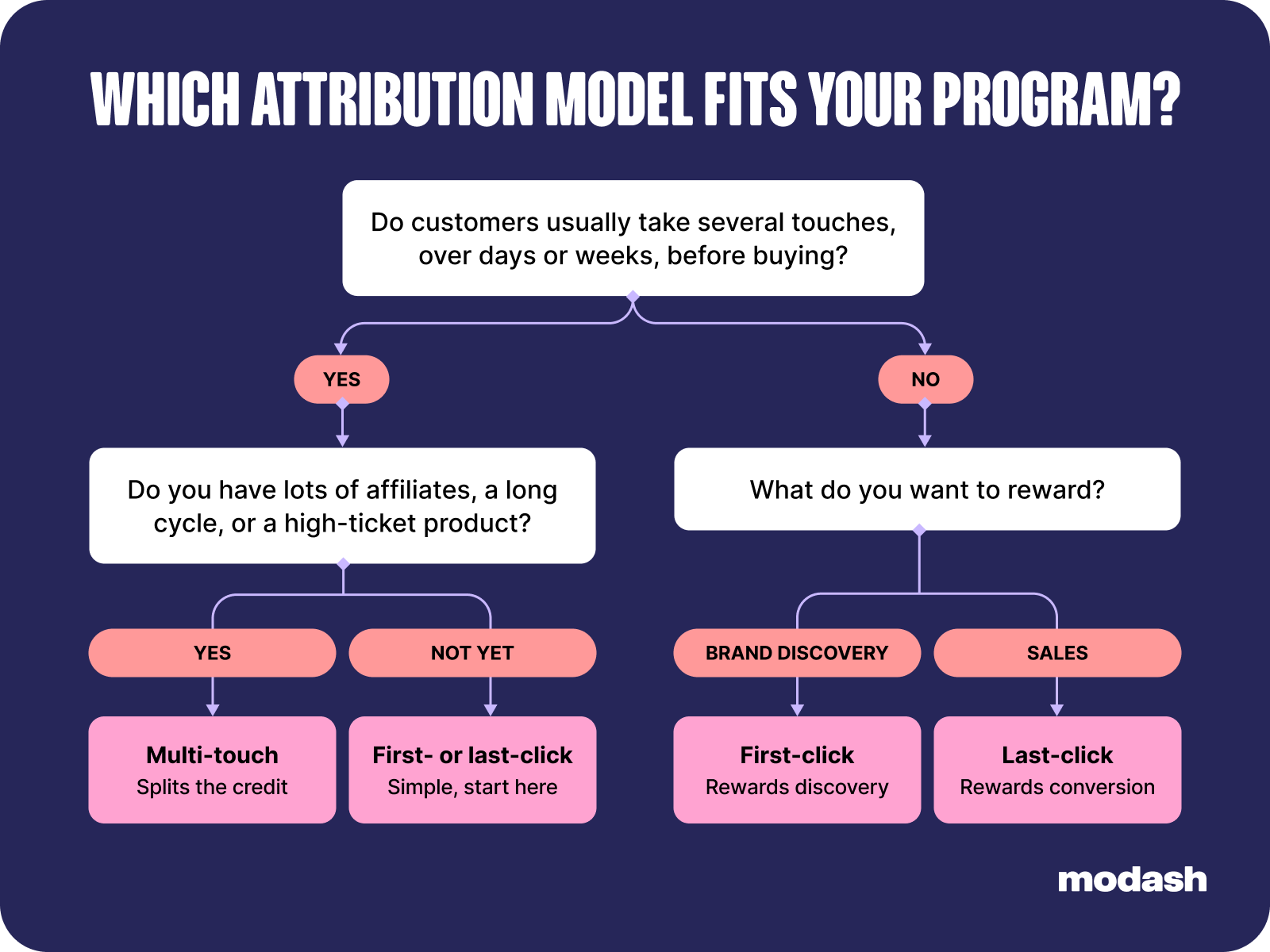
…or read on for a more detailed discussion:
Don’t be put off by the fact that last-click attribution is the “default” option. It’s a fine starting point for most programs – after all, popular things are popular for a reason.
So unless there’s a compelling reason not to, your best bet is to start with last-click, then revisit attribution as your program matures and/or your buying cycles get more complex.
Also, ask yourself just how much attribution you actually need. If you’re bringing in a few thousand bucks a month, you don’t need multi-touch attribution and holdout testing, you need three things:
Fact is, more sophisticated solutions only pay off when spend and buying cycles increase, so don't waste a chunk of time chasing precision that won't actually change how you run your program.
It might sound counterintuitive, but perfection shouldn’t be the main goal when setting up attribution.
For one thing, it’s probably not gonna happen – there are just too many unattributable actions. But even if you do somehow achieve it, it’s still less important than consistency.
Really, you need to be generating reports that let you compare one period or campaign or influencer with another, and you need to be doing it the same way every time. That’s the sort of data you can act on, even if the numbers aren’t 100% watertight.
Just because attribution models miss some influencer sales, that doesn’t mean you should give up on attributing those that you can track. Here’s how to ensure that the smallest possible proportion of sales slip through the net:
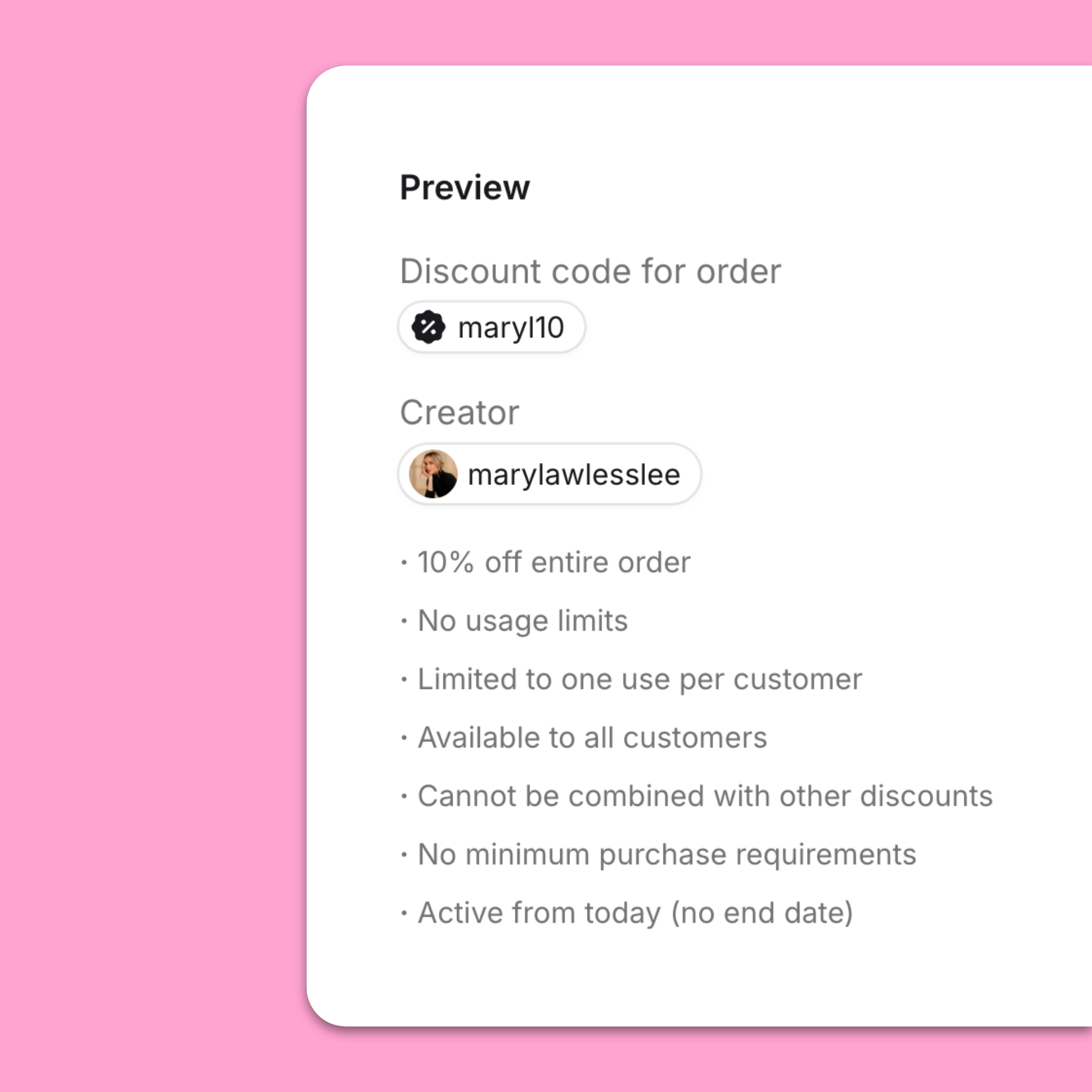
Sure, they’re not perfect, but codes and links are the backbone of trackable attribution, so you should absolutely be using them.
Best practice is to assign a unique link + code per influencer, so every touchpoint leads back to a single creator. When you use both methods, you can be sure that if one breaks down – say, the customer Googles you rather than clicking a link, or clicks a link but doesn’t use the creator’s promo code – you’ve still got the other to act as fallback.
🤓 Pro tip: Modash makes it easy to create links and codes for individual influencers through our Shopify integration.
You also need to consider which attribution model you’re gonna use alongside those links and codes.
Generally speaking, first- or last-click attribution makes most sense for brands with short paths to purchase and/or a tendency toward impulse buying. Whether you prioritize the first or final click is up to you – although if your buyer journey is super short, you’ll often only be dealing with a single click anyway.
On the flip side, if customers require a little more thinking time, a multi-click model like multi-touch, position-based, or time-decay is probably the way to go.
While assigning links and codes per influencer helps to close some tracking gaps, it causes another problem: double tracking.
This is when a buyer uses both a link and a code on their way to buying. They might click one creator’s link and use another’s code, or they could both be from the same influencer. Either way, if you don’t set a rule for handling this, you’ll end up paying two commissions for a single sale 🤦♀️
🤓 Pro tip: Modash fixes this by automatically prioritizing codes over clicks, but with a couple extra smart rules tacked on. Firstly, sitewide promos don't block link credit, and secondly, if a consumer uses two creator codes, the commission is split 🤝
Even when you’ve followed the previous two steps, there are still gonna be plenty of times when you know a sale was driven by a specific creator, but the conversion wasn’t picked up by a code redemption or a link click.
Maybe a cookie was rejected or accelerated checkout skipped the tracking script or someone bought after watching a story with no link.
Whatever the case, you have to decide whether to credit the sale manually, or whether you’re just guessing (in which case, you shouldn’t be tracking it).
Your only real option here is to pull on your fav Sherlock Holmes deerstalker and start looking for outside evidence connecting influencer and transaction 🕵️
Let’s consider some examples of when you should and shouldn’t manually attribute a sale:
Elementary, my dear Watson…
My wife always says I’m pessimistic, but I just think I’m a realist.
Similarly, there’s nothing defeatist about accepting that some influencer sales just can’t be tracked. Quite the opposite: once you accept it, you can get on with finding some practical solutions.
I’ve already mentioned how post-purchase “how did you hear about us?” surveys can help you attribute sales to your influencer program when no link clicks or code redemptions exist.
But if you want to actually attribute those sales to a specific creator, you need to go one step further and give customers a way to share whose content they saw. If you’re only working with a handful of influencers, it makes sense to jog the customer’s memory by including all their social handles in your survey.
Another couple post-purchase survey best practices:
Influencer marketing often produces a “halo effect” of increased engagement and conversions across other channels.
If only you could put some hard numbers next to that impact, eh?
Actually, you can, through holdout testing, which aims to measure the difference in results between a customer segment that has been exposed to influencer activity vs one that hasn’t. If you see 10% more sales from the “exposed” group, this suggests your influencer activity is driving incremental conversions that aren’t being captured by links and codes.
⚠️ N.B. in reality it’s pretty much impossible to guarantee that someone hasn’t seen a single piece of influencer content, so brands usually create “holdouts” they can control – such as comparing results before and after a campaign.
You wouldn’t criticize Lionel Messi for not saving enough penalties – that’s not his job. For one thing, he’s way too short to play in goal.
In the same vein, it doesn’t make sense to judge awareness-creators solely on last-click attribution.
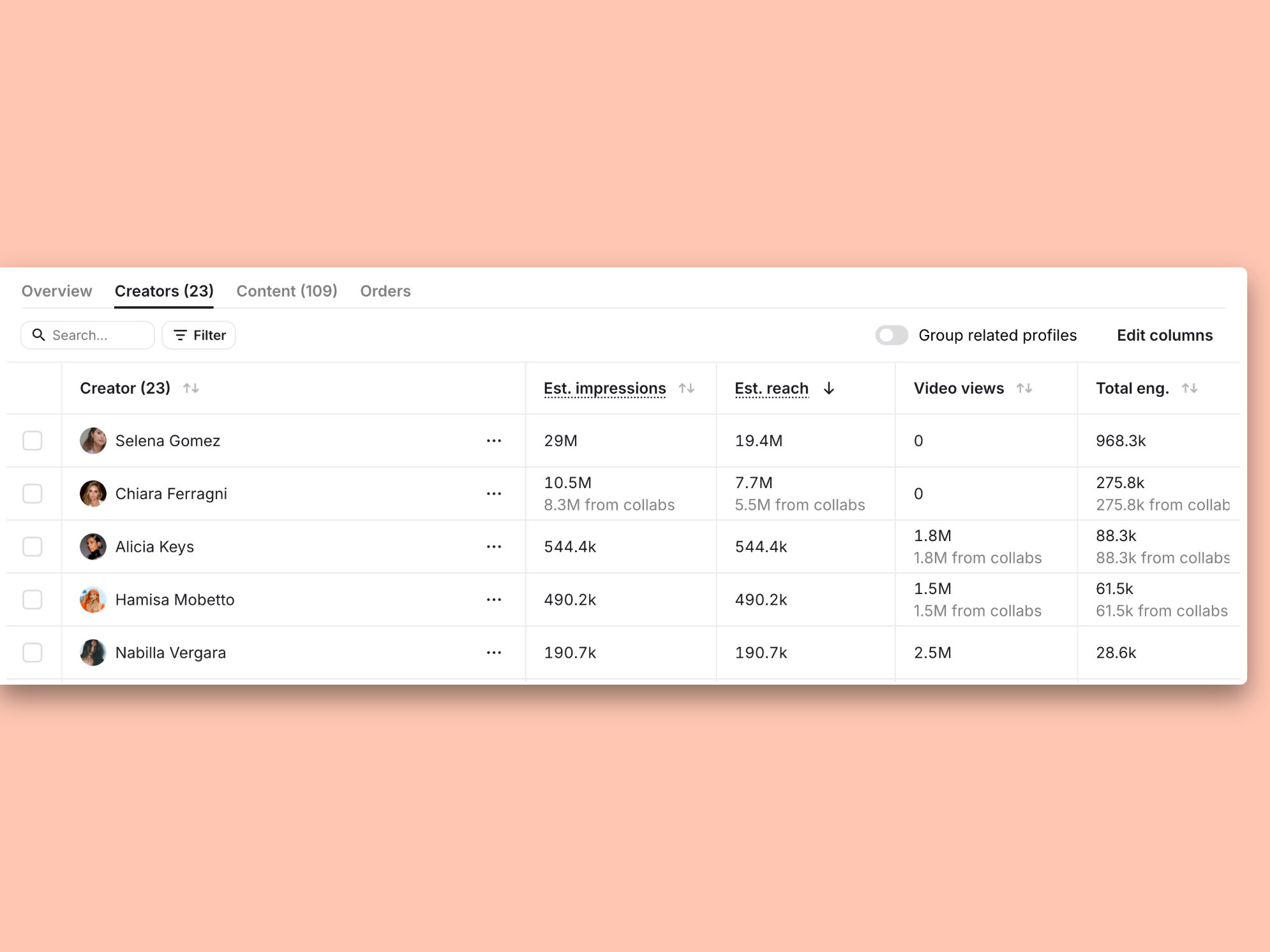
But if you don’t want to switch to first-click or multi-touch attribution, you can still recognize the creator’s impact by looking at how their content performs – in terms of views, engagement, and EMV – alongside the orders and revenue they’ve generated.
That way, you don’t end up abandoning or under-rewarding influencers who are driving impressive top-of-the-funnel results but few sales.
🤓 Pro tip: Modash gives you a per-creator view of content performance metrics like estimated impressions and reach, video views, total engagements, and engagement rate percentage.
While correlation =/= causation, it can at least give you a measurable indication that your influencer program is driving results. So look out for signs that increased influencer spending and/or posting volume is leading to more searches for your brand and/or product.
As soon as you stop chasing the dragon of perfect attribution, you can focus on making intentional decisions that get you where you need to be:
And, most of all, learn to accept that it’s possible to make smart decisions using imperfect data.
Of course, the tools you use play a big part in getting attribution right, too. If you’re already working with 5 – 10+ influencers, forget about tracking everything in a spreadsheet – you need a dedicated tool like Modash to assign per-creator links and codes and display results in a single influencer dashboard.
👉 See for yourself when you start your 14-day free Modash trial!
Influencer marketing attribution helps you understand how your campaigns and creators are performing by telling you which influencer or touchpoint gets credit for results.
Both influencer marketing attribution and measurement are about understanding the performance of your influencer program. However, measurement gives you the data you need (like clicks, views, reach, engagement rate, and revenue), while attribution tells you which influencers are generating traffic and sales.
Last-click attribution is the most common influencer marketing attribution model, and it’s generally the best fit for brands with newer and/or smaller programs – particularly those focused on bottom-of-the-funnel goals like leads and sales. First-click is an alternative for those prioritizing awareness over immediate conversions. Brands with more complex buyer journeys should consider multi-touch, position-based, or time-decay attribution.
The easiest way to attribute sales to an influencer without trackable links is to use unique promo codes instead. When a customer redeems one of these codes at checkout, they get a discount and the relevant influencer gets credit for the sale.
Absolutely! Whether or not you use Shopify, you can track influencer sales using promo codes and UTM links, then collate the results manually in a spreadsheet or automatically in an influencer marketing platform like Modash.
A surprisingly small proportion of revenue from influencer campaigns can actually be tracked directly, as influencer marketing consultant Andreea Moise (AKA the Hype Maven) explains:
If you’re just relying on links and codes, roughly 50% – 60% goes untracked, especially if you don’t know how people buy or where and just rely on direct attribution.
However, there are various ways to fill in some of those blanks, such as sending post-purchase surveys and measuring branded search volume before and after a campaign.