

More tools
Use cases



A discount code for influencers has two jobs, really. The first is obvious: it's an incentive for someone to buy from you. Secondly, it tells you which creator earned a sale (and, often, gets them paid for it).
Most brands go all in on job one and hope that job two will figure itself out along the way. But therein lies the problem. The ambivalent approach to job number two is how you end up with inflated numbers and leaking codes (more on that later), or a creator convinced they drove way more sales than your dashboard is crediting them for.
This guide is about setting up codes to do both jobs, which has a knock-on effect of converting offers, giving credit where credit’s due, and keeping your margins intact as much as possible.
Short answer: codes and links aren’t competing with each other, but they do work well together in the sense that they cover each other’s blind spots.
The good news is you don’t have to pick one. You can have unique codes and links for every creator.
This is the default in Modash (an influencer marketing platform). When you create a collab, you can generate a unique code and tracking link for the creator.
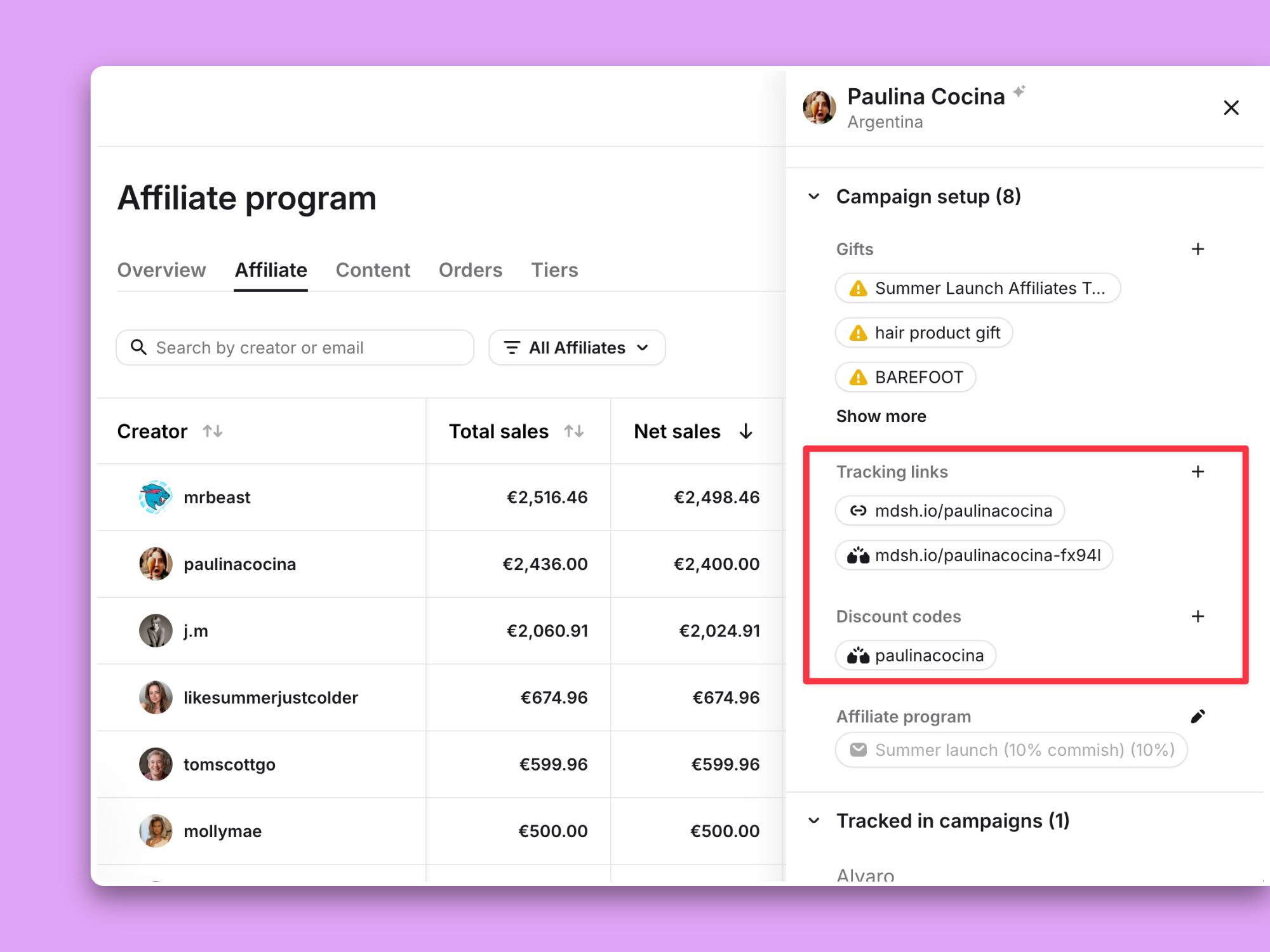
The two work together without stepping on each other. If a customer uses both an affiliate code and a link on one order, the code takes the credit. And if they use a plain sitewide code that isn't tied to a creator, that doesn't touch the creator's link credit at all.
Learn more about running influencer-affiliate programs in Modash here.
Before you get to the attribution side of things, a code has to actually do its first job: give someone a real reason to buy. But every discount you hand out also comes straight off your margin, stacked with whatever commission you're paying on top, so the choices you make here decide how much of that sale you get to keep.
That means making a handful of deliberate choices upfront, including redemption rules, timing, and naming, rather than just replicating whatever discount you used in your last campaign.
Here’s what you can do.
Most brands usually go for something between 10% and 20% off. That range tends to be deep enough to move someone to buy without training your audience to wait around for a code or handing out a sale so steep you lose money on it.
There’s no rule of thumb here. The right number for you depends on the math behind the sale.
Remember, a discount code doesn't cost you the discount alone, it costs you the discount and the commission. On a lower-margin or lower-AOV product, a 20% code plus a 15% commission can eat into a meaningful chunk of what's left, so you'd want to stay toward the lower end of the range (or make up for it with a lower commission rate).
On a higher-margin or higher-priced product, there's usually more room to go deeper, because the discount and commission both come out of a bigger pool.
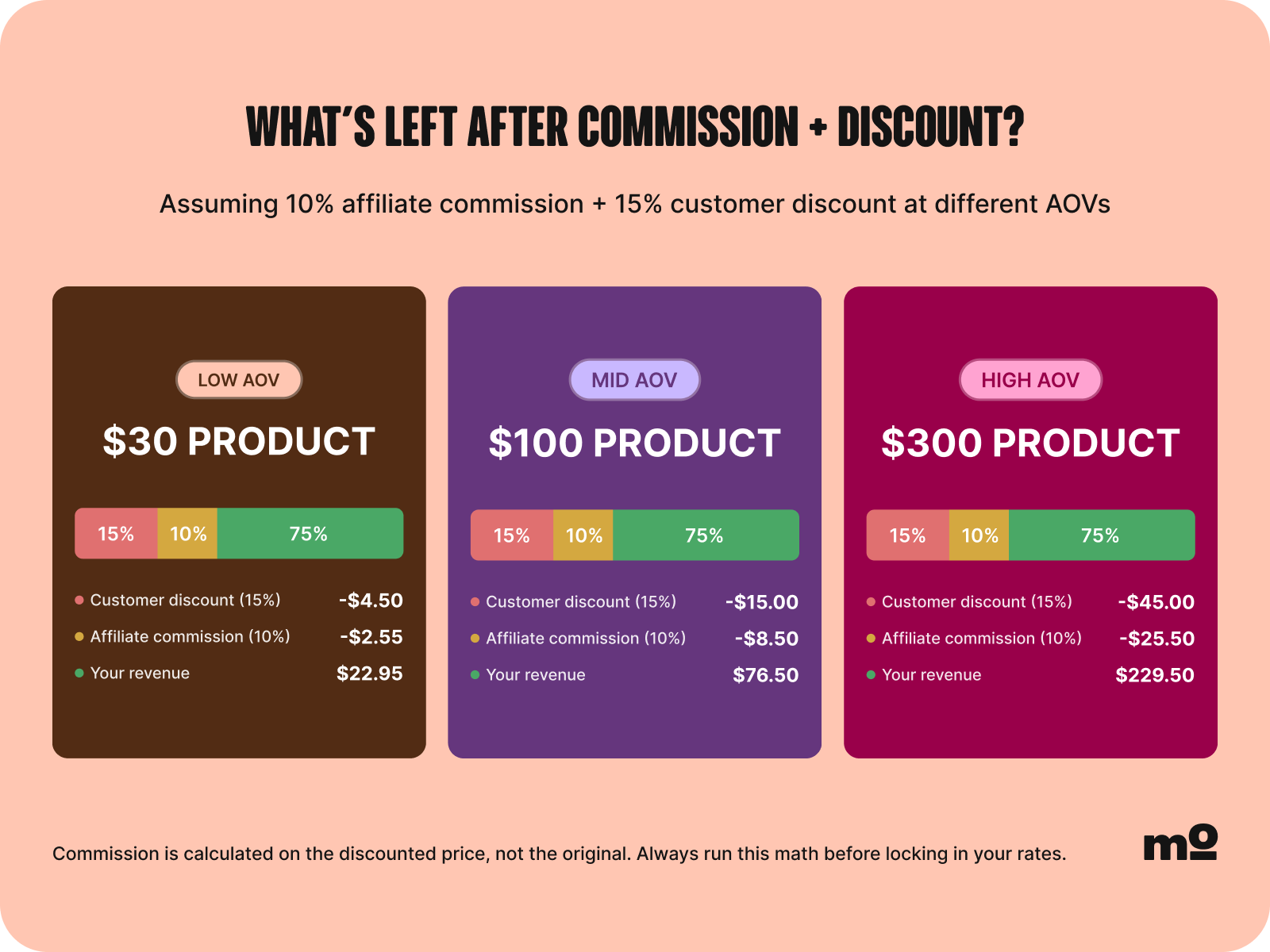
Going deeper than the 10 to 20% band can make sense, but only where you can show the payback. That might be a launch that needs a bigger push, or a creator whose audience reliably converts at volume.
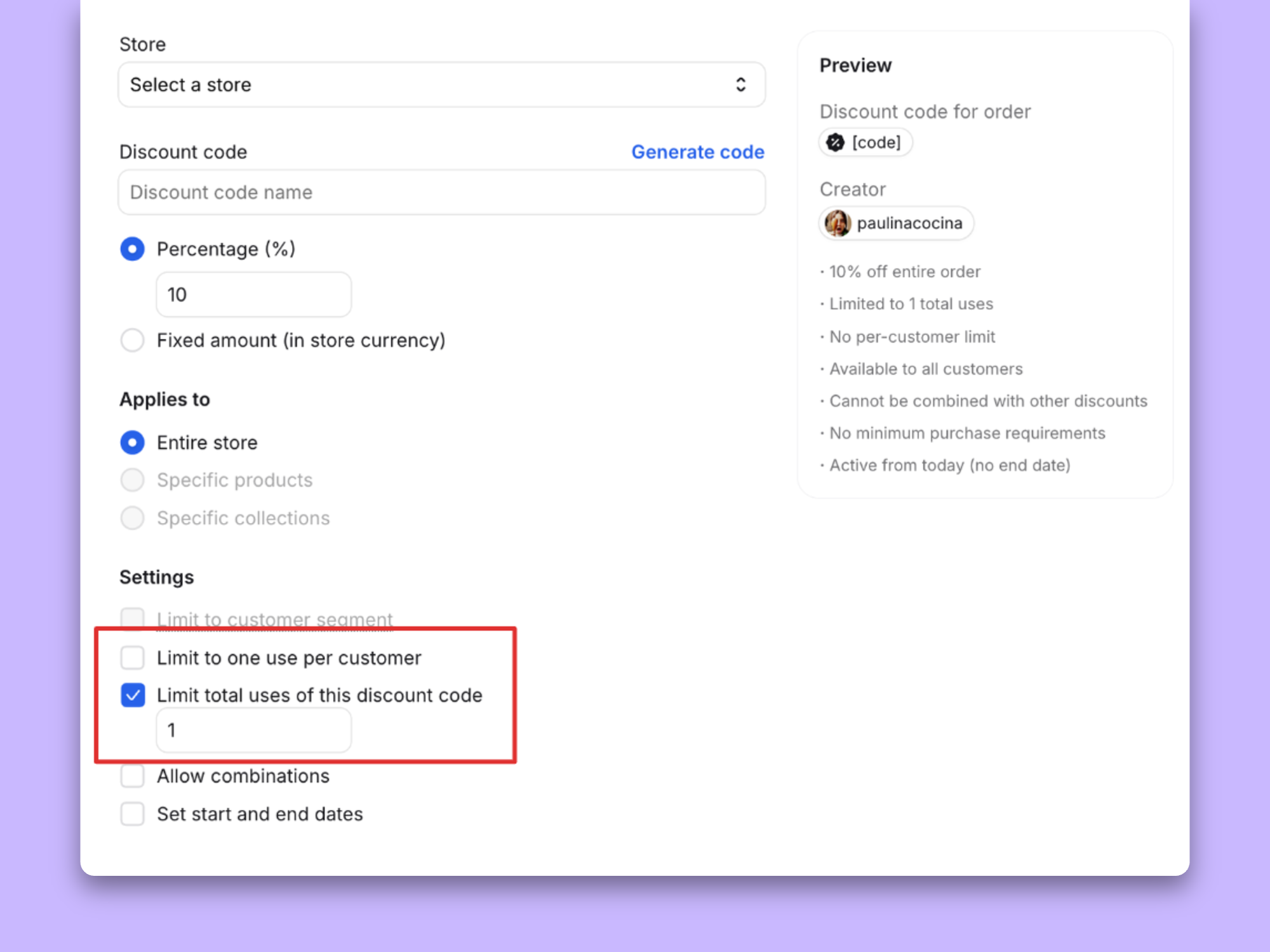
When you don’t set a usage limit on a code, anyone can use it as many times as they like, including people who have nothing to do with the creator earning credit for it.
Two things you can do here to avoid this:
It’s worth thinking about whether repeat buyers should be able to redeem a discount at all. If someone’s already a loyal customer, they’re generally not coming back because of a creator’s code. So, paying commission out on their reorders is pretty much a pure margin loss.
In Modash, you can choose the maximum number of total uses and whether you want to limit it to one use per customer when you create a creator's code.
A creator’s code needs to be the best deal available. If your welcome email gives shoppers 20% off and the creator’s code only gets them 15%, a price-checking follower is obviously going to take the bigger discount and route around the creator… even if they found you through that creator’s content in the first place.
So, before you lock in a creator’s discount, check it against whatever else you’re offering on your site (look at welcome pop-ups, sitewide sales, loyalty discounts, etc).
Someone is more likely to use a code they can remember than one they have to dig around for, copy and paste, and double check. That’s reason enough to choose something readable (like a creator’s name plus a relevant word, like CREATORROCK, over a name plus a number, like CREATOR15).
The bigger reason, though, is what happens when the value of the discount changes? A number baked into the code (like the 15 in CREATOR15) ties the code to that specific discount forever. A word-based code, on the other hand, has no number to contradict it, so you can adjust the discount behind the scenes and keep using the same code for a creator all year (especially handy for long-term partners).
The downside is that even a well-structured code doesn't guarantee you clean data. Codes distort in a few predictable ways, and if you don't know what to watch for, your dashboard can look oh-so-great while your actual attribution and margin look… not so good.
Here's where codes tend to “lie”, and what you can do about it.
Code leaking happens when a scammy coupon site gets hold of your code and offers it to anyone and everyone. This means the creator who it’s attached to gets credited for sales they may or may not have influenced. But worse, it dilutes your affiliate program data so it’s hard to tell if your efforts are working or not.
This is actually pretty common. In our own survey of influencer marketers, 47.6% said code poaching is an active problem for them. Most deal with it by frequently changing codes or leaning more on tracking links, while a fifth of marketers just accept it as a cost of doing business and don't act on it at all.
A few things can help you keep the damage under control:
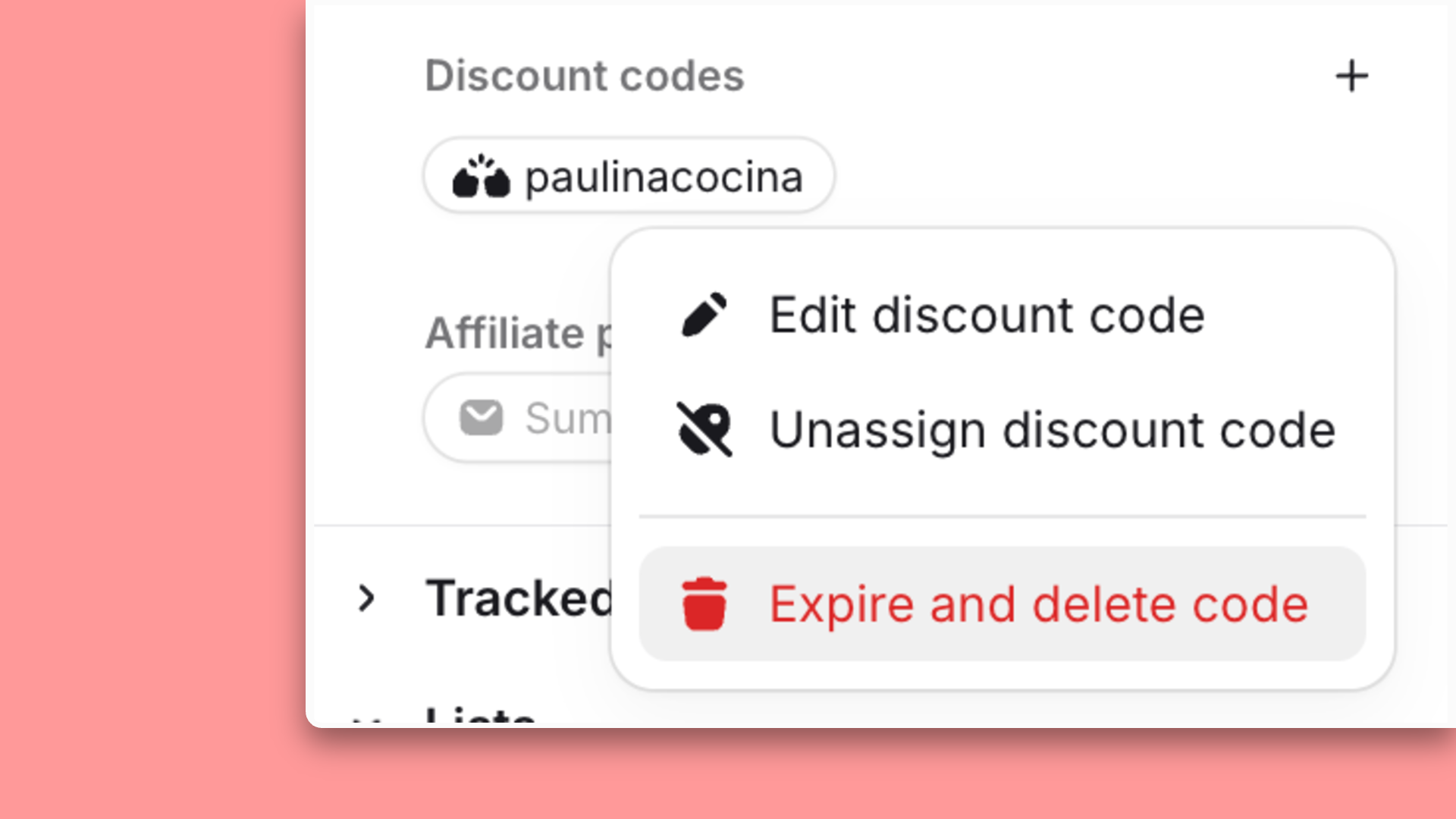
In Modash, expiring a code deactivates it in Shopify immediately, so it simply stops working, without losing its historical attribution data. That means you can shut down a leaked code and get a new one to the creator without losing a record of what they've already earned.
This problem is kind of the opposite of code leaking. Basically, real sales that a creator drove can sometimes get lost in the metaphorical post. For example, a follower might hear a code in a video and have every intention of using it but forgets to plug it in at checkout.
Or they mistype it.
Or they end up not buying that day and come back three days later having completely forgotten the code.
I think we can safely say these are sales the creator well and truly earned, but they don’t get attributed anywhere… and so the creator doesn’t get paid.
Pairing every code with a tracking link recovers some of this, since the link can pick up the click-through journey of the follower even if they don’t enter the code at checkout. But it won't recover all of it. There will always be some purchases that ultimately slip through the cracks.
Unfortunately, this isn’t really a problem you can solve… it’s more a limit to accept. Your numbers will always undercount a creator’s real influence to some degree. Modash tries to bridge this gap by pairing a code with a link to every creator by default.
Not every redemption represents a sale that the creator directly influenced. We just have to look at repeat customers here to see this in action. Imagine:
👆 Both will happily use a creator’s code if they happen to come across it. Even if the code didn’t change their behavior at all. Either way, you still pay the discount and commission.
This is actually pretty tricky to fully separate out from your data, so we recommend reading total code revenue as directional rather than as gospel.
One solution is to customize commission rates for new vs. existing customers (which you can do in Modash!), so a repeat buyer isn’t taking advantage of a creator’s code.
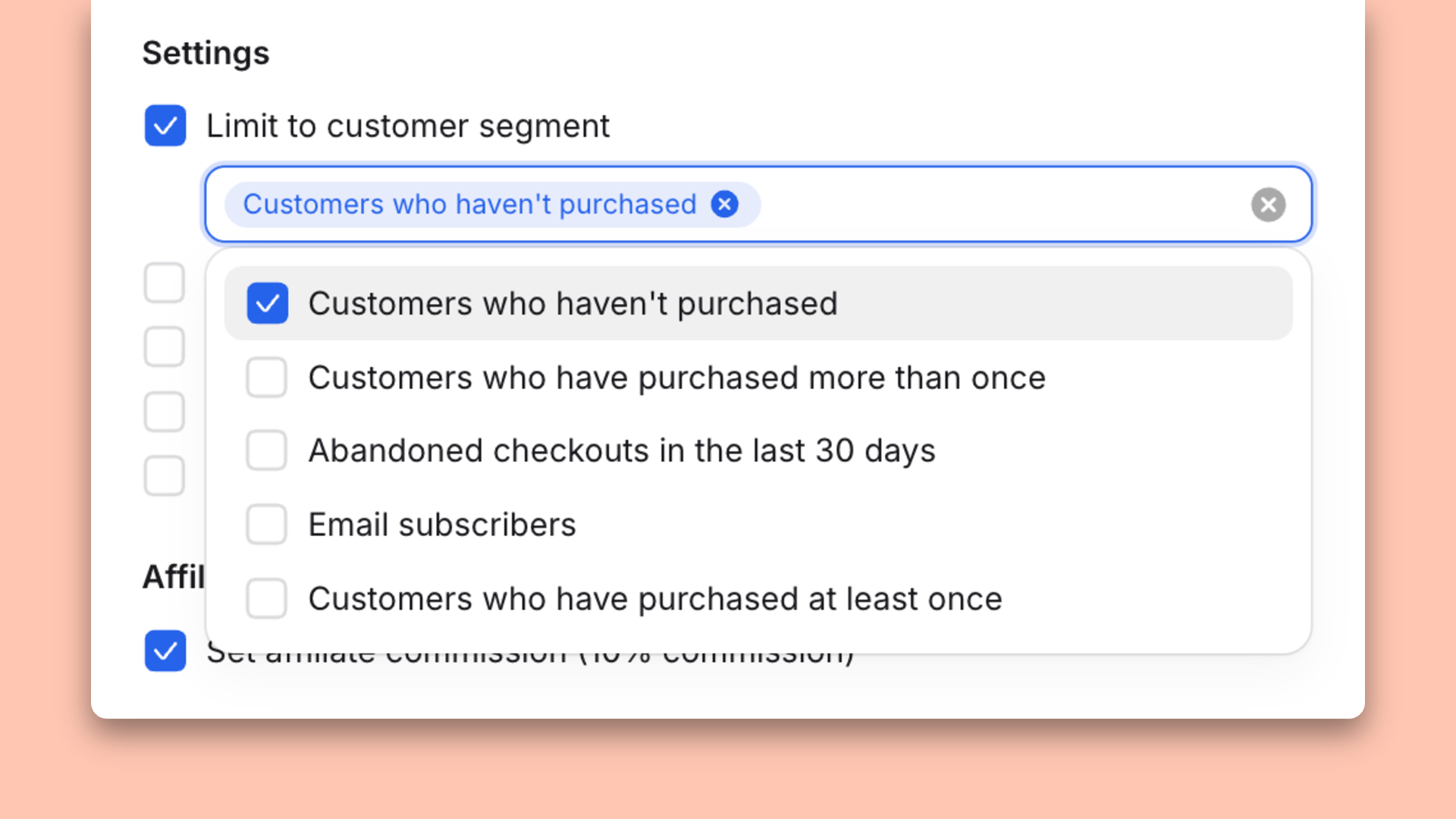
It’s a lot harder to figure out which sale belongs to which discount when you’re running a sitewide sale alongside a creator’s code.
A customer who was always going to buy during your Black Friday sale might grab a creator's code instead of your generic sitewide code simply because it's the one they saw first, and now that sale looks like it came from the creator when it was really your own promotion that did all the work.
Of course, the fix isn't to completely stop running sitewide promos, it's to make sure your system can tell the difference between these two types of code. A creator's code needs to stay distinctly theirs, even when it's rubbing shoulders with a public, non-affiliate discount that anyone can use.
In Modash, affiliate codes and non-affiliate sitewide codes are kept separate by design. A creator's affiliate code still gets credited properly even during a sitewide sale, and a non-affiliate code running alongside it won't steal a creator's link-based credit either.
Everything we’ve covered here assumes you can keep track of who has which code, what it's set to, and how well it's performing. That's obviously way more manageable with three creators than it is with 10 or 20.
The manual process – log into Shopify, create a code, copy it into a spreadsheet, email it to the creator – tends to work just fine until you’re managing roughly 10 creators. Past that point, it starts to collapse in a flurry of predictable-yet-entirely-avoidable ways (we’re talking duplicate codes, typos, codes that never got activated in the first place, and so on).
On top of that, you’ll start getting creators asking how their code is doing and if you don’t have an immediate answer for them… well, they’re not going to be too chuffed.
Modash creates and assigns codes in bulk straight from Shopify so there’s no real increase in admin work. And, because each creator gets their own portal, they can see their assigned code and per-order commission for themselves.
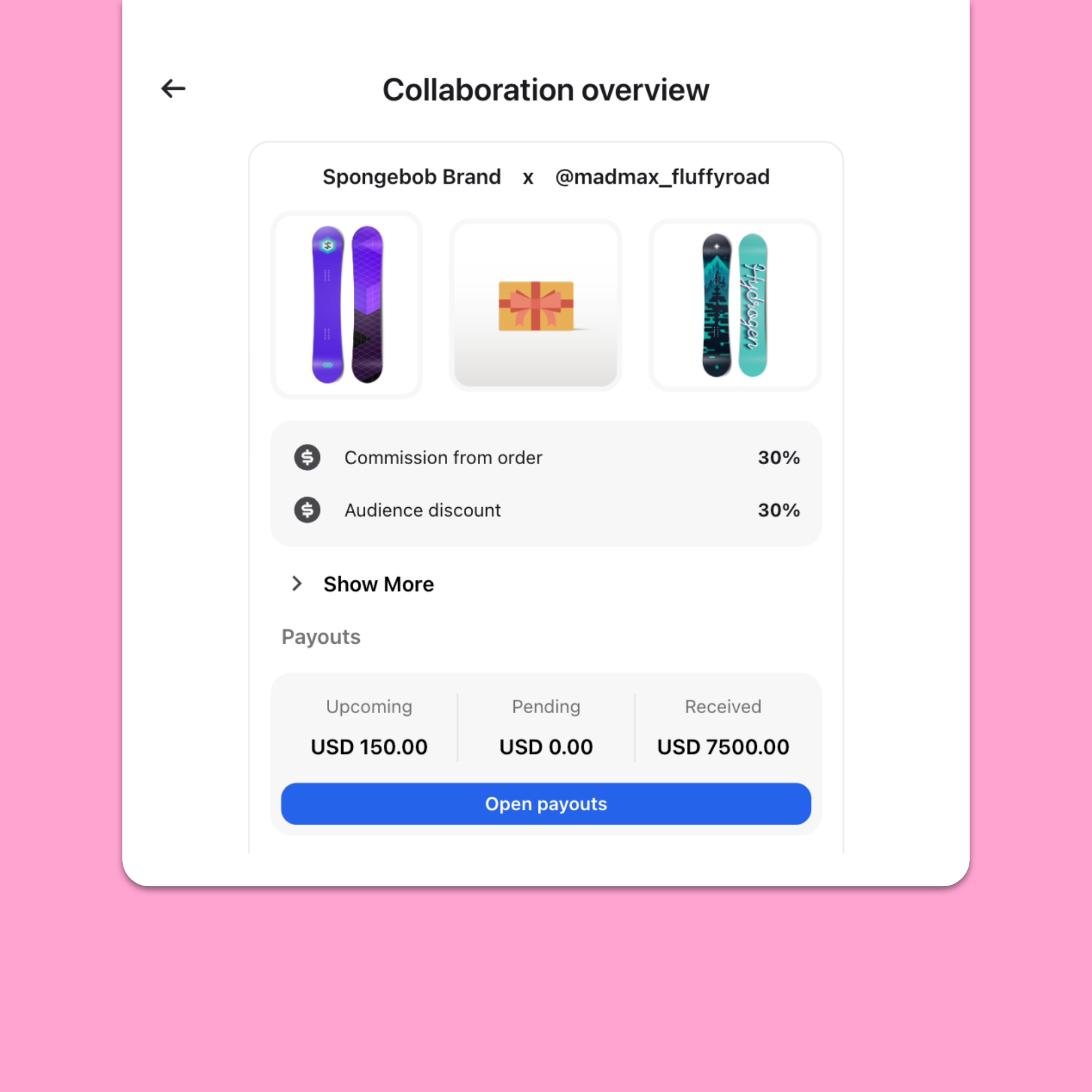
What if you’re running more than one Shopify store (like separate stores for different regions or languages)? Modash irons it out by letting you manage multi-store codes with duplicate ops and set per-store fixed amounts for regional stores.
A discount code for influencers will always look, on the surface, like a simple offer. But everything in this guide comes back to the same idea: the offer is the easy part. The harder part is the attribution that determines whether your numbers can be trusted, whether your margins are okay, and whether your creators feel fairly credited for the work they're doing.
Set the depth on purpose, protect it with usage limits, keep it from clashing with your own promotions, and pair it with a link so each one picks up whatever the other misses.
Then, watch for where codes “lie”. In particular, look for leakage to scammy sites, undercounting, non-incremental redemptions, and sitewide overlap. Knowing where there’s a problem is half the battle.
Get that right, and your codes will hopefully become a small piece of infrastructure you can use to tell which creator earned what and protect your margins at the same time.
Modash gives every creator a code and a tracking link, holds the attribution rules steady as you add partners, and gives each creator a portal to check their own numbers. Try it for free for 14 days.
A brand assigns a unique code to a creator, and when a follower enters it at checkout, they get a discount and the sale gets attributed back to that creator. It does two jobs at once: it's the incentive that gets someone to buy, and it's the signal that tells you (and often, what pays) the creator who drove the sale.
A code ties to the completed purchase, so it still works even if someone hears it in a video and buys days later without clicking anything. A link ties to the click itself, so it captures the journey from post to store, but it doesn’t work if a customer blocks cookies or switches devices before buying.
Most brands go for something between 10% and 20% off, which is deep enough to move someone to buy without training your audience to wait for a code. The right number for you depends on your margins and AOV, since the discount and the creator's commission both come out of the same sale.
You can't fully prevent it, but you can limit the damage: cap total redemptions or limit codes to one use per customer, keep a tracking link running as a backup signal, and monitor for usage spikes that don't match a creator's recent posts. When you do catch a leak, kill the code and give the creator a fresh one straight away.
Codes and creator-reported numbers are rarely a perfect match, because codes miss forgotten or mistyped redemptions, and creators often count views or engagement as "impact" that doesn’t actually convert into a tracked sale. Pairing the code with a tracking link closes some of the gap, but it's worth accepting that some of a creator's real influence will always stay invisible to your dashboard.
Shopify alone works fine for a handful of creators, since you can create and manage codes manually in the admin. Past around 10 creators, though, manual code creation tends to fall apart a bit (duplicate codes, typos, codes that never got activated), which is when a dedicated tool that creates, assigns, and tracks codes in bulk can really help.
That depends entirely on how you configure it. Whether a creator's code can stack with a sitewide sale, and whether a customer can combine multiple codes on one order, are both settings you control at the code level, so it's worth deciding this in advance rather than defaulting to whatever Shopify does out of the box.