Free virtual event: hear from influencer leaders at ŌURA, Adobe, Stanley 1913 & more.
See the lineup





Managing an affiliate program at scale is a totally different beast to launching one. Most brands hit a wall at 30 – 50 affiliates because the tools and habits they relied on from day #1 start breaking down. But it doesn’t have to be like that. Read on and I’ll dig into what effective affiliate program management actually looks like, including step-by-step guidance on how to do it yourself.
⚠️ Disclosure: I’m not an affiliate marketer, I’m a writer. So for parts of this article, I’ve leaned heavily on two legit experts, namely:
Most brands treat affiliate program management as a recruitment problem. They focus all their energy on finding, signing up, and onboarding new affiliates – then run out of steam when it comes to managing the creators they’ve already got 🤦♀️
I get it: it’s hard to resist a shiny new thing (in this case, a potential new affiliate partner). But lots of brands have more than enough affiliates already. They just aren't putting enough effort into ongoing comms post-onboarding, so they inevitably struggle with retention. Which explains why 60% of marketers we surveyed said their biggest challenge is “keeping affiliates happy”.
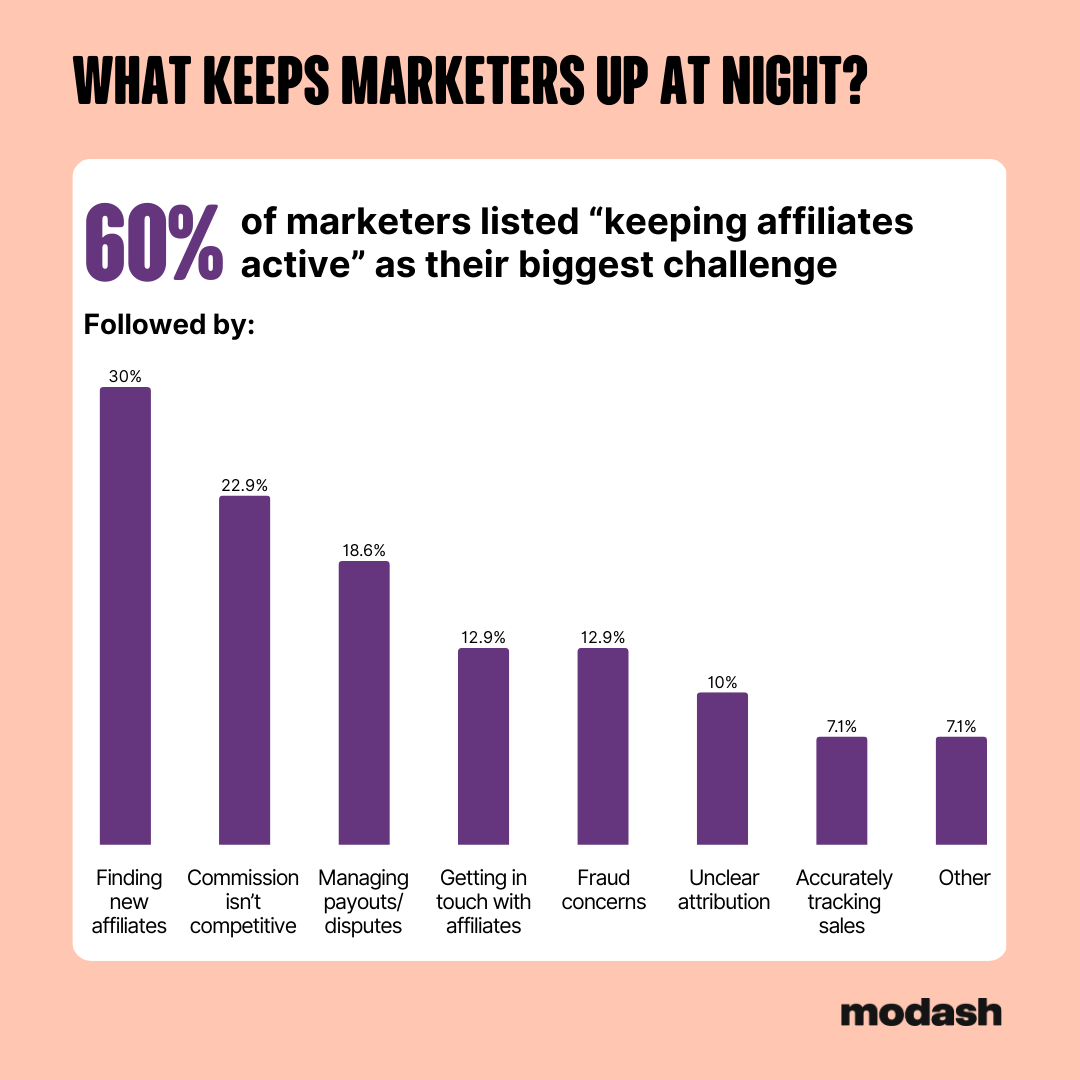
As I noted in the intro, the 30 – 50 affiliate mark is often the tipping point where all those manual processes that were so essential to getting a program off the ground start to become a serious burden. I’m talking about stuff like:
And trust me, if those processes are slowing things down at ~50 affiliates, they’ll be positively glacial when you scale to three figures or more.
Fact is, if you’re doing everything manually, you’re not really running a program at all – you’re doing a whole heap of admin. So if you’ve reached this point, it’s time to start automating.
🤓 Further reading: Find out more in Affiliate Marketing Automation: The Complete Guide to Scaling Your Program.
While different brands have different reasons for starting an affiliate program, the specific practices that contribute to solid affiliate program management are pretty transferable. Here are some key considerations, as recommended by Gabija and Robert:
With every campaign or release we prioritize content based on the same logic: active/proactive performers first, then active creators, then passive/complimentary creators.

You need to review and respond to requests daily, monitor the program’s health and performance metrics, and watch for any anomalies.

We organize social evenings where creators can meet the faces behind our company, talk with them not only as business partners, but as friends. Participating creators are always more motivated, have more ideas, and feel more hyped and excited.
We struggled to have any breakthrough in Canada for many years. But once we noticed our first baby steps in sales and celebrated this with the responsible creators, we hit a three-month streak of very good sales in the Canadian market.
Unless you’ve outsourced everything to an agency, there are three main ways to manage an affiliate program:
As always, there are strong and weak points to each…
| Management model 💼 | Pros 👍 | Cons 👎 |
|---|---|---|
| Centralized |
• Clear accountability and ownership • Consistent communication with affiliates • Faster decision-making • Stronger long-term partner relationships |
• Can become resource-intensive as the program scales • Heavy reliance on a small number of people • Knowledge silos can form • Requires experienced affiliate managers |
| Decentralized |
• Lower upfront staffing requirements • Easier to distribute workload across existing teams • Can work for smaller or early-stage programs • Specialized departments manage their own expertise areas |
• Lack of accountability • Slower communication and approvals • Inconsistent affiliate experience • Higher risk of missed payments or partner neglect • Difficult to track overall program performance |
| Tool-led |
• Highly scalable • Reduces manual admin work • Faster onboarding and payouts • Centralized data and reporting • Lower operational overhead • Easier to manage large creator or affiliate networks |
• May not suit enterprise partnerships requiring hands-on management • Platform costs can increase with scale • Automation gaps still require human oversight |
🤓 Further reading: For more on this, check out Influencer Marketing In-House vs. Agencies: Which Is the Right Choice for You? and read my recommendations for the 19 Best Influencer Marketing Platforms.
While scaling an affiliate program doesn’t have to mean recruiting hundreds of creators, it definitely does require building a go-to list of active high-performing affiliates.
As with most parts of affiliate program management, doing this manually means spending long enough in spreadsheets to become a serious contender for the Excel World Championship (yes, it’s a real thing). For each creator, you’ll want to add their:
Even if you only work with a half-dozen-or-so affiliates, maintaining this spreadsheet is gonna require some serious effort. At 10 or more creators it’s pretty much unworkable. And 30+? Fuhgeddaboudit 🤌
Save yourself the headache with a dedicated affiliate management platform like Modash, which automatically tracks how much content your affiliates are posting and when their most recent post went live.
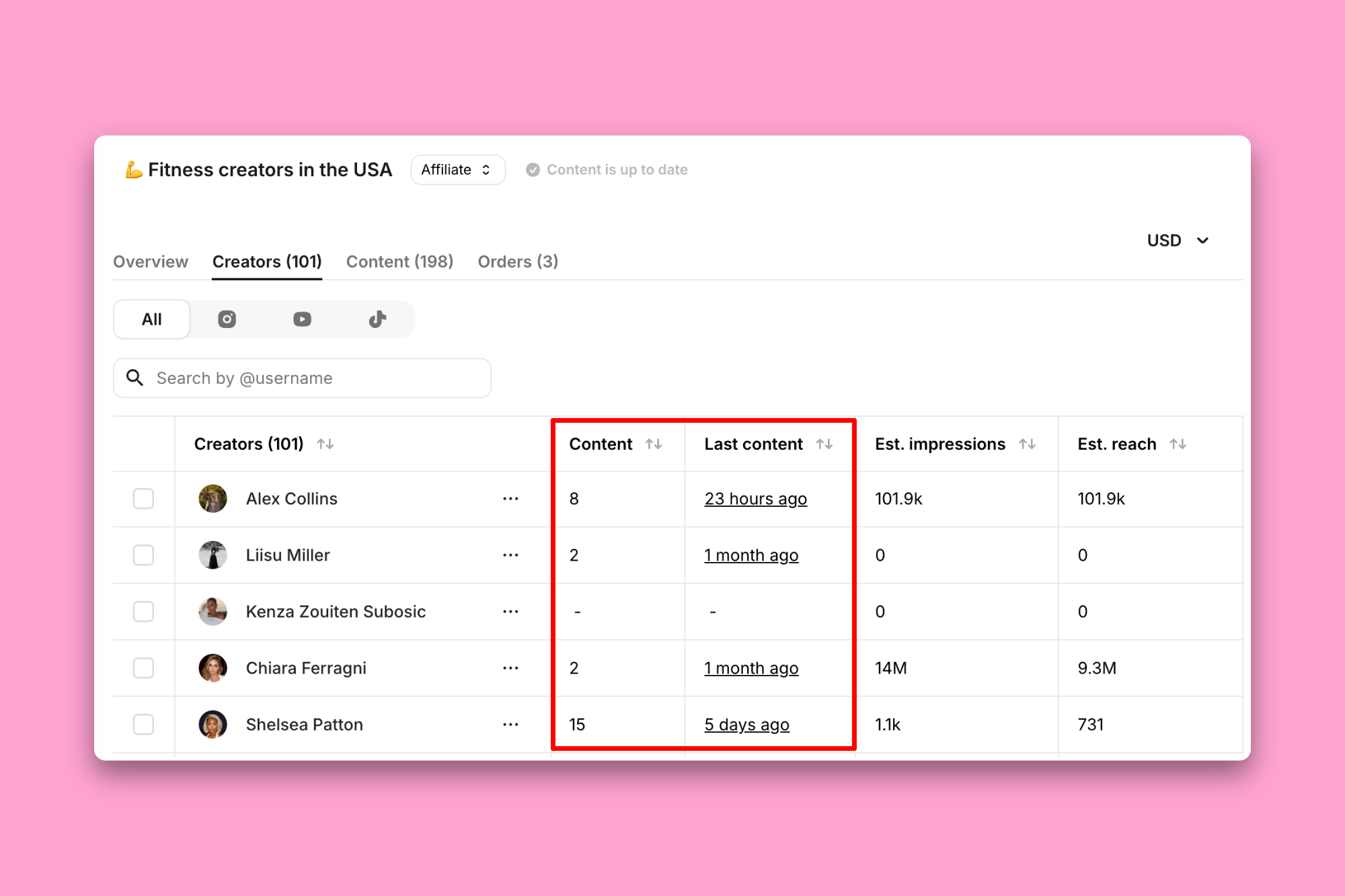
It only takes a couple clicks to create new lists, add relevant affiliates, and set their status (plus you can customize all your status options to match the needs of your program). Plus you can write notes for individual creators to help with the all-important task of building stronger relationships 💪
Remember: both Gabija Jankauskė and Robert Polonski say that reliable tracking is one of the most important elements to running a successful affiliate program.
You definitely want to figure this out before you start scaling or you’ll have no way of knowing if anything’s working. Should you hire more affiliates? Double down on a specific campaign or angle? Reach out to that underperforming creator? Who knows 🤷♀️
There are two main tools at your disposal for tracking performance:
🛍️ Promo codes (AKA discount codes): Unique to each affiliate. When a customer submits a code at checkout, they receive a discount, and the transaction is tied back to the relevant creator. Best for tracking sales.
🔗 UTM links: Custom URLs that tell analytics tools where a click came from. Again, they’re unique to individual affiliates, so they can tell you who’s sending the most visitors to your store. Best for tracking clicks and traffic from affiliate content.
Setting up tracking is only a tiny battle in a much larger war, because you also need a way to reconcile clicks and code redemptions to specific creators and transactions.
You can do it manually in a spreadsheet – in fact, you can even find a free template in our article 5 Spreadsheets for Influencer Marketers. But it’s a serious heavy lift for any program with more than a handful of affiliates.
For your own sanity, you’re much better off with an affiliate marketing platform like Modash, which automatically matches codes and links to sales in Shopify, giving you a clear picture of revenue and clicks per affiliate.

If you’re not on Shopify, you can still track results through Modash – you just won’t get the same end-to-end view of performance.
🤓 Further reading: For more on tracking sales, check out 12 Best Affiliate Tracking Software Tools.
In the early days of your program, you can afford to rely on one-to-one and bulk emailing for all your affiliate communication needs.
But once you reach 10+ affiliate partners, you’ll need a more scalable solution: broadcast channels like Discord, Slack, and WhatsApp. Just over half of marketers we surveyed already use them to communicate with affiliates – and you should too.
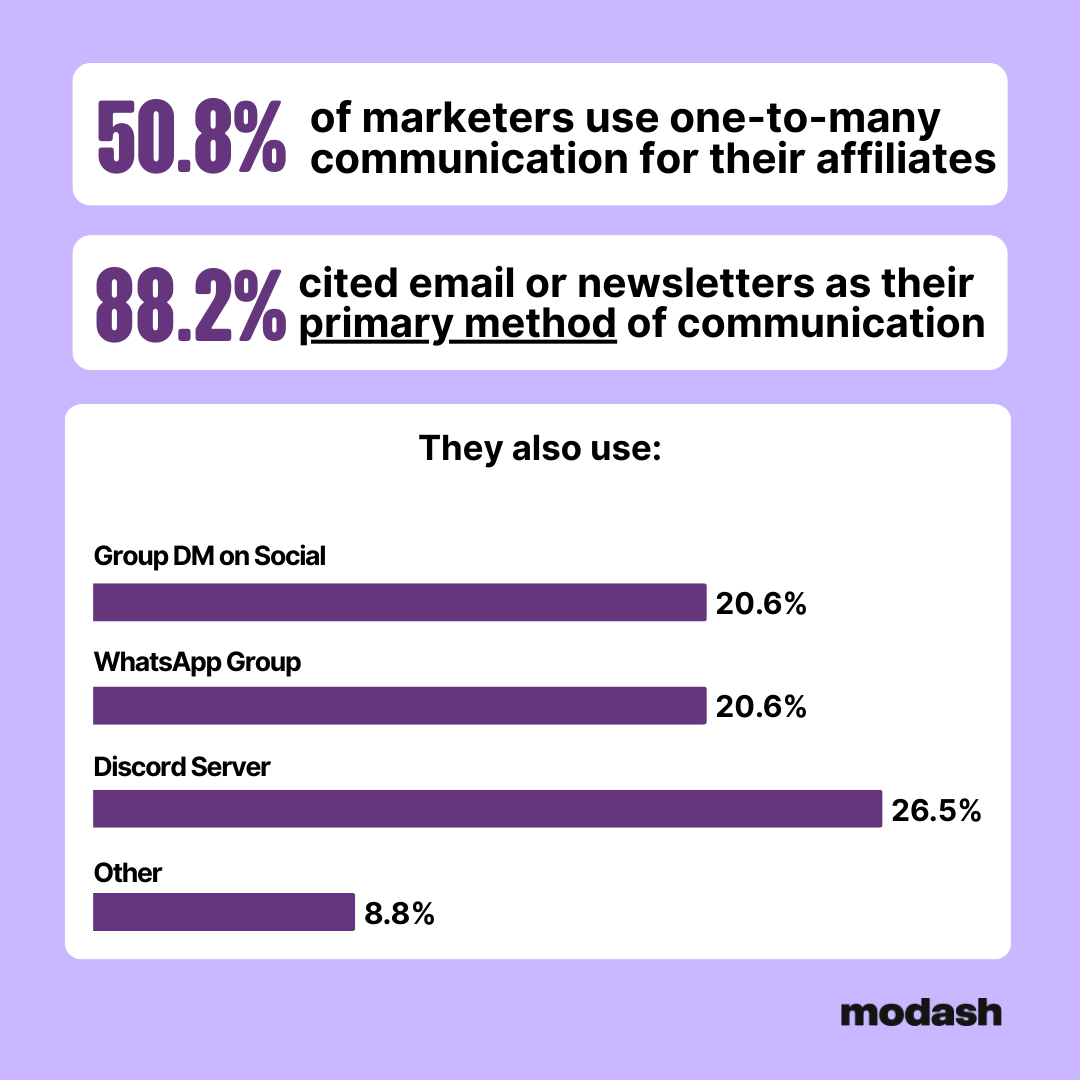
However, you don’t want to rely on “one-to-many” platforms for all your comms. Some interactions need the personal touch that only comes from 1:1 messaging.
So what’s the ideal split between 1:1 and broadcast? TBH if you asked 50 marketers you’d probably get 50 different answers. For his part, Robert says that at Deeper, they send roughly nine broadcasts for every 1:1 message.
In our case, only a few creators require direct instructions on what’s expected from them. Otherwise, we send a batched email presenting new campaigns, examples of integrations, and deadlines.
Gabija adds that while 1:1 is “always the best option”, in practice there often isn’t enough time for it – so it makes sense to share repetitive and/or generic messages more broadly.
While speaking to your affiliate partners mano-a-mano is always gonna take time, you can claw some of it back by using Modash’s dedicated influencer marketing inbox. From a single view, you can write your email and find a ton of essential info about the creator you’re messaging:
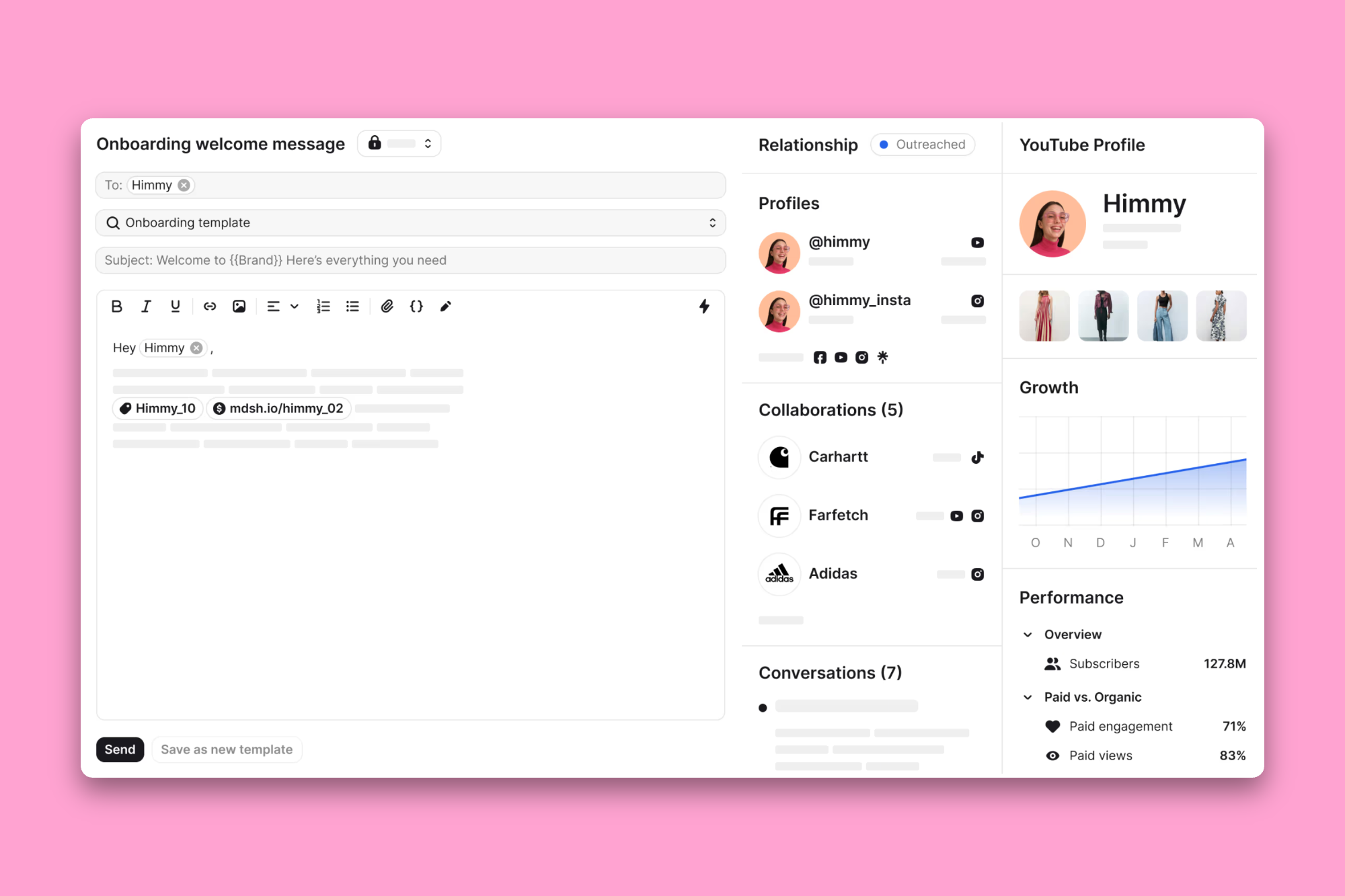
That way, you’ll never have to waste valuable time clicking through different spreadsheets and email threads to track down details about previous collabs, performance metrics, or conversations 😮💨
Capturing live affiliate content is another serious time sink. If you’re gonna do it manually, you’ve basically got two options:
👉 Ask creators to submit their own content
👉 Screenshot live content and/or capture links yourself
Neither is ideal. Your affiliate partners are busy and might simply forget to self-report. And while rounding up 10 – 15 posts a month yourself isn’t too arduous a task, it’s clearly not an option at scale.
That’s why, sooner or later, most brands start using an influencer tracking tool like Modash. We’ll collect all that live influencer content for you, including Stories.

All you have to do is tell us which hashtags, mentions, and/or keywords to track. Best of all, your creators don’t even have to sign up for anything.
🤓 Pro tip: Worried your affiliates might forget a mention or misspell a hashtag? Switch on Modash’s Event mode to automatically track every piece of content shared by selected creators. Easy!
Whether you’ve got five affiliates or 500, chances are that just a small proportion are driving the majority of clicks and sales. And if you’re serious about managing a successful program, you wanna keep a tighter hold on these precious “super affiliates” than Gollum clutching the One Ring 💍
Of course, to keep hold of them, first you need to know who they are – which requires regular performance monitoring.
Doing this manually is all about matching promo codes to transactions to understand where your revenue’s coming from. Once again, this is fine when you’re just starting out. But it pretty much becomes a full-time job once you’re managing dozens of creators.
The alternative is to use an affiliate tracking tool. If you’re on Shopify, Modash is the obvious choice – we track clicks, code redemptions, sales, and payouts for all affiliates…
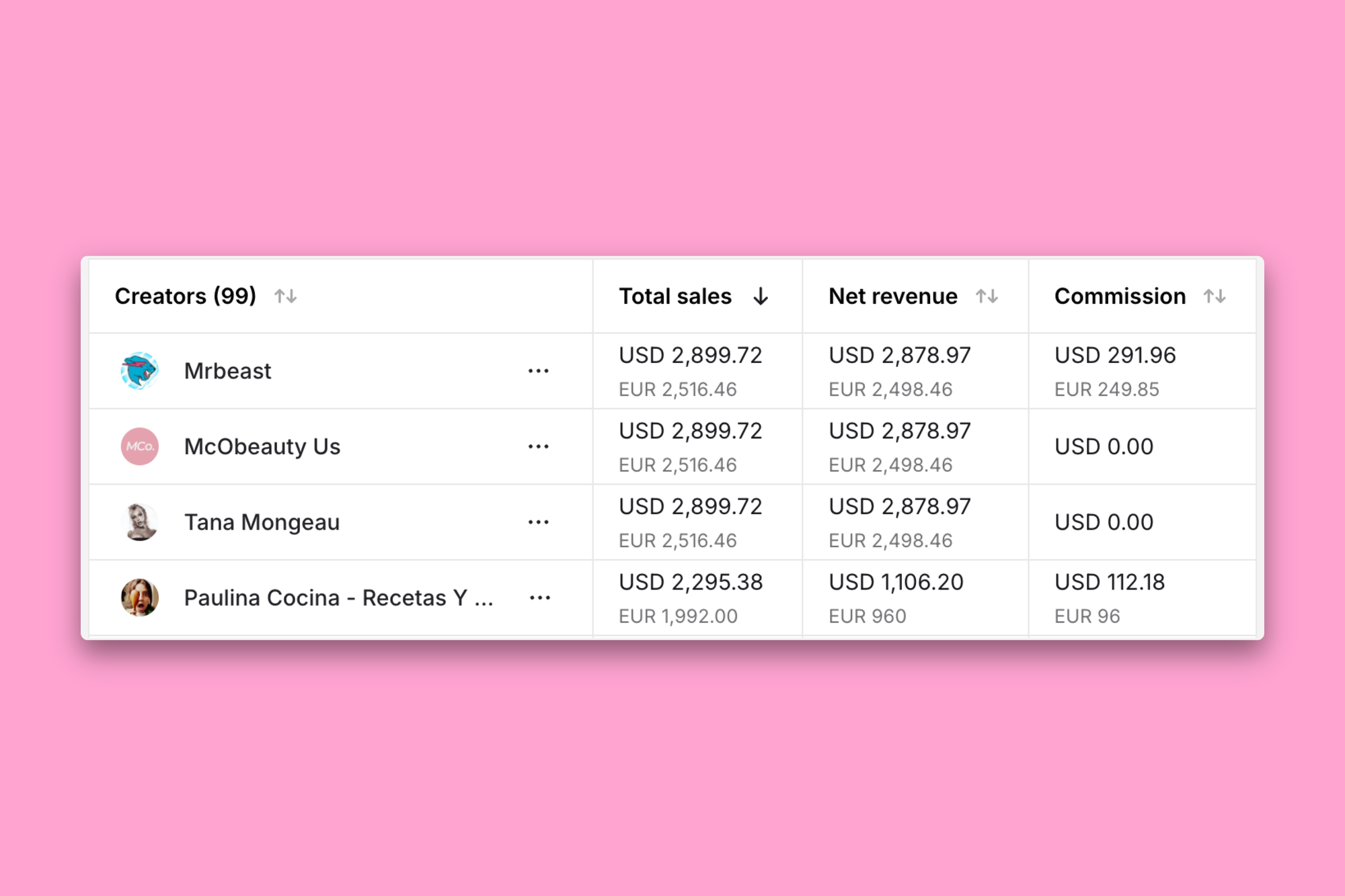
…so you can instantly spot your top performers.
Now you’ve identified those over-achievers, you can set about retaining them. Communication plays a part – maybe you wanna save most of your 1:1 messaging for your highest sellers? – but you should also reward them where it really counts: their bank 💰
To do this, segment your top ~20% of partners by revenue generated and add them to an exclusive VIP tier with special perks like:
Because the more love you show them, the more likely they are to stay.
However much time and effort you dedicate to onboarding and retention, some of your affiliates are still gonna ghost you 👻 It’s unavoidable. In fact, over one-third of marketers we surveyed admitted that <20% of their brand’s affiliates are active.
As a general rule, more active affiliates = more good 👍
So you’ll want to spend some time reactivating dormant partners. In a nutshell, that means sliding into their DMs or email inbox to remind them why they joined your program in the first place and (hopefully) encourage them to start posting again.
🤓 Pro tip: Sick of manually chasing creators who don’t reply to your emails? Use Modash to create personalized, multi-step sequences with custom delays between each message – you’ll never forget a follow-up again!

🤓 Further reading: For more on re-engagement sequences (including what to say in each message), check out How to Increase Affiliate Sales (Without Recruiting More Creators).
One final point on this…
While activation campaigns are important, bear in mind that your goal shouldn’t be to re-engage every single lapsed creator in your program. As Jessica Simpson and Nick Lachey would tell you, some relationships just aren’t meant to be, so don’t be afraid to cut and run if it isn’t working (more on this later in the article 👇👇👇).
Even if you nail every other element of affiliate program management, you’re doomed to failure if your payments are a mess. After all, why would creators stick around if they can’t trust you to hand over their hard-earned commissions?
While there are few universal truths in the affiliate marketing world, it’s pretty much standard practice to pay affiliate partners monthly (albeit you might want to build in a minimum commission threshold so you’re not wasting time and money on constant micro-payments). As Robert explains…
If we have a locked date by when each month's commission must be paid out, it makes it easier for both parties. The creator has less stuff to worry about and we have a stable movement of budget.
For early-stage programs, it’s fine to handle these monthly payments via bank transfer or a third-party platform like PayPal. But if you don’t fancy all that manual reconciliation, your best bet is Modash Pay. With Modash Pay, you can:
✅ Pay creators in 36 currencies across 180+ countries (with zero invoicing required)
✅ View your full payout history per affiliate
✅ Offload all your tax and regulatory compliance to us!

👉 Try all our affiliate program management tools for yourself when you create your free Modash account!
I’ve already spoken about how broadcast channels (Slack, Discord, etc) are an essential tool for reducing your reliance on 1:1 emails and DMs. But how, exactly, should you be using them?
For Gabija, the goal is to keep affiliates in the loop without being intrusive, which generally involves sending multiple messages per month via broadcast channels.
It’s important to inform broadcast channels about upcoming promotions, new collections, etc, so I would suggest doing this at least 1 – 3 times per month.
Robert also suggests using these channels to share details about new campaigns and product releases. In other words, anything that has wide relevance and requires little or no personalization.
🤓 Further reading: For in-depth guidance, check out How to Use One-to-Many Broadcast Channels in Influencer Marketing (Without Erasing the Personal Touch).
Gamification can have a big impact on engagement by giving creators a little extra incentive to post. There are various ways to gamify your affiliate program, but three popular options include:
For best results, don’t bombard affiliates with these gamified elements – instead, use them around key events like product launches or major promotions. For example, you might run a Black Friday/Cyber Monday leaderboard with a commission bump across the weekend, plus a flash bonus for the outright top performer.
Naturally, you don’t want to be too prescriptive about the content your affiliates create – after all, they’re the experts. But, at the same time, most creators appreciate a little market intelligence.
Dive into your analytics, look at your top-performing affiliate posts, and share your favs via broadcast channels. Not only will it offer invaluable inspiration to most of your affiliates, but it’s also a nice pat on the back for the creators whose content you chose to spotlight.
At the same time, ask yourself why those posts performed so well. Do they focus on particular products or feature particularly effective hooks? Again, your affiliates will love to receive these sorts of insights – because, unlike you, they don’t have a clear view of what types of content are generating the most sales.
Offering bonuses for early success gives new affiliates an extra incentive to start promoting your products.
For plenty of brands, this means rewarding creators for their first sale with a higher commission rate or a flash bonus. But instead of (or as well as) this, it makes sense for these early rewards to extend beyond the first month. For instance, you could:
All those incentives encourage affiliates to stick with you into month #2 (and hopefully beyond).
Modash research found that 55%+ of marketers rely on a flat, single-tier commission structure to attract and retain affiliates.
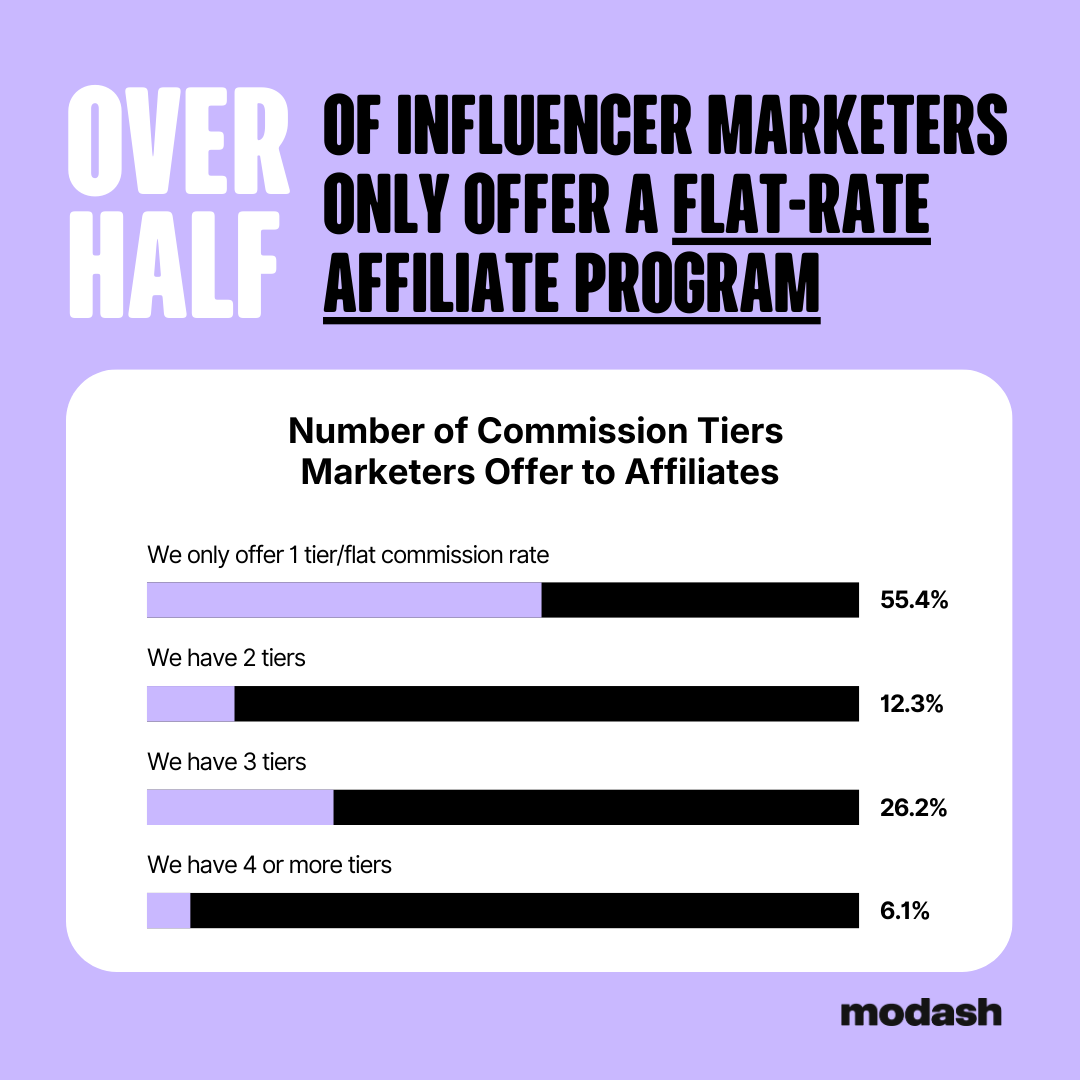
I’m sure some brands with flat commission rates are seeing superb results. But, as a general rule, offering multiple commission tiers helps your retention efforts.
(In fact, the same research I shared above revealed that brands with 3+ tiers see ~35% higher rates of active affiliates than those with only one tier.)
Ahhh, the thorny issue of when to show lapsed affiliates the door… 🚪
There’s no universal rule for this. Gabija prefers to put the ball in the creator’s court.
First, you contact them to see whether they’re interested in continuing the collaboration. If there’s no interest, the partnership should be ended. However, if the partner is motivated and shows potential, it may be worth trying to re-engage them.
Meanwhile, Robert says Deeper usually retains affiliates even after long periods of inactivity, simply because there’s little or no cost to keeping them around. At times, this approach has seriously paid off.
We’ve had cases where underperforming creators transformed into our most reliable go-tos because we didn’t give up on them as soon as performance dropped, but instead invested time and resources into helping them get back on track.
In short, if a creator has delivered results in the past, it’s probably worth sticking with them (even if they’re not posting ATM). Whereas if they’ve never shared a single post, you can likely live without them 👋
That depends. If they’re doing everything manually, one person will struggle to manage more than 5 – 10 affiliates (if that). It’s just too much admin. Whereas if they’re using a creator marketing platform like Modash with built-in automation, they could easily handle 10x as many.
Treating their affiliate roster as a set-and-forget list – AKA recruiting lots of affiliates but only checking in when there's a payout issue or a brand complaint. At scale, that means a large chunk of your partners are technically "active" but not posting.
If you only have a handful of affiliates, you can manage them all manually – communicate via Slack + email, get creators to share their live content, and pay them through PayPal or Wise (or similar). But at scale you’re going to need a dedicated tool like Modash for managing affiliate relationships and handling payments in 36 currencies across 180+ countries.
When you hit 10+ affiliates, the financial cost of a dedicated affiliate management tool starts to be outweighed by the opportunity cost of all those hours spent in spreadsheets manually tracking content and assigning discount codes to transactions. At 30+ affiliates, it’s no longer a question of if you should move – it’s imperative.
Share best practices, top-performing angles/formats, and trending products – essentially, anything that makes it easier for underperforming affiliates to post better content that’s more likely to deliver results. Otherwise they’ll likely lose motivation and eventually ghost you.
Our expert contributors