

More tools
Use cases



Most affiliate tracking tools do one thing well: attribute a sale to a link. That works fine for traditional publisher affiliates. But when your affiliate partners are creators, you're dealing with a different problem. You need to know what content went live, whether partners are actually promoting your brand, and how to tie social performance to revenue. Most tracking tools can't do any of that.
This article covers 12 affiliate tracking software tools evaluated on link and promo code reliability, Shopify integration depth, fraud controls, creator workflow support, and whether they help you understand what's driving conversions – not just that a conversion happened. Pricing, G2 ratings, and real user feedback from Reddit shaped every entry.
| Tool | Best For | Pricing |
|---|---|---|
| Modash | Ecommerce and Shopify brands managing creator affiliate programs end-to-end | Starts at $199/month (annual) or $299/month (monthly). Free trial available. |
| Refersion | DTC and ecommerce brands on Shopify or WooCommerce launching performance-based affiliate programs | From $39/month + 3% of affiliate-driven sales (Launch); $199/month + 2% (Growth); custom (Scale) |
| Impact.com | Mid-to-large ecommerce brands managing affiliate, influencer, and referral programs at scale | Starter $30/month; Essentials $500/month; Pro $2,500/month; Enterprise custom. 2.5% transaction fee on all plans. |
| PartnerStack | B2B SaaS companies building affiliate, referral, and reseller partner programs | Launch $1,000/month; Growth $1,520/month; Enterprise custom. All billed annually. |
| Trackdesk | Scaling SaaS companies and agencies needing unlimited affiliate tracking with transparent pricing | Business $249/month; Enterprise $499/month; Enterprise PLUS ~$1,999/month. 14-day free trial. |
| Rewardful | SaaS founders wanting a fast, Stripe-native affiliate and referral program | Starter $49/month; Growth $99/month; Enterprise $149+/month. 14-day free trial. |
| LeadDyno | Small to mid-sized ecommerce brands and SaaS companies needing simple, affordable affiliate management | Plans from $49/month to $749/month. 30-day free trial on all plans. |
| Tapfiliate | Ecommerce brands and SaaS companies wanting fast deployment without developer involvement | Launch $89/month ($74/month annual); Scale $179/month ($149/month annual); Enterprise custom. |
| FirstPromoter | SaaS and subscription companies wanting affordable, easy-to-set-up affiliate and referral management | Starter $49/month; Business $99/month; Enterprise $149+/month. 14-day free trial, no credit card required. |
| Everflow | Performance marketers and affiliate managers needing full-funnel tracking at scale | Reportedly ~$750/month billed annually (Starter). Official pricing not published on Everflow's website. |
| Affise | Affiliate networks, ad networks, and media buying teams managing high-volume campaigns | Beginner $625/month ($499/month annually); Core $888/month ($699/month annually); Expand $1,239/month ($999/month annually). 14-day free trial. |
| Voluum | Media buyers and performance marketers tracking and optimizing paid traffic campaigns at scale | Not publicly listed. Contact Voluum for a quote. |
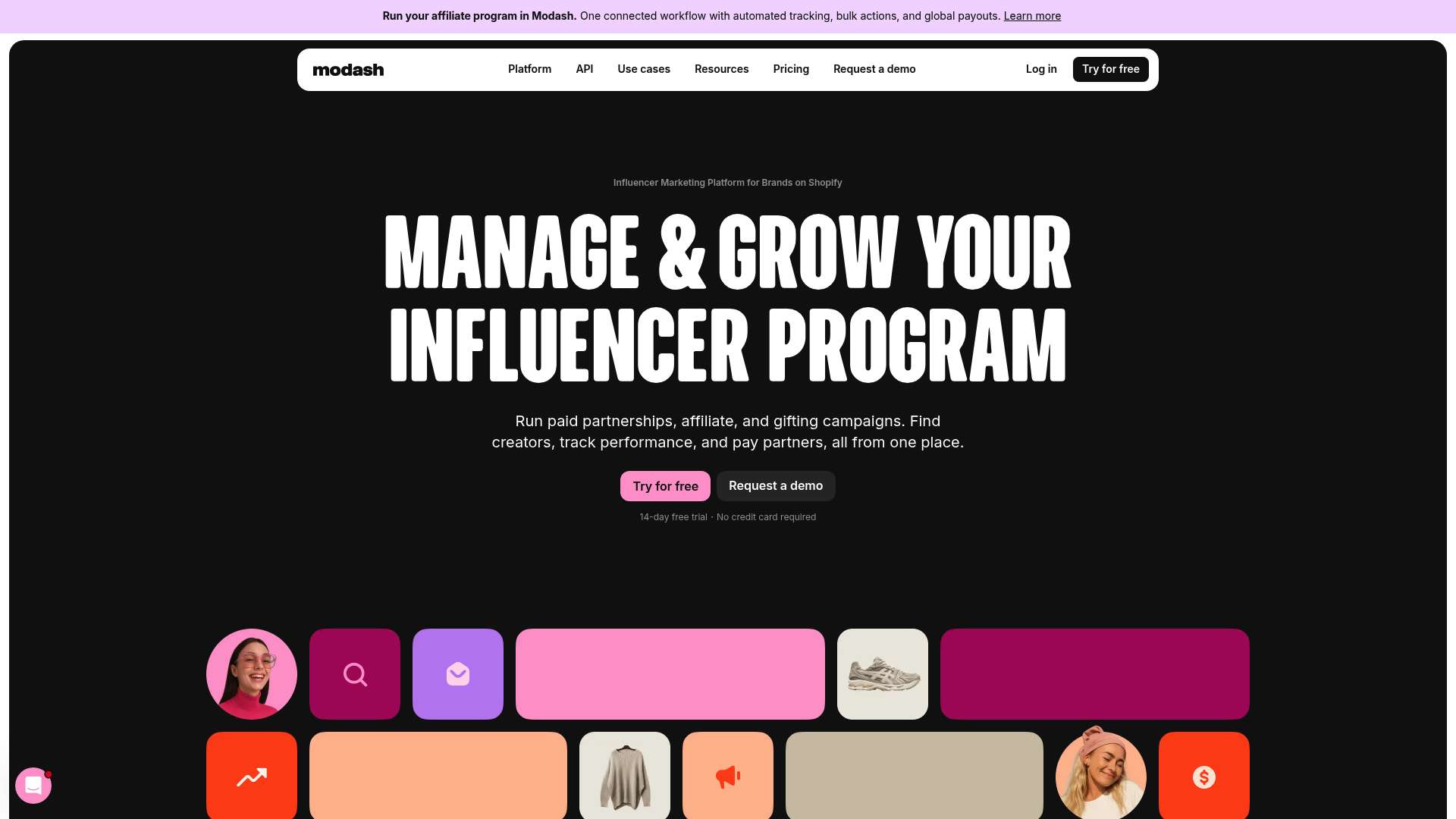
🥇 Best for: In-house marketing teams at ecommerce and Shopify brands who need to discover, manage, track, and pay creator affiliates from a single connected platform.
🤔 What is Modash?
Modash is an end-to-end influencer marketing platform built for ecommerce brands. It covers the full program lifecycle: finding creators, running outreach, tracking content and sales, and processing payouts globally. The platform indexes 380M+ public creator profiles across Instagram, TikTok, and YouTube without requiring any creator opt-in.
For creator affiliate programs specifically, Modash does something most tracking tools don't: it connects sales attribution (via promo codes and tracking links through Shopify) with content performance tracking (what was posted, how it performed, and whether partners are active). That dual view is the core differentiator.
The affiliate workflow handles promo code generation, link tracking, payout automation, and creator-facing dashboards in one system. You're not stitching together a tracker, a spreadsheet, and a payment tool separately.
Key features:
Influencer discovery and vetting: Search 380M+ creators using granular filters: audience demographics, engagement rate, estimated fake followers, brand collaboration history, and audience overlap. Unlike opt-in-only databases, every public profile with 1,000+ followers is indexed. This means you recruit from the full creator landscape, not just those who signed up for a network.

Outreach and campaign management: Built-in inbox with email templates, variable personalization, and shared team threads. You can manage creator conversations, track open and reply rates, and move creators through campaign stages without leaving the platform.
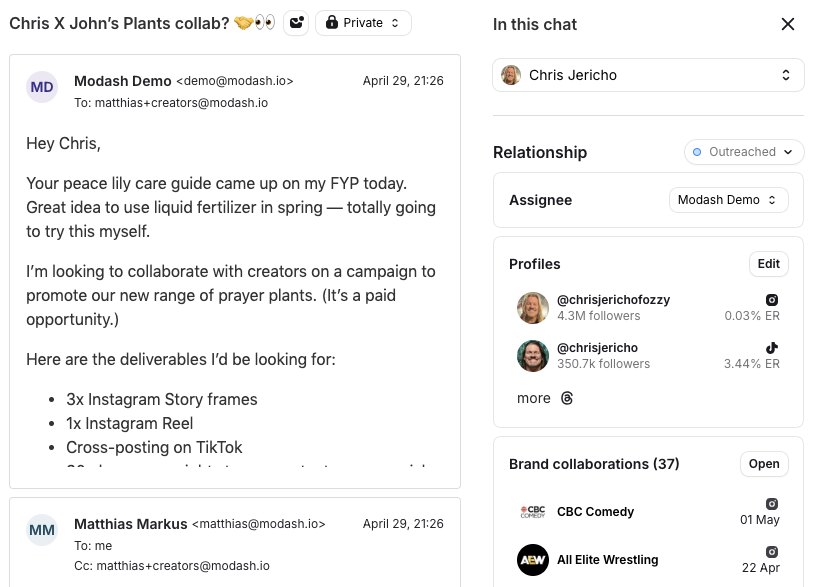
Content tracking (codes + links + posts): Modash tracks promo codes and affiliate links through a native Shopify integration, pulling order-level data directly into the platform. It also auto-tracks creator posts, Stories, and Reels without requiring creators to authenticate or sign up. Content refreshes approximately every 12 hours, and deleted content is saved in your dashboard. So your team can see exactly what went live, what drove clicks, and what converted, all in one view.

Payments and affiliate payouts: Modash acts as the vendor of record, handling invoicing, tax compliance, and currency conversion across 180+ countries and 36 currencies. Creators get a self-serve dashboard to set up banking, view commissions, and receive payouts. Payout timing and thresholds are configurable by your team. Auto-generated invoices remove the back-and-forth that slows programs down at scale.

Price: Starts at $199/month (annual) or $299/month (monthly). Free trial available. 👉 Modash Plans and Pricing
Worth noting: Modash's affiliate tracking is built around Shopify. If you're running WooCommerce, a custom cart, or TikTok Shop-native affiliate flows, you'll need a different solution or a workaround.
Review score: ★ 4.9/5 (G2)
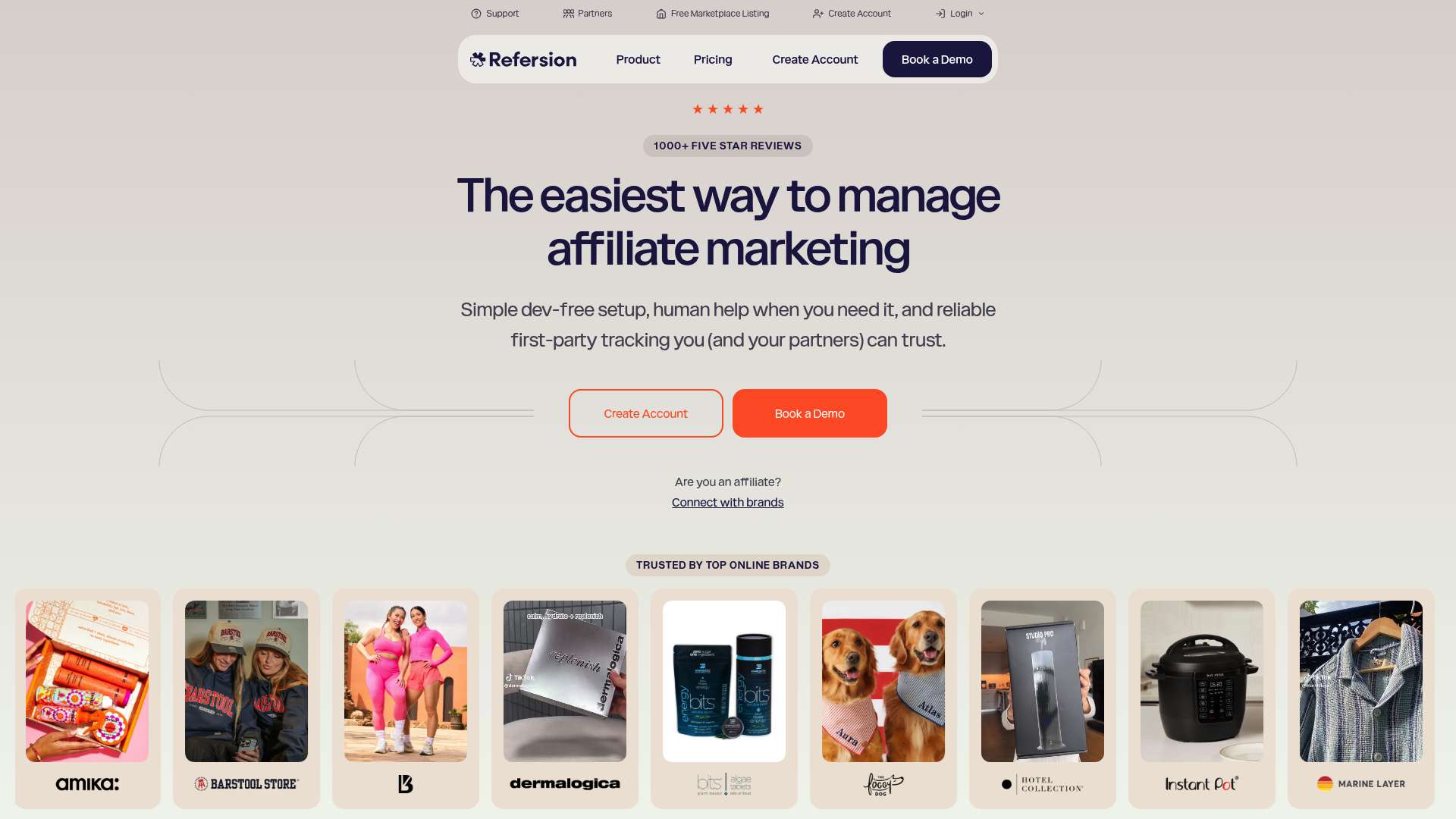
🥇 Best for: DTC and ecommerce brands on Shopify or WooCommerce looking to launch and scale a performance-based affiliate or influencer program without complex technical setup.
🤔 What is Refersion?
Refersion is an affiliate management platform built for online brands. It handles affiliate recruitment, tracking, and payouts with native integrations for both Shopify and WooCommerce. It also includes a built-in marketplace where affiliates can discover and apply to your program organically.
Key features:
First-party tracking (cookie-free): Refersion uses a first-party tracking domain rather than cookies,so browser privacy updates (Safari ITP, Firefox ETP) and ad blockers don't break attribution. Conversions are tracked at the order level, including returns. For ecommerce brands worried about attribution gaps, this is a real advantage over cookie-dependent trackers.
Flexible commission management: Commissions are configurable as a percentage of sale, flat fee, subscription-based, or by specific product and customer type (new vs. returning). You can differentiate rates by affiliate performance tier or product category. This makes it workable for brands running both influencer gifting and traditional publisher affiliates from the same account.
Refersion Marketplace and onboarding: Brands can list offers in the built-in marketplace for organic affiliate discovery. Invite flows, approval workflows, and centralized affiliate management are included.
Worth noting: Refersion doesn't offer native social content tracking or any view into what a creator actually posted. Attribution is click and conversion-only. If you need to monitor whether a creator ran their promotion at all, you'll need a separate tool. The revenue percentage fee structure (3% on Launch, 2% on Growth) also means costs scale with your program. At higher volumes, the Scale plan's flat-rate pricing makes more sense.
Price: Free marketplace listing tier. Launch plan from $39/month + 3% of affiliate-driven sales. Growth at $199/month + 2%. Scale is custom flat-rate. Annual billing saves 20%.

🥇 Best for: Mid-to-large ecommerce brands and agencies managing affiliate, influencer, and referral programs from a single performance-driven platform.
🤔 What is Impact.com?
Impact.com is a partnership management platform that consolidates affiliate, creator, and referral programs into one dashboard. It draws on $100B+ in partnership data and covers fraud protection, multi-channel attribution, and automated partner workflows. The platform is built for teams with dedicated affiliate managers and the operational complexity to match.
Key features:
Advanced tracking and multi-channel attribution: Impact.com supports cross-device tracking, API-based tracking, promo code tracking, and link tracking. Higher-tier plans add call-based and offline conversion tracking. Fraud scoring and anomaly detection sit at the Enterprise tier. A 2.5% transaction fee applies to all partner-driven transactions across every plan, including Starter.
Partner marketplace with 90,000+ vetted creators: From the Essentials plan upward, you get access to a marketplace of 90,000+ vetted partners with AI-powered match recommendations.
Unified program management: Affiliates, creators, and referral advocates are managed in one dashboard with shared contract templates, payout tools, and performance reporting. The Pro plan adds custom reporting via Data Lab and dedicated support.
Worth noting: Impact.com has no native social content tracking. You can see what a partner drove in revenue, but not what content they posted. Reddit users consistently flag this as a tool suited for teams with dedicated affiliate managers. Brands without that internal resource tend to find it complex and the onboarding process friction-heavy.
Price: Starter $30/month. Essentials $500/month. Pro $2,500/month. Enterprise custom. A 2.5% transaction fee applies on all plans, plus a one-time setup fee.

🥇 Best for: B2B SaaS companies building, managing, and scaling affiliate, referral, and reseller partner programs through a centralized platform.
🤔 What is PartnerStack?
PartnerStack is a partner relationship management platform designed specifically for B2B SaaS companies. It handles partner recruitment, onboarding, commission management, and payouts for affiliates, resellers, and referral partners. It includes a marketplace of B2B-focused publishers.
Key features:
B2B partner marketplace and network access: The PartnerStack Marketplace gives you access to a directory of B2B-focused affiliates and publishers. It's useful for SaaS companies new to partner-led growth, although Reddit users note it functions more like a database than an active recruitment engine. You still need to run your own outreach.
Automated onboarding, payments, and segmentation: PartnerStack automates partner onboarding, enablement, and commission payouts. Growth and Enterprise plans add MDF (Market Development Funds) management and partner challenges to incentivize activity. Advanced segmentation lets you tailor workflows and incentives by partner tier.
Worth noting: PartnerStack is not built for creator or ecommerce affiliate programs. There's no promo code flexibility suited to creator workflows, no social content tracking, and no Shopify integration. A Reddit user also questioned whether the $12,000/year entry cost delivers clear ROI when recruitment still relies on your own team's effort.
Price: Launch $1,000/month. Growth $1,520/month. Enterprise custom. All plans billed annually.

🥇 Best for: Scaling SaaS companies, affiliate networks, and agencies that need reliable, unlimited affiliate tracking with automated payouts and transparent revenue-based pricing.
🤔 What is Trackdesk?
Trackdesk is an affiliate tracking and management platform built for companies that need volume: unlimited clicks, conversions, and affiliates across all plans, with 99.99% uptime on Google Cloud infrastructure. It covers fraud protection, bulk automated payouts, real-time analytics, and 900+ integrations.
Key features:
Unlimited tracking with 99.99% uptime: No caps on clicks, conversions, or affiliates on any plan tier. Trackdesk runs on multiple geographically independent Google Cloud locations, and the platform includes a customizable Report Builder with error logs. For agencies or networks running high-volume programs where attribution gaps cost real money, the infrastructure reliability is a genuine differentiator.
Bulk automated payouts across multiple channels: One-click bulk payments via PayPal, Wise, Tipalti, bank transfer, and cryptocurrencies (BTC, ETH). Supports recurring commissions, tiered structures, and MLM setups. Fully automated on all plan tiers, not just enterprise.
Worth noting: Trackdesk has no native creator content tracking and no social performance metrics. It's built for tracking-only use cases. If your affiliate program includes creators and you need to know whether content went live, this isn't the right solution.
Price: Business $249/month (up to $30K/month program revenue). Enterprise $499/month (from $50K/month revenue). Enterprise PLUS approximately $1,999/month ($100K+/month revenue). Annual billing saves 2 months. 14-day free trial on all plans.

🥇 Best for: SaaS founders and marketers who want a fast, Stripe-native affiliate and referral program with minimal setup overhead.
🤔 What is Rewardful?
Rewardful is an affiliate and referral management platform built for SaaS and subscription companies. It integrates directly with Stripe as a verified Stripe Partner and is trusted by 2,800+ teams. The platform is designed to get a functional affiliate program live in under 15 minutes.
Key features:
Stripe integration and fast setup: Rewardful syncs affiliate data with Stripe billing in one click. Refunds, cancellations, and subscription changes automatically update affiliate commissions in both directions. G2 rates it #1 for ease of setup in the category. Multiple founders report switching from Impact.com and PartnerStack specifically because the setup friction is significantly lower.
Flexible commission structures and coupon code tracking: Recurring or one-time commissions, percentage-based or fixed, with minimum payout thresholds per campaign. Growth and Enterprise plans support coupon code tracking alongside link tracking, private invite-only campaigns, and double-sided referral incentives.
Worth noting: Rewardful is Stripe-dependent. If you process payments outside Stripe, the integration breaks down entirely. The affiliate revenue caps on lower tiers ($7,500/month on Starter, $15,000/month on Growth) mean fast-growing programs will need to upgrade.
Price: Starter $49/month. Growth $99/month. Enterprise $149+/month. 14-day free trial on all plans. Two months free on annual billing. No transaction fees on any plan.

🥇 Best for: Small to mid-sized ecommerce brands and SaaS companies looking for a straightforward, affordable affiliate program management platform.
🤔 What is LeadDyno?
LeadDyno is an affiliate marketing platform for recruiting, managing, and tracking affiliates. It covers commission management, lead and conversion tracking, affiliate payments, and 25+ integrations including Shopify, Stripe, and BigCommerce. All plans include unlimited clicks and conversions.
Key features:
Affiliate management and flexible commissions: Affiliates get customized dashboards with tracking links and marketing materials. Commission structures include flat-fee, tiered, and percentage-based options. Per-product commissions and MLM setups are available on higher plans.
Integrations and reporting: LeadDyno connects with Shopify, Stripe, BigCommerce, and 20+ apps via Zapier. Reporting covers visitors, leads, purchases, and customers. Higher tiers add personalized reporting and unlimited historic data exports.
Worth noting: Fraud prevention is basic on entry-level plans, and the reporting is limited compared to enterprise platforms. There is no native social content tracking or creator discovery.
Price: Lite $49/month (50 active affiliates). Essential $129/month (150 affiliates). Advanced $349/month (500 affiliates). Unlimited $749/month. Annual billing saves 15%. 30-day free trial on all plans.

🥇 Best for: Ecommerce brands and SaaS companies looking for a fast-to-deploy, all-in-one affiliate, referral, and influencer program management platform without heavy developer involvement.
🤔 What is Tapfiliate?
Tapfiliate is a cloud-based affiliate tracking and management platform. It supports affiliate, referral, influencer, and partner programs from one dashboard with 30+ pre-built integrations and a claimed setup time of under 30 minutes.
Key features:
Flexible commission management: Tapfiliate supports percentage-based, fixed, tiered, recurring, lifetime, and category-specific commissions. Bonus systems and group commissions are available on higher tiers. This covers both the one-time ecommerce model and SaaS subscription commission structures.
Promo code tracking and broad integrations: Native promo code and coupon tracking works alongside standard link tracking. Plug-and-play integrations cover Shopify, WooCommerce, Stripe, BigCommerce, and 5,000+ additional apps via Zapier. Automated workflows trigger actions based on affiliate behavior. Automated payouts via Trolley are available on the Scale plan and above.
Worth noting: The Launch plan is restrictive: 50 affiliates and 5,000 clicks per month with overage fees beyond that. Reddit users flag this cap as a scalability concern for growing programs. Tapfiliate also has no native influencer discovery nor social performance tracking, and the interface feels dated.
Price: Launch $89/month ($74/month billed annually). Scale $179/month ($149/month annually). Enterprise custom. Overage fees apply on Launch and Scale. Free trial ranges from 7 to 30 days depending on plan.

🥇 Best for: SaaS and subscription-based companies looking for an affordable, easy-to-set-up affiliate and referral program management tool.
🤔 What is FirstPromoter?
FirstPromoter is an affiliate, referral, and influencer management platform for SaaS and subscription businesses. It integrates natively with Stripe, Paddle, Recurly, Braintree, and Chargebee.
Key features:
Recurring commission tracking synced with billing: FirstPromoter automatically tracks recurring and one-time charges, upgrades, cancellations, and refunds from connected billing providers. Commissions adjust in real time when subscription events fire. Failed charges are ignored automatically. Reddit users running SaaS programs describe the recurring commission automation as largely hands-free once configured.
Customizable affiliate portal and payouts: The branded affiliate portal supports custom logos, colors, CSS, JavaScript, custom signup fields, A/B testing, and sub-ID link tracking. It can be embedded directly inside your SaaS app with auto-login. Managed payouts work in one invoice cycle: you pay once, FirstPromoter disburses to all affiliates.
Worth noting: Reddit users praise the Stripe setup ease and competitive pricing relative to Impact.com or PartnerStack, but flag that the analytics features feel limited at scale. Complex commission structures also require some developer involvement to configure. FirstPromoter isn't designed for ecommerce or creator-style affiliate programs, and there's no social content tracking.
Price: Starter $49/month (up to $5,000/month affiliate-referred revenue). Business $99/month (up to $15,000/month). Enterprise $149+/month. 14-day free trial, no credit card required.

🥇 Best for: Affiliate managers and performance marketers at mid-to-large businesses who need full-funnel partner tracking, real-time analytics, and automated payouts at scale.
🤔 What is Everflow?
Everflow is a partner marketing platform for tracking, managing, and optimizing affiliate, referral, influencer, and media buying channels from one dashboard. It includes real-time reporting, fraud detection, deep attribution, native payments, and a curated affiliate marketplace.
Key features:
Full-funnel partner tracking: Everflow tracks clicks, conversions, and post-conversion events including upsells, subscriptions, and repeat purchases across affiliates, referrals, paid ads, and offline channels. Flowchart-style reporting maps the full conversion journey from first click to final action. Reddit users note this captures 30% - 70% of repeat or subscription revenue that single-event tracking misses.
Everflow Pay and real-time analytics: Everflow Pay automates invoicing and global payouts without requiring third-party payment tools. Real-time dashboards break down performance by partner, placement, channel, and campaign. Traffic Health monitoring sends real-time alerts for blocked or broken tracking links. Reddit users describe the dashboard as cleaner and easier to navigate than Impact.com.
Worth noting: Everflow is not cost-effective if affiliate marketing isn't your primary revenue channel. Official pricing isn't published on Everflow's website, which adds friction for teams evaluating options.
Price: Reportedly around $750/month billed annually (Starter). Plus plan is quote-based. Official pricing is not published on Everflow's website. Contact Everflow directly for confirmed pricing.

🥇 Best for: Affiliate networks, performance marketers, ad networks, and media buying teams that need a comprehensive, scalable platform to manage, track, and optimize affiliate campaigns.
🤔 What is Affise?
Affise is a performance and partner marketing platform covering affiliate network management, mobile attribution, and SaaS partnership discovery. Its product lines include Affise Performance (affiliate network management), a mobile MMP layer, and Affise Reach (partnership discovery). It's built for high-volume, technically sophisticated teams.
Key features:
Advanced tracking and attribution methods: Affise supports S2S postback tracking, pixel tracking, view-through attribution, QR code tracking, promo code tracking, and parallel tracking. Higher tiers add Smartlinks (automatic traffic routing to best-performing offers), zip-code targeting, and landing page targeting. Sub-parameters go up to Sub1-Sub30, giving technical teams granular attribution control across complex multi-partner setups.
Campaign automation and optimization: CPAPI, Affise's automated data transfer platform, automates offer transfers between networks. DataFusion handles performance analysis and cap management across clicks, impressions, and conversions. Smartlinks route traffic automatically based on real-time performance data. Advertiser caps and commission tiers support complex partner relationships.
Worth noting: Affise is built for networks and technical performance marketing teams. There is no social content tracking, no influencer discovery, and the platform's depth comes with a corresponding learning curve. For ecommerce brands running creator affiliate programs, the complexity far exceeds what the use case requires.
Price: Beginner $625/month ($499/month billed annually). Core $888/month ($699/month annually). Expand $1,239/month ($999/month annually). Custom plan available. 14-day free trial. 7% discount on annual contracts.

🥇 Best for: Media buyers and performance marketers who need advanced campaign tracking, automation, and optimization across multiple paid traffic sources at scale.
🤔 What is Voluum?
Voluum is a campaign tracking and optimization platform primarily used by media buyers and performance marketing teams. It tracks paid traffic across multiple sources, maps conversion funnels, and automates traffic distribution rules based on real-time performance data.
Key features:
Multi-source traffic tracking and attribution: Voluum tracks clicks, visits, and conversions across paid channels including native, display, push, and social ads. It supports direct tracking, redirect tracking, and S2S postback integration. Traffic source cost data syncs automatically for real-time ROI calculation per campaign. However, this is purpose-built for paid media workflows rather than organic creator or affiliate partner management.
Automation and traffic optimization: Rule-based automation adjusts traffic distribution between offers, landing pages, and sources based on live performance metrics. Anti-fraud features flag suspicious traffic patterns.
Worth noting: Voluum is oriented toward media buyers optimizing paid campaigns. It has no affiliate partner management layer, no creator discovery, no social content tracking, and no payout infrastructure for managing creator affiliates. For brands building a creator affiliate program, this tool addresses a different problem entirely.
Price: Not publicly listed. Contact Voluum for a quote.
After reviewing these 12 tools, here are the capabilities that matter most when evaluating affiliate tracking software for ecommerce and creator programs.
Promo code and link tracking flexibility
For creator affiliates, promo codes often matter more than links. Creators share codes verbally in videos, in bio links, and across Stories where click-through tracking breaks down. A tool that handles both codes and links gives you attribution coverage across every content format. Check whether discount code generation is native or requires manual setup per creator.
Shopify (or ecommerce platform) integration depth
Surface-level integrations show that a sale happened. Deep integrations show which creator drove it, what the order value was, whether a return occurred, and what the net attributed revenue looks like. Order-level reporting, return handling, and hold periods are the difference between a tracking number and an actionable ROAS calculation.
Content activity visibility
Standard affiliate trackers tell you a conversion occurred. They don't tell you whether a creator posted anything that week. Look for platforms that auto-collect content without requiring creators to manually submit or authenticate, and that retain deleted content.
Fraud controls and code leakage handling
Promo codes leak to coupon sites. Click fraud inflates apparent partner performance. Any serious affiliate tracking tool should have fraud detection built in, not bolted on as an enterprise add-on. Understand where in the funnel fraud detection sits and whether it covers code attribution, not just click anomalies.
What's the difference between affiliate tracking and influencer marketing platforms?
Affiliate tracking tools attribute sales to partner actions, typically via links or coupon codes. They tell you a conversion happened and who gets credit. Influencer marketing platforms go further: they help you find partners, manage outreach, track what content was posted, and tie social performance to revenue. If your affiliate partners are creators, you need both layers. Most dedicated affiliate trackers don't offer content tracking, creator discovery, or social performance metrics.
Can I run a creator affiliate program using a standard affiliate tracking tool?
Technically yes, but you'll hit gaps quickly. Standard trackers handle link attribution well. They don't tell you whether a creator posted, how a piece of content performed, or whether partners are active. You also won't get tools for finding or vetting new creators. Teams running creator affiliate programs typically end up stitching together a tracker, a spreadsheet, and a separate outreach tool – which creates operational friction as the program grows.
How important is Shopify integration for affiliate tracking?
It depends on how much attribution clarity you need. A basic integration confirms that a Shopify order came from an affiliate link. A deep integration (like Modash's) connects creator-level activity to order-level data: which creator drove which order, net of returns, with ROAS calculated automatically. If you're making decisions about which creators to pay more, pause, or drop, you need order-level data. Shallow integrations won't give you that.
What's the best affiliate tracking tool for small ecommerce brands?
For small Shopify brands running creator affiliate programs, Modash starts at $199/month and covers discovery, tracking, and payouts in one platform. Refersion starts at $39/month plus a revenue percentage fee and handles tracking and payments well, but doesn't include creator discovery or content tracking. LeadDyno starts at $49/month and is straightforward for basic affiliate management. The right choice depends on whether you need tracking only or a full creator program workflow.
How do affiliate tracking tools handle promo code leakage?
Most tools don't address code leakage directly. Promo codes shared publicly will eventually appear on coupon aggregator sites, and any customer can use them regardless of whether they came through a creator. Some platforms (like Refersion's first-party tracking layer) reduce attribution errors from browser-based issues, but code leakage is a program design problem more than a tracking one. Solutions include single-use codes, attribution windows tied to the original creator's link, and monitoring through fraud detection dashboards.
Most tools on this list do affiliate tracking well. The question is whether tracking is all you need. If you're running a traditional publisher affiliate program for a SaaS product, tools like Rewardful or FirstPromoter handle the job with minimal setup and predictable pricing. For scaling B2B SaaS partner programs, PartnerStack is purpose-built for that structure.
But if your affiliate partners are creators, the tracking layer is only part of the equation. You also need to know what content went live, whether partners are active, and how social performance connects to revenue. Modash is built specifically for that use case. It handles promo code and link tracking through Shopify, auto-tracks creator content without any creator sign-up, and manages payouts in the same platform – so your program doesn't fragment across tools as it grows.
For in-house ecommerce teams scaling a creator affiliate program, Modash gives you the fastest path from finding a creator to seeing their attribution data and paying them. Try Modash free and see how it fits your program.