Fonctions
Intégrations







Usages
Fonctions
Intégrations
Usages

Affiliate marketing is performance-based, so you only pay when you make a sale.
That’s the theory, at least. But it’s not the real cost. The real cost is like a delicious lasagna: commission is the golden layer of bechamel and grated cheese that sits on top, while beneath it are your meat sauce and pasta sheets, AKA all your other outgoings – software fees, gifted products, discount code markdown, and more.
I really need to stop writing these intros hungry.
Anyway, the point is that two programs paying an identical 10% commission rate can have totally different costs, depending on what all those other tasty layers look like.
Read on to discover everything you’ll pay for when running an affiliate program and how to keep the total bill under control.
The cost of running an affiliate program is made up of two layers:
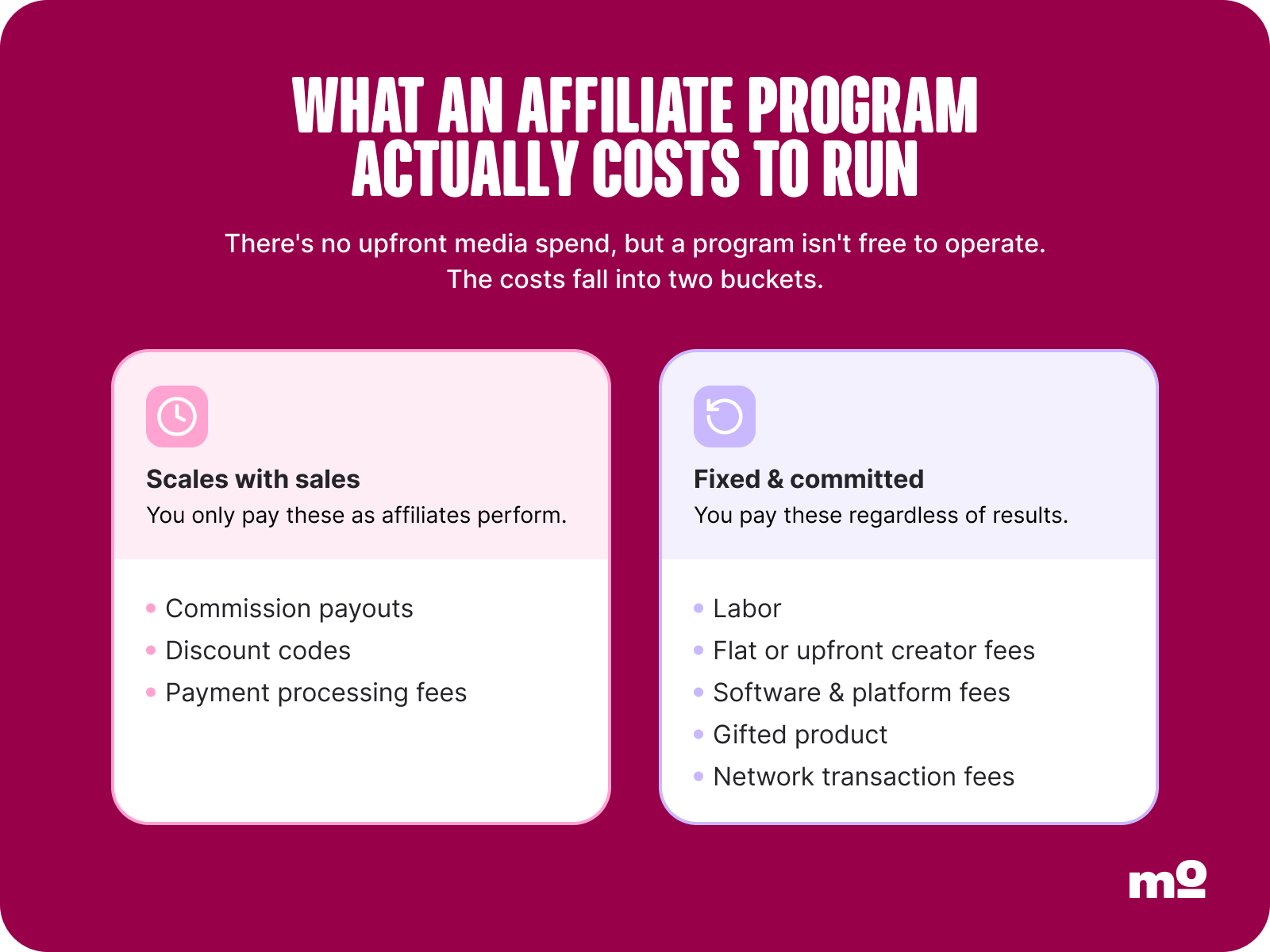
That’s a lot of stuff to factor into your cost calculations.
And to make matters more confusing, there are also various “hidden” layers – think internal labor and discount code markdown – that most affiliate budgets miss.
Before I dive into a full breakdown of all those costs, here’s a handy little table so you can see them side by side, based on a small to mid-sized ecommerce affiliate program:
Cost
Scales with sales?
Typical monthly range (illustrative ranges)
Notes
Commissions + creator costs
Yes
$500 – $10K+
Depends on what you offer to your creators, how many commission tiers you have, etc
Payment processing fees
Yes
$10 – $300+
Modash offers 0% on up to $100K of payouts, depending on your plan
Margin lost to discount codes
Yes
$100 – $2K+
Varies based on how much you discount and your proportion of code-based sales
Software fees
No
$30 – $2.5K+
Use spreadsheets to cut this cost, especially if you have a small scale program
Network fees
No
$30 – $3K+
Skip this if you're finding influencers manually or with an influencer search tool
Product + shipping
No
$100 – $2K+
Depends on your product lifecycle and and how often you launch new products
Agency fees*
No
$2K – $15K+
Disregard if you run your program in-house
If you use an agency, you probably won’t also have to pay for software
You’ve seen the at-a-glance breakdown, now let’s get into the real meat and drink of your affiliate marketing costs (great, now I’m thinking about lasagna again)...
Sure, commissions aren’t the be-all, end-all of affiliate marketing costs, but they’re usually gonna be your single biggest outlay.
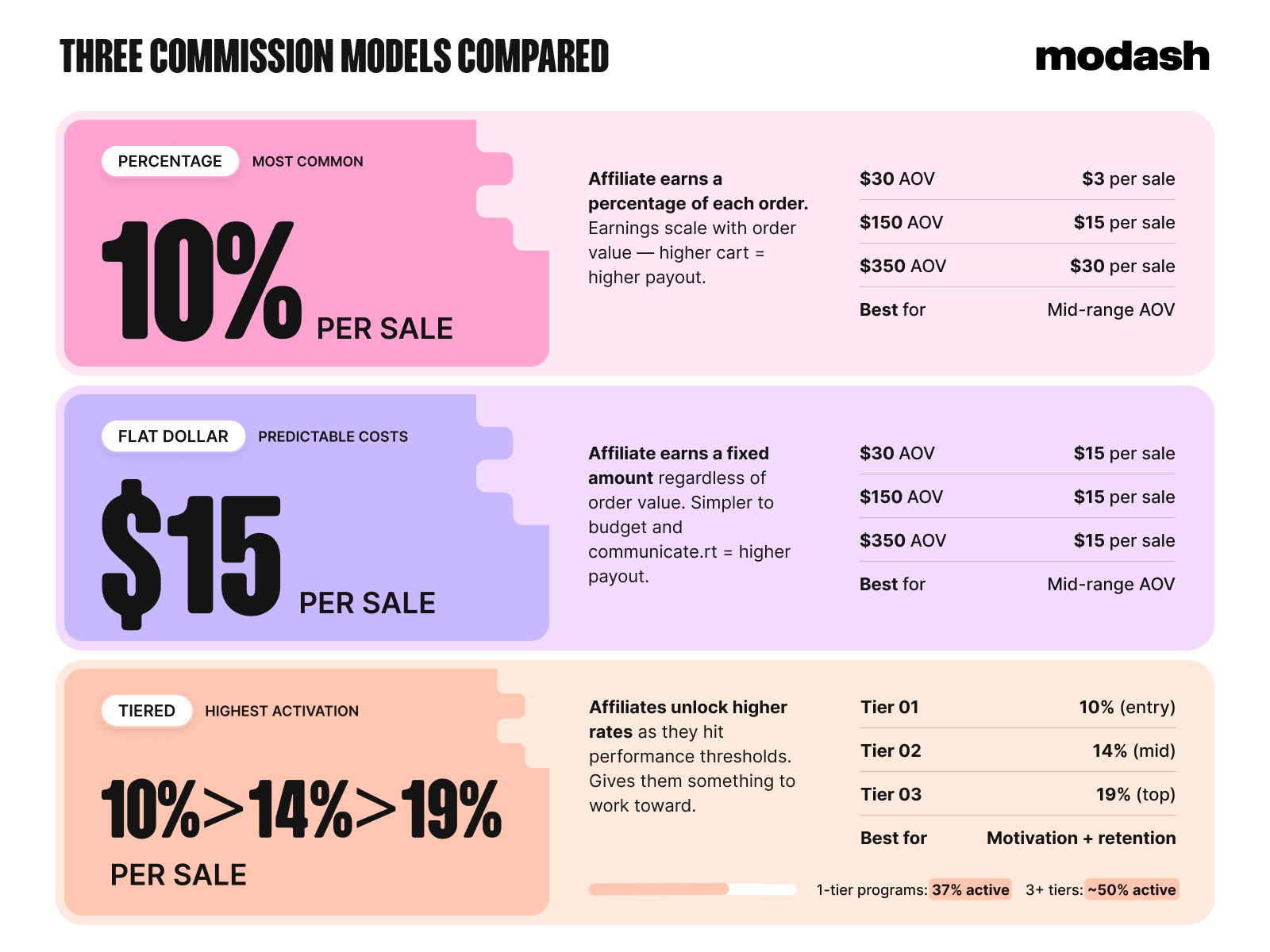
They come in three different “flavors”:
In the ecommerce world, commission rates typically range from 5% – 25%, while our research found that the average three-tier commission structure pays an entry-level rate 10%, a mid-tier rate of 14%, and 19% for top-tier earners.
Oh, and don’t overlook fixed creator fees if you’re running hybrid influencer-affiliate deals.
These arrangements are becoming increasingly popular, with Modash data revealing that commission-only deals aren’t attractive enough to hire 75% of creators.
This is hardly surprising given the innate unfairness of only being paid for attributable sales in a channel where so much of the impact goes unaccounted for – especially when creators can miss out on legit sales because tracking breaks on the brand’s side.
Paying a flat fee plus commission builds better relationships and gives creators the security to invest in creating better content, which ultimately benefits you.
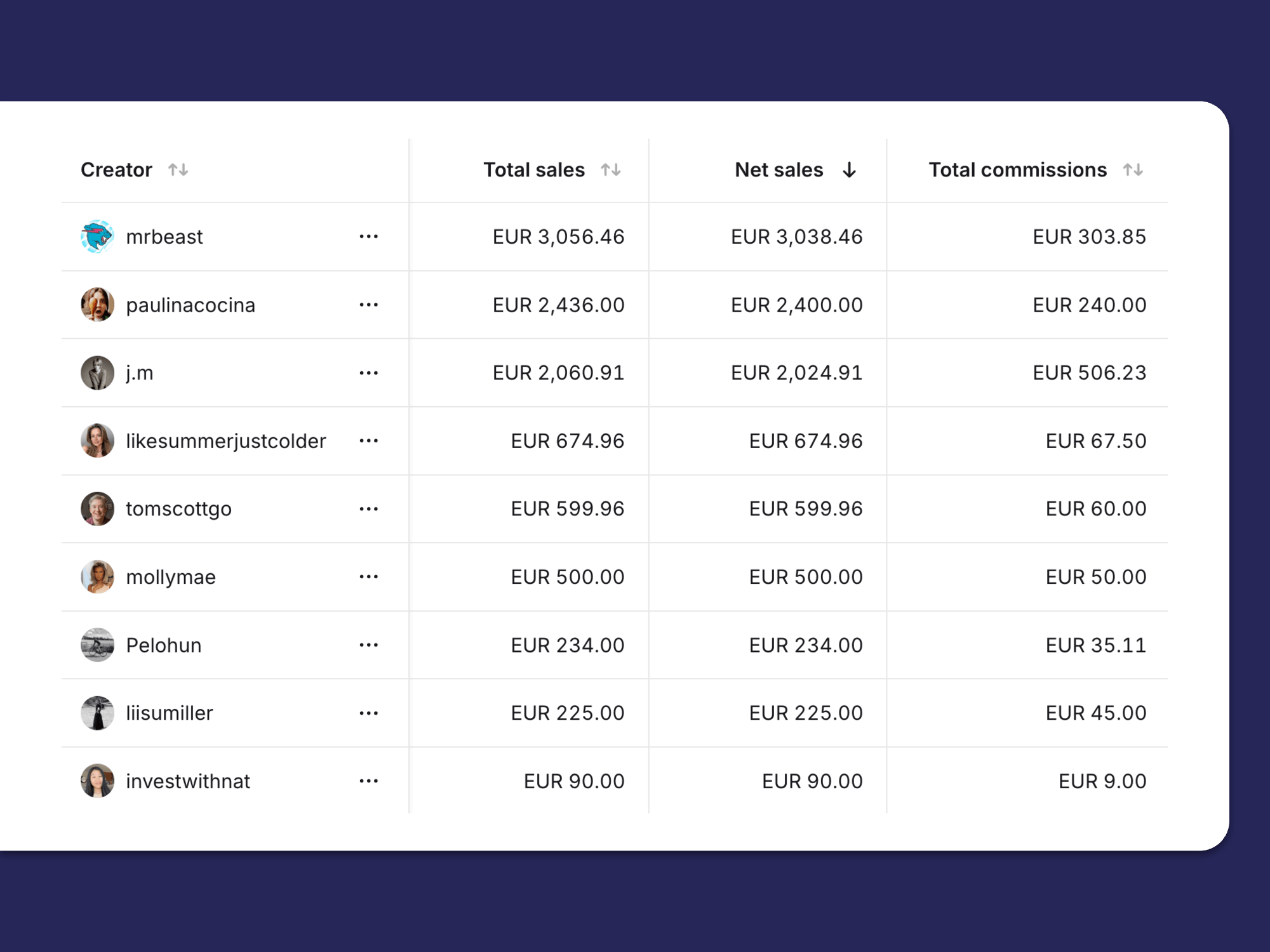
When it comes to accurately working out creator costs, your best bet is to calculate commissions on net revenue rather than gross, so you’re factoring in the effects of discount codes. Modash does this automatically, which keeps the biggest cost input clean.
🤓 Further reading: For (much) more on commissions, check out our guides on affiliate payout models and how to pay affiliates.
I just mentioned how commissions should be calculated on net rather than gross revenue.
Unfortunately, most brands forget this.
Why does it matter? Well, consider these two scenarios for a brand with a $30 AOV paying a 10% commission rate and offering a 15% affiliate discount code:
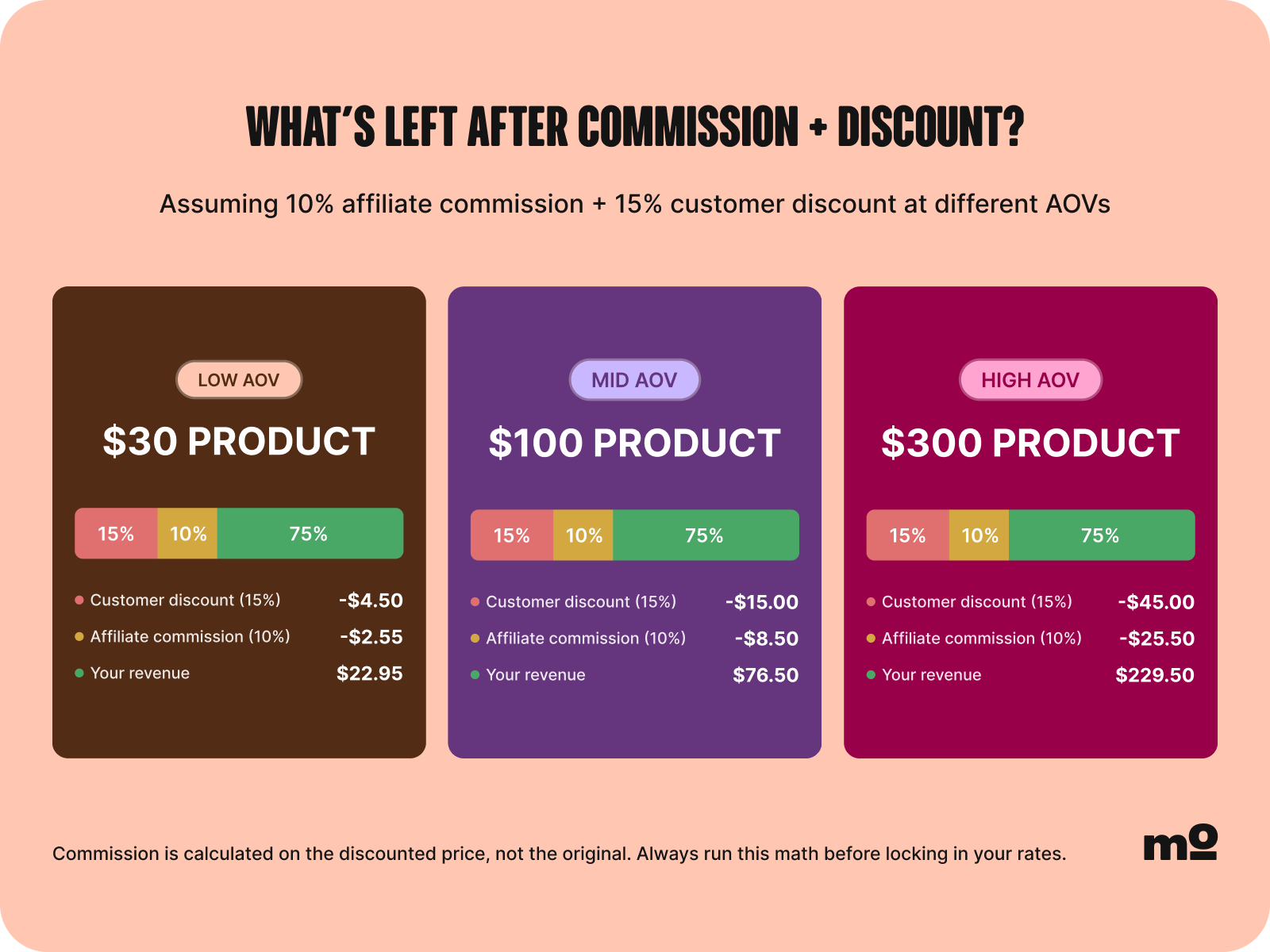
Sure, a difference of $0.45/transaction doesn’t sound like a huge deal. But look at it another way: the brand in our second scenario ends up 2% better off, which makes a serious difference across thousands of transactions.
For most brands with mature and/or growing affiliate programs, software represents their biggest “fixed” cost (i.e. it stays the same regardless of how their program performs).
While some tools offer free-for-life tiers, they don’t provide enough functionality or scale for the vast majority of brands. Which means you’ll almost certainly need a paid alternative, with costs ranging from ~$30 per month at the lower end to $2,500/month or more for enterprise-grade options.
⚠️ One key point on affiliate software: don’t be lured into overbuying.
If you only have, say, 5 – 10 affiliates, you can save the subscription cost by running your program through a spreadsheet.
And if you only need a “basic” tool for recruiting, managing, and paying influencers, there’s no need to shell out for enterprise features like competitor benchmarking and multi-program management.
🤓 Further reading: Check out a bunch of software recommendations in 11 Best Affiliate Management Software Tools and 10 Best Affiliate Payment Software Tools.
Affiliate networks connect brands (AKA “advertisers”) with affiliates (known as “publishers”).
Most also offer tools for tracking sales, calculating commissions, and handling payments.
In other words, they’re similar to affiliate marketing platforms like Modash, but they tend to focus on traditional affiliates – think bloggers and website owners – rather than social media content creators.
⚠️ With affiliate networks, be aware that the headline subscription fee is rarely the full cost. Chances are you’ll also have to pay a transaction fee (typically 2% – 3%), as well as a possible one-off setup charge.
Per our research, 93% of brands gift new products to their affiliates, with one in five doing so at least once a month.
Yet many forget to factor this into their cost calculations.
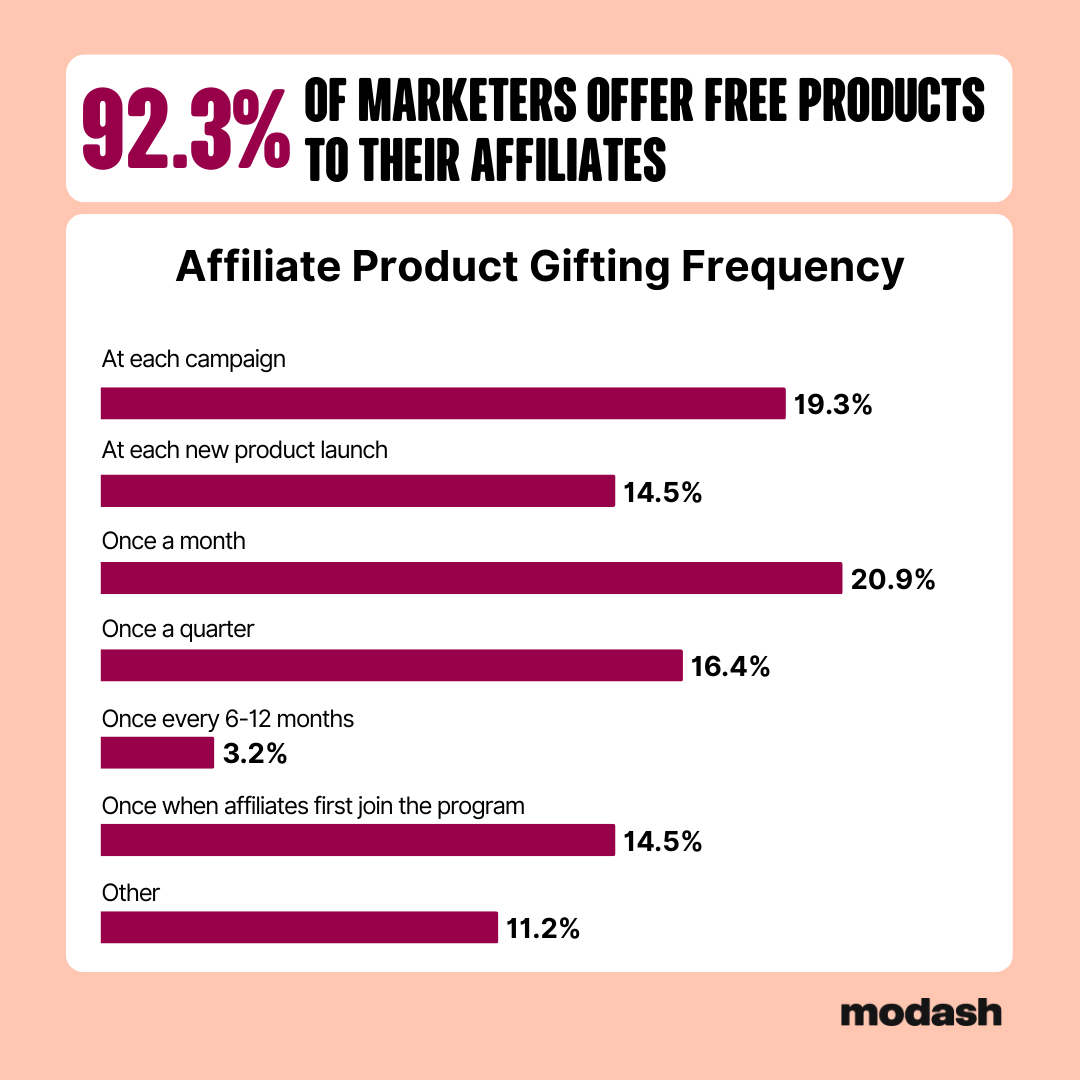
Because while gifting is often seen as an affordable way to start collaborating with creators, it isn’t free.
Every product you gift to an affiliate is a unit that can’t be sold to a paying customer, so you’ve got the cost of replenishment to think about. And you’ll have to pay for shipping, too.
As well as paying your affiliate partners a commission, you’ve also got to cover the cost of transferring those commissions.
There are four main ways to do this:
🤓 Further reading: For a deeper look at this, check out Affiliate Payout Models Explained (How to Choose the Right One).
Processing costs can add up fast, especially for cross-border transfers, so many brands implement minimum payment thresholds of $10 – $100 to avoid bleeding fees on endless tiny payments.
most affiliate software (if you use them) take a cut of your sales. In Modash, it's a cut of your creator payout fee. We can explain the difference to show why Modash Pay is the better choice
🤓 Pro tip: Rather than taking a cut of your sales, Modash Pay charges a percentage of your creator payments, with 0% fees on up to $100,000 of yearly payouts, depending on your plan. Modash Pay also combines all your individual commission payments into a single invoice, with no separate currency conversion fee. Use it to pay your affiliates in 180+ countries and 36 currencies.
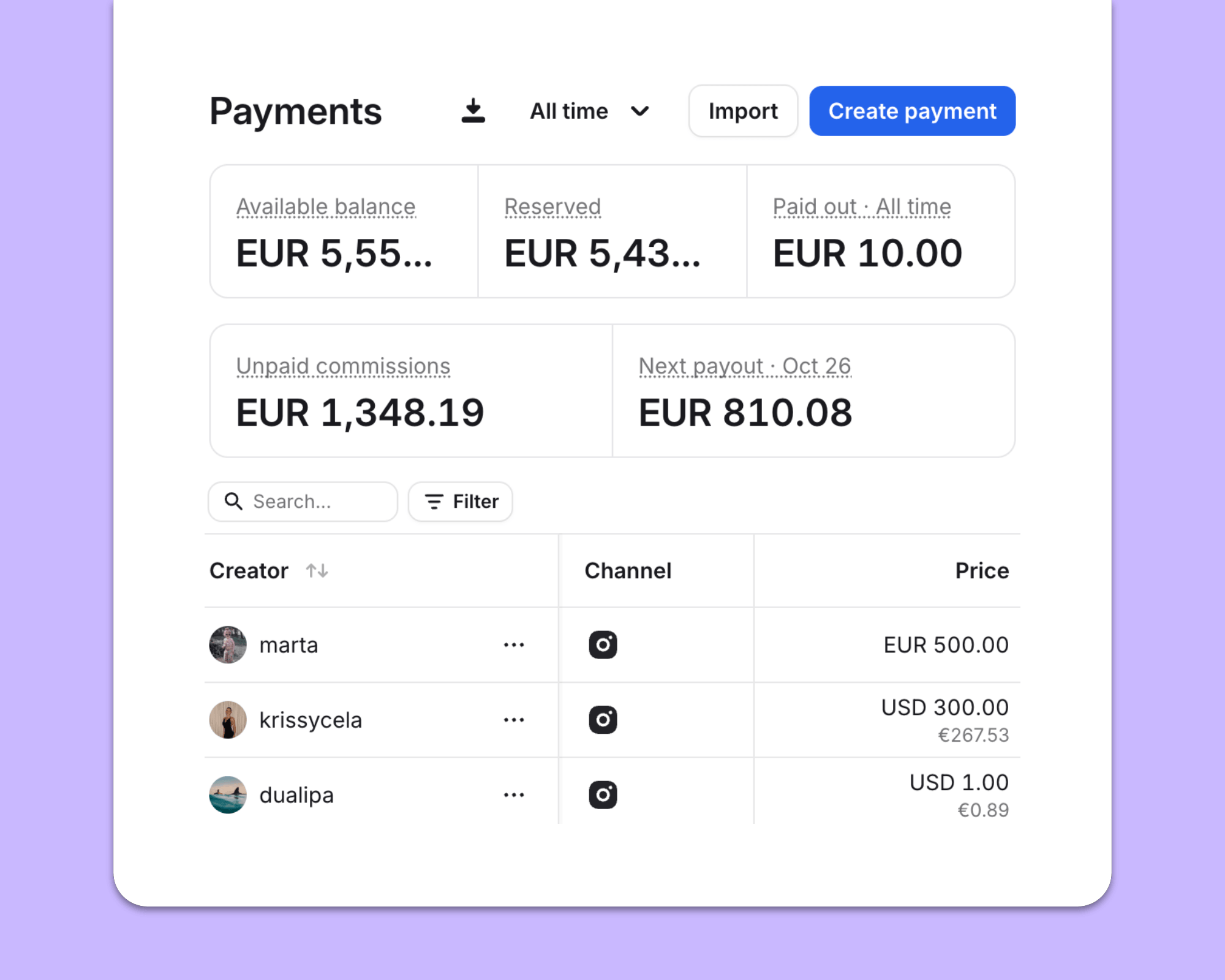
The most underestimated cost of all is management and labor, AKA the time you and your team spend running your affiliate program – from recruiting affiliates to onboarding them, reconciling orders, and handling payments.
Because the longer all that stuff takes, the less capacity you’ve got left for other strategic initiatives.
(Plus there’s a specific financial cost to factor in if you outsource program management to freelancers or an agency.)
There’s only so much you can do about this. Every program requires some management time, and Modash research revealed that the more “hands-on” you are with your program, the more active your affiliates will be:
At the same time, there are lots of efficiencies to be found.
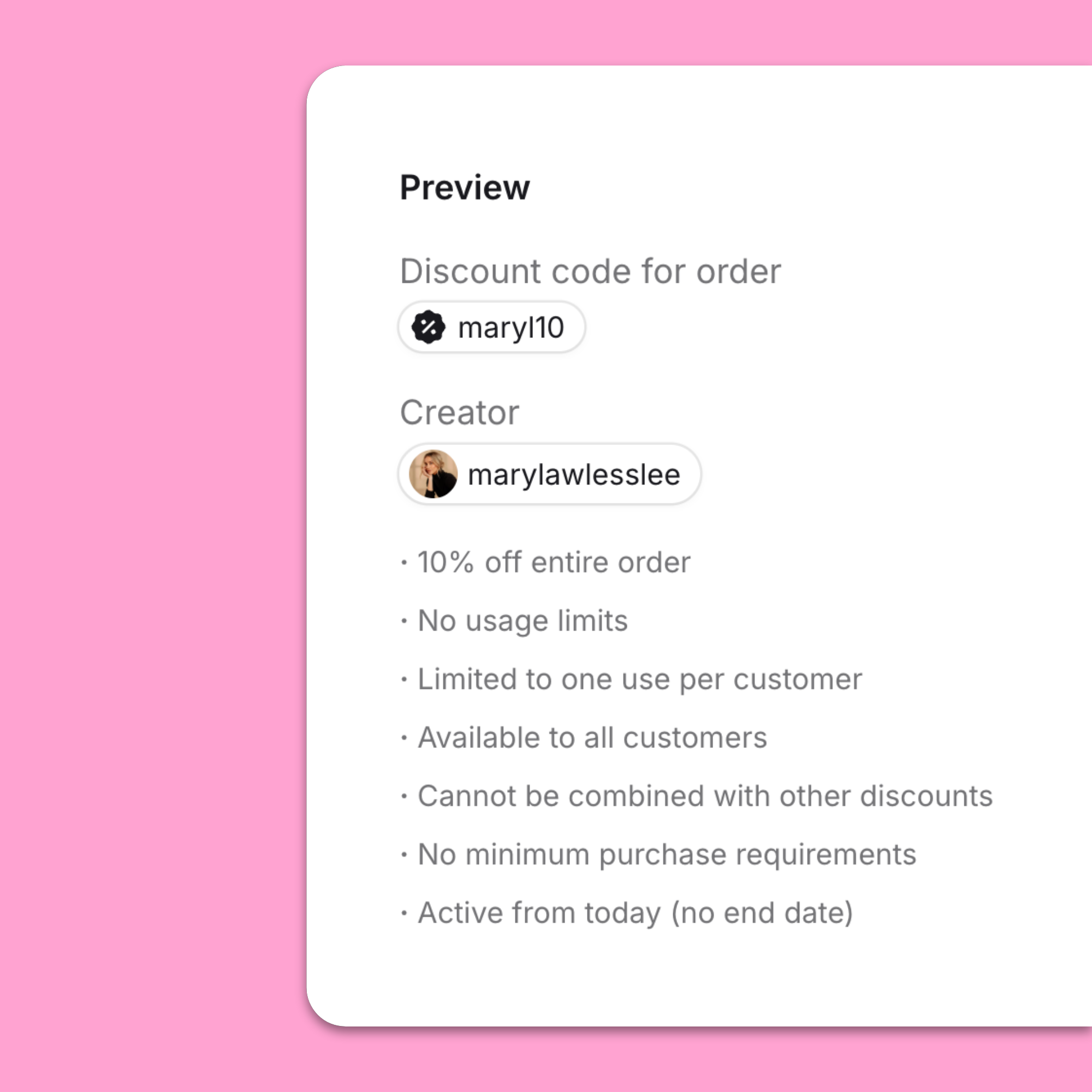
For instance, don’t fancy manually assigning discount codes and tracking links to every new affiliate who joins your program? No problem! If your store is on Shopify, Modash automatically shares codes and links when you add affiliates to a commission tier.
Oh, and Modash also calculates commissions and payouts automatically, so there’s no need to spend hours working it all out yourself in a giant spreadsheet 💀
To be clear, not every brand or program needs an affiliate or influencer marketing agency. But they’re worth considering if you’ve got the budget and you’re:
In all of those scenarios, you might need a little external help to run your program because you lack the time, expertise, or both to manage everything internally.
Agencies often aren’t cheap – but they’re worth the money if they allow you to do something you otherwise couldn’t (provided that “thing” is profitable enough).
Affiliates are generally a great bunch of lads.
However, there are a few bad apples out there who try to scam brands out of commissions through tactics like return abuse – when a creator generates an apparently legitimate sale, only for it to get cancelled/returned once they’ve received the commission.
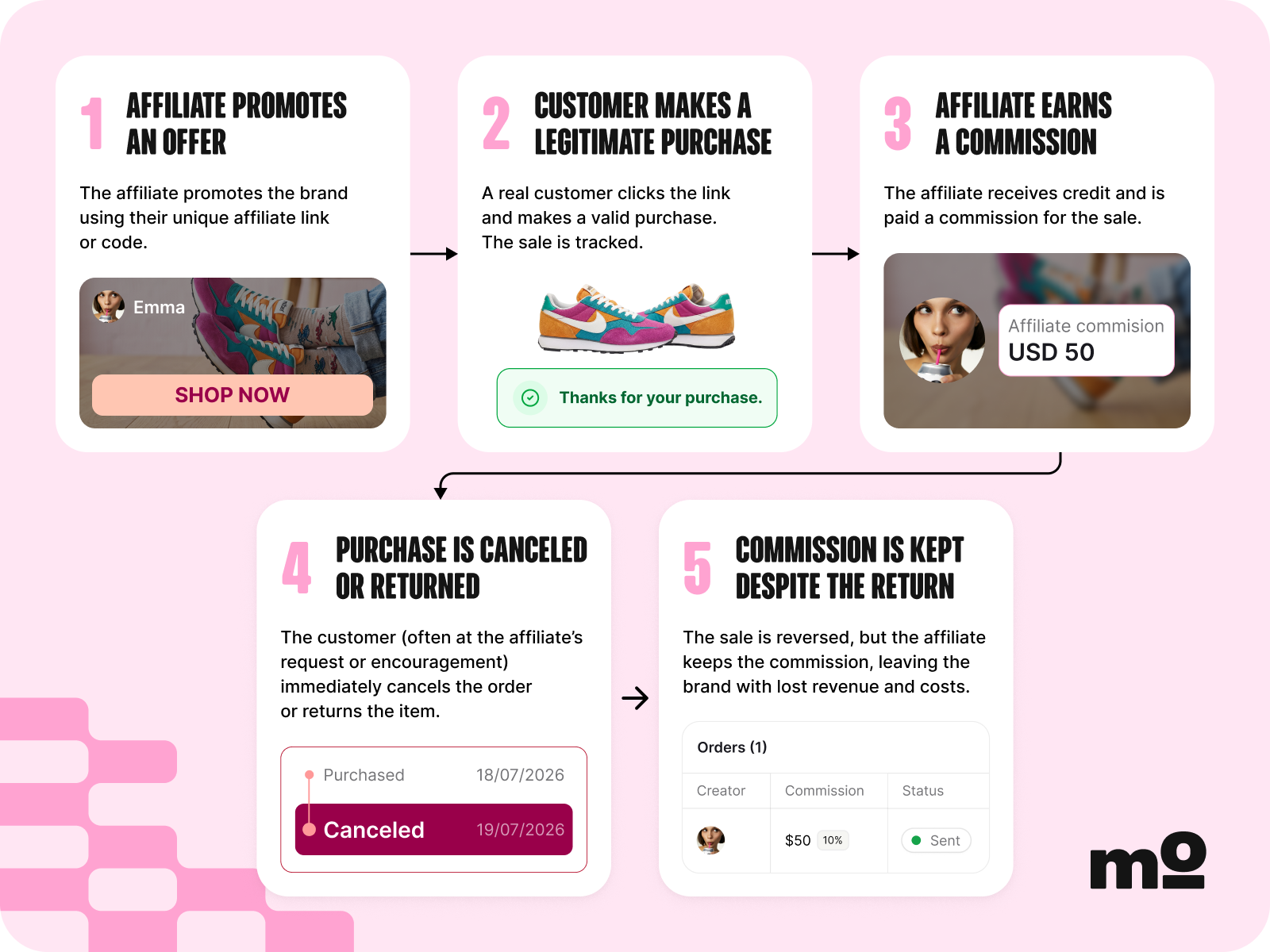
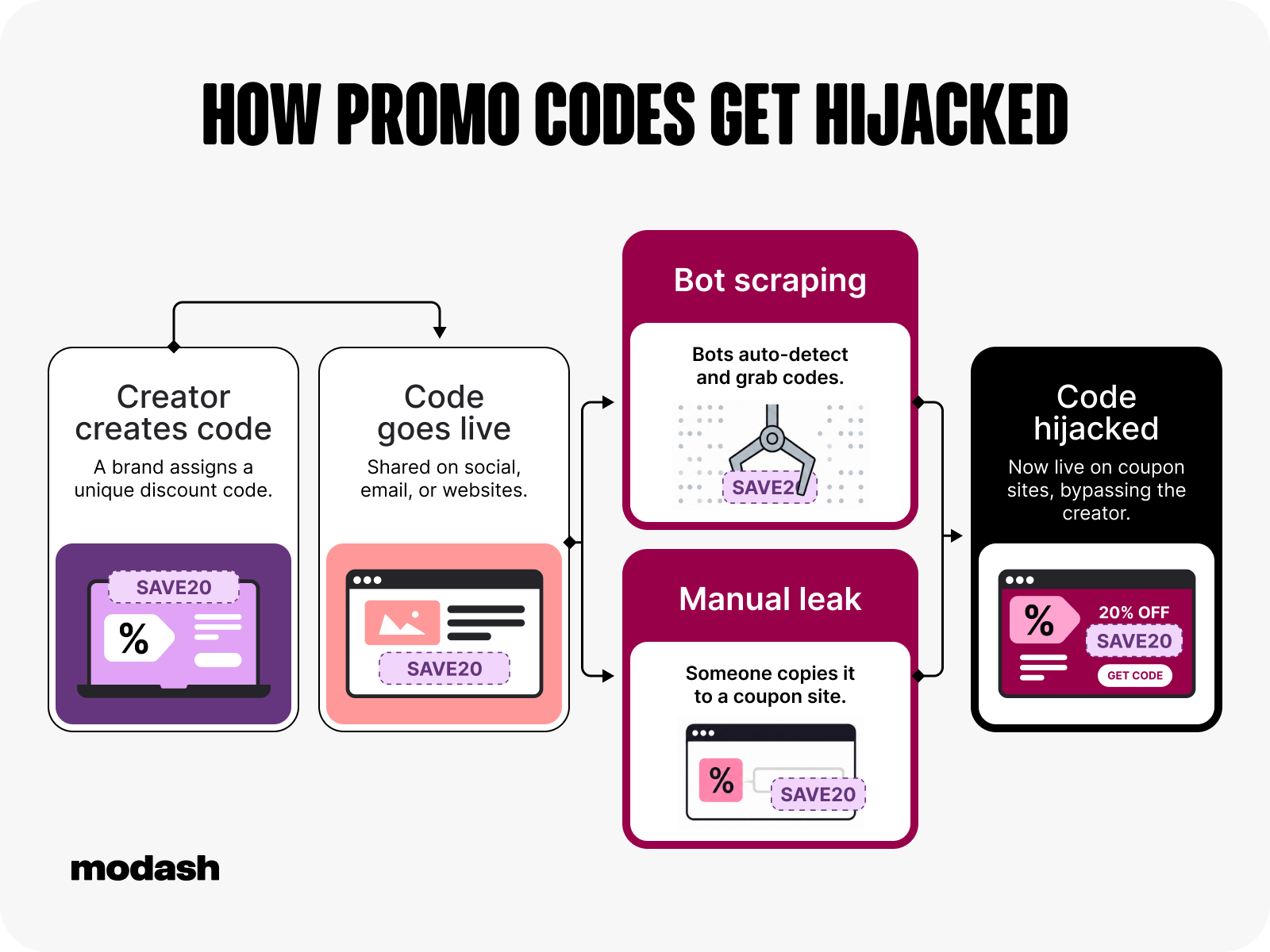
Then there’s the impact of code leakage and hijacking, where an affiliate’s unique promo code ends up on a third-party coupon site. Inevitably, this means it’ll be found by lots of people who were already going to purchase but just wanted a discount. So while it’s not a direct cost, it still eats into your margins.
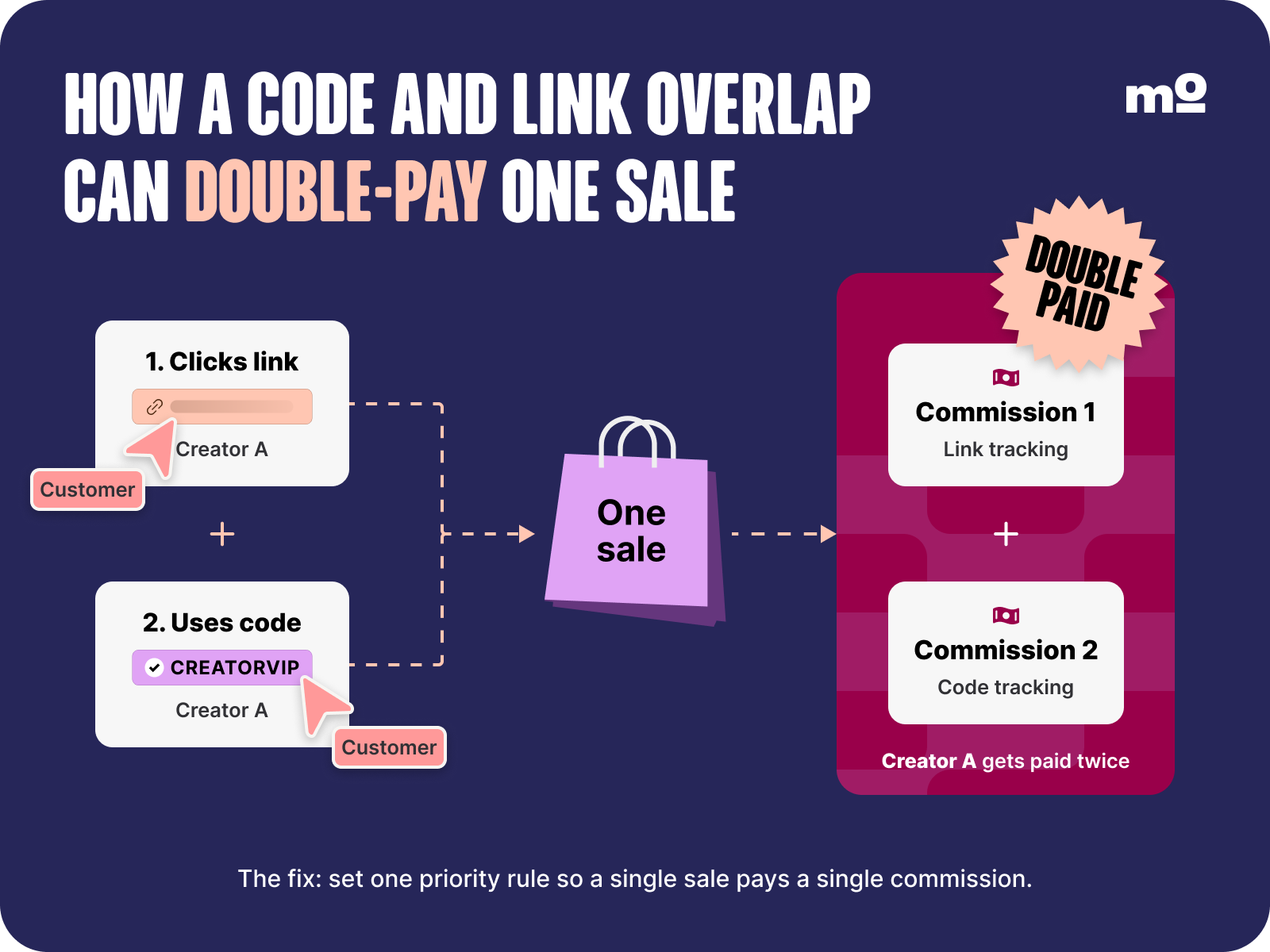
And don’t overlook the impact of duplicate attribution, where you accidentally pay two affiliates for a single order – typically because the customer clicked one creator’s link and used another creator’s code at checkout.
No doubt these issues are annoying, but they’re also very avoidable.
For instance, the best way to eradicate return abuse is to set up a commission hold period (more on this later).
🤓 Further reading: For more on fraud and leakage, check out How to Prevent Affiliate Abuse in Your Program (Before It Gets Expensive).
As you can see, there’s no shortage of affiliate marketing costs. But, fortunately, there are also plenty of practical steps you can take to keep those costs on a tight leash…
Too many brands set commission rates by simply paying the same as their rivals.
(Or, even worse, paying more than them in a bid to attract more affiliates.)
But your rival might have higher margins than you. Just because they can afford to pay 20% a sale, that doesn’t mean you can too. Also, don’t forget, their affiliate program might not even be profitable – so why the heck would you try to copy them??
Rather than simply following the herd, structure your commissions by working backward from your margin.
For example, with a 30% net margin, you probably don’t want to pay much more than a 15% top-tier commission rate. Although you can maybe push that a little higher if you’re targeting aggressive growth.
You’ve probably read that if you’re starting or scaling an affiliate program, you absolutely need affiliate software. It’s a non-negotiable, right?
Actually, no.
It’s totally possible to run smaller programs (~5 – 10 affiliates) using no more than a spreadsheet, or even a free tool like Shopify Collabs.
Even if you’ve outgrown Shopify Collabs, you don’t necessarily need to jump straight to an enterprise-grade tool. Dedicated affiliate software options like Modash are perfect for brands with growing programs – it’s only when you reach hundreds or thousands of affiliates that you should be thinking about an enterprise solution.
So before you invest in affiliate software, make sure you align your needs with your program stage:
Program stage
Number of affiliates
Tool type
Expected costs
Just starting out 🏁
0 – 10
Spreadsheet
Free, but requires manual management
Ready to grow 🌱
~5 – 10
Free software like Shopify Collabs
Free, but includes a 2.9% processing fee on automatic commission payments
Scaling 📈
~10 – 250+
Dedicated software like Modash
~$200+/month (👉 check out Modash pricing)
Let me share a couple eye-opening stats from our own research:

What does this tell us?
Well, if you’re struggling to keep affiliates active while constantly hunting for new recruits, it’s a good sign the real problem is that you aren’t spending enough time activating and engaging the affiliates you’ve already got.
This is a common issue, with one in three brands telling us that <20% of their affiliates are active.
Fact is, idle affiliates are a drain on your budget. It cost you to recruit them, onboard them, and send them products – and to replace them when they ghost you 👻
So do yourself a favor and double down on activation. Offer a first sale bonus, share more best practices, set clear expectations around posting frequency. Whatever it takes to drive that first sale – because once an affiliate actually starts making money from your program, they’re far more likely to stick around.
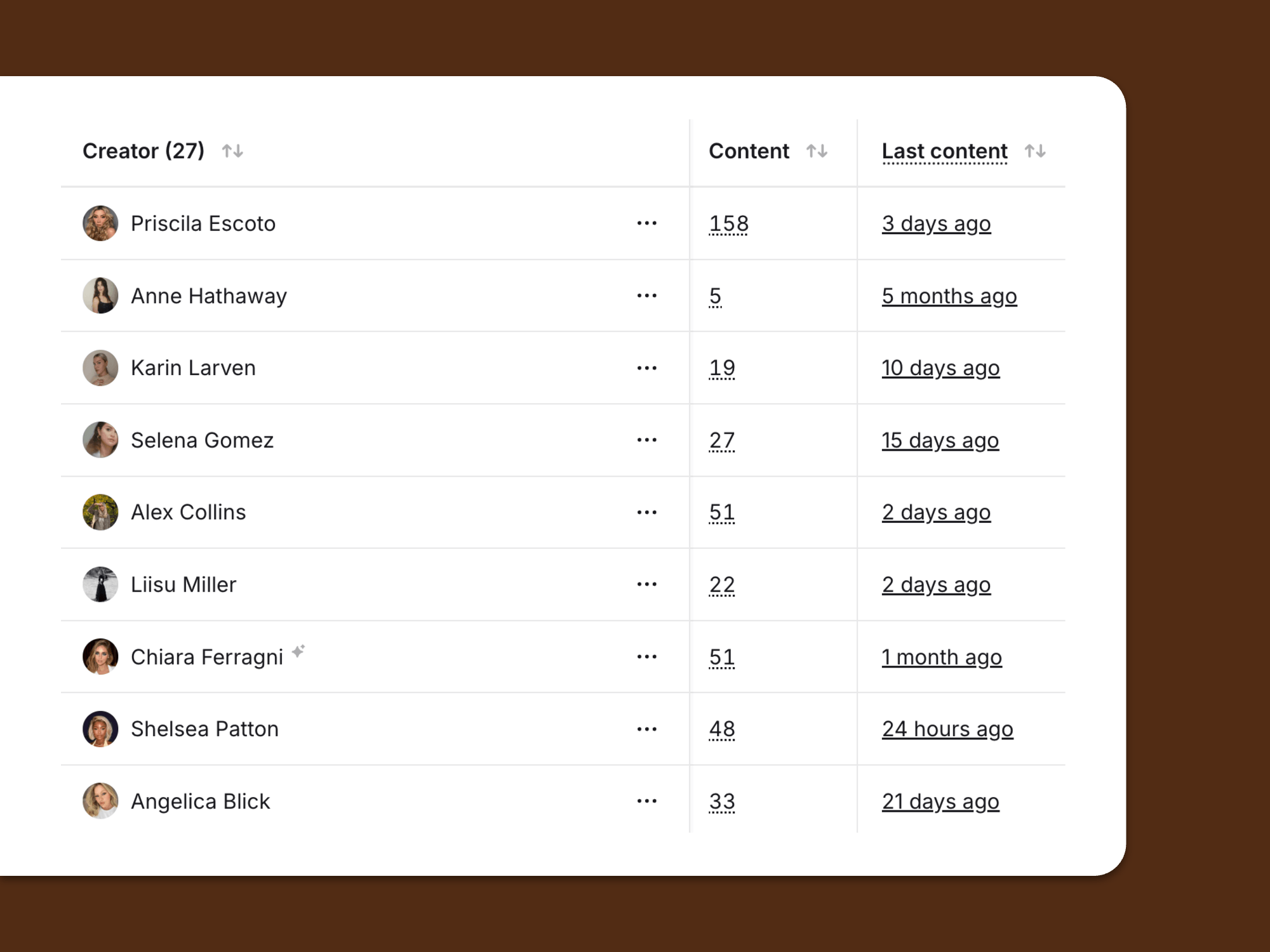
🤓 Pro tip: Modash’s tracking tools show you when each affiliate last posted (plus how much total content they’ve shared), so it’s easy to spot the creators who need a little extra TLC.
Sick of paying commissions on orders that end up getting cancelled or returned?
I don’t blame you.
Fortunately, there’s a simple solution: set a hold period that stops commissions being paid out until after your refund window has closed.
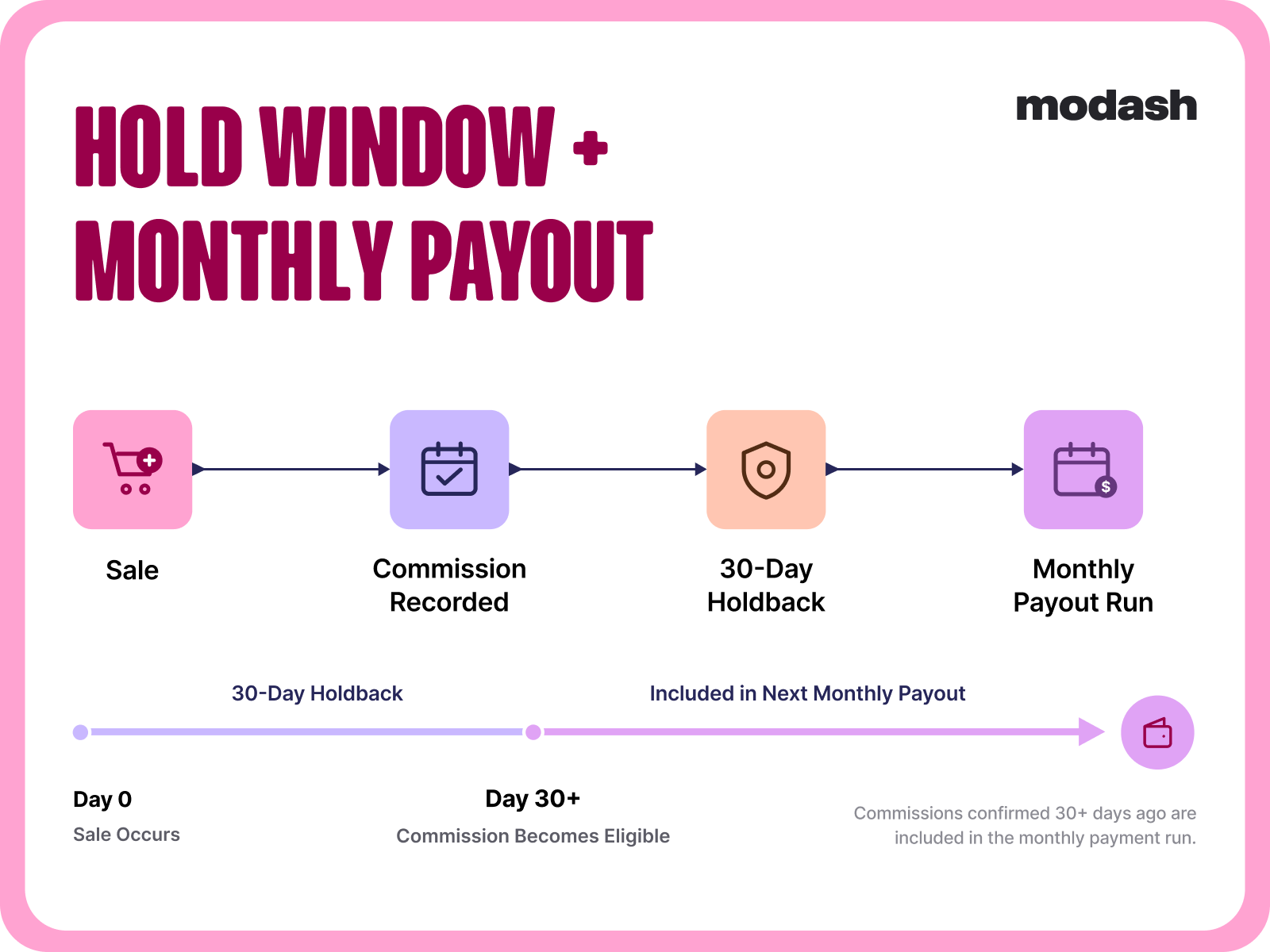
That way, when orders get cancelled/returned, you won’t have to waste valuable time trying to claw back commissions you’ve already paid.
(BTW you can set a configurable hold period in Modash – just sayin’ 💅)
Yes!
Oh, you wanted a more detailed answer? Fine, here goes…
Affiliate marketing is one of the few channels where costs scale with results, so the only real way to say whether or not it’s "worth it" is to calculate 2 numbers:
👆 In this scenario, it takes just a month for the affiliate program in question to cover its costs and generate a $10 per-customer profit. Which definitely sounds worth it to me.
But what if you haven’t launched your program yet and can’t run those numbers?
Well, for a more general answer, let’s compare affiliate marketing to the two most directly comparable channels – paid social ads and flat-fee influencer marketing.
With paid ads, you’re paying per click whether or not anyone buys, while flat-fee creator deals pay out before you know if the post converted 🤷♀️
Affiliate marketing shifts the risk because the single biggest cost is commission, which you only pay after a sale happens. The tradeoff is that affiliate marketing is typically slower to ramp up than social ads, and also requires more management. So it's a channel you build, not a tap you turn on.
In short, affiliate marketing is often worth the cost, but it isn’t for everyone. It probably isn’t right for you if:
The true cost of your affiliate program is more than your commission rate. It’s the whole cost stack, from software subscriptions to discount code markdown to shipping on gifted products.
So controlling costs isn’t about cutting your commission rate, it’s about all the individual elements that feed into your CAC.
For many brands, that stack gets expensive because it lives in a dozen different places – spreadsheets, affiliate networks, analytics tools, and more. So do yourself a favor and pull it all together in Modash.
Modash keeps affiliate links, codes, orders, net revenue, commissions, and payouts in a single Shopify-connected view. We calculate commissions on net revenue so returns and discounts are already accounted for, and hold payouts until returns clear.
Less wastage, more efficiency, and a tighter rein on your program budget 💪
See for yourself when you start your free 14-day Modash trial.
Starting an affiliate program could cost a few hundred dollars, or it could run to $5,000+/month, depending on your setup.
For example, you might spend $100/month on software plus $300 gifting products to 10 affiliates, at an average value of $20 per product plus $10 shipping. That's $400 in “fixed” costs. Then let’s say your affiliates earn a further $400 in commissions, taking your total costs to $800.
Other potential costs include payment processing fees, discount code markdown, internal management time, and agency fees.
Maybe, maybe not.
Whereas paid ads cost the same whether or not anyone buys, affiliate marketing lowers the risk by shifting much of the cost post-sale through commission payments. On the flip side, affiliate programs are generally slower to ramp up than paid ads and require more management.
As for which is cheaper – the only way to definitively answer that is to calculate your CAC and payback period for each channel.
As a general rule, most ecommerce brands pay commissions of 5% – 25%.
However, a “good” commission rate is an affordable one.
If your net margin is 30%, you probably don’t want to pay a 25% commission on every sale – when all your other affiliate marketing costs are factored in, you’ll probably be losing money.
Depends on the platform.
Some charge a cut of each affiliate-driven sale on top of the monthly subscription.
Modash takes a percentage of your affiliate payouts, not the revenue you generate (although fees are 0% on payments of up to $10K/year on our Performance plan).
Others only charge the subscription cost, but these tools generally only handle specific parts of the affiliate program management process, such as finding creators or analyzing their profiles.
To work out your budget, just use the following calculation:
👉 Total cost = [(Product cost + shipping) × number of affiliates onboarded] + replenishment costs for active affiliates
Nope!
While affiliate marketing is a performance channel, the “pay for results” element – AKA commissions – is only part of the total cost stack. Depending on your program’s structure, other costs can include: