

Meer tools
Toepassingen



Affiliate programs rarely collapse in a hail of (metaphorical) fireballs and explosions.
It’s more like death by a thousand cuts – a slow descent caused by a series of tiny, overlooked issues, most of which stem from the brand expecting their program to run itself.
In this article, I’ll walk you through 22 of the most common affiliate marketing mistakes, segmented by the following 5 program stages…
…so you can jump to the relevant point and self-diagnose.
Any errors you make during the foundational stage will compound over the life of your program. They might seem small in isolation, but they’ll cause you a serious headache over the coming months and years.
Don’t listen to all the talk about affiliate marketing as a passive income stream. Sorry, it’s all a big fat lie dreamed up by self-help gurus shilling get-rich-quick schemes.
Fact is, like anything else in life, your program needs real, hands-on effort to deliver results.
Modash research backs this up. We asked affiliate marketers how involved they were with their affiliates, then split out the responses and found the average active affiliate rate per response.
The results paint a clear picture:
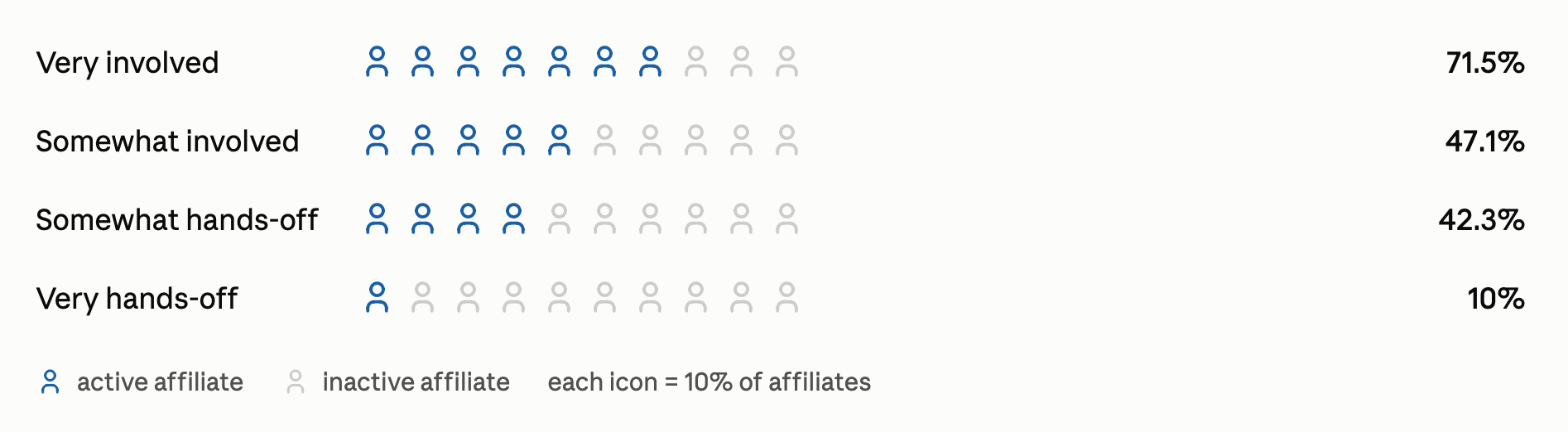
Simply put, the more involved you are, the more active your affiliates will be. Even an increase from very hands-off to somewhat hands-off more than quadruples activation 🤯 And a higher activation rate = more affiliate content = more sales.
Yet this message isn’t getting through to a lot of brands, because almost one-third of those we surveyed described their involvement as “hands-off” – meaning their program effectively runs on autopilot.
And while you might let autopilot handle the “everyday” business of flying a plane (LOL), you wouldn’t trust it to navigate extreme turbulence or deal with a mechanical failure.
🤓 Further reading: Check out our research for yourself in Affiliate Marketing Survey 2026: Why Hands-On Programs Outperform the Rest.
Another common issue that really applies to any marketing channel, not just affiliate: if you don’t have a meaningful goal for your program (and a structure to help you get there), you’re never going to succeed.
Worst of all, you’re not even gonna know that you aren’t succeeding, because you’re not sure what “good” actually looks like 🤷♀️
At this point, you might be thinking: “Sure I have a goal – making bank, babyyyyyy!”
Well, unfortunately, that’s just not gonna cut it. To be meaningful, your goal should combine the following:
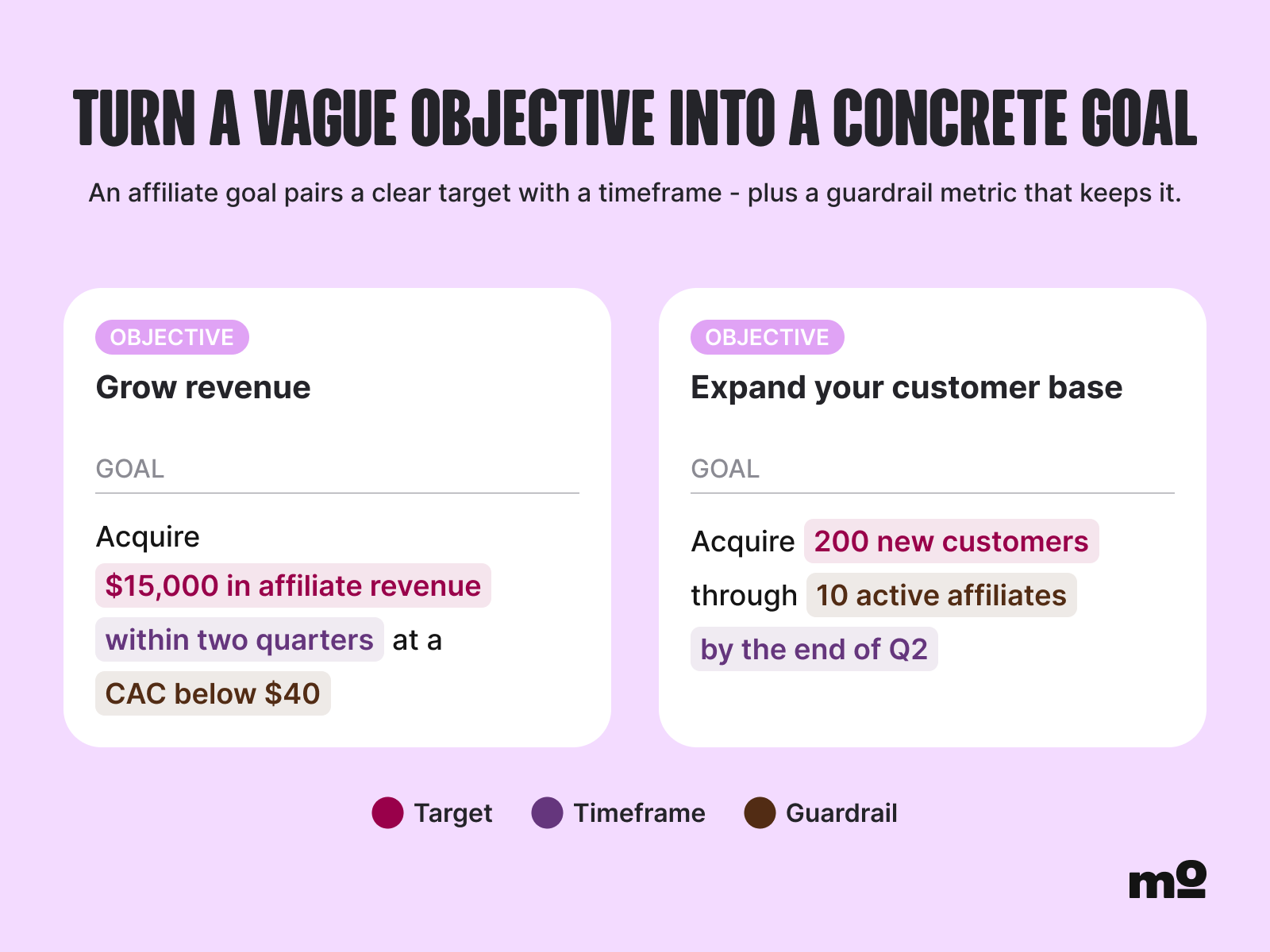
Sure, affiliate marketing can deliver a super healthy ROI. But if you’re expecting overnight results, you’re almost certainly going to be disappointed.
Before you launch your program, you need to set realistic expectations around cost and timelines. And remember, cost isn’t just the commission you pay your creator partners.
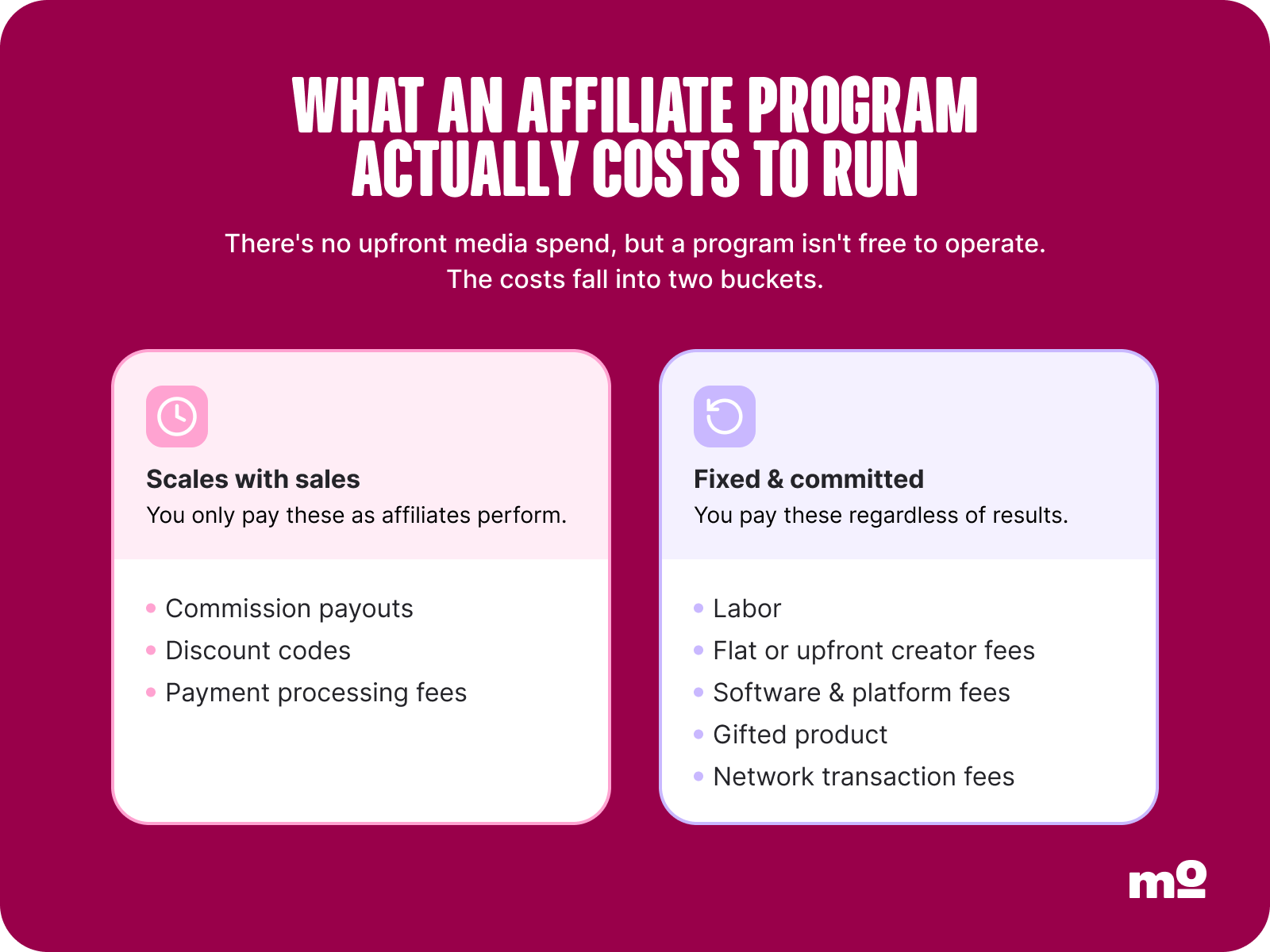
Chances are, you’re gonna invest a bunch of time and money into stuff like labor, software costs, and agency fees before you’ve even made your first sale. And you’ll have invested even more by the time you start turning a profit.
So start thinking of success in terms of months and quarters rather than hours, days, or even weeks.
Let me just clarify that subheading:
It’s totally, 100% possible to run your affiliate program entirely through Excel or Google Sheets. We’ve even written a whole article full of spreadsheets for influencer and affiliate marketers. Just don’t expect it to work at scale.
And by “scale”, I’m talking about ~5 – 10 affiliates.
At this point, manual reconciliation starts to break down under the weight of hundreds or thousands of different data points spread across multiple different platforms. Spreadsheets won’t cut it anymore – it’s time to shift to a dedicated affiliate marketing platform like Modash.
If your store is on Shopify, Modash acts as a single source of truth by consolidating all that messy affiliate data, including:
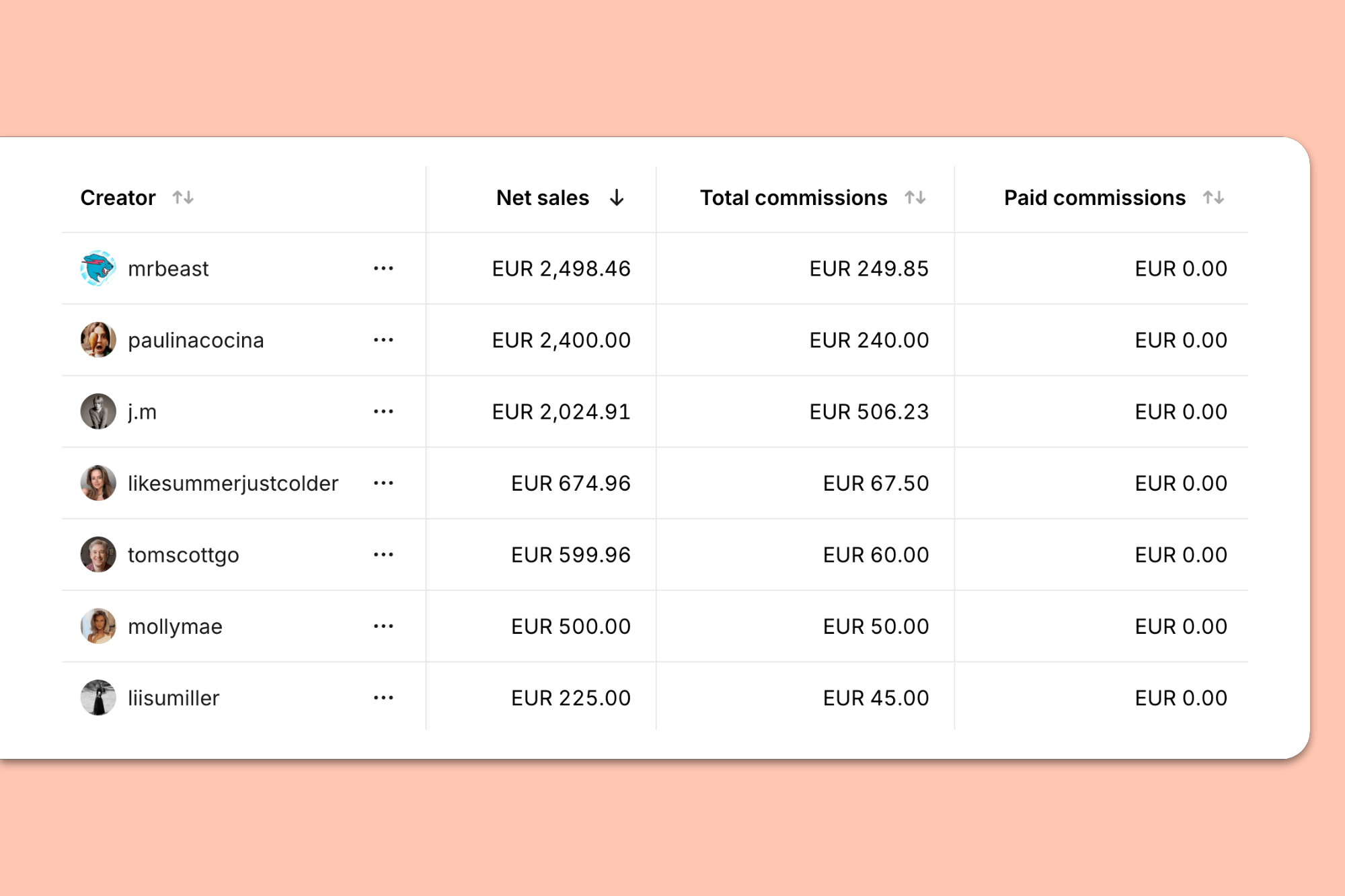
Just think of all the time you’ll save when you don’t have to manually match order numbers from Shopify against affiliate IDs and commissions in spreadsheets 😅
👉 Try all our tracking and analytics tools for yourself by starting your 14-day Modash free trial!
Hopefully, I’ve already done a decent job explaining why you shouldn’t just leave your affiliate program chugging along on autopilot.
But hands-on program management is about much more than stepping in during an emergency and sending the occasional email to your affiliates. It’s about constantly pushing boundaries to drive results.
That’s right: just like with social media ads or paid influencer partnerships, experimentation is at the heart of all successful affiliate programs.
Yet our research found some pretty glaring gaps here. For example, more than one-quarter of marketers only test new ways to engage affiliates every 6 months or less, while 1 in 3 never experiment with new commission and compensation models 😬
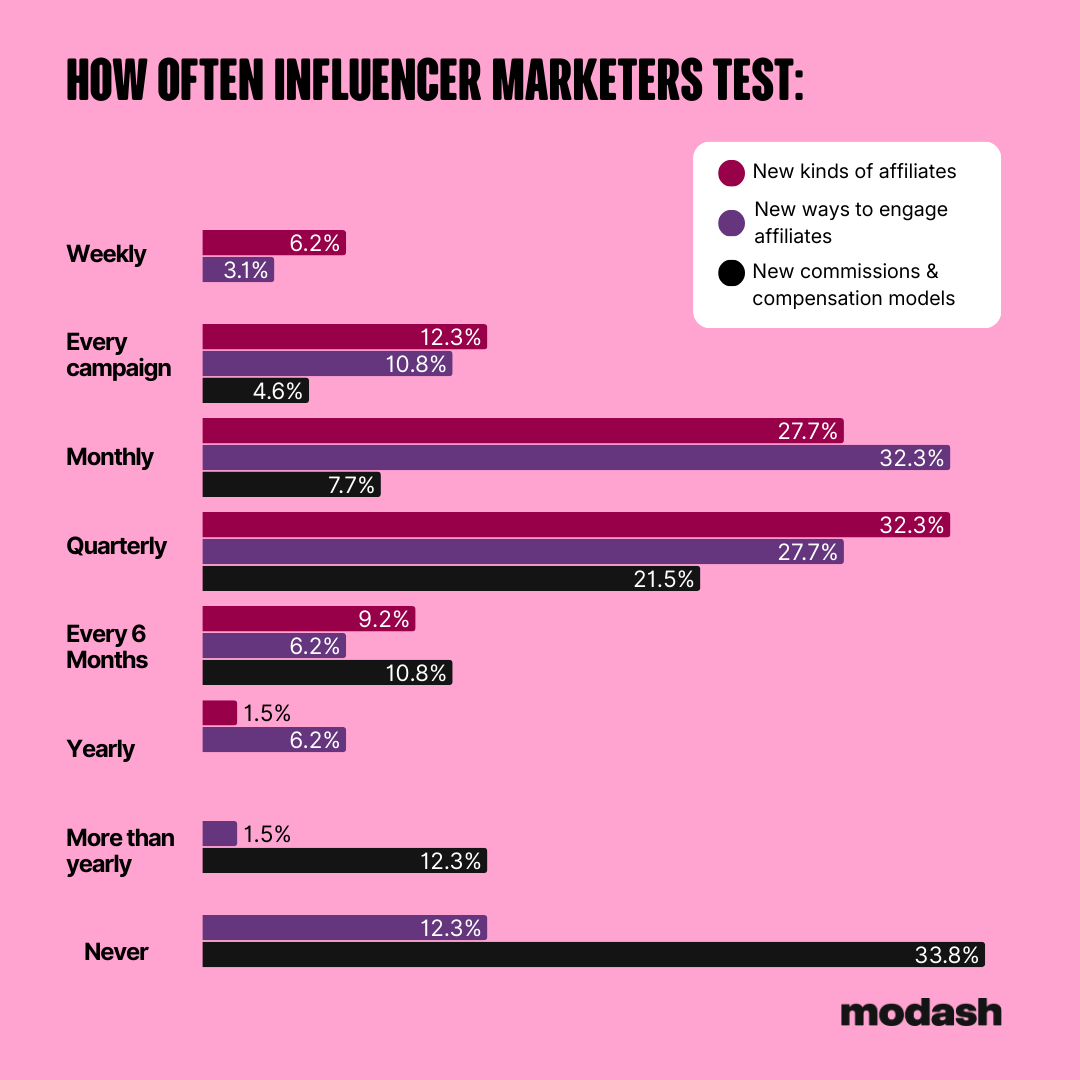
If you aren’t experimenting, you’re effectively saying: “Well, I guess my affiliate program is as good as it’s ever gonna be.” And isn’t that kind of defeatist?
So keep striving for improvement. There’s always something to test – new creative angles, new types of creators, new social platforms, new incentives, new communication methods.
An affiliate program is only as strong as the creators that join it. So if you’re recruiting the wrong people, you’re probably not gonna see the results you hoped for.
Activating your existing affiliates is super important. And so is affiliate recruitment, with 49.2% of marketers telling us they do it “constantly”.
However, many of them are missing a trick here by always searching for new creators while ignoring what’s right under their nose – their existing influencer partners.
That’s right: 40% of marketers we surveyed said less than a quarter of their influencers are also affiliates, while for 15%, their percentage of influencer-affiliates stands at a big fat zero.
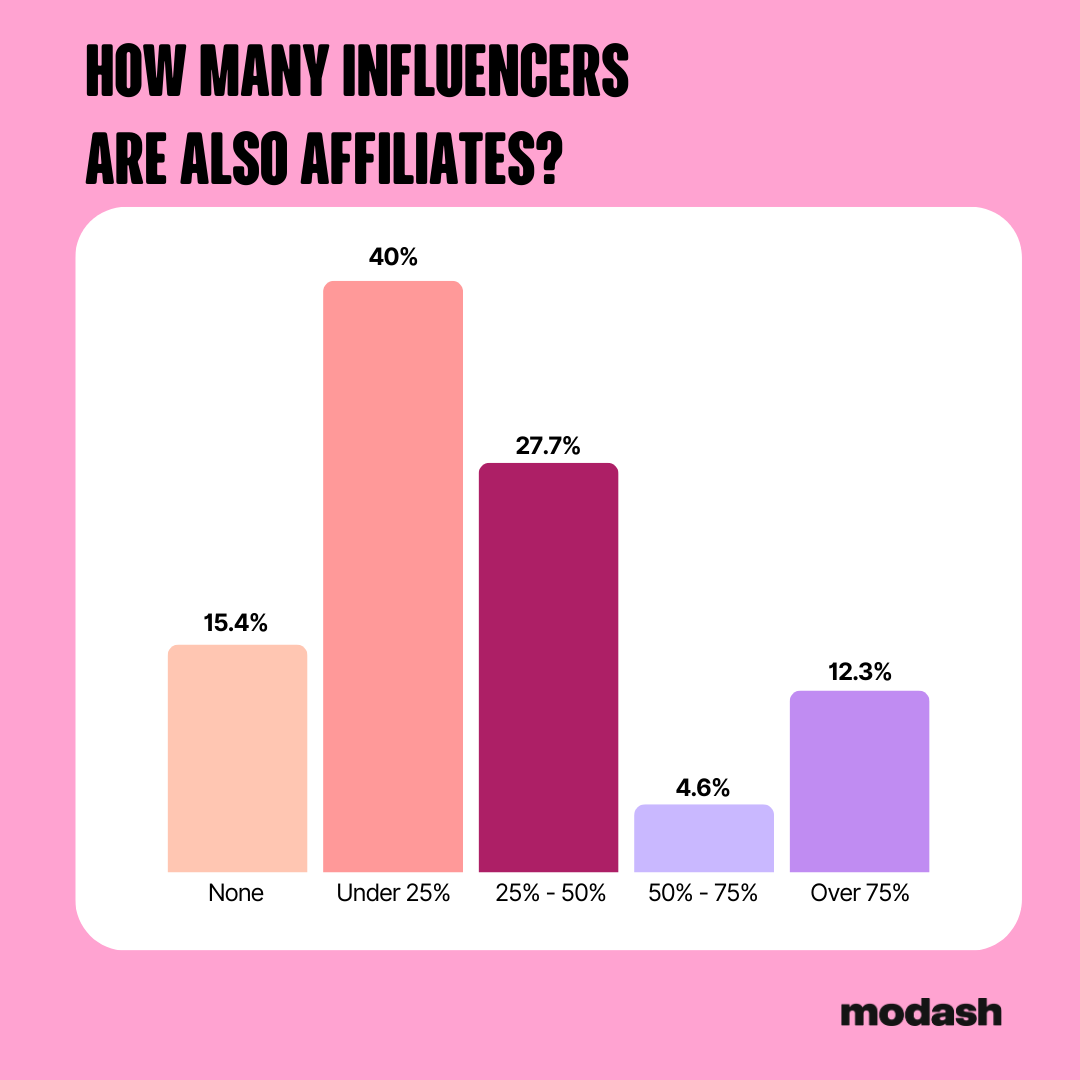
So if you’re already working with influencers, it absolutely makes sense to offer them affiliate terms, too. That way, they’ve got an extra incentive to drive more sales.
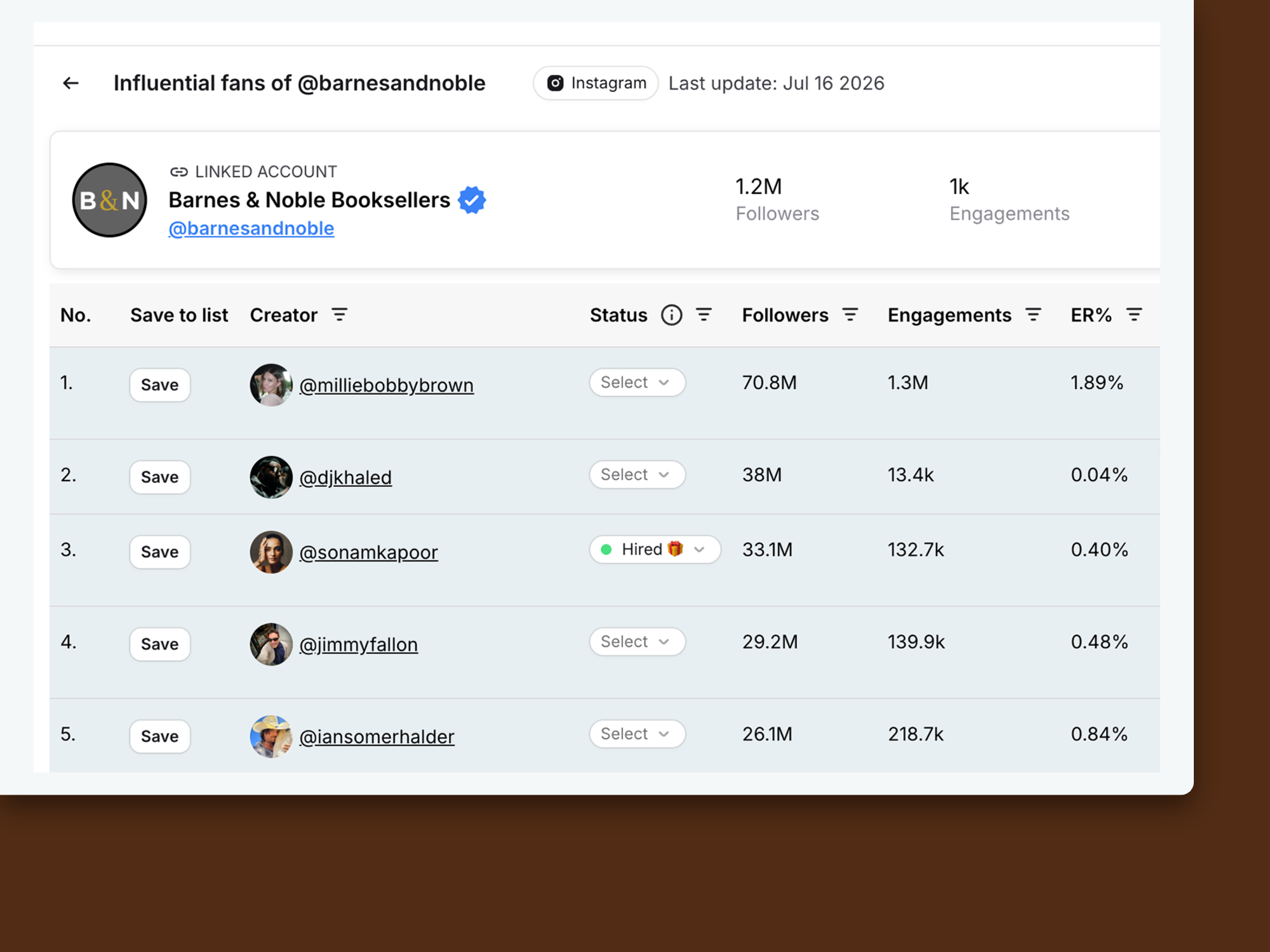
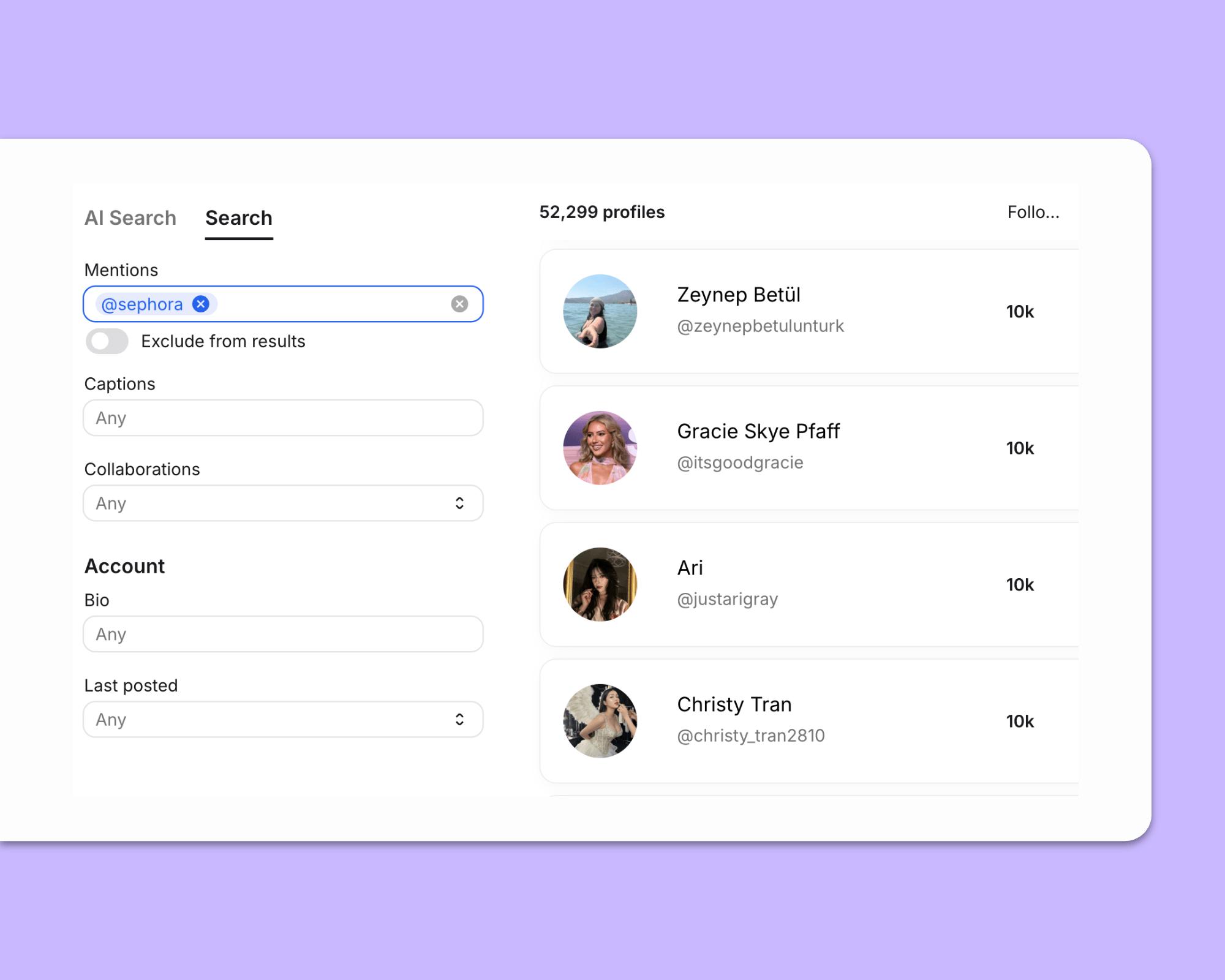
🤓 Pro tip: In a similar vein, you should also be striving to recruit affiliates who already love your brand and product. Modash makes this easy by letting you search for influential fans who already follow you (and/or you can find creators who mention your brand name in hashtags, mentions, and captions).
Don’t get me wrong: if a big account is a strong fit for your brand and audience (and you can afford their fees), they’re definitely worth recruiting.
Just know that they’re probably not gonna work with you on an affiliate-only basis. And also be aware that follower count really shouldn’t be the main factor in deciding whether or not to collaborate with a creator.
Because a massive following doesn’t automatically equate to massive sales. For starters, their audience might not have buying intent (some creators are followed just for entertainment). And also, just because they have a zillion followers, that doesn't automatically mean there’s any overlap with your ICP.
(Indeed, our research shows that “audience mismatch” is the most commonly cited reason for underperforming collaborations.)
Now, I’m not gonna go in-depth here on exactly how to find creators who align with your brand; if that’s what you’re looking for, check out How to Find Affiliates: 9 Strategies to Build a High-Quality Program.
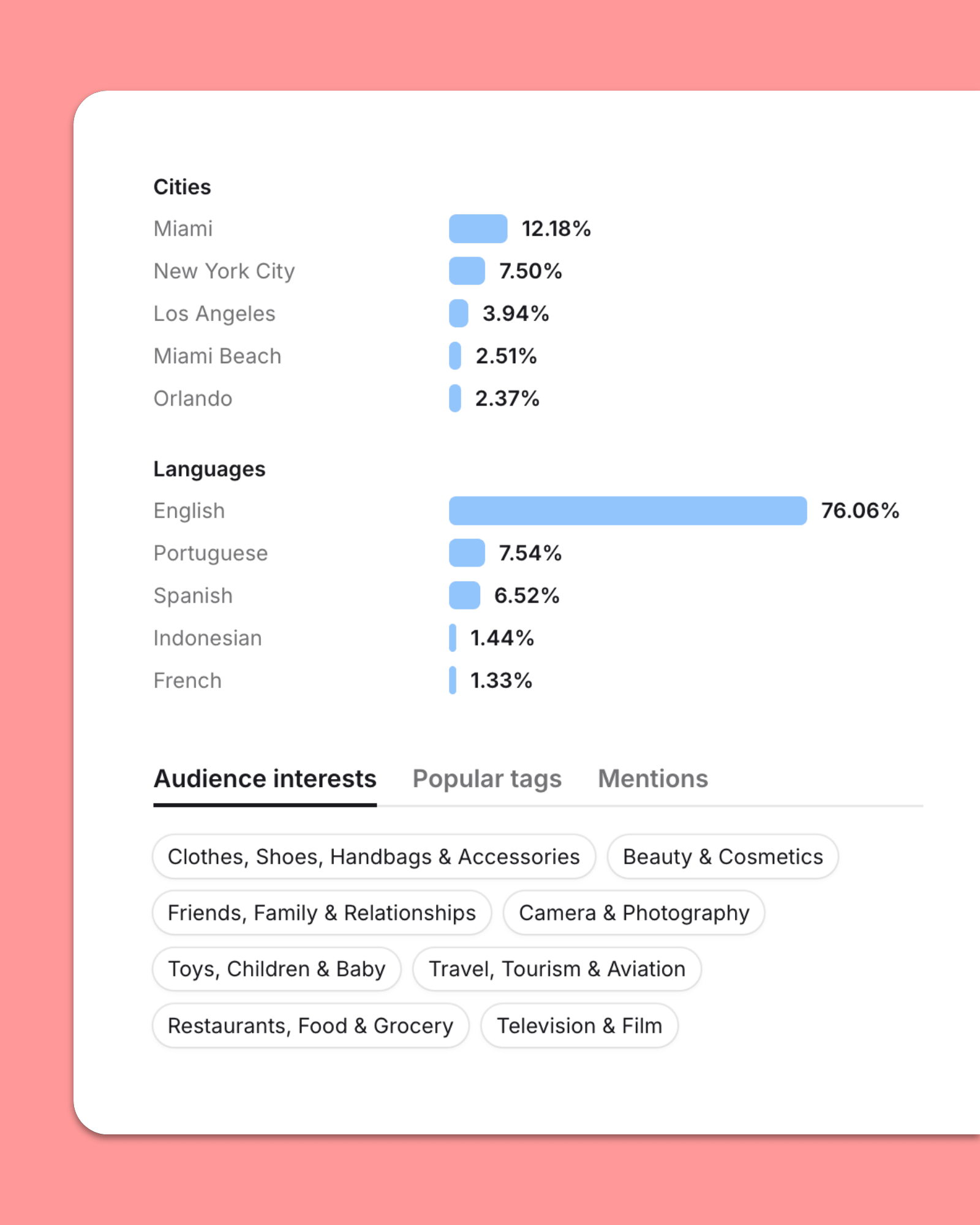
Instead, I’d like to point you toward Modash’s various discovery features, which let you dig into a creator’s audience – including age, gender, location, language, and interests – without forcing you to reach out for analytics screenshots first.
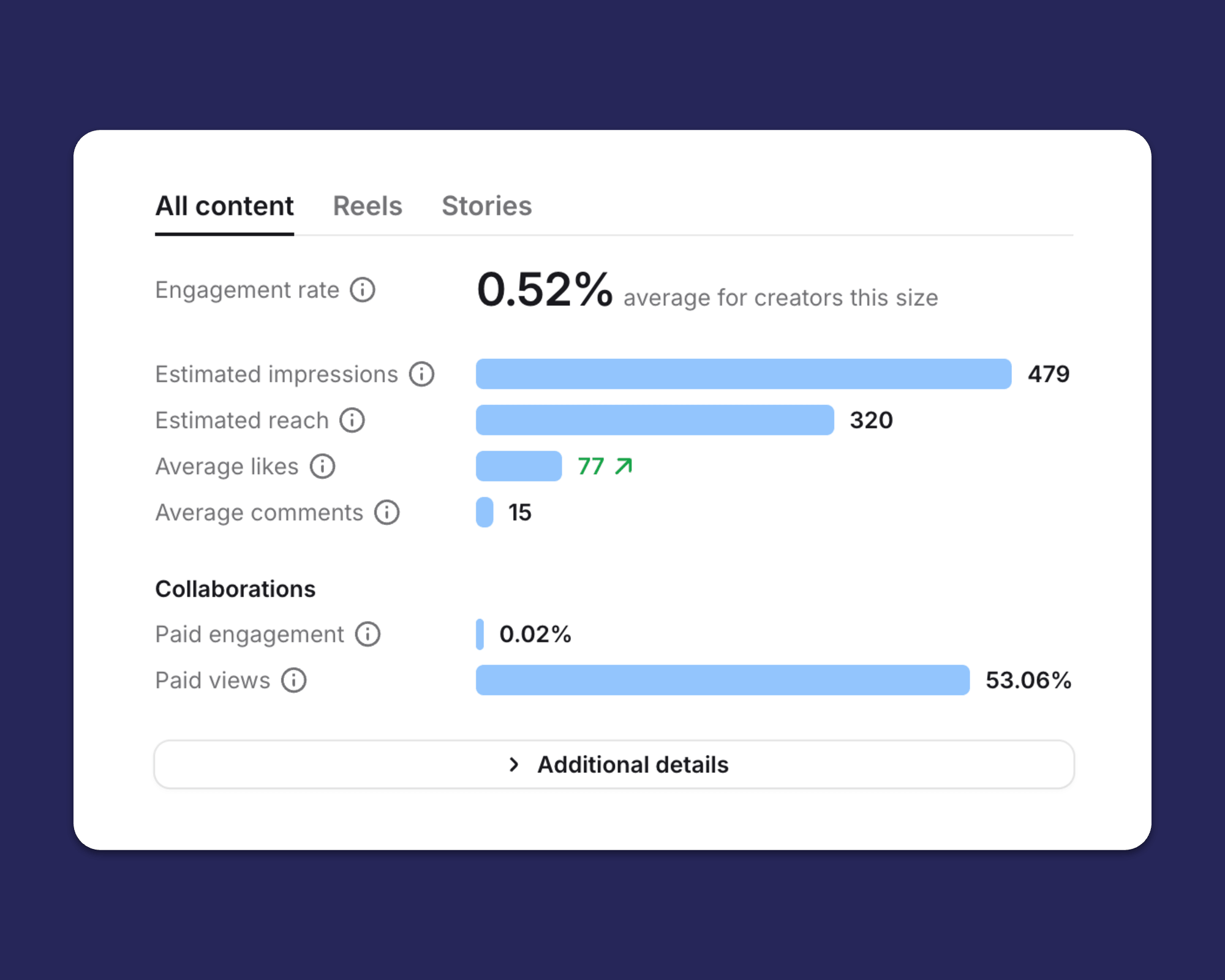
Not only that, but you can see whether their content is truly resonating with their audience by analyzing their engagement rate.
Again, this is the sort of insight you’d normally only get by speaking to the creator upfront and asking for screenshots. And honestly, who’s got time for that? 💁♀️
👉 Check out all of Modash’s creator search and vetting tools by starting your 14-day free trial!
I’ve already spoken about the importance of reviewing a creator’s audience and engagement metrics before trying to recruit them. But affiliate vetting and qualification goes a lot further than this.
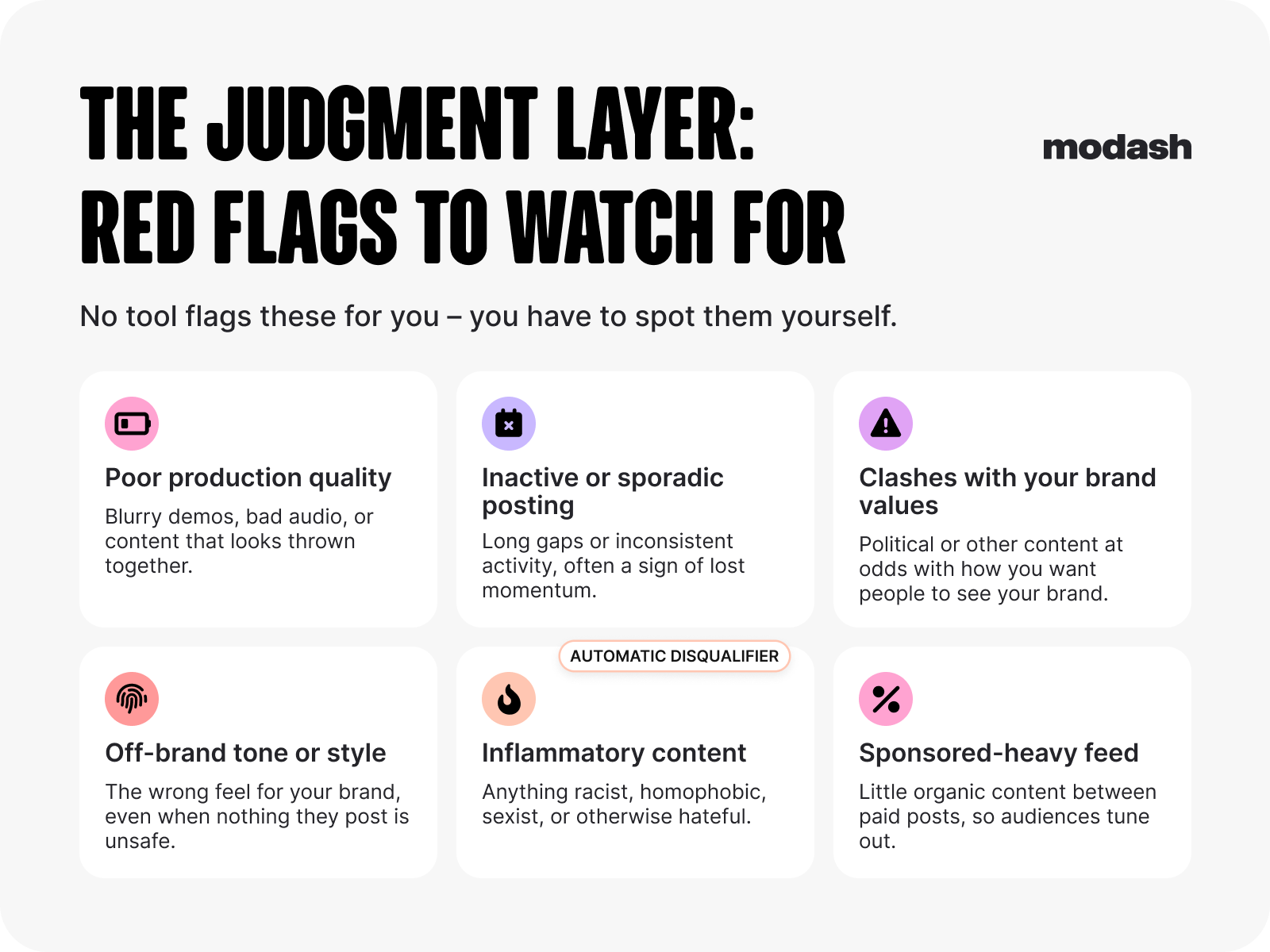
As a general rule, you’ll want to check a creator’s…
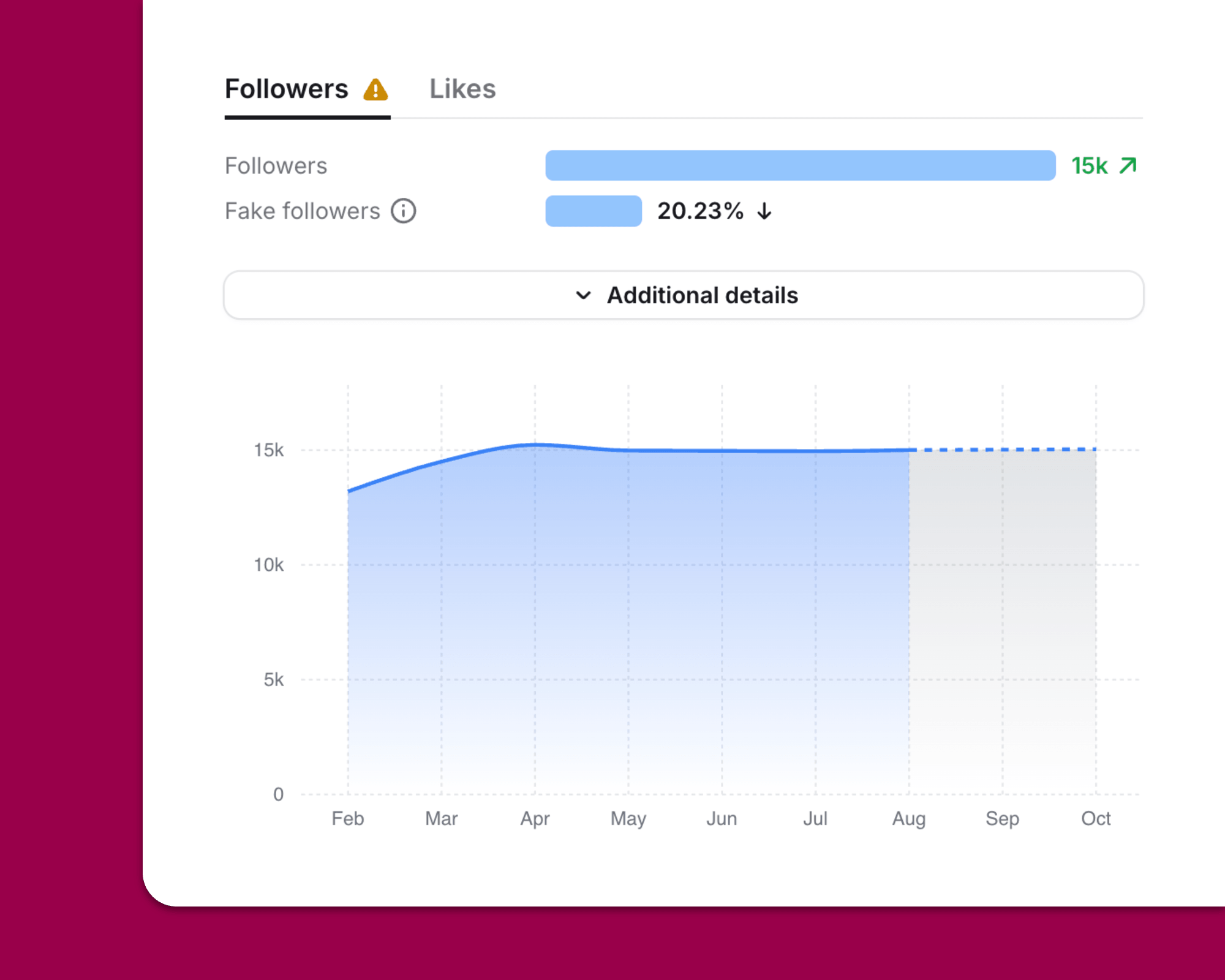
Analyzing all that stuff manually is a serious heavy lift. Mostly, it involves reaching out to the creator to ask for screenshots of their social analytics and/or using free tools to check their fake follower count.
So do yourself a favor and use Modash instead so you can see all that intel (and more) in one place.
I get it: at the end of the day, if your affiliate program goes south, it’s your neck on the line, not the computer’s. The computer doesn’t even have a neck.
Despite this, you need to fight the urge to recruit affiliates simply because you dig their vibe.
Data comes first, as illustrated by our sexy 2-layer vetting framework:
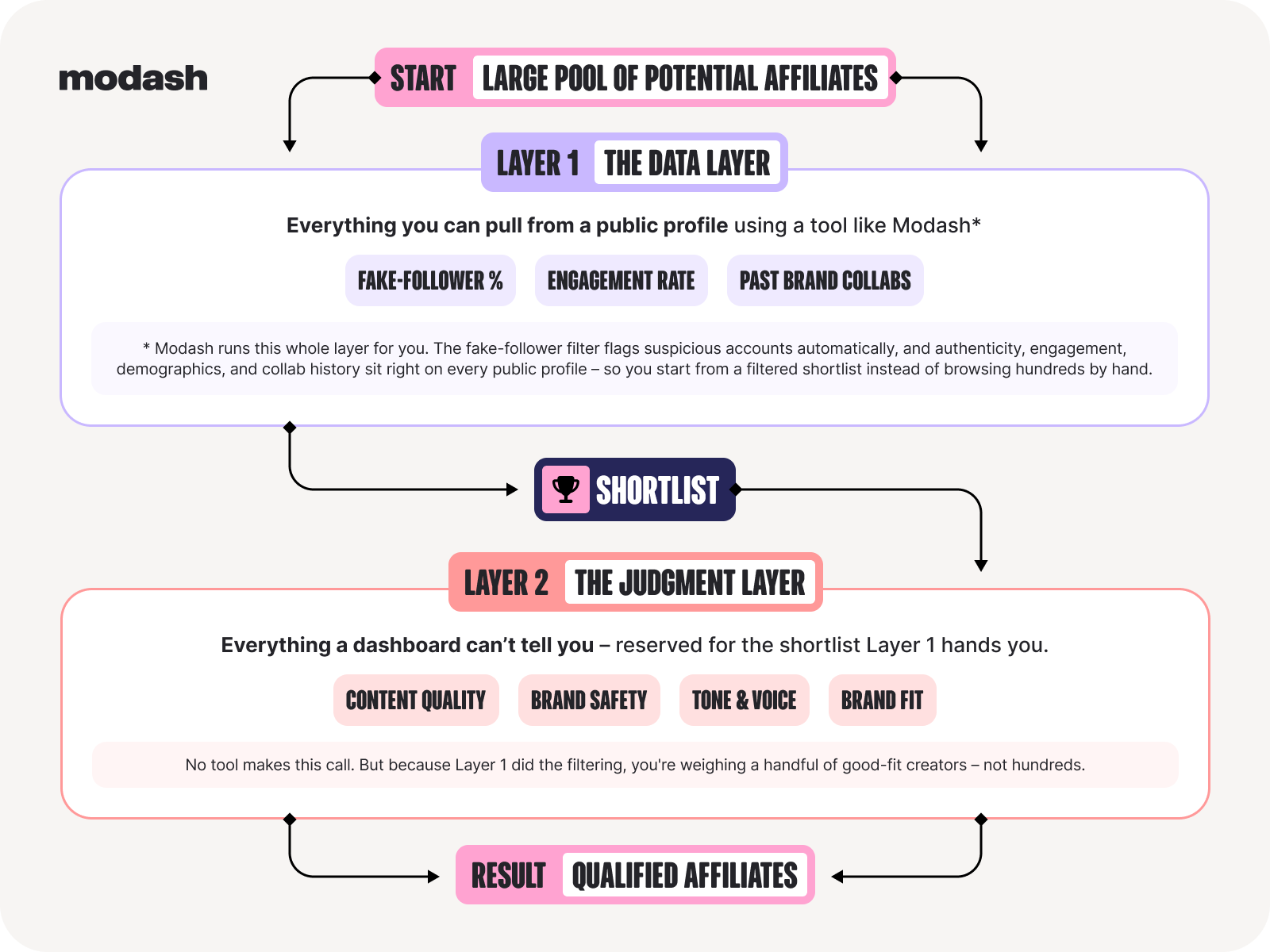
First, the data layer. Check all the stuff you can pull from a public profile – fake-follower percentage, engagement rate, audience demographics and location, past brand collaborations – to build a shortlist of high-quality brand fit creators.
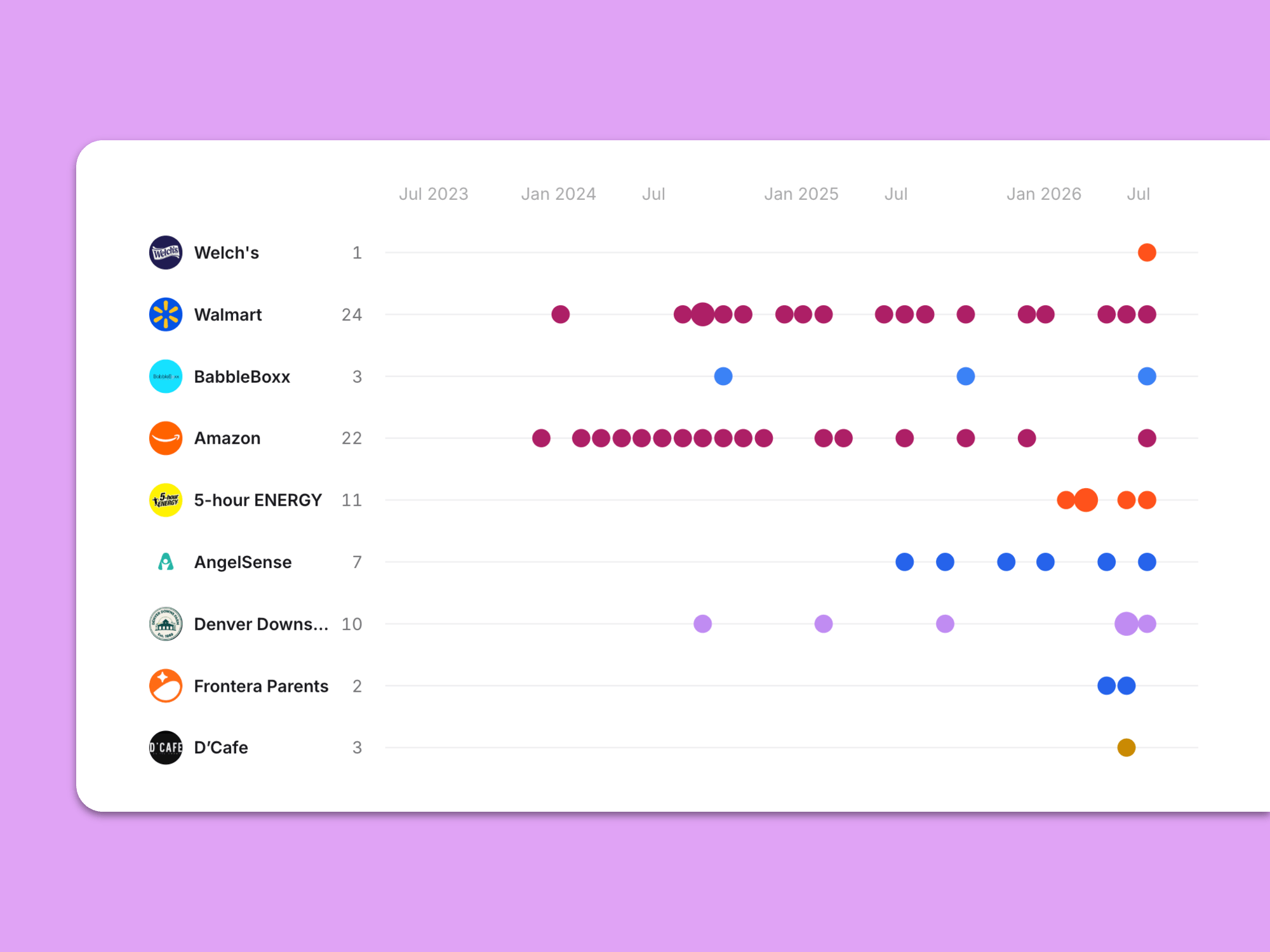
BTW, once again, Modash can help here by showing you all that stuff in one place, right down to a full history of the creator’s previous collabs:
Then, and only then, should you use your gut to assess the stuff that a machine can’t tell you, like:
That way, you’re using your valuable human judgment to pick from a pool of creators who the data tells you are a solid fit. It’s the most effective way to scale affiliate recruitment.
I’ve already spoken about how a lot of brands are weirdly shy about running affiliate marketing experiments around things like compensation models and ways to engage creators.
Well, another area they aren’t experimenting is in the types of affiliates they work with. Just 12% of marketers trial new kinds of affiliates every campaign, while almost 11% only run these kinds of tests every 6 months or less.
While it’s fine to stick with the same kinds of affiliates in the early days of your program, sooner or later you’re gonna run out of creators who meet all your vetting criteria and actually want to work with you. Plus your audience is gonna get preeeeeetty bored of the same old messaging.
Enter the storyfit influencer.
Storyfit influencers aren’t just folks in your niche. Instead, they’re any creators who can tell your brand’s story in their authentic voice while resonating with their audience (which, naturally, aligns with your own audience).
For example, let’s say you’re a brand selling protein products. Protein bars, protein powder, protein shakes… Man, everything has protein in it these days.
Rather than just recruiting generic fitness influencers or affiliates who review those specific products, with the storyfit model, you’d widen your search to consider category entry points, the creator’s identity, and/or the specific content format.
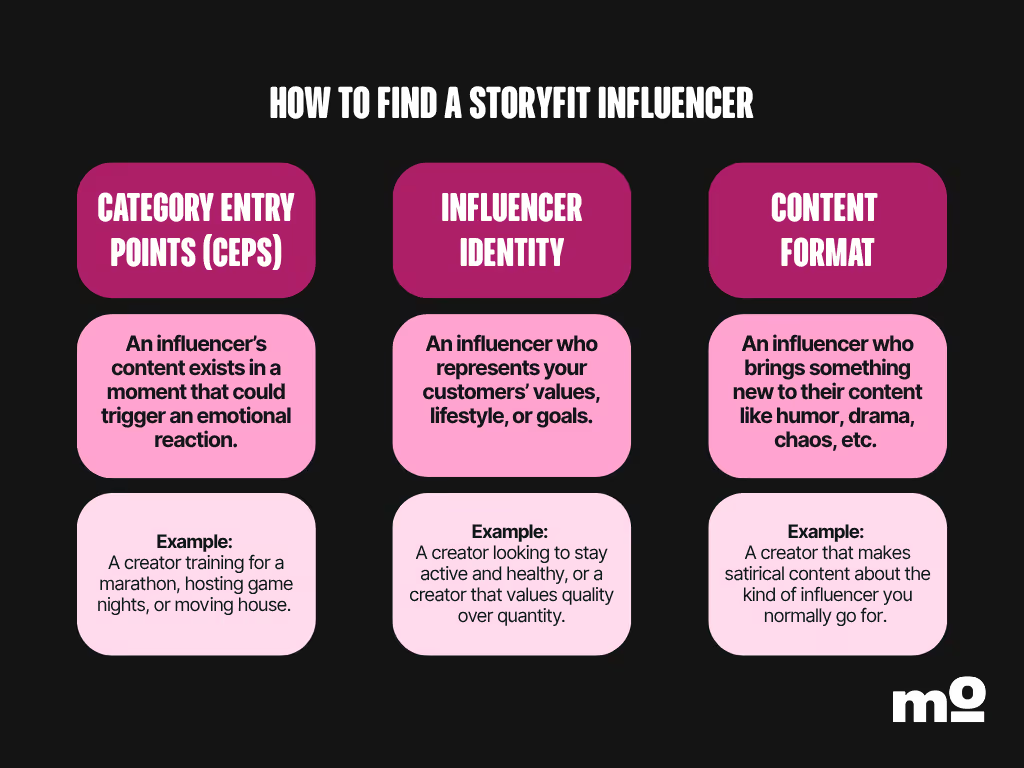
That way, your search broadens to take in creators who are training for a marathon, or losing weight by managing their macros, or supplementing their protein intake because they’re vegetarian or vegan.
If you get the tracking and attribution part wrong, you’ve got no chance of demonstrating your program’s ROI. In which case you’ll be in trouble next time your leadership team meets to discuss marketing budgets…
An “attribution model” is a fancy-sounding way to describe how an affiliate gets credited for a sale (including the window in which they’re eligible for commission).
There are 3 main models:
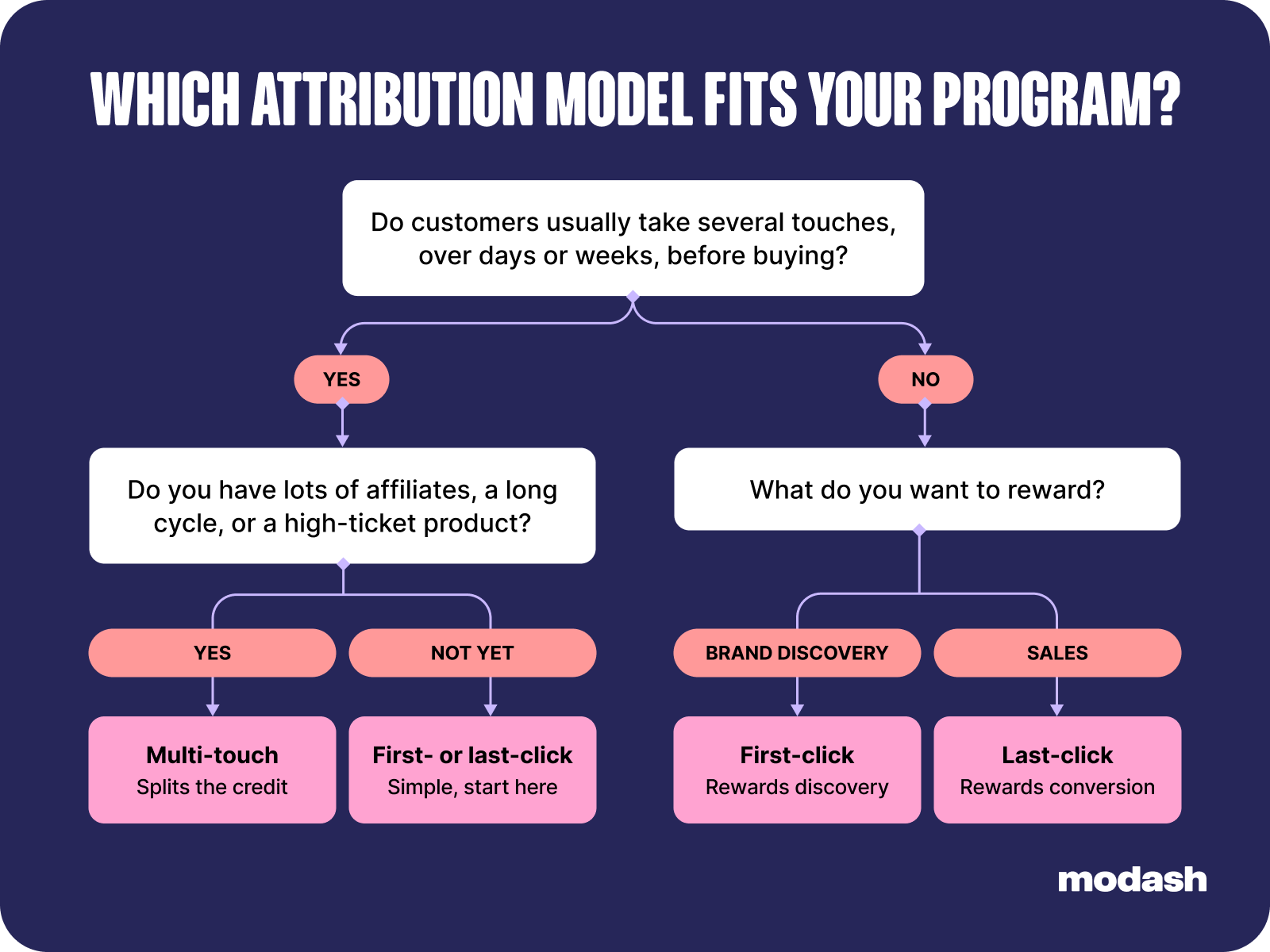
While multi-touch might sound like the most equitable approach, in reality, it’s unnecessarily complex for smaller programs. Especially for brands with simpler products and/or a relatively short purchase journey that doesn’t require multiple touchpoints.
That’s why most affiliate apps and platforms default to last-click attribution. It’s easy to explain – and as long as your creator partners understand how they get paid, it’s perfectly fair.
🤓 Further reading: For a deeper explanation, including the pros and cons of each model, check out Affiliate Attribution Models: How to Choose the Right One for Your Program.
There are various ways to track affiliate sales, but most brands use 1 (or both) of 2 methods:
Because they track different things, many brands use both. That way, if one breaks down, they can still track the sale through the other method.
But there’s a problem: the numbers don’t always agree.
For example, say a customer clicks an affiliate link but forgets to enter a discount code at checkout – in that case, link tracking would record a sale but the promo code wouldn’t. On the flip side, the customer might visit the store via another source (e.g. direct or organic) rather than clicking the affiliate link, then buy using the creator’s code. In this scenario, the code tracks a sale but the link doesn’t 🤦♀️
This isn’t necessarily a problem, but you need to build some logic into your attribution process to account for such discrepancies and ensure you end up with consistent numbers.
For example, Modash lets you assign codes and links to a creator – but if a code gets used, it always takes priority.
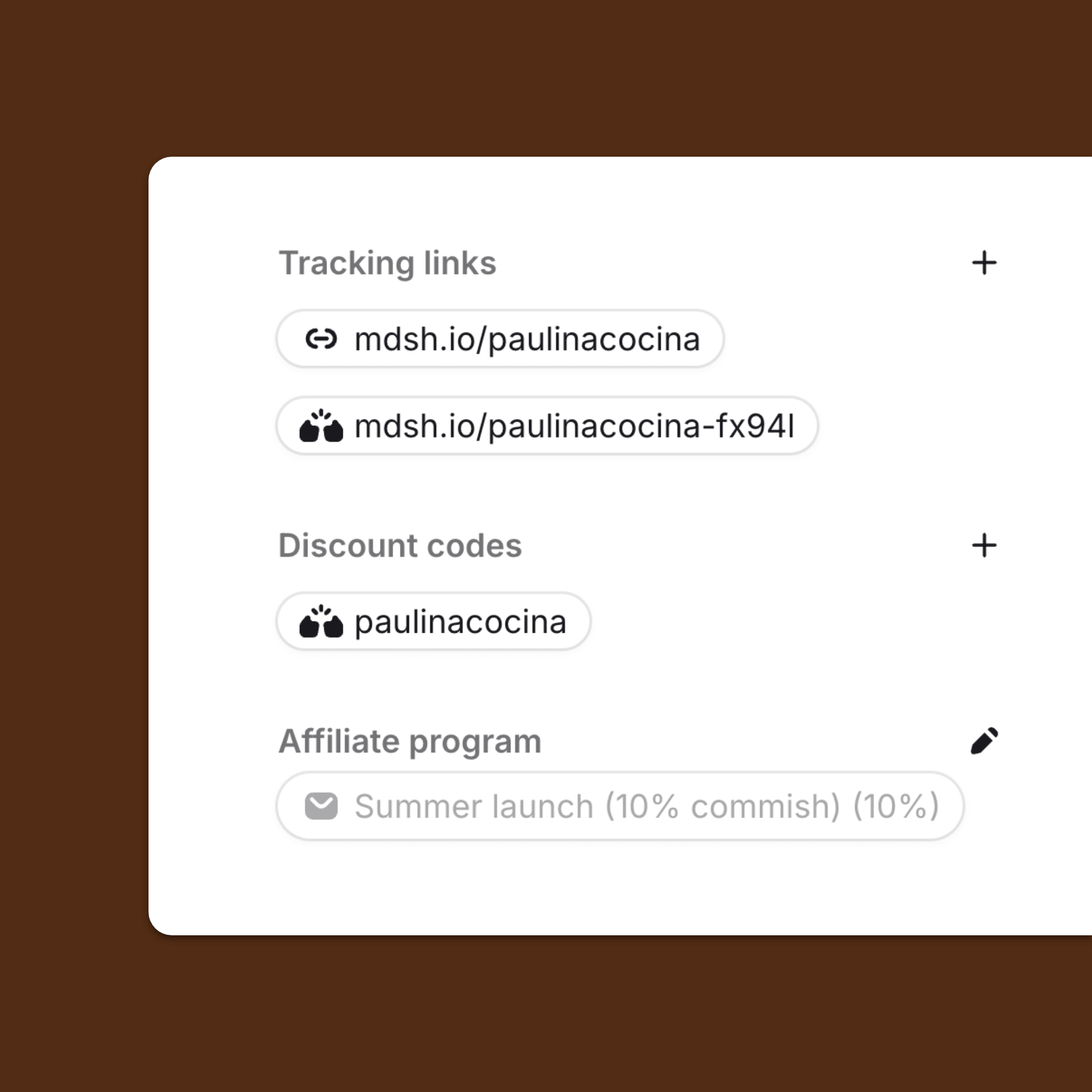
Not only does this leave no room for disagreement, but it also ensures there’s no risk of double-counting sales for customers who clicked a link and used a code.
🤓 Further reading: For waaaay more on this topic, check out How to Track Affiliate Sales: 5 Methods, Their Limitations, and What Actually Works.
In an ideal world, you’d pay commissions straight after a sale, because speedy payments keep affiliates happy – and happy affiliates are good for business.
Trouble is, this leaves you open to the risk of paying for sales that end up getting returned. Which is why it’s essential to consider your attribution window and build in a hold period.
An attribution window is the time following the initial link click in which an affiliate still earns a commission. Say you have a 7-day window and the customer buys 6 days after clicking an affiliate link, the creator in question gets the credit – whereas if the conversion doesn’t happen for 9 days or more, they get nada.
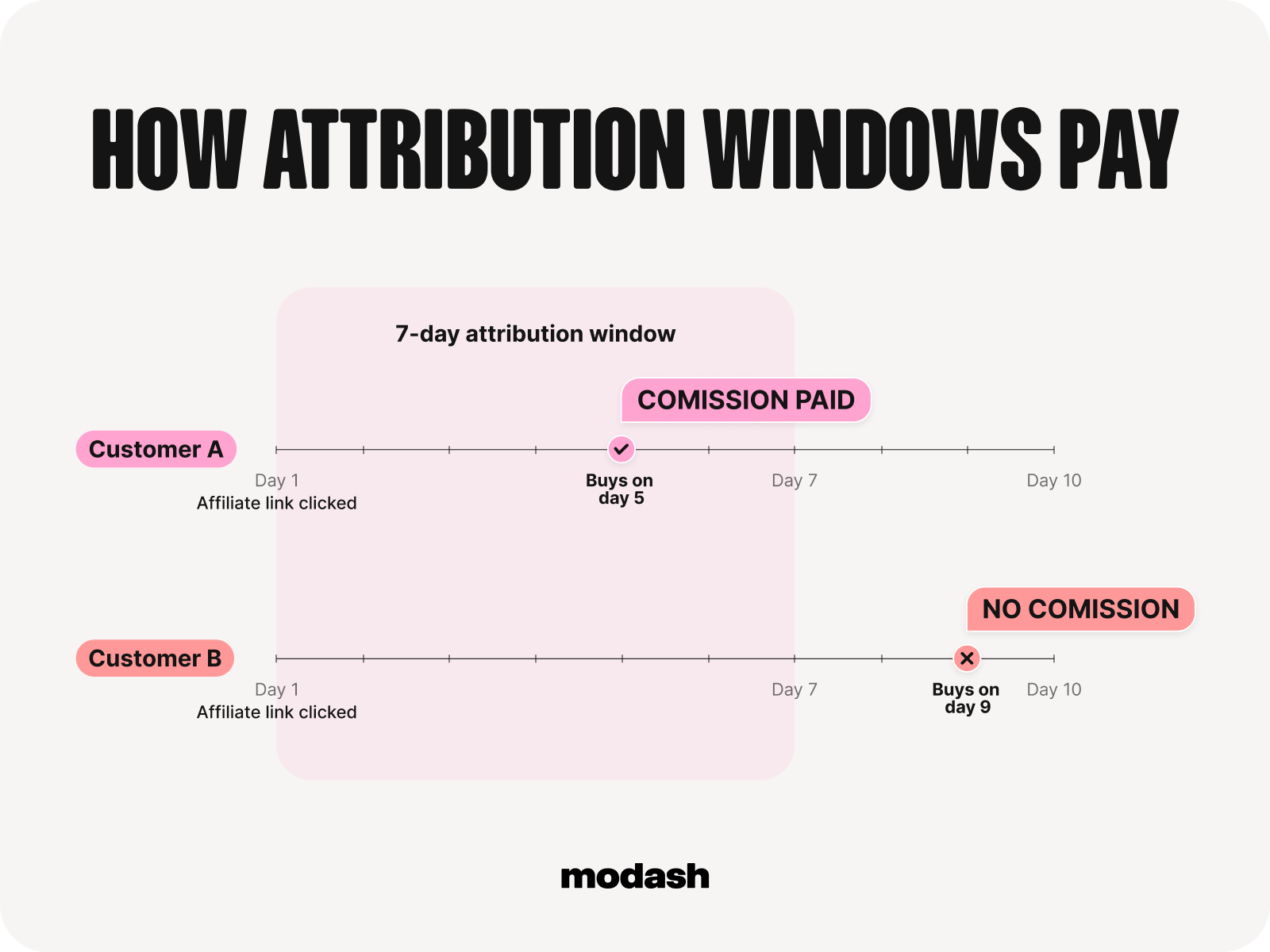
Ecommerce brands typically offer windows of 7 – 30 days, with stores selling impulse-buy products favoring shorter windows and those with longer buying cycles allowing their affiliates a little more time.
Then there’s the hold period – AKA the timeline in which a commission becomes eligible for payment.
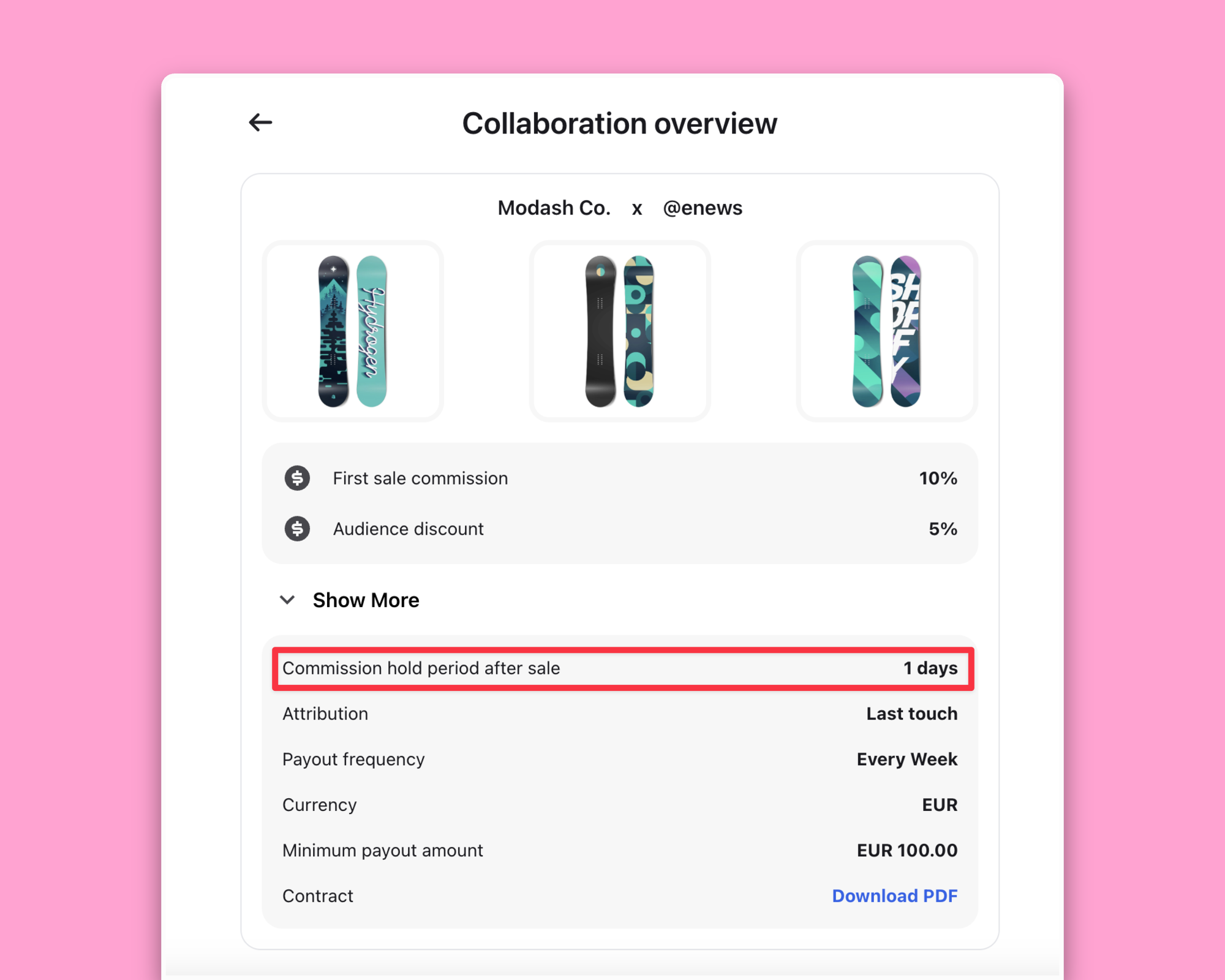
Building in a hold period protects brands against paying commissions on returns, cancellations, and chargebacks. For example, if you have a 30-day hold period and a sale happens on June 15, the commission would be eligible on July 15 and would be paid in the next payment run (say, August 1).
With Modash, you can configure your own attribution window of 1 – 30 days and also set your own hold period. Here’s how the latter appears in our creator portal:
Let’s make one thing clear: however much a creator loves your brand and product, they’re ultimately promoting you to get paid. So any mistakes here can seriously harm your affiliate relationships.
There’s more than one way to pay affiliates. In fact, there are 3 main commission models:
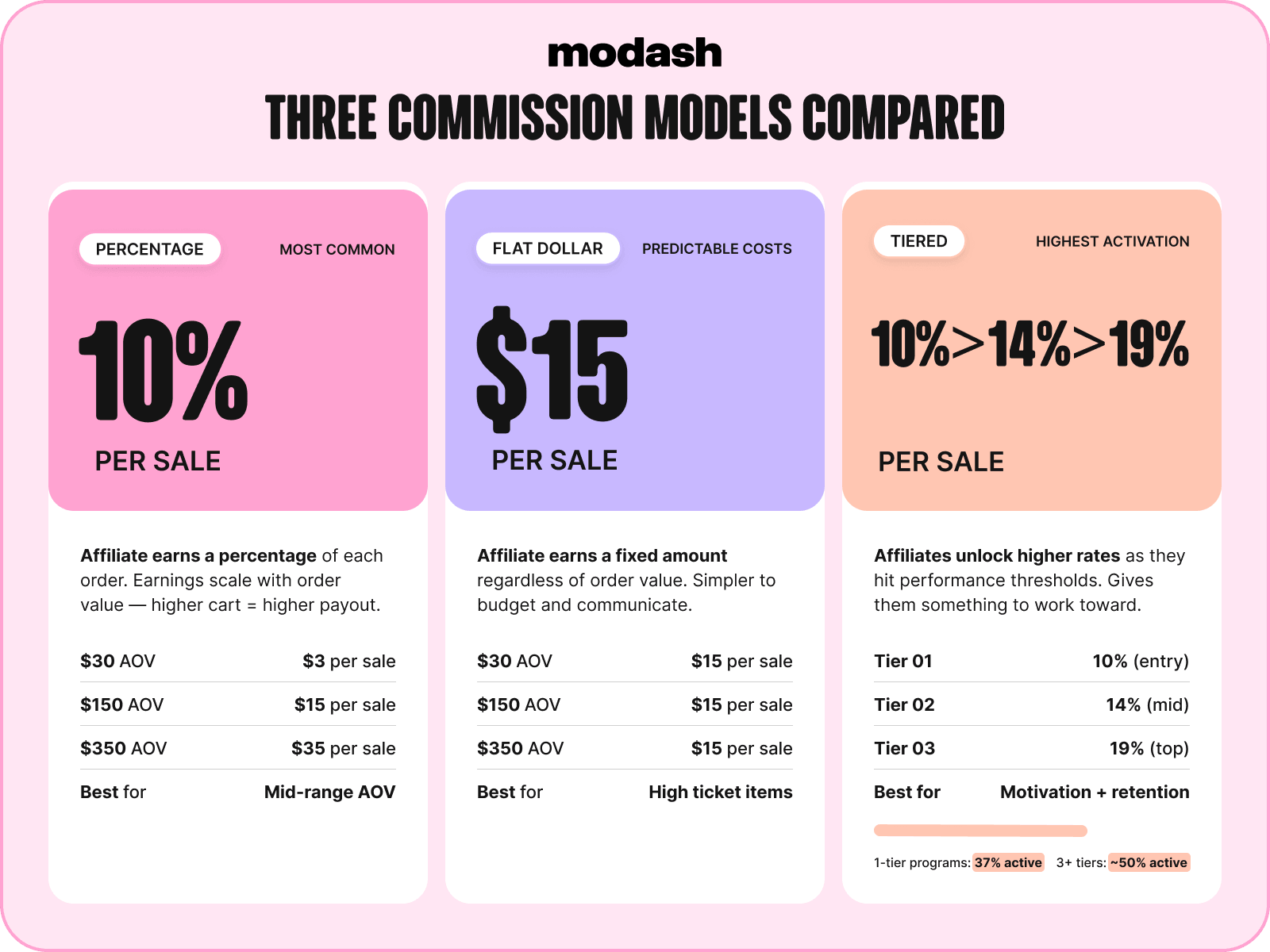
Our research shows that more than half of marketers are running a single-tier setup. It’s easier to manage, but it doesn’t give creators much reason to push harder, beyond the chance to earn more of the same commissions.
Unsurprisingly, then, our research also found that programs with tiered commission structures tend to have more motivated and engaged affiliates. That’s right:
As for what those tiers look like – well, we’ve got that covered too. Our study showed that, on average, commissions range from 10% at the entry level to 19% for top-tier performers:
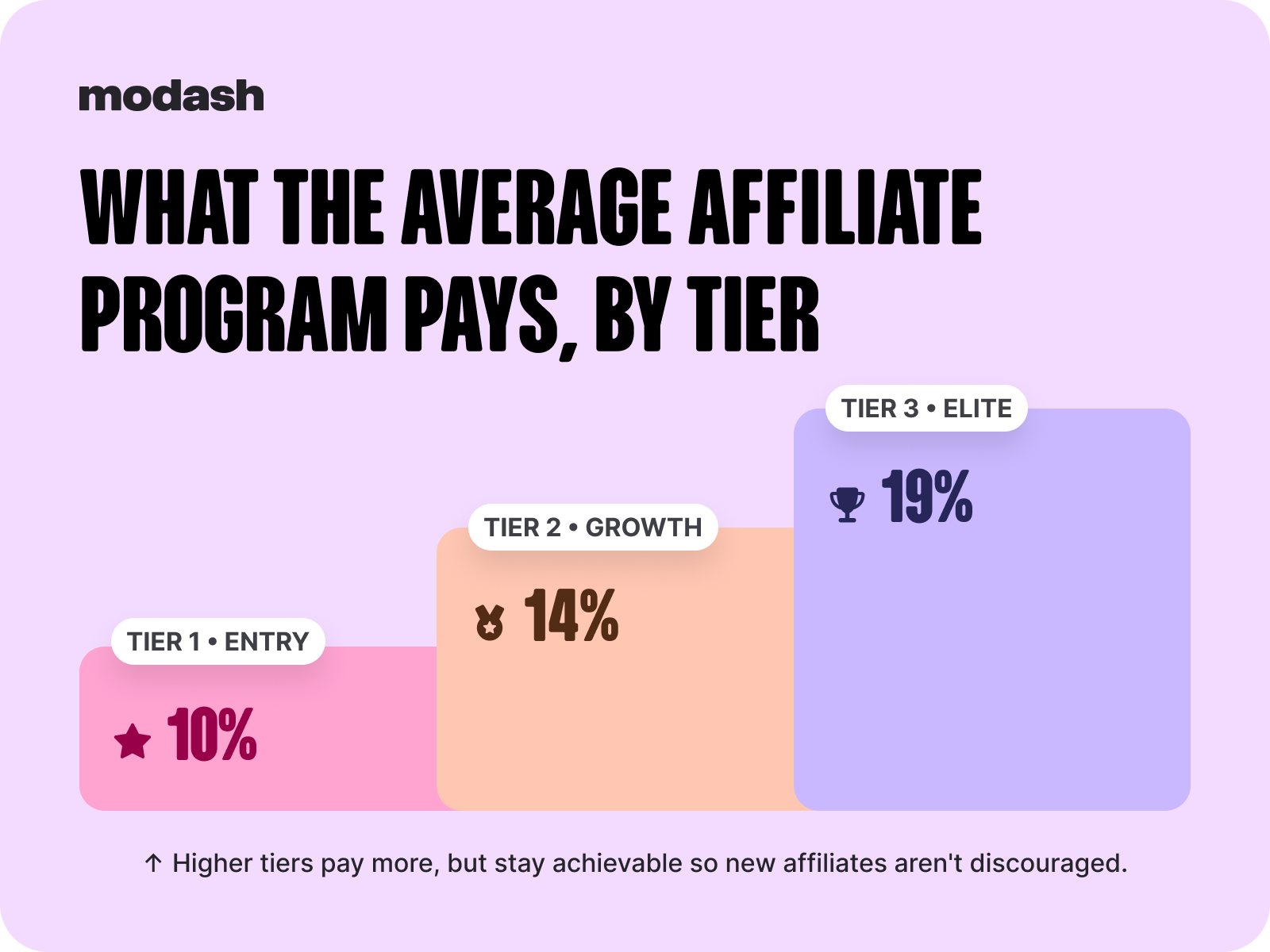
🤓 Pro tip: With Modash, you can create your own affiliates tiers with custom rates and automatically calculate how much each creator is owed based on their sales volume.

Okay, so we know how much the average brand pays across each commission tier.
But that’s not to say you should just blindly adopt the same rates without first considering 2 other key numbers, namely your:
Fail to account for these and you risk barely breaking even (or even making a loss) on affiliate-driven sales, which won’t do anything good for your program’s ROI 👎
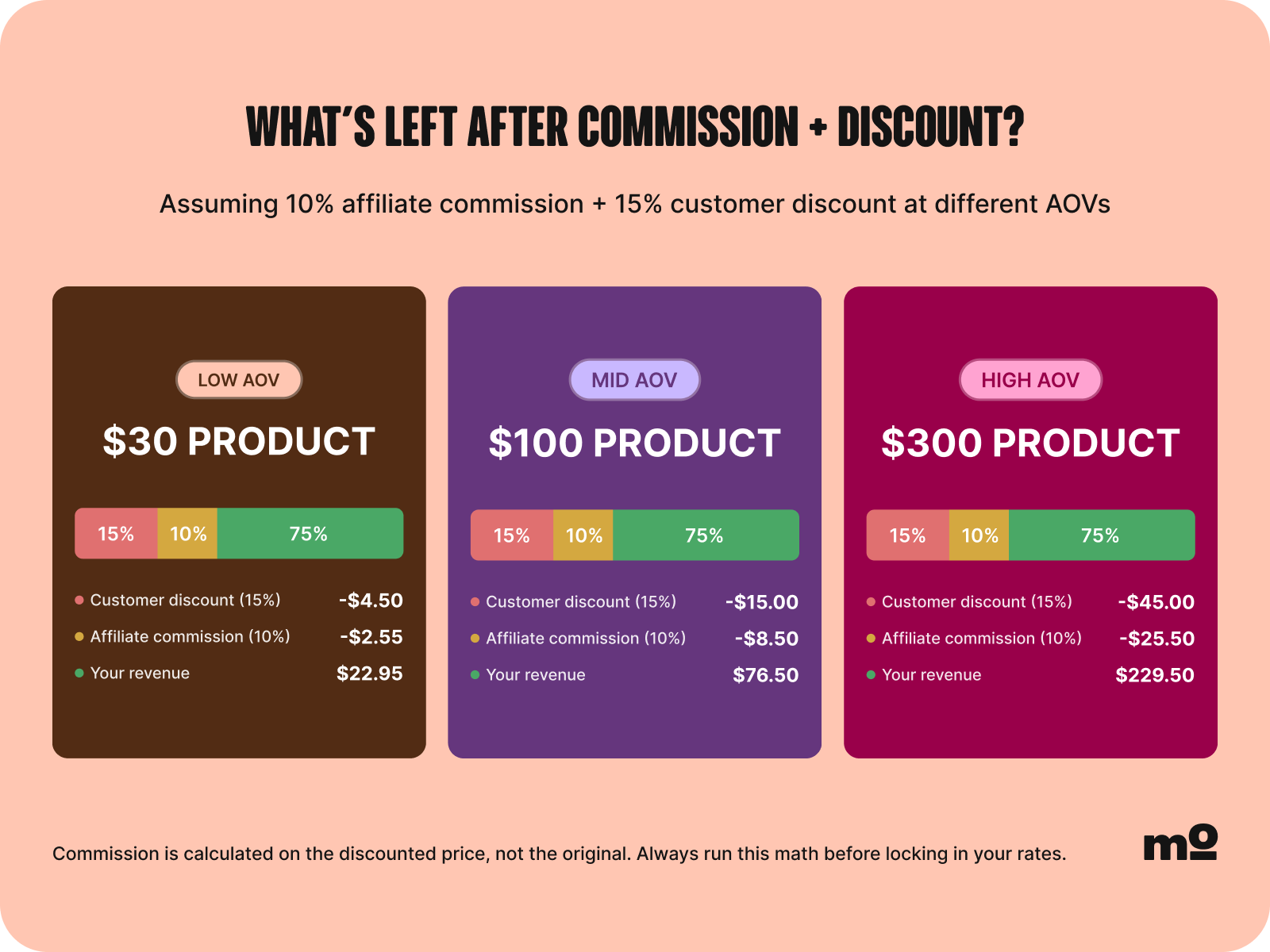
To demonstrate my point, let’s run some imaginary numbers:
Say you’ve got an AOV of $100 and a gross margin of 60%, equating to an average gross profit per order of $60. Your affiliates share a 15% discount code, so that’ll need deducting, and then you’ve got various other costs to factor in – platform and agency fees, management time, yadda yadda.
Suddenly, your $100 order looks more like ~$30 of net margin, and that’s where your commission’s got to come from. So you probably don’t want to eat up 2/3 of that by paying a bumper 20% rate, right?
Understandably, your affiliate partners want to know exactly how much they’ve earned and when they can expect to receive it. Any lack of transparency on your side risks driving disputes and damaging relationships.
Realistically, it’s gonna be tough to share real-time information on earned commissions and payment status without affiliate software to back you up – you’ll spend all your time updating numbers in a spreadsheet.
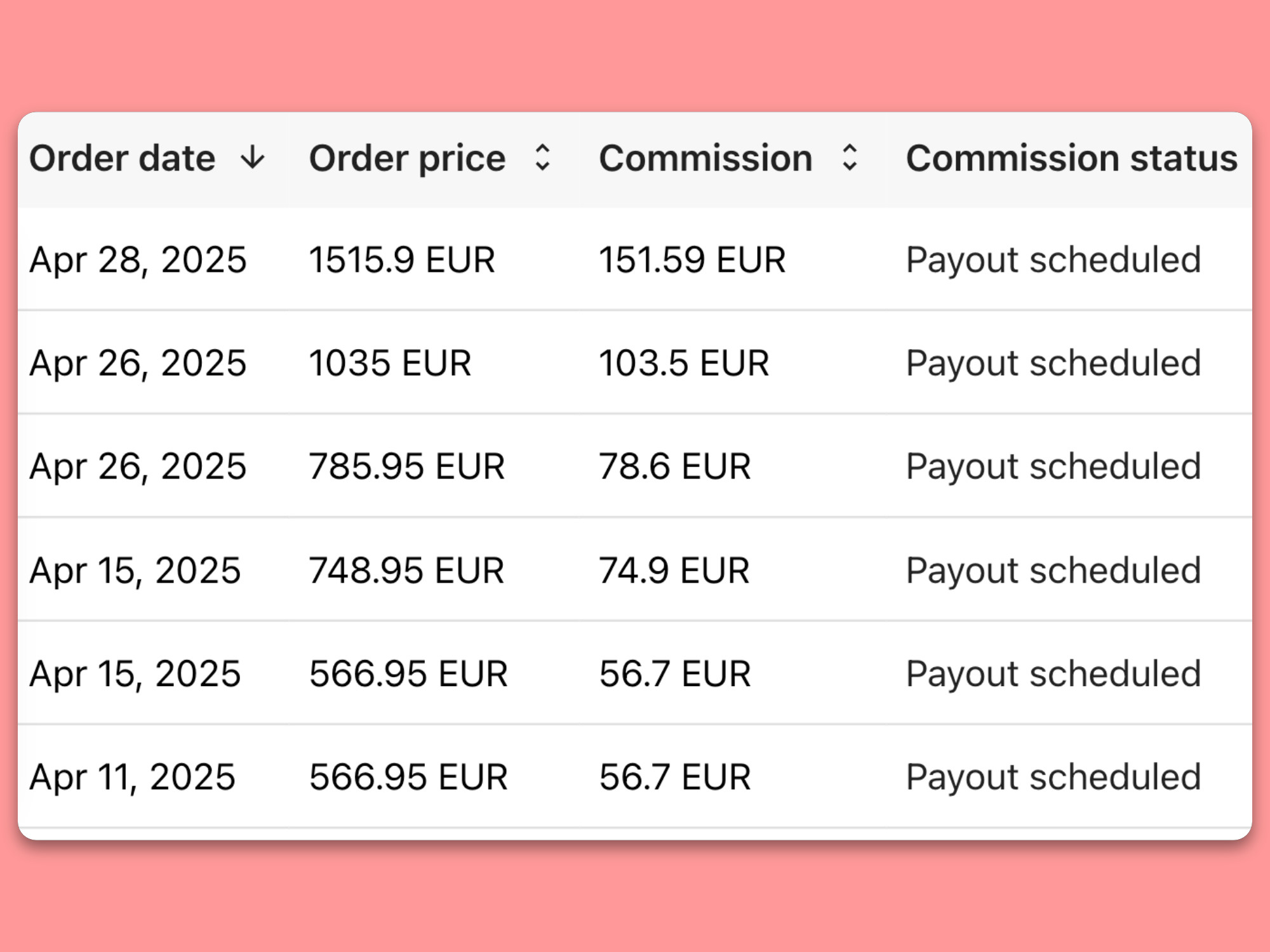
Modash’s creator-facing portal does all the hard work for you, allowing affiliates to follow order dates, commission totals, and status from a single live view.
A lack of transparency around commissions is one thing, but slow, unreliable, or generally unclear payments are arguably even worse.
In fact, this is probably the single biggest cause of affiliate churn. And who can blame them? Creators think their money is on the way – then, next news, their hard-earned commissions are nowhere to be seen 😡
To be fair, handling payments is complex. Your finance team has hundreds of payments to process, your affiliates want to know when they’re getting paid, and you’re stuck in the middle.
That’s why a lot of brands use affiliate payment software like Modash Pay.
Modash Pay lets you pay affiliates in their local currency, as well as handling all the tricky stuff like creator bank onboarding and invoice generation.
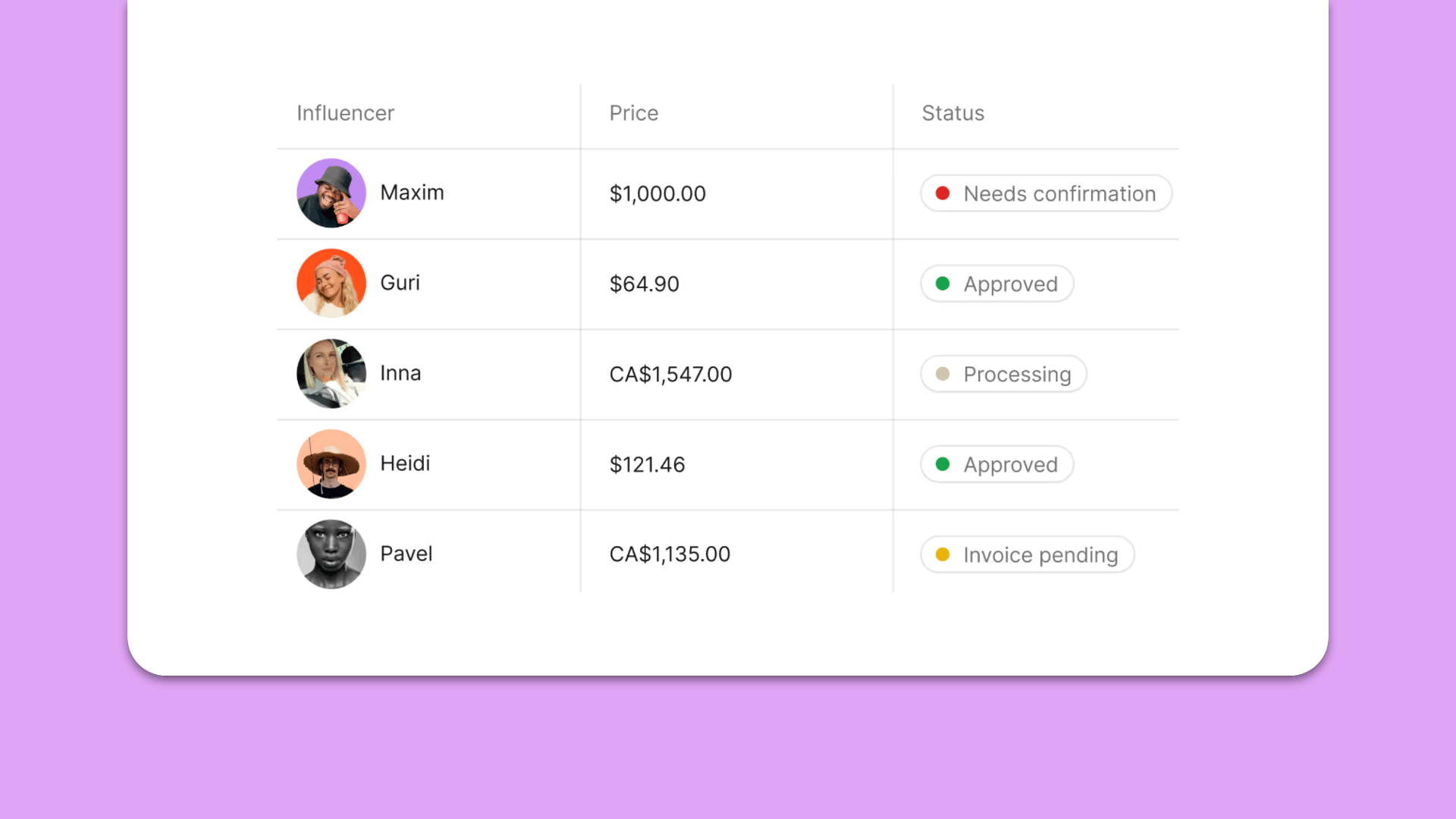
It’s easy: you send secure payment links to your affiliate partners, they upload or auto-generate compliant invoices, and we handle the rest – invoice validation, compliance, payment processing.
🤓 Further reading: Learn everything you need to know about paying creators in Affiliate Payouts: Which Model to Choose & How to Structure Your Process.
So far, this section has all been about money, money, money 💰
But while it might make the world go round, it isn’t the only way to motivate and reward affiliates. There are various non-financial incentives you can offer, too, such as:
Ignoring rewards like these is a mistake because they give you a valuable differentiator versus brands that only pay “regular” commissions. If your non-financial rewards are attractive enough, you might even be able to pay lower cash commissions, thereby protecting your margins.
🤓 Further reading: Find out more about rewards – including non-financial ones – in 5 Affiliate Incentives That Actually Drive More Sales (With Examples).
Finding and hiring brand-fit affiliates takes a lot of work. So the last thing you want is to burn a high proportion of your new recruits through poor onboarding, low-quality management, and other retention-related mistakes.
Weak onboarding is the #1 reason why affiliate programs plateau. You spend an age tracking down the right affiliates and persuading them to work with you – then you don’t show them the necessary love during the onboarding process so they never post, pushing you right back to square one.
The word “process” is key here because effective onboarding =/= a single welcome email.
Sure, the welcome email is important; it’s your opportunity to share a ton of valuable information, including:
But if that’s your only touchpoint until you chase them up a month later to find out why they haven’t posted yet, you’re doing onboarding wrong.
Instead, you should be in touch regularly via email and one-to-many broadcast channels to share new creative angles, top-performing context examples, product updates, incentives… basically, anything that motivates your new affiliates to start promoting your brand.
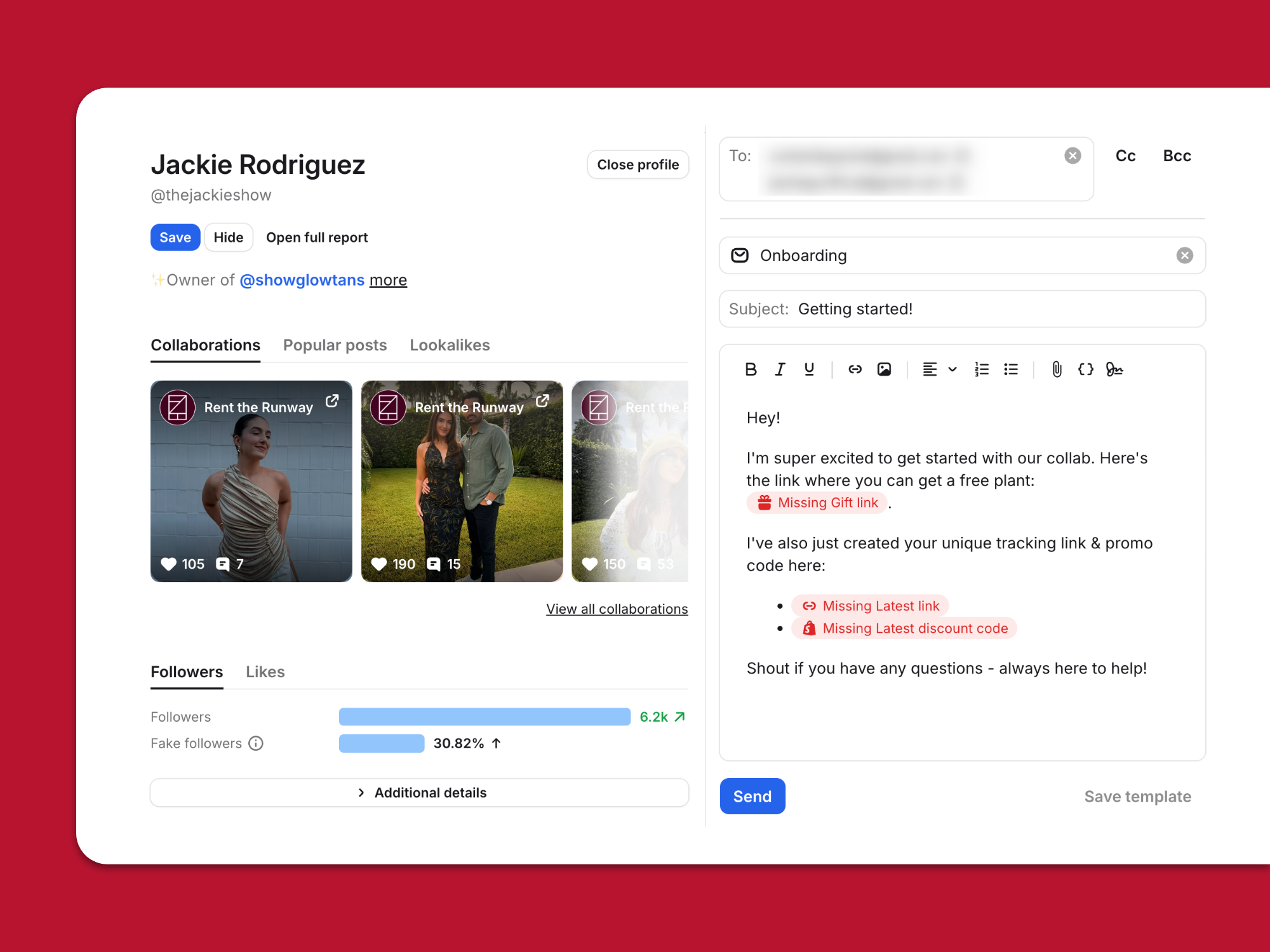
🤓 Pro tip: Modash Inbox makes it easier to write engaging onboarding emails by including all a creator’s vital statistics – handles, metrics, past collabs – right alongside your email copy. Plus it integrates with your existing Gmail or Outlook account, so you don’t need to create yet another email address.
🤓 Further reading: Improve your retention by reading our 7-Step Affiliate Onboarding Process to Boost Activation Rates.
A quick additional point about onboarding…
Much of the process is about giving new affiliates clear guidance about what to do next. Here’s your referral link, here’s your discount code, here’s how your ad disclosure should look.
But it shouldn’t just be endless instructions. Don’t overlook the value of educating them about your brand and product, such as:
Stuff like this helps creators figure out the best way to promote you to their audience, which is the whole reason you wanna work with them in the first place.
You’ve successfully steered your new affiliate through the onboarding process to the point where they’ve shared their first posts and generated their first sale. Woohoo!
But this is no time to rest on your laurels because, without active management and ongoing communication, they could still disappear off the face of the Earth reaaaaal fast.
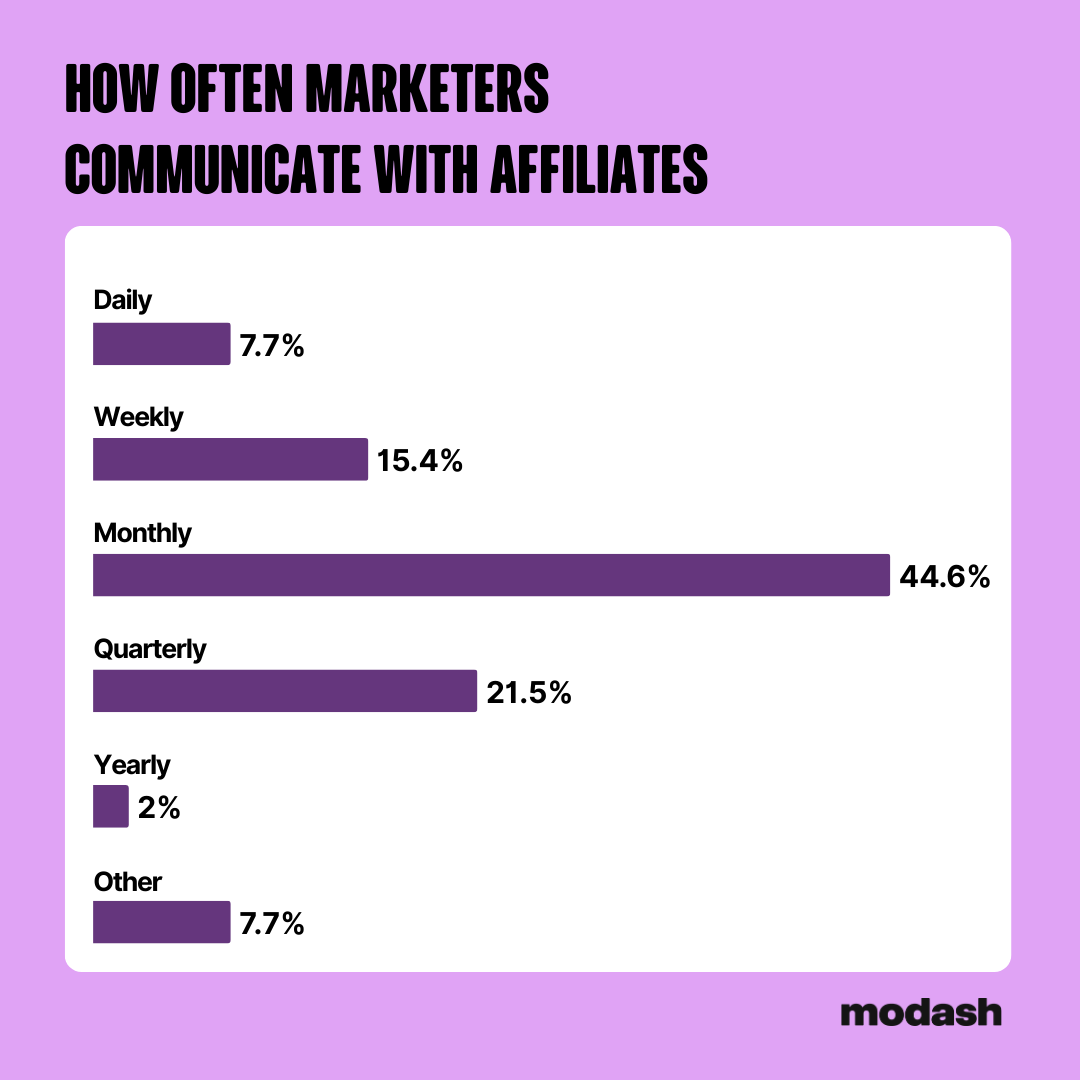
This is a real problem for brands. Our research found that less than a quarter communicate with affiliates at least once per week, while about 1 in 3 only get in touch quarterly or less. That’s simply not frequent enough to keep creators motivated.
Of course, I’m not suggesting you start spamming creators with messages about your lunch or pictures of your aunt’s cockatiel.
Instead, keep your comms engaging and targeted by sharing things like:
🤓 Further reading: For lots more ideas on keeping creators engaged, check out 13 Affiliate Program Management Best Practices to Scale Without the Chaos.
Just because an affiliate has gone quiet on you, that doesn’t mean they’re never gonna reappear. Maybe they just went on holiday? Or maybe they’re going through a really long tunnel?
Whatever the case, it’s your job to get those lapsed affiliates back on board before they go dormant by reaching out with a re-engagement sequence. Over 3 – 5 emails, you should:
Of course, the challenge here isn’t just encouraging lapsed creators to start posting again – it’s also to identify them in the first place.
Modash makes this process a whole lot easier by tracking when your affiliate partners last posted:
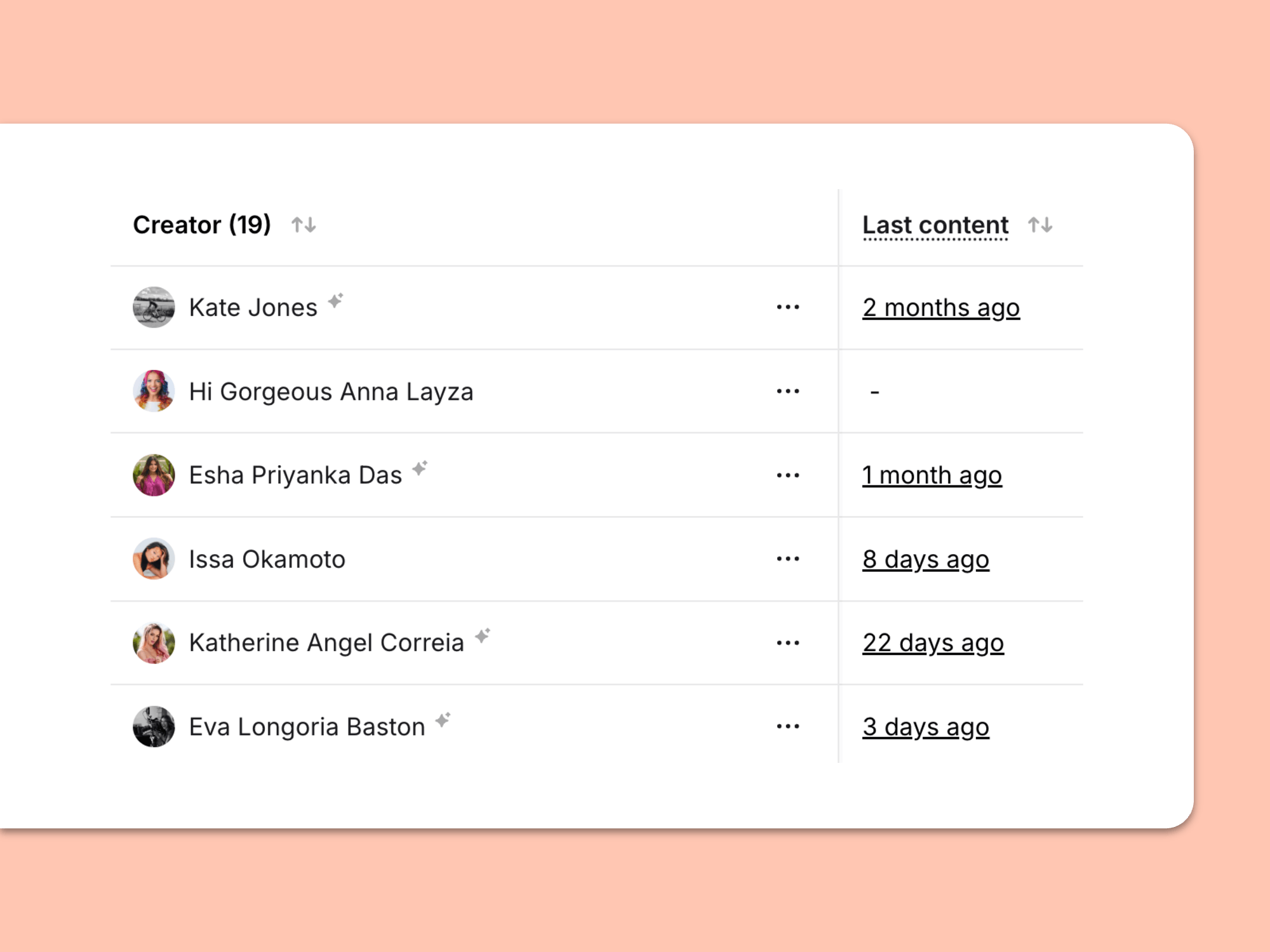
So when that figure ticks past 14 days, or a month, or whatever period of time you prefer, you’ll know it’s time to drop them a line.
🤓 Further reading: For a deeper dive on re-engaging lapsed affiliates, check out How to Increase Affiliate Sales (Without Recruiting More Creators).
As you can see, there are a whole lot of ways to get things wrong when managing an affiliate program.
But the biggest of all is attempting to run your program passively. Not only is it a problem in its own right, but it also leads to most of the other mistakes in this article.
So, for a lot of brands, the “fix” to a failing affiliate program is rarely a bigger roster of creators or more attractive commissions – it’s paying hands-on attention at each stage. Realistically, you’re only gonna be able to do this if you’ve got a dedicated affiliate marketing platform in your corner to handle all the busy work, from recruitment to onboarding to campaign management to payments.
👉 See what difference affiliate software can make by starting your 14-day free Modash trial!
Not investing the time and effort required to activate the affiliates you’ve already recruited. Our research shows that keeping affiliates active is the #1 challenge for affiliate marketers, with 60% saying it keeps them up at night – twice as much as the second biggest issue, finding new affiliates. And the biggest reason for affiliate churn is a lack of effective communication, whether that’s during the onboarding process or when they’ve already started posting.
There are lots of reasons why affiliates might sign up for a program but never post, but they mostly boil down to one thing: effort. You need to make it as easy as possible for them to start promoting your brand by sharing everything they need to get going – links, promo codes, high-converting angles, creatives, product samples, and anything else you can think of.
Our research shows that brands with 3 or more commission tiers see active affiliate rates of almost 50%, compared to just 37% for those with a single tier. So 3 tiers seems to be the sweet spot.
Because they track different things. For example, a customer might click a tracking link but forget to enter the promo code at checkout, or use the code after visiting your store via a different source rather than clicking the affiliate link. In both scenarios, one tracking method registers a sale while the other shows nothing.
Maybe. In our research, 47.6% of marketers said they struggle with code poaching and try to deal with it through various measures, such as:
That said, 20% of marketers admitted they’re doing nothing about code poaching. If it’s not massively affecting your sales and/or attribution, there’s no reason to worry.
That all depends on your average order and margins. After all, if affiliate marketing generates a $100 AOV and your net margin minus commissions leaves you with an average profit per sale of $30, you probably don’t want to spend $20 of that on paying the creator. At the same time, you need to consider the wider market, too – if your rivals are paying higher rates, you need to decide whether to match them, beat them, or differentiate your offer.
🤓 Further reading: Learn more about this in Affiliate Program Competitive Analysis: What to Analyze & How to Compete.