




More tools
Use cases



Exclusivity is a clause in your agreement that prevents a creator from posting other sponsored content (entirely, or from specific competitors) for a duration. The exact scope of what exclusivity means can vary.
But…
With the help of 3 influencer marketing experts, I'll answer these questions (and more).
The short answer is yes. At least, in some capacity. But:
1- It depends on the product, and
2- There are varying definitions of exclusivity.
In some product categories, it would be weird if an influencer used two similar products. We'll see an example of this further down (a fishing sonar).
In other product categories, it would be weird if an influencer didn't use two similar products. Think fashion, clothing. Why would someone only buy clothes from one place?
So the first thing we need to do is apply common sense.
Next, let’s consider the varying scopes of exclusivity.
First up: are we talking about full exclusivity, or category exclusivity?
It's quite normal to see something like this. 1-2 days of full exclusivity, followed by a longer period of category exclusivity.
.png)
Beyond that, you can also customize and negotiate some nuances:
Let's dive more into full vs. category exclusivity, with some examples of how others approach this.
Most brands, if they discuss it at all, ask influencers for category exclusivity.
In those cases it’s A-OK for a lifestyle influencer to post about a haircare brand one day and a skincare brand on another day, for instance.
When you ask for full exclusivity though, you create a breathable ad-free space before your sponsored post. That is likely to increase the percentage of followers/viewers who are receptive to your ad.
For that reason, Anna-Maria Klappenbach (Community & Brand Marketing Lead at Aumio), advises in favor of always having full exclusivity for at least a little duration before and after a collaborative post with an influencer.
Anna has the following two terms regarding full exclusivity with her creator partners at Aumio:
YouTube content typically has a longer shelf life than Instagram and TikTok, so it’s advisable to customize your exclusivity clause for each social media platform.
Once again, your exact request is going to vary depending on the nature of your business, product, & influencer strategy.
We have three examples here that cover different products, markets, and collaboration types. They're explained in more detail below, but the overview is:
Here's a few more details about each.
Deeper Sonar's flagship product is a portable sonar. In this category (and many others), it makes sense to request category exclusivity for the full duration of the relationship (and a little buffer afterwards). Without it, everyone (including the creator) will lose authenticity. Valeriia Chemerys, Head of Partnerships, says their target audience won’t trust an influencer who promotes Deeper today and another sonar two weeks later.
It isn't good for both the influencer or the brand. Anglers smell "promotion" and they don't like it. But when the creator uses one product for a long time and shares educational info and tips, it's a win-win for us both. The influencer becomes a trusted & reputable source, and we get more authentic-feeling promotion to our target audience.

And, back to our fashion counter-example, Ben Williams, (Influencer Team Manager at Blast, ex-FARFETCH) says the opposite can be true with everyday items like clothing, beauty, or skincare.
If an influencer is only promoting one brand/product, it can feel inauthentic. It's clear that they're being paid to promote that brand, and consumers will start to see right through it. Having variation on an influencer’s page can actually add authenticity and credibility.

In these categories, long-term exclusivity may be unreasonable. However, even in those cases, Ben recommends still asking for at least two days of exclusivity:
Ask for a short period of time around your post date where the influencer can't talk about a competitor brand. This could be two days on either side of the post to maximize the effectiveness of your collaboration.
1-2 days is really the minimum for category exclusivity, and it's a reasonable ask. If an influencer is promoting similar products more frequently than that, they risk their own credibility. Nobody wants to see ads on every post.
For one last example, Anna-Maria at Aumio requires that their partners avoid promoting any children’s mental health product or service for one month after their collaborative post goes live. (They're an app to help children & babies sleep.)
That longer window works in their space, and it might work in yours. Just remember to apply common sense, test, and negotiate. Everything in influencer partnerships is negotiable.
Whether or not you should pay extra for exclusivity (and how much should you pay) depends on the factors that we've already been talking about:
In our survey of 42 influencer marketers regarding Instagram influencer pricing, exclusivity among competitors was one of the most valuable add-ons — thus, worth paying extra for.
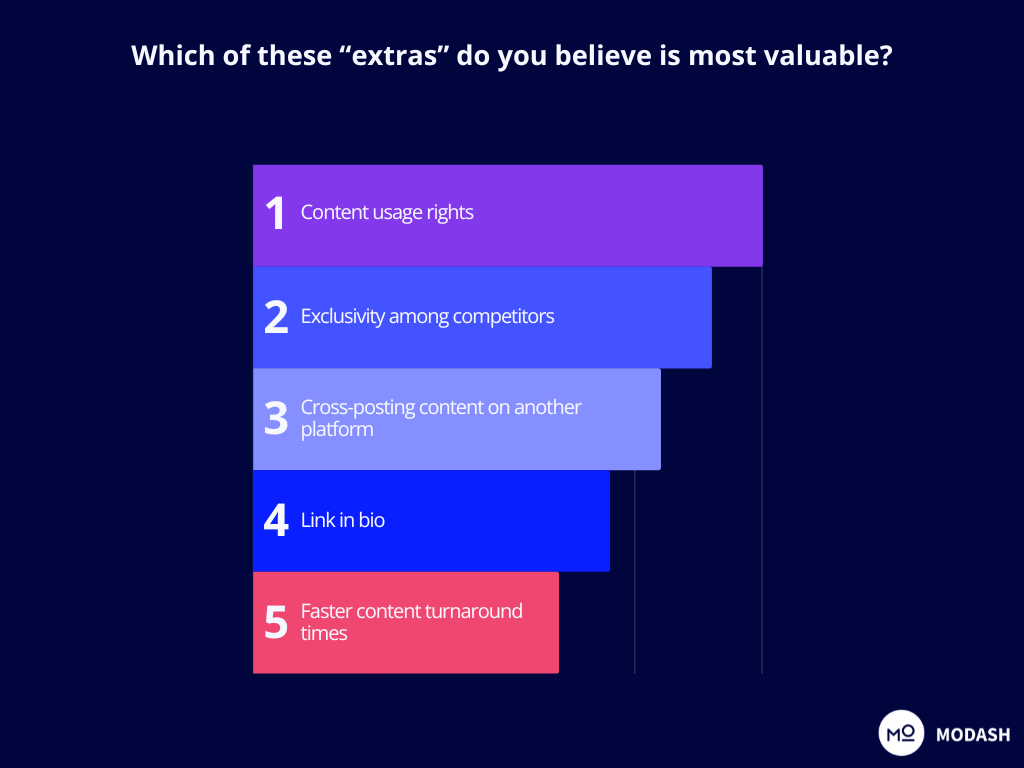
But, like everything, it depends. In some niches, it's normal to see exclusivity without fees. At Deeper, Valeriia says they never specifically pay extra for exclusivity. Even with 150+ long-term ambassadors on board.
It's always a part of their deal by default, and it's included in the contract. It makes sense in their space, because:
a) their product is its own category
b) most influencers in their niche are conscious about what they’re promoting
Similarly, at Aumio, Anna never does influencer outreach to creators who advertised Aumio’s competitors in the first place.
What do the creators have to say, though? Here are some perspectives from the influencer community:
While these opinions might give you a good benchmark, remember that the reality might be more complex. For example, your exclusivity rates also depend on the type of influencer collaboration. Exclusivity for brand ambassadors will be different than for affiliates.
It’s also worthwhile to remember that many excellent creators will include at least some exclusivity window as part of their price by default.
The short version: if your exclusivity terms are a bit tight for your product category, it’s best to start the topic early — as soon as you get a response. At Deeper, Valeriia brings up exclusivity in the first conversation. The creators must know what exclusivity means for your brand, what terms are included, and which companies might count as competitors. Valeriia clarifies all this and more during her first partnership calls with the creator.
This is what it looks like in their contract, which is shared transparently and early:
2. Exclusivity.
2.1. The type of partnership between Influencer and Advertiser is exclusive. That means that the Influencer agrees to avoid mentioning other sonar brands 1 month prior and 1 month after the last post / the Influencer agrees to avoid mentioning other sonar brands during the terms of partnership.
If you're worried about overwhelming the creator with too many points and terms all at once, some brands bring it up later, at the point of signing. This is especially fine if it's less restrictive, and unlikely to be a deal-breaker. At Aumio, for example, influencers see the exclusivity terms directly in the contract signing stage. The conversation can start from there if the influencer has any questions or concerns.
Most influencers expect exclusivity to be a part of the discussion, so don’t hesitate to bring it up.
And remember to always specify the ins and outs of your exclusivity terms clearly and transparently. Examples of things you should specify:
Answer and address all these questions in your exclusivity conversations with creators and in your official contract.
Exclusivity is a fair ask if:
a) it’s natural in your product category
b) it’s for the short-term
However, if you want long-term exclusivity, it can often mean a creator has to turn down other work and income to honor your agreement. Since that’s a heavy-lift ask, be prepared to pay a bit extra, but you can always negotiate the amount and/or percentage. Here are four negotiation tactics to make exclusivity less of a friction point for the creator:
1. The easiest way to negotiate exclusivity is through a long-term partnership. If a creator knows that a part of their income is stabilized because you’re giving them recurrent work each month, they’ll be more comfortable with being exclusive to your brand.
2. You can also negotiate for exclusivity by adjusting the platform, type of content, and timeframe of your terms. For example, can a creator post about a competing brand on TikTok, if they partner with you only for Instagram? Or can you reduce the exclusivity duration? Perhaps they can post an Instagram Story, but not a dedicated in-feed post about a competitor.
3. Instead of asking the creator for category exclusivity, you can also be more specific and request only collaboration refrains from a selected list of your top competitors.
4. Ben Williams also suggested promoting an influencer to a only from your brand would be inconvenient and unrealistic.brand ambassador if you’re negotiating for long-term exclusivity. But it’d cost you extra and might still not make sense for some industries like fashion, beauty, and skincare. For example, asking a creator to wear clothes
If you want longer-term collaborations and exclusivity, one way is to make an influencer a brand ambassador. There are usually non-compete clauses in this contract, however it is balanced with higher fees, and it’s only really possible in certain verticals.
Ultimately, any degree of exclusivity is a major request. In some industries, exclusivity might be expected. But in other markets, you’re closing off potential revenue streams for the creator.
Think about what’s realistic from the influencer’s standpoint. If your budget allows the creator to supplement their income till the exclusivity’s duration, they’ll readily accept it. But it might be a dealbreaker if you want exclusivity but can’t cover the income they’d lose by turning down other brand deals.
If you want to learn more about the whole influencer marketing shebang, subscribe to Modash’s newsletter. Each week, we share actionable advice — like when you should use automation in your influencer marketing efforts — from real influencer marketers who’ve been there, done that.