Free virtual event: hear from influencer leaders at ŌURA, Adobe, Stanley 1913 & more.
See the lineup


Most of this article is going to focus on the actionable stuff. How to execute great long-term partnerships well, not just why you should do them.
To start though, I think it's worth spending 2 minutes exploring the advantages & challenges that come with long-term influencer partnerships.
(Instead of blinding advising everyone to do them!)
There are a ton of great upsides to long-term influencer partnerships. Like any strategic decision though, you've gotta figure out what makes sense for you. Your team size, your budget, your product, your goals (etc).
First up, fatigue is a big one. It's not uncommon for partnerships to go something like this:
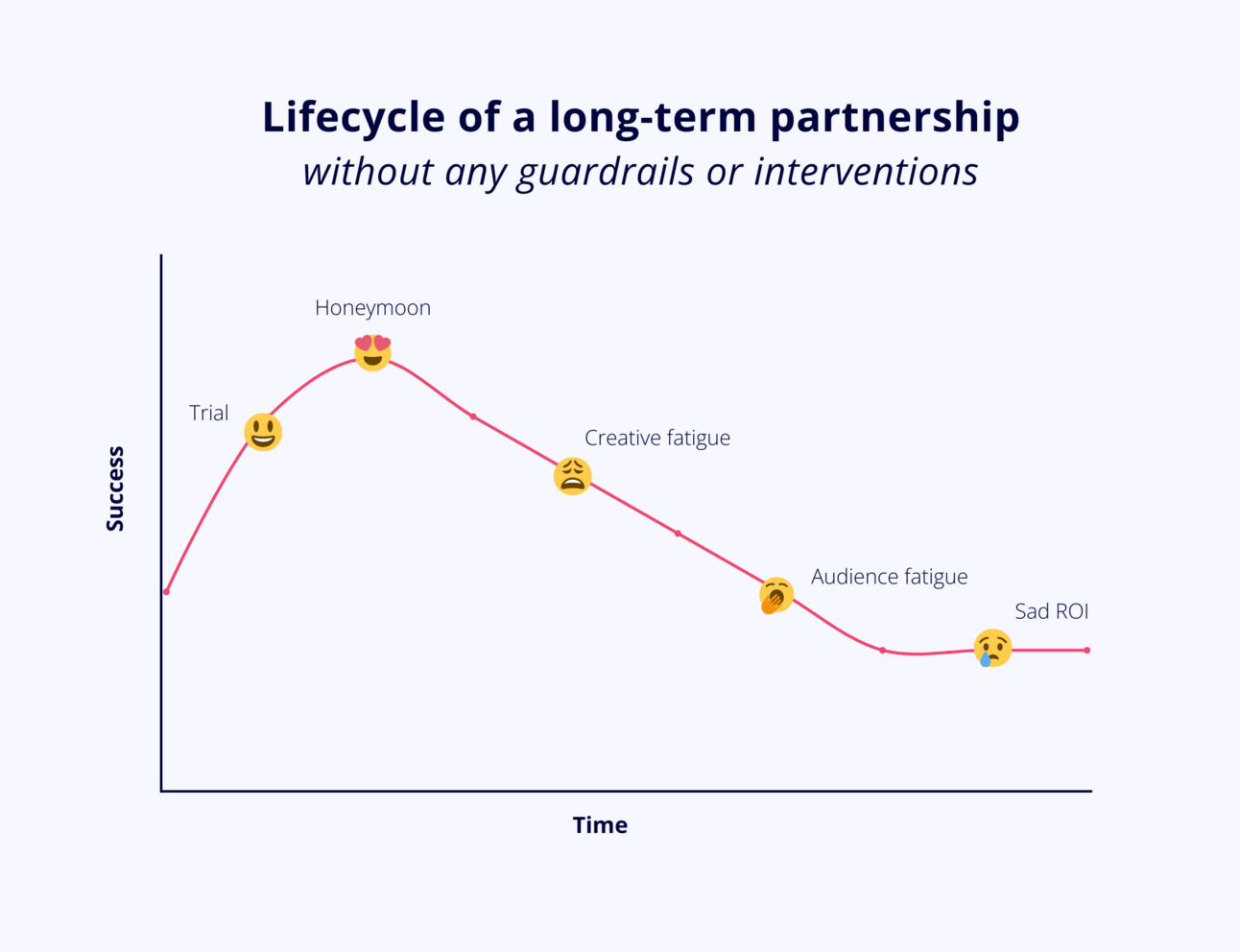
It becomes harder for the influencer to come up with new creative angles. Which in turn, leads to audiences getting tired of the brand promos. And/or, if you have a narrow range of products, you can simply "exhaust" the audience too. (They've either bought already, or they're not interested.)
Other than that, here are more challenges you might consider:
The good news is that there are plenty of things you can do as the influencer marketing manager to mitigate those downsides, and maximize the upside.
Let's get into the fun stuff: how to execute great long-term partnerships.
(I enlisted the help of 10 full-time influencer marketing pros for this.)
Influencer partnerships aren’t ad campaigns. If you engage in a 6-month contract with a creator, you can’t just turn it off if it isn’t working halfway through.
You need to build a process to trial new creators before making a long-term commitment.
Trial periods are a win-win, and with the right pitch, creators will understand that too.
Omer Mohamed, Head of Social Media & Influencer Marketing at Bang & Olufsen, recommends just being transparent with creators.
Tell creators that, to justify long-term financial commitments, brands need to test waters. It should be a win-win as it allows both parties to assess how their relationship could play out in the long-term.

During his time at FARFETCH, Ben Williams used the potential of a long-term partnership as an incentive during initial conversations.
I mentioned that over 60% of our partnerships are long-term ambassadors, and there’s the opportunity for that if things go well. As a creator, you’ll be motivated by long-term prospects. They’ll likely work a little harder on the content, which translates to more sales.

Now let’s see what these trial periods actually look like in practice.
Valeriia Chemerys, Head of Media Partnerships at Deeper, manages 150+ paid long-term ambassadors on annual contracts. There are more creators starting trial periods every month.
Deeper’s trial period usually lasts three months. They start by sending out a product kit tailored to the creator’s style of fishing, and they ask for one key deliverable each month.
Each creator typically has a strength when it comes to content. One creator might excel in Reels, while another creates great long-form YouTube videos. We request deliverables based on those strengths. For example one Reel, a set of Stories, one TikTok video, or one YouTube integration each month.

Around 85% of creators continue after their trial with Deeper. The number is high because they do a lot of vetting & analysis up front. After that, here’s Valeriia’s criteria for continuing:
One Medical has several influencer partnerships lasting 2-3+ years. Georgina Whalen, One Medical’s Influencer Marketing Manager, shared a little about how they test new creators.
We typically work with creators for a two month trial period to get a feel for how their audience reacts to the brand partnership, what kind of engagement their posts garner, the quality of the content, and how different topics are resonating.

The partnership kicks off with an onboarding call. Once they know what kind of story they want to tell, Georgina works with each creator to decide deliverables case-by-case. Each creator also gets a free one-year One Medical membership. That adds value, and ensures that creators have an authentic experience.
If I see comments & questions about One Medical, that is the kind of engagement we are looking for. I track each creator’s metrics closely so that I can decide if we should extend a contract, or put ad dollars behind the content.
Historically, Georgina has been tracking awareness & new member sign ups (by promo code redemptions). Moving forward, her priority is local awareness of One Medical's Amazon Prime offering. Clicks, engagement, and quality of engagements.
Anna-Maria Klappenbach leads influencer & brand marketing at Aumio. When her team works with a new influencer, the initial collaboration is always a single activation.
There are multiple deliverables in the initial deal (e.g. 2x Stories & 1 Reel), but no commitment for further activations.
(They almost never experience pushback from creators asking for longer terms – but your experience might vary per market or niche.)
For Aumio, a typical long-term relationship might develop like this:
Even though 60-70% of Aumio’s promo code redemptions come from creators that they’ve collaborated with 5+ times, Anna rarely makes deals that last longer than 3 months. Because:
As ever, there’s no “right” way to do a trial period – these examples are just for inspiration.
Picture this:
You sign a long-term contract with a new creator. They’re full of energy. Content is great.
Fast-forward 4 months, and their content starts to become stale. There’s less effort, less enthusiasm, and weaker results. It feels like they’re just checking a box to fulfill the contract.
(Note: exhausting the audience is a separate issue. We’ll get to that in a minute. We’re talking specifically about creative fatigue here.)
Here are three ideas to solve the problem.
Giving time 1:1 with the creator to brainstorm creatives can be a big unlock.
If you’re successful, the relationship improves, your messaging is delivered better, and the creator is excited & brimming with content ideas.
First thing to remember: the creator might know their audience best, but Rugile Paleviciute (Head of Partnerships, Burga) reminds us that you know your product best. Inputs from both sides are needed.
Creative freedom is great, but many creators won't spend the time to thoroughly research your products. They don't know all the benefits and selling points like you do. Talk to them about their creative ideas and see if your visions align.

And if you’ve been working in the social media space for a while, there’s a good chance you have even more to offer too. It’s not just about product knowledge.
Anna Fatlowitz is Director of Influencer Marketing at a food media company, feedfeed. They invest heavily in their own social media presence – which means they know what works in organic social, and their expertise can help creators too.
Most of the feedback we give influencers revolves around putting less product in their videos, and making sure the product appears naturally. We’re also requesting authentic storytelling in the form of voiceovers, and encouraging influencers to use a combo of trending commercial use audio, ASMR, and voiceover.

Anna’s team are hands-on in the collaboration process. They work with creators to approve concepts, suggest opening hooks, and more.
There isn’t anything wrong with having contracts that are based solely around flat fees – it works for many brands & influencers.
But if you structure deals like that and you have problems with creative fatigue, consider adding another incentive.
Negotiating a performance-based element to the compensation is one possible incentive.
Ben Williams, Influencer Team Manager at Blast, has used event invitations as another incentive:
Brand events are an exciting lever that can be utilized here. Give your long term ambassadors certain targets, which if they meet, they get invited to attend an in-person event.
If events aren’t on the table, and you can’t easily track sales via links or codes, you can also try including flat-rate bonuses. For example, an extra $X based on a reach or engagement target.
The core idea is to structure the deal so that the outcome is better for the influencer if they knock it out of the park.
If you’re still having trouble, consider redefining what a “long-term partnership” means to you.
Not every collaboration has to have a weekly or monthly cadence. Ben Williams suggests leveraging those relationships partly based on seasonality.
You don’t need to activate every single month. Consider activating strategically at key points in the year. For example, Black Friday, end of season sales, (etc.) That way, each post has a high impact, motivation stays high, and there’s no unnecessary fatigue through the rest of the year.
Even if the creator is still engaged, you might still “exhaust” their audience. That’s a separate problem.
After X months of promoting your brand, there’s a good chance the creator’s followers are already aware of your brand by this point. They’ve either bought, or they’re not going to… right?
Typically, the fewer products you offer, the more of a challenge this will be. And sometimes you really should just hit “pause”.
That said, if you want to explore whether you can extend the lifespan of your long-term influencer partnerships, here are some best practices.
It’s easier said than done, but the simplest way is to work with creators who are constantly adding new followers.
Ben Williams favors this approach:
Influencers that are experiencing follower growth are regularly creating high quality content that is being favored by the algorithm. Working with these growing creators reduces the chance of reaching saturation point, as new followers are being introduced to your brand.
By far the easiest way to find fast-growing influencers is to filter with software. In Modash, after you’ve applied your usual criteria (audience demographics, follower range, min. engagement rate etc.) you can filter by follower growth too.
For example, “show me only creators that have grown by at least 50% in the last 6 months”.

And if you’re evaluating an influencer that you found via a different method, and you discover that they’re achieving fast follower growth – consider that in the negotiations. It might make them worth a little more to you.
There’s a lot of overlap between “creative fatigue” & “audience fatigue”.
Audiences don’t get tired of hearing about your brand. They just get tired of hearing the same message over and over.
One thing you can do is to pivot that message. Most influencer campaigns have a main talking point, a specific product line, or an evergreen value prop.
For long-term partners, you'll want them to start mentioning the other value props, and even come up with some more nuanced ones that aren't typically shared in the brief.

Assuming the influencer has been able to use your product through your collaboration, they can also start sharing unique, authentic experiences about long-term use.
After a while, the audience already knows the main talking points. So creatively, you want to focus on what comes after. For example, experience after long time use, and how the product holds up over time.
Dmitri also suggests introducing "sneak peeks" into new and upcoming products, which benefits both you & the creator.
If you think you’ve exhausted the organic audience, and the creator isn’t growing fast but you really like their content, consider amplifying their reach with paid ads.
Since the influencer has passed a trial period to become a long-term partner, they must be doing something right, and their content is resonating. You can leverage paid ads to amplify that high-quality content even further.
You can do this with any creator, but your long-term partners could be the best candidates.
In my experience, brands get really positive results from boosting branded content from the influencer channel. And doing this with creators who you already have strong relationships with can make the process a lot simpler. They know you & the product, and they might be open to waiving usage rights & other extra fees.
Next, a quick tip.
Long-term partnership doesn't have to mean long-term contract.
It might, but it doesn't have to.
So if you're concerned about things like:
...Then consider negotiating shorter terms, like 3 months at a time.
Locking in for longer will secure you better rates, since influencers usually raise their prices throughout the year as their audience grows.
It's a trade-off, and you'll need to make the call case-by-case depending on your products, industry, level of conviction, and so on.
I’m not going to go into detail on reporting sales impact from long-term partners. That’s a whole other post.
Right now, we’re talking about the step before that: just keeping track of which creators have even published at all (and what they posted).
As you add more creators, this can get difficult. If long-term partners miss their deliverables, it’s your job to stay on top of it, right?
Josie Hull is a team of 1 working on UK creator partnerships at Just Spices, without software.
I like to add influencer posting dates to my Google Calendar. That way I have a clear view of who is going live each day, and I can check the content (or chase up) as needed.

Shayna Macklin also keeps track of creator deliverables mostly manually. Here’s her tips:
First, I tell the Instagram or TikTok manager to look out for it. Second, I make sure to follow every influencer we’re working with personally. That way I know what’s going on with them – both in relation to our collab, and more generally, which helps to build great relationships too.

If you don’t have precise posting dates, that gets a little trickier. And when the volume of influencer content grows, it gets even tougher to manage. That’s when using a paid influencer tracking tool becomes more viable.
Valeriia & team Deeper use Modash to collect all the content from long-term ambassadors. They check in once per week, with campaigns divided by country & social platform (e.g. Instagram / Sweden, shown below). Then, they can follow up with anyone who hasn’t posted the expected deliverables.
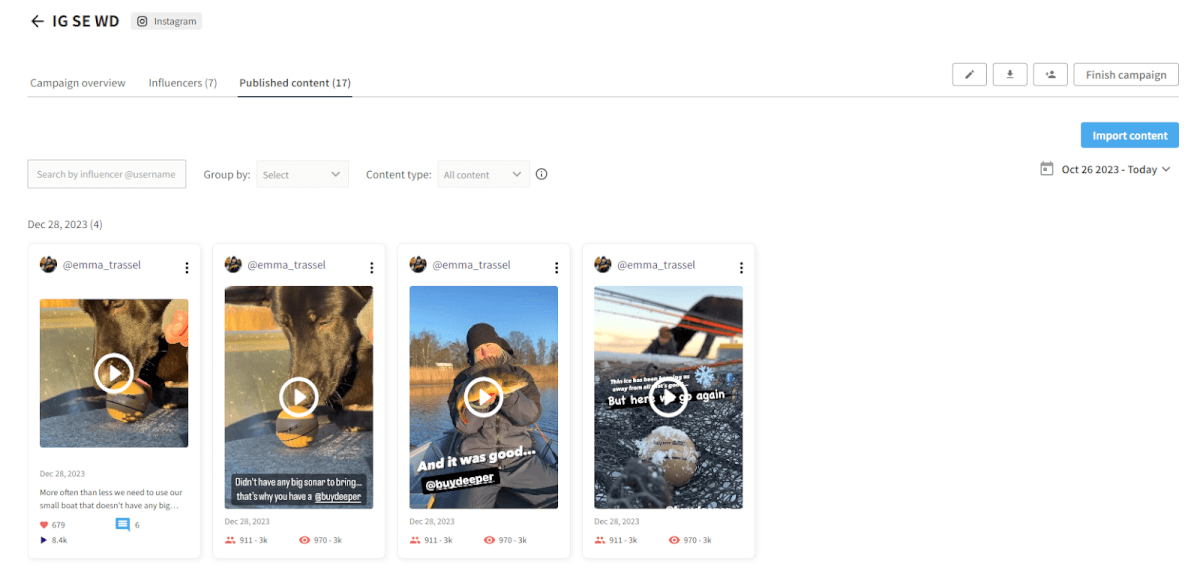
You give the tool a list of creators, and a way to identify the content (e.g. posts using a certain hashtag or mention). Then all content (even Stories) gets automatically tracked & added to a dashboard.
Simply juggling all your relationships is one of the trickiest parts of scaling influencer marketing.
As your brand onboards more influencers, how the heck do you maintain those personal 1:1 relationships?
First up, know that the work involved with each partnership is front-heavy. In the first month or two there’s onboarding, extra back-and-forth with creative, more education, and general getting to know each other.
The longer you work together, the less work you’ll have to put in (usually). This is Josie Hull’s experience of working with long-term partners.
You naturally learn how each creator works: the products they like, who needs the most guidance,and so on. Over time, through regular collaboration, it gets easier and more seamless because they understand your brand & processes, and you understand their working style.
Getting to that point of seamless working with your proven long-term partners is one of the keys to scaling your influencer channel. The less time you need to give to each creator, the more creators you can manage.
At Ruggable, Dmitri Cherner (former Director of Influencer Marketing) separated the teams who look after new vs. existing influencer partnerships.
Finding new partners is a ton of work: vetting, outreach, considering rates, content, engagement. Email back-and-forth. And much more.
Building a team structure that separates initial and continuing partnerships allows each team to focus on getting the most possible value out of each group.
As you grow, it’s extremely difficult for a single person to recruit new influencers, and look after your long-term partners at the same time.
Proven long-term partners are your VIPs. It requires a lot of care and thought to keep them interested (and to reduce the chance they’ll work with your competitors). A well-developed long-term program builds a bigger moat around your brand than just testing new ones constantly.
I suspect most people reading this don’t have the team size to execute on that ☝ advice.
The fundamental concept still applies: prioritize your long-term partners, and clear headspace to give them the attention they need.
For the 1-person teams, here’s some advice from Shayna Macklin:
I block time out on my calendar to focus. For example, 2pm-4pm I’ll go through all my creative approvals, and reply to emails relating to ongoing campaigns. Then, I’ll have a separate time block for reporting, outreach, or other tasks.
And if you have multiple people, but not enough to separate teams, here’s what Anna-Maria Klappenbach suggests:
Try to make sure each influencer always has the same point of contact. At Aumio, whoever makes the first contact with an influencer will look after that relationship for the lifetime of the collaboration.

Running long-term influencer partnerships is difficult, but none of this stuff matters until you’ve found creators in the first place.
Brands that are successful in influencer marketing typically have a mix of tactics to find new partners.
We ran a survey on finding influencers, with inputs from 63 full-time influencer marketing pros. I recommend reading, but here’s the quick version of the top 2 tactics.
The most common method is to simply browse directly on social platforms like IG. For example Josie Hull curated her personal social feeds around her target topics.
I have the best success when I curate my personal algorithms to the target topics. For example, by following food influencers and food brands, or by engaging with recipe content. My explore page is always up to date with trending creators and content.
If you’re just starting, or working with a small volume of creators, that’s where you should start.
The second most common method, which is faster & provides more data, is to use influencer search tools like Modash. That lets you apply filters (like audience locations, minimum engagement rates, and more) to skip irrelevant creators, and recruit much faster.

You can run a search, then open up a profile to analyze the audience, performance, and content. It looks something like this:

Modash pricing is public, with monthly plans and self-serve options to get started. Give it a spin, no credit card needed.
And with that, I wrap up.
If you found this useful, you might like our newsletter: Return on Influence.
It’s so difficult to find real examples and helpful advice from people that actually do influencer partnerships full-time.
We’re trying to solve that with content like this. And you can subscribe to it!
My content-partner-in-crime, Eleni Zoe, summarizes the 80/20 of topics like this one. The idea is to give actionable influencer marketing advice & examples right in the inbox. With no need to click on anything, read 3k+ word articles, or listen to 1h+ podcasts.
See the past editions here. If that’s up your street, subscribe for free, and follow along with what we’re learning.
Lastly, I’m personally happy to connect with new people on LinkedIn.
Catch you in the next one!
Our expert contributors








.jpeg)