Free virtual event: hear from influencer leaders at ŌURA, Adobe, Stanley 1913 & more.
See the lineup


Affiliate onboarding is where most programs quietly fail. Brands put all their effort into recruitment, then send a single welcome email and wonder why the bulk of their affiliates never post 🤷♀️
Fact is, onboarding =/= a one-off touchpoint. Done well, it’s a structured process spanning multiple steps that directly determines your activation rate. I’ll walk through those steps (and a bunch of other stuff) in this article…
The biggest reason so many brands fail at onboarding “processes” is that they expect a single action to do all the heavy lifting. They send a welcome email after approving an affiliate – then it’s crickets until they notice the creator hasn't posted. In other words, there's no sequence for keeping affiliates accountable or nudging them toward that first post.
First and foremost, affiliates need motivation before they start sharing your products. They might be working with a bunch of other brands. And unless they’re a full-fledged pro influencer, they likely have a day job too. So if you don’t give them a compelling reason to post, there’s always a risk they’ll leave it ‘til tomorrow… then next week… then next month…
Beyond that, there are a bunch of practical things affiliates require upfront, including:
✅ Affiliate link(s)
✅ Unique promo code
✅ Product overview
✅ Key selling points
✅ Ad disclosure requirements
✅ Program rules
I’ll go into more depth on most of that stuff throughout this article.
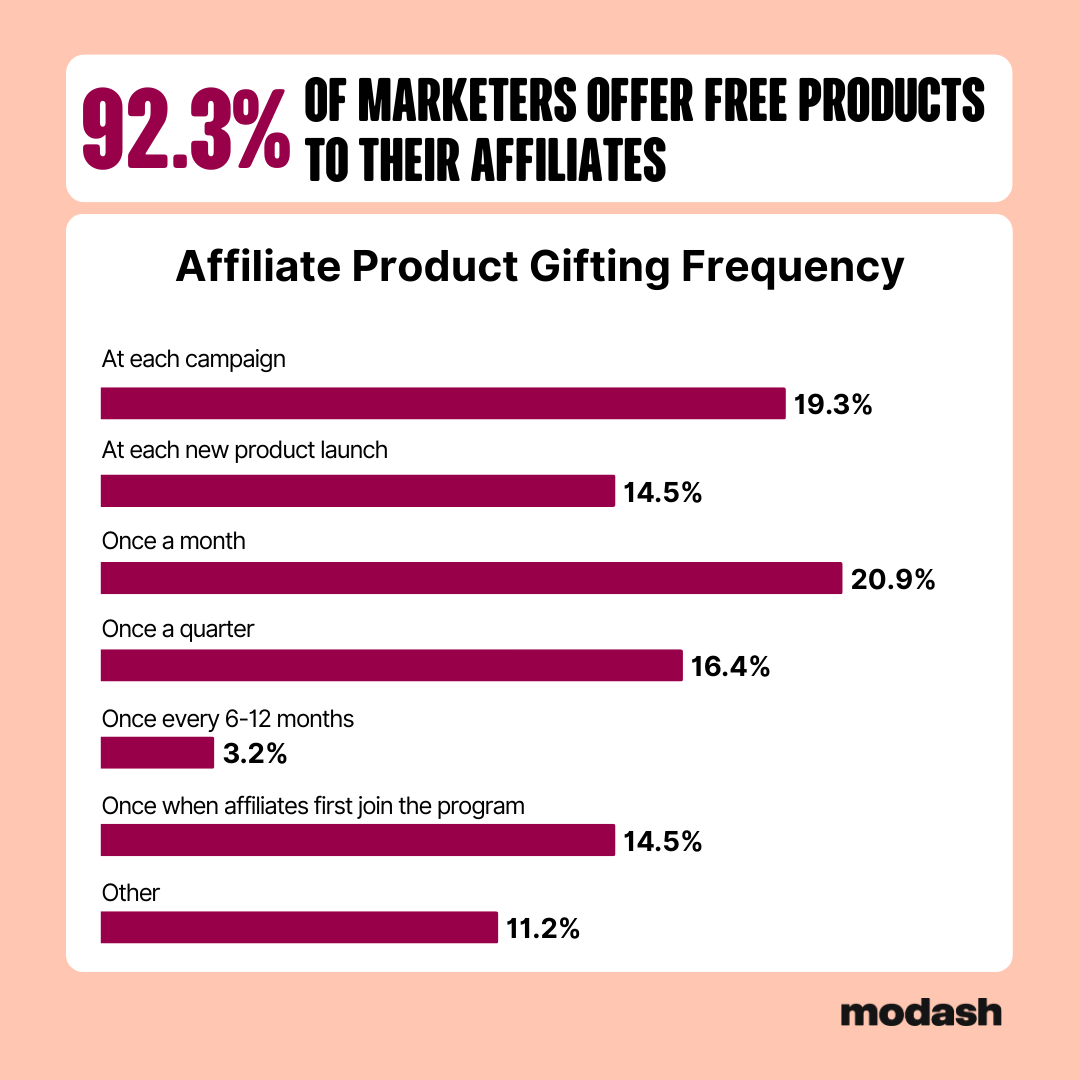
One last point: if affiliates are gonna promote your product authentically, they need to get their hands on it first, so you might want to gift them. Our research found that nine in 10 marketers offer free products to their affiliates, with one in five doing so for each campaign.
🤓 Further reading: Learn more about gifting in How To Do Influencer Gifting: A Complete Guide. And for more on promo codes and UTM links, check out How to Measure Influencer Marketing: 8 Proven Tracking Methods.
Let’s be honest: if a new affiliate doesn’t post within 30 days of joining your program, they’re probably never going to.
Even if they do post, there’s a good chance they’ll give up if they don’t make any sales in that all-important first month. After all, sharing quality content takes time – and unless you’re giving them a fixed fee + commission, there are no guarantees they’ll ever see a return for their efforts.
On the flip side, if they start strong and bring in some serious 💰💰💰 they’re highly likely to stick with you. Because why wouldn’t they?
Every brand with an affiliate program has a slightly different way of onboarding creators, but they all fit into one of three categories:
👨💻 Self-serve onboarding: Affiliates sign up through a landing page, get access to all the program essentials via a dedicated affiliate portal, and receive an automated email sequence to teach them how everything works. It’s low-cost and highly scalable, but less personal – which can lead to lower activation rates.
🤝 High-touch onboarding: An affiliate manager (or whoever owns the onboarding process) onboards new affiliates through direct comms. This super-personalized approach delivers high rates of activation, but it’s fundamentally unscalable, so it’s best reserved for high-value creators.
⚖️ Hybrid: All the basics are handled via automation, landing pages, and portals, but affiliates also receive a personal check-in a week or two after signup. It’s a halfway house between the other two approaches.
| Criteria 👇 | Self-serve 👨💻 | High-touch 🤝 | Hybrid ⚖️ |
|---|---|---|---|
| Scalability | High | Low | Medium–High |
| Cost per affiliate | Low | High | Medium |
| Personalization | Low | High | Medium–High |
| Relationship building | Low | High | Medium |
| Activation rate potential | Medium | High | High |
| Management effort | Low | High | Medium |
Brands often start out with high-touch onboarding, then shift to a hybrid or fully self-serve model when they’re looking to scale.
Start your onboarding process on the right foot with a short, focused welcome email that gives affiliates access to your program and orients them with how it all works. Here’s everything you’ll want to cover in that all-important first message:
✅ Confirmation they're approved
✅ Their unique affiliate link and/or promo code
✅ Login details for your affiliate portal
✅ Commission rate and payout timing
✅ One clear next action (e.g. "Post your first piece of content using the link below and let us know when it's live")
🤓 Pro tip: If you use Modash to build and manage your affiliate program, you can generate promo codes and UTM links and share them immediately with your affiliate partners, all without leaving the platform.

There’s just one last thing to include in your welcome emails, and it comes direct from Modash’s Senior Influencer Marketing Manager Anna Klappenbach: humanity 🧘
Add humanity, make them feel like they're a person that you (as the brand) are proud of welcoming to the team. Show how excited you are to work with them instead of treating them like a money-making machine.

Whether you’re working with traditional publishers or social media creators, your affiliates will hopefully know what great content looks like for their specific audience – that’s why you’re working with them.
But remember: it’s your goal to make it as simple as possible for affiliates to start generating sales and earning commissions. You can’t force people to buy from them, but you can give them a leg up by sharing:
✅ Creative assets, like your logo, banners, and product imagery
✅ High-performing product angles (e.g. “We’ve seen great results from affiliates recommending our noise-cancelling ear plugs as a study aid.”
✅ Content examples, ideally showing some of those top-selling product angles in the wild
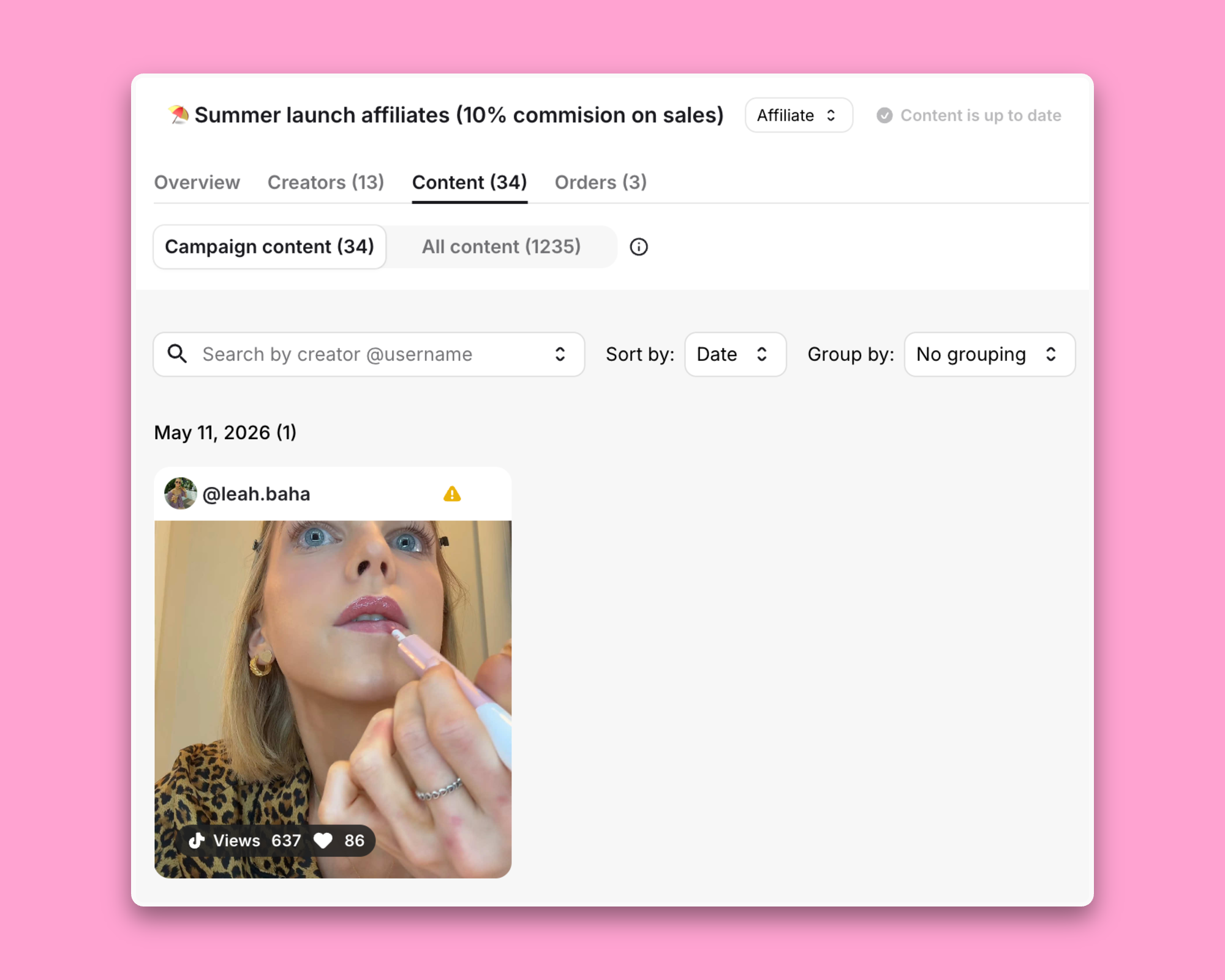
🤓 Pro tip: Modash makes it easier to round up your fav content examples by automatically capturing all your live affiliate posts – yep, even Stories. So you don’t have to ask creators to share their content with you (or worse, capture screenshots and links yourself).
Brands often end up frustrated that their affiliate content doesn’t meet their lofty expectations – yet many forget to actually communicate those expectations during the onboarding process 🤦♀️
Your creators might be fantastic at what they do, but they (probably) aren’t psychic. Help them out by sharing clear, easy-to-understand posting requirements around:
✅ Frequency: How often do you want them to post? And do you have specific rules around how frequently they post on specific channels and/or share certain types of content (e.g. 1x Reel per month + 3x Story frames + 1x in-feed post)?
✅ Affiliate disclosure: How do you want affiliates to disclose that they’re working with you? Learn more about this in Influencer Ad Disclosure: A Marketer’s Guide (FTC Guidelines).
✅ What “good” looks like: Ideally, you’ll share real-world examples of existing affiliates who are getting it right (quality content, correct disclosures, consistent posting). If you don’t have any examples or can’t share them for some reason, look at other brands’ affiliates instead.
Affiliates want to feel like you care about them and appreciate their efforts. Plus, on a practical level, you need to keep them clued-in about brand news – product launches, promotions, etc – and program updates like:
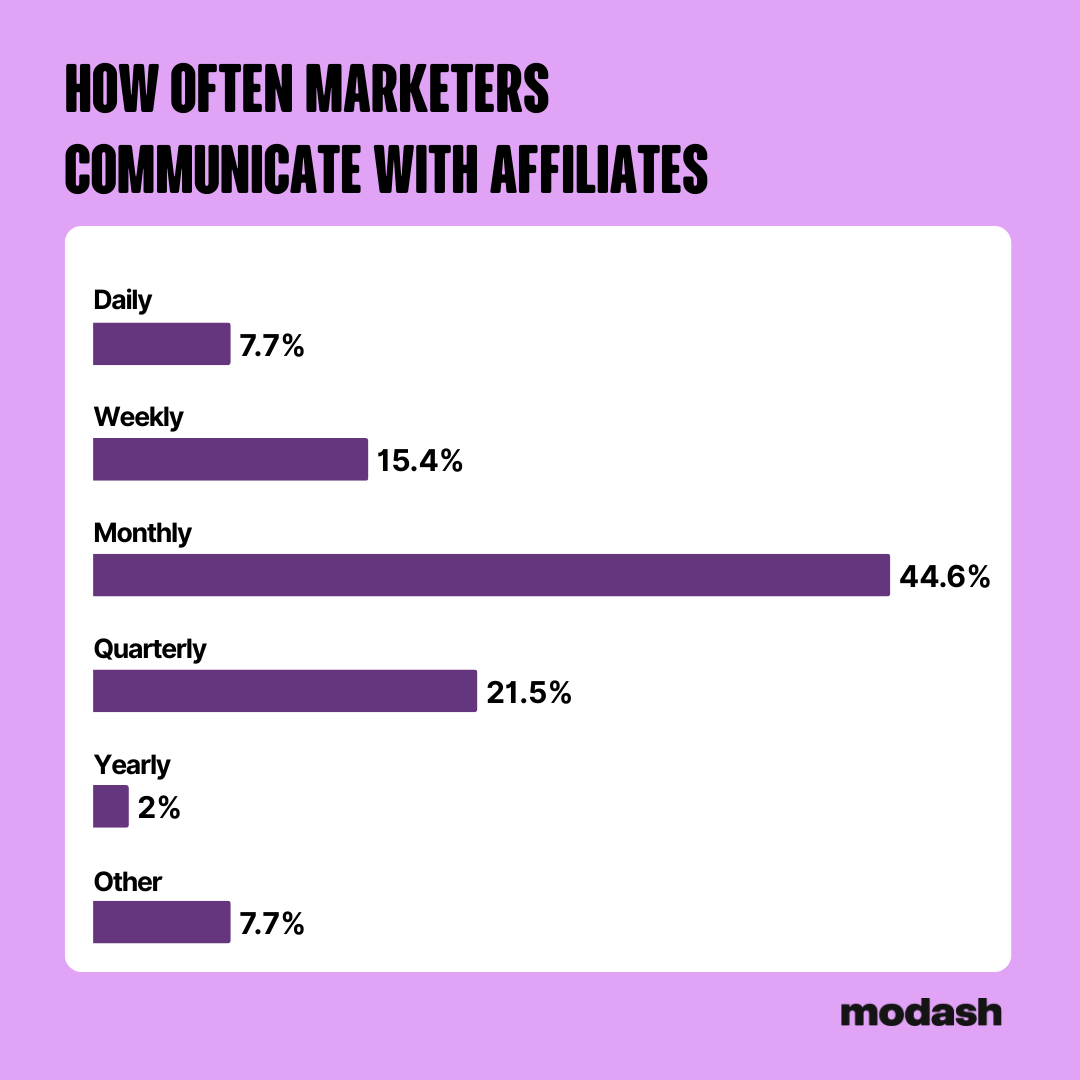
Despite this, only about one-quarter of marketers communicate with affiliates on a daily or weekly basis, while the same proportion only get in touch quarterly or yearly.
If you’re taking the hybrid or high-touch approach, you’ll definitely be in more regular contact during the onboarding process. But once things cool down a little, you want to shift them to regular “business as usual” comms via affiliate newsletters and broadcast channels like Discord and WhatsApp.
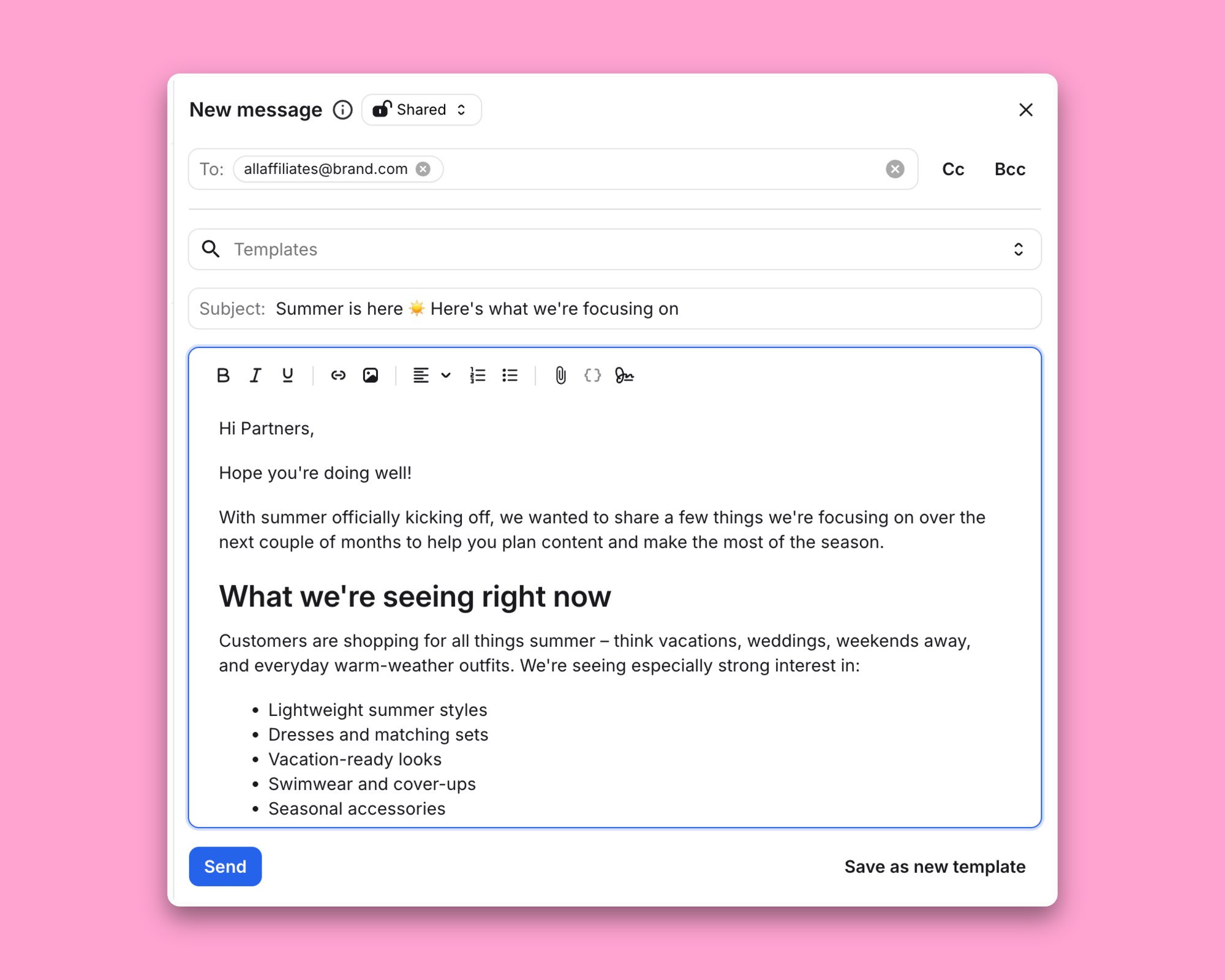
🤓 Pro tip: With Modash, you can send batch emails to your affiliate roster directly from our platform without exporting a list and switching to a separate tool.
As well as giving affiliates all the tools they need to notch up their first sale, you should be incentivizing them to make it happen. And money is the most powerful incentive for most creators.
An early milestone bonus provides an added reason for affiliates to get posting, beyond the standard commissions on offer. But you’re not just encouraging them to post once – you want it to become a habit.
With that in mind, here are some ideas for early milestone bonuses to sustain momentum beyond their first post:
✅ Pay a higher commission rate for an affiliate’s first 30 days in your program
✅ Offer a fixed cash bonus for affiliates who hit a specific sales target in their first month
✅ Send a free gift to creators who post X+ times a month for three months in a row
In an ideal world, every new affiliate would share their first post within 24 hours of being approved to join your program. But there are all sorts of reasons why it might take creators longer to get up and running. Maybe they lost their phone? Maybe they got embroiled in some sort of The Hangover-style escapade? Maybe they just forgot?
You can either curse those laggards for not making your affiliate program their #1 priority in life, or you can drop them a line to find out what’s going on. You might be able to remove whatever barrier’s stopping them from posting – or you might just give them the nudge they need to get started.
Leave it a week after signup, then reach out if they still haven’t posted. And remember, unless you’re paying a fixed rate on top commissions, they’re under no obligation to do anything – so keep your tone supportive and encouraging.
After all, you catch more flies with honey 🍯
If your affiliate onboarding efforts are working up to this point, you’ll have a bunch of creators who’ve shared at least one post, and you’ll be seeing your first affiliate sales come in.
However, things can still go wrong at this stage. It’s easy for affiliates to lose momentum, especially if they struggle to repeat any early success. It’s your job to ensure that doesn’t happen by keeping them engaged.
Of course, if you’re gonna do that, you need a reliable record of who’s posting (and who isn’t).
In the early days of your program, when you only have a handful of affiliates, you can just create a spreadsheet to manually track when each creator last posted. But by the time you have 10, 20, or 30+ affiliates to monitor, you’re looking at a task worthy of Sisyphus himself 🫸🪨⛰️
(Didn’t expect to see a Sisyphus emoji in this article did you?)
That’s when it’s time to switch to an influencer marketing platform with built-in content tracking capabilities, like Modash. With Modash, you’ll always know how many pieces of content each affiliate has shared during a given period, including when their last post went live.

👉 Take all of our affiliate onboarding tools for a spin when you create your free Modash account!
You want affiliates to feel excited they’ve been approved, right? So hype them up with a positive welcome that invites them in with open arms 🤗 Something like:
Hi {{First Name}},
Congratulations! 🎉 I’m excited to let you know that your application to join the {{Brand Name}} Affiliate Program has been approved.
It’s great to have you on board and we can't wait to see you start sharing our products with your audience.
🤓 Further reading: For more email inspo, check out 14 Influencer Outreach Examples From Real Brands.
Affiliates can’t start posting until they get hold of their promo code/UTM link. So it makes sense to share them in your welcome email – and you might also provide instructions on how to track them down in your affiliate portal.
If an affiliate has signed up to your program, they presumably already have some idea about your commission rate.
However, they might not have taken the time to digest exactly what’s on offer, so it’s worth confirming in your welcome email. Because you don’t want them to feel disappointed that they’re not earning your top commission tier from day #1.
At the same time, tell them about your payout timing, including any thresholds (like a minimum payment amount or hold period).
🤓 Further reading: Learn more about payout timings, payment thresholds, and more in How to Pay Affiliates: Methods, Tools, and Best Practices.
Round out your welcome email with a clear call to action that explains exactly what you want the creator to do next. This could be logistical – like submitting payment details in your affiliate portal – or it could be more creative, like sharing their first piece of content.
Just make sure the next step is easily and immediately achievable. If it’s too broad, you risk demotivating your affiliates. So don’t start them off by demanding $1,000 worth of sales in the next six months.
While the vast majority of marketers use email as their primary means of communicating with affiliates, more than half keep in touch via broadcast channels like Discord, Slack, and WhatsApp.
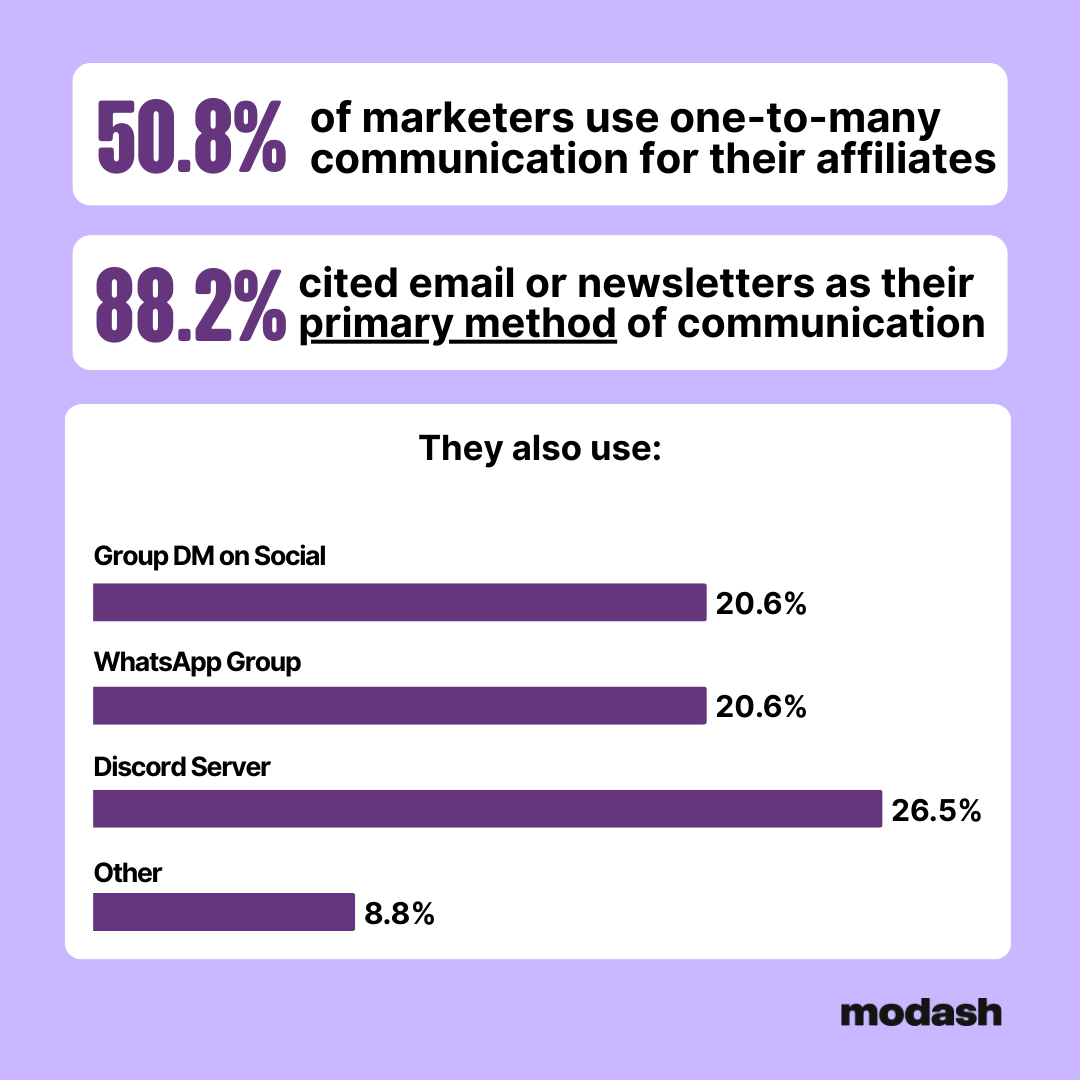
Each of these “one-to-many” platforms allows you to share important messages, while encouraging back-and-forth conversation in a way that bulk email just can’t.
Let’s take a look at the pros and cons of the three main broadcast channels:
| Channel 💬 | Strengths 👍 | Weaknesses 👎 |
|---|---|---|
| Discord |
• Highly interactive community environment • Supports channels for different affiliate segments, niches, or campaigns • Real-time discussions and peer-to-peer support • Easy sharing of resources, announcements, and creative assets • Strong community-building and engagement potential • Bots and integrations can automate onboarding and updates |
• Important announcements may get buried in conversations • Less familiar to some affiliates, especially older or non-technical audiences • Requires active moderation and community management |
| Slack |
• Organized channel structure for campaigns, products, or affiliate tiers • Strong search functionality and message history • Integrates well with CRM, project management, and analytics tools • Easy to distribute updates, assets, and performance information |
• Free plans limit message history • Less community-oriented than Discord • Can feel transactional rather than engaging • Affiliates may not want another “work-focused” communication tool |
| WhatsApp Channels |
• High adoption and familiarity worldwide • High message open and engagement rates • Broadcast-style communication minimizes noise • Direct delivery to affiliates' mobile devices • Simple for distributing promotions, offers, and time-sensitive updates |
• Can become noisy and overwhelming • Limited community interaction compared to Discord or Slack • Less effective for resource organization and search • Fewer automation and integration options • Can become difficult to manage at scale as content accumulates |
Of course, there’s nothing to stop you using more than one of these channels. Lots of brands use WhatsApp for urgent broadcasts and Discord/Slack for “BAU” messaging, or do most of their comms through Discord while running a private Slack for top-performing creators.
🤓 Further reading: For more on this, head over to How to Use One-to-Many Broadcast Channels in Influencer Marketing (Without Erasing the Personal Touch).
If nothing ever changes about your product(s) or program, sooner or later your affiliates are gonna run out of ideas and/or get demotivated. Keep them locked in by using your affiliate newsletter and/or broadcast channels to communicate:
I’ve already shared various ways to engage and motivate creators during their first 30 days in your program – but what happens next?
Well, hopefully, your ongoing broadcast channel/email comms will do the job. But realistically, sooner or later someone’s gonna ghost you, with over a third of marketers seeing active affiliate rates of <20%.
When this happens, it’s time to reach out with a re-engagement sequence that reminds the lapsed creator why they signed up in the first place and gives them a reason to start posting again. Something like this:
Naturally, you’ll want to vary the timings in this sequence based on your expectations around posting frequency. If most affiliates only post once a month, a 15-day gap between posts isn’t such a big deal.
🤓 Further reading: For a more detailed look at re-engagement, including what to include in a five-step email sequence, check out How to Increase Affiliate Sales (Without Recruiting More Creators).
If your re-engagement sequence doesn’t work, it might be time to cut the cord. But don’t be too hasty. Robert Polonski, Media Partnerships Manager at Deeper, says there’s still time to turn things around.
We’ve had cases where underperforming creators transformed into our most reliable go-tos because we didn’t give up on them as soon as performance dropped, but instead invested time and resources into helping them get back on track.

Affiliate onboarding should be as quick and easy as possible. However, Gabija Jankauskė, Affiliate Marketing Manager at PartnerGap and former Influencer and Affiliate Marketing Manager at Son de Flor, notes that this isn’t always the case.
Sometimes onboarding can take several weeks. The most frustrating part is when you send a lot of outreach emails and no one responds. Then, once you finally get a response, communication can still be slow because affiliates are busy people – and different time zones definitely don’t help.

Beyond time zones and unresponsive affiliates, Gabija says there are various other reasons for the onboarding process to stretch on, including back-and-forth negotiations and legal considerations.
For a lot of affiliates, life simply gets in the way after joining a new program, as Gabija explains:
Some affiliates become inactive or disengaged because they have jobs and responsibilities, and creating content after a full-time job can require a lot of time and energy.
Another issue is when affiliates get approved by brands with lower commission rates than other programs in their niche. In that case, they might lose inspiration and motivation over time (and possibly start promoting competitors instead).
If all your affiliate recruitment is targeted at one type of creator then sure, it makes sense to keep your onboarding consistent. However, if you work with both “regular” affiliates and influencer-affiliates, you might want to use a high-touch approach for the influencer-affiliates while relying on self-serve/hybrid onboarding for the regulars.
If an affiliate ghosts you after joining your program, your job is to make it simple for them to start posting. Share some top-performing products and content angles, and remind them why they signed up in the first place (commissions, bonuses, free products, etc). And encourage them to reach out if there’s a specific barrier preventing them from getting started.
Depends on what affiliate management software you use. Most platforms require affiliates to join a separate portal, but not all. For example, with Modash, your affiliates don’t have to sign up for anything – yet you can still use our software to message them, track their content, and pay them.
Our expert contributors