Use Modash in Claude, ChatGPT, Cursor, and other AI tools
Get started with MCP


Here at Modash, people often ask us questions like:
🤔 What’s best, long-term influencer partnerships or short-term affiliate deals?
🤔 Should I invest in AI or focus on building more “human” influencer relationships?
🤔 Which influencer marketing channels should I prioritize this year?
But while everyone loves a binary answer, things are rarely that simple. More and more brands are finding success by diversifying their influencer marketing programs – in other words, doing a bit of everything.
We asked 33 influencer marketers about how they’re going to manage their programs over the next year. The single common thread? They’re all testing new things this year.
Traditionally, influencer marketing has been extremely online. If it wasn’t on social media, it wasn’t worth doing. But the times are changing, with many of our respondents keen to build offline influencer partnerships.
For instance, Fernanda Marques explained that her brand is planning a range of offline, in-person initiatives to “strengthen our brand-community bond” and enhance authenticity in influencer partnerships. These include:
👉 Enlisting influencers to serve as “correspondents” at niche events – such as cosplay and anime conventions – to engage audiences on the ground
👉 Inviting influencers to the Mini Katana studio to co-create content with their in-house team
👉 Bringing influencers into the development process to create unique, co-branded products
Similarly, Bakhtawar Shahzaib plans to rely less on social platforms going forward.
In 2025, we'll leverage influencers beyond traditional social media through podcasting, live events, content creation, and ambassador programs. These innovative partnerships will drive diversified content, increased engagement, and enhanced credibility.

And Cheyanne Pettyjohn is also excited about the potential of taking influencer marketing offline.
We would love to use influencers more through in-person events to give real testimonials during sampling and building in-person brand awareness.
That’s just a sample of the responses we received on the theme of non-traditional, in-person influencer marketing. We’re not saying it needs to be the primary focus of your influencer campaigns this year – but there are so many upsides that you should at least consider giving it a go.
One of the biggest issues affecting influencer marketing (and practically every other industry) today is how best to use AI.
Whether you love, hate, or feel ambivalent about artificial intelligence, it’s clearly not going away. Just over half of our respondents already use AI in influencer marketing, and going forward, three-fifths plan to incorporate more AI into processes like:
👉 Influencer search
👉 Influencer relationship management

Michael Todner explained that he’s broadly “against relying on AI in influencer marketing.” Even so, he still uses it during the discovery process to help filter lists of several hundred or more influencers down to more manageable sizes.
There were plenty of other use cases. For instance:
👉 Athira Aravind leans on AI for performance analysis, reporting, and sentiment analysis.
👉 Alycia Lykins uses it for creative brief inspiration “to make them fun and exciting”.
👉 Zuzana Jiříčková primarily uses AI for audience targeting and content optimization – and sometimes for forecasting campaign performance and writing creative briefs.
Several respondents also said they use AI for writing tasks like sharing information about events, promoting giveaways, and writing emails.
As for future use cases, much depends on the quality (and affordability) of AI-powered influencer marketing software.
For instance, Joshita Dodani said she’d expand her use of AI if she could find “software that does it well” – but admitted she hasn’t come across the right fit yet. Gabija Jankauskė added that she’d “love” to do more with AI, but that this would be budget-dependent.
The final word on this hot topic goes to Tamara Torrecillas, who spoke for many of our respondents by explaining that she’s “open to testing ideas” around artificial intelligence.
We like to work on relationships personally, but if there's anything to be optimized without losing our personal touch, we would be happy to explore AI.
Developing long-term influencer relationships can be a key tool in building trust and authenticity.
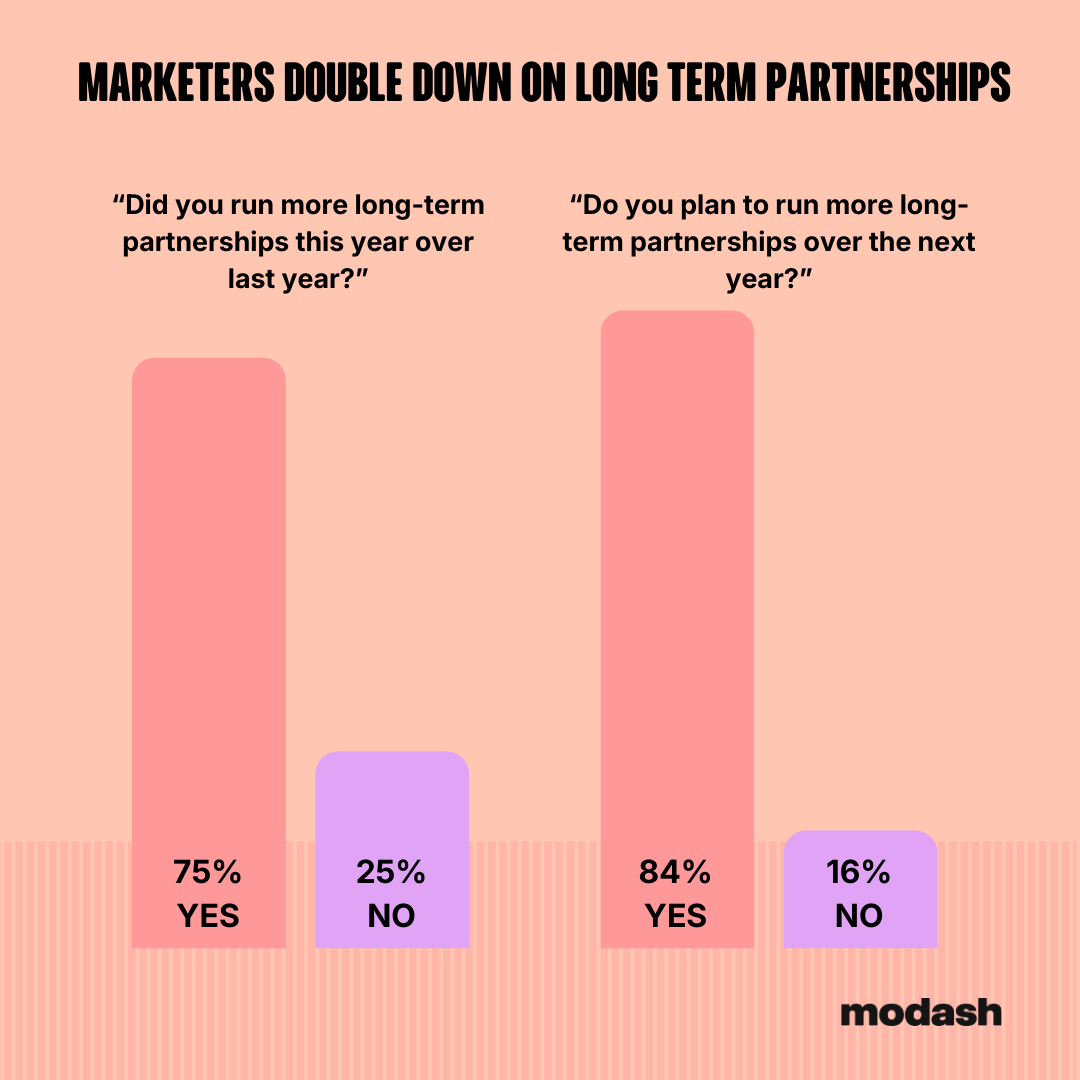
So it’s no big shock that 75% of our respondents ran more long-term partnerships this year than the previous year – or that 85% plan to run even more long-term partnerships next year.
Naturally, trust was a common reason for influencer marketers to prioritize longer-term influencer relationships. Cheyanne Pettyjohn highlighted just why those long-term partnerships are so important:
Long-term partnerships show that the brand has built trust with an influencer, and usually influencers who focus on those kinds of partnerships have audiences that trust them to promote real products they use/believe in.
Leslie Belen added that authenticity is a key factor in her decision to run more long-term influencer partnerships. She noted that these relationships “allow influencers to grow with the brand, creating more genuine content that resonates with their audience”.
But it’s not just about trust and authenticity.
Lauren Roth explained that thinking long-term offers multiple benefits.
Long-term partnerships tend to be more fruitful in driving brand awareness and conversions. Audiences see content as more organic when it’s shown over a longer period and in use in their daily life.

And Kat LaFata highlighted a bunch of other plus points for working with influencers long-term:
✅ Allows audiences to see that the influencers are truly promoting a brand they believe in rather than just doing it for a paycheck
✅ Gives greater time for planning, which means better content
✅ Improves brand KPIs
However, not all our respondents were quite so positive about long-term influencer relationships. Miroslava Petkova argued that a “big percentage” of influencers drop the quality of their work when in long-term partnerships with brands, while Noor Ahmed said it’s good to introduce a “fresh face” every once in a while.
Interestingly, while brands are increasingly prioritizing long-term partnerships, nearly two-thirds of our respondents said influencers are becoming more open to affiliate deals.

Miroslava Petkova believes this is simply a case of oversaturation in the influencer market.
Since being an influencer has become so popular nowadays, collaborations are limited, so affiliate is rising up again as another form of collaboration.
On the flip side, Zuzana Jiříčková insisted that affiliate deals aren’t simply a last resort for influencers who can’t find paid collaborations. Instead, she said affiliate partnerships are especially attractive to influencers who “know they have big buying power while promoting products they genuinely like.”
The launch of TikTok Shop – and its expansion into more markets – has been a major driving force behind the growth in affiliate recruitment, according to Tamara Torrecillas. In particular, she said influencers love the platform’s automations and the transparency it offers around results.
TikTok Shop is changing the game. It's now easier to find influencers open to work even on a gifting basis knowing they might make money from linking products and generating sales.
In other words, affiliate arrangements aren’t just good for brands – they can be great for influencers, too.
At this point, it’s worth stressing that affiliate deals aren’t necessarily the opposite of long-term partnerships. We know plenty of brands that work with the same influencers on an affiliate basis for multiple years.
In fact, Bakhtawar Shahzaib argued that influencers’ openness to affiliate deals might even lead to more long-term relationships.
Brands merge influencer and affiliate programs for cost-effective, trackable marketing. This resurgence drives long-term collaborations, targeted promotions, and valuable content creation.
So if you’re thinking about affiliate partnerships and influencer marketing as two separate things, it might be time to stop.
Lee Drysdale told us that he recently switched from full-time influencer marketing to an affiliate and partnerships role, with some influencer campaigns thrown in. In his view, using influencer and affiliate marketing together encourages influencers to boost their earnings by posting extra organic content containing affiliate links – so everyone wins.
Being able to leverage both affiliate partnerships and influencer marketing has been a game changer!

The same goes for AI: sure, keep giving your influencer relationships the personal touch. But at the same time, leverage AI to automate low-value influencer marketing tasks that sap your energy and distract your focus from building strong relationships with influencers.
And it’s fine to keep doing the great stuff you've been doing online, but also look beyond those traditional channels and get creative to deepen your influencer relationships.
This sort of diversification gives you more scope to reach your audience, which translates to higher brand awareness, engagement, and sales. Plus it leaves you less reliant on a single platform or channel – so if your favorite social network suddenly becomes unavailable, it won’t tank your entire influencer program.
The key point here: there’s no one playbook to running a great influencer marketing program.
It’s about diversifying your tactics. It’s about putting your efforts into a little bit of everything and making those little moving parts work together.
There’s no silver bullet that’s going to be the one thing that makes your program great. It’s more a matter of how you can learn from others, test, and see what works for you.
And I’ve got you covered there too. Check out some of our latest trends articles here:
👉 Influencer Trends: The Platforms, Creators, & Content Driving ROI in 2026
👉 Influencer Trends: How Brands Balanced Tight Budgets & Creator Needs
👉 When to Stick & When to Shift: How to Decide When to Follow a Trend
And don’t forget to sign up for our newsletter, Return on Influence, to get red-hot insights straight to your inbox once a week.
Our expert contributors