

More tools
Use cases




Most gaming influencer marketing advice stops at "work with micro-influencers" and "be authentic". We wanted to see what the biggest gaming brands actually do, so we pulled the 50 most recent sponsored posts for each of the most-searched gaming brands in the US and looked at who posted, how each deal was disclosed, and which posts took off.
Here's why gaming brands work with creators, the commonalities in their strategy, and a step-by-step way to run your own campaign.
Creators do a few things for gaming brands that ads and product pages can't:
These are the most-searched gaming brands in the US, according to Ahrefs. Deal types show how each post was disclosed (for example, with a paid partnership label or an ambassador hashtag). Creator tiers: micro 10k–50k followers, mid-tier 50k–500k, macro 500k+.
| Brand | What they sell | Most common deal type | Typical creator size | Signature tactic |
|---|---|---|---|---|
| Minecraft | Sandbox video game | Paid | Mid-tier | Parents playing with their kids on camera |
| Fortnite | Online battle royale game | Paid | Mid-tier | Creators of every size posting each update |
| Xbox | Consoles, Game Pass and games | Paid | Mid-tier | A gaming outlet covering every big launch |
| Pokémon | Games, cards and merch | Paid and gifted | Mid-tier | Collectors posting Pokémon Center merch |
| PlayStation | Consoles and games | Paid | Mid-tier | Creators flown to the Champions League final |
10 of Minecraft's last 50 sponsored posts come from parents, from a mom's game night with her kids to creators explaining tools that keep children safe online, and 4 of those are family days at the Minecraft Experience in London. Others come from far outside gaming, like a nail artist and a baker promoting its Chase the Skies drop. Its creators are based in the US (20) and the UK (9), the posts go back to April 2025, and only one includes a code.

What to take from it: Show who plays together, not just the game. A mom with 322k followers filmed a game night with her kids and called Minecraft "just one of the little ways we hangout together", and it got 5.0M plays, Minecraft's most-viewed post.
Fortnite's last 50 sponsored posts follow its update calendar, from the Chapter 7 Season 2 launch in March to its Star Wars games and islands in May (19 posts mention Star Wars). 37 carry #EpicPartner, and 5 include a creator's own Item Shop code, like GREENSKULL. Its creators range from 3k to 8.4M followers, 20 are based in the US, and 49 posts were disclosed as paid partnerships.

What to take from it: Spread a launch across creators of every size. A creator with 3k followers posted the Chapter 7 Season 2 launch and got 10.5M plays and 70k likes, Fortnite's most-viewed post.
14 of Xbox's last 50 sponsored posts come from gaming outlet @dexerto, and most of the rest follow two launches: Forza Horizon 6 (12 posts) and Halo: Campaign Evolved (12), which also came to PlayStation. Another 7 promote a Fanta x Xbox can promotion. Its creators are based in Australia (10), with 3 each in the US, the UK, Canada and Singapore, and 45 posts were disclosed as paid partnerships.

What to take from it: Write the game into a story people recognize. A creator with 126k followers joked about sneaking off to play Microsoft Flight Simulator 2024, and the post got 2.1M plays, Xbox's most-viewed.
Pokémon's last 50 sponsored posts are mostly about merch, not games: 17 promote the Pokémon Center store, from plushies to bean bag chairs, and 23 were labeled as gifted. 8 come from the new Pokémon Fossil Museum at Chicago's Field Museum, often with free access to the event. Only 27 creators made the 50 posts, 20 of them in the US, and none use a code.

What to take from it: Let creators have fun with the oddest product in the range. @leonhart's post about ordering a "chair" from Pokémon got 990k plays and 69k likes, Pokémon's most-viewed post.
25 of PlayStation's last 50 sponsored posts come from the Champions League finals, where PlayStation brought footballers, freestylers and creators to a PlayStation House in Budapest. Another 10 cover early hands-on time with Marvel's Wolverine, and NBA star Giannis Antetokounmpo posted 4 times. Its creators are based in the UK (6), the US (6), Canada (3) and Brazil (3), and none of the posts use a code.

What to take from it: Give creators something they can only film at your event. A creator with 144k followers asked followers to rate his shot during PlayStation's Champions League weekend, and it got 1.2M plays and 49k likes.
Looking across all 250 posts, four patterns stand out:
Here's how to run a campaign step by step, using what the top gaming brands do at each stage.
Decide what the campaign is for before you pick a single creator, because the goal changes who you book, how you pay them and what you ask them to post. The top gaming brands' posts show both goals at work. PlayStation's Wolverine pre-order posts and Minecraft's holiday sale posts are built to drive sales. PlayStation's Champions League weekend and Fortnite's Star Wars islands are built for reach.
Pick one metric per campaign so you can compare creators fairly afterwards.
Follower count is the last thing to filter on. A car fan with 19k followers toured Xbox's Forza Horizon 6 launch festival, from the JDM cars to a Japanese driving test, and got 402k plays, about 20 times her following, because car culture is what Forza is about. Across all five brands, creators under 50k followers got about three times the likes relative to their audience.
Our survey found niche micro-creators are outperforming mega-influencers: nearly 60% of marketers said niche influencers performed better in 2025 than in 2024.

You can also find gaming influencers for free, for example by searching the hashtags your buyers follow.
Gaming brands pay per post. Fortnite disclosed 49 of its last 50 posts as paid partnerships and PlayStation 46. Pokémon is the exception, with 23 posts labeled as gifted.
Commission-only is getting harder to sell, though. Over 23% of marketers in our survey said creators would take performance pay only if a flat fee came with it. If you run tiers, the average commission tiers in our affiliate research were 10%, 14% and 19%, and brands with more than one tier had more active affiliates.
The captions from the top gaming brands point to three formats that carry most of their creator content:
Whatever the format, give creators the launch date and platform ("exclusively on PS5 on September 15"), plus any island or creator code followers need to join in.
The top gaming brands send people to a launch, a free download or a pre-order, not a discount code. Minecraft's creators linked to a 25% off holiday sale, and PlayStation's asked followers to pre-order Marvel's Wolverine.
Codes also leak. In our affiliate marketing research, 47.6% of marketers said they struggle with code poaching, where a creator's code ends up on coupon sites.
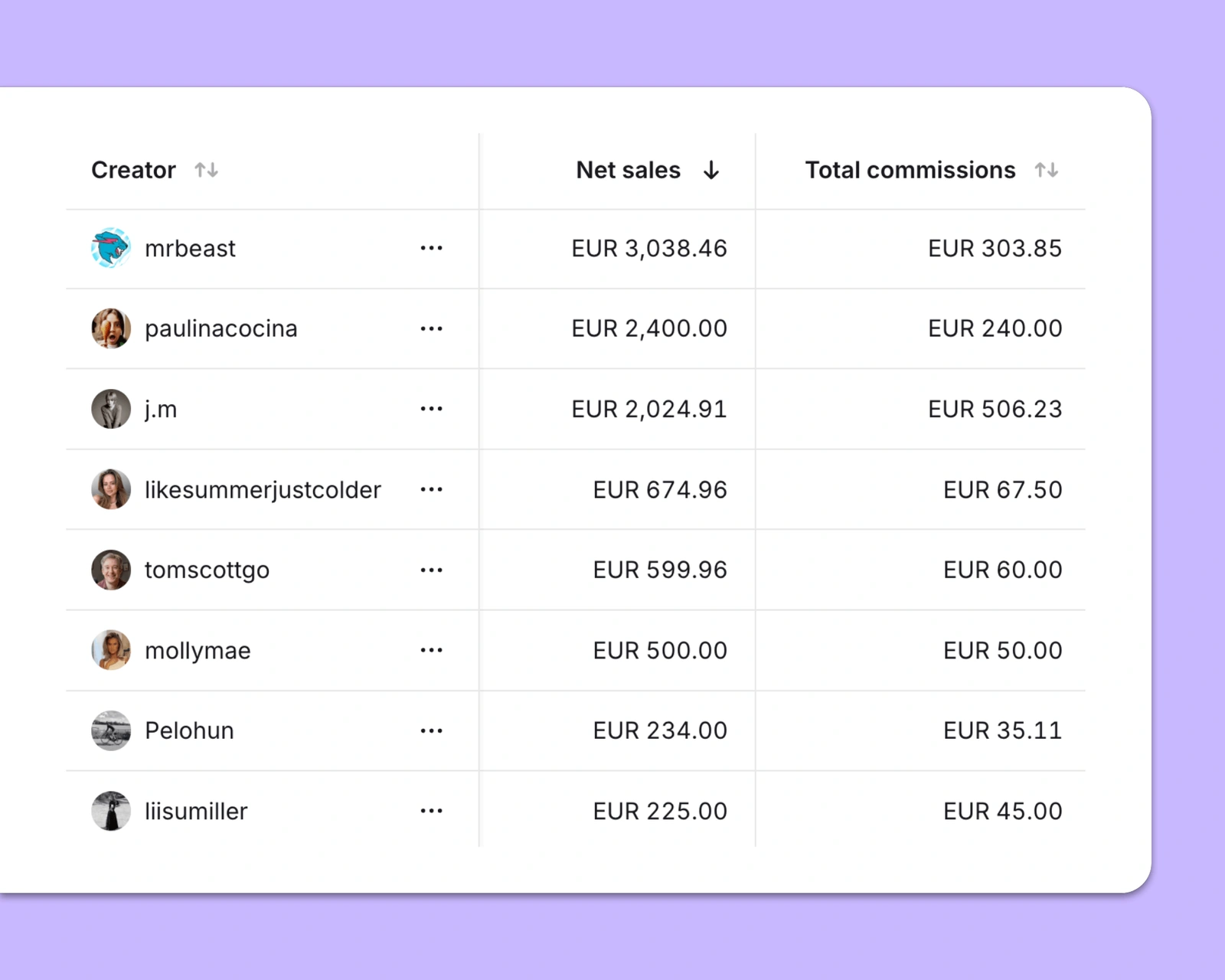
In Modash, each creator gets a tracked link and a code tied to your Shopify data, so sales from DMs, bios and stories all count toward the right person. Commission is calculated on net revenue after refunds and returns.
The top gaming brands keep coming back to the same people: PlayStation rebooked 11 of its 33 creators and Pokémon 10 of its 27. Games change with every update and season, so a creator who already plays has a reason to post every time something new drops.
Most marketers want to do more of this. In our influencer marketing trends survey, over 60% said they plan to invest more in long-term partnerships, but only 54% actually ran more of them last year.
The top brands avoid a few mistakes that trip up smaller programs:
It depends on platform, following and engagement. Micro-influencers often work for free product plus a fee in the low hundreds per post, or an affiliate commission. Larger creators charge more. Many brands start with gifting plus commission to test fit before committing to flat fees. To estimate what a specific creator is likely to charge, drop their handle into our free Instagram influencer pricing calculator.
Instagram carries most gaming creator work, and every sponsored post we analyzed for the five most-searched gaming brands ran there. TikTok is worth testing too: in our survey, marketers rated TikTok videos the highest-performing deliverable (53.2%).
Minecraft, Fortnite, Xbox, Pokémon and PlayStation are the most-searched gaming brands in the US, and all of them run active creator programs. See the breakdown above for who each one works with.
It depends on your goal. A launch chasing awareness leans bigger, a conversion play leans smaller and more trusted. In the gaming posts we analyzed, creators under 50k followers got about three times the likes relative to their audience size, so most brands should build their base with micro-influencers (10k–50k followers) and add bigger names for launches.
Track sales per creator with unique links and codes, then compare revenue against what you paid (fees, product and commission). Our engagement rate calculator and fake follower checker help you vet creators before you spend, and our guide to influencer marketing ROI covers the full calculation.
Find creators, manage relationships, pay them in 180+ countries and 36 currencies, and track every sale through Shopify – all in one place, with no fees taken out of creators' pay. Try Modash free, no credit card required – or browse the top gaming influencers to see who's already out there.