Use Modash in Claude, ChatGPT, Cursor, and other AI tools
Get started with MCP



Most affiliate platforms were built for bloggers and coupon sites, not creators. They handle tracking links and commission payouts, but stop there. You still have to find your creators somewhere else, ship products manually, chase down content proof, and piece together social KPIs from separate tools.
This list covers nine platforms that actually support creator-based affiliate programs, including tools that handle discovery, gifting, content tracking, and payouts. Each entry is evaluated on workflow coverage, data quality, pricing transparency, and real user feedback from G2 and Reddit. Whether you're building an affiliate program from scratch or switching from a broken setup, there's something here for you.

🥇 Best for: In-house marketing teams at e-commerce brands (especially Shopify) who need end-to-end influencer management — discovery through payment.
🤔 What is Modash?
Modash is a full-lifecycle influencer marketing platform covering every stage of running a creator affiliate program: finding creators, reaching out, sending products, tracking content, and processing payments. It's built specifically for ecommerce brands on Shopify, with native integrations that connect creator activity directly to store revenue.
Most affiliate platforms make you bring your own creators. Modash handles that too. With a database of 380M+ creators across Instagram, TikTok, and YouTube (no opt-in required), you can recruit, manage, and pay affiliates all without leaving the platform.
What sets it apart for affiliate programs is flexibility. Track sales via links, promo codes, or both. Pay a percentage sales commission or a fixed amount per order. Build unlimited affiliate tiers with different commission rates, gift product budgets, and discount levels. And you only pay processing fees on payouts, not a percentage of your affiliate-generated revenue.
Key features:
Influencer discovery and vetting: Modash indexes 380M+ public creator profiles without requiring anyone to opt in. Search uses true visual AI, meaning you can search by image similarity, not just keyword-to-filter translation. Filters cover audience demographics, engagement rate, follower count, fake follower estimates, and past brand collaborations. You can also find creators who are already fans of your brand by uploading your customer email list or searching for your brand name in bios, captions, hashtags, and mentions. Unlike platforms with opted-in-only databases, you're searching the full public creator landscape.

Outreach and communication: A built-in inbox handles email sequences, customizable templates, and variable insertion (names, links, promo codes). Conversations are shared across your team, so no partnership falls through the cracks. If you're thinking about influencer outreach, you don't need a separate CRM or email tool.
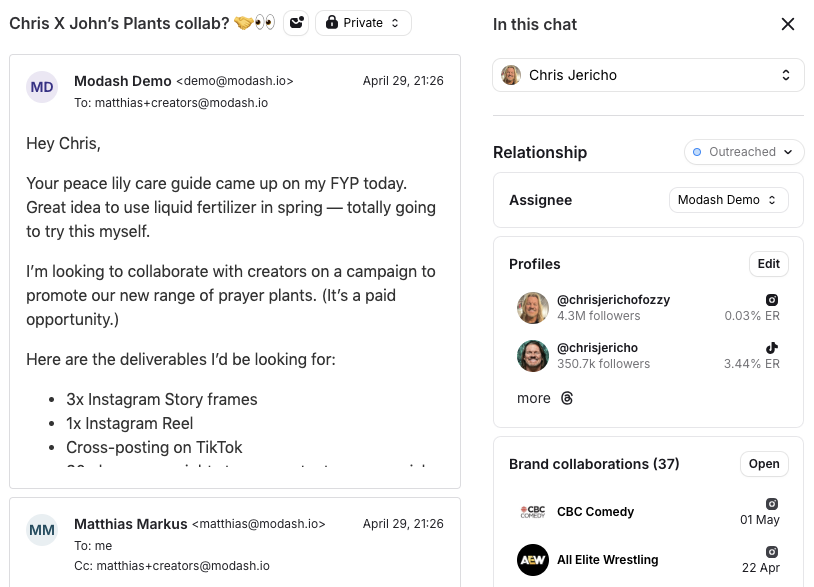
Content and campaign tracking: Modash automatically collects posts, Reels, Stories, and YouTube content without requiring creators to sign up or authenticate anything. Content data refreshes approximately every 12 hours, and posts are saved in your dashboard even if a creator deletes them later. The campaign dashboard shows views, EMV, clicks, revenue, ROAS, and CPM in one place. This means you get social-specific KPIs that pure affiliate platforms completely miss.

Affiliate program management and Shopify integration: The Shopify integration is where Modash separates from general affiliate tools. You can generate promo codes, create trackable affiliate links, and ship products directly from the platform. Affiliate tiers let you set different commission structures, gift budgets, and discount levels for different creator groups. Sales attribution flows back into your Modash dashboard automatically. So your team can see exactly which creators are driving revenue, without manual exports or spreadsheet merges.
Payments: Modash handles invoicing, tax compliance, and currency conversion across 180+ countries and 36 currencies. Auto-generated invoices mean creators don't have to send them manually. You pay processing fees on payouts only, not on a percentage of every affiliate sale your creators generate.
Price: Starts at $199/month (annual) or $299/month (monthly). Free trial available. 👉 Modash Plans and Pricing
Worth noting: Modash's affiliate features are built around Shopify. If your store runs on WooCommerce, BigCommerce, or another platform, the Shopify-specific integrations (gifting, discount codes, sales attribution) won't apply. The platform also covers Instagram, TikTok, and YouTube only, so if your creators are active elsewhere – like Twitch or Snapchat – you'd need a separate solution for those channels.
Review score: ★ 4.9/5 (G2)
🥇 Best for: Ecommerce brands and agencies looking to run scalable influencer and affiliate campaigns with deep platform integrations and AI-assisted automation.
🤔 What is Upfluence?
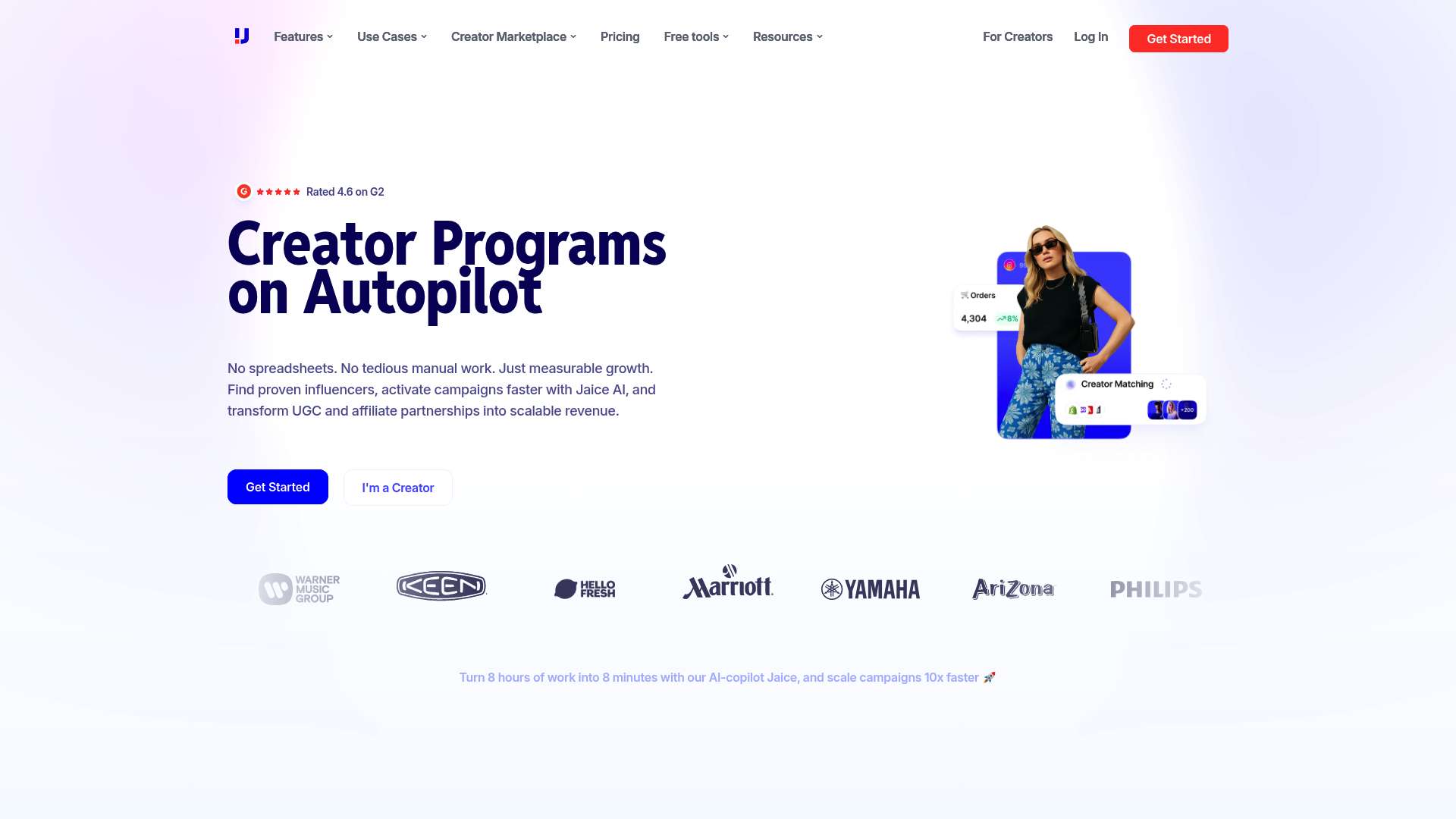
Upfluence is an all-in-one influencer and affiliate marketing platform with native integrations across Shopify, WooCommerce, Magento, BigCommerce, Amazon, and Stripe. Its AI co-pilot, Jaice, automates time-intensive tasks like creator selection and email outreach. It's one of the most popular platforms for brands already operating across multiple ecommerce environments.
Key features:
AI-assisted campaign automation: Jaice compresses campaign setup, creator matching, and outreach sequences into a largely automated workflow. For teams running high volumes of creator campaigns, this reduces hours of manual coordination. The AI layer pulls from a database of 12M+ creator profiles with data on content performance, audience demographics, and brand affinity.
Affiliate tracking across ecommerce platforms: Upfluence auto-generates unique promo codes and tracks revenue, ROI, AOV, and commissions from a central dashboard. Unlike Modash, which is Shopify-native, Upfluence connects to multiple ecommerce backends including Amazon (via Amazon Attribution).
Global creator payments: Bulk creator payments in multiple currencies are also supported – particularly useful if you run more than one storefront or sell across different platforms.
Customer-to-creator discovery: One standout feature: Upfluence can identify creators who are already customers. This is a useful starting point for brands building affiliate programs from their own audience.
Worth noting: pricing isn't public, and a demo is required before you get any numbers. Third-party reports and G2 data suggest starting costs of $800–$3,000+/month depending on the tier. Key features like the Shopify integration and API access are reportedly locked behind higher-tier plans. If you want to compare Upfluence against a close competitor, Upfluence vs GRIN breaks down the differences in detail.
Price: Third-party sources suggest $800–$3,000+/month in practice. Official pricing requires a demo.
Review score: ★ 4.6/5 (G2)

🥇 Best for: Mid-to-large ecommerce brands and agencies looking to manage affiliate, influencer, and referral programs from a single, performance-focused platform.
🤔 What is impact.com?
impact.com is a partnership management platform that unifies affiliate, creator, and referral programs under one dashboard. It's backed by $100B+ in partnership data and integrates with Shopify, BigCommerce, and WooCommerce. The platform tracks actual sales and conversions, not just clicks or impressions, making it well-suited for performance-driven marketing teams.
Key features:
Unified affiliate and creator dashboard: impact.com consolidates affiliate, influencer, and referral programs so attribution flows through a single system. The platform includes a vetted marketplace of 90,000+ partners, letting you discover affiliates whose audiences actually convert. Cross-channel insights show how blending affiliates and influencers affects overall sales performance. Reddit users describe it as "probably the best platform for building a profitable affiliate program at scale."
Performance tracking and fraud protection: Tracking covers clicks, transactions, lifetime value, and ROI across every partner type. Enterprise plans add fraud scoring, anomaly detection, conversion path analysis, and CPC tracking. The depth on the analytics side goes well beyond what most influencer-native platforms offer.
Worth noting: impact.com is not built for creator-specific workflows. You won't get influencer discovery filters, content tracking, or social KPIs like EMV or views. Reddit reviewers consistently flag it as "not for novices" and recommend having a dedicated affiliate manager or agency before adopting the platform. The pricing jump from Essentials ($500/month) to Pro ($2,500/month) is steep, and a 2.5% transaction fee applies to all partner-driven sales on every plan.
Price: Starter from $30/month. Essentials from $500/month. Pro from $2,500/month. Enterprise: contact sales. A 2.5% transaction fee applies on all tiers. One-time setup fee required.

🥇 Best for: DTC brands and agencies running high-volume affiliate and gifting programs that want less manual work.
🤔 What is Influencer Hero?
Influencer Hero is an all-in-one influencer marketing platform covering discovery, outreach, CRM, gifting, affiliate tracking, payouts, UGC, and reporting. Its focus is automation. Teams can set trigger, condition, and action rules across their campaign board and combine them with 45+ integrations, so each step of an affiliate program can kick off the next one.
Key features:
Discovery across 450M+ creators: AI content search finds creators by what they post, with filters for location, followers, engagement, and brand affinity. It also detects creators who already follow you or buy from your store.
Multichannel outreach: Outreach rotates across email, Instagram DMs, TikTok DMs, and WhatsApp, with AI-generated templates and automated follow-ups.
Gifting and affiliate tracking across stores: Ship products, create discount codes and affiliate links, and track sales for Shopify, WooCommerce, Magento, BigCommerce, PrestaShop, and Amazon.
Code leak protection: AI scans coupon leak websites, rotates leaked codes automatically, and notifies the creator.
Creator payouts: Batch auto-payouts in multiple currencies, with a 0.5% processing fee.
Reporting and UGC: Live dashboards for clicks, conversions, EMV, and gifting COGS, plus a central library for creator content and usage rights.
Worth noting: Pricing starts at $649/month with a 3-month minimum, which puts it out of reach for smaller teams just testing an affiliate program. There's no free trial, so teams can't try it before committing.
Price: Standard: $649/month. Pro: $1,049/month. Business: $2,490/month. Custom pricing for agencies. All plans have a 3-month minimum term. Quarterly billing saves 20%, and annual billing saves 30%. No free trial – evaluating the platform means booking a demo.
Review score: ★ 4.8/5 (G2)

🥇 Best for: Ecommerce brands looking to build long-term creator and ambassador relationships while managing influencer and affiliate programs at scale.
🤔 What is Aspire?
Aspire is an influencer and affiliate marketing platform focused on long-term creator partnerships. It combines campaign management, tiered affiliate rewards, custom landing pages, and relationship tracking for ecommerce brands managing multiple creator tiers or ambassador communities.
Key features:
Tiered affiliate rewards and ambassador tools: Aspire supports tiered commission structures and custom landing pages for affiliate programs. For brands running ambassador programs alongside standard influencer campaigns, this makes it easier to manage different reward levels from one place. The platform emphasizes ongoing creator relationships over transactional, one-off activations.
Campaign performance tracking: Analytics tools cover creator performance, conversions, and ROI across multiple programs simultaneously. This is useful for marketing teams managing several product lines or regional campaigns at once.
Scalability: Unlimited user licenses and comprehensive onboarding are included in the monthly fee, which is a practical benefit for larger in-house teams.
Worth noting: Pricing isn't publicly listed, so you'll go through a sales process before knowing what it costs. Third-party data from Vendr puts the median contract at around $15,588/year, with an annual range of $11,139 to $36,599. At least one Reddit user reported being quoted roughly double the price of Upfluence for a comparable setup.
Price: No public pricing. Vendr data: median ~$15,588/year, range ~$11,139–$36,599. Three tiers (Essentials, Pro, Enterprise), pricing on request.

🥇 Best for: Ecommerce advertisers looking to scale partnerships through a large, established global affiliate network.
🤔 What is Awin?
Awin is a global affiliate and partner marketing network connecting 30,000+ brands with 1M+ approved affiliate partners across retail, fashion, travel, finance, and telecom. With 25+ years in the industry and operations across 14 countries, it's one of the most established affiliate networks available. G2 named Awin one of the Best Marketing and Digital Advertising Software Products for 2026.
Key features:
Large, established affiliate network: The scale here is the core value. Brands get access to a wide pool of vetted affiliate partners, including bloggers, social creators, and newsletter publishers. Affiliates can support multiple content formats (social posts, videos, blogs, newsletters), giving brands flexibility in how their affiliate program is promoted. Easy Instagram integration is available for social-first creators.
Flexible commission structures: Entry-level plans support basic product-category commission splits. Higher-tier plans add unlimited custom attribution-based commission rules, letting you incentivize specific partner behaviors, product categories, or customer types (such as new versus returning buyers).
Transparent mobile-friendly reporting: Real-time performance tracking is available via a mobile app for affiliates and publishers.
Worth noting: Awin is primarily a network-first platform. It doesn't natively handle influencer discovery, creator outreach workflows, or social KPIs like EMV or estimated reach. Brands that need to manage the full creator lifecycle, from finding influencers to tracking their content, will need additional tools. Early-stage businesses on Reddit question whether the platform fee (starting at $49/month plus 3.5% per transaction on the Access plan) delivers enough value over manual outreach at smaller volumes.
Price: Access: $49/month + 3.5% transaction fee (free first month). Accelerate: from $99/month + 2.5% transaction fee. Advanced: custom pricing.

🥇 Best for: Large brands and established publishers looking for a proven, high-reach affiliate network with deep tracking infrastructure and a massive partner ecosystem.
🤔 What is CJ Affiliate?
CJ Affiliate (formerly Commission Junction) is one of the world's largest affiliate marketing networks. It drives $16B+ in annual revenue through the platform and processes 157M+ transactions per year. The network reaches over 1B customers monthly and is used by more IR500 brands than any competing platform, reportedly at 2x the adoption rate of the nearest competitor. Adjacent solutions include CJ Influence (influencer marketing) and CJ Leads (lead generation).
Key features:
Global publisher and advertiser network: The scale and reach of CJ's network is its primary differentiator. For large advertisers seeking fast audience reach across virtually every vertical, the breadth of affiliate publishers is hard to match.
Flexible commission structures: CJ supports percentage-based, lead-based, and two-tier models where publishers earn additional commissions by recruiting new affiliates.
Deep performance tracking: CJ processes 14B+ interactions annually with tracking across clicks, transactions, and commissions. The data infrastructure is why major enterprise brands choose CJ over lighter-weight affiliate tools.
Worth noting: CJ is not built for creator workflows. There is no native influencer discovery, no social content tracking, and no social-specific KPIs. Reddit publishers report affiliate links sometimes failing to register clicks. Advertiser pricing isn't public, and third-party sources describe upfront network access fees, a refundable deposit, and approximately 30% of each transaction retained by CJ as network revenue share (unconfirmed by CJ). Smaller brands and newer affiliates consistently describe the platform as clunky and difficult to reach payout thresholds on.
Price: Advertiser pricing not public — contact sales. Third-party sources indicate a network access fee, refundable deposit, and ~30% transaction revenue share to CJ .

🥇 Best for: Lifestyle, fashion, and beauty brands looking to tap into a large existing creator community for affiliate-style commerce and product promotion.
🤔 What is LTK?
LTK (formerly LikeToKnowIt) is a creator commerce platform connecting brands with lifestyle influencers through shoppable affiliate-style links and sponsored content. The consumer-facing LTK app has 40M+ shoppers, and the brand-side platform (LTK Connect) supports creator discovery, campaign management, and payments. The product catalog spans 450M+ items across 8,000 brands in fashion, beauty, home, and travel.
Key features:
Existing creator marketplace: LTK gives you immediate access to a large established creator community in lifestyle verticals. You don't need to do cold outreach from scratch. LTK Connect lets you search creators, review audience demographics, and send collaboration offers directly.
Essential features on all plans: Unlimited campaigns and built-in creator payments are included across all plan tiers. Shopify integration is included at every plan level too.
Worth noting: Full creator audience demographic data is only available on Enterprise plans. Dedicated support is also gated at that tier. The Pro plan at $999/month requires a $25,000 annual brand spend commitment.
Price: Launch: $99/month. Pro: $999/month (requires $25,000/year brand spend commitment). Enterprise: variable pricing. Add-ons: $399/month for advanced reporting; up to $499/month per additional user seat.

🥇 Best for: Ecommerce brands on Shopify or WooCommerce looking to launch and manage a performance-based affiliate or influencer program without technical setup.
🤔 What is Refersion?
Refersion is an affiliate management platform for direct-to-consumer brands, with native integrations for Shopify, WooCommerce, and Stripe. Merchants manage, track, and pay affiliates and influencers through unique links and promo codes. A built-in marketplace lets prospective affiliates discover and apply to your program.
Key features:
First-party affiliate tracking: Refersion uses a first-party tracking domain rather than third-party cookies, making attribution reliable regardless of browser privacy settings or ad blockers. Tracking works via both referral links and promo codes, supporting the way most creator-based affiliate programs actually run. This is a practical advantage over platforms that still rely on third-party cookie tracking.
Flexible commission management: Commissions are configurable as a percentage of sale, flat fee, subscription-based, or differentiated by product or customer type. Higher-tier plans let you set different rates for new versus returning customers, all managed within the platform without developer involvement. One-click PayPal payouts are included.
Worth noting: Refersion handles affiliate tracking well but doesn't offer influencer discovery, content tracking, or social KPIs. It's a capable starting point for launching an affiliate program, but brands that want to manage the full creator relationship will need to bring in additional tools. The revenue percentage fee on lower-tier plans (3% on Launch, 2% on Growth) can add up quickly as affiliate sales grow. The Scale plan switches to a flat monthly fee, but requires a demo for pricing.
Price: Launch: $39/month + 3% of affiliate-driven sales. Growth: $199/month + 2% of affiliate-driven sales. Scale: custom pricing (demo required). Annual billing available at 20% discount.
After evaluating these nine platforms, here are the capabilities that separate full-featured influencer affiliate tools from basic tracking software.
End-to-end creator workflow coverage
A platform that only tracks links and pays commissions assumes you've already handled recruitment, onboarding, and gifting elsewhere. Look for tools that cover the full workflow: finding creators, reaching out, sending products, tracking the content they post, and processing payments. Handling these stages in one place removes the spreadsheet-stitching that slows teams down.
Social-specific KPIs beyond clicks and conversions
Standard affiliate platforms report clicks and revenue. Creator-based programs also need views, EMV (earned media value), engagement rate, and impressions. These metrics reflect the brand awareness value of an influencer post, which a sale-conversion metric alone won't capture. Platforms built for creators include these; traditional affiliate networks typically don't.
Flexible commission and tier structures
Not every creator should be on the same affiliate deal. Look for platforms that let you create multiple affiliate tiers with different commission rates, discount levels, and product gift budgets. The ability to mix gifted collaborations with affiliate codes, or reward top performers with higher commissions, gives you the flexibility to run a nuanced program rather than a flat-rate network.
What's the difference between an influencer marketing platform and a traditional affiliate platform?
Traditional affiliate platforms (like CJ Affiliate or Awin) are built for publisher networks: bloggers, coupon sites, and content aggregators. They handle link tracking and commission payouts well, but assume you've already recruited your affiliates somewhere else. They also don't track social-specific content or provide KPIs like EMV or views. Influencer marketing platforms are built around creator workflows: finding the right creators, reaching out to them, managing gifting and onboarding, tracking posts automatically, and processing payments. The best influencer affiliate platforms combine both, handling performance tracking alongside the full creator relationship.
Can I run gifted and affiliate collaborations with the same creator on one platform?
Yes, on platforms like Modash. You can send a creator a free product (gifted collab) and simultaneously give them an affiliate code, so the same partnership drives both brand awareness and measurable revenue. Most traditional affiliate networks don't support product gifting at all, and most influencer platforms handle affiliate codes as an add-on rather than a core feature. If mixing collaboration types is important to your program, prioritize platforms that treat gifting and affiliate tracking as part of the same workflow.
Do I need to pay a percentage of my affiliate revenue to the platform?
It depends on the platform. impact.com charges a 2.5% transaction fee on all partner-driven sales across every plan. Awin charges 2.5%–3.5% per transaction depending on your tier. Refersion charges 2%–3% of affiliate-driven sales on lower-tier plans. Modash charges processing fees only on payouts, not on your affiliate-generated revenue. At scale, these fee structures make a significant difference in total program cost, so factor them in when comparing plans.
What happens to content tracking if a creator deletes a post?
On most platforms, nothing. The post disappears from your records. Modash automatically saves all tracked content in your campaign dashboard even if the creator deletes it later. This matters for reporting and for verifying that creators delivered what they agreed to, particularly on time-limited Stories or posts tied to specific campaigns.
Is Shopify integration actually important for an influencer affiliate program?
If you're on Shopify, it's one of the most valuable features to look for. A genuine Shopify integration lets you automatically attribute sales to specific creators, generate and assign promo codes, ship products directly from the platform, and calculate ROAS per creator without manual exports. Without it, you're copying data between systems. Platforms like Modash and Refersion have native Shopify integrations. Upfluence supports Shopify alongside several other ecommerce platforms. impact.com integrates with Shopify but is more focused on the affiliate network side than the creator workflow side.
If you're an ecommerce brand on Shopify and you want one platform to handle creator discovery, outreach, product gifting, affiliate tracking, and payments, Modash is the most complete option available. The Shopify integration is native, not bolted on, which means sales attribution, promo codes, and product gifting all work without manual configuration. The flexible affiliate tier system, no revenue-percentage fees, and true AI-powered discovery make it the strongest fit for in-house teams building serious creator programs.
If you're a larger brand that runs on multiple ecommerce platforms and needs enterprise-grade affiliate infrastructure, impact.com or Upfluence are worth evaluating. For brands that are focused on lifestyle verticals and happy to tap into an existing creator community, LTK offers immediate access without cold outreach. And if you're just starting with a basic affiliate program on Shopify or WooCommerce and don't need full creator workflow coverage, Refersion is a low-barrier entry point.
For most ecommerce teams that treat influencer marketing as a core acquisition channel, try Modash free and see how much of your current workflow it can consolidate.