Use Modash in Claude, ChatGPT, Cursor, and other AI tools
Get started with MCP



GoAffPro and Affiliatly are two of the lowest-cost ways to run an affiliate program on an ecommerce store. Both sell fixed monthly plans, and both have a free plan you can start on.
As we'll see, the real differences sit below the price tag. Read on to learn which platform is best for you and whether there are any alternatives you should be considering (hint: there are!).
GoAffPro is for brands that want to recruit influencers, run multi-level commissions, and keep an unlimited affiliate roster on a free plan. It charges by plan features, so your affiliate count stays unlimited even on the free tier.
Affiliatly is for smaller stores that want the cheapest paid entry and plan to predominantly recruit affiliates from their own customers, although you can also list your program on a marketplace to attract inbound applications.
However, both tools have a problem for brands that use affiliate marketing to generate content: they don't track what your affiliates publish. So you can see which orders came from a link or coupon, but not which Reel or TikTok drove them, or what the content looks like.
Modash fills that gap – you find creators in a 380M+ database, then see the content they post alongside the affiliate sales it brings in. Here's how the three compare.
Where do your affiliates come from? That is the question that splits these two apps, and it's worth answering before you commit to either as your affiliate recruitment software.
GoAffPro has a Recruit tab where you proactively search for influencers and invite them to join your affiliate program. You can filter influencers by niche, region, tags, country, and category, so you narrow the pool before you send an invite.
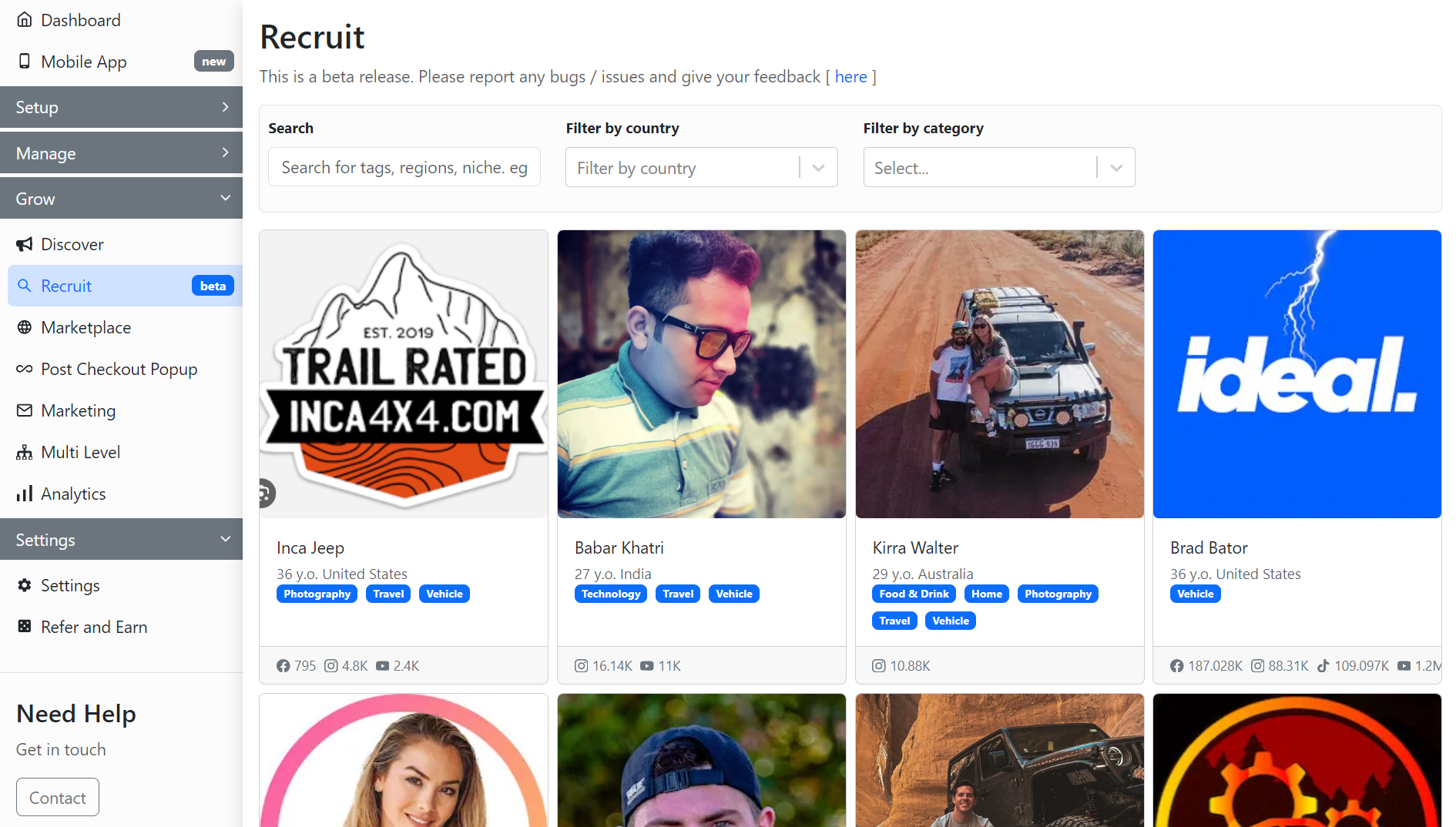
However, it's worth noting that GoAffPro doesn't share any details about the size of its database, so it's presumably not huge – if it was, they'd definitely promote it, right?
GoAffPro also handles the inbound side.
You can add an affiliate portal link to your Shopify store menu so visitors find the program on their own. Registrations can be approved manually from a Pending Approval queue, approved automatically, or approved after a set delay. You can also restrict signups by country, and customers without an affiliate account can be registered as affiliates through the single sign-on settings.
Affiliatly doesn't offer any proactive recruitment tools. Instead, it focuses on turning the people who already buy from you into affiliates.
A post-checkout popup appears right after a customer completes an order and invites them to register for your affiliate program. Affiliatly can also send an automated email inviting recent customers to become affiliates, though this is available only for Shopify and BigCommerce stores.
For reach beyond your customer base, Affiliatly lets you list your program on its marketplace so affiliates and influencers can find you. The public directory can be browsed by category and spans industries including:
Affiliatly also lets you embed a registration form or a full signup page with a banner and text on your own site.
However, neither tool is a great fit if you need to recruit affiliates at scale rather than wait for them to find you. If that's a problem for you, you need an alternative like Modash.
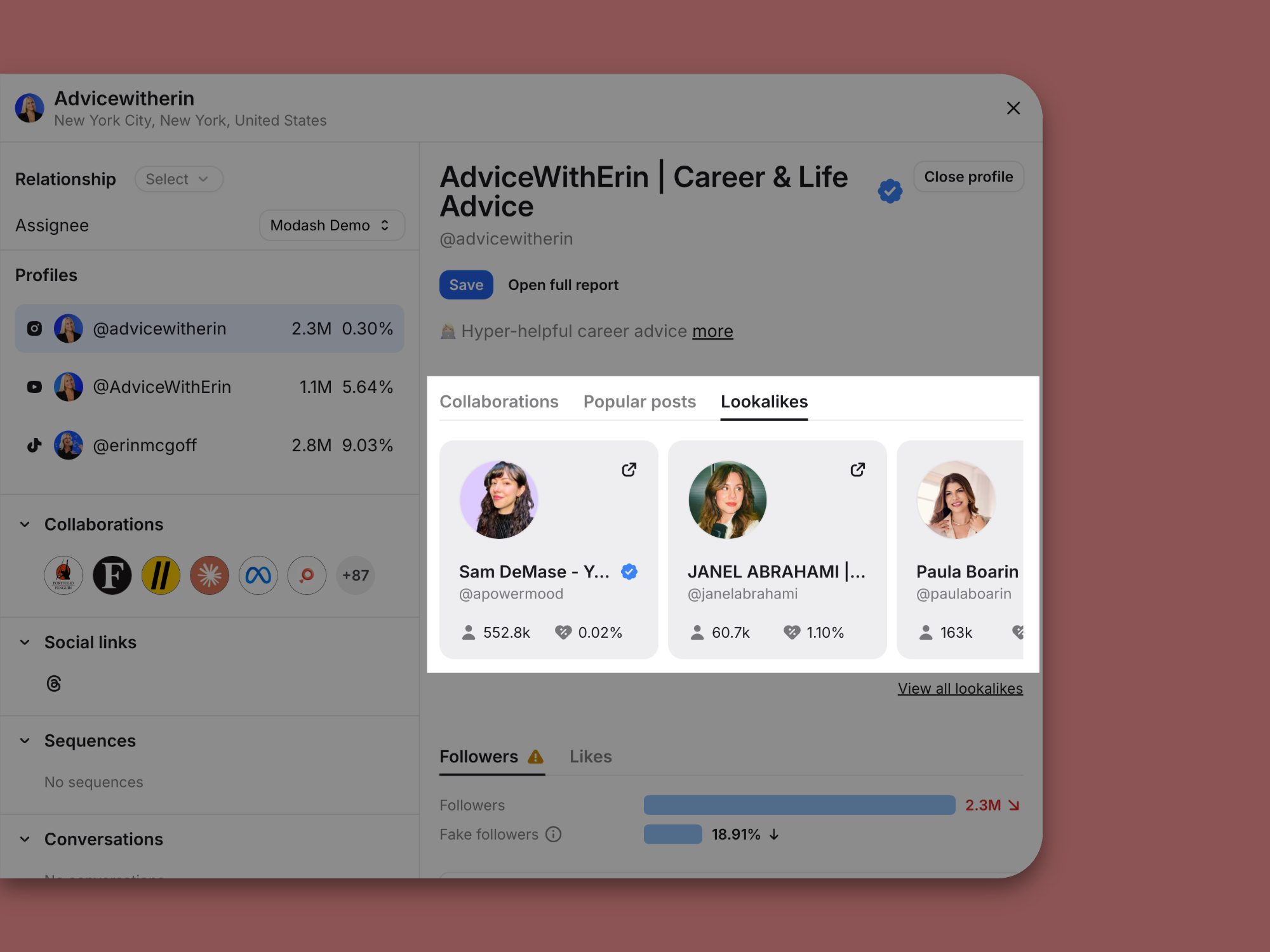
Modash lets you search a database of 380M+ creators and see audience demographics and engagement metrics before you reach out. That means you can check who a creator reaches before you spend time on an invite.
Once you find one creator who works, Modash shows you more creators like them, so you can build a shortlist quickly instead of starting every search from scratch.
✍️ Bottom line: GoAffPro suits brands that want to search for and invite influencers themselves while still handling inbound signups. Affiliatly fits stores that would rather convert existing customers into affiliates and pick up new ones from a marketplace listing. If you want to find creators far outside either network, Modash's 380M+ creator database is the bigger pool.
Both tools sell fixed monthly plans, so what matters is what pushes you up a tier. One charges you for features. The other charges you for headcount.
GoAffPro offers 3 plans: Hobby, Premium, and Business. The Hobby plan is free, and it is the plan you land on when you install the app.
Every GoAffPro plan, including the free version, allows unlimited affiliates, so your bill never rises because your roster grew.
Premium costs $49/month and moves your program onto dedicated server space rather than the shared resources free users get. Business starts at $99/month for up to $10K affiliate sales a month, with prices increasing further as sales grow.
Affiliatly also has a Free plan, although users are moved to a paid plan once they hit 50 total affiliate-driven orders.
Its paid tiers are priced by affiliate count. Starter costs $16/month for up to 50 affiliates with unlimited orders. Advanced costs $24/month and raises the cap to 200 affiliates. Affiliatly's plans go up to $129/month at the top end, including unlimited affiliates.

Larger paid plans can be started with a 14-day trial, and Shopify merchants are billed through Shopify's own subscription billing, so their price options differ slightly.
Modash's prices are fixed too, starting at $199/month on an annual contract or $299/month with no yearly commitment. It doesn't have a free plan, but you can sign up for a 14-day free trial.
✍️ Bottom line: Affiliatly is the lower-priced paid entry at $16/month, but your monthly bill rises with your affiliate count as you scale affiliate marketing. GoAffPro's free Hobby plan has no affiliate limit, and its paid tiers at $49 and $99/month buy features rather than headroom (although the price of its top-tier plan increases in line with affiliate sales volume).
Both GoAffPro and Affiliatly let you reward affiliates for referring other affiliates, but how deep that structure goes is 1 of the clearest differences between them.
On all paid plans, GoAffPro lets you set up a hierarchical multi-level affiliate network where commission is distributed across multiple levels of affiliates. Existing affiliates recruit newer affiliates under them and earn network commissions on the sales those downline affiliates refer. There's also a Playground section where you can test how your network setup will work before going live.
Multi-level is only 1 layer of GoAffPro's commission controls. By default the app sets a 10% commission on all products, and you can change that rate from the Commissions tab. Affiliate Groups let you give different types of affiliates different commission structures. On an individual affiliate's profile you can add special commissions for a specific product, collection, or royalty.
Then there are the incentives on top. Turning on Targets and Bonuses adds targets, commission boosters, recurring bonuses, and a signup bonus. Automations can move an affiliate to a different commission group or give a bonus when a new order comes in, on a daily run, or when an affiliate signs up.
Affiliatly stops at 2 tiers. Its 2-tier affiliate program lets you choose whether it applies to new or existing affiliates. You enter a separate 2-tier commission percentage that is paid on top of the commission affiliates already earn, and you choose whether it's calculated on the referred affiliate's earnings or on the total order sum.
A quick caveat worth reading before you turn it on: Affiliatly's own documentation warns that PayPal treats tiered affiliate programs as spammy networks, so paying 2-tier commissions through PayPal may violate the payment platform's terms and risk account suspension.
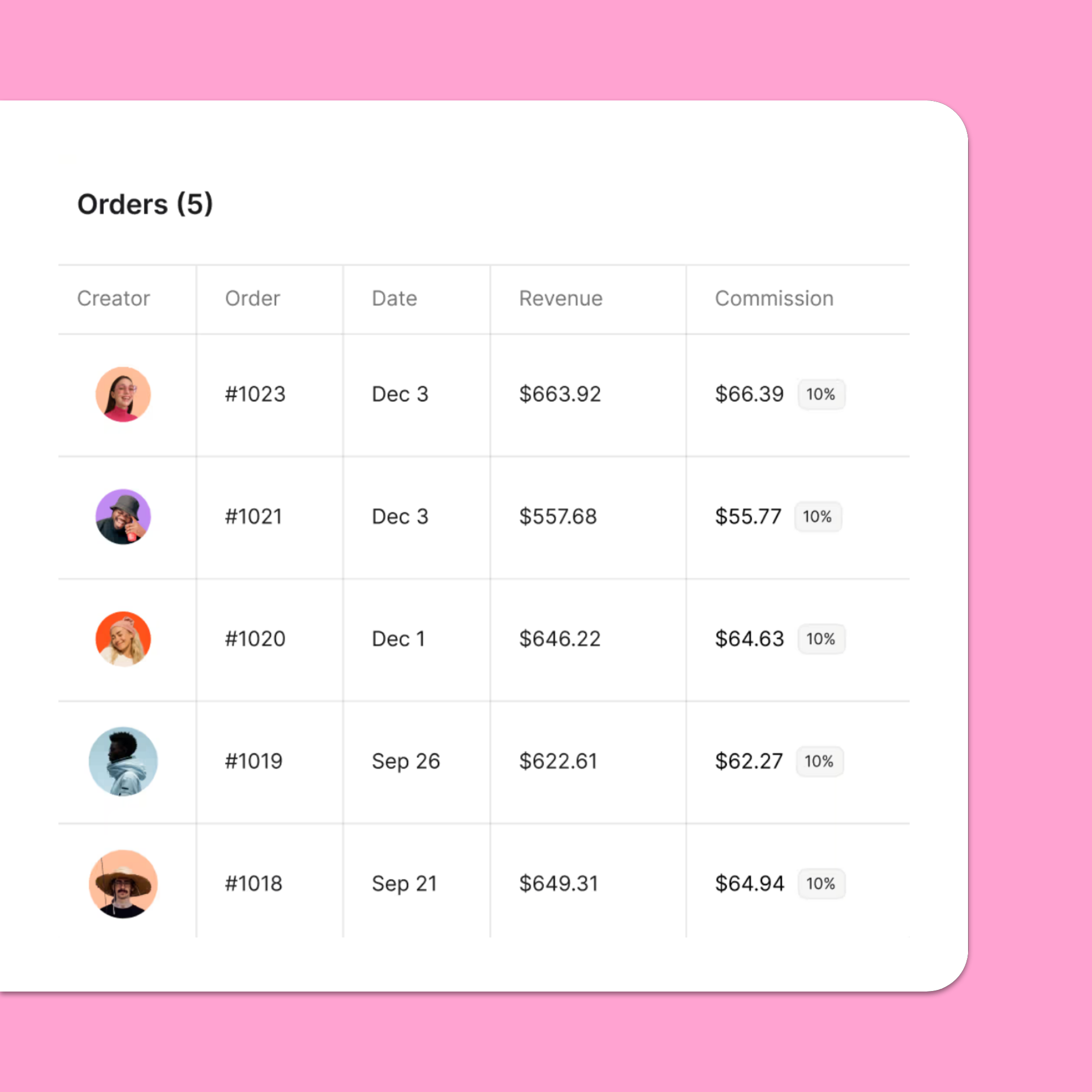
Modash takes the per-creator route rather than the network route. You reward each creator on their own terms: commission tiers set how the creators in each tier are paid, every creator sits in exactly one tier, and you move them up as they prove themselves. You can also pay a different rate on a customer's first order than on repeat orders, so you reward acquisition without overpaying for retention.
✍️ Bottom line: Go with GoAffPro if you want a deep multi-level program with groups, boosters, and automated commission changes. Affiliatly covers the simpler case of paying a referrer a bonus percentage on one level of recruits.
The way you track affiliate sales decides how many of those sales get tied back to a partner, and how long after a click that credit still counts. Affiliatly answers that question 4 ways; GoAffPro in 2.
FIrst up, Affiliatly. Tracking is available via link, coupon code, QR code, or the customer's email address. That gives you a fallback for sales where nobody clicked a link – a QR code on packaging or a coupon passed on by word of mouth still ties the order back to the affiliate.
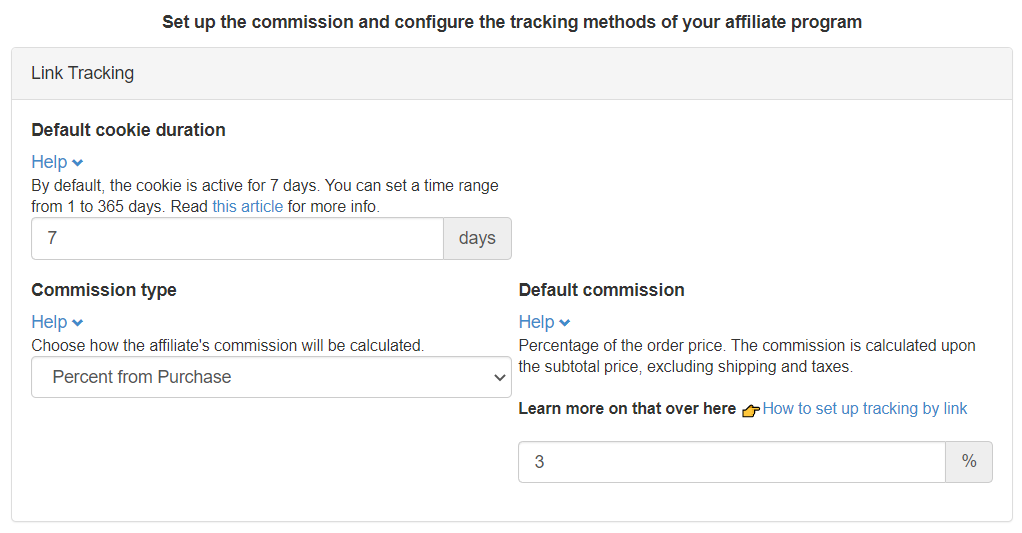
Affiliatly also lets you decide how long a link click keeps earning credit. By default, Affiliatly uses a cookie duration of 7 days. You can set that window anywhere between 1 and 365 days. And you can set a cookie duration individually for each affiliate instead of relying on one global setting.
GoAffPro's documented tracking methods are referral links and coupon codes.
Each affiliate's dashboard shows a unique referral link and a coupon code if you have assigned one. Affiliates can also generate their own trackable links to specific product pages from their dashboard. They can edit the unique code at the end of their referral link, which makes it easier to share something memorable.
Modash tracks affiliate sales through tracking links and Shopify discount codes, providing a per-affiliate view of orders and sales.
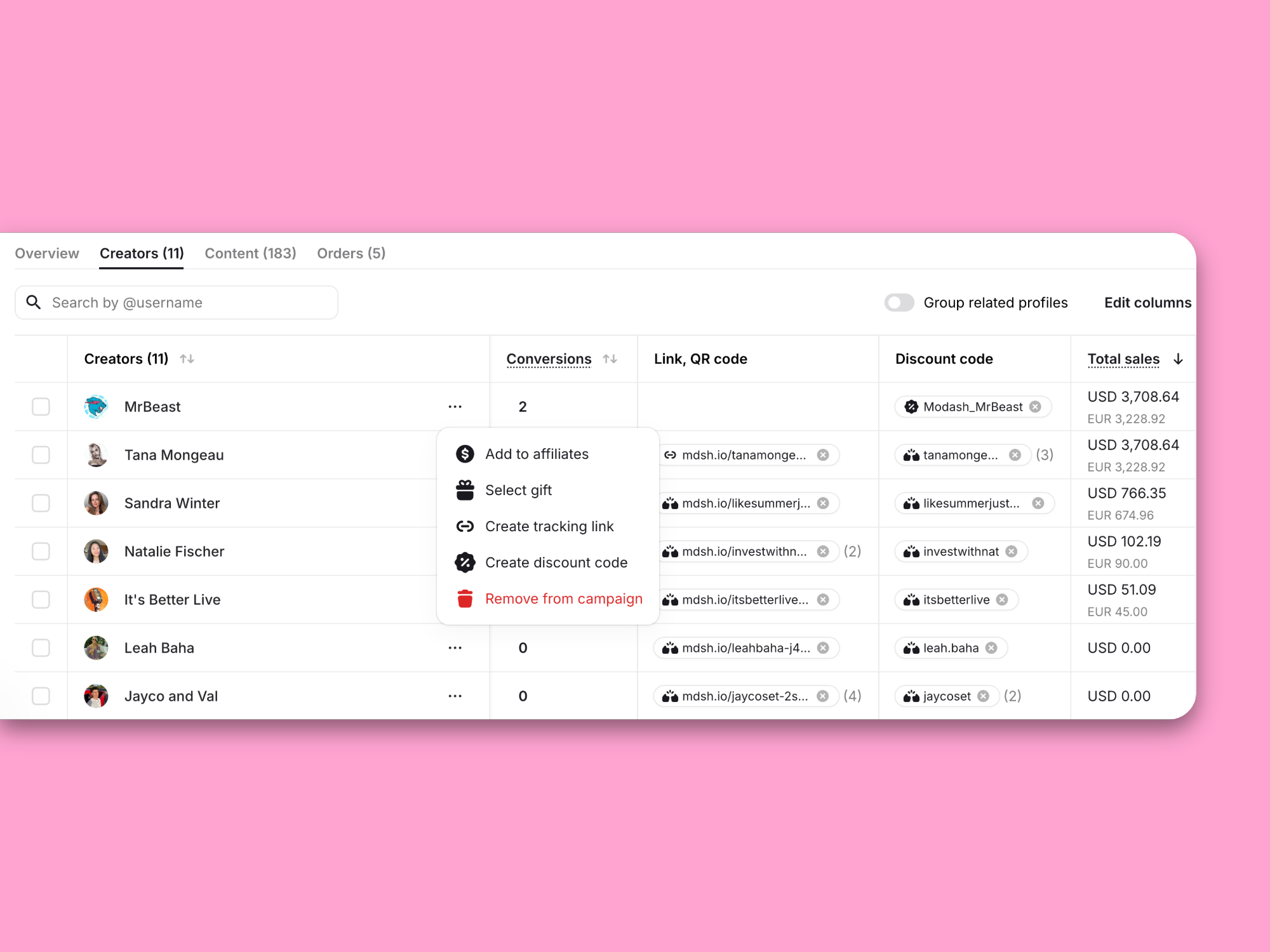
Link clicks stay valid for up to 30 days, while a discount code always credits the relevant affiliate no matter when it is used.
✍️ Bottom line: If your affiliates sell in places where links don't get clicked, Affiliatly is the better fit, since QR codes and customer emails still earn credit and you can tune the tracking window per affiliate. GoAffPro keeps tracking to referral links and coupon codes, with affiliates able to build their own product links.
How does the money reach your affiliates each month? Both tools cover the two methods most affiliates expect, PayPal and bank transfer. One adds more cash channels. The other takes the non-cash route and runs it for you.
GoAffPro pays commissions from inside the app once you connect PayPal Payouts, either in bulk or one at a time with quick payments. That same PayPal Payouts connection lets you send Venmo payments to affiliates too.
If an affiliate wants a bank transfer or another method, you pay them outside GoAffPro and mark the payment as paid in the Payouts tab. GoAffPro can also settle commissions as store discount coupons instead of cash, and it generates invoices for the commission payments you make.
Affiliatly connects to PayPal too, so you can pay affiliates in bulk, and its payout documentation covers PayPal, PayPal MassPay files, bank transfer, and store gift cards.
The gift card route is the one that runs itself. Turn on automatic gift codes and Affiliatly emails a gift card code to an affiliate the moment they reach the minimum payout sum. You set the gift card value to match your default minimum payout, because that figure is what lands in the affiliate's payment history. Run out of gift codes and the automatic payment is canceled, so keep the pool topped up.
With Modash, you skip the payout chore entirely – you pay one Modash invoice and Modash handles paying each creator and the tax side. Creators add their own banking details to receive their earnings, so you never collect PayPal addresses or upload payment files.
✍️ Bottom line: GoAffPro covers more cash payout routes, with PayPal, Venmo, and anything you settle outside the app and mark as paid. Affiliatly is the one that sends store gift cards automatically once an affiliate hits the payout minimum.
Both GoAffPro and Affiliatly connect to storefronts other than Shopify, which matters if you sell on more than one platform or expect to replatform later.
The split is how many platforms each supports out of the box, and what else plugs in around the store: GoAffPro names more storefronts; Affiliatly names fewer and routes other tools through Zapier.
GoAffPro lists 12 ecommerce platforms it supports, including Shopify, BigCommerce, WooCommerce, Wix, Magento, and Squarespace. If your platform isn't on that list, GoAffPro offers custom integration with other platforms.
The connections don't stop at the store. GoAffPro connects with Klaviyo, Mailchimp, and Omnisend so affiliate data syncs into your email tools automatically. If you are moving from another affiliate app, GoAffPro's team will import your old program data files into your new program.
Affiliatly names Shopify, BigCommerce, and WooCommerce among its working integrations, and it supports non-listed platforms through a custom integration process.
On Shopify, BigCommerce, and Ecwid, Affiliatly performs the store integration automatically, though it still recommends testing before you go live. For connecting other tools, Affiliatly's knowledge base documents a Zapier integration rather than named email-platform connectors.
If you sell on Shopify, Modash gives you one place for the whole job. Modash runs on a Shopify store connection, so you track affiliate sales in the same place you search a 380M+ creator database and manage the creators you find there.
✍️ Bottom line: If you sell on a less common platform or plan to move, GoAffPro covers more storefronts out of the box, with 12 named platforms plus email-tool sync and a data migration service. Affiliatly handles Shopify, BigCommerce, and Ecwid automatically and leans on Zapier for everything else.
Which Reel or TikTok drove that order? Affiliate apps are built to report what happens after a click or a coupon code, not the content in front of it. If all you need is to track affiliate sales, that gap won't matter. If you also want to know which content is working, it will.
Neither GoAffPro nor Affiliatly collects the Instagram posts, Reels, Stories, TikToks, or YouTube videos your affiliates publish, so you can't tell which content earned the sale without checking each profile by hand.
Modash does that for you – it automatically collects creator posts, Reels, Stories, and videos that use your campaign hashtags, mentions, or keywords.

Filter that content by creator, content type, or date, and sort it by engagement or views.
✍️ Bottom line: GoAffPro reports referrals, sales, and earnings, and Affiliatly reports sales and hands affiliates promo assets. Neither tool records the social posts behind those numbers – you see the sale, not the post that drove it.
Modash closes the content tracking gap I mentioned earlier, while supporting the end-to-end affiliate management process, from recruitment to management to payments.
You search 380M+ creators and see audience demographics and engagement before you send a single message, so you only reach out to people whose followers look like your customers.
Once creators join your program, Modash tracks their sales through links and Shopify discount codes and collects the posts, Reels, Stories, and videos they publish, so you see the post behind every sale, not just the sale.
Try Modash for free with a 14-day trial, no credit card required.