


More tools
Use cases



Measuring engagement takes about 30 seconds. Punch a username into a calculator, and out pops a percentage. Done.
Except that number doesn't tell what you really need to know: is this creator's audience actually paying attention, or are you simply looking at a well-decorated wall of bots and lurkers? Sure, having a number is better than nothing. But digging a little bit deeper can show you whether that number is good for this creator’s size and platform, and whether it’s even…real.
Here, we'll break down:
When you strip it back to basics, engagement is just audience interaction relative to reach, a.k.a. how many people who saw a post did something about it. Simple enough as a concept.
The problem is that "engagement rate" as a single percentage doesn’t really tell you much. That’s because it compresses very different behaviors (likes, comments, saves, shares) into one number, with no way to tell how much of it is passive versus higher-quality interaction, and it also doesn’t take into account any interactions that happen in DMs and other non-public places.
In other words, two creators can post the exact same engagement rate and it can mean completely different things. One might be getting genuine, thoughtful comments from people who are ready to buy. The other might be getting 200 heart-eye emojis from an engagement pod. The rate alone won't tell you what’s what, which is why it’s confusing.
Likes sit at the passive end of the engagement spectrum. They cost a follower almost nothing (a mere thumb-tap while scrolling) so a high like count tells you a post was seen and mildly appealing, but not much more than that.
Comments take more effort, which makes them slightly more revealing, but only if you actually read them.
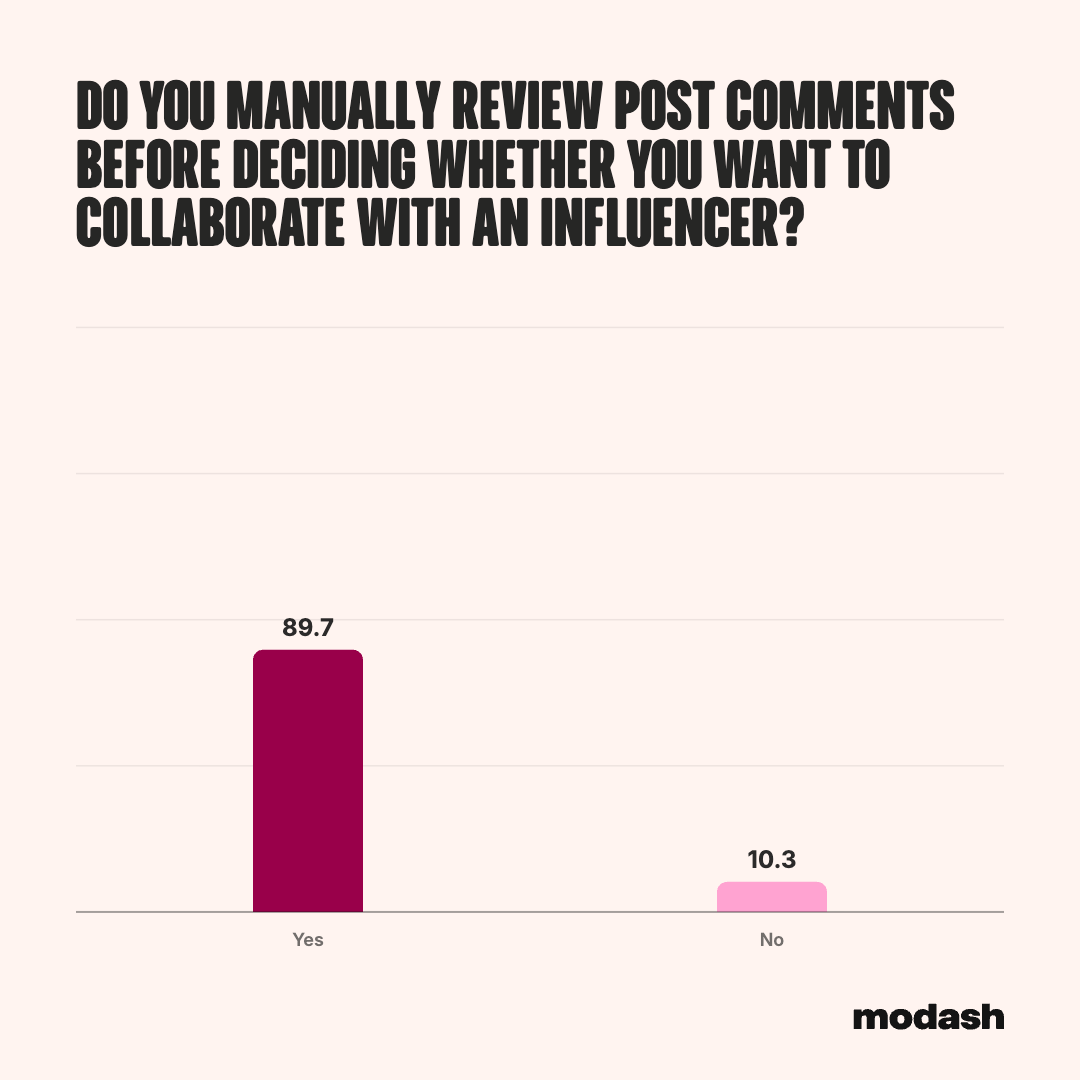
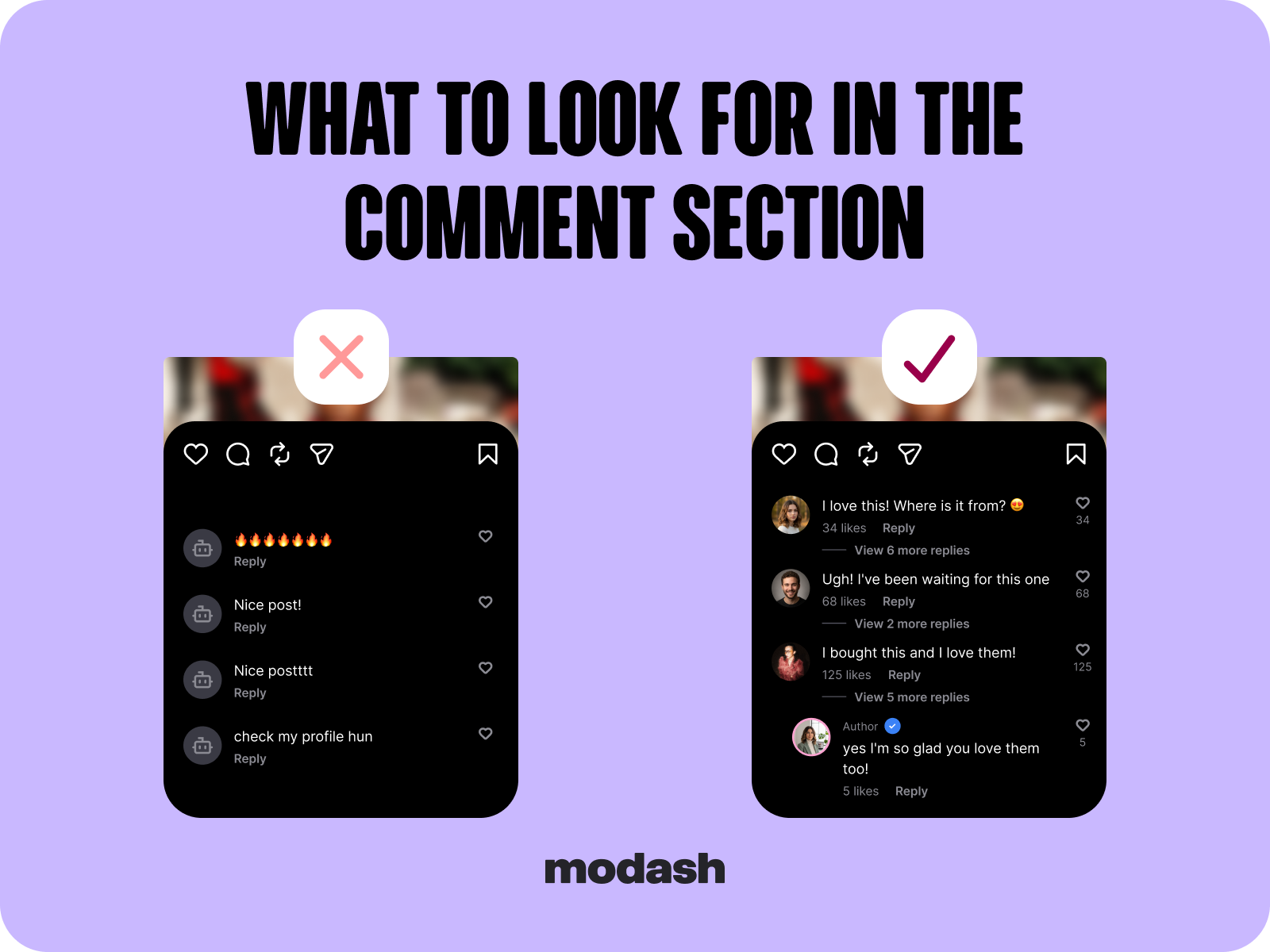
Most marketers know this: in our survey, 89.7% said they manually review post comments before deciding on an influencer. Real interest tends to come in the form of questions or specific reactions rather than a string of emojis. It’s also worth specifically checking sponsored posts for comments where people are asking about the product itself.
Flora Macher adds:
I prioritize influencers who not only receive genuine, thoughtful comments but also actively participate in the conversation by responding and initiating discussions with their audience. This level of interaction reflects a deeper connection with followers and indicates a higher engagement, which is crucial in influencer marketing.

Look out for the same red flags every time you scan a comment section:
One or two of these isn't necessarily a dealbreaker, but if there’s a pattern of them across multiple posts that’s… not a good sign.
Saves sit at the high-intent end of the spectrum. Someone usually saves a post because they're planning to come back to it, which is a pretty strong buying signal for ecommerce brands.
Shares mean someone liked a post enough to send it to a pal (also a good signal that they plan to take action on the post). But they also push the post in front of a new audience, and platforms like Instagram treat shares as a strong positive signal in the algorithm. More reach usually means more chances for comments, likes, and saves to follow, so a share can end up snowballing into extra engagement on its own.
The stuff that best predicts a sale often happens out of the public eye.
Picture a skincare creator who posts a normal, mid-performing feed post about your product. We’re not talking anything viral here, just a completely average engagement rate for their size.
But behind the scenes, 40 people in their Stories replies are asking where to buy it, and a dozen more have DM'd asking if it works for sensitive skin. You can’t see any of that on the post so it’s difficult to measure.
Engagement rate is essentially a single, very public-facing metric that simply can’t capture DMs, Story replies, or word-of-mouth conversations that happen off-platform. This is called the halo effect and while it’s impossible to fully capture it, you can capture some of it using these methods:

Hence why it’s important to treat engagement rate as part of a wider decision (basically, it shouldn’t be the full verdict).
Here's the standard formula:
Engagement rate = (Median likes per post ÷ Total followers) × 100
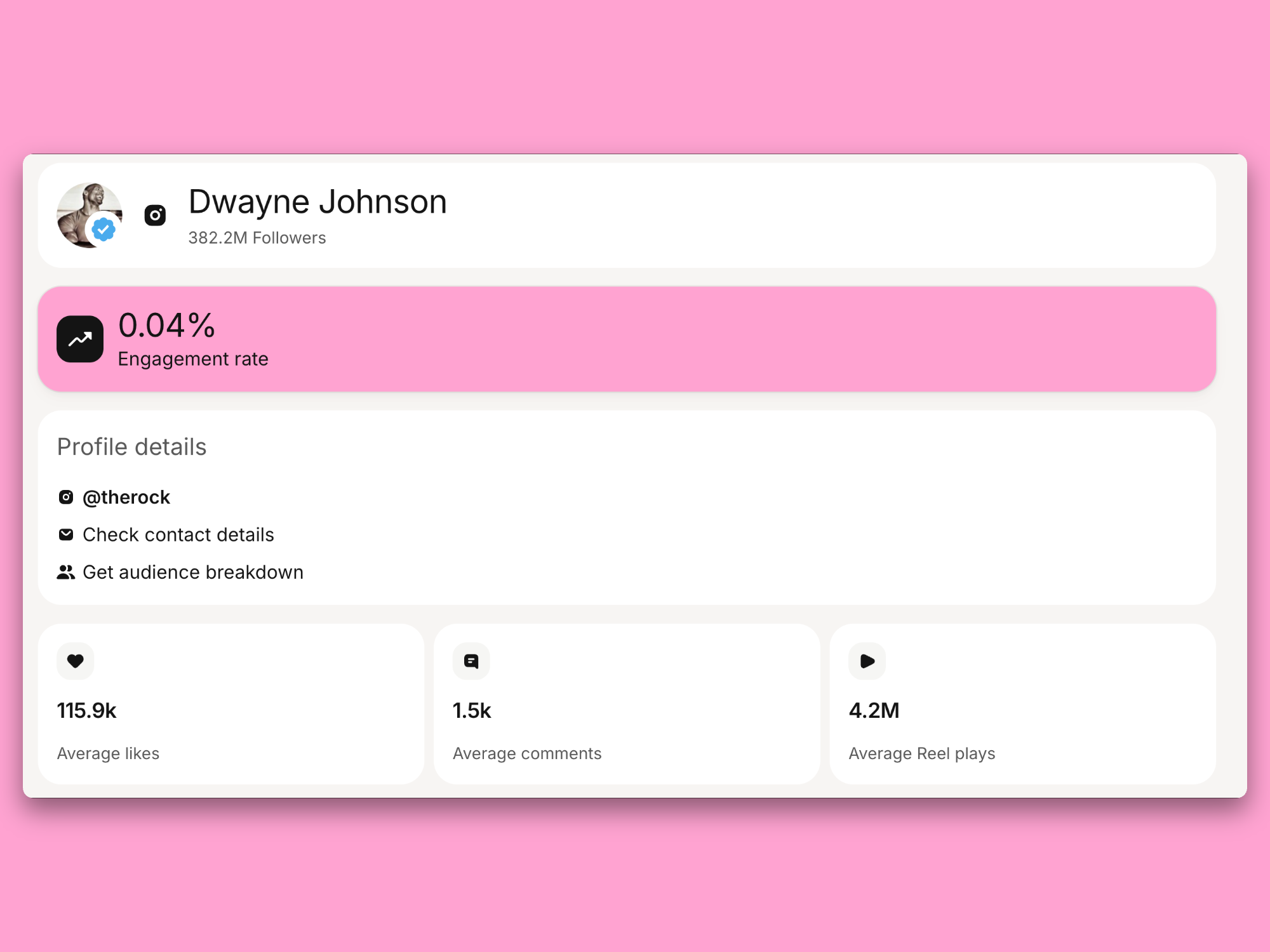
Realistically, though, you don't need to do this math by hand. Our engagement rate calculator will spit out the number for any public creator in a few seconds:
The baseline formula above is a good starting point, but "total engagements" isn't calculated the same way everywhere.
Here's how Modash (an influencer marketing platform) calculates it per channel:
Why median for Instagram instead of average? One viral post can drag an average wildly out of proportion (more on that in a second), so the median gives you a steadier, more honest look at a creator's typical performance.
TikTok and YouTube lean on views instead of followers, since view count is a better proxy for how many people saw the content on those platforms.
You don't need to pull these numbers manually or ask a creator to send you screenshots. Modash automatically shows engagement rate per platform on each creator's profile.
Even with the right formula, a raw engagement number can still lie.
1. One viral post skews everything. If a creator's average engagement is boosted by one post that blew up for reasons that have absolutely nothing to do with your brand (e.g., a trending sound, a lucky algorithm push, a random celebrity share, etc.), that single post can make their "typical" performance look a lot better than it really is.
2. Instagram's hidden likes can throw off the count. Since Instagram lets creators hide their like counts, some engagement tools either miss that data entirely or have to estimate it, which chips away at how accurate the end result is.
3. Engagement rate tends to shrink as follower count grows. A creator with a smaller, tighter community will often see a higher engagement rate than one with a much larger following, simply because it's much easier to stay closely connected to 5,000 people than it is to 500,000.
Don’t think of that as a red flag though, just bear in mind that a low engagement rate on a larger account and a low one on a smaller count can mean different things.
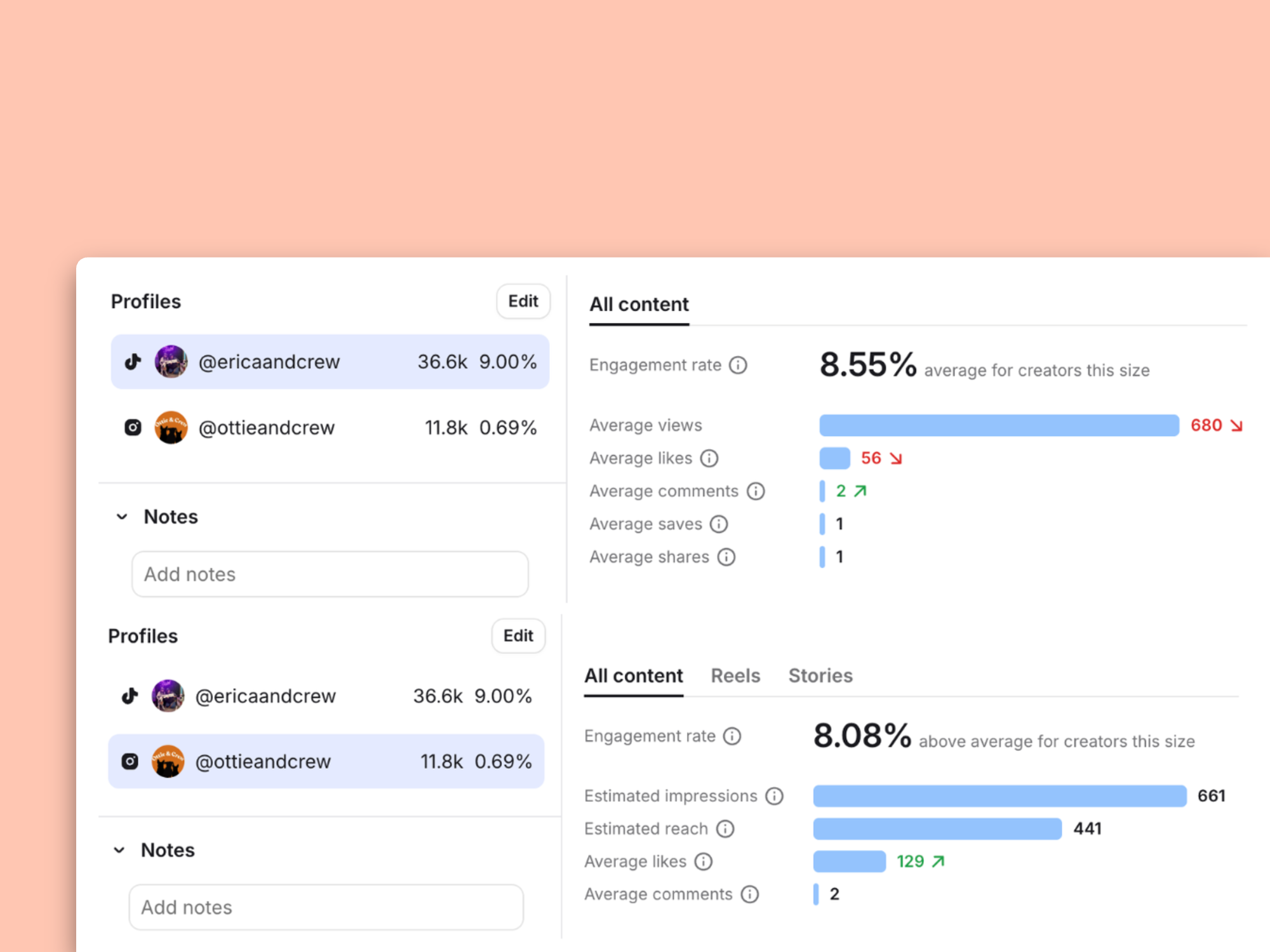
With Modash, you don’t have to scratch your head figuring out if an influencer’s engagement rate is “good” for their size – you can see the benchmark rate for creators of similar sizes.
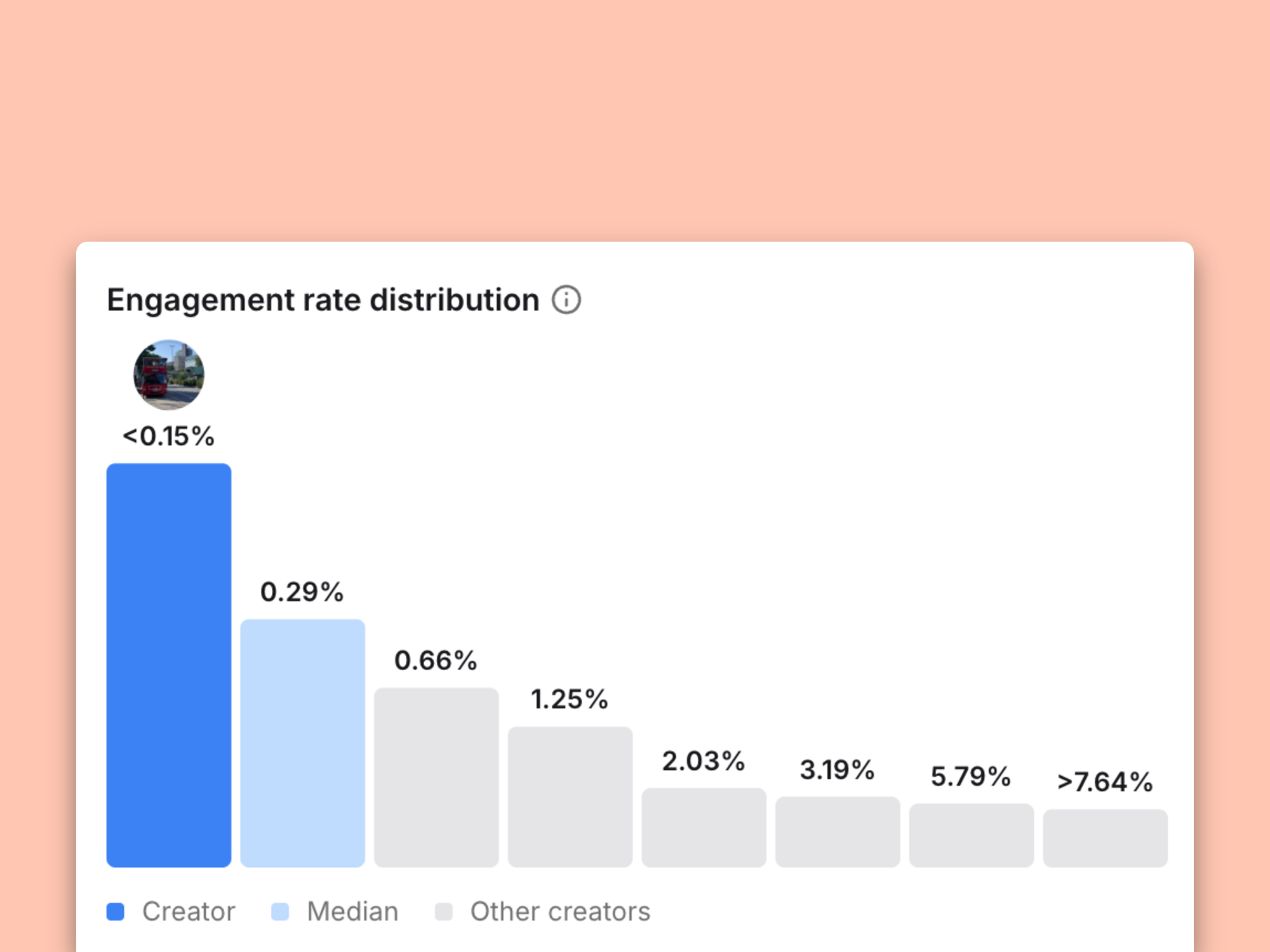
Valerija Somi adds:
The follower count matters to a point. If the follower count is not followed by good engagement and average reach, then the follower count is not that important. In terms of success, smaller accounts may bring the same results as the bigger accounts, especially when it comes to ROI.

Annoyingly, there isn't one number to rule them all. "Good" really just depends on what you're comparing it against… and if you're comparing every creator to the same flat benchmark (2%, 3%, or whatever number you've chosen), there’s a good chance you’re going to misjudge a lot of good creators as bad ones, and vice versa.
The biggest factor here is follower count, and we have to remember that engagement rate tends to drop as an account grows. Because, as we said above, it’s obviously a lot easier to stay closely connected to 3,000 followers than 300,000.
Here's what this looks like using median Instagram engagement rates across follower tiers:
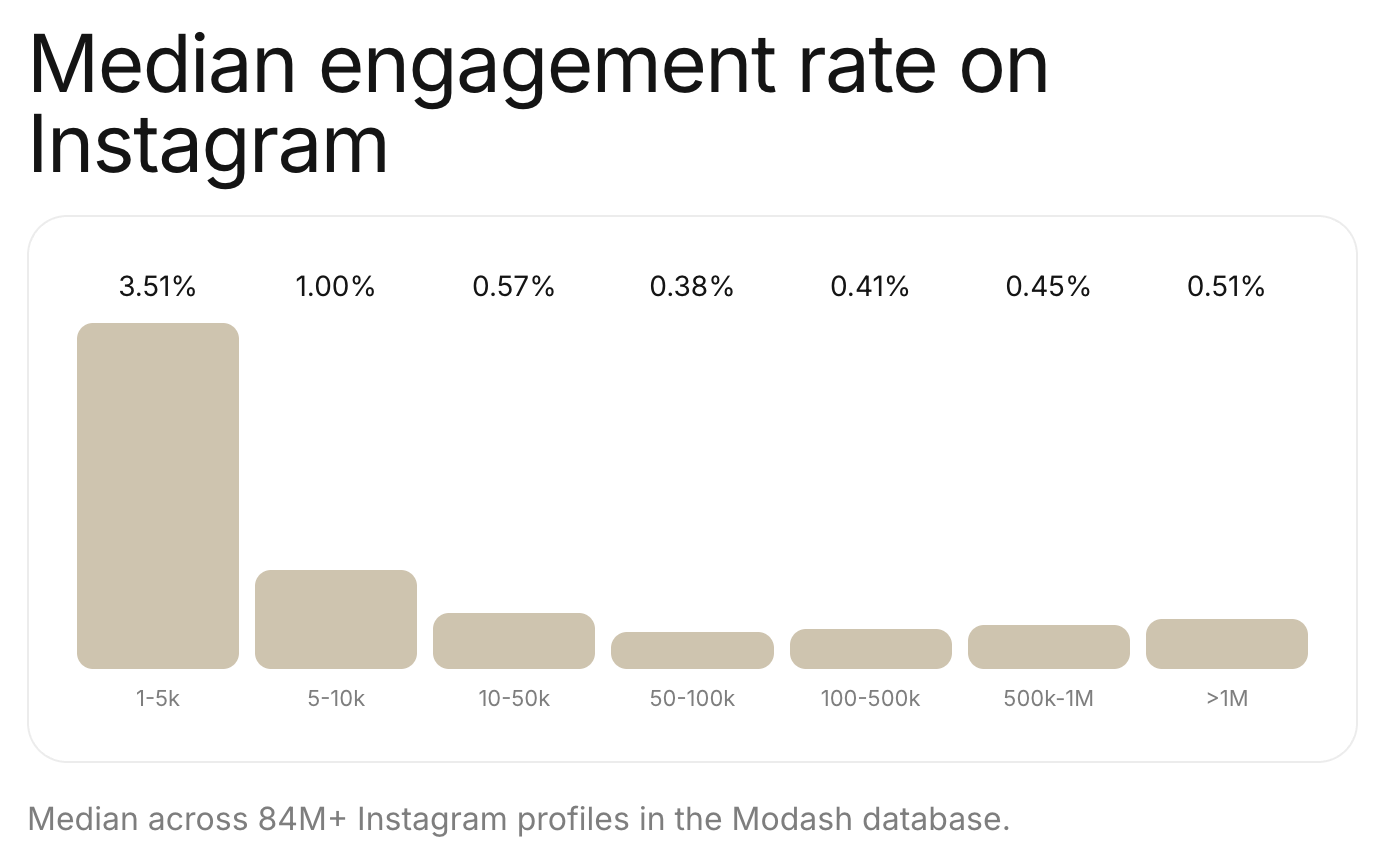
Look at how much the median moves. A creator with 3,000 followers posting a 2% engagement rate is actually performing below the typical range for their size. But a creator with 800,000 followers posting that same 2% has an exceptionally good engagement rate.
(The median can differ wildly by industry too. Some industries are just more popular on specific platforms – like skincare, beauty, fashion, etc. on Instagram – and will get more traction.)
This is why we don’t recommend judging engagement rate against a single universal cutoff because it just… doesn’t work. Instead of wondering whether 2% is good in general, think about whether 2% is good for a creator of this size on this platform.
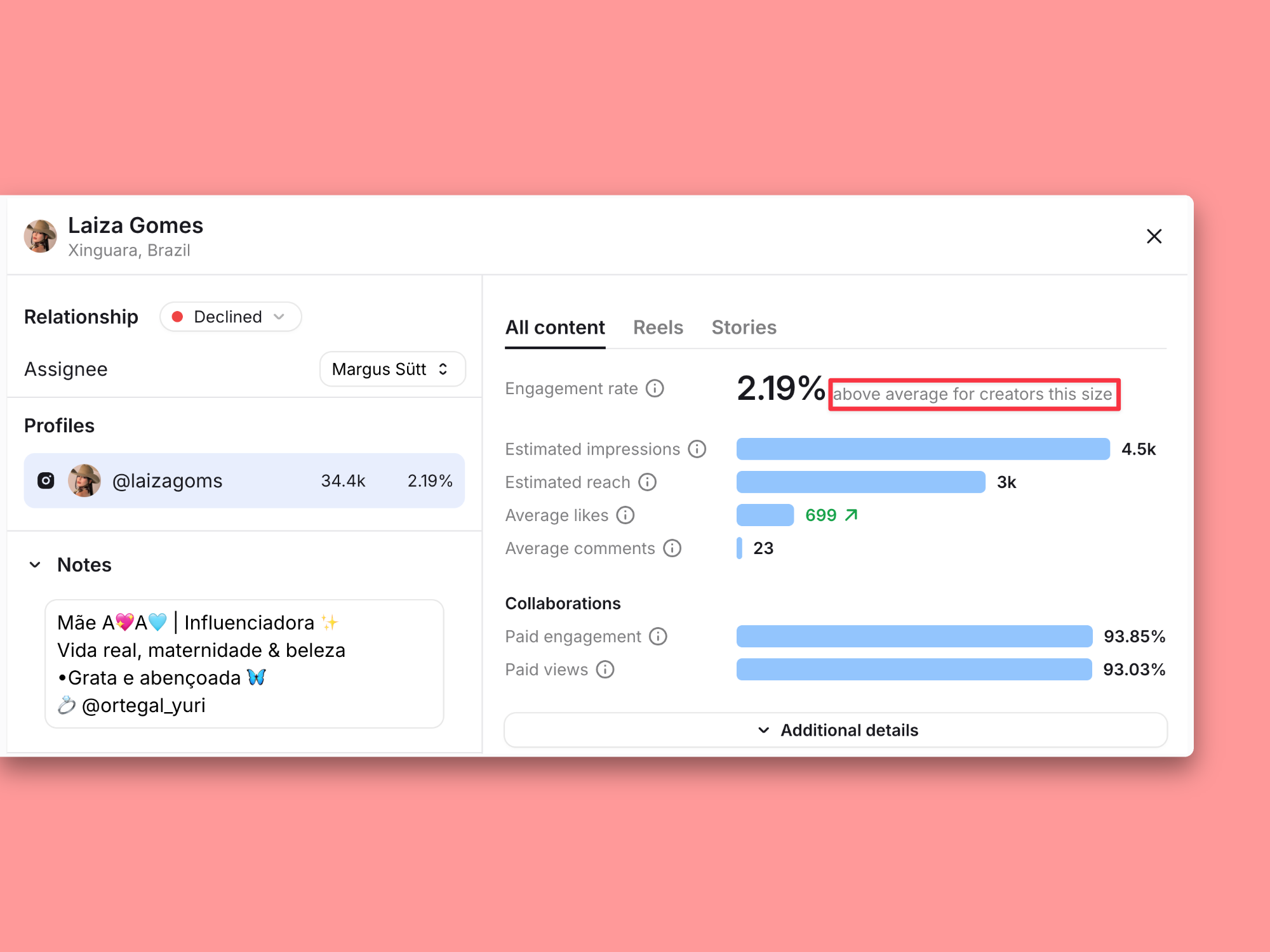
Modash automatically does this comparison. Instead of measuring a creator against a made-up standard, creator profiles show you their engagement rate relative to others in the same follower tier, so you can immediately tell if you're looking at a below-average creator with a decent-looking number, or an above-average one.
Spoiler alert: a high engagement rate doesn’t automatically mean people like a creator’s content. It can be bought, which sounds a bit icky, but it’s pretty common.
A quick search turns up plenty of services happy to sell likes, comments, and views for a flat monthly fee (Insfamous and Buzzoid are just a couple of examples).
Between paid services like these and engagement pods (more on those in a second), a healthy-looking rate can be almost entirely manufactured. So, before you factor engagement rate into your decision, do a few quick checks to make sure a creator’s numbers haven’t been massaged.
You don’t even really need to don your detective’s hat to figure out whether engagement is real if you know what to look for.
Here are some things to keep an eye on:
Another red flag is always seeing comments from the same five people, usually other influencers. And then when you go check out their content, it's the same story. That tells me they're likely running a pod and inflating each other's engagement metrics.

Sometimes, a little bot content is inevitable. But if I see a creator with 40,000 followers, 100 likes per post, and 3 comments, most of which saying, "Check out my profile love!" I know their community isn't organic and their content would not sell to real people.

None of these is a dealbreaker on its own (every creator gets the odd bot comment or troll). But when you see two or more of these patterns together across a few posts, it’s a pretty glaring sign that something’s not right.
I think we’ve hammered home the fact that engagement rate only means something if real people are behind it and that fake audiences are no bueno.
This is why it’s a good idea to pair engagement rate with an audience quality check rather than looking at engagement in isolation.
Modash's audience credibility score does this by breaking a creator's followers down into five groups:
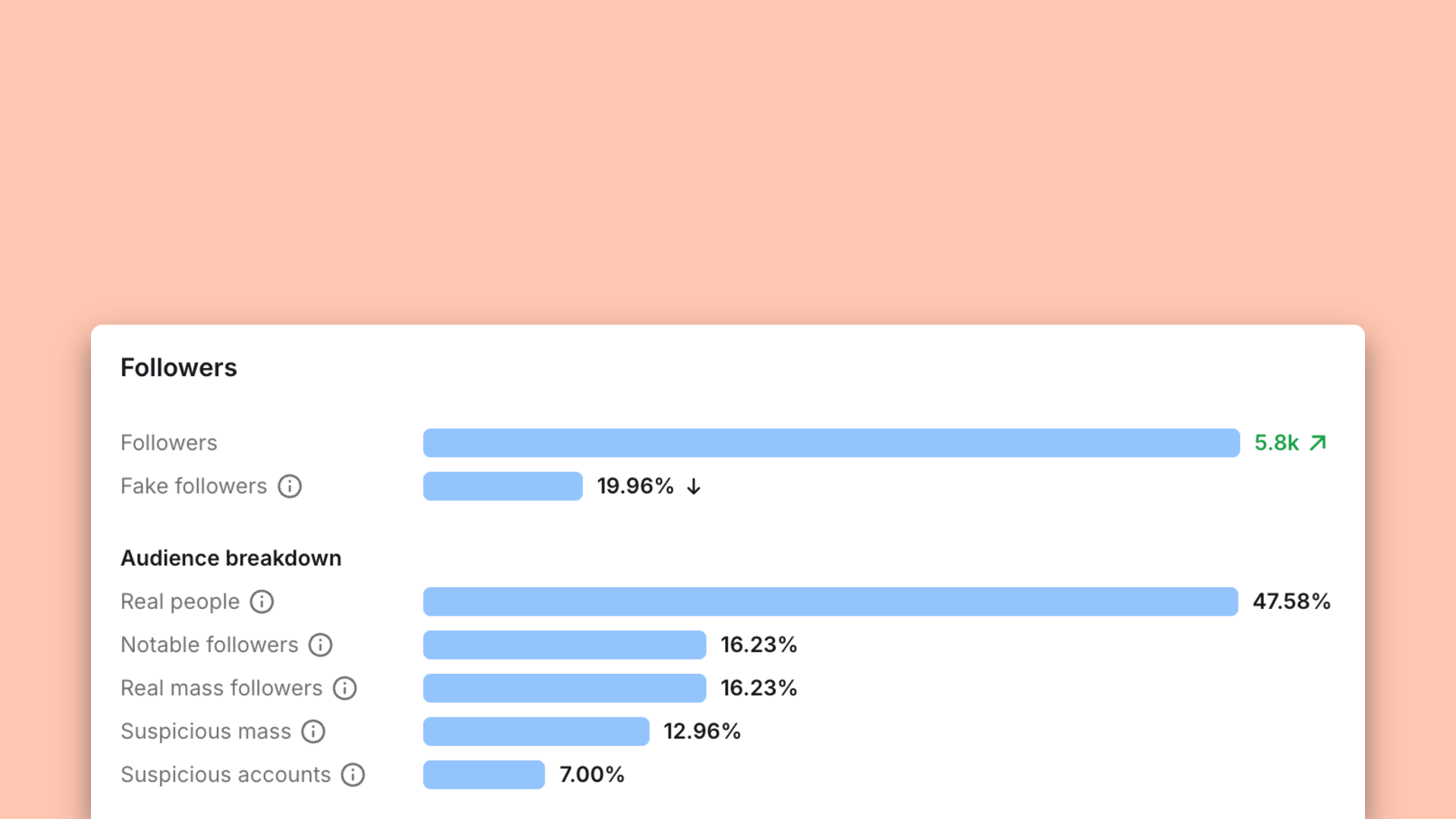
If a creator's engagement rate looks great, but their credibility score is low (meaning a big chunk of their audience falls into the "suspicious" buckets), that's a strong indicator the engagement is inflated. A creator can't have thousands of real people commenting and liking if a large share of their followers aren't actually real.
Even a creator with perfectly real, perfectly organic engagement can get totally different results on an ad.
It's an extremely common pattern: organic engagement is strong, but the same creator's sponsored posts see way fewer likes and comments. This isn’t automatically a red flag (some audiences just naturally scroll past anything they can tell is paid) but it does matter for you because you’re going to be the one paying for a sponsored post.
Modash's paid-post performance metric compares a creator's #ad engagement directly against their organic engagement and shows it as a percentage.
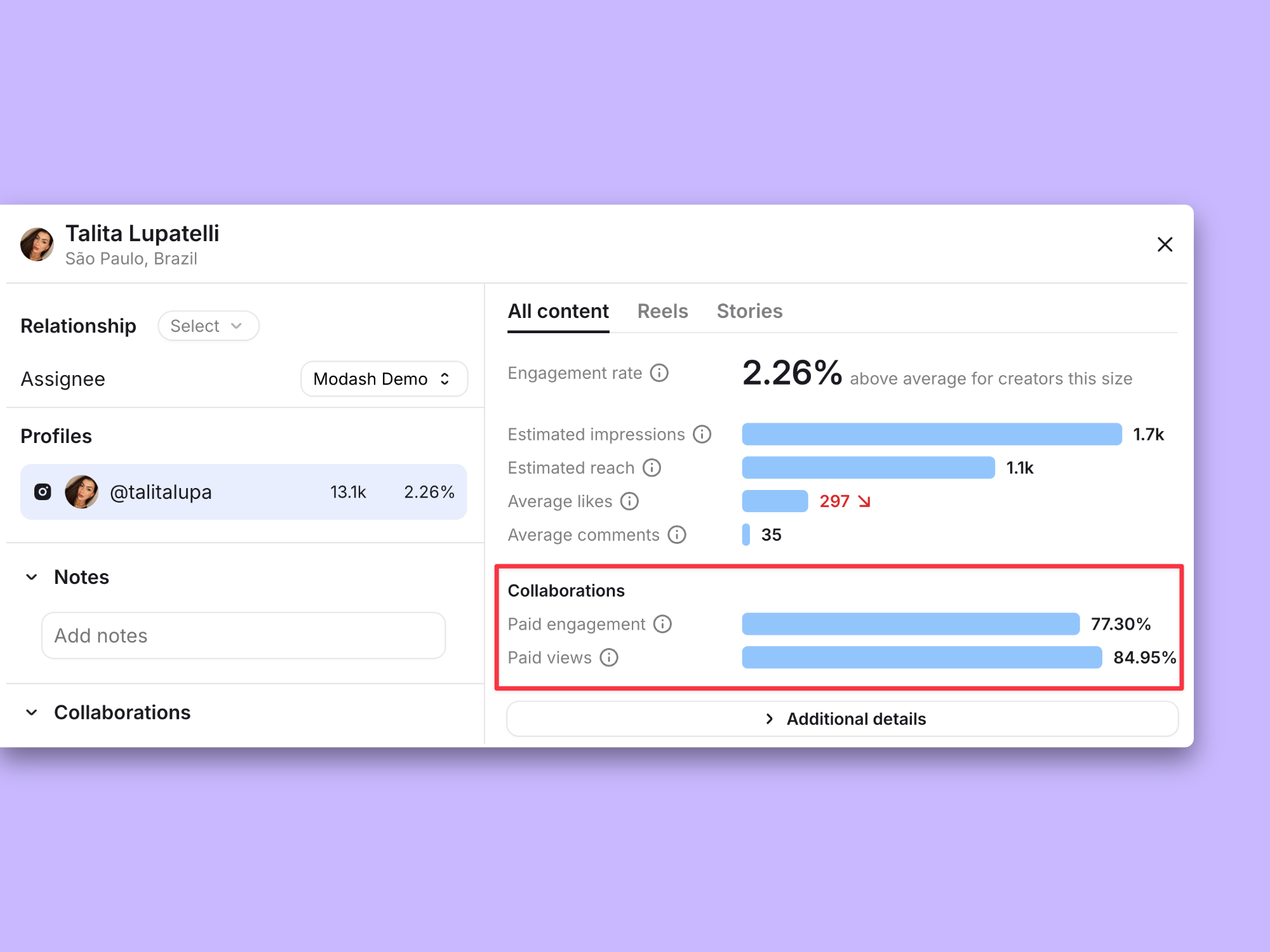
Everything covered so far works great when you're sizing up one creator at a time. But once you've got a shortlist of 10, 20, or 50 names, manually checking each one can really eat into your time.
For a single creator, you just need the engagement rate calculator. Punch in a username, get the number, voila.
For a shortlist, that same one-at-a-time process just doesn't scale well at all. This is where an influencer marketing platform like Modash can be extremely useful.
You can find each creator’s engagement rate by platform, benchmark it against similar influencers, and assess a lot more (like their past collabs, audience interests, etc.). But that’s not all.
If you already have found creators using another method, you can simply import your shortlist and Modash pulls the engagement rate and audience data across every creator on it in one clean list.
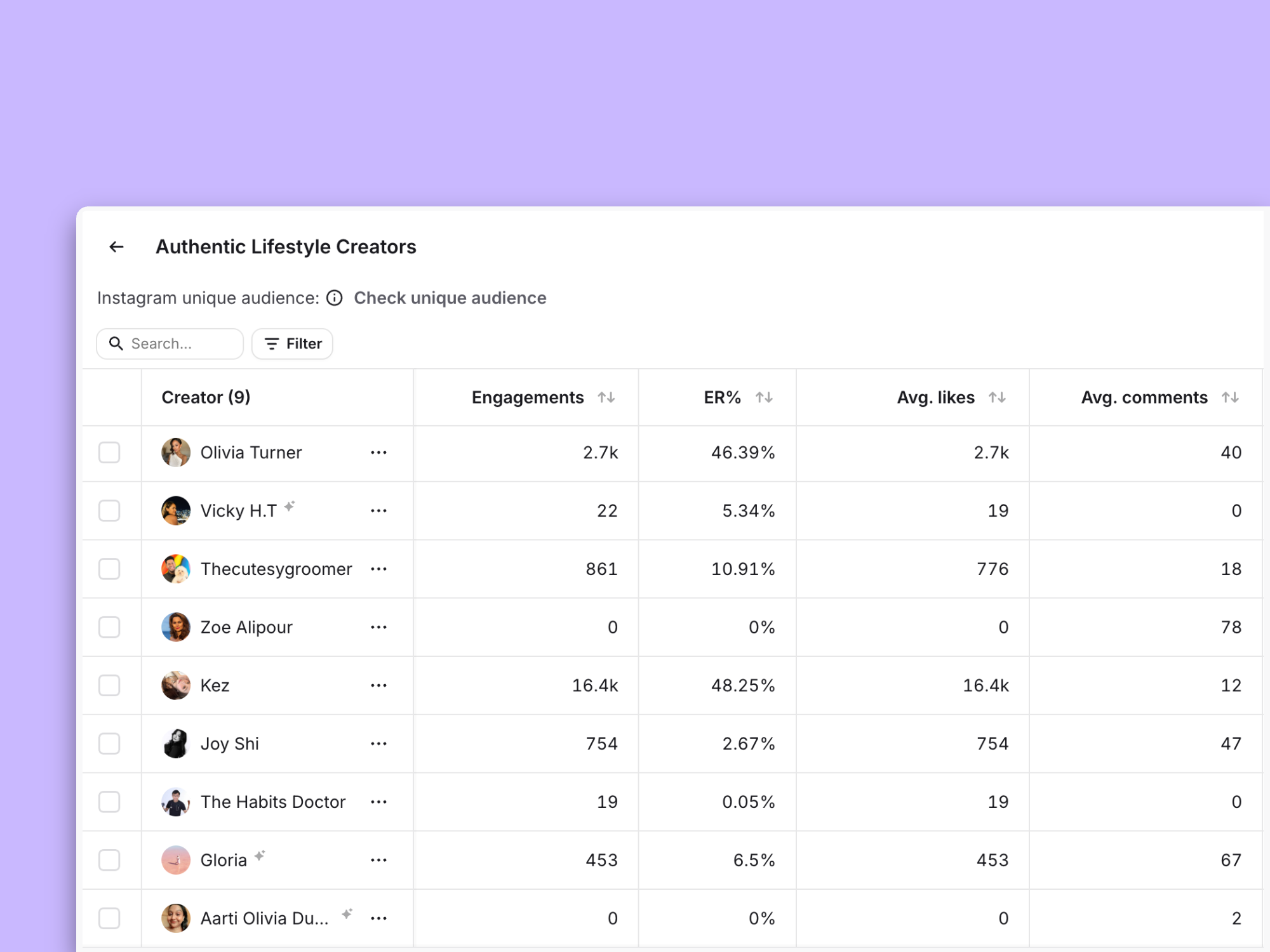
Once it's done, you can export the whole thing and compare creators side by side, instead of switching between profiles and copying numbers into a spreadsheet by hand.
Try Modash free for 14 days and skip straight to the comparing part.
Everything in this guide has been about getting engagement rate right… calculating it properly, judging it against the right benchmark, and making sure it's, you know, real. That's very important work, but it's still just one small piece of the picture.
Yes, engagement tells you whether people interact with a creator's content, but it doesn't tell you whether their audience matches yours, whether their personality and values fit your brand, or whether they can actually sell a product.
A creator with a stellar engagement rate but an audience in the wrong country, the wrong age range, or the wrong niche isn't going to move the needle for you, no matter how many times you verify the legit-ness of their comments.
So, your best bet is to treat engagement rate as one filter in a bigger vetting process, alongside things like audience demographics, brand fit, content quality, and past sponsored-post performance.
Want the full picture on how other marketers vet creators beyond just the engagement rate? Check out our survey findings on how marketers vet creators.
And if you'd rather not juggle five different tabs to vet a single creator, use Modash. It pulls engagement, audience quality, and vetting data into one place, alongside discovery, outreach, and creator payments. Try it free for 14 days and see the magic yourself.
Yes. Engagement pods, bought comments and likes, and fake followers can all inflate a rate to look better than the audience actually is. Checking comment quality and cross-referencing an audience credibility score are the best ways to catch it.
For most ecommerce brands, yes – a smaller, highly engaged audience that trusts a creator's recommendations is usually worth more than a large, passive one. Follower count still matters for reach, but it says nothing about whether people actually pay attention.
Because the formulas differ by platform, rates aren't directly comparable across them – Instagram measures against followers, while TikTok and YouTube measure against views. The better comparison is always against other creators on the same platform and around the same follower size, rather than a single number applied everywhere.
Different tools use different formulas and timeframes, so if there’s a mismatch, it usually comes down to methodology. Modash, for instance, uses median likes over the last 2 months for Instagram specifically to cover up any outlier viral posts, which can produce a different (and often more representative) number than a simple average.