

More tools
Use cases




Most travel influencer marketing advice stops at "work with micro-influencers" and "be authentic". We wanted to see what the biggest travel brands actually do, so we pulled the 50 most recent sponsored posts for each of the most-searched travel brands in the US and looked at who posted, how each deal was disclosed, and which posts took off.
Here's why travel brands work with creators, the commonalities in their strategy, and a step-by-step way to run your own campaign.
Creators do a few things for travel brands that ads and product pages can't:
These are the most-searched travel brands in the US, according to Ahrefs. Deal types show how each post was disclosed (for example, with a paid partnership label or an ambassador hashtag). Creator tiers: micro 10k–50k followers, mid-tier 50k–500k, macro 500k+.
| Brand | What they sell | Most common deal type | Typical creator size | Signature tactic |
|---|---|---|---|---|
| Airbnb | Vacation rentals and experiences | Paid | Mid-tier | Sponsoring Rio Ferdinand's World Cup shows |
| American Airlines | Domestic and international flights | Paid | Mid-tier | Creators flown to World Cup games |
| United Airlines | Flights and premium Polaris cabins | Paid | Mid-tier | Creators on the first flights of new routes |
| Southwest Airlines | US and nearby international flights | Paid | Mid-tier | Local creators pushing nonstops from one city |
| Expedia | Flights, hotels and trip bundles | Paid and ambassador | Mid-tier | Ambassadors invited to its own partner events |
35 of Airbnb's last 50 sponsored posts come from former footballer Rio Ferdinand and his co-hosts, who reacted to World Cup matches, interviewed former players and vlogged their trip in partnership with Airbnb. Another 10 show stays, like a château booked by the group chat or a loft in Vancouver. All 50 went live between June 13 and July 1, only 17 creators made them, and none use a code. Its creators are based in the US (8), the UK (4) and Sweden (2).

What to take from it: Back a show fans already watch, and let the host keep their voice. Rio Ferdinand's reaction to a Cristiano Ronaldo goal got 2.5M plays and 431k likes from an account with 715k followers, Airbnb's most-viewed post.
American's last 50 sponsored posts lean on big moments. 9 mention the World Cup, with creators flying to games in Boston, Los Angeles and Vancouver, and 9 celebrate its 100th year, 4 of them from a Dallas Mavericks game. It works almost only with US creators (31 of the 33 with a location), 48 posts were disclosed as paid partnerships, and none include a discount code.

What to take from it: Let creators mark your milestones in their own voice. A creator with 904k followers wished American a happy 100th birthday in Spanish, and it got 522k plays and 35k likes, the most of any of its anniversary posts.
11 of United's last 50 sponsored posts come from inaugural flights and new routes, from Newark to Bari and Split to a new route to Adelaide and the first flight of its new Elevated Dreamliner to Singapore. 4 more come from behind-the-scenes airport tours at SFO and O'Hare. 37 of its 38 creators with a location are in the US, 48 posts were disclosed as paid partnerships, and none use a code.

What to take from it: Announce new routes the way travelers search for them. @lilmsawkward called United's new nonstop to Adelaide "the largest U.S. carrier to Australia," and the post got 9.3k plays and 493 likes from a creator with 109k followers.
11 of Southwest's last 50 sponsored posts come from Austin creators, who all posted between April 29 and May 1 to promote its nonstop flights from the city, from a 30A beach weekend to sweets in Las Vegas. Another 9 are holiday posts where creators passed a Southwest gift on to someone they love (#SouthwestUnwrapTheJoy). All 35 creators with a location are in the US, all 50 posts were disclosed as paid partnerships, and none use a code.

What to take from it: Tell followers about a perk they didn't know existed. A creator with 39k followers explained Southwest's Sip & Ship program, which lets you check a full case of wine on select West Coast flights, and the post got 4.2M plays, Southwest's most-viewed.
30 of Expedia's last 50 sponsored posts carry #ExpediaAmbassador or #EGAmbassador, though only 17 were labeled as ambassador posts. 8 come from its Priority Access and Expedia Explore partner events, where creators previewed new app features, and 6 are from Budapest, including a series built around Liverpool FC players' favorite spots in the city. Its creators are based in the US (20), the UK (3), Canada (2) and Australia (2), and none use a code.

What to take from it: Give a creator a series, not a single post. A creator with 32k followers tasting Hungarian food for Expedia's Budapest series got 860k plays, about 27 times their following.
Looking across all 250 posts, four patterns stand out:
Here's how to run a campaign step by step, using what the top travel brands do at each stage.
Decide what the campaign is for before you pick a single creator, because the goal changes who you book, how you pay them and what you ask them to post. The top travel brands' posts show both goals at work. Southwest's status match posts and Expedia's Bundle & Save posts are built to drive bookings. Southwest's college hoops street interviews and United's Hallmark Channel mini movie are built for reach.
Pick one metric per campaign so you can compare creators fairly afterwards.
Follower count is the last thing to filter on. A creator with 23k followers posted about flying Flagship First with American on a honeymoon and got 85k plays, nearly four times their following, because couples planning a big trip are the people who book premium seats. Across all five brands, creators under 50k followers got about twice the likes relative to their audience.
Our survey found niche micro-creators are outperforming mega-influencers: nearly 60% of marketers said niche influencers performed better in 2025 than in 2024.

You can also find travel influencers for free, for example by searching the hashtags your buyers follow.
Travel brands pay per post. Airbnb and Southwest disclosed all 50 of their last 50 posts as paid partnerships, and American and United 48 each. Expedia is the exception, with 17 labeled as ambassador posts.
Commission-only is getting harder to sell, though. Over 23% of marketers in our survey said creators would take performance pay only if a flat fee came with it. If you run tiers, the average commission tiers in our affiliate research were 10%, 14% and 19%, and brands with more than one tier had more active affiliates.
The captions from the top travel brands point to three formats that carry most of their creator content:
Whatever the format, give creators the exact route or destination, the dates any offer runs, and one partner hashtag like #UnitedPartner or #SouthwestPartner.
The top travel brands send people to a booking, not a code. Southwest's creators asked followers to comment a word like "STATUS" to get the link in 4 posts, and Expedia's pushed Bundle & Save in 4.
Codes also leak. In our affiliate marketing research, 47.6% of marketers said they struggle with code poaching, where a creator's code ends up on coupon sites.
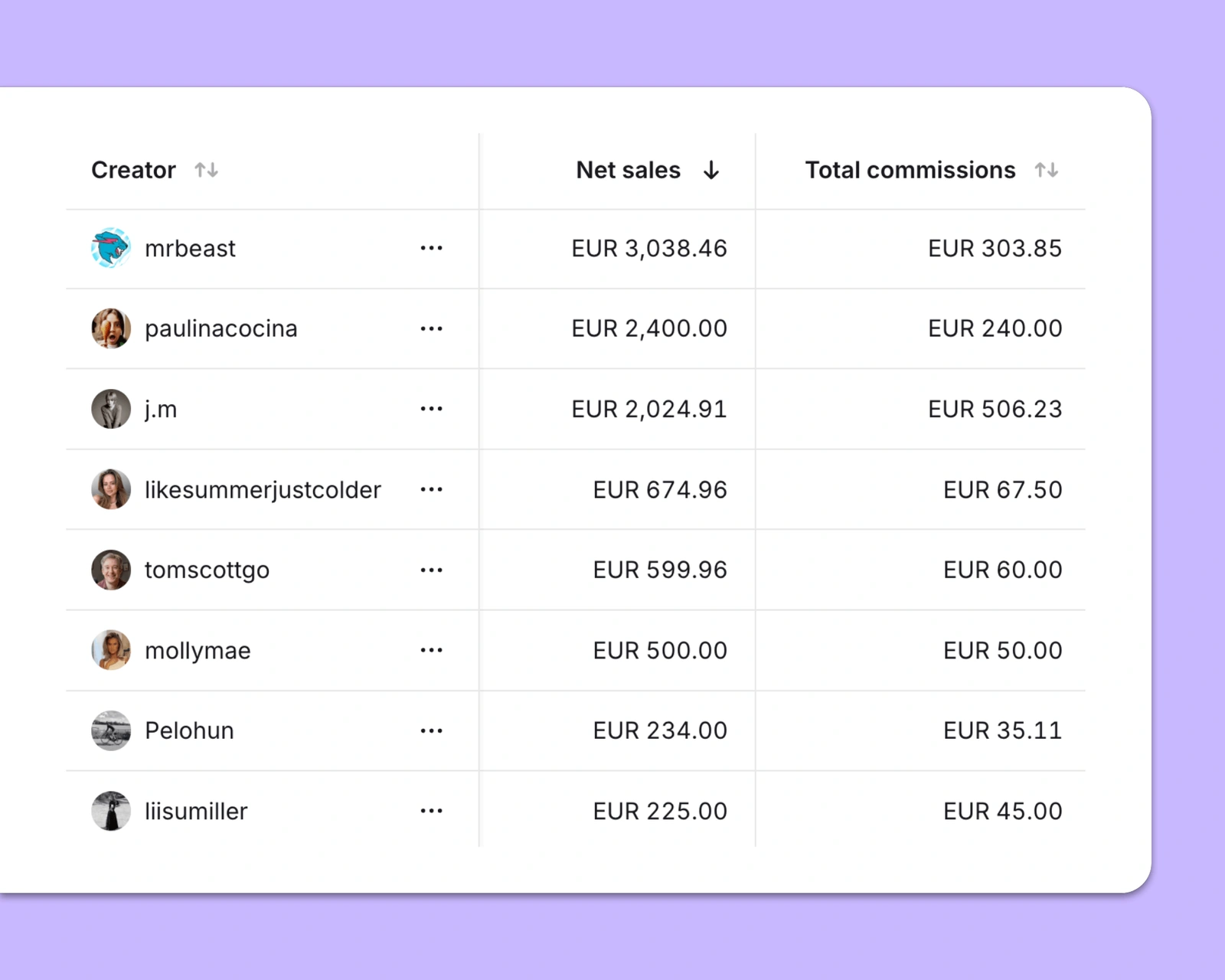
In Modash, each creator gets a tracked link and a code tied to your Shopify data, so sales from DMs, bios and stories all count toward the right person. Commission is calculated on net revenue after refunds and returns.
The top travel brands bring some creators back: 42 of their 163 creators posted more than once, like Expedia's @reneeroaming with five posts. That matters in travel, where followers trust a creator who has already flown the route or stayed at the place, and every new trip gives them something fresh to post.
Most marketers want to do more of this. In our influencer marketing trends survey, over 60% said they plan to invest more in long-term partnerships, but only 54% actually ran more of them last year.
The top brands avoid a few mistakes that trip up smaller programs:
It depends on platform, following and engagement. Micro-influencers often work for free product plus a fee in the low hundreds per post, or an affiliate commission. Larger creators charge more. Many brands start with gifting plus commission to test fit before committing to flat fees. To estimate what a specific creator is likely to charge, drop their handle into our free Instagram influencer pricing calculator.
Instagram carries most travel creator work, and every sponsored post we analyzed for the five most-searched travel brands ran there. TikTok is worth testing too: in our survey, marketers rated TikTok videos the highest-performing deliverable (53.2%).
Airbnb, American Airlines, United Airlines, Southwest Airlines and Expedia are the most-searched travel brands in the US, and all of them run active creator programs. See the breakdown above for who each one works with.
It depends on your goal. A launch chasing awareness leans bigger, a conversion play leans smaller and more trusted. In the travel posts we analyzed, creators under 50k followers got about twice the likes relative to their audience size, so most brands should build their base with micro-influencers (10k–50k followers) and add bigger names for launches.
Track sales per creator with unique links and codes, then compare revenue against what you paid (fees, product and commission). Our engagement rate calculator and fake follower checker help you vet creators before you spend, and our guide to influencer marketing ROI covers the full calculation.
Find creators, manage relationships, pay them in 180+ countries and 36 currencies, and track every sale through Shopify – all in one place, with no fees taken out of creators' pay. Try Modash free, no credit card required – or browse the top travel influencers to see who's already out there.