Capabilities
Integrations







Use cases
Capabilities
Integrations
Use cases

Refersion and Affiliatly both give affiliates a trackable way to send customers to your store, and the software works out which sales to credit and what commission is owed.
But they're not the same tool. The differences show up in how you pay, how a sale gets attributed, where new affiliates come from, and how partners get paid.
This comparison covers recruitment, tracking, pricing, commission rules, payouts, and content tracking, then looks at Modash as a third option for brands whose affiliates are creators.
Refersion is best for brands that want first-party tracking links, a documented menu of commission structures, and a way to proactively find and hire new affiliate partners. Affiliatly makes most sense for brands that aren't bothered about outbound recruitment, but want a predictable flat monthly fee tiered by affiliate count and tracking by link, coupon, email, or QR.
The problem with both tools is that neither collects the posts, Reels, Stories, or videos affiliates publish about your brand, so you can see which affiliate converted a sale but not the content that drove it.
Modash is an influencer marketing platform for Shopify brands that covers creator discovery, campaign tracking, product gifting, and affiliate payouts in one place, which is why it belongs here as the option for brands whose affiliates are creators.
Here's how the 3 compare:
Every affiliate program needs a steady supply of new partners. So before you compare commissions or payouts, you need to know whether the software helps you find affiliates or only manages the ones you already have.
Both Refersion and Affiliatly allow brands to list their program on their respective marketplaces, where creators browse offers and apply for those that catch their eye. Refersion's is used by 6.6 million opt-in affiliates, influencers, publishers, and brand ambassadors, whereas Affiliatly doesn't share this information publicly.
The big difference is Refersion also offers an outbound recruitment option by letting brands browse its directory for relevant creators. The platform's AI also creates curated lists of affiliates based on a brand's customers and products.

However, neither tool can compete with Modash when it comes to hiring affiliates.
Modash lets you search a database of 380M+ creators directly, and each profile shows audience demographics and engagement metrics before you send a single message. You can describe the creator you want in plain language, narrow the pool with audience and performance filters, or start from a partner who already converts and find more creators like them.
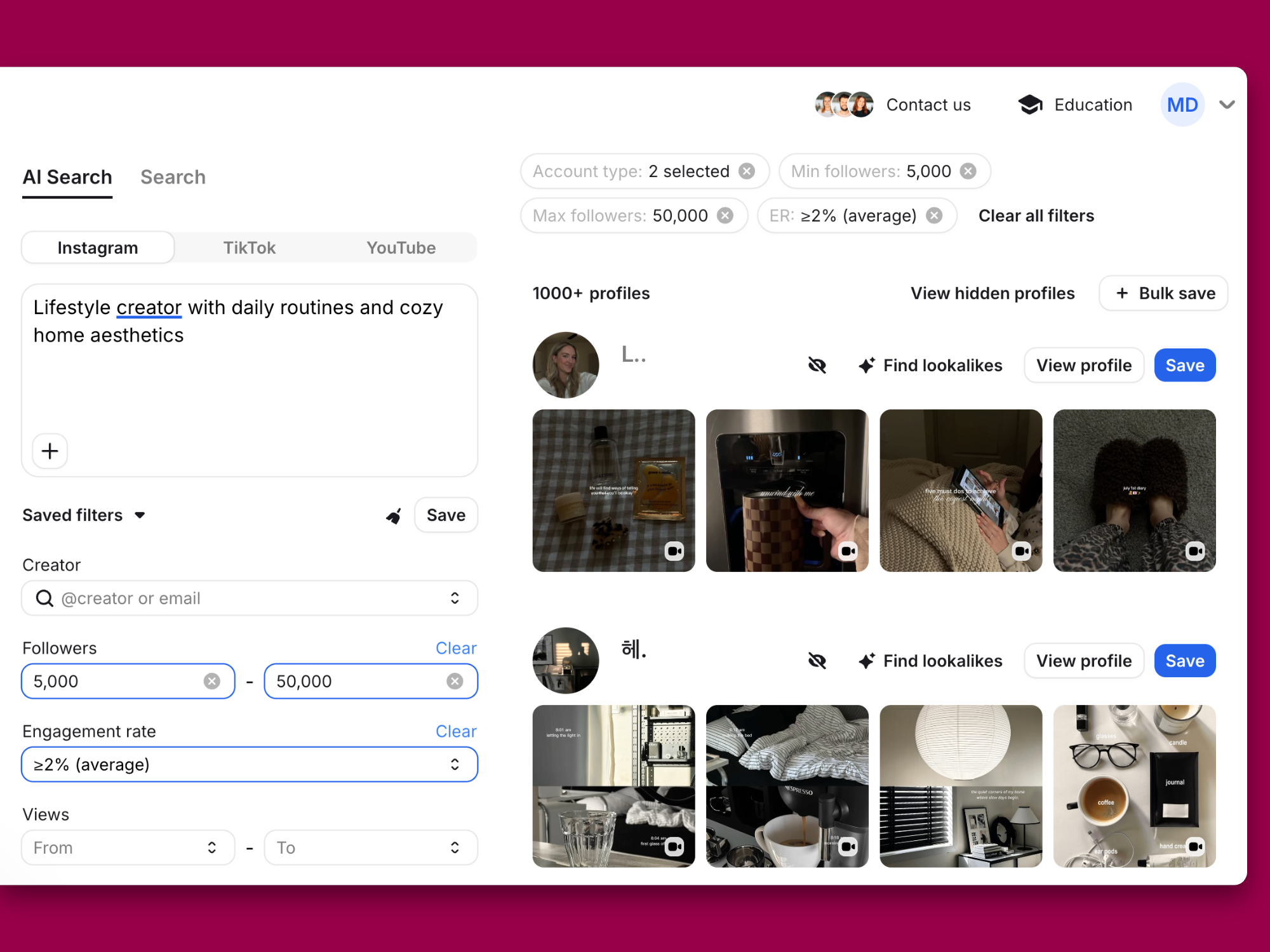
Bottom line: Unlike Affiliatly, Refersion offers a proactive way to recruit affiliates. But it falls way short of Modash, which lets you search 380M+ creators without waiting for anyone to apply.
Before you pay a commission, you need to know which affiliate sent the customer. Both tools track affiliate sales back to a specific affiliate, but they take different routes to get there:
Refersion's tracking is built around first-party links, designed to eliminate attribution gaps and user redirects. On top of the link, Refersion lets you add attribution rules based on email, SKU, and code redemption, so you have more than 1 way to decide who earned a sale.
Affiliatly matches affiliates to orders by email, link, coupon, SKU, tag, or QR. An affiliate who shares a coupon code or a QR code gets credit through that method, not only through a tracked link.

Those methods apply to orders from all the store types Affiliatly connects to: Shopify, BigCommerce, WooCommerce, and Squarespace, plus custom stores.
Modash keeps credit simple with last-touch attribution: the last creator link a shopper clicked before buying gets the credit, so every payout traces back to 1 creator and you never have to untangle competing claims.
Bottom line: Refersion suits brands that want first-party links plus email, SKU, and code rules to decide who earned a sale. Affiliatly suits brands that want several ways to match an affiliate to an order – link, coupon, email, QR, and more – across Shopify, BigCommerce, WooCommerce, Squarespace, or a custom store.
Before you commit to a plan, you need to know how much of your affiliate revenue the software keeps as the program grows. Here the 2 pricing models pull in opposite directions. Refersion's bill rises with every affiliate-driven sale; Affiliatly's only increases when you add more affiliates.
Refersion's plans run from $39 – $199/month (or $29 – $159/month billed yearly) plus 2% – 3% of affiliate-driven sales.
The top-tier Growth plan takes the smaller percentage, and Refersion positions it for brands nearing $1M in GMV. In practice, the percentage, not the subscription, becomes the bigger line item once sales pick up.
Affiliatly offers a free plan for up to 50 total tracked orders, then flat monthly fees from $16 to $129/month that are tiered by affiliate count rather than by sales. The $16 Starter plan covers up to 50 affiliates with unlimited orders, and the ceiling is the $129 Pro Unlimited plan, with all features and no limit on how many affiliates you can work with.
Modash takes a slightly different route. Fixed fees start at $199/month on an annual plan or $299/month on a monthly one, while higher plans offer additional features and usage limits.
And there's also a variable component: if you use Modash to pay affiliates, the first $10,000 you pay out each year carries a 0% fee, and a 5% fee applies only to the amount above that. You settle 1 Modash invoice and Modash handles the creator payments and tax, so a record sales month never shows up as a surprise on your software bill.
Bottom line: Pick Affiliatly if you want a software cost you can forecast, since a flat monthly fee tiered by affiliate count means a strong sales month doesn't raise your bill.
Once commissions are approved, you need to move money to affiliates without exporting a spreadsheet and settling every balance by hand.
Affiliatly supports a wide range of payout methods, from Bitcoin and PayPal to bank transference and Venmo. Here's a full list of options:

As you can see, only one of those methods – gift card payments – can be automated.
It's a similar story on Refersion, where gift card/store credit is the only automatic payment option (and even then, it's only available to Shopify Plus users).
The platform also integrates with PayPal Payouts and Trolley, while Unified Payments is an option for US-based merchants. Or you can choose to pay affiliates manually outside Refersion.
Either way, both tools leave the payout run with you. By contrast, Modash takes this step off your plate altogether: you pay one Modash invoice, and Modash handles creator payments and tax.

Bottom line: Affiliatly supports more payment methods, but Modash is the obvious choice if you want to save time on affiliate payments.
If your affiliates are creators, you eventually want to see the posts behind the sales, not only the link or code that converted. On this job, the 2 tools land in the same place.
Neither Refersion nor Affiliatly collects the posts, Reels, Stories, or videos an affiliate publishes about your brand. In practice, that means the content side of the program lives outside the tool. Someone on your team keeps a spreadsheet of post URLs and screenshots Stories before they expire. When it's time to decide which affiliates deserve a bigger commission or a renewed contract, that list gets matched back to the sales report by hand.
Modash does things differently. It collects affiliate content automatically as creators post it, based on your campaign's hashtags, mentions, and keywords. You can then sort what came in by engagement or views, so you can see which affiliates earned their commission with content that actually performed, without chasing anyone for links.

Bottom line: Refersion and Affiliatly both leave content tracking to you, so if seeing affiliate posts alongside affiliate sales matters, plan on a spreadsheet or a second tool. Modash handles both in one place.
Refersion and Affiliatly both stop at the sale. Neither shows you the posts behind the commissions, and neither tool's public sources describe a way to search for creators by audience data before they join your program.
Modash is built for that wider job. You can search 380M+ creators and see each one's audience demographics and engagement metrics before you send a message, so you pick partners on data instead of waiting for applications to arrive.
Once creators are posting, Modash collects their posts, Reels, Stories, and videos automatically from your campaign's hashtags, mentions, and keywords, and you can sort what came in by engagement or views to see which affiliates earned their commission. In practice, that means you see the content behind every sale without asking anyone for screenshots.
Sales attribution is last-touch, so the last creator link a shopper clicked gets the credit and every payout traces back to one creator. When it's time to pay, you settle one Modash invoice and Modash handles creator payment and tax.
You can try Modash free for 14 days, no credit card required.