

More tools
Use cases



Managing creator affiliates isn't the same as running a traditional affiliate program. You're not just handing out links. You're coordinating discount codes, tracking which creator drove which sale, setting commission tiers, handling payouts, and giving creators a way to see their own performance without emailing you every week. Most generic affiliate tools aren't built for this. They lack Shopify discount code syncing, creator-facing portals, and the attribution logic you need when a creator's promo code and tracking link are both in play at the same time.
This list covers nine creator affiliate management tools worth considering in 2026. The selection criteria focused on commission structure flexibility, attribution clarity, creator portal functionality, Shopify or ecommerce integration depth, and real user feedback where available. Whether you're running a small program or scaling to hundreds of creator partners, there's a tool here built for your situation.
| Tool | Best For | Pricing |
|---|---|---|
| Modash | In-house teams at Shopify ecommerce brands managing end-to-end influencer and affiliate programs | Starts at $199/month (annual) or $299/month (monthly). Free trial available. |
| impact.com | Mid-to-large brands managing multi-type partnership programs at enterprise scale | Starts at $30/month. |
| Rewardful | SaaS companies running affiliate and referral programs with Stripe-based billing | Starts at $49/month |
| Tapfiliate | Ecommerce and SaaS brands launching a self-serve affiliate program quickly | Starts at $89/month. |
| Tracknow | Businesses with complex, multi-channel affiliate programs across multiple verticals | Starts at $129/month. |
| Systeme.io | Solopreneurs and small businesses needing built-in affiliate management at low cost | Free for all core features with limited usage. |
| Trendio | Brands and agencies managing TikTok Shop affiliate creator programs at scale | Starts at $149/month. |
| PartnerStack | B2B SaaS companies building structured affiliate, referral, and reseller partner programs | Starts at $1,000/month. |
| Refersion | Ecommerce brands on Shopify tracking affiliate orders and discount codes natively | Starts at $39/month + 3% of affiliate-driven sales. |
🥇 Best for: In-house marketing teams at ecommerce and Shopify brands who need to run discovery, outreach, campaign tracking, affiliate management, and payments inside one connected platform.
🤔 What is Modash?
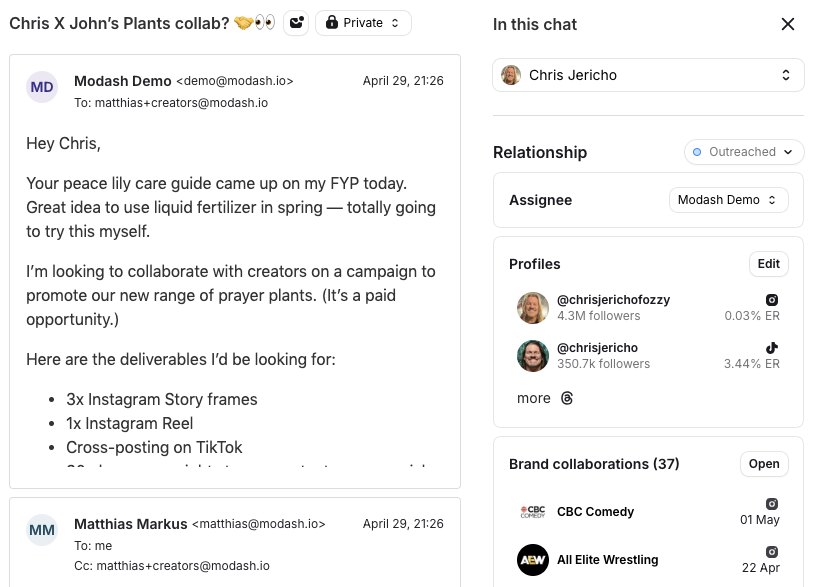
Modash is an end-to-end influencer marketing platform covering the full creator program lifecycle: discovery, outreach, content tracking, affiliate management, and global payments. It was built specifically for in-house teams at physical product brands, with Shopify as its deepest integration point.
The affiliate side of Modash is designed to sit inside the same workflow you already use to manage campaigns. You create or sync Shopify discount codes directly in the platform, set commission tiers (percentage or fixed, first sale and/or repeat sales, with configurable hold periods), and invite creators into a branded affiliate portal where they can see their own sales, expected payouts, and upload their payout details.
Attribution logic between discount codes and tracking links is documented so your team can communicate rules clearly to creators. Everything ties back to Shopify orders, so the data in your Modash dashboard reflects what's actually happening in your store.
Key features:



Price: Starts at $199/month (annual) or $299/month (monthly). Free trial available.
Worth considering: Modash's affiliate model is invite-only. There's no open application flow where creators can discover your program and apply on their own. If you want a public-facing affiliate marketplace, you'll need a separate tool for that recruitment layer.
🥇 Best for: Mid-to-large brands seeking an enterprise-grade platform to manage, automate, and scale multi-type partnership programs including affiliates, influencers, and strategic partners.
🤔 What is impact.com?
impact.com is an all-in-one partnership management platform that covers affiliates, influencers, B2B partners, and brand ambassadors within a single system. It automates the full partner lifecycle from recruitment through payout, making it well-suited for brands running complex, high-volume programs across multiple partner types simultaneously.
Key features:
Worth noting: impact.com doesn't offer any tools for tracking creator content, so you'll need a separate tool for this (or do it all manually). And if you want to use the platform for recruiting affiliates, your only option is to browse a database of 300K+ vetted and verified global partners. That's much smaller than dedicated creator marketing tools like Modash.
Price: Starter from $30/month. Essentials from $500/month. Pro from $2,500/month.
🥇 Best for: SaaS companies looking for a straightforward affiliate and referral program with strong conversion tracking and commission management.
🤔 What is Rewardful?
Rewardful is an affiliate marketing tool built specifically for SaaS businesses. It connects with Stripe-based billing workflows, tracks conversions across longer sales cycles, and handles commission configuration and payouts. The focus is squarely on subscription revenue attribution, not creator content workflows.
Key features:
Worth noting: As an affiliate tracking and management tool for SaaS brands, Rewardful has no native Shopify integration and doesn't support key ecommerce creator workflows like product gifting.
Price: Starter $49/month. Growth $99/month. Enterprise from $149/month.
🥇 Best for: Ecommerce brands and SaaS companies looking to launch and scale a self-serve affiliate program quickly without technical complexity.
🤔 What is Tapfiliate?
Tapfiliate is a self-serve affiliate tracking platform designed for fast setup. The company claims you can have a program live in roughly 30 minutes. It handles clicks, conversions, and commission tracking with pre-built integrations and minimal technical overhead.
Key features:
Worth noting: Tapfiliate doesn't capture affiliate content, so you'll have to find some other way to do this.
Price: Launch $89/month. Scale $179/month. Enterprise unlisted, contact for quote.
🥇 Best for: Businesses running complex, multi-channel affiliate programs that require advanced tracking and optimization across multiple verticals.
🤔 What is Tracknow?
Tracknow is an affiliate tracking platform focused on performance optimization across diverse traffic sources and program architectures. It handles multi-tier affiliate structures and multi-channel tracking within one system.
Key features:
Worth noting: Tracknow is a pure tracking tool. So if you're looking for a solution that also supports features like creator recruitment, vetting, and product gifting, this ain't the one.
Price: Pro $129/month. Enterprise $249/month. Enterprise Plus from $700/month.
🥇 Best for: Solopreneurs and small businesses looking for an all-in-one marketing platform with built-in affiliate management at low cost.
🤔 What is Systeme.io?
Systeme.io combines sales funnels, email marketing, course creation, and affiliate program management in a single platform. The affiliate management module is native, meaning no third-party integration is required to recruit affiliates and track referrals.
Key features:
Worth noting: The affiliate management module lacks advanced commission tier logic and has no dedicated creator-facing portal.
Price: Free for all core features with limited usage. Startup $17/month. Webinar $47/month. Unlimited $97/month.
🥇 Best for: Brands and agencies managing TikTok Shop and/or YouTube Shopping affiliate creator programs at scale.
🤔 What is Trendio?
Trendio is a creator management platform built specifically for TikTok Shop and YouTube Shopping affiliate workflows. It covers the full creator lifecycle from creator onboarding through affiliate payouts, and includes AI-powered video optimization tools designed to improve performance on shoppable content. It's a purpose-built tool, not a general affiliate tracker adapted for TikTok.
Key features:
Worth noting: Trendio is primarily focused on TikTok Shop and YouTube Shopping, so it's not a good fit for brands running multi-platform or non-video creator programs.
Price: Starter $149/month. Plus $249/month. Pro $449/month. Managed pricing unlisted.
🥇 Best for: B2B SaaS companies looking to build and scale structured affiliate, referral, and reseller partner programs with tiered commission logic.
🤔 What is PartnerStack?
PartnerStack is a partner program platform purpose-built for B2B SaaS. It manages affiliates, referrals, and resellers from one platform with structured commission configuration, automated payouts, and a partner-facing portal.
Key features:
Worth noting: If your creator affiliates use promo codes rather than referral links, PartnerStack won't cover that natively.
Price: Launch $1,000/month. Growth $1,520/month. Enterprise custom pricing.
🥇 Best for: Ecommerce brands on Shopify looking to manage affiliate and influencer programs with native order and discount code tracking.
🤔 What is Refersion?
Refersion is an affiliate and influencer marketing platform built for ecommerce, with deep Shopify integration as its core technical advantage. It tracks orders, commissions, and discount codes natively, and supports both link-based and discount code attribution. This makes it a practical choice for brands where creators share promo codes on social rather than clickable links.
Key features:
Worth noting: Refersion's pricing scales with program size, which can become expensive as your creator roster grows.
Price: Free for marketplace listing. Launch $39/month + 3% of affiliate-driven sales. Growth $199/month + 2% of affiliate-driven sales. Scale plan has a flat monthly subscription, but pricing is unlisted.
Evaluating these tools across creator workflows, Shopify compatibility, and commission logic revealed a consistent set of capabilities that separate tools built for creator programs from tools adapted from traditional affiliate software. Here's what to prioritize.
Commission structure flexibility
Creator affiliate programs rarely use a single flat rate. You need the ability to set percentage or fixed commissions, apply different rates to first-sale versus repeat purchases, and configure hold periods before payouts are released. Tools that only support basic flat-rate structures will create manual workarounds as your program grows.
Discount code and link attribution logic
Creators share promo codes on social media. Tracking links don't always work in every placement. Your affiliate tool needs to handle both attribution methods simultaneously and have documented rules for what happens when a customer uses both. Without this clarity, commission disputes become a recurring problem.
Creator-facing performance portal
Creators want to see their sales, commissions, and payout status without emailing your team. A self-service portal cuts down on inbound questions and signals that you're running a professional program. Tools without this shift the communication burden back onto your team every payout cycle.
What's the difference between a creator affiliate program and a traditional affiliate program?
Traditional affiliate programs typically work with bloggers, coupon sites, and media publishers who use tracking links. Creator affiliate programs involve influencers who post content on social media and primarily share discount codes rather than links. The key operational differences are: creators need a portal to see their performance without chasing your team, attribution has to handle both codes and links, and commission logic often reflects content-driven behavior (first sale, repeat sale, tiered rates by volume) rather than simple click-to-convert tracking.
Does my affiliate tool need to integrate with Shopify?
If you're on Shopify, yes. A native Shopify integration means discount codes are created or synced between your store and the affiliate tool automatically. Orders and returns are the source of truth for commissions, not manually exported reports. Without this integration, your team reconciles affiliate performance against Shopify data manually, which breaks down quickly as programs scale.
Can I use a creator affiliate tool that doesn't offer an open application model?
It depends on how you recruit. Invite-only programs (like Modash's model) work well for brands with an established creator discovery and vetting process. If you want creators to find and apply to your program independently, you'll need a tool with a public-facing affiliate marketplace or a network-based platform like impact.com. The trade-off is control: open application models widen your pool but reduce vetting precision.
How should attribution work when a creator uses both a discount code and a tracking link?
This scenario is more common than most brands plan for. The attribution rule needs to be documented and communicated to creators before the program launches. Some tools prioritize the discount code, some prioritize the last click, and some let you configure the logic. Whichever rule you apply, it should be consistent across all creators. Ambiguity here leads to commission disputes that erode trust with your creator partners.
What's a reasonable hold period for creator affiliate commissions?
Most ecommerce brands use a hold period that covers their return window, typically 15 to 30 days after a sale. This ensures commissions aren't paid on orders that get returned. If your tool doesn't support configurable hold periods, you either pay commissions on returned orders or build a manual reconciliation step into every payout cycle. Look for tools that let you set this at the program level or per commission tier.
If you're a Shopify ecommerce brand managing creator affiliates as part of a broader influencer program, Modash gives you the most connected workflow. Discount codes, commission tiers, attribution logic, creator payout visibility, and campaign tracking all live in the same platform. You're not syncing data between tools or managing Shopify codes separately from affiliate performance.
If you run a B2B SaaS business, PartnerStack or Rewardful are better fits. They're built around referral and subscription logic, not ecommerce orders. If you need TikTok Shop specifically, Trendio's specialized workflow is worth evaluating. For brands that want immediate access to a broad affiliate pool without building a program from scratch, impact.com's network gives you a fast start.
For most in-house ecommerce teams scaling from gifting into performance programs, Modash is the place to start. You can try it free and test the Shopify integration with your actual store before committing. Start your free trial here.