Capabilities
Integrations







Use cases
Capabilities
Integrations
Use cases

Refersion and Bixgrow do the same core job: tracking clicks and orders, and working out which affiliate earned the commission. The differences show up in what you pay and how offers are built.
This comparison walks through recruitment, tracking, commission setup, pricing, and plan tiers, then looks at Modash as a third option for brands that want creator discovery and content tracking alongside affiliate payouts.
While they share the same fundamentals, Refersion and BixGrow are actually pretty different. Refersion is an established affiliate marketing tool that provides cookieless first-party tracking and integrates with multiple ecommerce platforms, while BixGrow is an affordable affiliate and referral marketing app built specifically for Shopify.
One problem with both tools is that neither shows you the content behind the sales: both report which affiliate earned the commission, not which post, Reel, or Story earned it.
If that's a feature you need, consider Modash instead. Modash is an influencer marketing platform for Shopify brands that covers creator discovery, campaign tracking, product gifting, and affiliate payouts in one place, which makes it the third option here for brands that run influencer and affiliate together.
Here's a quick look at how the 3 compare:
Finding and hiring the right creators is a key part of building a successful affiliate program.
With BixGrow, recruitment is largely built around the platform's marketplace, used by 200k+ affiliates to find relevant offers.

On the mid-tier Pro plan and above, BixGrow users can also import their own affiliates, convert existing customers into affiliates through post-purchase widgets, and recruit through multi-level marketing.
Trouble is, these methods are mostly passive, forcing brands to sit back and wait for creators to find them (unless they already have a bunch of trusted affiliates they can import to the platform).
Refersion has a much larger marketplace, comprising 6.6 million opt-in affiliates, influencers, publishers, and brand ambassadors. However, the big difference is that you can use it to recruit proactively by searching the platform's directory for brand-fit creators. Refersion even uses AI to build you lists of potential affiliate partners based on your product catalog and customer base.

Plus Refersion also offers post-purchase widgets so you can use your existing customer network to grow your program.
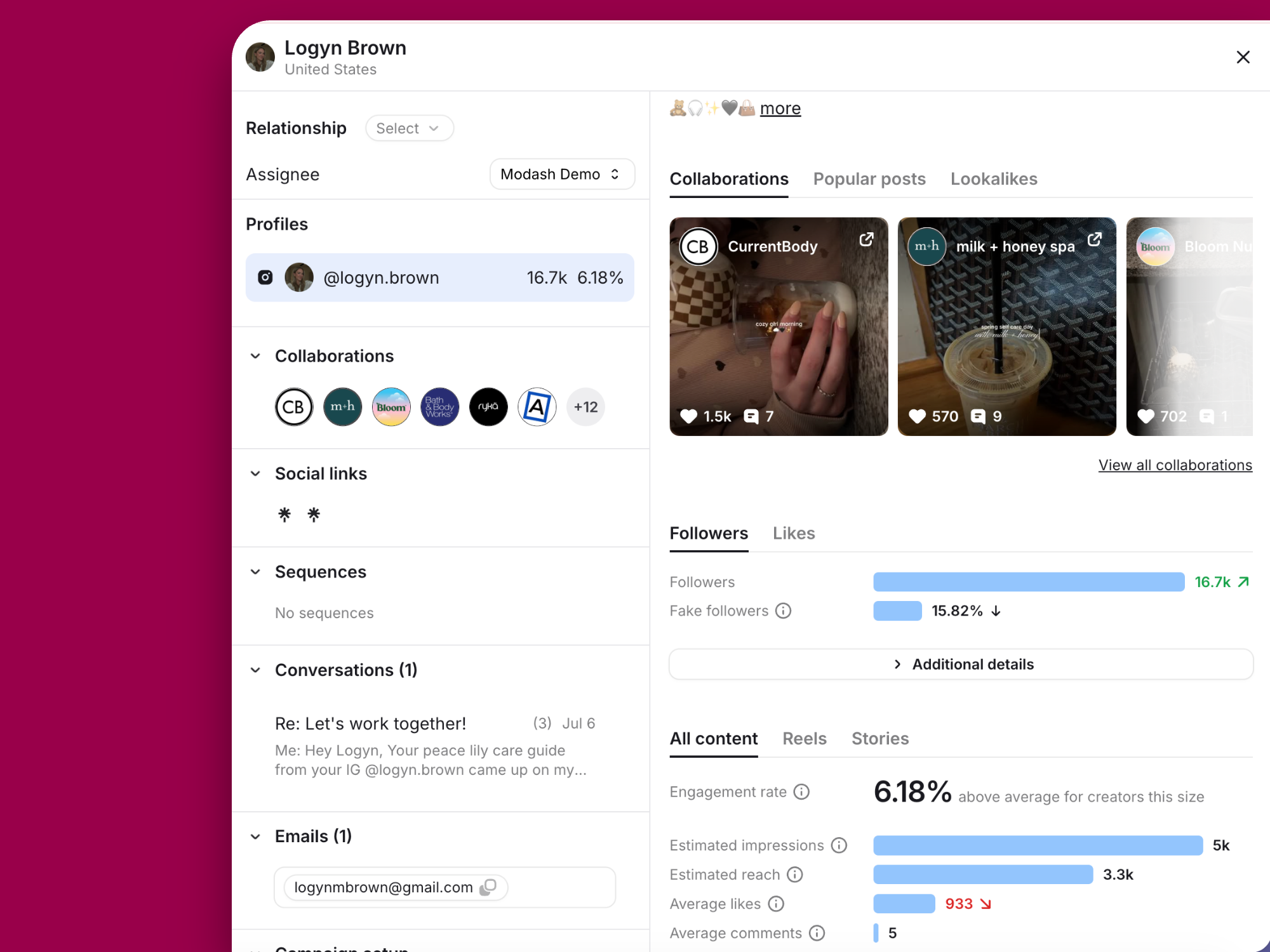
But while Refersion is a stronger fit for brands looking to hire affiliates, it falls well short of a dedicated affiliate recruitment platform like Modash, which lets you search 380M+ creators for people who fit your brand instead of relying on a listing.
Audience demographics and engagement metrics sit on every creator profile during discovery, so you know who you're reaching before you send a single message.
Bottom line: Refersion is better than BixGrow for recruitment, but it can't compete with Modash here.
Tracking decides which affiliate gets paid when a customer buys The 2 tools diverge on how the link itself is built and on what else an affiliate can hand out beyond it.
Refersion's tracking is built on first-party tracking links, designed to eliminate costly attribution gaps and painful user redirects, so a sale is less likely to go unrecorded when a shopper clicks through from an affiliate's post.
BixGrow takes a different shape. It gives each affiliate a branded dashboard where they pick up their links and coupons, along with creatives and an earnings view.
Coupons give affiliates a second way to earn credit beyond the link, which matters when they promote somewhere a clickable link is awkward, such as a video or a podcast.
Modash tracks affiliate sales on Shopify with last-touch attribution, so the final link click or discount code before checkout earns the commission. It doesn't rely on cookies alone, so a sale can still be credited when a shopper's browser blocks them, and when a customer uses both a link and a code on one order, the code's owner gets the credit.
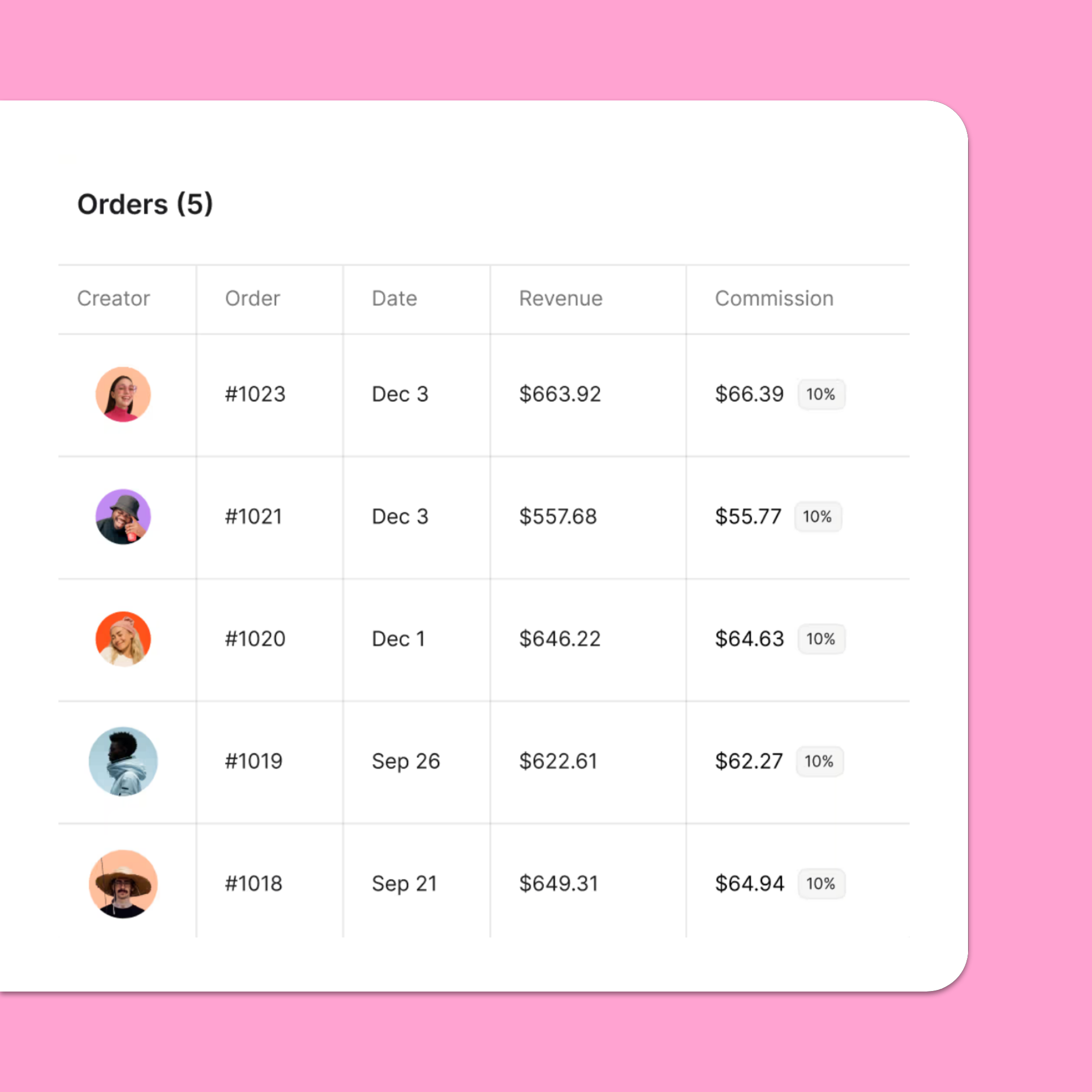
Bottom line: Refersion is the pick if first-party tracking links are on your checklist.
When it comes to commissions, Refersion lists several offer structures you can combine, while BixGrow starts from a store-wide offer and lets you carve out product exceptions.
With Refersion, you can build offers as a percentage of sale or flat fee, pay subscription commissions, and offer SKU-specific rates, multi-level structures, and sign-on bonuses. That range matters if you pay differently on a recurring subscription than on a one-off accessory, or if you want to reward an affiliate who brings in other affiliates.
BixGrow doesn't provide quite so much customization, but it does let you set different per-product rates and build multi-tier commission structures, which can help you keep higher performers motivated.

Modash supports multi-tier structures, too. It shows you what each creator sold and what they earned next to the content they posted, so you read commissions and performance in one dashboard once your Shopify store is connected.
Bottom line: Refersion is the pick when your catalog needs several commission structures running at once, such as subscription payouts next to SKU-specific rates and sign-on bonuses.
What will your bill look like once affiliates actually start converting? Refersion's cost climbs with affiliate revenue, while BixGrow's stays the same whatever your affiliates sell.
Refersion pairs a monthly subscription with a percentage of affiliate-driven sales, which varies based on the plan you choose. The Launch plan runs $39/month plus 3% of affiliate-driven sales, and Growth climbs to $199/month plus 2%.
By contrast, with BixGrow, you pay a flat monthly price with zero additional fees, regardless of your plan.
So say your affiliates drive $20,000 in sales in a month. On Refersion you'd pay $639 on Launch ($39 plus 3% of $20,000) or $599 on Growth ($199 plus 2%). On BixGrow Advanced you'd pay $49.99 whether affiliates drove $2,000 or $200,000. Double the affiliate sales and Refersion's bill rises again, while BixGrow's doesn't move.
Modash's charge is tied to what you pay affiliates, not to what they sell. We offer the following plans:
Extra fees only apply to commission payouts. On the Performance annual plan, these carry a 0% charge up to $10,000 in total payout volume per year, and 5% applies only to the amount above that. You settle one Modash invoice and Modash handles creator payment and tax, so you can pay affiliates without running a separate payment process.
Bottom line: Refersion's subscription plus a percentage of affiliate-driven sales means your software cost grows in step with affiliate revenue, which matters most if you expect revenue to climb. BixGrow's flat pricing keeps the bill predictable no matter how much affiliates sell. Modash sits between the 2, with a flat subscription and a charge tied to creator payouts rather than sales.
Once affiliates are live, you want to know more than how many orders came in. You want to see which posts drove them, whether a creator actually published, and whether the disclosure was there. On this job, Refersion and BixGrow land in the same place.
Refersion tracks affiliate sales from the click through to the commission, but it doesn't collect the posts, Reels, Stories, or videos behind those sales. BixGrow takes the same approach – orders and commissions are logged, the content that produced them is not. In practice, that means checking an affiliate's feed by hand or asking them to send links if you want to confirm a post went up or compare which creative is converting.
That's where Modash differs. Modash collects creator posts, Reels, Stories, and videos automatically based on your campaign's hashtags, mentions, and keywords, so you see the content next to the sales it drove.

It captures Instagram Stories while they are still live, and it flags posts missing a required hashtag, @mention, or ad disclosure, so you catch compliance issues without scrolling feeds.
Bottom line: Refersion and BixGrow both tell you which affiliate earned the commission, not which post earned it. If you need to see and measure the content behind affiliate sales, neither tool covers that job. Modash does.
Refersion and BixGrow both track affiliate clicks and orders through to commissions, and both leave the same 2 jobs to you.
The first is finding partners: both offer various recruitment tools, but neither has an extensive database. The second is tracking content: neither tool collects the posts, Reels, Stories, or videos an affiliate publishes, so you learn which affiliate earned the commission, not which post it came from.
That's where Modash differs. You can search 380M+ creators and see each creator's audience demographics and engagement metrics before you send a message, so your outreach time goes to people who already fit your brand.
Once creators are live, Modash pulls their posts, Reels, Stories, and videos into your campaign automatically from your hashtags, mentions, and keywords, so every piece of content sits next to the sales it drove. It catches Instagram Stories before they expire and flags any post missing a required hashtag, @mention, or ad disclosure.
Plans start at $199/month for Essentials and $499/month for Performance, and you can try Modash free for 14 days without a credit card.