Capabilities
Integrations







Use cases
Capabilities
Integrations
Use cases



Affiliate commission is the hard-earned cashola you pay a creator for driving a sale through their affiliate link or promo code (or both).
But the rate you offer is just one of several rules that dictate how much your affiliates actually receive. I’ll walk through all of them in this article – and to keep things practical and actionable, I’ll be sharing a bunch of worked examples built around the following conditions:
Affiliate commissions work by attributing a sale to the relevant creator, most likely via link or code, then calculating their earnings, and paying them after an agreed hold period.
Kinda like this:
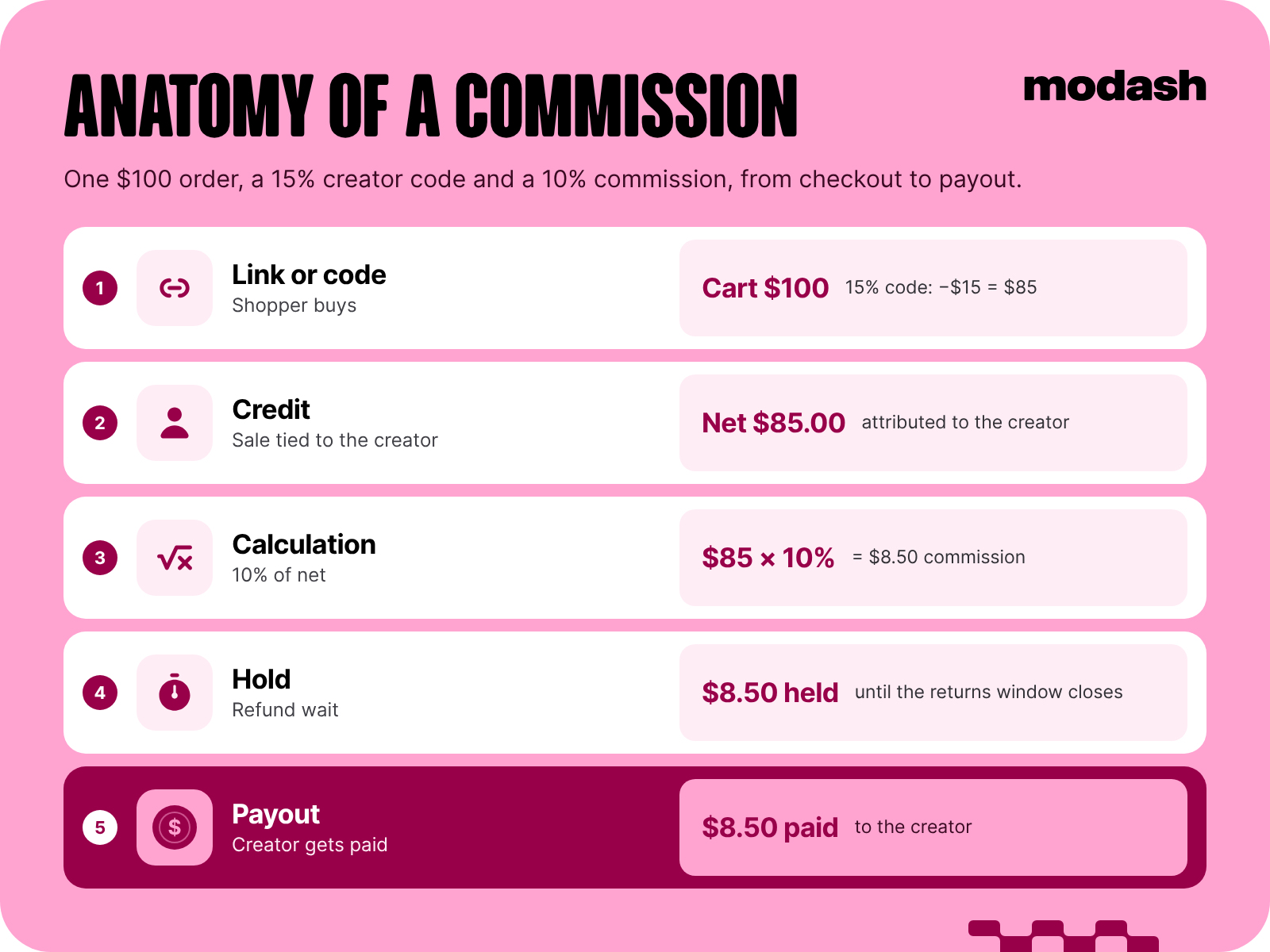
Now let’s take a deeper look at the 5 specific steps that make up the affiliate commission process:
As I said a couple of sentences ago, most brands rely on links and codes to track affiliate sales.
It’s a pretty simple process. When a customer purchases after clicking a link and/or entering a code at checkout, the creator in question earns a commission. Job done, bada bing, bada boom.
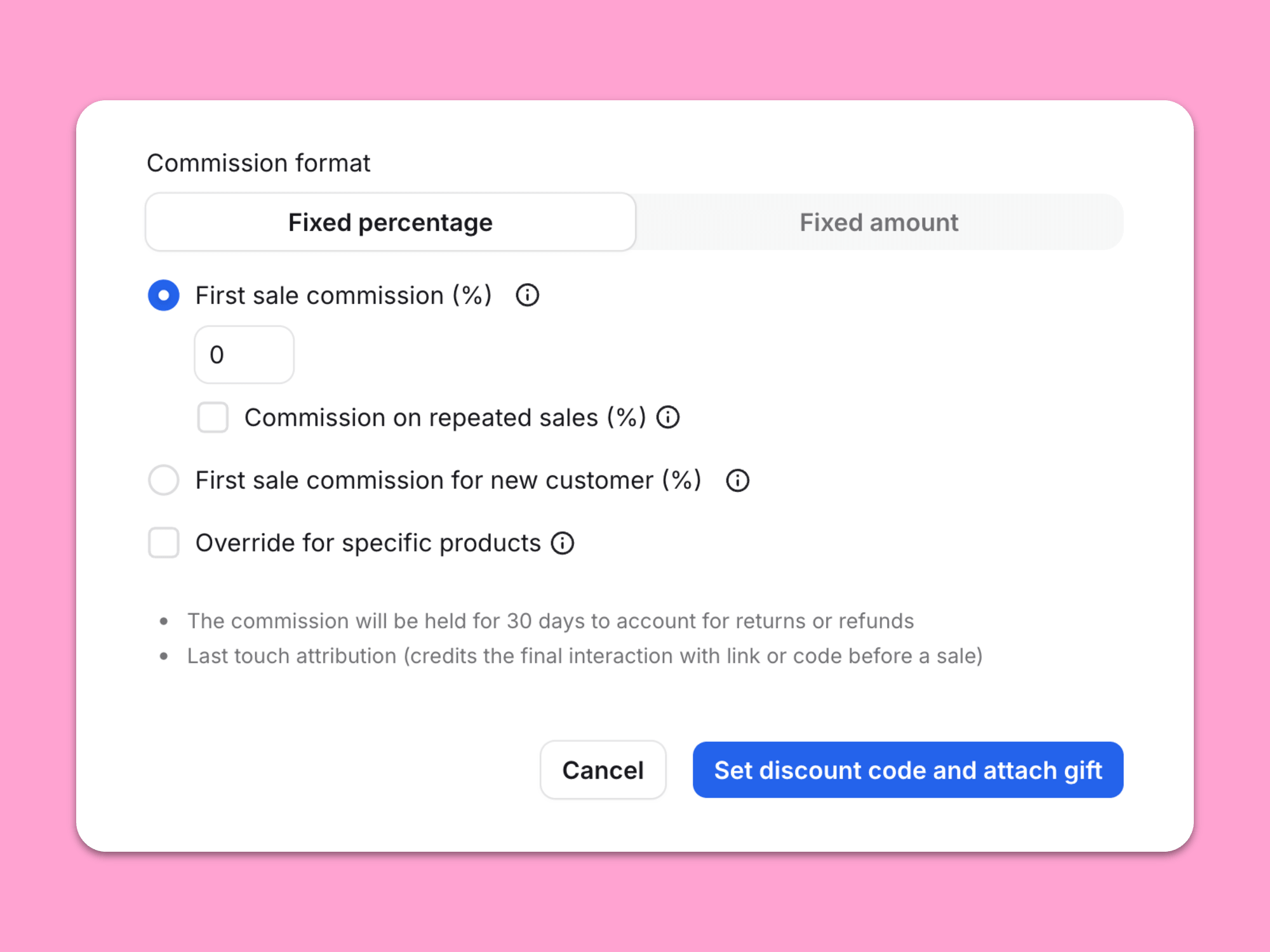
Actually, there’s a little more to it, because there’s a big decision to make at this stage: do you want to pay the same amount for all sales? Or would you rather incentivize your affiliate partners to attract certain types of customers?
For example, if you primarily see affiliate as an acquisition channel, you might set a higher rate for new customer sales – or even make existing customer sales non-commissionable.
🤓 Pro tip: With Modash, you can create custom commission tiers with separate rates for first sales, recurring sales, and new customers. This saves a ton of time on manual calculations.
I’m not gonna get into the weeds on attribution here – if that floats your boat, check out Affiliate Attribution Models: How to Choose the Right One for Your Program.
Instead, I’ll keep it brief by saying that if you are using links and codes for attribution, they’ll tell you which creator gets credit for the sale.
Or at least they should, provided you set clear rules around attribution first.
These rules ensure there are no gray areas when assigning credit. For example, what happens if a customer clicks one creator’s affiliate link but uses another’s discount code? Sorting this stuff out upfront builds trust with affiliates, while also mitigating the risk of paying 2 commissions for a single order.
🤓 Pro tip: In Modash, codes take priority over links on the same order, so you automatically pay a single commission to the code’s “owner”. Oh, and if a customer enters a sitewide promo code instead (or your checkout adds one automatically), the creator's link still gets credit, as long as the shopper clicked it in the last 30 days.
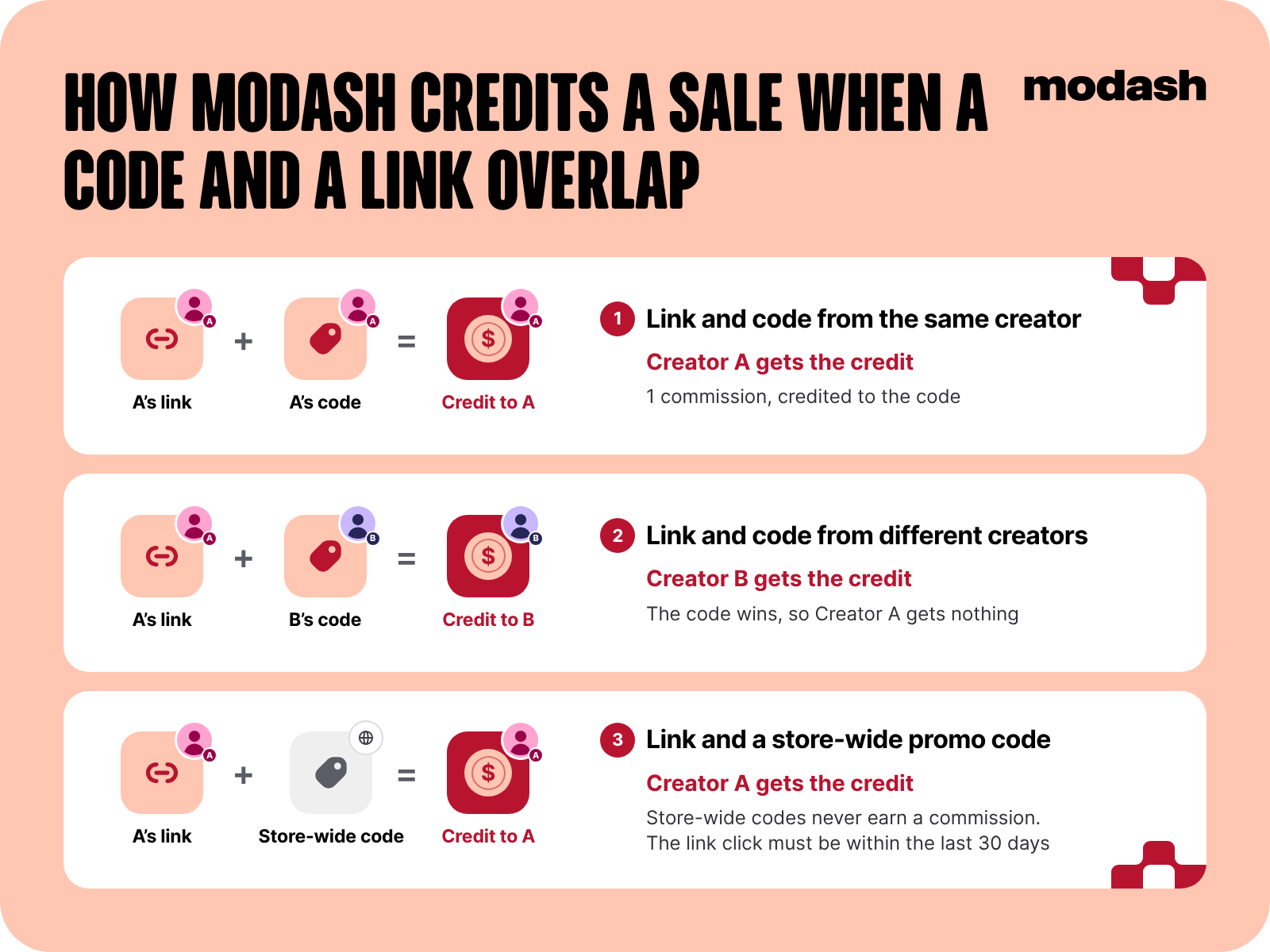
Another big decision: do you pay commissions based on gross revenue or net?
It’s easy to default to gross without thinking about it. Word to the wise: pay on net instead (at least if you don’t want to put a serious dent in your margins).
To demonstrate why, let’s use the worked example I teased so enticingly in the intro:
That’s a 15% saving, which makes a massive difference across thousands of affiliate-driven transactions.
Net revenue usually means the order after discounts and refunds, without shipping or tax.
🤓 Pro tip: Modash automatically calculates commission on Shopify net revenue, so you don’t have to.
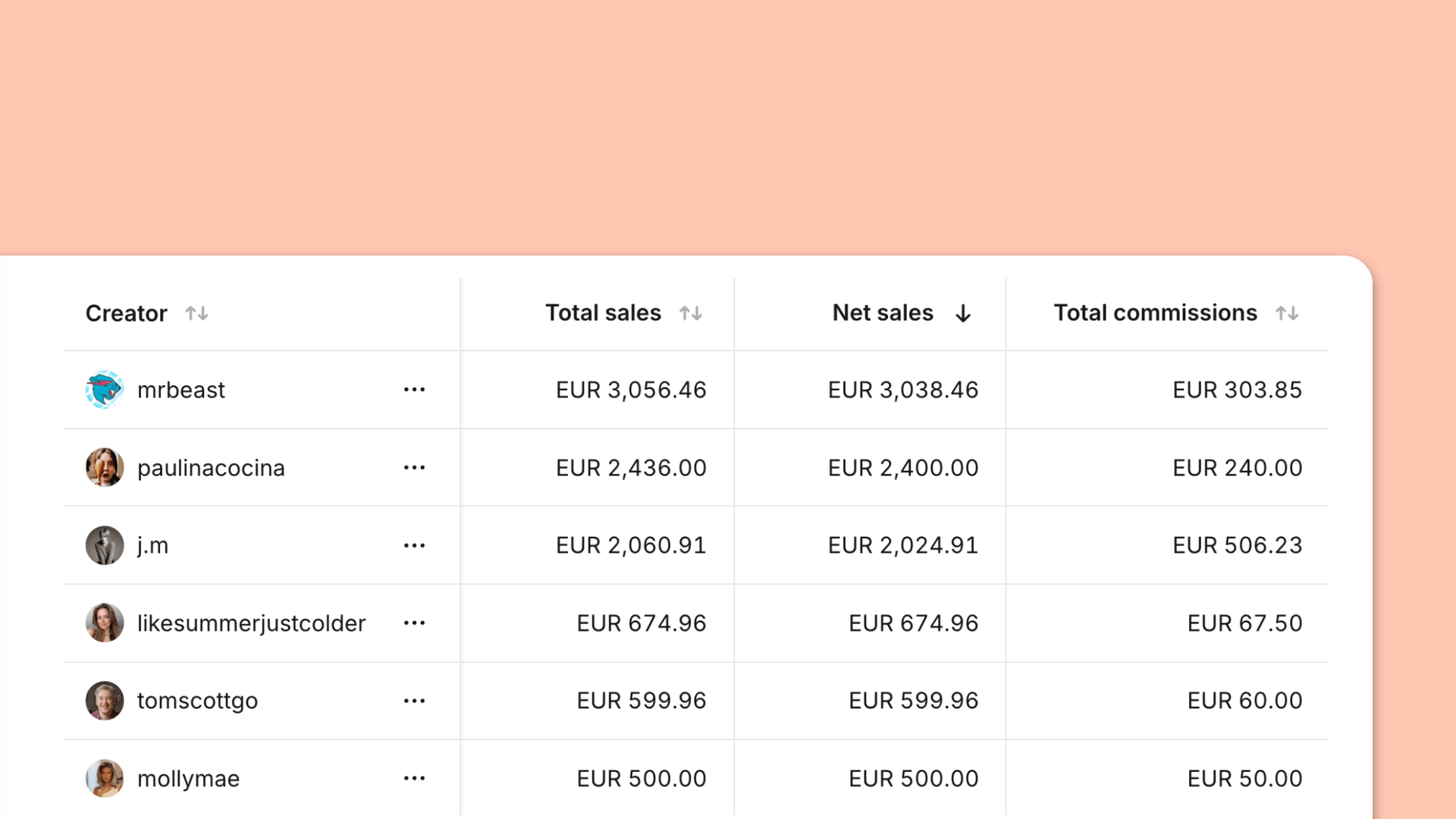
A hold period is exactly what it sounds like: a defined delay between an affiliate sale being made and the commission for that sale becoming eligible for payment.
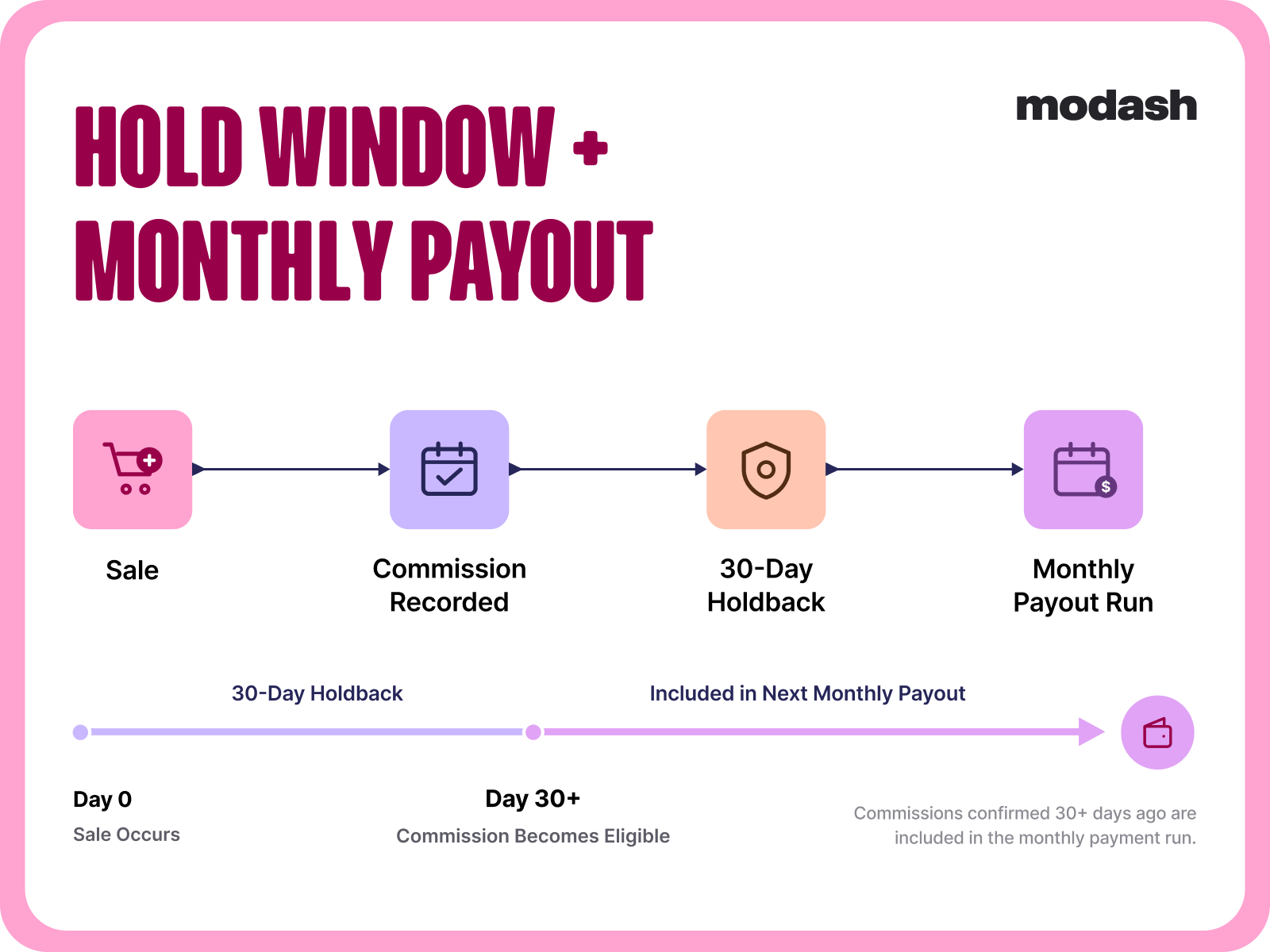
Rather than paying affiliates the moment a sale shows up in your Shopify admin, building in a hold period means you don’t end up losing money on cancelled or returned orders.
Your hold period should line up with your return window so you’re not approving commissions on sales that can still fall through.
For example, let’s say the customer returns half of our $100 order. With a hold period, there’s still time to adjust the commission so we’re only paying for the remaining half of the order, for a total commission payout of $4.25.
Without one, we’d be stuck trying to claw back the other $4.25 from the affiliate.
🤓 Pro tip: Modash automatically reduces or removes commissions when an order is returned during the hold period. Plus you can optionally choose to only commission fulfilled orders.
Once your hold period is cleared, the only thing left is to show me the money. And by “me” I mean your affiliates.
There are a couple more decisions to make at this stage.
First, you need to set a payout threshold, AKA the minimum amount of commission a creator needs to earn to be eligible for your current payment run. Most brands set a threshold of ~$10 – $100 so they don’t waste time and money on constant micropayments.
Use your average commission to set your threshold. For example, assuming the $8.50 commission in our worked example is par for the course for our imaginary brand, a threshold of up to $50 feels pretty reasonable. Whereas a $100 minimum means an affiliate needs about 12 “average” sales to get paid, so set it with your typical creator’s volume in mind.
And second, it’s time to decide your payout cycle, or how frequently you pay affiliates. While daily payouts aren’t totally unheard of, most brands pay commissions weekly or monthly. Check your competitors’ terms before choosing your own cycle.
🤓 Pro tip: Modash runs payouts weekly or monthly with a minimum amount, so brands aren't sending dozens of tiny payments.
There’s more than one way to pay affiliates. In fact, there are no fewer than 6 structures you can use, each with strengths and weaknesses.
Here’s a quick snapshot of the different structures…
…and now I’ll dig a little deeper into each.
(Although if you’re looking for a proper deep dive on the topic, check out Affiliate Payouts: Which Model to Choose & How to Structure Your Process.)
While there are half a dozen structures to choose from, the simplest place to start is to pay affiliates a fixed percentage of each sale they drive, AKA revenue share.
Like how in our worked example the affiliate in question gets a 10% commission.
As Senior Influencer Marketing Manager Melissa Sorby explains, this structure naturally incentivizes more expensive products and/or more upselling and cross-selling:
“Revenue share keeps commissions relative to the amount of order value generated in one sale, so it encourages creators to drive higher-value purchases.”
That’s almost always a good thing, but it can put a strain on your margins if you use gross rather than net revenue to calculate commissions.
With cost per action/acquisition (CPA), affiliates earn a fixed cash amount – say, $10 – for every sale they generate, regardless of order value.
Melissa says CPA can make more sense for brands with little price variance across their catalog. If every product sells for $30 – $35, a percentage won’t change much, so a fixed amount per sale is simpler.
It’s easy to explain and calculate, but doesn’t give creators any incentive to push higher-value items or cross-sell complementary products.
Pay every affiliate the same rate and you’re running a single-tier program.
In our research, single-tier programs had an average active affiliate rate of 37%, compared with almost 50% for programs with 3+ tiers.
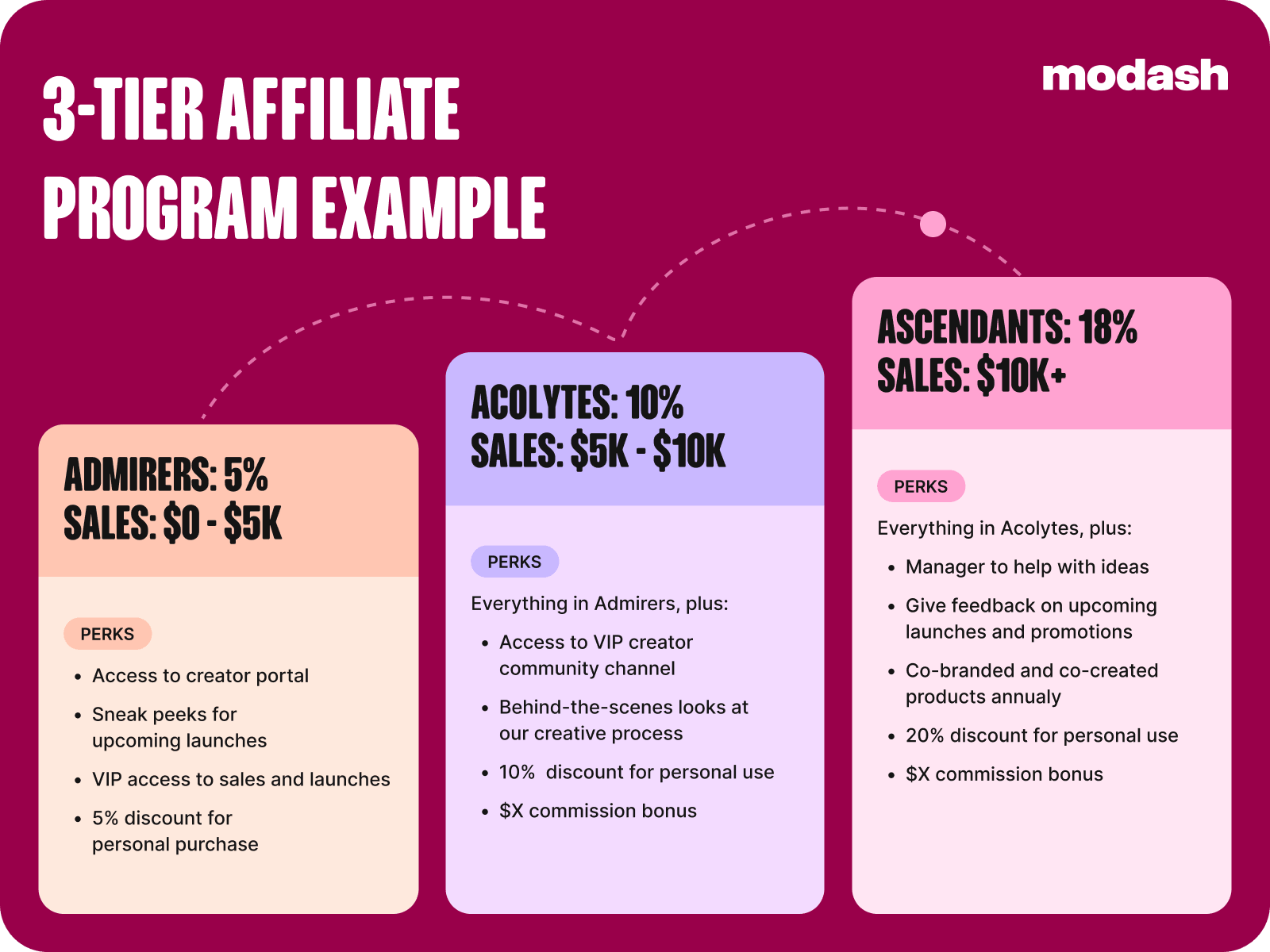
Programs with more tiers had more active affiliates – just be sure not to set unrealistic thresholds for higher tiers or you risk putting people off. Especially smaller and/or less-established creators.
Oh, and for context, the average tiers in our survey were 10%, 14%, and 19%.
🤓 Pro tip: Modash lets you set up as many tiers as you need and move a creator up when they hit your milestone, and it calculates each tier’s rate for you.
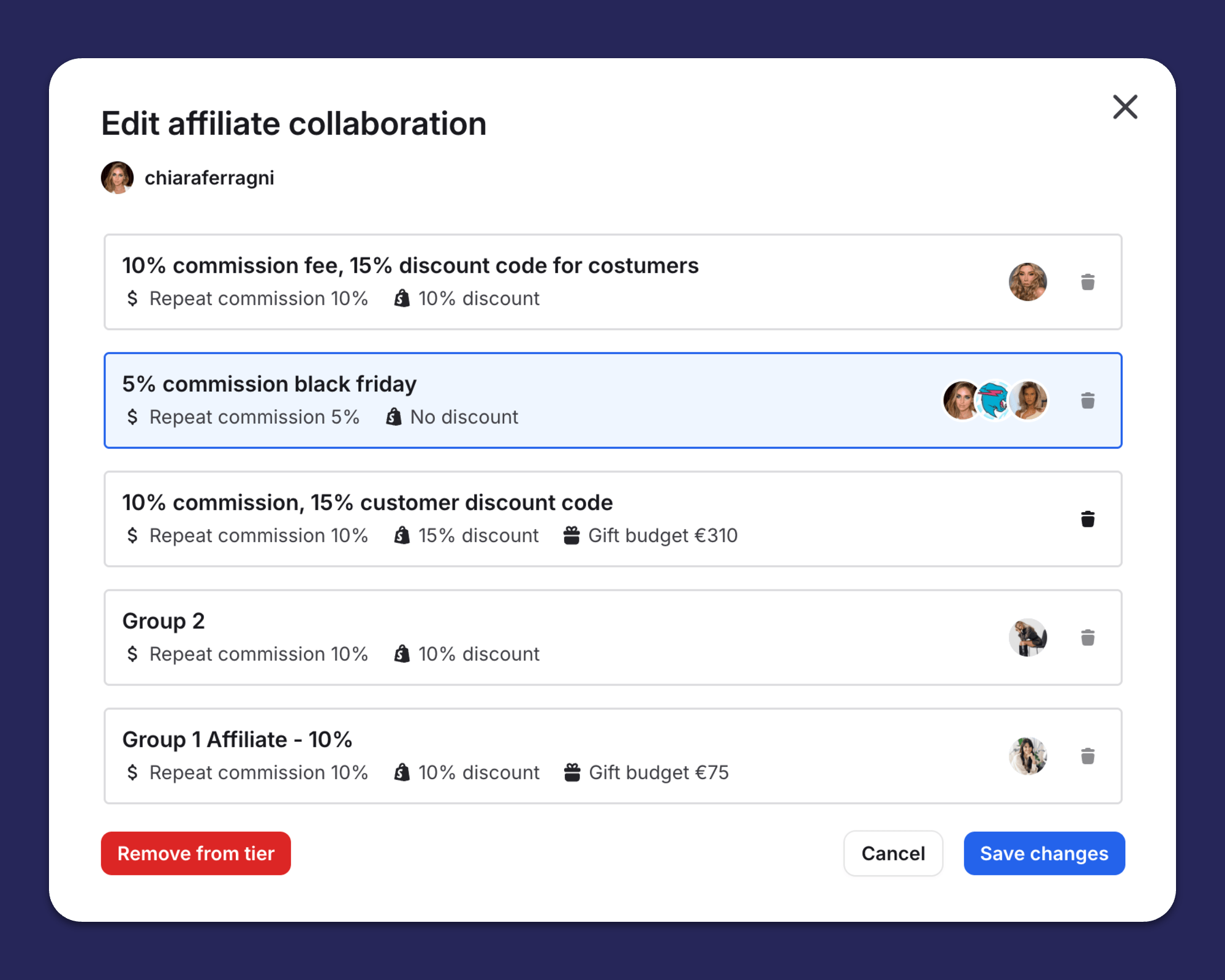
For most brands, affiliate marketing is all about acquisition.
So it makes sense for them to offer more attractive rates for sales that are actively growing their audience. For example, they might pay 10% for new customer sales, but only 5% for existing customers.
The only downside to this approach is that it takes a ton of time to manually calculate all those different types of commissions. But remember, Modash lets you automate this by creating your own tiers with different rates for new vs existing customers and/or first sales.
In an ideal world, every product in your store would have exactly the same margin. Easy breezy.
But things are rarely that clean.
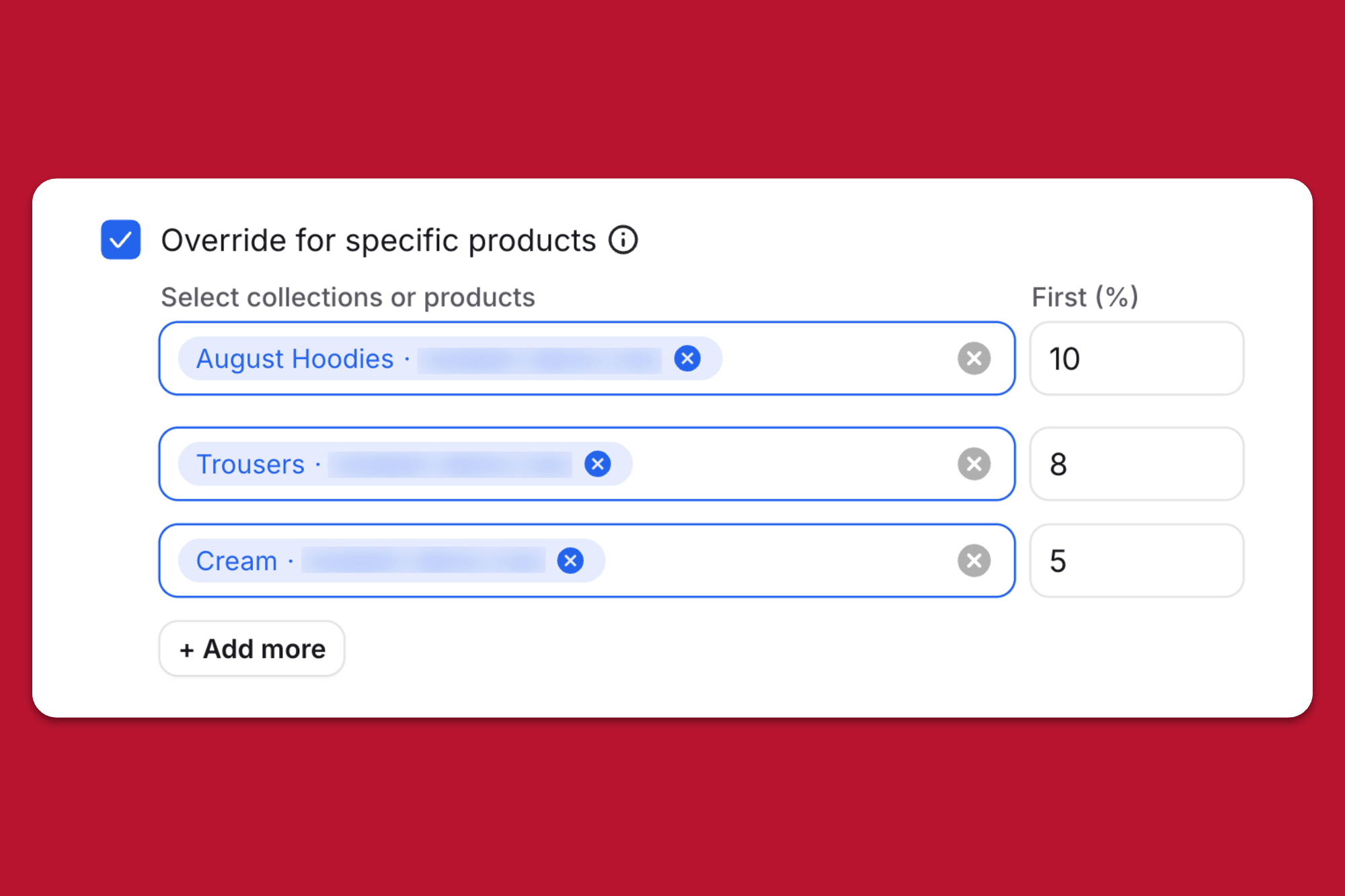
For brands with big variations in margins, it often makes sense to set specific commission rates for individual collections, or even right down to the product level. Just bear in mind that the more different rates you set, the more confusing things become for your affiliate partners.
🤓 Pro tip: With Modash’s Shopify integration, you can set different percentage rates for specific products or collections within a tier.
This whole article is about affiliate commissions.
But there’s an elephant in the room: it often takes more than just commissions to attract, engage, and retain creators 🐘
When we surveyed 57 creators, 68% said they still accept affiliate commissions as full or partial compensation. Yet 75% of those who do added that commissions alone aren’t attractive enough to incentivize posting.
That’s where hybrid deals – a combination of upfront fee or bonus + commission – come in.
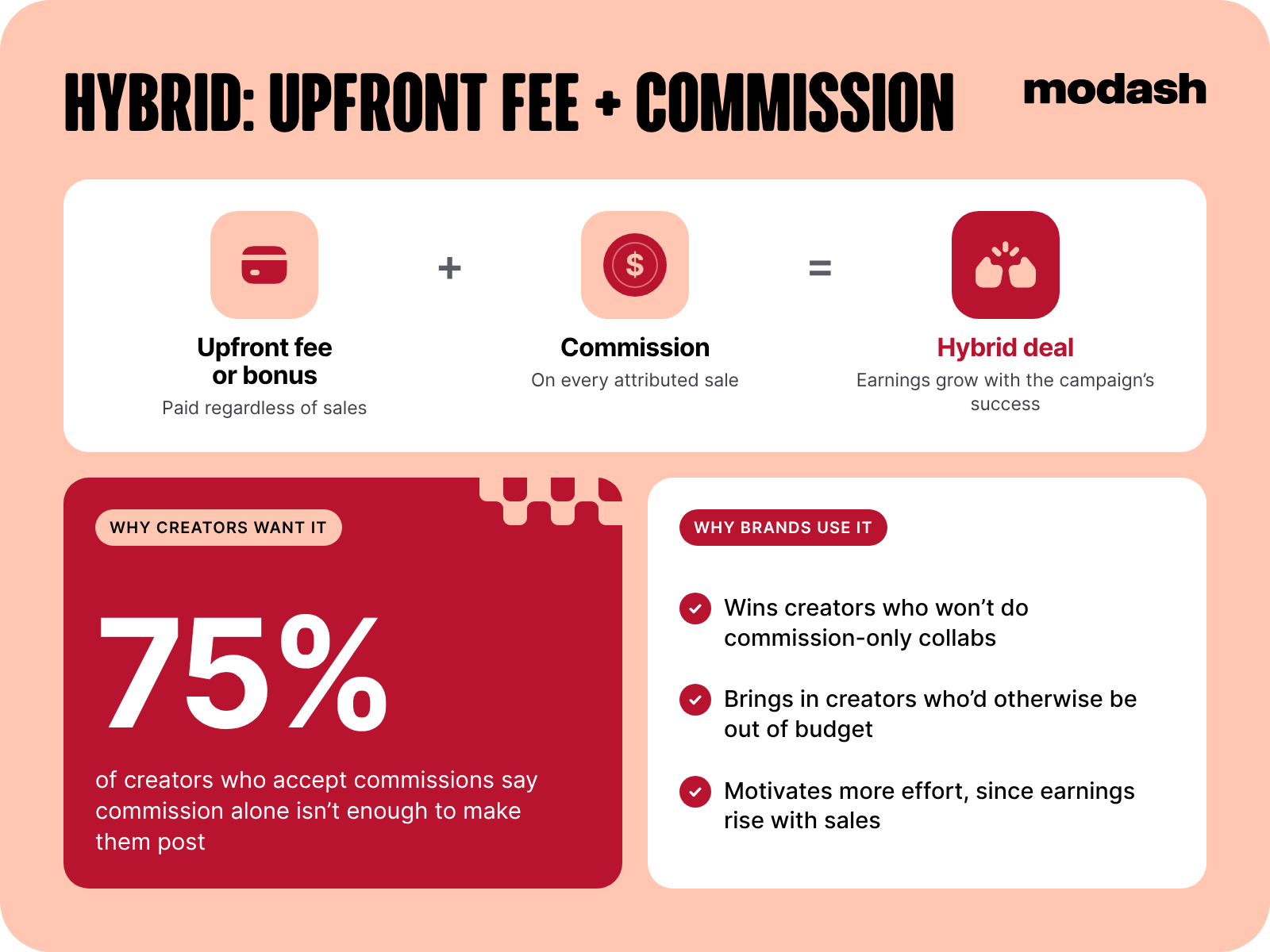
Hybrid deals are a way to negotiate with creators who are otherwise out of budget and/or who aren’t open to commission-only collabs.
Influencer Marketing Manager Nacho Selma adds that they’re a big motivator, too:
“The hybrid model not only helps me stay within budget but also motivates the influencer to put in more effort, as their earnings increase based on the campaign’s success.”
🤓 Pro tip: Still struggling to seal the deal? Modash lets you set a guaranteed payout amount: each payout run, the creator gets whichever is higher – the guarantee or their commissions. Here’s how it works with a $100 guarantee:
Hopefully, by this point, you’re clear on how commissions work and the different structures that exist, so now let’s tackle the thorny subject of how much to pay.
If you only have time to read exactly 20 words about rate-setting, let them be these: your commission rate(s) should be based on your margins and AOV, not plucked from thin air or based on benchmarks.
Or read on if you’ve got the bandwidth for a slightly deeper dive…
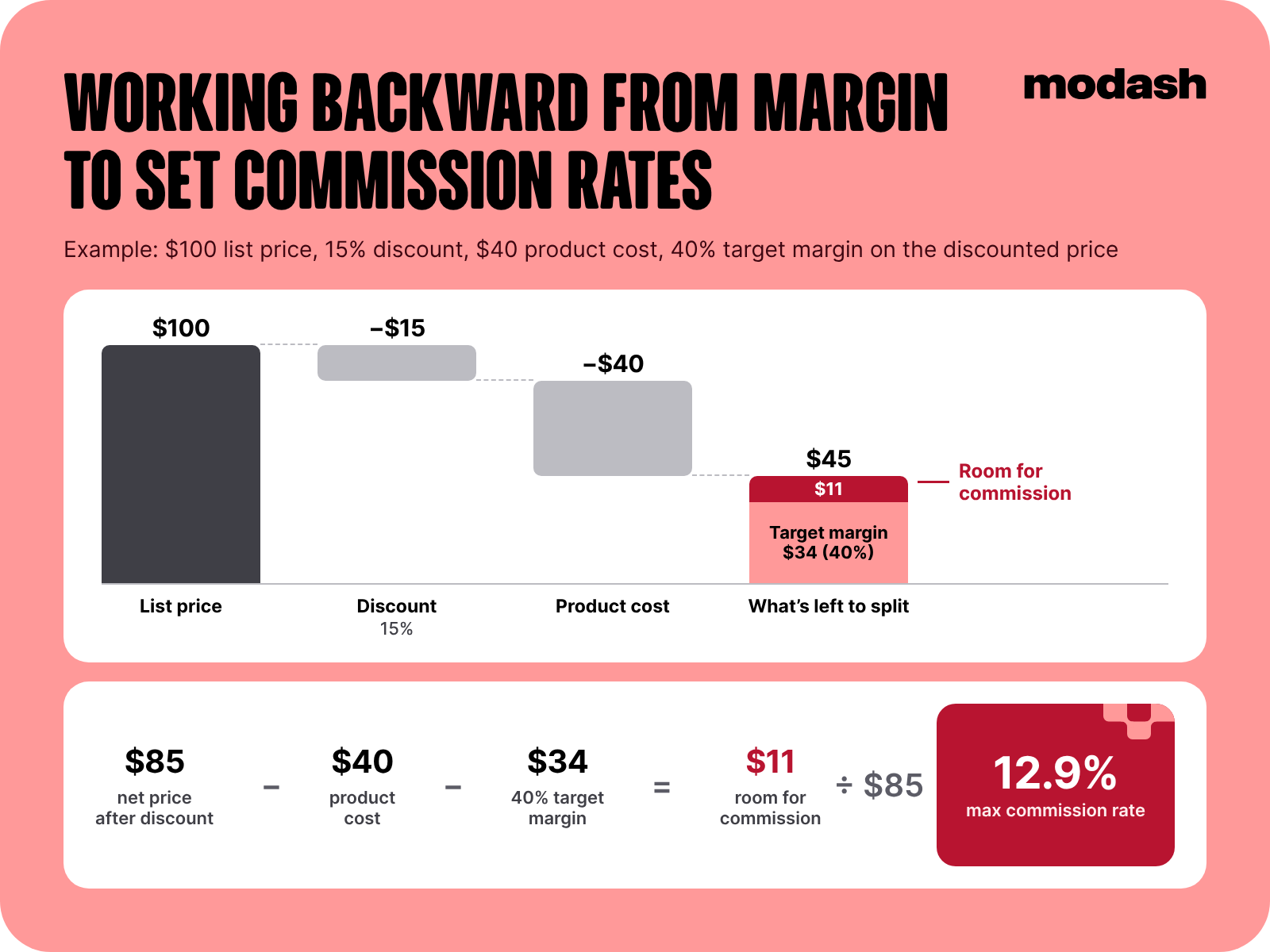
The best way to set sustainable commission rates is to work backward from your target margin.
For example, let’s say:
Now we can run the numbers:
$100 minus our 15% discount leaves $85, minus the product cost leaves us with $45. Our target margin is $34 (that’s 40% of $85, math fans), which means we only have $11 left to play with – and that’s where our commissions have to come from.
Finally, divide $11 by our net product price of $85 and we’ve got a maximum commission rate of just under 13%.
That may have given me a mild stress headache, but it works.
But your margin isn’t the only consideration – you also need to factor in your average order value and repeat purchase rate.
First up, let’s tackle AOV: the lower it is, the higher your commission rate should be.
Why? Well, consider these examples:
In this scenario, the low-AOV brand might have to pay a more aggressive rate to attract affiliates (while the high-AOV one would still look appealing with a slightly lower rate).
Next, repeat purchases.
If you already have a sky-high repeat purchase rate, there’s really no point rewarding affiliates for selling to existing customers – chances are, a decent chunk of those customers were gonna buy anyway.
Whereas if you struggle with retention, you might be happy to pay the same for existing customer sales as for new ones.
Remember, no affiliate program is an island. You need to know what other brands – including those in your industry – are paying before finalizing your rates.
As a general rule, ecommerce brands typically pay anywhere from 5% – 25% per sale – the tiers in our survey averaged 10%, 14%, and 19%.
Just make sure you’ve done the margin math first, otherwise you risk getting lured into paying high rates that you can’t afford in the long run.
🤓 Further reading: For guidance on how to see what your rivals are paying, check out Affiliate Program Competitive Analysis: What to Actually Look At (and What to Do About It).
I’ve given you ~2,500 words on what to do when setting commissions, so now here’s a couple hundred more on what not to do – plus the solutions you need to fix or avoid them.
An affiliate sale comes in, you pay the creator a commission, and then it gets returned 😱
Not only have you lost the original sale, but you’ve also lost the money you sent to the affiliate. Nightmare, eh?
Your only option here is to attempt to claw the lost commission back from the affiliate. But if they don’t make any more sales, well, you’re kinda screwed.
That’s why the best solution is to avoid this problem completely by building in a hold period that aligns with your returns window. If you give customers 14 days to return or cancel their purchases, don’t sign off on commissions until at least day 15.
Modash can help you here, too, by automatically adjusting commissions on items that get returned during the hold period.
It’s best practice for brands to use both links and codes to track sales – that way, if one method breaks, the other can act as backup.
However, this approach can lead to problems of its own, especially for brands that track sales and calculate commissions manually.
For example, a transaction involving both a link click and a code redemption might show up as 2 separate lines in a spreadsheet.
The result? If the same affiliate owns the link and code, they get paid twice. Or if they belong to different creators, you might pay each a commission. Either way, you’re stumping up double the commission for a single order 🤦♀️
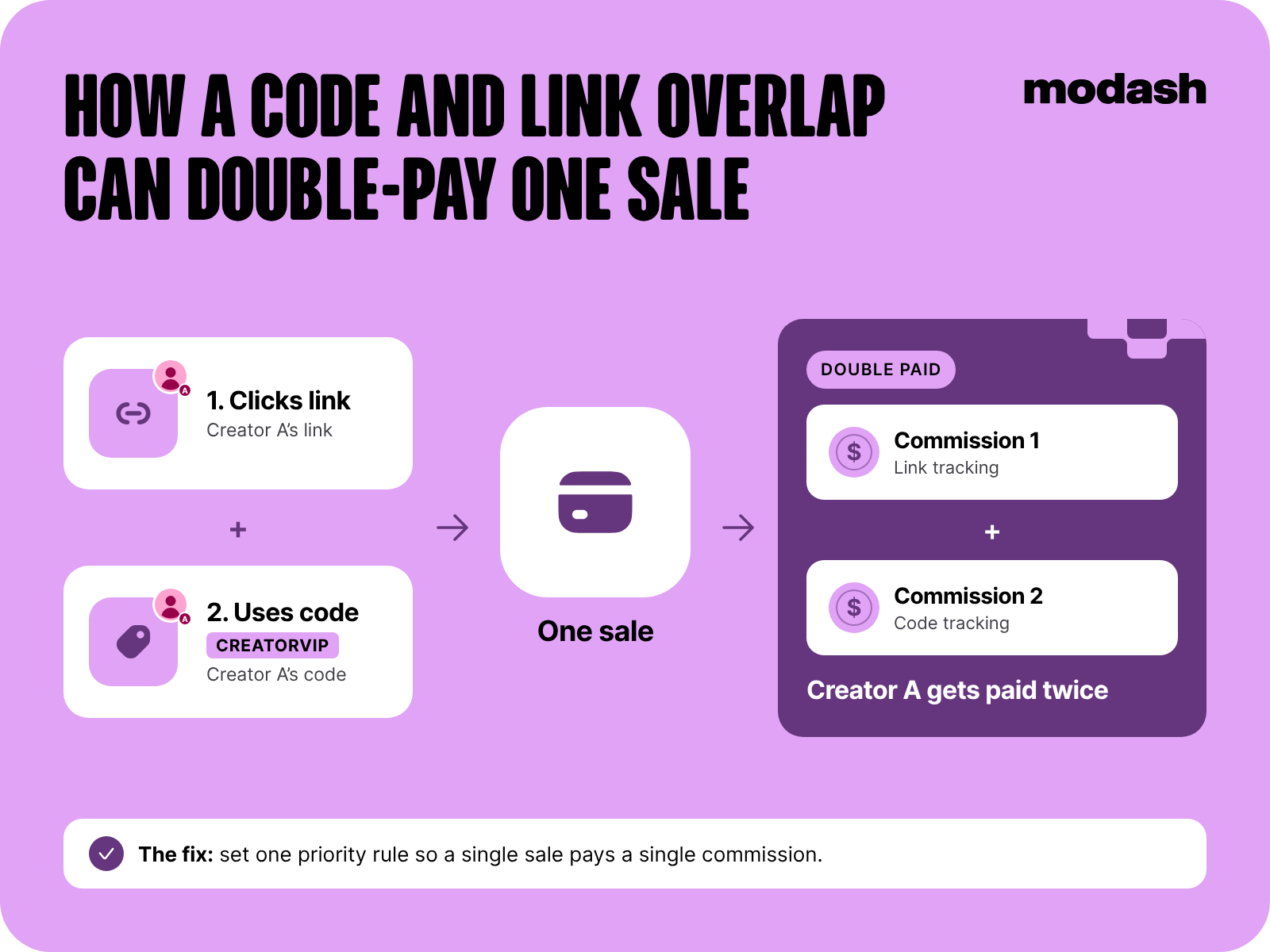
The fix is one written priority rule (say, codes beat links) applied to every order. That’s hard to enforce by hand in a spreadsheet, which is why an affiliate marketing tool like Modash applies it automatically – codes beat links, except generic sitewide codes.
For anyone running an affiliate program, a major part of the job is about keeping creators happy.
In our survey, programs where marketers were “very involved” had 7x more active affiliates than “very hands-off” ones.
Disagreements over commission pose a major threat to these all-important relationships. Because if you think someone owes you $20 and they only pay you $10, you’d be annoyed, right?
Most often, these clashes are caused by misunderstandings over how commissions are calculated.
The affiliate sees a $100 order and expects their 10% commission rate to earn them $10. But actually, the brand (sensibly) calculates commissions on net revenue, minus their 15% discount code, so they “only” get $8.50.
The solution is simple: be transparent.
Explain the commission math in your affiliate agreement and show it per order in your affiliate dashboard so there’s no room for confusion.
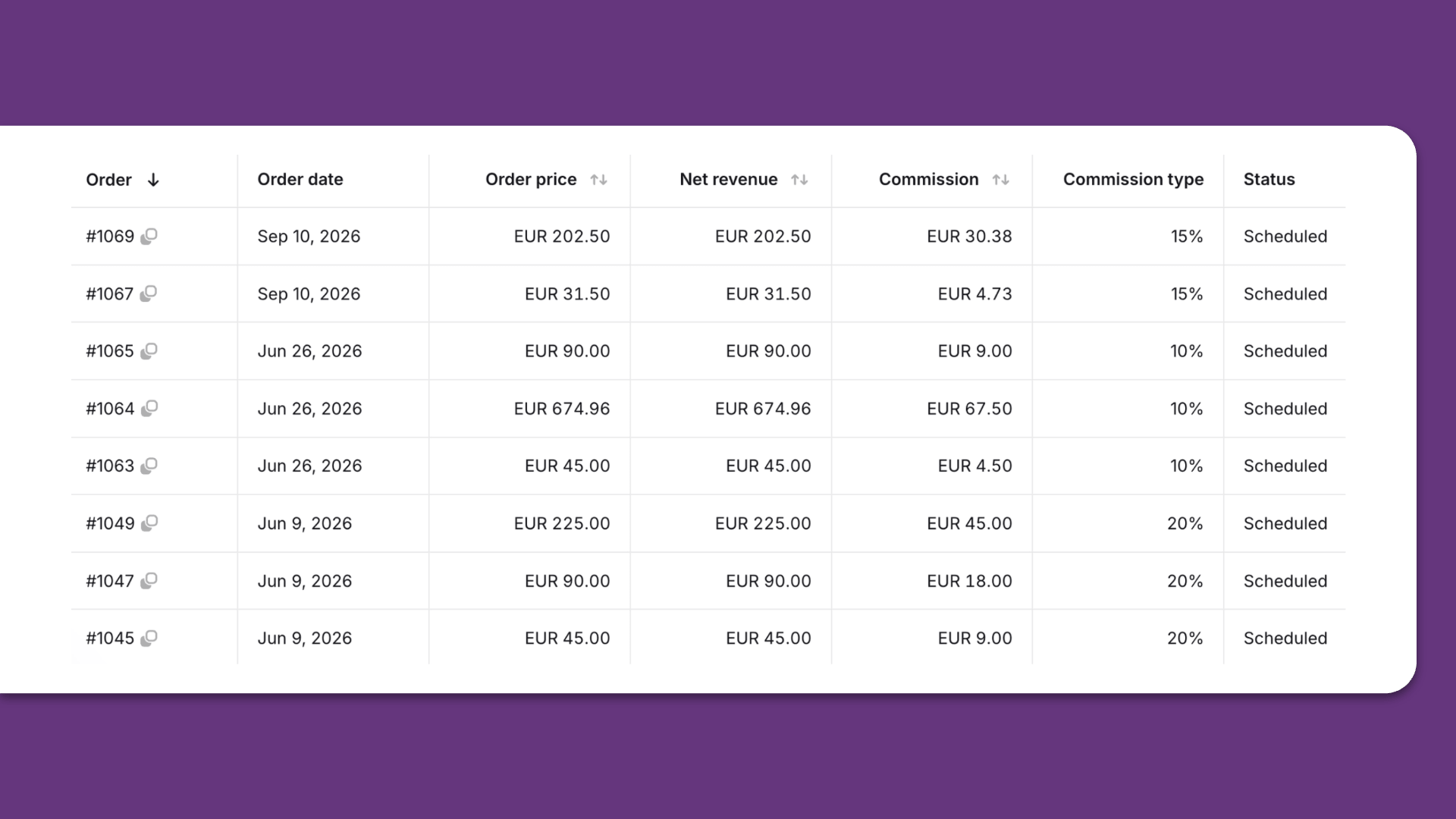
🤓 Pro tip: Modash does this for you. Our Orders view shows order price, net revenue, commission, status, and estimated payout date in a single view. Creators can see the same order-level breakdown in their own dashboard if you switch it on.
Code leakage, AKA code poaching, is where an affiliate code gets shared on places like forums and discount websites – with or without the original creator’s knowledge.
Why’s that a problem?
Well, imagine a customer watches Creator A’s Instagram Story about your product and decides they need to buy right now. So they click the affiliate link and add to cart, then start hunting for a discount.
Next thing you know, they find Creator B’s promo code on a third-party site and use it at checkout. The result? Creator B gets the commish that should have gone to Creator A.
Almost half of marketers say code poaching is an issue, per Modash research. They deal with it in lots of ways, including:
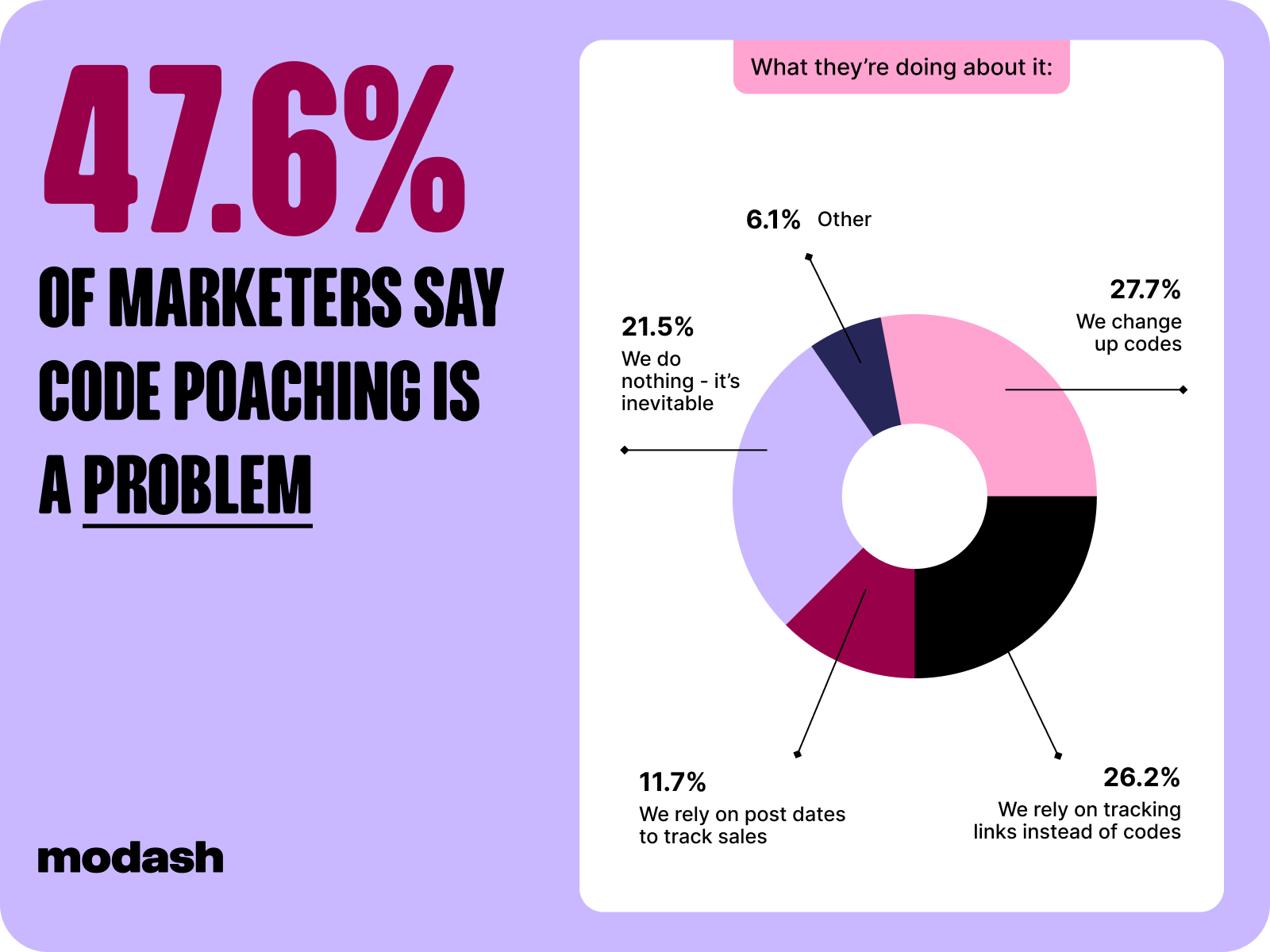
At the same time, 1 in 5 simply shrug their shoulders and accept that some poaching is basically inevitable 🤷♀️
The best solution is to keep a close eye on affiliate sales. If you see a sudden spike in code usage that doesn’t correlate with the creator’s post volume and/or engagement, look closer – there’s a good chance their code has been leaked.
🤓 Pro tip: In Modash, you can make a creator’s code new-customer-only, so your existing customers can’t reuse a leaked code.
🤓 Further reading: For more on code poaching, check out How to Prevent Affiliate Abuse in Your Program (Before It Gets Expensive).
Your entry-level commission tier has already paid 10%.
But you’re missing your target margin, so you drop the rate to 8%, effective immediately.
This sort of change can cause big problems if you don’t communicate it clearly, because your affiliate partners suddenly and unexpectedly find they’re earning less per transaction.
Don’t just rely on a single email blast to get the news across. Send multiple emails and use one-to-many broadcast channels like WhatsApp Groups and Discord servers, too.
Oh, and make sure your new rate – whether higher or lower – only applies to future orders placed after you first communicate the change.
🤓 Pro tip: In Modash, past sales retain the commission rate that applied when the order was placed, while new sales automatically use the updated rate.
While your headline commission rate plays a big part in convincing creators to join your affiliate program, the rules behind it are what actually builds trust and makes them stick around.
(Plus they protect your precious margin.)
From attribution to net vs gross revenue to hold periods, make sure you set every rule deliberately, communicate it clearly, and show creators the math.
This process gets a whole lot easier when you’ve got a tool like Modash to handle the labor-intensive stuff like attributing sales, calculating commissions, and letting affiliates know how much they’ve earned and when they’ll get paid. And the same platform helps you find creators, run outreach, send gifts, and track content, so your whole program lives in one place.
👉 See for yourself when you start your 14-day free Modash trial!
Affiliates get paid commission when they generate sales that can be attributed back to them, typically because the customer clicked their affiliate link and/or used their discount code. Commissions are generally paid weekly or monthly after a “hold period”, which stops brands paying out on orders that later get returned.
There’s no universal “good” commission rate. In general, ecommerce brands pay rates of 5% – 25% per sale, but it really all depends on your target margin. Paying high commissions on tight margins is unsustainable and might even mean your program loses money.
It can be calculated on either – it all depends on the brand. However, it’s best to calculate commission on net sales to protect your margins.
They shouldn’t, no. Most brands use a hold period, whereby commissions are held back until after the return date has passed. That way, they don’t end up paying a commission on cancelled or refunded orders.
Again, depends on the brand. Those that already have high repeat purchase rates might pay a lower commission for sales to existing customers, or even make them non-commissionable. Whereas a brand struggling with retention might value repeat purchases just as highly as new customer sales.
Guess what? It depends. Most brands pay affiliate commissions weekly or monthly after a hold period.
Here’s how it looks for a brand with a 30-day hold period and a monthly payment run:
An affiliate commission is the amount of money a creator earns from attributed sales, whereas an affiliate payout is when they actually receive the commission they’re owed.
Sure! Lots of brands use performance-based tiered commission structures that pay higher rates for top sellers. Modash research shows that tiered structures tend to have higher levels of active affiliates than single-tier ones, which suggests tiers help keep affiliates motivated.
Our expert contributors