

More tools
Use cases



You're under pressure to prove that influencer marketing drives revenue, not just impressions. The trouble is that "ROI tracking" means wildly different things across different tools. Some stop at engagement metrics. Some estimate media value and call it a day. Only a handful actually tie content to real sales, and those are very different claims to put in front of your CFO.
This list covers 10 influencer marketing platforms with ROI tracking, chosen on data quality, integrations, pricing transparency, tracking depth, and real user feedback. And, of course, I've pulled apart what each one actually measures. Read on so you know which promise you're buying.
🥇 Best for: In-house marketing teams at ecommerce brands (especially Shopify) who need end-to-end influencer management, from discovery through payment.
🤔 What is Modash?
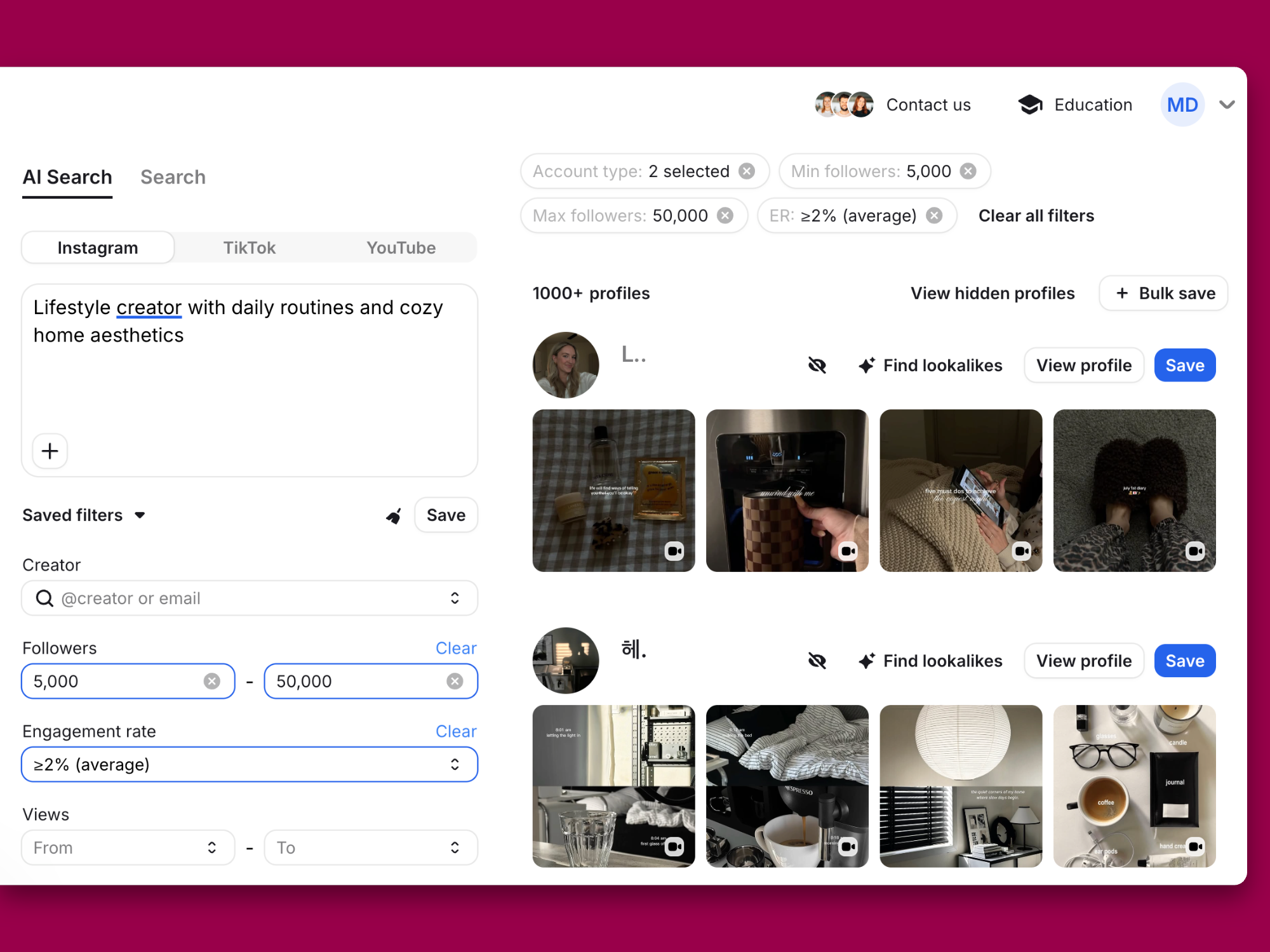
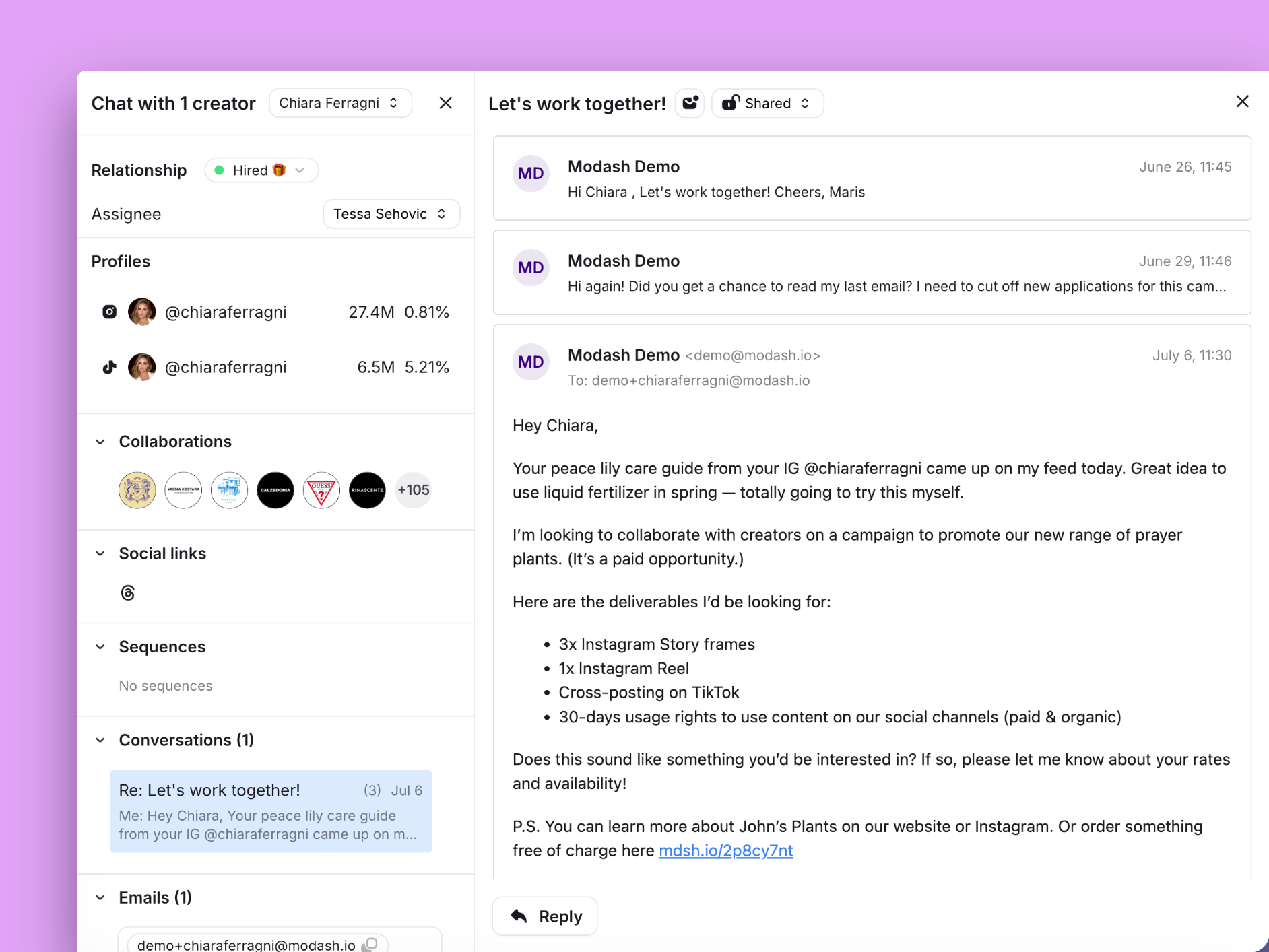
Modash is an influencer marketing platform built for the full lifecycle: find creators, vet them, run outreach, track content and sales, then pay everyone. It indexes 380M+ creators across Instagram, TikTok, and YouTube, with no opt-in required. That means any public profile with 1K+ followers is searchable.
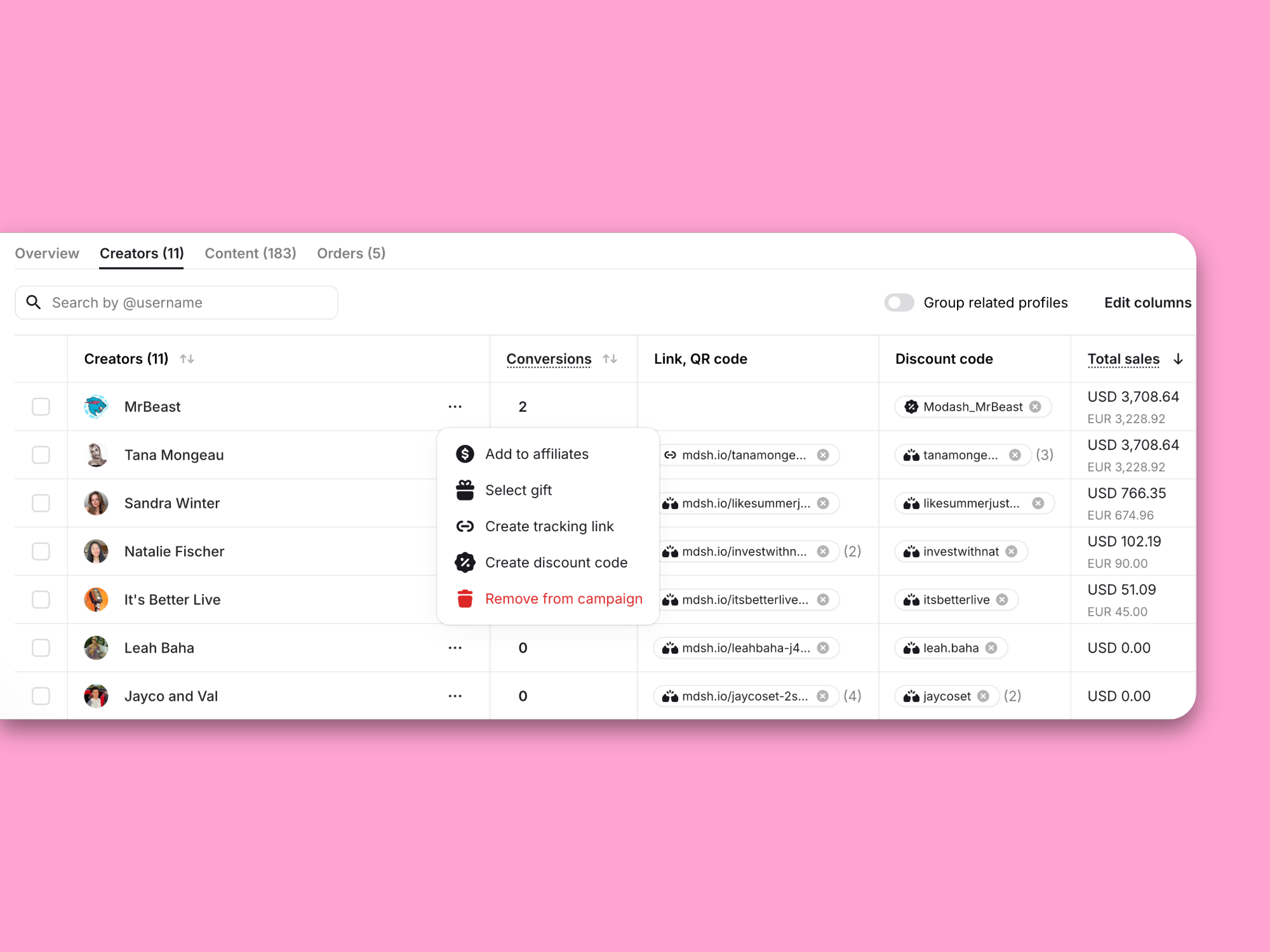
For ROI specifically, Modash tries to keep you honest. It calculates EMV for awareness value. Connected to Shopify, it attributes actual orders to each creator and campaign through their discount codes and tracking links. So your ROAS reflects real orders against real spend, not a flattering estimate.
That combination matters when leadership asks "did this make money?" You get EMV for organic exposure and ROAS for hard return, side by side.
Key features:

Price: Starts at $199/month (annual) or $299/month (monthly). Free trial, no card required.
Worth noting: Automatic sales and revenue attribution needs a Shopify connection. Without it, you still get content tracking, views, engagement, and EMV, plus a manual "log sales" option, but not automatic ROAS. If you're on Shopify, this is a non-issue.
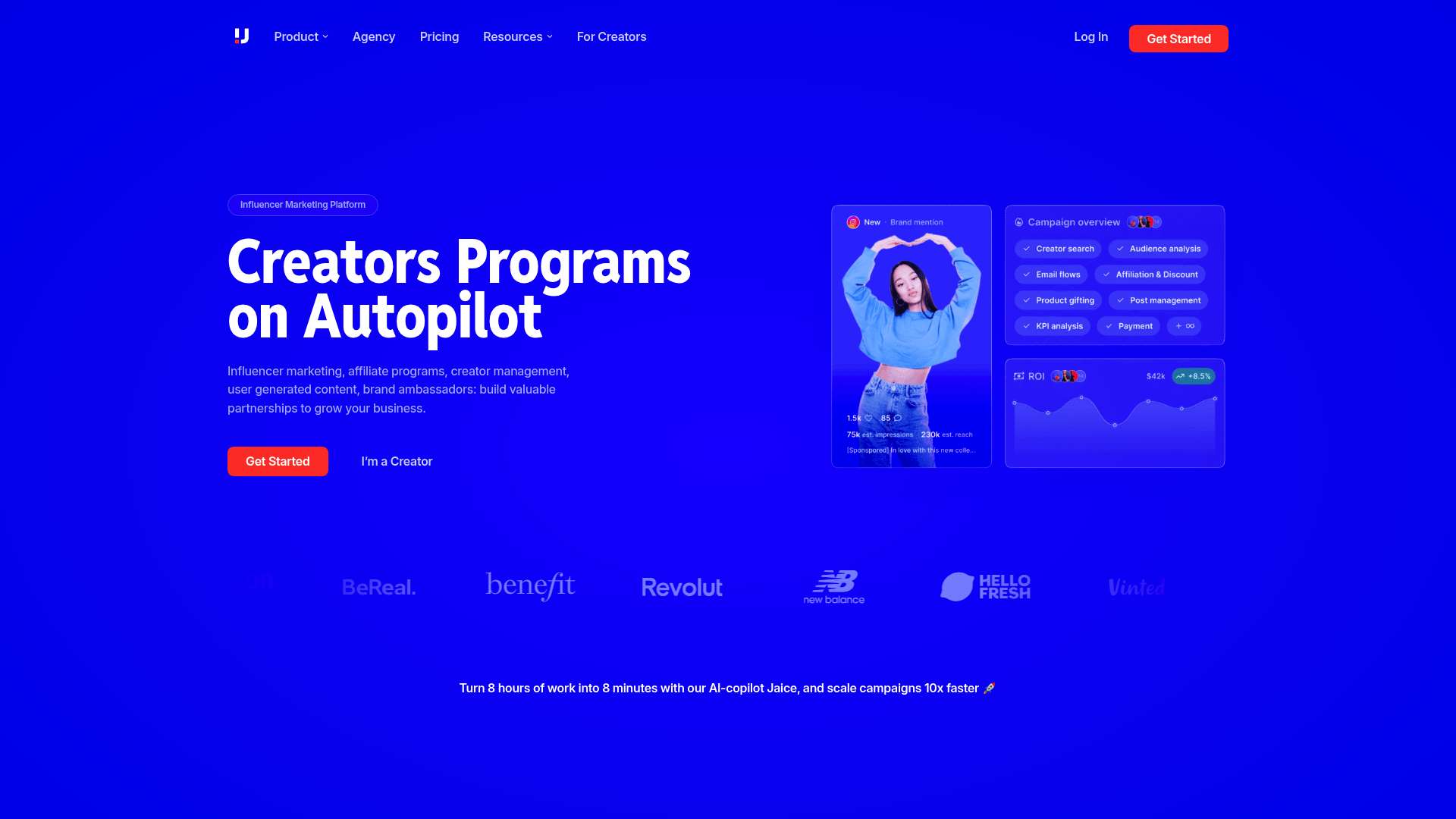
🥇 Best for: Mid-market and enterprise brands and agencies running ecommerce-driven influencer and affiliate programs.
🤔 What is Upfluence?
Upfluence is an influencer platform with a 12M+ creator marketplace, an AI campaign co-pilot called Jaice, and a hatful of native ecommerce integrations. It's built for teams running paid influencer and affiliate programs who want discovery, tracking, and payments in one place.
Key features:
Worth noting: Ecommerce integrations are only available on the mid-tier "Scale Creator Programs" plan and above. The entry-level plan includes discovery and outreach tools.
Price: Custom-quoted, not published.
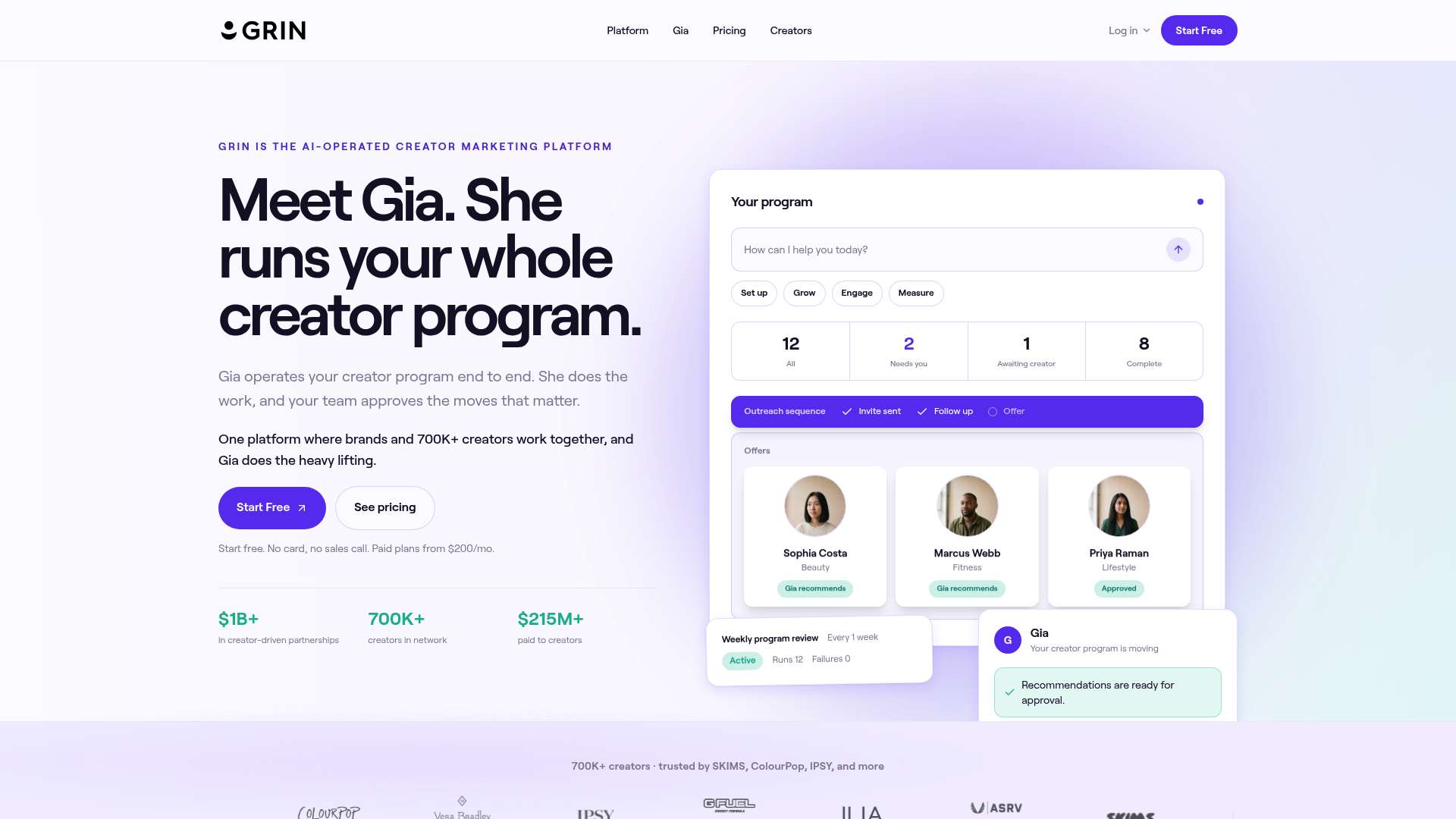
🥇 Best for: Ecommerce and DTC brands that want a creator program largely operated by an AI agent on top of a dedicated CRM.
🤔 What is GRIN?
GRIN is a creator marketing platform built around an AI agent named Gia, which runs discovery, outreach, negotiation, payment, and reporting while you approve the key decisions. It sits on a creator CRM with a 700K+ opted-in network and a decade of performance data.
Key features:
Worth noting: The GRIN Classic workspace caps user logins at 5 across the Growth, Scale, and Complete plans, and the network is opted-in only rather than an open index.
Price: Free plan available; paid from $200/month.
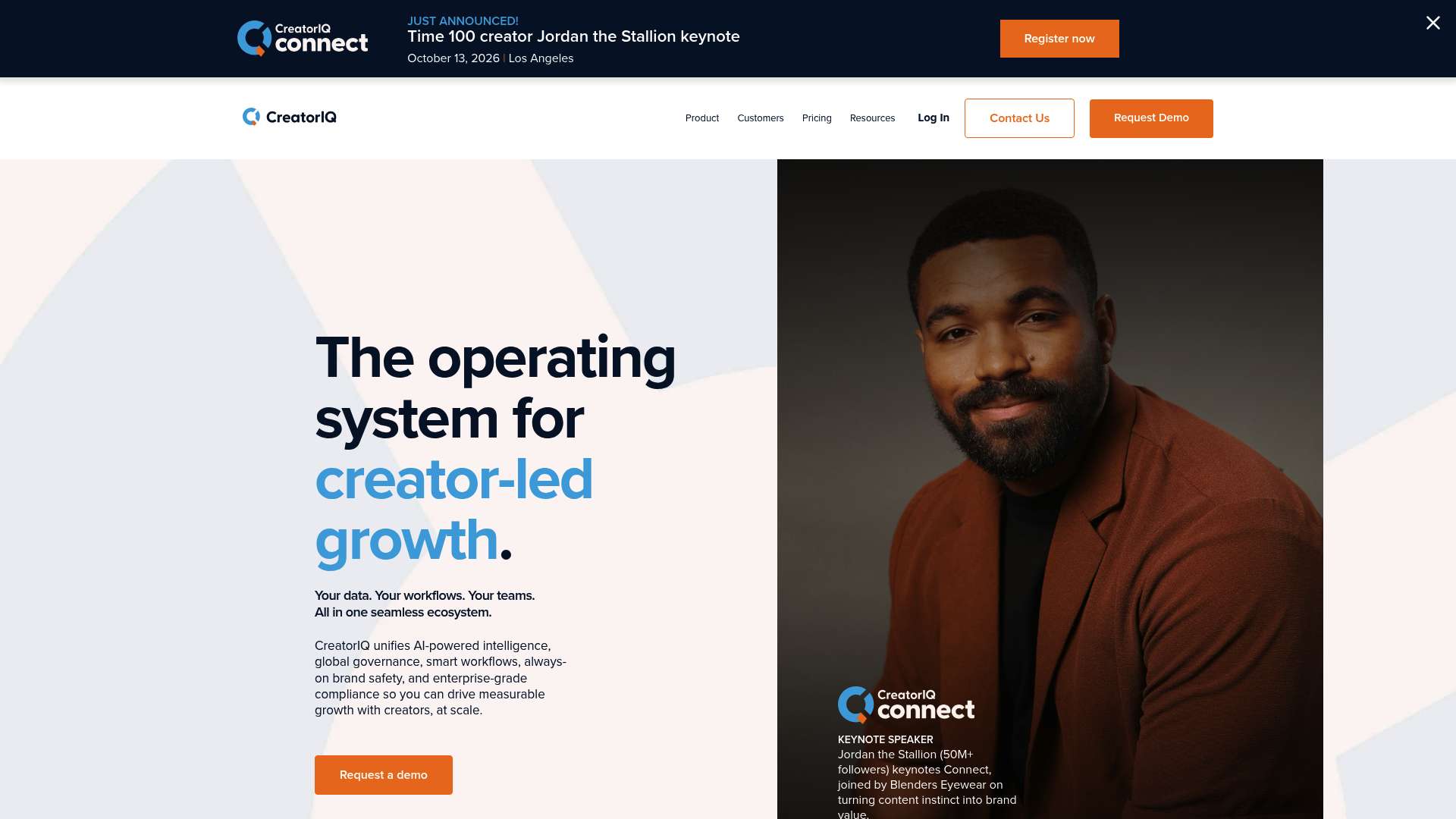
🥇 Best for: Enterprise brands and agencies running large-scale, safety-focused creator programs.
🤔 What is CreatorIQ?
CreatorIQ is an enterprise creator marketing platform built around its Creator Graph intelligence infrastructure. It's trusted by 1,300+ brands and agencies including Sephora, Unilever, and Google, and covers discovery, program management, measurement, and brand safety at scale.
Key features:
Worth noting: There's no free trial or free version, and contracts are annual-only. Procurement data cited by third parties puts contracts starting around $30,000/year, with Capterra listing a plan from $36,000/user/year. If you're weighing lighter options, it's worth reviewing CreatorIQ alternatives.
Price: Custom, annual-only. No public pricing.
.png)
🥇 Best for: Ecommerce brands on Shopify running influencer, affiliate, and ambassador programs.
🤔 What is Aspire?
Aspire is an influencer marketing platform that integrates with Shopify to attribute sales through promo codes and tracking links. It supports affiliate and ambassador programs alongside standard campaign management.
Key features:
Worth noting: Aspire doesn't publish influencer marketing pricing on its site, so you'll need to request a quote.
Price: Contact Aspire for a quote.
.png)
🥇 Best for: Enterprise brands that need media intelligence, social listening, and AI tracking alongside influencer marketing.
🤔 What is Meltwater?
Meltwater is an enterprise-grade media intelligence and social listening platform that also offers influencer marketing capabilities thanks to its 2021 acquisition of Klear, a formerly standalone influencer solution.
Key features:
Worth noting: Influencer marketing is only available on the mid-tier Pro plan and above.
Price: Not publicly listed. Contact for pricing.
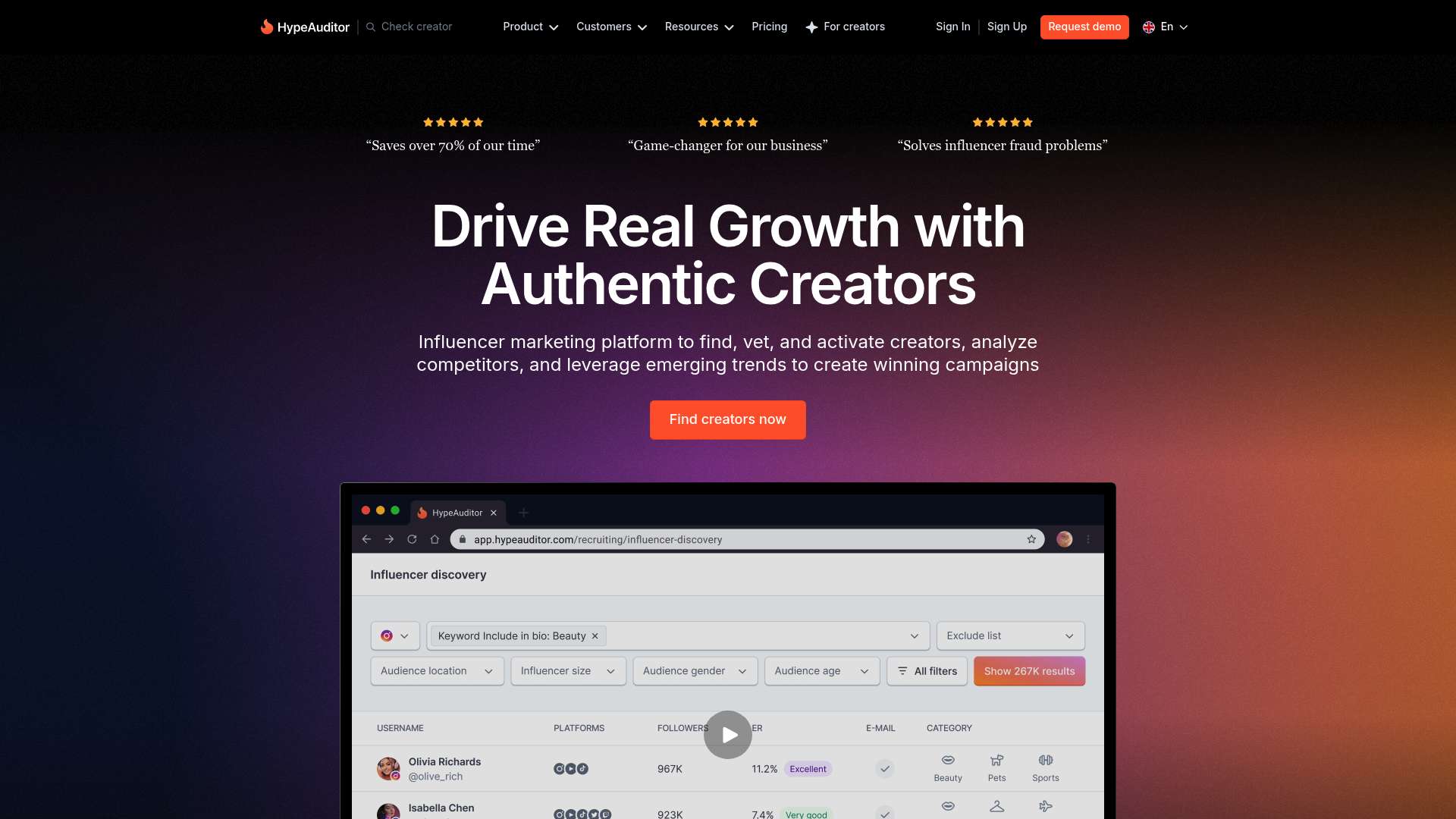
🥇 Best for: Brands and agencies that need rigorous creator vetting and fraud detection before activating campaigns.
🤔 What is HypeAuditor?
HypeAuditor is built around creator analytics and AI-powered fraud detection. It pairs a 227.2M+ influencer database with discovery filters, campaign management, and competitor analysis across Instagram, TikTok, YouTube, X, and Twitch.
Key features:
Worth noting: HypeAuditor's media tracking tool can't automatically capture live Instagram Stories, so you have to either do it yourself or get creators to upload their own metrics.
Price: From $299/month when billed annually.
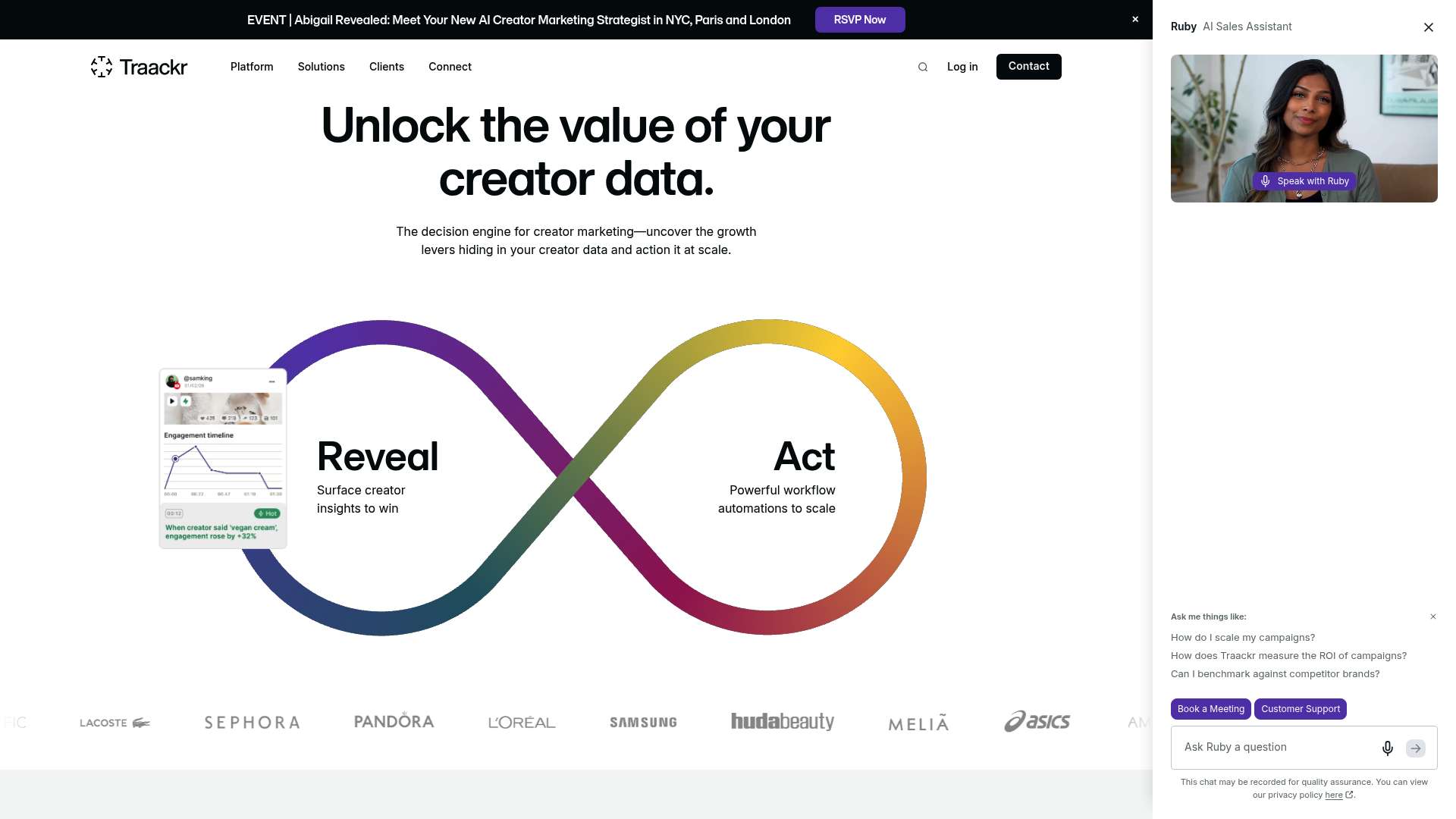
🥇 Best for: Global enterprise brands and agencies that want to turn creator data into a benchmarked growth engine across markets.
🤔 What is Traackr?
Traackr is a data-led influencer marketing platform aimed at global enterprise teams. Its focus is turning creator data into measurable, benchmarked performance across markets and regions.
Key features:
Worth noting: Traackr doesn't publish pricing, so evaluation means a conversation with their team. If you're scoping options at the enterprise level, it's worth looking at Traackr alternatives.
Price: Custom. Contact Traackr.
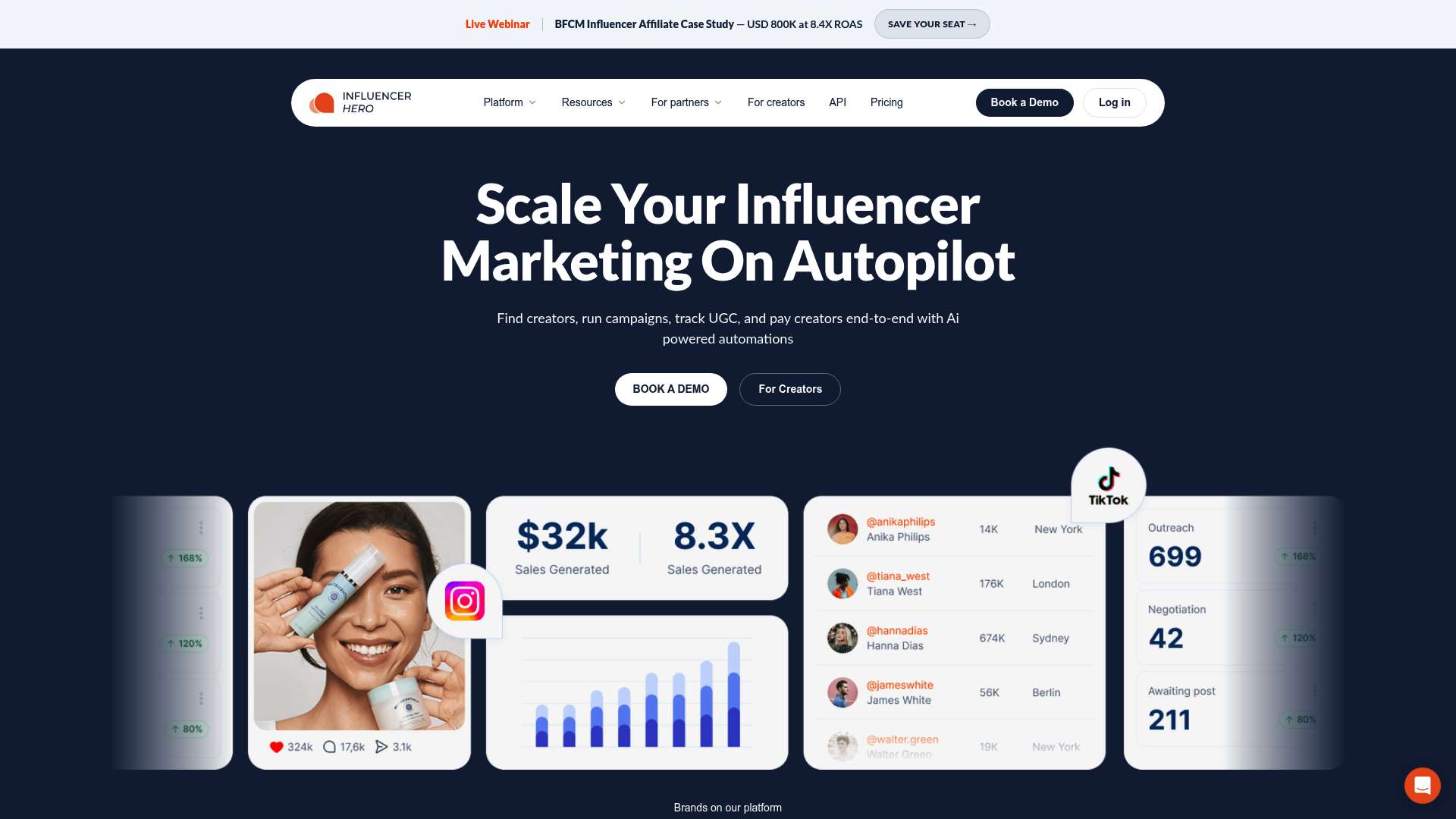
🥇 Best for: D2C and ecommerce brands and agencies that want to run influencer, UGC, and affiliate programs end to end within a single CRM.
🤔 What is Influencer Hero?
Influencer Hero is an all-in-one platform for D2C and ecommerce brands, combining influencer, UGC, and affiliate program management inside a single CRM.
Key features:
Worth noting: The entry-level Standard plan only includes a single user seat, so multiperson teams will need to choose the Pro plan or higher.
Price: From $649/month with a minimum three-month commitment. Save 20% with a quarterly plan or 30% with a yearly one.
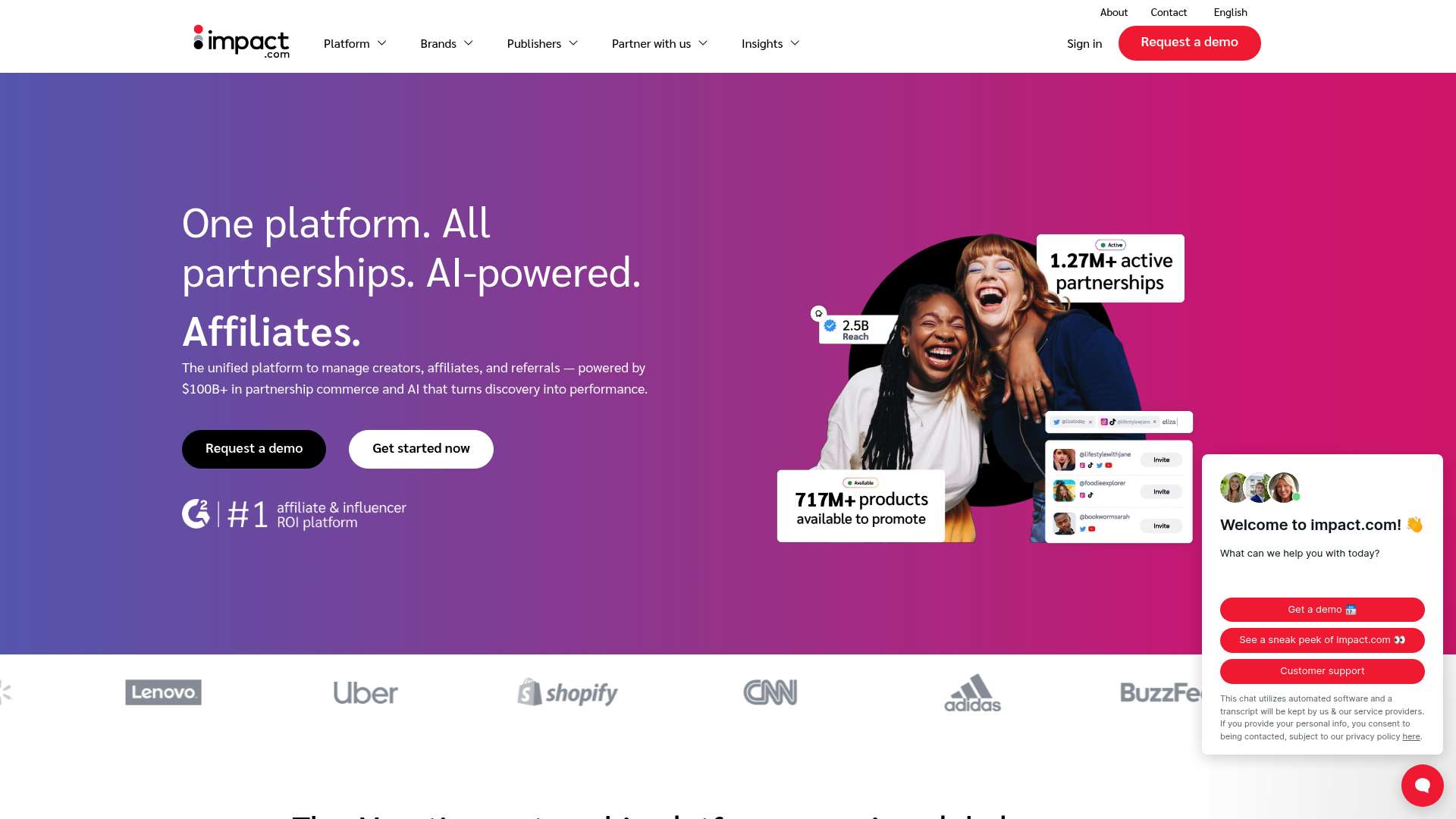
🥇 Best for: Brands that want to manage affiliate, creator, and referral partnerships from one platform with revenue-based tracking.
🤔 What is Impact?
Impact is a partnership management platform spanning affiliate, creator, and referral programs. Its strength is revenue-based performance tracking across all partnership types in one system.
Key features:
Worth noting: Impact's opt-in creator marketplace features 80K vetted profiles. This is significantly smaller than platforms with public creator databases like Modash (380M+ profiles).
Price: From $30 – $2,500+ per month.
After digging through these tools, a few capabilities separate the platforms that actually prove revenue from the ones that stop at reach. Here's what to prioritize.
Real sales attribution, not just media value
The most important distinction on this list. EMV and estimated reach are useful for awareness, but they aren't revenue. Look for a platform that attributes actual orders to each creator and campaign through promo codes and tracking links, ideally tied to your store. That's the number leadership actually asks about.
Honest cost accounting
ROI is only meaningful if the spend side is complete. A good platform rolls affiliate commissions in alongside flat fees and product cost when it calculates ROAS. If a tool leaves commissions out, your return will look better than it really is.
Low-friction content tracking
Some platforms need creators to sign up or authenticate accounts before their content is tracked, which stalls your reporting. Automatic tracking that needs no creator action keeps your data complete, including Stories that would otherwise disappear.
Does "ROI tracking" mean the same thing across these tools?
No, and that's the trap. Some tools stop at engagement metrics. Others estimate a media value like EMV and present it as return. Only some attribute content to real sales through codes and links. Before you buy, ask exactly which of those three a tool does, because they're very different claims.
Can I track true ROAS without connecting a store?
Usually not. On most of these platforms, and on Modash specifically, automatic sales and revenue attribution requires a store connection like Shopify. Without it you still get views, engagement, and EMV, plus manual sales logging as a fallback, but not automatic ROAS.
What's the difference between EMV and ROAS?
EMV estimates the media value of organic exposure. It's an approximation, not money in the bank. ROAS is a hard return figure: attributed revenue against what you spent. Use EMV to gauge awareness, and ROAS to prove revenue. The strongest tools show both side by side.
Do I need creators to sign up for content tracking?
It depends on the tool. Some require creators to authenticate their accounts before tracking works, which adds friction and delays. Others, including Modash, track public content automatically with no creator action required.
Why is so much pricing hidden on these tools?
Several platforms here don't publish pricing and route you to a sales call. That makes fast comparison harder. Tools like Modash and GRIN list starting prices publicly, so you can evaluate before committing time to a demo.
The right pick comes down to what you actually need to prove. If you're an enterprise team running programs across many markets with brand safety at the center, CreatorIQ or Traackr fit that scale. If vetting and fraud detection come first, HypeAuditor leads on analytics depth. If you want an AI agent running the day-to-day, GRIN is built for that.
If you're an in-house team at a Shopify ecommerce brand and your goal is to prove revenue, not vanity metrics, Modash ties ROAS and sales to real orders per creator, calculates EMV and CPM automatically, and rolls affiliate commissions into cost so your ROI isn't flattered. Discovery, outreach, tracking, and payments all live in one place, with public pricing from $199/month.
Try Modash free and see your real ROAS per creator, no credit card needed.