Capabilities
Integrations







Use cases
Capabilities
Integrations
Use cases
Your creator program, minus the manual work.
Find creators, manage relationships, and track results. All in one place.

Refersion and AvantLink offer 2 different approaches to running an affiliate program:
But which is the best fit for you? And are there any alternatives with names that rhyme with "Bodash" that you should be considering? I'll answer both of those questions in this article.
Refersion is for brands that want to run their affiliate program themselves on their ecommerce store, recruiting through an open marketplace and building the offers on their own. AvantLink is for brands that would rather join an established network, where a compliance team screens every applicant and the network pays affiliates on your behalf.
The problem with both tools is that neither collects the posts, Reels, Stories, or videos your affiliates publish. Both report on the link and the order behind it, so finding out what went live means asking each affiliate for post URLs or scanning their feeds by hand.
If that's important to you, consider Modash as an alternative. Modash is an influencer marketing platform for Shopify brands that covers creator discovery, campaign tracking, product gifting, and affiliate payouts in one place, which is why it sits here as the option for creator-led programs. Here's how the 3 compare:
If you don't already have a bench of affiliates, the first question is where new partners come from and who checks them before they start promoting you. Refersion gives you an open marketplace and leaves the screening to you, whereas AvantLink screens every applicant before you ever see them.
Refersion's Marketplace is an open network where you list your program and commission offer, and affiliates browse it to find brands to promote. Listing an offer there is free for every Refersion customer.
When a Marketplace user applies, you approve or deny them yourself in the My Affiliates tab, using whatever custom form fields you added to the application. Refersion's own documentation tells you to inspect those leads carefully to make sure they uphold your brand standards.

Beyond the Marketplace, Refersion's recruiting leans on your own site and your existing customers.
You can customize the affiliate registration page, embed the signup form on your website, and track how that page performs with Google Analytics or Facebook Pixel.
2 integrations extend reach further:
⚠️ Bear in mind that Refersion's sources don't publish how many affiliates are in the Marketplace.

By contrast, AvantLink puts a compliance team between applicants and your program. That team reviews every new affiliate application by hand, 1 at a time, and accepts or denies it against the network's acceptance criteria. Per AvantLink, template-driven coupon sites, duplicate-content sites, banner farms, and lead-generation networks are not accepted, while content, social media, community, and product-review affiliates are among the accepted categories.
Once affiliates are inside the network, AvantLink gives you traffic and influencer analytics to use when recruiting affiliates and reviewing applications. Traffic figures are estimates built from third-party clickstream data, apply only to traditional affiliates, and refresh monthly, while influencer data refreshes daily.
⚠️ The only public documentation I could find says there are "over 10,000 affiliates in the AvantLink network - and counting", which is tiny compared to dedicated creator search platforms like Modash.
Your program also gets a public description page on AvantLink.com that you edit to tell affiliates why to join and what is prohibited. AvantLink's sources likewise do not publish a count of affiliates in its network.
Both tools start recruiting once an affiliate applies.
Modash, on the other hand, starts the vetting before an application exists – you can search a network of 380M+ creators (that's every public account on Instagram, TikTok, and YouTube with at least 1,000 followers), and see each creator's audience demographics and engagement metrics before you send a single message.

Bottom line: AvantLink suits a brand that wants the network to run the first round of screening and will accept its acceptance criteria as the filter. Refersion fits a brand that wants to recruit through a free open marketplace and its own site, and is happy to qualify affiliates itself.
Budgeting for an affiliate program means knowing what you pay before the first sale and what you pay as sales grow, so let's take a look at the costs for both platforms.
First up, AvantLink, which charges an upfront one-time integration fee. After that, it's totally free to use (minus the commissions your affiliates earn). However, it's worth noting that the platform also offers a range of optional managed services, priced as follows:
As for Refersion, there's no upfront fee, but you will have to pay an ongoing subscription plus fees (unless you choose the free plan, which only offers a listing in the Refersion Marketplace).
Paid plans run from $29 – $159/month billed yearly, or $39 – $199/month billed monthly, plus 2% – 3% of affiliate-driven sales. So a brand on the top-tier Growth plan driving $50,000 in affiliate sales in a month pays $159 plus $1,000 as its 2% share, so about $1,159 for that month. The share rises with every sale, so a strong month costs more.
And then there's Modash, which prices by plan rather than by sales volume: Essentials is $199/month (or $299/month without an annual contract), Performance is $499/month (or $599 monthly), and Enterprise starts at $14,700/year.
Optionally, you can also use Modash to pay creators. On our Performance plan, payouts carry a 0% fee on the first $10,000 you pay out each year, and 5% applies only to the amount above that.
Bottom line: AvantLink charges upfront and has optional monthly managed plans, whereas with Refersion, all the costs come from the monthly subscription + sales percentage. It's up to you which model you prefer.
Once affiliates start sending traffic, you need to know which partner gets credit for each sale and what the customer did before buying. Both tools tie clicks to conversions, but they differ in how far back into the customer journey each one reports.
Refersion runs on last-click attribution, so credit goes to the affiliate link the customer clicked most recently before ordering. Its tracking links rely on first-party tracking rather than cookies, which Refersion positions as a way to close attribution gaps and avoid redirects.
For link-based conversions, Refersion shows the referring URL, so you can see which site a customer came from and which channels drive the most orders. Refersion notes that referring URLs are only available for link-based conversions and may be missing when shoppers opt out of cross-web tracking.
Reporting in Refersion comes as 4 standard reports:
Refersion recommends automating the Performance by Affiliate report, and its team can build custom reports on request within your plan's allowances.
⚠️ If you run more than one affiliate platform, Refersion suggests adding a unique tracking parameter to each channel's links and manually denying duplicate conversions where the referring URL shows another network.
AvantLink's standard reporting also credits the final tracked click before a sale, but its Insights product (formerly AvantMetrics) adds the clicks that came before it across the referral window. AvantLink describes this as tracking the entire click stream of each converting customer so you can see the impact of your referral program alongside other marketing channels.
Its Arches platform presents results in interactive, customizable graphs, and AvantLink lists reports built on custom parameters on the Arches roadmap.
On the affiliate side, AvantLink's Custom Link Builder lets affiliates create tracking links to any page on your site, and links in HTML format also track impressions.

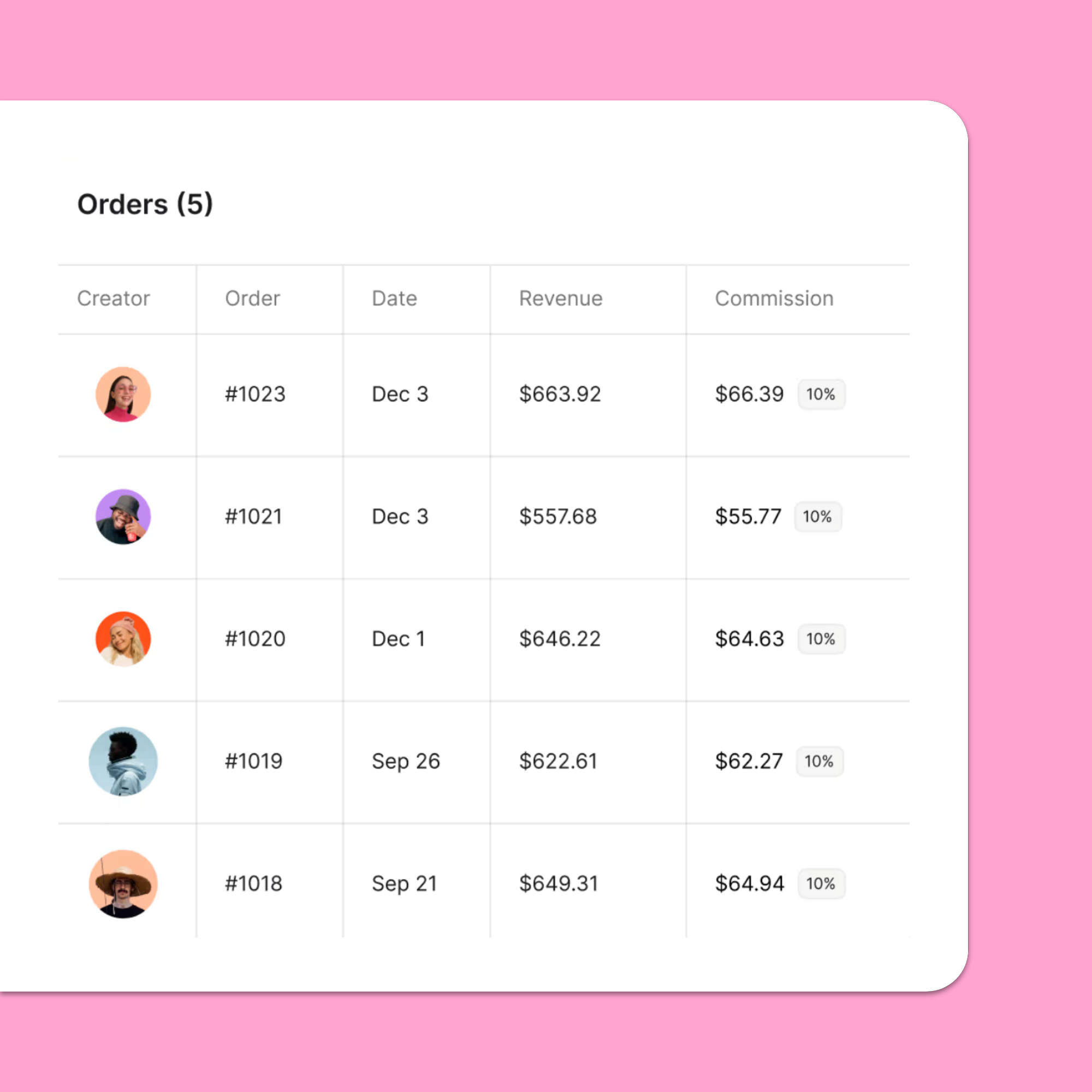
Modash credits the last touch too, and each order shows whether a tracking link or a discount code earned the credit, so you can settle who-gets-paid questions without digging through logs. Tracking-link clicks stay valid for up to 30 days, while discount codes attribute a sale no matter when the customer uses them.
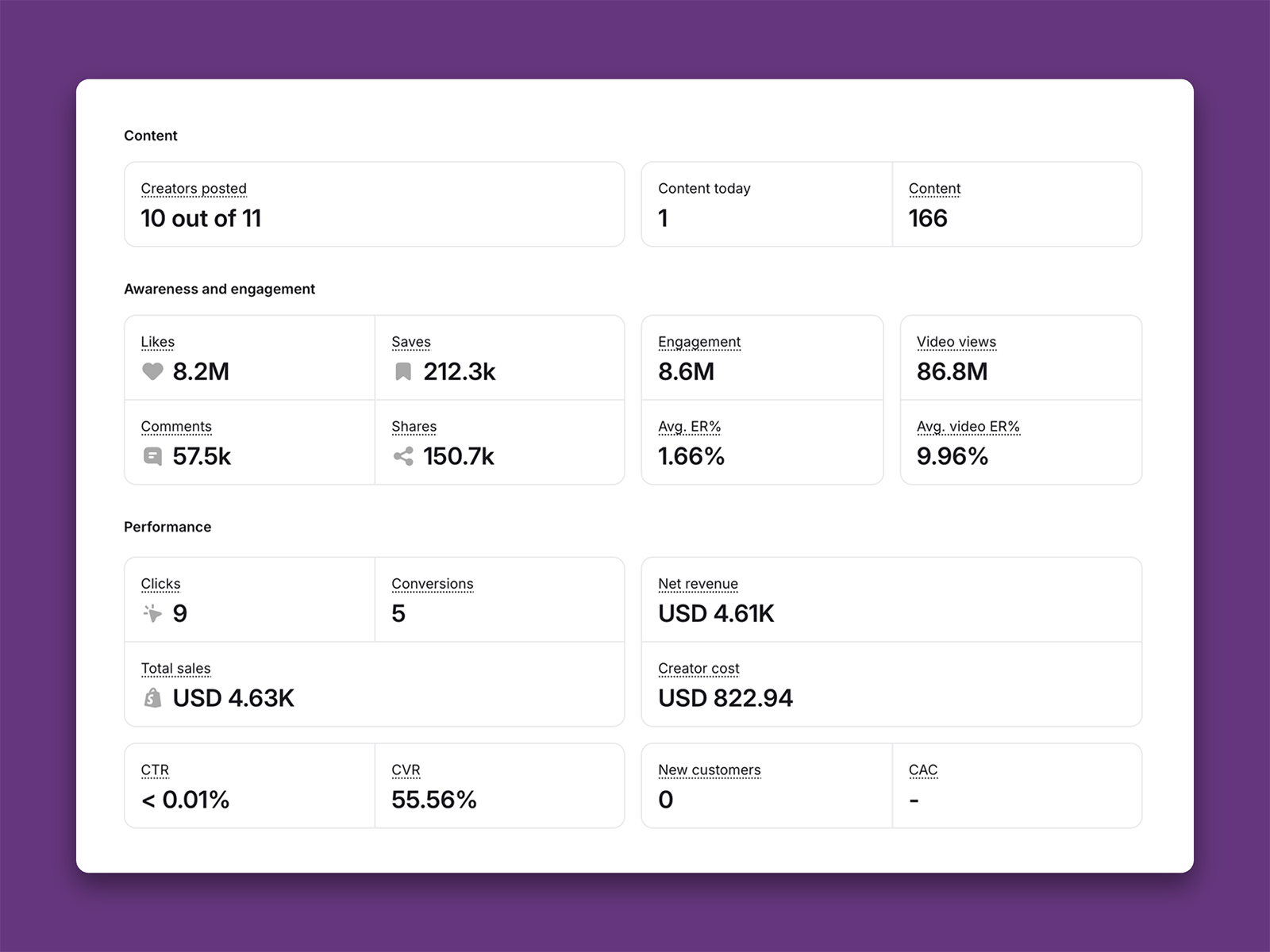
Bottom line: Refersion gives you last-click credit with first-person tracking, plus the referring URL on each link-based order, which is enough to see which affiliate and which site drove a sale. AvantLink's Insights reports on the clicks that preceded the final one across the referral window, which suits brands that want to see how affiliate traffic interacts with their other channels.
Once commissions are approved, someone has to pay affiliates and handle the tax paperwork. Refersion treats central payouts as an opt-in feature with eligibility rules. AvantLink sends every affiliate payment through one third-party processor.
Refersion's Unified Payments sends affiliates one consolidated monthly payout covering every merchant they work with. For affiliates who have signed up for direct monthly payments, any approved conversion left unpaid for 30 days or more is added to Unified Payments automatically. At tax time, both you and your affiliates receive 1099 forms for everything paid through Unified Payments.
Eligibility is the fork: Unified Payments is only available to merchants with a business registered in the US, a bank located in the US, and affiliates paid in USD.
Outside those rules, Refersion's Actions feature covers the manual route, letting you act on tracked information such as paying an affiliate whose conversions you have approved.

AvantLink has no opt-in step for merchants. It partners with Tipalti, a third-party payment provider, and sends all affiliate payment information to Tipalti on the 23rd of each month. Payouts only go to Tipalti after you have paid your AvantLink invoice, so you settle one bill with the network and the network pays your affiliates.
Each AvantLink payout bundles commissions, bonuses, paid placement earnings, and cost-per-click earnings into one payment, and none of it reaches the affiliate until your invoice is paid. Affiliates set their own minimum payout threshold on AvantLink, which defaults to $25 and can be raised to $1,000 or more.
Modash matches AvantLink on this point: a single Modash invoice covers creator payment and tax. Payouts then run on the schedule your program sets, once a creator's commissions reach the minimum payout threshold.
Bottom line: Refersion gives US-registered merchants paying in USD a consolidated monthly payout with 1099s included, and merchants outside those requirements are not eligible for it. AvantLink centralizes payouts for every merchant through Tipalti, and affiliates get paid once your invoice is settled.
If your affiliates are creators rather than coupon or review sites, you need to know what they published – which Reel, Story, or video drove the sales – and whether it carried the right disclosure. Neither Refersion nor AvantLink collects that content for you.
Both tools can track affiliate sales back to a referral link. What's missing on both is the post behind that link, so you'd ask each affiliate for post URLs or scan their feeds by hand to see what went live and how it performed.
Modash closes that gap by pulling in your creators' posts, Reels, Stories, and videos automatically from your campaign hashtags, mentions, and keywords, so you see which content drove results without chasing screenshots.
It also flags content that is missing a required hashtag, @mention, or ad disclosure, so you catch compliance problems while there is still time to fix them.

Bottom line: Refersion and AvantLink both report on links and orders, not on the posts behind them. If you need to see what affiliates published and how it performed, you'll be collecting that content yourself with either tool (whereas Modash does it for you).
Refersion and AvantLink both report on the link and the order behind each affiliate sale. Neither collects the content your affiliates publish, so with either tool you gather post URLs yourself to see what went live and how it performed.
Modash is an influencer marketing platform built for Shopify brands whose affiliates are creators. You search its creator database and see each creator's audience demographics and engagement metrics before you reach out, so vetting happens before the first message rather than after an application lands.
Once creators are selling, Modash credits each Shopify order to the creator whose link or discount code brought it, using last-touch attribution, so there is no ambiguity about who gets paid. It also collects their posts, Reels, Stories, and videos automatically from your campaign hashtags, mentions, and keywords, and flags anything missing a required hashtag, @mention, or ad disclosure. The post behind the link sits next to the order it drove.
Payouts carry a 0% fee on the first $10,000 you pay out each year, and 5% applies only to the amount above that, charged on what you pay affiliates rather than on the revenue they drive.
Plans run from $199/month for Essentials to $499/month for Performance, with Enterprise from $14,700/year. You can try Modash free for 14 days with no credit card required.
Your creator program, minus the manual work.
Find creators, manage relationships, and track results. All in one place.