9 Modash Alternatives: When You Need One (and When You Don’t)
Phil Norris
Writer @ Modash
Published date:
October 22, 2026
I get it: shopping around for software can be scary 👻
You’re feeling under pressure to compare tools without any clear, standardized criteria to assess them against. You’re worried about paying for features you don’t really need. And you’re confused about why each tool feels so different.
All of which means you’re looking for Modash alternatives. To help you out, I’ve explained:
When Modash is the best choice
When a Modash alternative is worth considering
Which are the best Modash alternatives
Let’s get into it…
When Modash is the best choice
Let me save you some time.
If you agree with one or more of the following statements, you don’t need a Modash alternative at all – because Modash is already the ideal solution:
You’re a Shopify DTC brand with a small influencer team
If you…
✅ Sell direct to consumers on Shopify
✅ Have a focused influencer team of ~1-5 people
✅ Treat influencer partnerships as a core acquisition channel, not a side experiment
…then Modash is perfect for you. You need a good Shopify integration for influencer gifting, discount code generation, and sales attribution. Modash does all that stuff without forcing you to stitch together multiple tools.
You’re scaling your influencer program
You started out with ~10–50 influencers, but now you’re scaling your influencer program to 100-300+ active partnerships – and your trusty spreadsheets are starting to crack under the weight. At this stage, things like…
✅ Discovery volume
✅ Repeatable workflows
✅ Operational efficiency
…become more important than one-off campaigns or manual influencer outreach. All areas in which Modash excels.
You prioritize speed and cost-effectiveness over enterprise complexity
For many brands, speed and cost-effectiveness matter more than complex enterprise functionality. If you fall into this camp, then you’re looking to launch campaigns in a single day and iterate quickly. And you definitely want to steer clear of two to eight-week implementation periods, heavy onboarding, and wallet-busting enterprise pricing.
In other words: if you want serious capability without enterprise-level costs, Modash just makes sense.
Sure, I think Modash is the best thing since chili crunch, but that doesn’t mean it’s right for everyone.
Specifically, Modash likely isn’t a great fit if…
📱 You require platform coverage beyond the “Big Three”: Modash supports the three main influencer-friendly social platforms – Instagram, TikTok, and YouTube. If your strategy depends heavily on Pinterest, Twitch, Facebook, blogs, or something else, you’ll need a tool with broader platform coverage, like Upfluence or HypeAuditor.
🤳 You're only buying content, not distribution: If you need UGC creation without influencer reach (i.e. no posts to their audience), simpler tools like Billo are purpose-built with this in mind.
🛒 You don’t sell on Shopify: Modash’s only ecommerce integration is Shopify. If your store runs on WooCommerce, BigCommerce, or Adobe Commerce, you’ll want a tool that connects to it directly, like Upfluence (which integrates with all three) or Influencer Hero (WooCommerce and BigCommerce).
💼 You need custom BI integrations or multi-level approval workflows: Tools like Traackr and CreatorIQ are built around those.
The best Modash alternatives by use case
How I chose these alternatives
I compared each tool on the things ecommerce teams ask about most:
Creator database size and search filters
Platform coverage beyond Instagram, TikTok, and YouTube
GRIN: Best for AI copilot-assisted influencer marketing
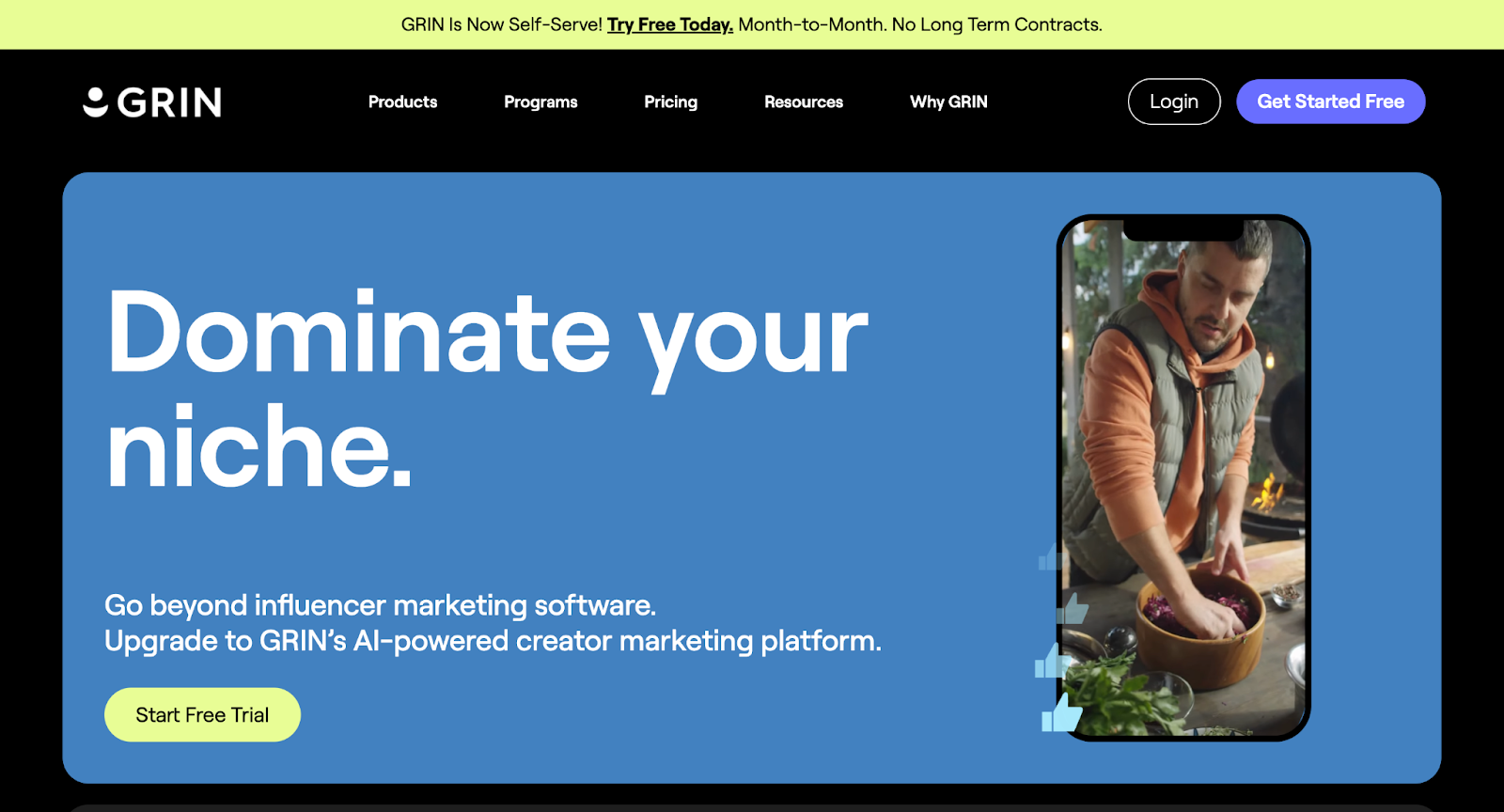
Influencer discovery: Modash makes it easier to find the brand-fit influencers you need to reach your ideal audience. Our database is almost twice the size of GRIN’s, covering every influencer on the planet with 1,000+ followers on Instagram, TikTok, and YouTube. Plus our visual AI search tool lets you find creators based on what’s inside the content (e.g. you can search for “woman applying lipstick”), not just what’s in the caption.
AI agent assistance: GRIN says its AI agent, Gia, can run an affiliate program on autopilot – including discovery, outreach, tracking, and optimization. There are no AI agents built natively inside Modash, but we do use AI in our search tool to help you find more relevant influencers.
Influencer management: Unlike GRIN, you don’t need to ask influencers to sign up for Modash in order to track their content. Modash also features a more intuitive influencer CRM – for example, creator profiles can be viewed from anywhere in the platform.
Landing pages: GRIN gives you the tools to build basic landing pages for generating inbound influencer applications.
Influencer payments: GRIN only supports payments via PayPal, potentially leading to extra fees for your influencer partners. Whereas with Modash Payments, your influencer partners get paid direct to their bank accounts.
Upfluence: Best for enterprise brands looking for agency support
Influencer database: Upfluence has a much more limited influencer pool than Modash, with just 9+ million profiles in its “regular” database (plus over 12 million in its opt-in influencer marketplace). So you’ll likely need to purchase an additional tool alongside Upfluence to find brand-fit influencers.
Platform coverage: Both Upfluence and Modash cover the big three of Instagram, TikTok, and YouTube. However, Upfluence also supports Twitch, X/Twitter, Pinterest, and blogs.
Agency support: Upfluence offers white-glove influencer marketing agency services – ideal for brands with lots of money that don’t want to run their own influencer program. Modash doesn’t do this.
Ecommerce integrations: Upfluence integrates with Adobe Commerce, BigCommerce, Shopify, and WooCommerce, whereas Modash only has a Shopify integration (it’s pretty slick though, allowing you to create promo codes, manage affiliate links, simplify influencer product orders, and more).
Influencer comms: With Upfluence, all communication with influencers has to go through the platform, giving you yet another inbox to check. Whereas Modash works with your existing Gmail or Outlook account.
Purchase risk: Upfluence only offers annual plans. So if you find that it’s not working as expected, you’re locked into a year-long commitment. Modash, on the other hand, offers monthly plans – allowing you to downgrade, upgrade, or cancel at any time.
Influencer Hero: Best for automating and scaling influencer programs end to end
Influencer database: Influencer Hero has a slightly bigger database than Modash, with 450+ million profiles vs. our 380+ million. Both cover the big three of Instagram, TikTok, and YouTube. Both platforms offer AI search based on creators’ content and ways to find creators who already follow your brand.
User reviews: Modash has the stronger review track record, with a 4.9/5 rating on both G2 and Capterra. Influencer Hero has fewer reviews overall.
Workflow automations: This is where Influencer Hero stands out. Trigger-condition-action rules on its campaign board can send the product, contract, discount code, or next email as soon as a creator moves to a new stage. So if you’re running hundreds of partnerships at once, a lot of the busywork runs on its own.
Influencer comms: Like Modash, Influencer Hero works with your existing Gmail or Outlook account. It also brings Instagram DMs and WhatsApp into the same inbox, with drip sequences and automated follow-ups across all of them.
Integrations: Influencer Hero integrates with Shopify, WooCommerce, BigCommerce, and Amazon, whereas Modash’s only ecommerce integration is Shopify. Beyond ecommerce, it has 45+ integrations, including Klaviyo, Omnisend, Mailchimp, Slack, DocuSign, and Zapier (which connects 8,000+ other apps).
Influencer payments: Both platforms let you pay influencers. Influencer Hero adds scheduled auto-payouts and invoice workflows, with fees from 0.1–0.4% via bank debit.
Price and purchase risk: Influencer Hero is the pricier option, starting at $649 per month with no free trial. Modash starts at $199 per month (billed annually), and you can try it free before committing.
Metric
Influencer Hero
Modash
Database size
450+ million profiles
380+ million profiles
Platform coverage
Instagram, TikTok, YouTube
Instagram, TikTok, YouTube
Free trial
No
Yes, 14 days (no credit card required)
Pricing
Pricing starts at $649/month, or save up to 30% with an annual plan
Pricing starts at $199/month (paid annually) or $299/month
AI Creator Search (text and image), Find your fans, Engagement benchmarks, Email outreach and sequences, Relationship management (CRM), Product seeding via Shopify, Affiliate management, Content tracking, Influencer payments, API
CreatorIQ: Best for centralizing influencer marketing data via API
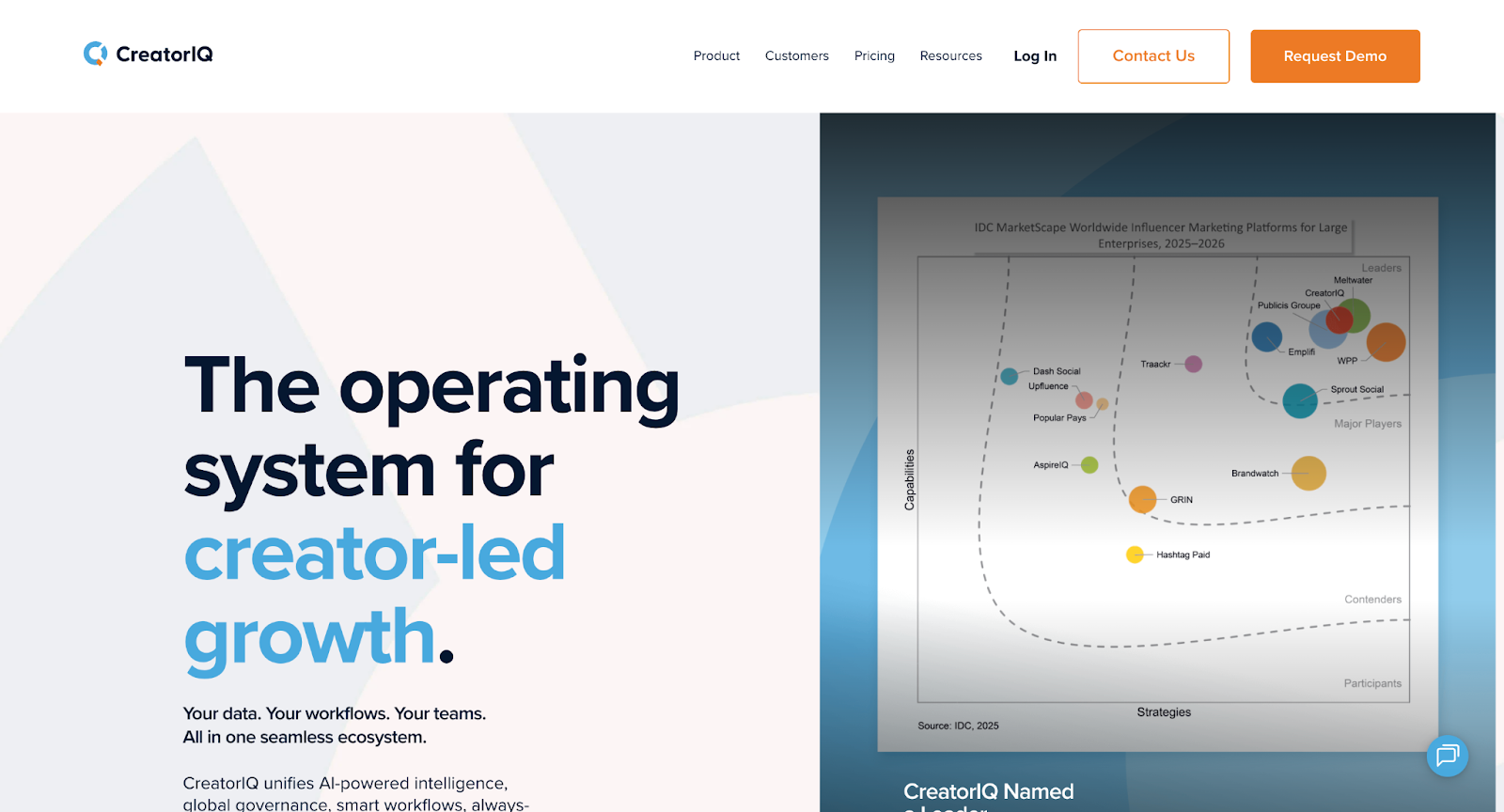
Data management: CreatorIQ has an API that lets you send influencer marketing data straight to your business intelligence tool so it can be centralized alongside your other marketing data (paid media etc). Modash doesn’t offer this (although you can do a bunch of other stuff with our influencer marketing API).
Creator search: CreatorIQ isn’t a great choice for finding brand-fit influencers at scale. It only contains ~20 million influencer profiles, compared to Modash’s database of 380+ million profiles. Users also say its search functionality often returns irrelevant results.
Platform coverage: While CreatorIQ’s search tools aren’t the best, you can use them to find influencers across a wide range of platforms (Facebook, Instagram, Snapchat, TikTok, Twitch, X/Twitter, and YouTube). Modash only covers the three main platforms of Insta, TikTok, and YouTube.
Transparent pricing: CreatorIQ doesn't publish pricing information, although I've seen reports ranging from ~$2,300 per month to $36,000 per year for an entry-level plan 💸 That puts it out of range for smaller businesses. Modash, on the other hand, offers plans starting at $199 per month (billed annually).
Competitor benchmarking: With BenchmarkIQ from CreatorIQ, you can discover how your influencer program is performing vs your competitors across key metrics like share of voice, engagement, and exposure.
Self-serve purchase options: CreatorIQ doesn’t offer a free plan or free trial, so the only way to learn more is to request a demo. If you’re like me, you’d rather do your own due diligence before speaking to a sales rep.
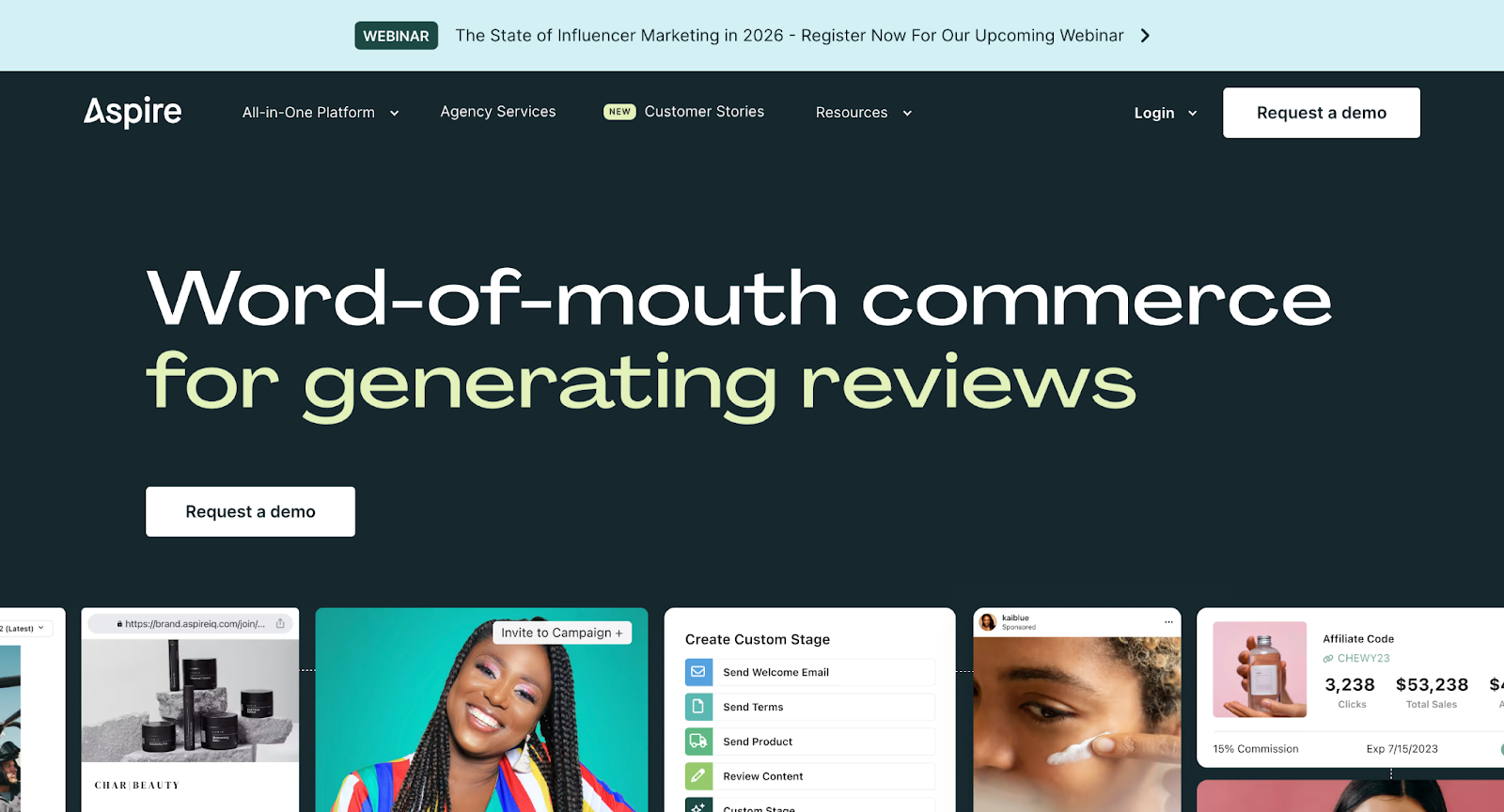
Influencer database: Aspire has a database of 170+ million influencers, which is roughly half the size of Modash’s database.
Transparent pricing: Aspire doesn't publish pricing information, although estimates suggest a starting price of $2,000+ per month. Whereas Modash shares pricing details for all our standard plans, which start at $199 per month (billed annually).
Low-touch solutions: With Aspire’s creator marketplace, you can attract pitches from 1+ million influencers for a low-touch approach to influencer recruitment (although it’s not exactly scalable). Aspire also offers agency services for brands that want to completely outsource influencer marketing. Modash doesn’t do either.
Lookalike search:Aspire doesn’t support “lookalike” searches on Instagram, making it harder to find influencers who match your current best performers. Whereas Modash shows you lookalikes for each of an influencer’s profiles.
Content tracking: Aspire only tracks live content if an influencer tags the brand or submits it manually, which is a pain. Modash supports tagging too, of course. But we also automatically pull in all influencer content during a set time period – so you can be sure you’ll never miss a post.
Platform coverage: Both tools cover Instagram, TikTok, and YouTube, but Aspire also lets you search for influencers on Pinterest.
Influencer payments: With Aspire, payments are sent via PayPal in US dollars – so if your influencer partners use a different currency, they’ll be charged a conversion fee on their agreed rates. By contrast, Modash supports 36 currencies across 180 countries.
Metric
Aspire
Modash
Database size
170+ million profiles
380+ million profiles
Platform coverage
Instagram, Pinterest, TikTok, YouTube
Instagram, TikTok, YouTube
Free trial
No
Yes, start your free trial
Pricing
Unlisted
$299/month, or $199/month billed annually (pricing)
HypeAuditor: Best for finding influencers on Twitch and X/Twitter
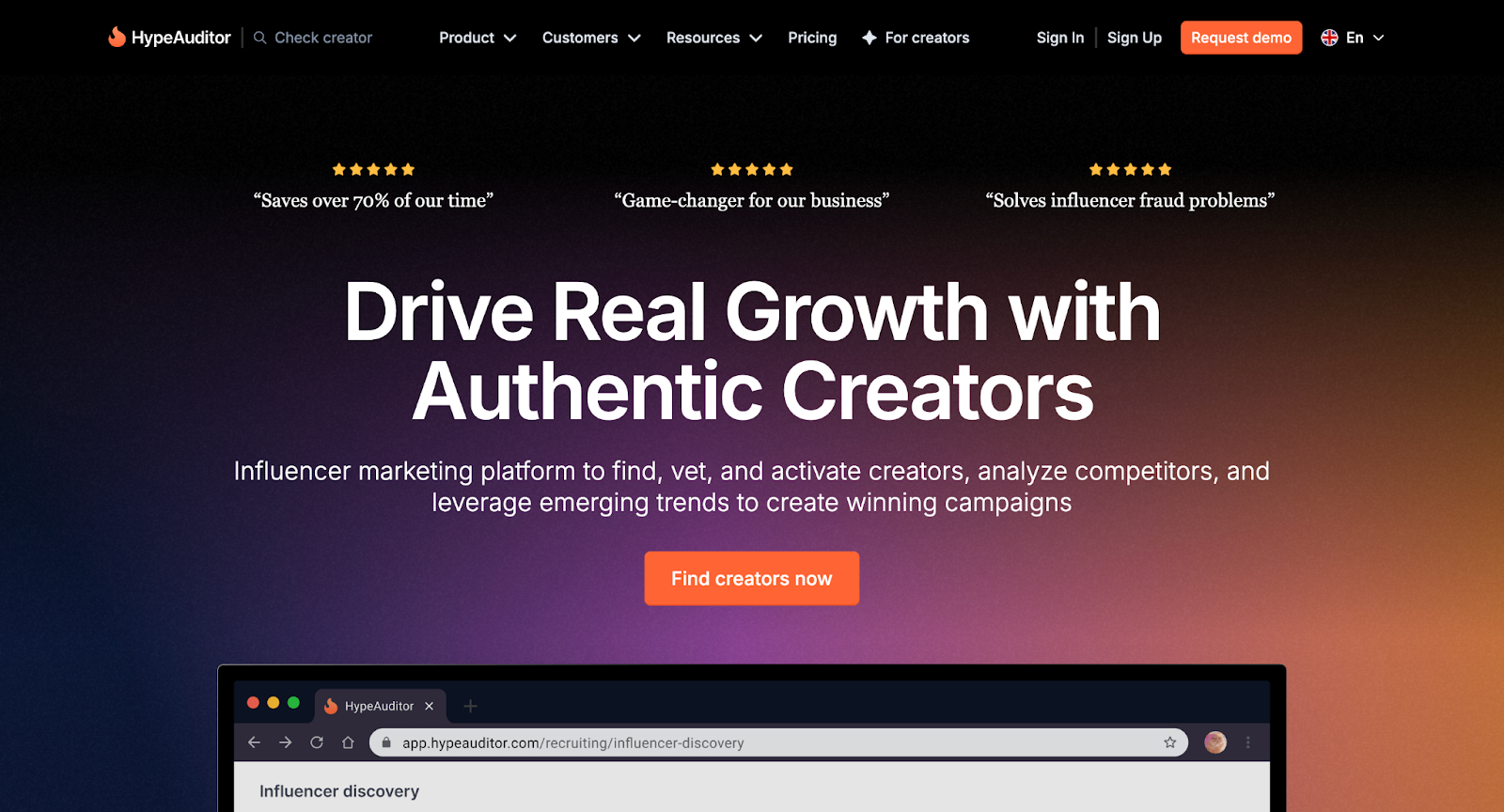
Transparent pricing: With no public pricing information, it’s hard to understand HypeAuditor’s value vs cost ratio (although G2 says it’s 26% more expensive than other influencer marketing platforms for small and mid-market businesses). Modash has nothing to hide – you can view all our pricing details on our pricing page.
Platform coverage: HypeAuditor covers more platforms than Modash. Both support Insta, TikTok, and YouTube, but HypeAuditor also has Twitch and X/Twitter.
Influencer database: HypeAuditor offers one of the larger databases, featuring 218.7+ million profiles – but it’s still far smaller than the 380+ million in Modash’s database.
Influencer marketing services: Whereas Modash is a purely self-serve platform, HypeAuditor offers various professional influencer marketing services, ranging from targeted guidance to full campaign management.
Content monitoring: Modash gathers all live influencer content across Instagram, TikTok, and YouTube, whereas HypeAuditor can’t capture Instagram Stories. So you’ll have to do it manually (before they vanish after 24 hours!).
Shopify integration:Modash’s Shopify integration is best-in-class, whereas HypeAuditor’s doesn’t support product gifting. Which means more manual work for your team.
Metric
HypeAuditor
Modash
Database size
218.7+ million profiles
380+ million profiles
Platform coverage
Instagram, TikTok, YouTube, Twitch, X/Twitter
Instagram, TikTok, YouTube
Free trial
By request on a case-by-case basis
Yes, start your free trial
Pricing
None publicly available
$299/month, or $199/month billed annually (pricing)
Influencity: Best for all-round social media management
Content tracking limitations: Influencity can’t automatically track performance data from Instagram Stories and YouTube Shorts. Instead, you’ll have to ask your influencer partners to share it themselves – which can be pretty time-consuming at scale. Modash does all this automatically.
Influencer database: Both platforms have huge influencer databases, but Modash has the edge here with 380+ million profiles vs 300+ million.
Social media management: Unlike Modash, Influencity offers built-in social media management – allowing you to schedule posts, track performance, and manage messages from a single platform. Of course, if you only want an influencer marketing solution, you could end up paying for something you don’t need.
Social listening: Influencity also offers built-in social listening tools, helping you uncover insights and trends based on millions of online conversations.
Transparent pricing: Influencity is yet another tool that doesn't share pricing information, although estimates suggest that prices start around €400 per month. Modash plans start at $199 per month (billed annually) and are visible on our pricing page.
Metric
Influencity
Modash
Database size
300+ million
380+ million profiles
Platform coverage
Instagram, TikTok, YouTube
Instagram, TikTok, YouTube
Free trial
Yes
Yes, start your free trial
Pricing
Unlisted
$299/month, or $199/month billed annually (pricing)
Key features
Social media management, influencer discovery, CRM, campaign reports, content tracking
Shopify Collabs: Best for basic Shopify influencer marketing
Influencer database: Unlike Modash with our database of 380+ million influencers, Shopify Collabs doesn’t say how many influencer profiles it offers – just that you can search “millions” of creators. At time of writing, Collabs wasn’t accepting any new influencer signups, so the database isn’t growing any time soon.
Scalability: Shopify Collabs only lets you invite up to 100 influencers in any seven-day period. If you’re recruiting at scale, you could easily bump up against this. Modash scales as you need it to; if you hit our limits on team members, opened profiles, unlocked emails, or tracked creators, you can simply upgrade to a higher plan.
Free functionality: It’s totally free to get started with Shopify Collabs, making it a popular choice for smaller brands with lower budgets. While Modash offers a free trial, it doesn’t have a free-for-life plan.
Ongoing fees: That said, Shopify Collabs isn’t as “free” as it initially appears, charging an additional 2.9% payment processing fee on influencer-affiliate commission payments. If you’ve got hundreds of influencers driving thousands of sales, these fees can really add up – in which case you’re better off with Modash’s fixed monthly plans.
Platform support: Shopify Collabs supports more social platforms than Modash (Insta, TikTok, and YouTube, plus three extras – Facebook, Twitch, and X/Twitter). On the downside, it’s only for Shopify stores, whereas any brand or business can use Modash.
Metric
Shopify Collabs
Modash
Database size
Unlisted
380+ million profiles
Platform coverage
Instagram, TikTok, YouTube, Facebook, Twitch, and X/Twitter
Instagram, TikTok, YouTube
Free trial
n/a (no monthly cost)
Yes, start your free trial
Pricing
Free, but subject to additional 2.9% processing fee on influencer-affiliate commissions
$299/month, or $199/month billed annually (pricing)
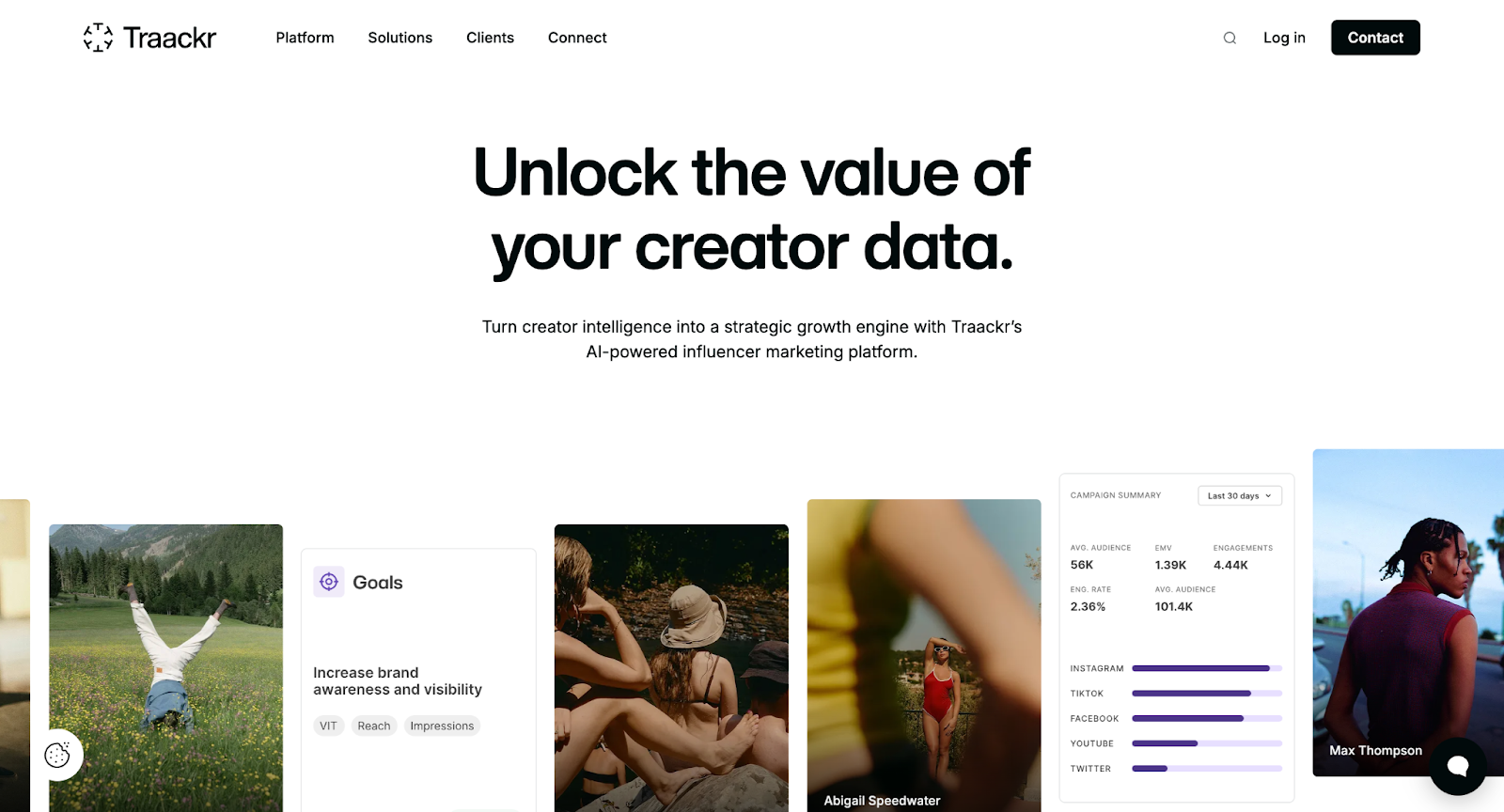
Influencer database: Traackr’s database only features 7+ million influencer profiles. That’s about 50 times smaller than Modash 🤏
Platform coverage: Although its database is comparatively small, Traackr lets you search for influencers across 13 social platforms (it doesn’t list them all, though). Modash only covers Instagram, TikTok, and YouTube.
Benchmarking: Traackr shares data and insights about top competitors for brands in five industries – beauty, personal care, fashion, spirits, and consumer electronics.
Opt-in requirement: Influencers have to opt in to campaigns on Traackr. If they don’t, you won’t be able to brief them, track their content, or pay them. Modash doesn’t require opt-ins, making for a smoother journey for your influencer partners.
Enterprise-grade pricing: Traackr no longer publishes pricing information – but you can still view its old pricing page via the Wayback Machine, with prices starting at $32,500 per year (plus a further $8,000 per year for benchmarking). Modash pricing starts at just $299 per month (or $199 per month on an annual contract).
Metric
Traackr
Modash
Database size
7+ million profiles
380+ million profiles
Platform coverage
Unlisted, but apparently covers 13 platforms
Instagram, TikTok, YouTube
Free trial
Yes, on a case-by-case basis
Yes, start your free trial
Pricing
Unlisted, used to start at $32,500/year
$299/month, or $199/month billed annually (pricing)
Clearly, there’s no shortage of potential Modash alternatives. I could easily have included twice as many tools in this article. But remember – Modash is already the perfect fit for your brand if you check one or more of these boxes:
✅ You sell DTC on Shopify
✅ You have a small (1-5 person) influencer team
✅ You’re scaling from ~10–50 influencers to 100-300+ active partnerships
✅ You value speed and cost-effectiveness over enterprise complexity
Still deciding? If you sell on WooCommerce, BigCommerce, or Adobe Commerce, start with Upfluence or Influencer Hero. If you’re on Shopify with almost no budget, Shopify Collabs is free to start. If you want to try before you buy, GRIN offers a 30-day trial on its Starter plan and Modash offers a 14-day free trial with no credit card.
Which Modash alternative is best for brands not on Shopify?
Upfluence and Influencer Hero. Upfluence integrates with Adobe Commerce, BigCommerce, Shopify, and WooCommerce. Influencer Hero integrates with Shopify, WooCommerce, BigCommerce, and Amazon. Modash’s only ecommerce integration is Shopify.
Do any Modash alternatives offer a free trial?
GRIN has a free plan and a 30-day trial on its Starter plan. Influencity offers a free trial, and HypeAuditor and Traackr offer one on a case-by-case basis. Upfluence, Influencer Hero, CreatorIQ, and Aspire don’t offer free trials. Modash has a 14-day free trial with no credit card required.
Which Modash alternative is the cheapest?
Shopify Collabs is free to use, apart from a 2.9% processing fee on affiliate commissions. GRIN also has a free plan (with a 20% management fee on wallet deposits), and its paid plans start at $200/month. Most other tools in this list don’t publish pricing, and estimates start at around €400/month for Influencity and $2,000+/month for Aspire. Modash costs $299/month, or $199/month billed annually (see pricing).
Which Modash alternative covers the most social platforms?
Traackr reportedly covers 13 platforms. Upfluence covers YouTube, Instagram, TikTok, Twitch, X/Twitter, Pinterest, and blogs, and CreatorIQ covers Facebook, Instagram, Snapchat, TikTok, Twitch, X, and YouTube. Modash covers Instagram, TikTok, and YouTube.
Which Modash alternative is best for small teams?
If you’re a Shopify brand with a small influencer team, Modash is built for you, with self-serve monthly plans and a free trial. On a very tight budget, Shopify Collabs is free to start. GRIN’s self-serve plans are another month-to-month option.